 (+971) 8007 4267
 (+91) 946 340 7140
 (+1) 628 432 4305

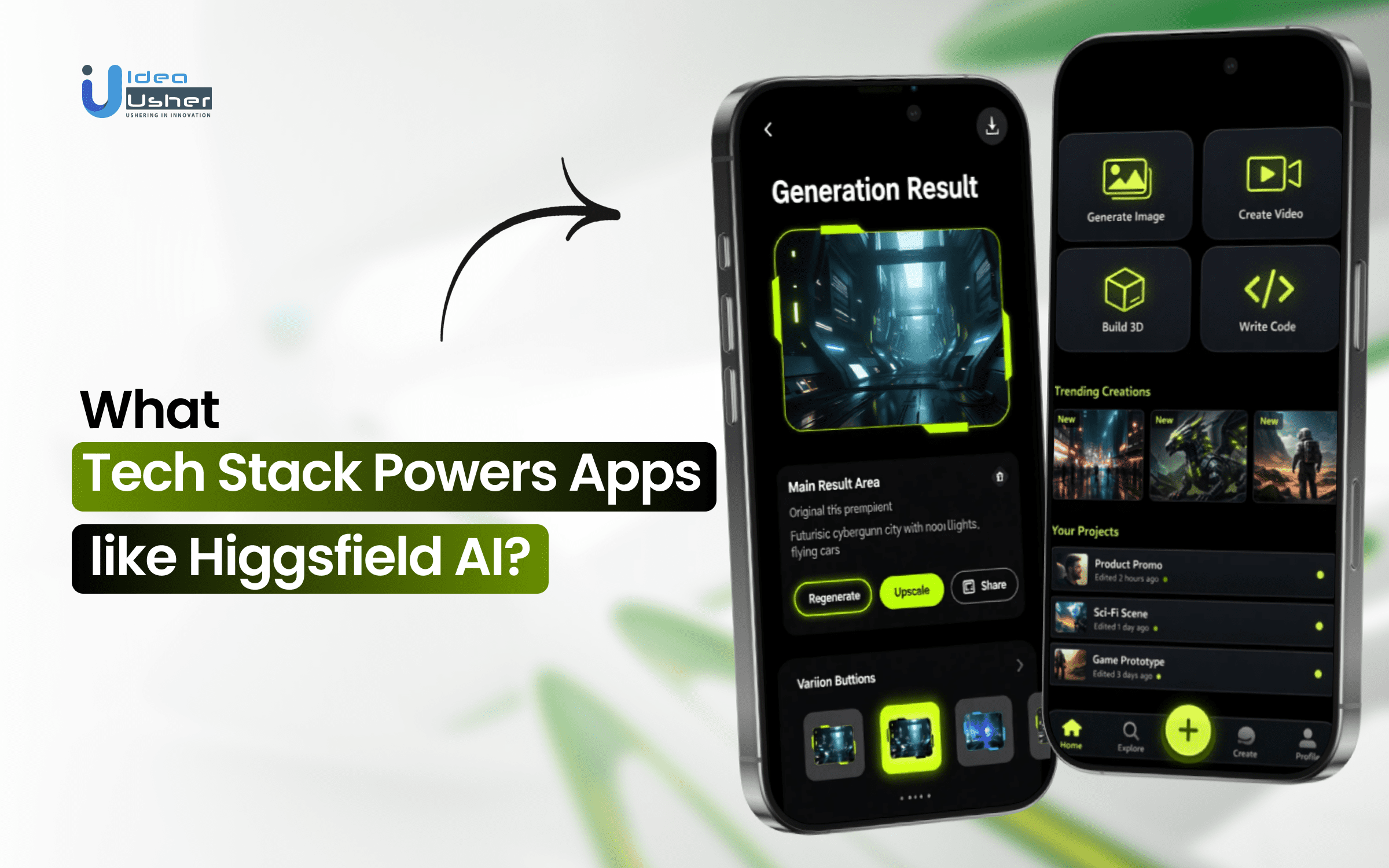
Not long ago, producing cinematic video demanded teams and heavy software, so speed was never part of the equation. Then platforms like Higgsfield AI changed expectations because output suddenly had to be instant and scalable. That pressure could only be handled through tightly engineered model pipelines and GPU-accelerated infrastructure.
This is exactly why choosing the right tech stack becomes critical when building an app like Higgsfield. The wrong architecture will quickly increase latency and GPU costs. A poorly aligned stack may also cause frame instability and identity drift under load. If the foundation is not carefully selected from day one, scaling will become expensive and technically unstable.
Over the years, we’ve developed numerous AI video generation solutions, powered by generative video architectures and distributed model orchestration. Given our expertise in this space, we’re sharing this blog to discuss the essential tech stack layers required to build an app like Higgsfield AI.
Key Market Takeaways for AI Video Generation Apps
According to Precedence Research, the AI video generation market is expanding rapidly. It was valued at USD 11.2 billion in 2024 and is projected to reach USD 246.03 billion by 2034, growing at a CAGR of 36.2%. North America currently leads with a 36.9 percent share, representing USD 4.13 billion in 2024, supported by strong AI infrastructure and rapid media adoption.

Source: Precedence Research
Adoption is accelerating because these platforms dramatically reduce production time and cost. What once required full crews and large budgets can now be generated from text or images within minutes.
Many tools reduce production expenses by up to 90 percent while enabling advanced capabilities such as lip sync, dynamic camera movement, and style transformation.
Leaders in this space continue to push technical boundaries. Runway’s Gen 4 model focuses on character consistency, image-to-video transformation, and physics-aware motion to deliver cinematic-quality results. Pika Labs emphasizes flexible text-to-video generation, expressive effects, and precise camera control, designed for social-first storytelling.

What is the Higgsfield AI App?
Higgsfield AI is a generative artificial intelligence platform and mobile app designed to help creators, marketers, and businesses easily produce cinematic-quality videos and images from simple text, images, or prompts, without advanced editing skills.
It uses advanced AI models to automate creative tasks such as camera movements, effects, and animations, enabling professional-grade video content creation to be fast, intuitive, and accessible for social media and marketing.
How Does the Higgsfield AI App Work?
Higgsfield AI first translates a simple human idea into a structured production plan using reasoning models that interpret intent and scene logic. It then intelligently routes that plan to specialized video and animation engines, which generate frames with controlled motion and temporal consistency.

From Human Intent to Machine Instruction
The most sophisticated part of the Higgsfield app is not the video generation itself. It is the “Cinematic Logic Layer” that happens before you ever hit “render.”
The Problem
Users do not think in shot lists. They think in terms of feelings, such as “make it dramatic” or “make this product look premium.” Video models like Sora 2 require rigid technical instructions about timing, motion constraints, and focal length.
How Higgsfield Solves It
When you paste a product URL or upload an image into the app, the backend immediately kicks off a multi-step reasoning process.
- Intent Extraction: Using OpenAI’s GPT 4.1 mini and GPT 5, the system analyzes the input to infer the narrative arc, pacing, and visual emphasis.
- Preset Mapping: It compares this analysis against a library of viral “presets” that encode patterns of what makes content successful on social platforms. Roughly 10 new presets are created daily, and outdated ones are cycled out.
- Routing: The system acts as a Model Router. It decides which underlying engine is best suited for the job based on reasoning depth and latency needs.
The Takeaway
The app abstracts away the complexity of “prompt engineering.” It turns a vague idea into a structured, machine-readable production plan before a single pixel is rendered.
The “Model Agnostic” Core
Unlike proprietary platforms, Higgsfield functions as an aggregator. It hosts over 15 leading AI models under one hood. This is the “Unified AI Ecosystem” we discussed previously, and it is the secret to its versatility.
Here is how the app routes your request to the right brain:
| App Feature | Backend Engine(s) | Why This Model? |
| Click-to-Ad / Product-to-Video | Sora 2 (OpenAI) | Handles complex physics, fluid dynamics, and multi-object interactions required for accurate product placement. |
| Cinema Studio (Camera Control) | Higgsfield DOP / Popcorn | Proprietary models built for granular control over camera movement, lens aberrations, and sensor-specific color science. |
| Soul ID (Character Lock) | Higgsfield Soul | A custom in-house model designed for fashion-aware, hyper-realistic human anatomy and fabric rendering. |
| Lipsync Studio | Seedance 1.5 Pro | Specialized in high-accuracy audio-visual synchronization for broadcast-quality dialogue replacement. |
| UGC Factory / Avatars | Kling Avatars 2.0 | Industry leader in cinematic motion and maintaining temporal consistency for human gestures. |
| Sketch to Video | Wan 2.6 & Minimax 02 | Interprets hand-drawn storyboards and generates connected narrative scenes with structural control. |
Why This Architecture Wins
It future-proofs the user. If a new model, such as “Sora 3” or “Veo 4.0,” outperforms the current stack, Higgsfield can swap it into the workflow without requiring users to change their habits.
The Mobile Experience
Higgsfield was founded by Alex Mashrabov, the former Head of Generative AI at Snap, the mind behind Snap Lenses. This gives the app a distinct “Social DNA” that pure play research labs lack. It is built for the pocket, not just the workstation.
A community-built replica of the iOS app built with SwiftUI reveals the thoughtful structure designed to reduce friction.
Design System
Dark Theme with Neon Accents: The app uses a consistent design system with black backgrounds and #CDFF4D neon green to keep the UI performant and visually focused on the generated media.
Tab-Based Navigation: The app is segmented into clear creative modes.
- Explore: A TikTok style feed of trending styles and filters such as Glitch, Y2K, and Selfcare to inspire users.
- Soul: The AI image generation interface with toggles for “Lite/Pro” models and aspect ratios such as 16:9 for landscape and 9:16 for vertical.
- Camera: The video workflow in which users select motion (such as Zoom, Pan, and Tilt) and upload reference images.
- I Can Speak: The avatar lip sync interface, requiring microphone permissions via AVFoundation.
- Canvas: A modal editing view that allows for “Draw to Edit” using the Reve model to convert sketches into photorealistic elements.
The Infrastructure
Higgsfield’s CTO, Yerzat Dulat, emphasizes that they do not look for the “best” model, but rather the right “behavioral strengths.” This philosophy extends to their infrastructure choices.
To manage the massive VRAM requirements of video generation, the app relies on a sophisticated backend.
Job Scheduling
Tasks are queued asynchronously to prevent the UI from freezing. A typical generation takes 2 to 5 minutes, but because the platform supports concurrent runs, teams can generate dozens of variations in an hour.
Specialized Compute
By partnering with GPU clouds like GMI Cloud rather than relying solely on generic hyperscalers, they reportedly cut compute costs significantly, enabling them to offer 4x as many generations at similar price points.
Temporal Consistency
The app uses “Reference Anchor” workflows. By locking a “Hero Frame,” the video engine inherits exact facial geometry and lighting, ensuring characters do not morph between frames.
What Tech Stacks Are Required to Develop an App like Higgsfield AI?
Building an app like Higgsfield AI requires a Next.js or React frontend with TypeScript and a backend in Python or Node.js to manage APIs and model orchestration. Diffusion-based video models and large language models must run on GPU-powered Kubernetes with asynchronous job queues such as Redis.

1. The High-Level Architecture
Before diving into specific technologies, it’s crucial to understand that Higgsfield AI is not a single monolithic model. It’s an orchestration platform that coordinates multiple AI engines, infrastructure layers, and user-facing components into a seamless creative workflow.
The platform operates across several distinct layers:
- Frontend Presentation Layer – The browser-based interface where creators interact with the platform
- Application Logic Layer – API routes, authentication, and business logic
- AI Orchestration Layer – The “brain” that routes requests to appropriate models
- Model Execution Layer – The actual generative models (both proprietary and third-party)
- Infrastructure Layer – GPU compute, orchestration, and storage
- Content Delivery Layer – Global distribution of generated videos
Let’s examine each layer in detail.
2. Frontend Stack
Higgsfield AI is a fully browser-based platform, meaning no desktop software installation is required. The frontend must handle complex interactions, image uploads, real-time previews, camera motion selection, and video playback, while maintaining responsive performance.
Core Frontend Technologies
Based on reference implementations and industry patterns, the frontend stack includes:
| Component | Technology | Purpose |
| Framework | Next.js 15 (App Router) | React framework with server-side rendering and API routes |
| Language | TypeScript | Type safety across the entire application |
| Styling | Tailwind CSS | Utility-first styling for responsive design |
| UI Components | Custom React components | Motion selectors, upload interfaces, video players |
The choice of Next.js is particularly strategic. It provides:
- API routes that can securely handle Higgsfield API credentials without exposing them to the client
- Server components for improved performance on initial page loads
- Image optimization for uploaded reference images
- Turbopack for fast development iteration
Key Frontend Features to Implement
A Higgsfield-style platform requires several sophisticated frontend capabilities:
- File Upload Handling: The platform must support both file uploads and mobile camera capture, processing FormData submissions to send images to backend APIs.
- Motion Selection Interface: One of Higgsfield’s standout features is its library of 50+ AI-crafted camera moves. The frontend needs intuitive controls for selecting motion types (dolly zoom, crane shot, FPV arc, etc.) and adjusting motion strength parameters.
- Real-time Generation Status: Video generation is compute-intensive and can take 2-5 minutes. The UI must provide clear progress indicators without blocking user interaction, typically implemented via asynchronous job status polling.
- Video Playback and Download: Once generated, videos should play smoothly with adaptive streaming and one-click download.
3. Application Layer
Behind the polished frontend lies a sophisticated application layer that handles authentication, request routing, job queuing, and API integrations.
Backend Framework Options
Higgsfield’s backend infrastructure supports both Python and Node.js ecosystems, reflecting the dual needs of AI/ML integration and web application performance:
| Language | Framework | Use Case |
| Python | FastAPI / Django | AI model integration, ML pipelines |
| TypeScript | Next.js API Routes | Lightweight API endpoints, serverless functions |
Critical Backend Components
Environment Validation: Security is paramount when dealing with AI API credentials. Reference implementations use Zod schemas to validate environment variables at runtime, ensuring HF_API_KEY and HF_SECRET are properly configured before the application starts.
Client Wrapper Architecture: To keep API credentials secure, all calls to AI services should be routed through server-side client wrappers. This prevents sensitive keys from being exposed in client-side code.
Job Queue Management: Video generation cannot happen synchronously during an HTTP request. Higgsfield relies on asynchronous job queuing using tools like Redis or RabbitMQ to manage generation tasks without freezing the user interface. When a user requests video generation:
- The request is validated and added to a queue
- An immediate response returns a job ID
- The frontend polls a status endpoint
- The completed video URL is returned when ready
Multi-model Routing Logic: Perhaps the most sophisticated part of the application layer is the orchestration engine that decides which AI model should handle each request. Higgsfield uses internal rules that weigh:
- Required inference depth vs. acceptable latency
- Output stability requirements vs. creative freedom
- Explicit instructions vs. inferred intent
- Machine-readable vs. human-consumable outputs
This logic determines whether a request routes to GPT-4.1 mini (for stable, fast execution) or GPT-5 (for deep reasoning and multimodal understanding).
4. The AI Model Stack
What truly sets Higgsfield apart is its model-agnostic architecture. Rather than building one model to do everything, the platform orchestrates multiple specialized models, each optimized for different tasks.
Language Models for Cinematic Planning
Higgsfield’s “cinematic logic layer” uses OpenAI’s GPT-4.1 mini and GPT-5 to convert vague creative intentions (“make it dramatic”) into precise technical instructions for video models. These language models:
- Infer narrative structure and pacing
- Determine shot logic and visual focus
- Extract brand intent from product URLs
- Map creative goals to specific technical parameters
The platform’s “Click-to-Ad” feature demonstrates this beautifully. Users paste a product URL, GPT models analyze the page to extract brand intent and key selling points, then automatically map to trending style templates.
Video Generation Models
Higgsfield aggregates multiple state-of-the-art video models:
| Model | Primary Use Case |
| Sora 2 | High-fidelity video generation with cinematic realism |
| Kling 3.0 | Human motion and realistic physics |
| Veo 3.1 | Large-scale environmental shots |
This multi-model approach provides flexibility and future-proofing. If one model’s performance degrades or pricing changes, users can seamlessly switch to alternatives.
Proprietary Models: Higgsfield DoP
Higgsfield has also developed its own proprietary models, including Higgsfield DoP I2V-01-preview, an Image-to-Video model that blends diffusion models with reinforcement learning. Rather than simply denoising frames, this architecture is trained to understand and direct:
- Motion patterns
- Lighting behavior
- Lensing effects
- Spatial composition
The reinforcement learning component, applied after diffusion, instills intent and coherence in generated sequences, essentially teaching the model the “grammar of cinematography”.
Specialized Feature Models
Soul 2.0 for Character Consistency:
One of AI video’s biggest challenges is “identity drift”, characters changing appearance between frames. Higgsfield’s Soul 2.0 acts as a Reference Anchor system, locking facial geometry and wardrobe across multiple shots. This enables “virtual influencers” and brand spokespeople who remain consistent across entire campaigns.
Seedance 1.5 for Audio Synchronization:
Modern AI video requires native audio integration. Seedance 1.5 generates Foley sound effects that match on-screen action, if a glass breaks in the video, the “clink” happens at the exact frame of impact.
Turbo Model for Rapid Iteration:
For creative exploration, Higgsfield offers a speed-optimized Turbo model that runs approximately 1.5x faster at roughly 30% lower cost, enabling rapid testing of different creative directions.
5. Infrastructure Stack
AI video is among the most compute-intensive workloads in technology. Higgsfield’s infrastructure choices reveal hard-won lessons about scaling generative AI.
GPU Computing Strategy
Higgsfield initially worked with various GPU providers but struggled with limited capacity and insufficient orchestration options. Their infrastructure priorities evolved to include:
- Instant access to high-performance GPUs with the ability to scale based on demand
- Autoscaling GPU infrastructure for unpredictable, high-volume workloads
- Managed Kubernetes with GPU worker nodes for orchestration
- Fast onboarding and responsive support
Strategic Partnerships
Higgsfield partnered with Gcore to access:
- Large volumes of NVIDIA H100 GPUs on demand
- Managed Kubernetes with GPU worker nodes and autoscaling
- Deployment through the Gcore Sines 3 cluster in Portugal for regional flexibility
The results have been significant: seamless deployment to managed Kubernetes, on-demand H100 access, and Kubernetes-based orchestration for efficient container scaling.
AMD and TensorWave Collaboration
For their proprietary DoP model, Higgsfield partnered with TensorWave to benchmark performance on AMD Instinct™ MI300X GPUs. Key findings included:
- Out-of-the-box inference with pre-configured PyTorch and ROCm environments
- Faster generation at 720p resolution compared to NVIDIA H100 SXM
- Ability to handle 1080p resolution without out-of-memory errors (unlike H100)
- No unexpected slowdowns, kernel mismatches, or memory leaks
This multi-cloud, multi-vendor approach provides flexibility and cost optimization. Higgsfield reportedly reduced compute costs by 45% through specialized GPU partnerships.
Container Orchestration
Kubernetes forms the backbone of the infrastructure by running GPU-enabled worker nodes that scale dynamically in response to real-time demand. It allows efficient container scaling, balanced workload distribution across generation nodes, and controlled deployment of new model versions without disrupting active jobs.
Storage and Content Delivery
Generated videos are stored in scalable object storage and distributed through CDN networks for low-latency global access. Adaptive bitrate streaming ensures smooth playback on mobile and desktop while maintaining performance and reliability under high traffic.
6. Data and Validation Layer
Professional AI platforms require rigorous testing. The reference implementation demonstrates comprehensive testing practices:
| Test Type | Tools | Purpose |
| Unit Tests | Jest | Test individual functions and utilities |
| Integration Tests | Jest + Testing Library | Test API routes with mocked dependencies |
| E2E Tests | Playwright | Test complete user flows |
| Type Checking | TypeScript | Catch type errors at compile time |
| Code Quality | ESLint, Prettier | Maintain consistent code standards |
| Pre-commit Hooks | Husky, lint-staged | Automate quality checks before commits |
CI/CD Pipeline
GitHub Actions runs all checks on every push, ensuring code quality and test coverage before deployment. This automation is essential for maintaining velocity as the platform scales.
7. Security and Privacy Considerations
Building a platform like Higgsfield requires careful attention to security and compliance:
API Key Management
All API credentials must remain server-side. Environment variables should never be committed to version control. Reference implementations include .env.local in .gitignore.
User Data Protection
Higgsfield’s privacy policy addresses handling of prompts, media, and metadata. For commercial use, teams must verify:
- Output ownership and licensing terms
- Training opt-out availability
- Enterprise controls for sensitive data
Likeness and Biometric Data
The privacy policy explicitly advises against providing confidential, sensitive, unlicensed proprietary, or biometric information via the service.”
How Do AI Video Generation Apps Optimize Inference Costs?
AI video generation apps optimize inference costs by compressing video into smaller latent spaces, enabling the model to process far fewer tokens per frame. They can also reduce the number of denoising steps through distillation and intelligently route requests to the most efficient model for each scene.

The Scale of the Challenge
Before diving into solutions, it is essential to understand why video inference is uniquely expensive. Video generation models face several computational challenges:
- Massive token counts: Video requires approximately 100× as many tokens as text generation for an equivalent output length. A 10-second 1080p video at 30 fps comprises 300 frames, each requiring complex attention calculations.
- Quadratic complexity: Diffusion Transformers DiTs, the architecture behind state of the art video models, suffer from quadratic computational complexity relative to context length. Processing long video sequences becomes exponentially more expensive.
- High resolution demands: Professional creators expect 4K output, which multiplies pixel counts by 8× compared to 720p.
- Iterative denoising: Diffusion models require multiple denoising steps, typically 30 to 50, per generated video. Each step requires a full forward pass through the model.
These factors combine to create inference costs that can easily exceed $ 10 per hour of GPU time. For a platform processing thousands of videos daily, costs spiral quickly.
1. Model Level Optimization
The most fundamental cost optimizations happen at the model architecture level. Innovations here reduce the computational requirements for each generation.
Deep Compression Autoencoders
DC-VideoGen, introduced in late 2025, represents a breakthrough in efficient video generation. This post-training framework compresses video data before it enters the diffusion process, dramatically reducing computational load.
The key innovation is the Deep Compression Video Autoencoder DC-AE-V, which provides:
- 32× to 64× spatial compression
- 4× temporal compression
This means the diffusion model operates on a latent space that is 128-256× smaller than the original video, yet can reconstruct high-quality output. The results are striking. DC-VideoGen delivers 14.8× faster inference than base models and can generate 2160×3840 resolution video on a single H100 GPU.
Critically, this optimization requires only 10 H100 GPU days of training. That is 230× lower than the cost of training from scratch.
Extreme Motion Compression
The REDUCIO framework takes compression even further by exploiting video’s inherent redundancy. Videos contain significantly more redundant information than images, allowing them to be encoded with very few motion latents.
REDUCIO’s image conditioned VAE achieves a 64× reduction in latents compared to standard 2D VAEs, without sacrificing quality.
The practical impact is substantial. REDUCIO-DiT can generate a 16-frame 1024×1024 video in just 15.5 seconds on a single A100 GPU, with a total training cost of only 3,200 A100 GPU hours.
Sparse Attention Mechanisms
Attention mechanisms are computationally expensive because they require every token to attend to every other token. Research shows that much of this computation is wasted.
Sparse VideoGen SVG leverages the observation that attention heads naturally specialize:
- Spatial heads focus on relationships within each frame
- Temporal heads focus on relationships across frames
By dynamically classifying heads and computing only the relevant attention patterns, SVG achieves 2.28× to 2.33× end-to-end speedup on models like CogVideoX and HunyuanVideo, while preserving quality.
BLADE advances this further by combining block sparse attention with step distillation. It delivers 14.10× end-to-end acceleration on Wan2.1-1.3B and 8.89× on CogVideoX-5B. It also improves quality, raising VBench-2.0 scores from 0.534 to 0.569.
Step Distillation
Diffusion models traditionally require 30 to 50 denoising steps. Step distillation trains models to produce equivalent quality in fewer steps. BLADE’s sparsity-aware distillation incorporates sparsity directly into the training process, enabling fast convergence without quality loss.
2. Infrastructure Optimization
Even with optimized models, deployment decisions dramatically affect costs.
The Higgsfield AI Case Study
Higgsfield AI’s partnership with GMI Cloud provides a real-world blueprint for infrastructure optimization.
Before optimization, Higgsfield faced unsustainable cost growth:
- Compute costs increasing 25% monthly
- An 800ms inference latency is hurting user experience
- 24-hour model training cycles are slowing innovation
By migrating to GMI Cloud’s specialized AI infrastructure, Higgsfield achieved:
- 45% reduction in compute costs
- 65% reduction in inference latency to approximately 280ms
- 200% increase in user throughput
The key factors in this success:
NVIDIA-certified partnership: As one of only 6 NVIDIA Cloud Partners globally, GMI Cloud provides access to the latest-generation GPUs with optimized drivers and configurations.
AI-tailored architecture: Rather than generic cloud instances, GMI Cloud offers dedicated clusters and customized inference engines that maximize hardware utilization.
Precise resource scheduling: Eliminating idle GPU time through intelligent workload distribution.
Serverless GPU
Traditional cloud GPU instances charge by the hour, whether workloads are active or not. Serverless GPU computing fundamentally changes this model.
Alibaba Cloud’s Function Compute GPU-accelerated instances demonstrate the potential:
- Per-second billing with pay-as-you-go pricing
- Scale to zero during idle periods
- Automatic scaling based on traffic
- 70%+ cost reduction for low utilization workloads
For quasi-real-time inference workloads, which characterize most AI video generation, serverless architectures are ideal. They handle sparse invocations without requiring always on infrastructure.
Example comparison from Alibaba Cloud: A workload with 3,600 one-second inferences daily cost $48 on traditional ECS GPU instances but only $1.52 on Function Compute, a 95% reduction.
Multi Cloud GPU Sourcing
GPU pricing varies dramatically across providers. A 2025 study of 8× H100 clusters found:
| Provider | Hourly Price (8× H100) | Price per GPU-Hour |
| AWS | $55.04 | $6.88 |
| Google Cloud | $88.49 | $11.06 |
| Azure | $98.32 | $12.29 |
| Oracle | $80.00 | $10.00 |
Sophisticated platforms dynamically route workloads to the most cost-effective providers based on real-time pricing and availability.
3. Operational Optimization
Beyond models and infrastructure, operational practices significantly impact inference costs.
Dynamic Resource Allocation
Video generation workloads fluctuate. Smart platforms implement auto scaling that:
- Scales up GPU resources during peak demand
- Deallocates resources during idle periods
- Uses spot or preemptible instances for non-critical tasks
For example, a platform might run initial draft generation on spot instances, saving up to 90 percent, while reserving on-demand GPUs only for final high-quality rendering.
Multi-Resolution Pipelines
Instead of rendering everything in 4K from the start, the system can first generate a 720p draft to validate motion and composition. Only the approved sequences are then upscaled to 4K and passed through enhancement models for refinement. This approach can significantly reduce GPU load and ensures high resolution compute is used only when it truly matters.
Batch Processing and Queue Management
For non-urgent workloads, batching requests during off-peak hours reduces costs. Message queues such as Tencent Cloud’s CMQ manage these workflows efficiently.
Reserved Capacity for Predictable Workloads
For predictable baseline demand, reserved instances offer significant discounts over on-demand pricing, typically 30 to 60 percent for one- to three-year commitments.
Automated Cost Controls
Sophisticated platforms implement automation scripts that:
- Halt GPU instances after 15 minutes of inactivity
- Switch instance types based on workload requirements
- Terminate orphaned jobs automatically
- Alert on cost anomalies exceeding thresholds
3. Architectural Innovation
Long-term cost optimization comes from rethinking the fundamental architecture of video generation.
Model Agnostic Orchestration
Higgsfield’s architecture demonstrates the power of orchestration. Rather than building one model for everything, the platform routes requests to the most appropriate specialized model:
- Kling 3.0: Human motion and realistic physics
- Veo 3.1: Large-scale environmental shots
- Sora 2: High fidelity cinematic output
This best-of-breed approach ensures each request uses the most efficient model for its specific needs, avoiding the overhead of monolithic models.
Hybrid CPU GPU Processing
Not all video processing requires GPUs. Real-time streaming platforms like Red5 demonstrate that careful architectural choices enable CPU-based processing for many workflows.
Key principles:
- Use CPUs for logic, workflow management, and packaging
- Deploy GPUs only for compute-intensive AI inference
- Optimize encoding settings. Default high-resolution profiles often exceed requirements
Progressive Quality Scaling
Advanced platforms can dynamically adjust diffusion steps based on scene complexity so simple shots process quickly with fewer iterations. More complex sequences may receive additional computation to preserve motion detail and spatial coherence.
Feedback signals can further guide the system so that higher quality rendering is applied only where it delivers measurable value.
Cost Per Generation Metrics
To effectively optimize costs, platforms must track the right metrics:
- Cost per video minute: The ultimate measure of efficiency
- GPU utilization percentage: Idle GPUs waste money
- Inference latency: Directly impacts user experience and throughput
- Cold start frequency: Serverless architectures must balance cost and responsiveness
- Quality-adjusted cost: Cost per unit of user satisfaction
Conclusion
Apps like Higgsfield AI run on far more than a diffusion engine. They combine orchestration layers, temporal consistency control, identity persistence systems, GPU scheduling, and cinematic simulation to ensure outputs remain stable and production-ready. For enterprise leaders, this architecture can serve as the foundation for next-generation media infrastructure rather than just another creative tool. Teams like IdeaUsher can strategically design and scale such platforms, leveraging reliable pipelines and structured monetization models to support long-term growth.
Looking to Develop an App like Higgsfield?
IdeaUsher can architect your AI video platform from orchestration design to GPU-optimized deployment, so the system stays stable under heavy generation loads. Our team can strategically implement temporal consistency layers, identity persistence modules, and scalable inference pipelines for production-grade output.
Why Partner with Idea Usher?
- Ex-MAANG/FAANG Architects – Our team has built at Google, Meta, Amazon, and Netflix scale
- 500,000+ Hours of Elite Coding – Proven expertise in AI/ML, video pipelines, and cloud infrastructure
- Multi-Model Orchestration Experts – We don’t lock you into one model; we future-proof your stack
- Cost-Optimized Cloud Architecture – Cut compute costs by 45%+ with our specialized GPU cloud strategies
- End-to-End Product Development – From concept to 4K video delivery, we handle the entire lifecycle.


FAQs
A1: A basic AI video app usually runs a single diffusion pipeline and stops there. A platform like Higgsfield AI integrates multiple models under a unified orchestration layer, so identity can stay locked and camera physics can be simulated more realistically. It can dynamically switch models based on scene complexity while maintaining temporal stability. This layered control makes outputs production-ready rather than experimental.
A2: Infrastructure cost will largely depend on GPU hours, model licensing terms, and target resolution. High frame rates and longer clips can quickly increase compute demand. However, teams can significantly reduce expenses by quantizing, batching, and efficiently scheduling GPUs. With careful optimization, the platform may scale without uncontrolled burn.
A3: Enterprises can structure monetization through subscription tiers that unlock generation limits and premium models. API licensing enables third-party integrations, while enterprise dashboards support brand teams at scale. Creator marketplaces can further generate transactional revenue from templates and assets. When architected correctly, the platform can operate as both a tool and a revenue engine.
A4: Development time will depend on scope and performance targets. An MVP focused on orchestration and core generation may take several months if the architecture is clearly defined. Scaling to enterprise-grade GPU infrastructure and stability layers can further extend timelines. A phased roadmap usually ensures technical depth without compromising reliability.


