

Key Takeaways
- Source-to-Pay platforms centralize sourcing, procurement and payments into one unified enterprise workflow.
- Modern S2P software uses AI automation and ERP integrations to improve procurement efficiency.
- Core features include supplier management, contract lifecycle management and AP automation.
- Enterprises adopt S2P platforms for better spend visibility and faster procurement approvals.
- How IdeaUsher can help you build scalable S2P platforms with AI workflows and enterprise-grade cloud infrastructure.
Enterprise procurement is no longer judged only by cost savings, as businesses now expect procurement systems to improve operational speed, supplier collaboration and financial visibility across the entire purchasing lifecycle, increasing demand for an intelligent source-to-pay platform capable of connecting sourcing, procurement, invoicing, approvals and payments within one unified ecosystem.
Traditional procurement environments relied on disconnected tools, manual approvals and fragmented supplier workflows that slowed decision-making and reduced spending visibility. As enterprise operations become more global and procurement data more complex, companies now expect automated sourcing workflows, supplier intelligence, real-time spend analytics, contract management and integrated payment orchestration built into a centralized platform.
In this blog, we will talk about core features, architecture, development costs and how IdeaUsher can help build a scalable source-to-pay platform for enterprises with operational infrastructure that directly influences financial efficiency and supplier performance at scale.
Why Enterprises Are Moving Toward Unified Source-to-Pay Platforms
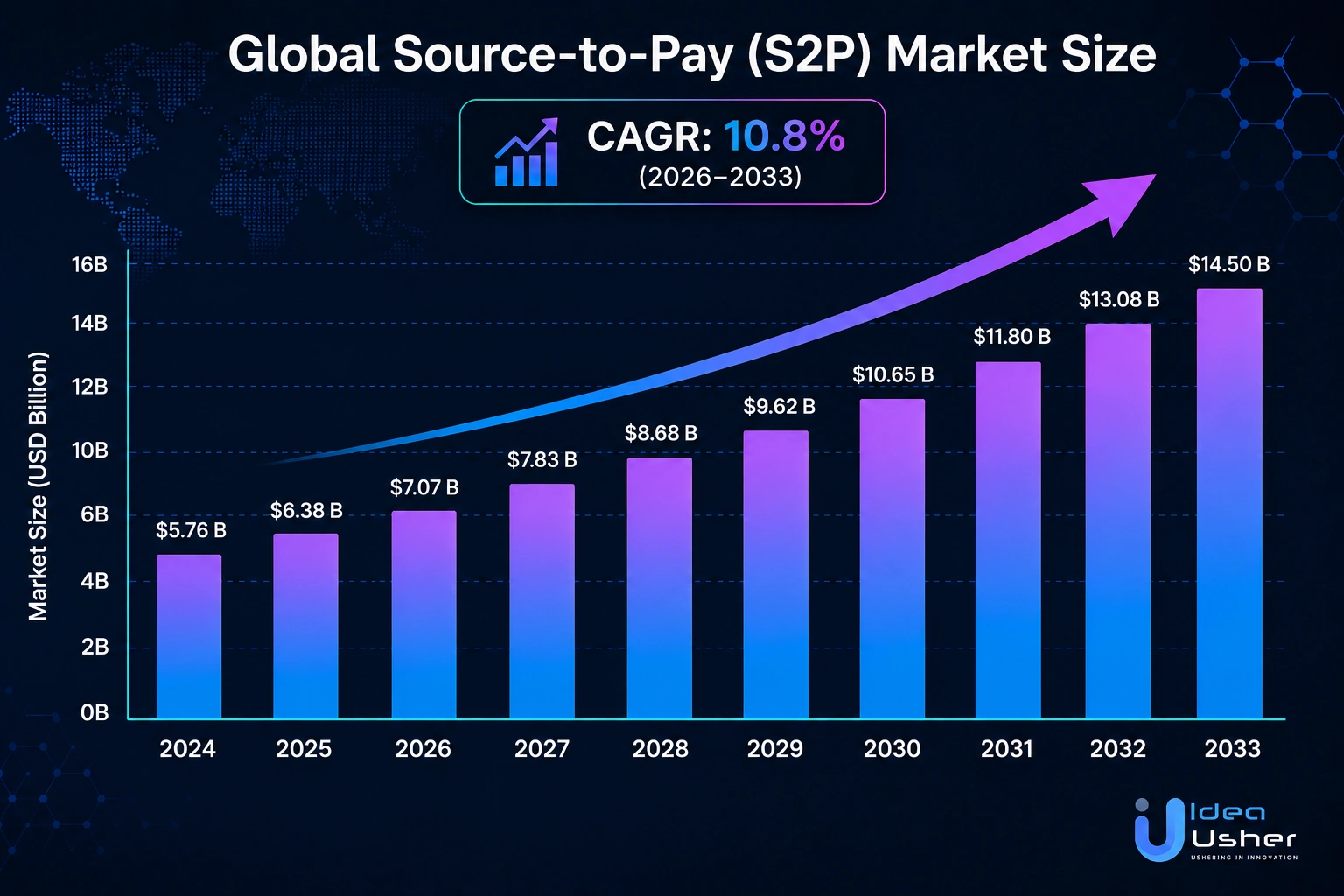
The global Source-to-Pay market, valued at USD 6.38 billion in 2025, is projected to reach USD 14.5 billion by 2033. This growth represents a 10.8% CAGR from its 2026 valuation of USD 7.07 billion as organizations are migrating to modern, unified platforms to stop financial bleeding, streamline complex integrations, and leverage intelligent automation.
Studies show 68% of operational technology investments fail because of data integration issues. Consequently, businesses lose 10% to 20% of negotiated procurement savings to maverick spend, or unauthorized employee purchasing.
Legacy procurement tools were built for an era of manual tracking and siloed operations as software implementation surveys indicate that 74% of corporate procurement leaders state their internal master data is completely unready for AI ingestion.
A. Fragmented Procurement Workflows Create Cost Leakage
When procurement workflows are fractured across different departments, spreadsheets, and emails, financial efficiency plummets.
- Bottlenecks from Manual Approvals: Relying on manual sign-offs via email or paper chains stalls operations. This slow pace often forces frustrated employees to make unauthorized, off-contract purchases (maverick spend) just to move their projects forward.
- Vendor Mismanagement: Without a centralized vendor repository, enterprises struggle to track supplier performance, monitor compliance, or leverage their total buying power to negotiate volume discounts.
- Lack of Spend Visibility Across Departments: When data is trapped in department-specific silos, leadership cannot get a real-time, consolidated view of corporate expenditure. You can’t optimize or cut costs on what you can’t see.
B. ERP-Centric Enterprises Need Unified Source-to-Pay Infrastructure
Many enterprise organizations treat their Enterprise Resource Planning (ERP) system as the ultimate source of truth. However, legacy procurement tools rarely play nice with these core systems.
- Procurement Disconnected from Finance: When procurement and finance operate in separate software ecosystems, reconciling purchase orders, goods receipts, and invoices becomes a logistical nightmare.
- Integration Challenges with Core Systems: Legacy tools require expensive, brittle custom middleware to sync with heavy-duty ERP setups like SAP, Oracle, NetSuite, or Microsoft Dynamics 365. When the ERP updates, these custom integrations frequently break.
- Approval Delays Caused by Siloed Systems: A seamless workflow requires data to flow back and forth effortlessly. Siloed architecture forces manual double-data entry, driving up human error rates and dragging out approval cycles from days to weeks.
C. AI and Automation Are Reshaping Enterprise Procurement Operations
The shift away from legacy systems isn’t just about fixing what’s broken, it’s about adopting next-generation capabilities that actively drive value. Modern platforms integrate artificial intelligence directly into the intake and purchasing cycles.
- Intelligent Vendor Recommendations: Instead of relying on guesswork, AI analyzes historical supplier performance, market pricing, and risk factors to automatically recommend the optimal vendor for any given requisition.
- Automated Invoice Matching: Modern tools utilize “three-way matching” automation, instantly verifying that the purchase order, receiving report, and invoice align perfectly. This eliminates hours of manual data verification and catches billing errors instantly.
- Predictive Procurement Analytics: Rather than just generating historical reports on what was already spent, predictive AI forecasts future supply chain disruptions, flags potential budget overruns before they happen, and identifies upcoming contract renewal optimization windows.
What is a Source-to-Pay (S2P) Platform?
Source-to-Pay (S2P) software is an all-in-one digital platform that automates the entire procurement lifecycle, from finding and vetting suppliers to finalizing contracts, ordering goods, and issuing final payments. By integrating strategic sourcing with transactional accounts payable functions, S2P software helps businesses consolidate data, enforce purchasing compliance, and gain complete visibility over enterprise spend.
A. Core Modules of an S2P Platform
Comprehensive S2P software unifies several core procurement stages into a seamless, interconnected workflow:
- Strategic Sourcing: Tools for running competitive bidding events (RFIs, RFPs, RFQs) and evaluating supplier proposals.
- Supplier Management: Centralized databases to track vendor qualifications, risk profiles, onboarding data, and ongoing performance.
- Contract Lifecycle Management (CLM): Digital repositories to author, negotiate, and store agreements while tracking milestones and renewal alerts.
- eProcurement (Procure-to-Pay): Consumer-style guided buying catalogs and automated requisition routing to ensure employees buy from preferred vendors.
- AP Automation: AI-powered OCR scanning to match invoices automatically against purchase orders and receipts, speeding up payment approvals
- Purchase Orders (POs): Systems that convert requisitions into binding POs and track fulfillment.
- Spend Analytics: Engines that aggregate data to find savings and monitor budget consumption.
B. S2P vs. P2P: Understanding the Key Differences
The Source-to-Pay (S2P) and Procure-to-Pay (P2P) mostly sound similar but represent different scopes of the procurement lifecycle. S2P is an end-to-end strategic process, whereas P2P is a tactical subset focused purely on transactional execution.
The Golden Rule: Every S2P process includes P2P, but P2P does not include S2P.
Think of S2P as the macro-level strategy that decides who to buy from and how contracts are structured, while P2P is the micro-level engine that handles the day-to-day purchasing once those contracts are already in place.
The table below breaks down the primary differences between the two frameworks:
| Feature | Source-to-Pay (S2P) | Procure-to-Pay (P2P) |
| Core Definition | An end-to-end process encompassing strategic sourcing, contract negotiation, and transactional payment. | A transactional workflow focused entirely on buying goods and processing the subsequent payments. |
| Scope | Comprehensive (Strategic + Operational). | Narrow (Operational/Transactional only). |
| Starting Point | Market Research & Sourcing: Identifying a business need and finding/vetting vendors. | Requisitioning: Selecting an item from an established catalog or raising a purchase request. |
| Ending Point | Payment & Analysis: Settling the invoice and analyzing vendor performance for future cycles. | Payment: Issuing the final payment to the vendor. |
| Key Stages Included | Sourcing, Spend Analysis, Supplier Relationship Management (SRM), Contract Management, Requisitioning, Purchasing, AP Automation. | Requisitioning, Purchase Order (PO) Creation, Goods Receipt, Invoice Matching (3-way match), Payment. |
| Primary Objective | Long-term value creation, cost reduction, risk mitigation, and strategic supplier alignment. | Operational efficiency, process automation, compliance, and accurate financial accounting. |
| Software Focus | Platforms like Coupa, SAP Ariba, or Ivalua that manage upstream strategy and downstream transactions. | Core ERP modules or specialized AP automation tools focusing on workflow efficiency. |
C. Enterprise Architecture Behind Modern Source-to-Pay Platforms
Modern Source-to-Pay platforms combine scalable cloud infrastructure, real-time event processing, secure access controls and API-driven integrations to support enterprise procurement operations across distributed teams, systems, and suppliers globally.
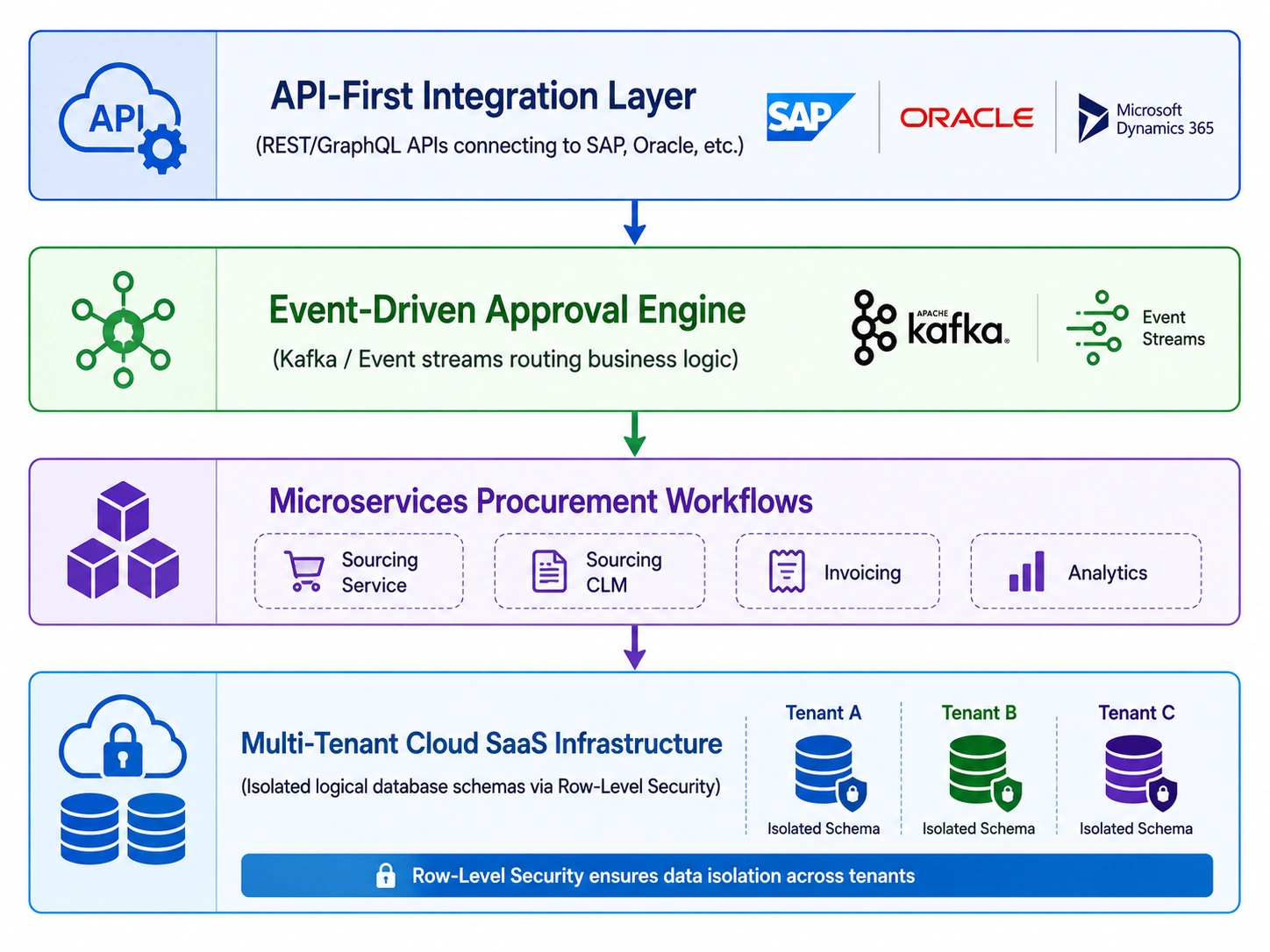
Beneath the user interface, modern S2P software relies on a sophisticated cloud-native tech stack engineered to handle immense volume and seamless data translation:
- Multi-Tenant SaaS Architecture: Shared cloud infrastructure with strict database-level tenant isolation using advanced row-level security (RLS), enabling instant platform-wide updates without cross-client data exposure.
- Microservices-Based Procurement Workflows: Independent, containerized services (like invoicing, sourcing, contracts, and RFPs) prevent high-volume spikes or service failures from impacting the broader platform.
- Event-Driven Approval Engines: Modern event streaming architecture (like Apache Kafka) enables real-time asynchronous workflows for approval recalculations, budget updates, and manager notifications.
- Role-Based Access Control (RBAC): Granular role-based permissions integrated with Single Sign-On (SSO) providers like Okta or Azure AD to enforce secure, permission-specific procurement actions.
- API-First Integration Layer: Robust REST or GraphQL APIs enable real-time, bi-directional integrations with ERPs like SAP S/4HANA and Workday, replacing legacy batch-file transfers and nightly SFTP syncs.
Enterprise Source-to-Pay Software Architecture Explained
The biggest misconception in procurement SaaS is assuming Source-to-Pay (S2P) software is simply a glorified dashboard with a few tracking fields.
In reality, modern enterprise S2P systems are mission-critical orchestration hubs. They must process high-volume financial data, evaluate supplier risk profiles in real-time, and securely bridge communication between dozens of fragmented core systems simultaneously.
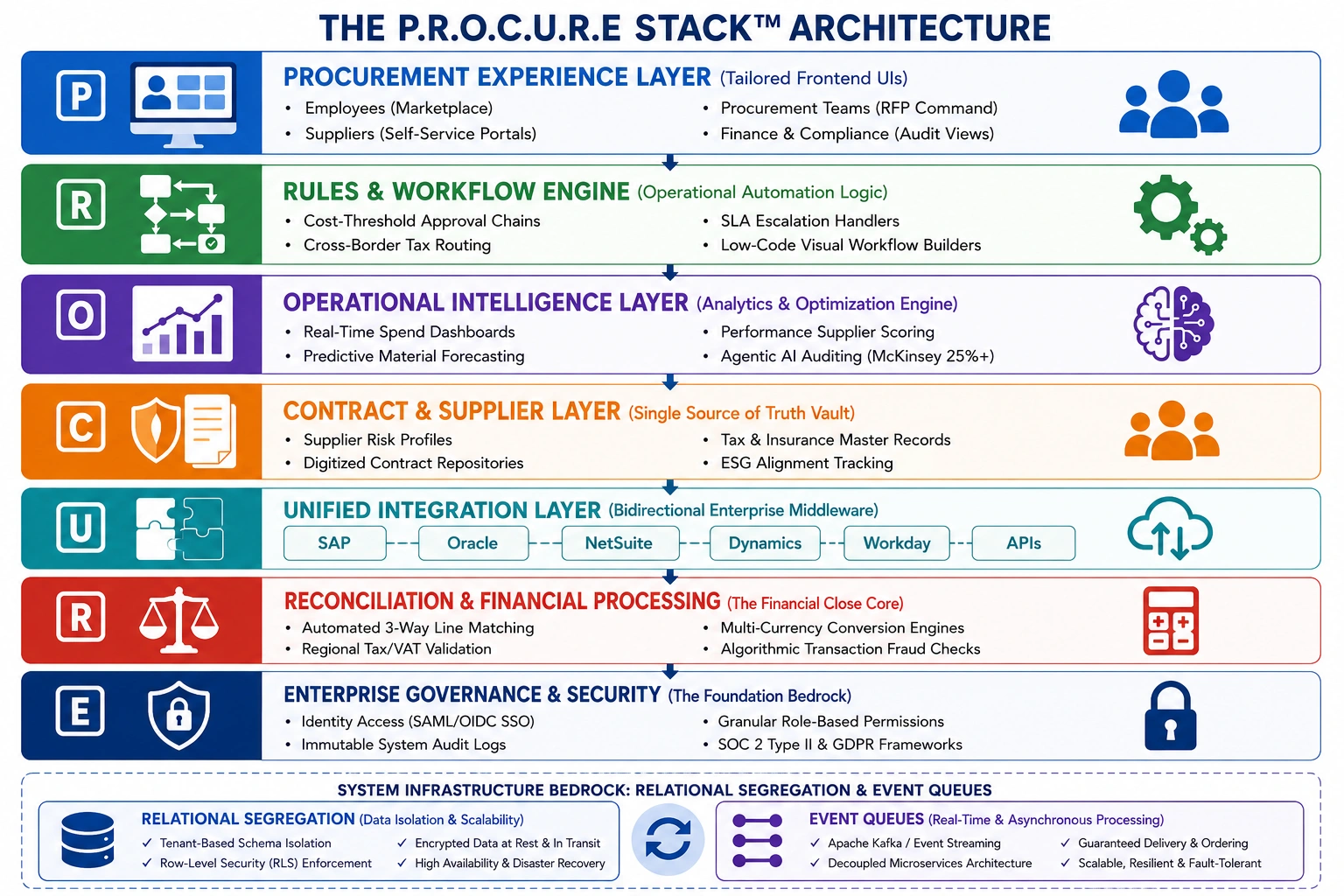
A. Deconstructing the 7-Layer P.R.O.C.U.R.E Stack™
To successfully build, buy, or deploy an enterprise-grade procurement ecosystem, organizations must treat the system as a multi-layered infrastructure. The P.R.O.C.U.R.E Stack™ breaks down how these interlocking components function together:
1. P — Procurement Experience Layer
The frontend application layer serves as the entry point for all internal and external stakeholders. Instead of a single interface, it provides tailored user interfaces (UIs) mapped to specific organizational functions:
- Employees: A simplified, intuitive “marketplace” experience for submitting quick purchase requisitions.
- Procurement Teams: Advanced control rooms for monitoring macro spend trends and executing complex RFPs.
- Suppliers: Self-service portals used to upload invoices, maintain bank information, and update tax documentation.
- Finance & Compliance Teams: Specialized auditing and ledger monitoring views.
Modern platforms deploy these across web dashboards, native mobile procurement apps for on-the-go approvals, and natural-language conversational AI interfaces to handle basic employee intake requests.
2. R — Rules & Workflow Engine
The operational logic layer dictates exactly how data flows across the organization. It evaluates transactional details against corporate guidelines to automatically manage:
- Granular approval chains based on cost thresholds.
- SLA escalation logic when a manager lets an invoice sit too long.
- Complex, regional procurement and tax compliance rules across international borders.
Legacy hardcoded logic has given way to modern low-code workflow builders. This allows business process analysts to adjust routing rules on the fly without waiting on engineering sprints.
3. O — Operational Intelligence Layer
Procurement data is a goldmine for efficiency optimization and this layer continuously ingests transactional telemetry to deliver core data services:
- Spend Analytics: Instantly flagging duplicate line-items or sudden price anomalies.
- Supplier Scoring: Evaluating vendors on historical delivery speed, quality, and contract accuracy.
- Predictive Analytics: Forecasting raw material price shifts or identifying upcoming contract expiration risks.
The AI Impact: AI-driven procurement analytics have evolved from a luxury to a baseline competitive necessity. McKinsey estimates that implementing agentic AI solutions can improve overall procurement efficiency by 25% to 40% by automating manual auditing processes.
4. C — Contract & Supplier Layer
This is the single source of truth (SSOT) for all vendor identities and legal agreements. It serves as a secure data vault tracking supplier profiles, insurance certificates, banking info, and environmental, social, and governance (ESG) compliance records. It explicitly matches every individual purchase back to its parent legal contract to prevent cost leakage.
5. U — Unified Integration Layer
The bridge between procurement activities and the enterprise core. An S2P platform is only as strong as its integrations; failure here is the leading reason enterprise procurement transformations collapse.
This layer handles bidirectional data syncing with core systems including SAP, Oracle, NetSuite, Microsoft Dynamics, Workday, Salesforce, and clearinghouse banking APIs to execute payments.
6. R — Reconciliation & Financial Processing
Once a product or service is delivered, this engine manages the financial close. It automates line-by-line three-way invoice matching (matching the PO, the goods receipt, and the vendor invoice). It runs real-time tax validation, handles multi-currency conversions for global trade and checks transaction histories against fraud detection models before issuing final payment approvals.
7. E — Enterprise Governance & Security
The foundational bedrock of the stack because S2P platforms handle bank routing numbers, employee identities, and millions of dollars in corporate capital, strict security measures are mandatory. This layer enforces granular role-based access control (RBAC), immutable system-wide audit logs, SOC 2 Type II compliance, and GDPR data controls over vendor and employee records.
Key Features Every Enterprise Source-to-Pay Software Must Have
Evaluating enterprise Source-to-Pay (S2P) suites requires looking past high-level marketing claims to inspect granular operational capabilities. To deliver actual return on investment (ROI), an enterprise S2P platform must provide a highly resilient feature set organized across eight core structural domains.

1. Strategic Sourcing
This upstream infrastructure orchestrates competitive bidding, sanitizes historical corporate expenditure, and automates vendor selection mechanics to aggressively minimize an enterprise’s total cost of ownership (TCO).
- eRFX Management: Digitally tracks electronic Requests for Information (RFIs), Requests for Proposals (RFPs), and Requests for Quotations (RFQs) using automated matrix scorecards.
- eAuctions: Runs real-time reverse or Dutch auctions to drive competitive, real-time supplier bidding.
- Spend Analytics: Categorizes historical corporate purchasing data using standard taxonomies like UNSPSC codes.
- Supplier Discovery: Accesses B2B networks to find global vendors based on diversity and compliance.
- Sourcing Workflows: Automates cross-functional bid comparisons and executive sourcing decision-making paths.
2. Supplier Management
This core framework centralizes the end-to-end vendor lifecycle, programmatically auditing compliance documentation and calculating operational risk factors to safeguard the enterprise supply chain.
- Supplier Onboarding: Automates self-service vendor registration, secure banking collection, and tax form validation.
- Performance Tracking: Scores operational telemetry against KPIs like On-Time In-Full (OTIF) delivery rates.
- Risk Monitoring: Continuously screens supplier records against global legal, ESG, and OFAC sanctions databases.
- Supplier Segmentation: Classifies vendors by spend volume and operational criticality to mitigate supply risks.
- Vendor Communication Portals: Centralizes all message exchanges and documentation within a single, fully audited hub.
3. Contract Lifecycle Management (CLM)
This legal orchestration layer converts negotiated sourcing terms into enforceable digital agreements, mitigating institutional risk by continuously monitoring compliance milestones and contract utilization rates.
- Clause Libraries: Stores pre-approved legal templates and fallback language to accelerate contract drafting.
- Digital Signatures: Integrates with e-signature tools like DocuSign for legally binding, authenticated execution.
- Milestone Alerts: Triggers automated notifications for renewals, expirations, and tiered pricing changes ahead of schedule.
- AI Contract Intelligence: Uses NLP engines to extract hidden liabilities and obligations from legacy paper contracts.
- Version Control: Tracks real-time redlining histories, revision cycles, and stakeholder approval chains transparently.
4. eProcurement & Purchase Management
This downstream transactional engine deployment enforces corporate spend governance, guiding employees through consumer-style marketplaces while validating requests against real-time ledger budgets.
- Guided Buying: Delivers a consumer-grade marketplace interface featuring approved corporate catalogs and punch-out sites.
- Approval Workflows: Routes requisitions dynamically based on target departments, project codes, or cost thresholds.
- Purchase Order Generation: Automatically translates approved requisitions into structured digital POs sent to suppliers.
- Multi-Entity Procurement: Supports complex corporate operations across multiple subsidiaries, local currencies, and VAT/GST regions.
- Budget Controls: Runs real-time budget checking to block unauthorized spending before capital is committed.
5. Accounts Payable Automation
This financial close module ingests multi-channel invoicing streams, executing touchless three-way verification matching against operational events to eliminate manual accounting data entry errors.
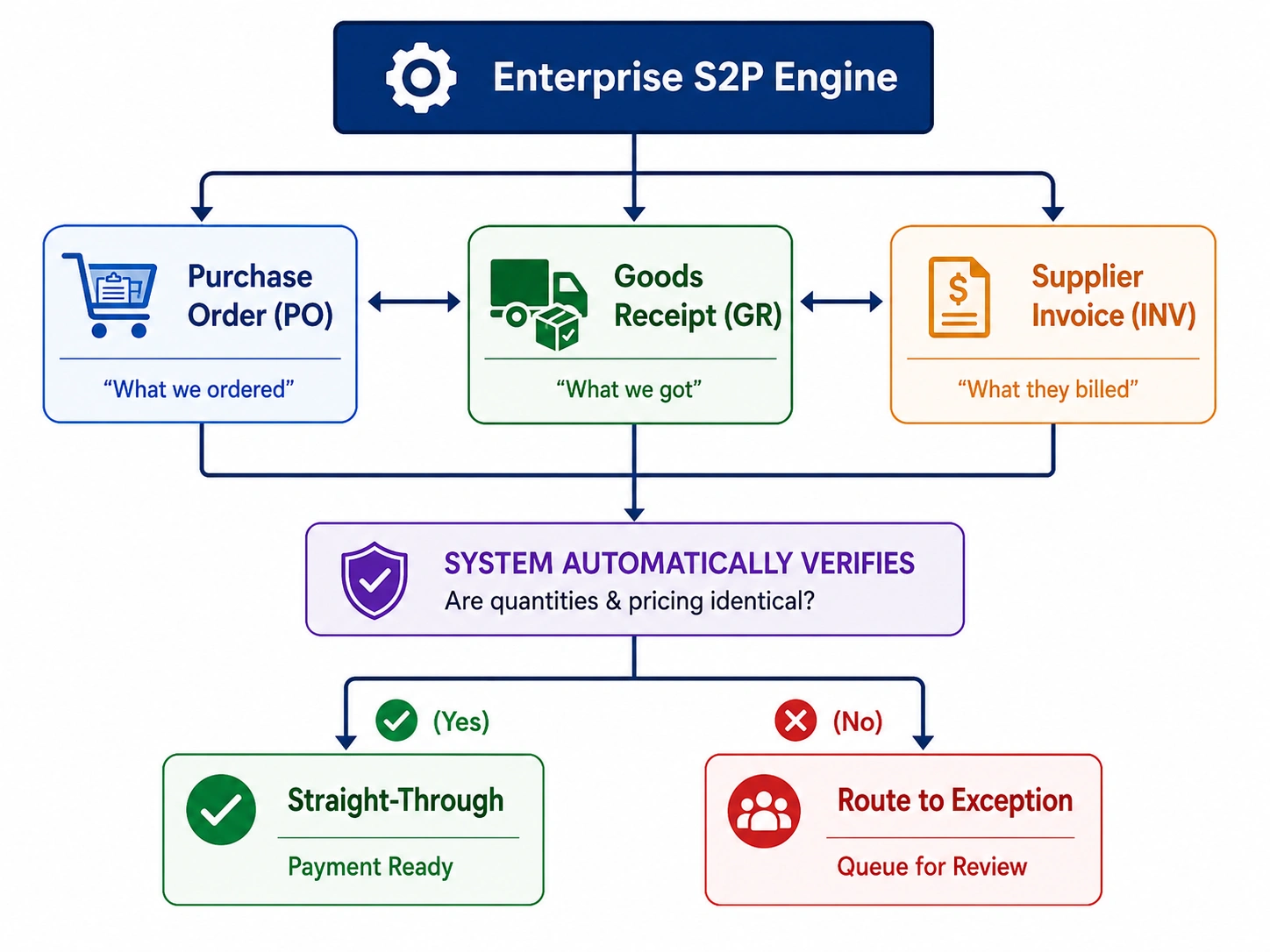
- Invoice Ingestion: AI and OCR-powered tools extract line-item details from various channels, including emails, EDI, scans, and portals, ensuring high-precision invoice processing.
- Three-Way Matching: An automated reconciliation tool that validates Invoices against Purchase Orders and Goods Receipts/Bills of Lading. Invoices within set tolerances are auto-approved for payment.
- Payment Execution: Routes cleared invoice data directly into corporate banking rails for automated ACH transfers.
- Exception Handling: Isolates mismatched invoices automatically, routing discrepancies to dedicated supplier resolution queues.
- Tax & Compliance Validation: Audits incoming invoices against regional tax regulations to maintain permanent audit readiness.
6. Enterprise Analytics & Procurement Intelligence
This descriptive and predictive business intelligence layer translates raw transactional telemetry into board-ready visualizations, uncovering hidden cost leakages and capacity forecasting opportunities.
- Real-Time Spend Dashboards: Provides instant visibility into company-wide spend velocities and categorical outlays.
- Procurement Forecasting: Uses machine learning to project future inventory demands and seasonal pricing trends.
- Savings Opportunity Detection: Flags maverick spending patterns and identifies opportunities for strategic vendor consolidation.
- KPI Reporting: Measures core procurement lifecycle efficiencies, including average Requisition-to-PO cycle times.
- Executive Reporting: Generates presentation-ready financial summaries and impact metrics for board-level review.
7. ERP Integrations & Enterprise Infrastructure
This bidirectional integration architecture provides a real-time data sync pipeline, linking procurement workflows seamlessly with core corporate ledgers and distributed microservices.
- ERP Connectivity: Offers native, out-of-the-box integration pipelines for SAP S/4HANA, Oracle Cloud, and NetSuite.
- API-First Architecture: Employs robust REST and GraphQL endpoints to link procurement with internal HR tools.
- Data Synchronization: Maintains real-time, automated data mirroring for general ledger (GL) and cost-center codes.
- Workflow Orchestration: Automates multi-system processes, syncing warehouse management status with downstream invoice processing.
- Scalable Cloud Infrastructure: Features high-availability cloud deployment with elastic scalability to handle high transaction volumes.
8. Enterprise Security, Governance & AI Automation
This foundational defense layer enforces institutional security parameters, leveraging immutable system logs and automated pattern-matching tools to actively prevent corporate financial fraud.
- Role-Based Access Control (RBAC): Maps permissions to identity providers via SAML/OIDC; capping branch managers at $5,000 and VPs at $250,000.
- Audit Trails: Generates immutable, time-stamped logs of every requisition modification, invoice edit, and approval.
- Compliance Management: Enforces strict systemic guardrails to ensure alignment with SOX, GDPR, and global ESG regulations.
- AI Procurement Automation: Deploys background agents to automate supplier recommendations and intake query routing.
- Fraud Detection: Runs continuous pattern matching to flag duplicate vendors, phishing invoices, and internal anomalies.
How to Build Source-to-Pay Software for Enterprises
Developing an enterprise Source-to-Pay (S2P) platform requires a strict, modular engineering approach. Because these platforms orchestrate heavy financial data and cross-system ledger balances, our development sequence prioritizes architectural stability and systemic data normalization before building frontend interfaces or automation layers.
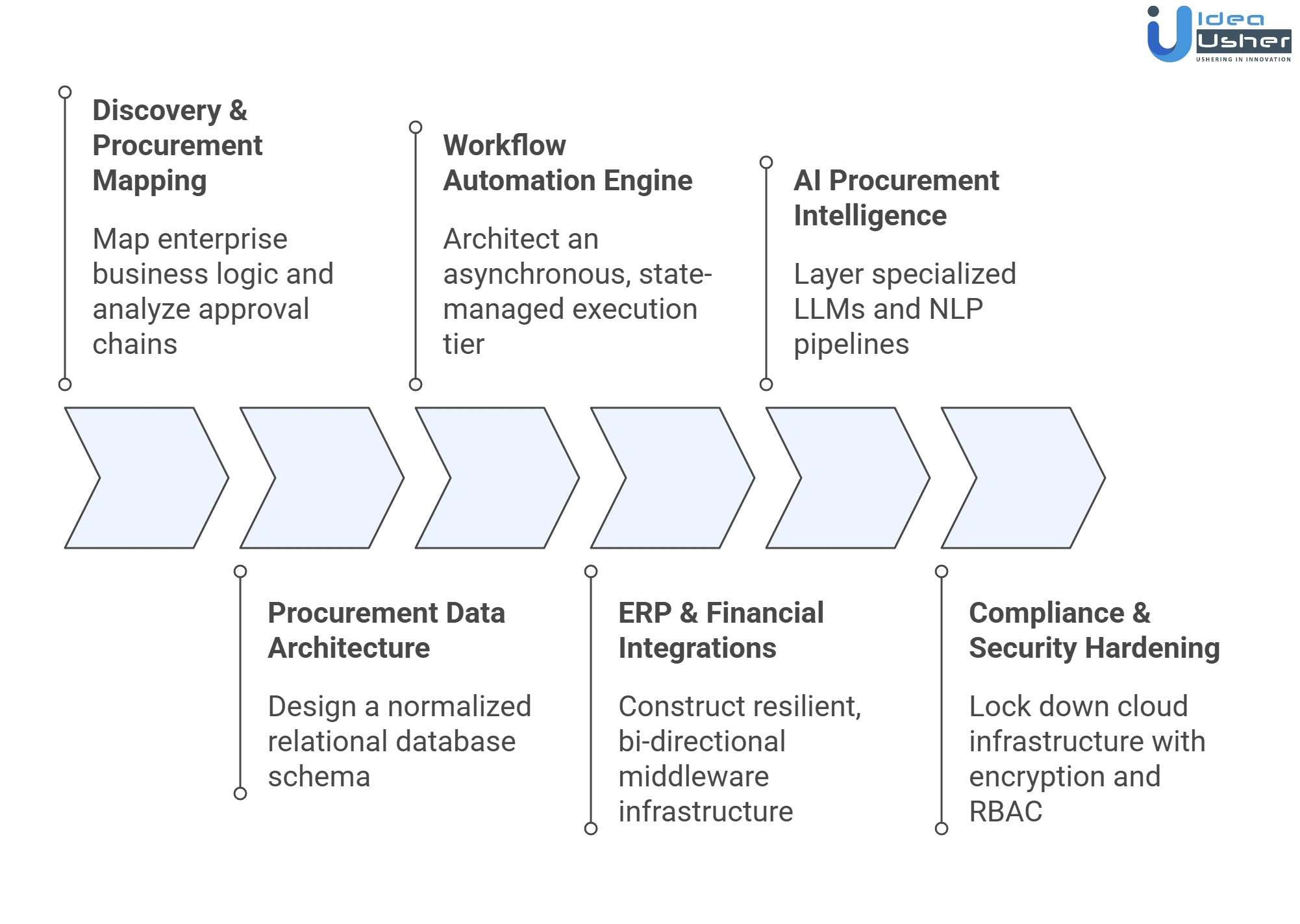
1. Discovery & Procurement Mapping
Before writing code, we map out the enterprise business logic, consult with our client to document manual procurement hierarchies, analyze existing approval chains, map legacy ERP data dependencies, and isolate regional compliance parameters before writing single lines of code.
- Stakeholder Profiling: Identifies purchasing agents, legal reviewers, accounts payable managers, and compliance controllers.
- Approval Mapping: Graphs dollar-value escalation paths, regional signing authorities, and multi-departmental sign-off rules.
- ERP Discovery: Inventories target ledger architectures to determine data formatting requirements for core integrations.
- Architecture Pitfall: Building application code before mastering internal enterprise approval politics stalls adoption permanently.
2. Procurement Data Architecture
Our developers design a robust, normalized relational database schema engineered to securely ingest and standardize highly fragmented vendor profiles, multi-line item invoices, unstructured contract metadata, and complex spend taxonomies.
- Vendor Normalization: Consolidates erratic supplier inputs into a single, clean SQL database schema format.
- Line-Item Structuring: Designs data objects that support split-accounting codes, multi-currency fields, and tax variants.
- Taxonomy Mapping: Integrates standardized asset classification codes, including UNSPSC arrays, directly into databases.
- Data Warning: Fragile early data modeling completely corrupts downstream machine learning and analytics ingestions.
3. Workflow Automation Engine
We architect an asynchronous, state-managed execution tier using Temporal or Camunda, empowering the platform to route workflows dynamically, trigger real-time webhooks, and escalate idle internal purchase requisitions automatically.
- Durable Execution: Implements fault-tolerant state engines to ensure business logic survives server restarts smoothly.
- Dynamic Routing: Evaluates payload parameters to route requisitions based on cost centers or departments.
- Asynchronous Webhooks: Fires real-time event updates to internal microservices and external vendor portal nodes.
- Escalation Handlers: Monitors processing idle-time, auto-routing stale requests to secondary management approval queues.
4. ERP & Financial Integrations
We construct resilient, bi-directional middleware infrastructure utilizing Apache Kafka pipelines to synchronize our procurement transactional states instantly with heavy-duty ERP environments like SAP, Oracle, NetSuite, and Workday.
- Event-Driven Queues: Leverages Kafka messaging streams to decouple ERP pipelines from core app processing.
- Bidirectional Syncing: Syncs general ledger strings, purchase order numbers, and payment statuses across platforms.
- Banking Rails: Plugs straight-through clearing arrays into corporate treasury networks via automated banking APIs.
- Integration Risk: Brittle API synchronization and unhandled ledger race conditions represent primary implementation failure vectors.
5. AI Procurement Intelligence
Our engineers layer specialized Large Language Models and natural language processing pipelines onto our structured tables to automate unstructured invoice data extraction, document risk parsing, and predictive spend analytics.
- Intelligent Extraction: Employs fine-tuned OCR transformer pipelines to extract messy line-item invoice data instantly.
- Predictive Analytics: Processes historical transactional telemetry data to forecast corporate inventory demand and pricing.
- Risk Scoring: Analyzes external global databases to flag supplier compliance anomalies or credit drops.
- Clause Isolation: Scans legal contract documentation using NLP to highlight non-standard liabilities automatically.
6. Compliance & Security Hardening
We lock down our cloud infrastructure by implementing rigid data encryption standards, deploying immutable log arrays, and configuring enterprise authentication layers to easily clear stringent corporate IT security audits.
- Identity Governance: Integrates enterprise Single Sign-On using secure SAML and OIDC authentication protocols.
- Granular RBAC: Controls user interface access using cryptographically verified role-based access control policies.
- Immutable Ledgers: Records all ledger adjustments, approvals, and credential modifications into append-only log databases.
- Certifications Framework: Configures infrastructure environments to meet SOC 2 Type II, ISO 27001, and GDPR compliance.
7. Testing & Deployment Verification
Our engineers build rigorous multi-tenant sandbox environments to execute high-volume load testing, validate zero-drift ledger updates, and establish canary release pipelines that update global production tenants smoothly without operational downtime.
- Financial Regression Testing: Runs automated matrix assertions verifying that three-way document matches never yield calculation errors or false payment flags.
- Canary Deployment Pipelines: Deploys software updates progressively to minor tenant cohorts first, measuring system error rates automatically before global cluster rollouts.
- Idempotency Verification: Simulates network dropouts and broken API connections mid-transaction to confirm data layers never post duplicate ledger entries.
- Performance Staging: Subjects asynchronous execution engines to extreme artificial request spikes, validating our per-tenant API rate limits and connection pooling boundaries.
S2P Implementation Timeline
Phase 3 and 4 are the application’s true foundations. A state machine that manages edge cases and a resilient API tier make implementing subsequent analytics and AI layers much simpler. This 30-week engineering timeline balances foundational database design with integrations and security hardening:
| Phase | Core Deliverable | Risk Level | Approx. Timeline |
| Phase 1 | Process Blueprint Document | Low | Weeks 1–4 |
| Phase 2 | Normalized Relational Database Schema | Medium | Weeks 5–8 |
| Phase 3 | Asynchronous State Machine | High | Weeks 9–14 |
| Phase 4 | Bi-directional ERP Sync Pipelines | Critical | Weeks 15–22 |
| Phase 5 | Data Enrichment & OCR Microservices | Medium | Weeks 23–26 |
| Phase 6 | Hardened Identity & Audit Systems | High | Weeks 27–30 |
Cost to Build a Source-to-Pay (S2P) Platform
The cost of building a Source-to-Pay platform depends on workflow complexity, ERP integrations, AI capabilities, compliance requirements, and enterprise scalability. Development budgets can vary significantly based on procurement automation depth, supplier management features, and multi-region operational support requirements.
A. MVP S2P Development Cost According to Phases
Building an MVP Source-to-Pay platform requires multiple development phases, from procurement workflow planning to deployment infrastructure. The table below breaks down estimated costs for each major development stage involved in launching a scalable procurement platform.
| Development Phase | What the Phase Will Cover | Estimated Cost |
| Procurement Workflow Planning | Defines procurement processes, approval hierarchies, supplier lifecycle requirements, ERP dependencies, and enterprise compliance expectations. | $8,000 – $15,000 |
| UI/UX & Procurement Dashboard Design | Designs procurement dashboards, supplier portals, approval interfaces, mobile responsiveness, and user workflow navigation experiences. | $10,000 – $18,000 |
| Backend & Database Development | Builds scalable procurement infrastructure, workflow logic, databases, APIs, authentication systems, and procurement data management layers. | $20,000 – $35,000 |
| Supplier Management & Sourcing Module Development | Develops supplier onboarding, RFQ/RFP workflows, vendor profiles, sourcing events, and procurement collaboration functionalities. | $12,000 – $22,000 |
| Purchase Order & Invoice Workflow Automation | Implements requisition approvals, PO generation, invoice uploads, matching workflows, and procurement status tracking systems. | $10,000 – $18,000 |
| ERP & Third-Party System Integrations | Connects procurement platform with ERP, accounting, payment gateways, tax systems, and external procurement data sources. | $8,000 – $16,000 |
| Reporting & Analytics Dashboard | Creates spend analytics dashboards, procurement reporting tools, supplier performance tracking, and operational visibility systems. | $5,000 – $10,000 |
| QA Testing & Security | Performs penetration testing, role-based access implementation, audit logging, bug fixing, and compliance readiness assessments. | $5,000 – $10,000 |
| Deployment & Launch | Handles cloud hosting setup, CI/CD pipelines, production deployment, monitoring tools, and infrastructure optimization processes. | $2,000 – $6,000 |
| Total Estimated MVP Budget | Complete MVP Source-to-Pay platform with procurement automation, supplier workflows, integrations, analytics, and deployment readiness. | $70,000 – $130,000 |
Note: Actual MVP development costs may vary depending on integration complexity, procurement workflow customization, AI feature requirements, security standards, and the chosen technology infrastructure stack.
B. Source-to-Pay Platform Cost Comparison by Enterprise Scale
Source-to-Pay software costs increase as procurement systems become more advanced, intelligent, and enterprise-ready. The table below compares estimated pricing, included capabilities, and scalability across MVP, mid-level, and enterprise-grade S2P platforms.
| Platform Scope | What’s Included | Estimated Cost |
| MVP S2P Platform | Supplier onboarding, RFQ/RFP, requisition/PO workflows, invoice uploads, basic ERP links, and role-based cloud access | $80,000 – $150,000 |
| Mid-Level Enterprise Platform | Advanced sourcing, supplier portals, contract management, spend analytics, automated invoice matching, ERP/accounting integrations, compliance controls | $250,000 – $600,000 |
| Enterprise AI-Powered S2P Suite | AI procurement copilots, predictive analytics, supplier risk intelligence, autonomous workflows, advanced ERP integrations, enterprise compliance | $1M+ |
C. Cost-Affecting Factors of S2P Software Development
Development costs for Source-to-Pay software vary widely because enterprise procurement platforms require deep integrations, complex workflow automation, compliance infrastructure, and scalable data systems tailored to organizational size, procurement volume, and operational regions.
- ERP Complexity: Integrating with enterprise systems like SAP, Oracle, or NetSuite can increase development costs by 20%–35% due to custom APIs, procurement data mapping, and workflow synchronization.
- AI Infrastructure: AI-powered procurement features such as invoice OCR, supplier risk scoring, and spend forecasting may add $50,000–$250,000+ depending on model training, automation depth, and data volume.
- Compliance Requirements: Achieving enterprise-grade compliance standards like SOC 2, ISO 27001, GDPR, and audit logging can contribute 15%–25% of the total infrastructure budget.
- Multi-Region Support: Supporting multiple currencies, tax systems, languages, and regional procurement policies across global markets can increase engineering effort by approximately 25%–40%.
Recommended Enterprise S2P Tech Stack
This vetted, cloud-native tech stack optimizes enterprise source-to-pay lifecycles by pairing robust, compliant backend microservices with advanced multi-agent orchestration layers. When designing an architecture capable of running the P.R.O.C.U.R.E. Stack™ smoothly at enterprise scale, specific technologies excel at handling high-volume data and strict decoupling:
| Stack Layer | Recommended Technologies | Architectural Purpose |
| Frontend | React, Next.js | Provides fast, responsive, localized web views for global teams. |
| Backend | Node.js, Java Spring Boot | Handles massive transactional throughput and highly structured business logic. |
| Workflow Engine | Temporal, Camunda | Ensures microservice orchestration state-management and durable approval chains. |
| Database | PostgreSQL, MongoDB | Combines rigid relational tables (for financial accounting) with flexible document storage (for vendor metadata). |
| Search | Elasticsearch | Delivers instant, fuzzy-matching search results across millions of catalog inventory items. |
| Analytics | Snowflake, BigQuery | Cloud data warehousing engineered for heavy, multi-year spend analysis and data modeling. |
| AI Layer | OpenAI APIs, Claude, Vertex AI | Drives intelligent document intake (OCR), predictive forecasting, and intake chatbots. |
| Integrations | MuleSoft, Apache Kafka | Manages event-driven message queuing and deep enterprise ERP connectors. |
| Authentication | Okta, Auth0 | Enforces secure Single Sign-On (SSO) and multi-factor corporate access controls. |
Common Challenges in S2P Software Development
Developing enterprise source-to-pay software requires balancing strict financial controls with seamless user experiences. Unlike basic SaaS apps, these systems need specialized engineering to prevent ledger corruption, manage diverse data formats, and maintain stability during high-volume transactions.
1. Managing Complex ERP Ledger Synchronization
Challenge: Syncing real-time transactional states with legacy enterprise resource planning (ERP) systems like SAP or Oracle frequently causes data race conditions and ledger discrepancies.
Solution: Our developers deploy an event-driven architecture using Apache Kafka to decouple transaction streams, enforcing strict data idempotency to guarantee perfectly synchronized general ledger records across all environments.
2. Reconciling Messy Supplier Invoices
Challenge: Invoices arriving via erratic channels such as blurry PDFs, physical scans, or non-standard EDI files cause high data extraction error rates and matching failures.
Solution: We implement multi-modal AI transformer pipelines backed by a human-in-the-loop (HITL) validation framework, allowing our system to securely flag, isolate, and correct data anomalies before database ingestion.
3. Designing Resilient Workflow State Machines
Challenge: Enterprise approval chains are highly unpredictable, featuring complex multi-departmental paths, localized currency changes, and sudden employee delegation shifts that break linear logic.
Solution: Our engineers architect a durable, asynchronous state machine using Temporal, enabling long-running approval workflows to dynamically adapt to shifting organizational paths while surviving system restarts.
4. Securing High-Volume Financial Data
Challenge: Handling corporate bank routing info, tax identification numbers, and multi-million dollar capital flows introduces massive security exposure to fraud and compliance audits.
Solution: We isolate corporate data schemas using row-level security, enforce enterprise Single Sign-On via SAML/OIDC protocols, and record system mutations inside immutable, append-only system audit logs.
5. Ensuring Supplier Portal Adoption
Challenge: Forcing external suppliers through complex, slow registration and onboarding processes causes widespread user abandonment and forces accounts payable teams back to manual spreadsheets.
Solution: We build frictionless, self-service supplier portals featuring automated global registry lookups and tax form validation, ensuring vendors onboard inside minutes without technical assistance.
Market Leading Source-to-Pay Software Solutions
Navigating the procurement landscape requires robust tools to optimize efficiency and cash flow. From compliance-driven workflows to AI-powered analytics, these premier platforms redefine business spend management. Here is a showcase of the market’s leading Source-to-Pay software solutions.
1. Coupa
Coupa excels in enterprise-wide business spend management, merging community-driven AI insights with an intuitive, user-friendly interface. Its massive supplier network empowers global organizations to seamlessly optimize electronic transactions and corporate expense management.
- Community Intelligence: Leverages collective, AI-driven data from trillions in spend to suggest prescriptive cost-saving recommendations.
- User-Centric Interface: Features an easy, consumer-like shopping experience that drives high internal adoption and compliance.
- Unified Spend Control: Optimizes everything from procurement and invoicing to digital treasury management within a single ecosystem.
2. SAP Ariba
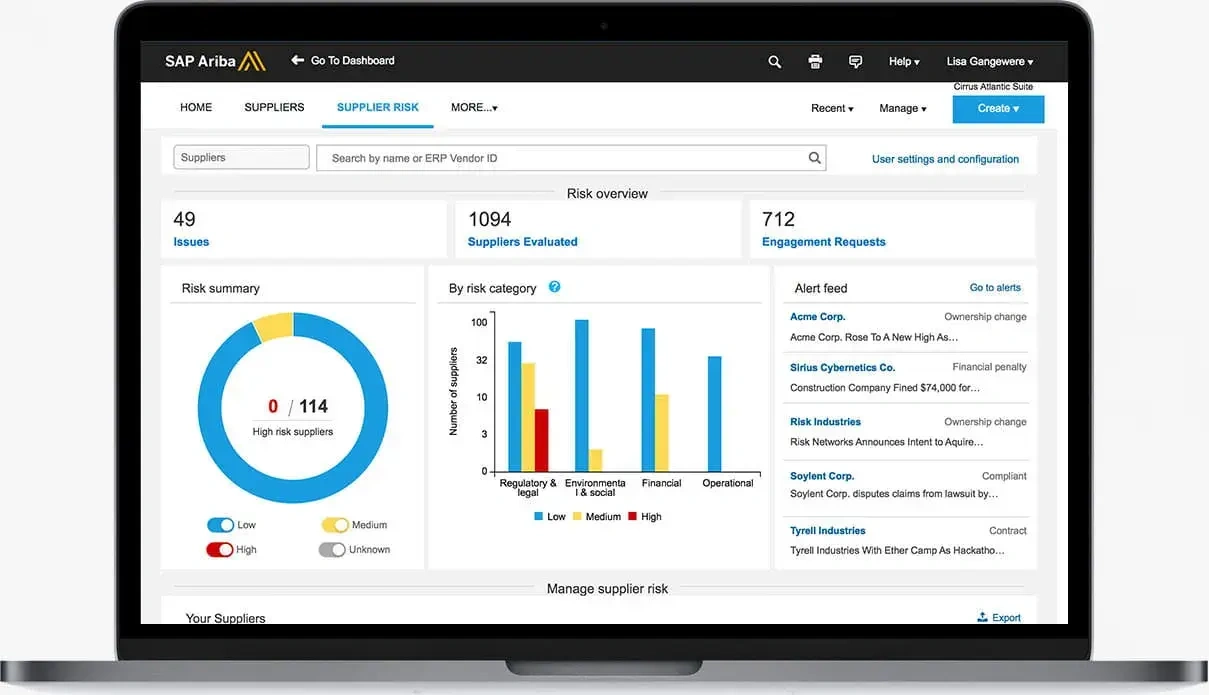
SAP Ariba delivers unparalleled global scale for direct materials procurement, natively integrating with core SAP ERP systems. It provides massive B2B connectivity, allowing enterprises to easily screen, vet, and transact with global trading partners.
- Core ERP Synergy: Offers native, deep integration with SAP S/4HANA to streamline highly complex global supply chains.
- Ariba Network Growth: Connects millions of global buyers and suppliers to accelerate digital collaboration and secure sourcing.
- Direct Materials Mastery: Advanced tools tailored specifically for manufacturing and production-critical supply chain workflows.
3. Ivalua
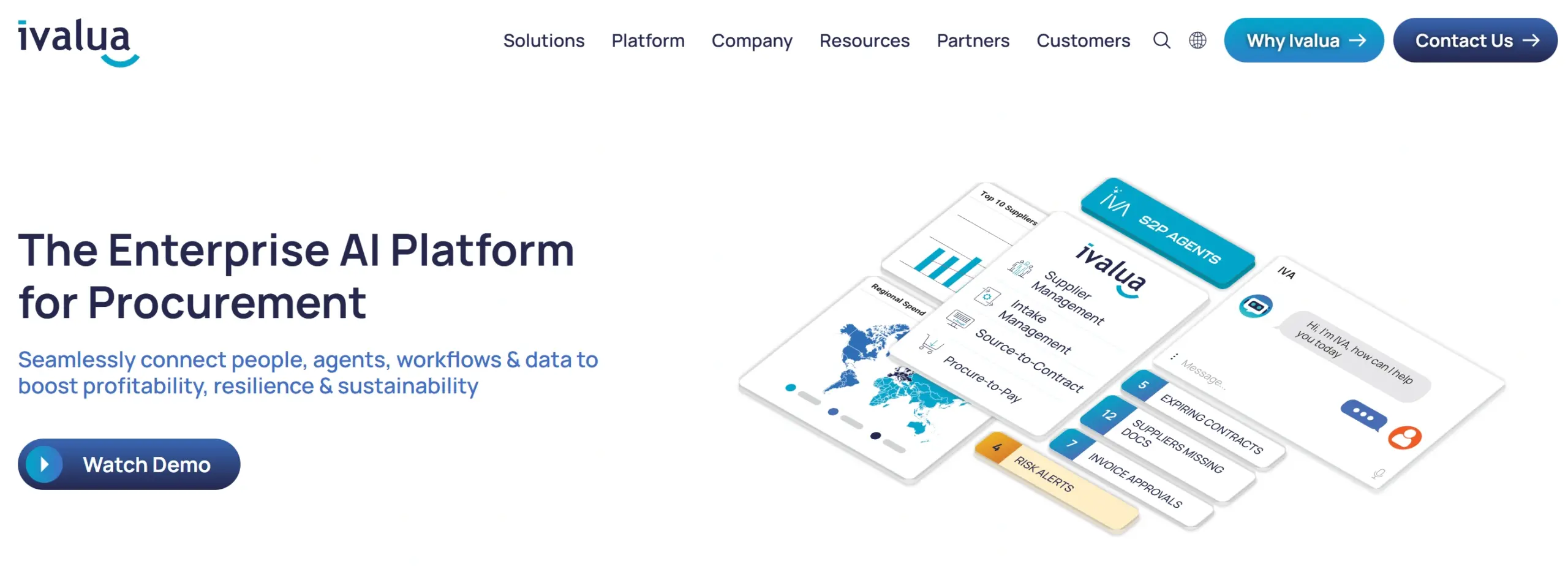
Ivalua specializes in highly configurable, unified workflows built entirely on a single code base. This ensures seamless data sharing across sourcing, contracts, and accounts payable modules for complex, compliance-driven global enterprises.
- Single Code Base: Eliminates data silos by running sourcing, contract lifecycle management, and AP on one unified architecture.
- Deep Configurability: Allows tailored customization of intricate corporate compliance rules without compromising future software upgrades.
- Supplier Collaboration: Enhances transparency with flexible portals that easily adapt to unique supplier relationship management needs.
4. GEP SMART
GEP redefines procurement with cloud-native, mobile-first operations featuring an intuitive, consumer-like purchasing environment. The platform leverages built-in AI agents to deliver predictive spend analytics and proactive, real-time supplier risk tracking.
- Mobile-First Design: Prioritizes an agile, on-the-go user experience to maximize compliance and employee adoption rates.
- Predictive AI Insights: Deploys intelligent agents to forecast spending trends and actively mitigate potential supply chain disruptions.
- Unified SMART Platform: Merges strategic sourcing software and operational ERP tools into one seamless, cloud-native ecosystem.
5. Zycus
Zycus champions AI-guided sourcing and advanced AP automation, embedding heavy generative AI capabilities to speed up contract optimization. It is ideal for procurement-driven organizations looking to eliminate manual paper processing entirely.
- Generative AI Core: Utilizes advanced cognitive bots to accelerate contract reviews, legal compliance, and project cycle times.
- Hyper-Automation in AP: Eliminates manual data entry entirely through touchless invoice processing and smart matching technology.
- Sourcing Guidance: Empowers procurement teams with predictive market intelligence and autonomous negotiation recommendations.
Build Enterprise-Grade Source-to-Pay Software With Idea Usher
Building an enterprise-grade Source-to-Pay (S2P) platform requires a partner who understands that beautiful user interfaces are useless if the underlying database structure breaks under high transaction loads or corrupts an ERP ledger.
With 11+ years of engineering experience, 250+ experts, and 1,000+ deployments across 50+ countries, Idea Usher is uniquely positioned to build and deploy your enterprise-grade procurement infrastructure.
Our Specialized Procurement Engineering Pillars
Idea Usher utilizes a hybrid global delivery model, combining expert engineering with agile management to build resilient business logic. Our “glass-box” approach provides transparent development cycles for modernizing internal operations or launching multi-tenant S2P SaaS platforms.
- Logic-First Workflow Design: We map complex routing and accounting hierarchies before frontend development, utilizing no-code builders for flexible, administrator-led rule adjustments.
- High-Availability Infrastructure: We employ a PostgreSQL core for transaction safety, enhanced by Redis, Elasticsearch, and Apache Kafka for rapid, asynchronous data processing.
- Deep ERP Integration: Our bidirectional pipelines sync vendor profiles and payment statuses with major platforms like SAP, Oracle, NetSuite, Workday, and Coupa.
- Native AI Engines: We embed transformer pipelines for invoice OCR, predictive risk scoring, and automated contract analysis directly into enterprise workflows.
- Zero-Trust Governance: Security is engineered from day one, featuring SAML/OIDC SSO, verified RBAC, and immutable audit logging to clear strict corporate IT audits.
Whether you’re modernizing procurement operations or building a next-generation Source-to-Pay SaaS platform, Idea Usher helps enterprises design scalable procurement ecosystems with intelligent automation, ERP connectivity, and enterprise-grade infrastructure.
Conclusion
Modern enterprises do not need disconnected procurement tools, they require unified Source-to-Pay platforms that streamline sourcing, supplier management, contracts, procurement, invoicing and payments within a single intelligent ecosystem. Building scalable S2P software demands deep expertise in enterprise workflows, ERP integrations, automation, analytics, and compliance infrastructure. With experience in enterprise SaaS development and complex workflow automation, Idea Usher helps businesses build secure, scalable, and AI-ready Source-to-Pay platforms tailored to modern procurement operations and long-term digital transformation goals.
Things to Know
Q.1. What is the core architecture of enterprise source-to-pay software?
A.1. A modern platform requires a decoupled, multi-tenant SaaS architecture utilizing microservices, event-driven approval engines, and a robust API-first integration layer to securely orchestrate high-volume data and financial workflows.
Q.2. Why do integration strategies cause procurement software failure?
A.2. Platforms frequently collapse post-onboarding when they lack real-time data sync, relying instead on brittle middleware or batch-file transfers that cause general ledger discrepancies and massive downstream financial reconciliation bottlenecks.
Q.3.How does agentic AI optimize enterprise procurement operations?
A.3. Embedding machine learning and multi-modal transformer pipelines automates unstructured invoice data extraction, provides predictive spend forecasting, isolates contract liabilities, and continuously tracks real-time global supplier compliance risk factors.
Q.4. How platforms prevent fraud during high-value procurement transactions?
A.4. To secure multi-million dollar capital flows, platforms must enforce cryptographically verified role-based access limits, integrate enterprise Single Sign-On, and log every single requisition mutation into immutable, append-only system databases.