


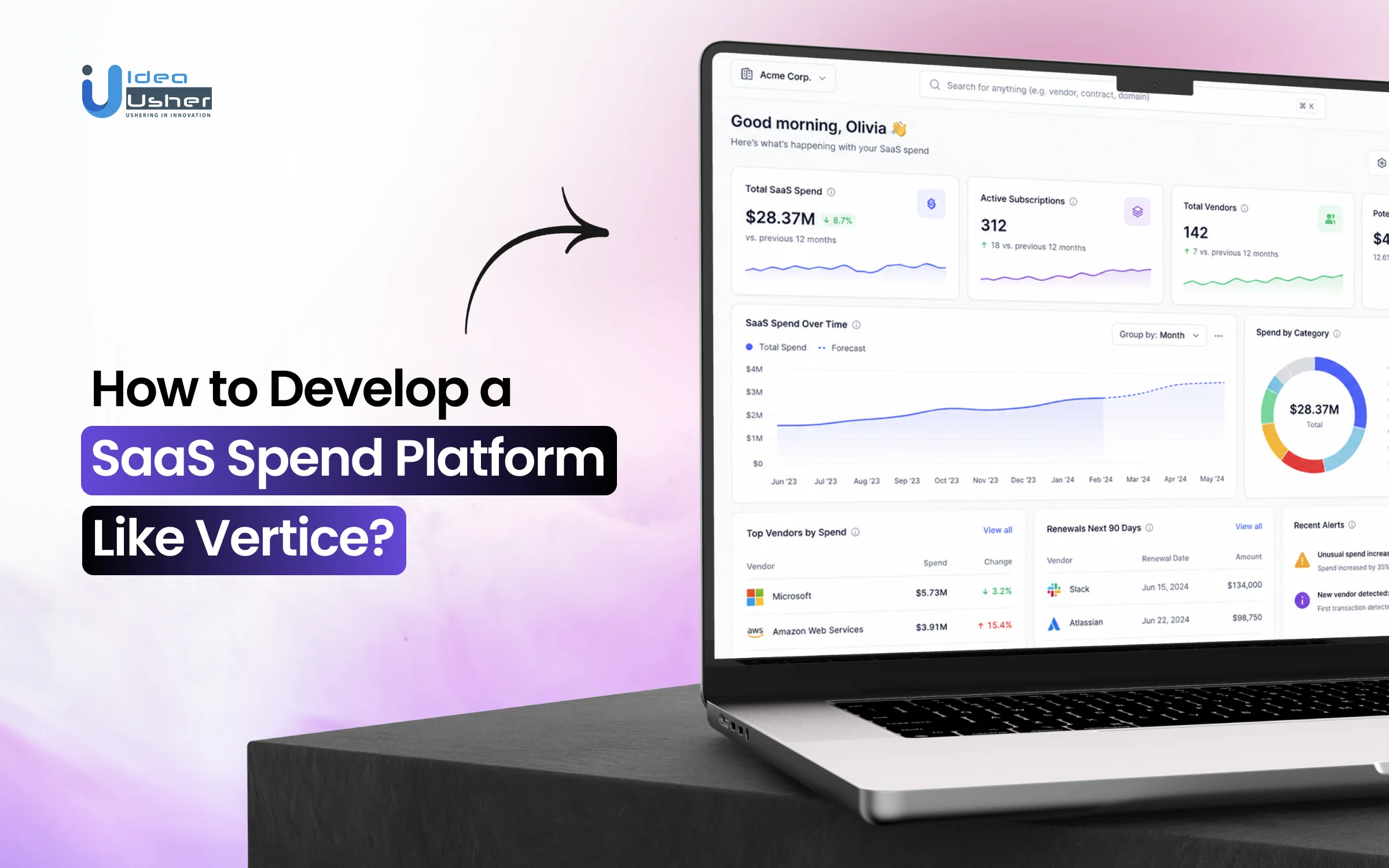
Key Takeaways
- Enterprises are losing SaaS spending visibility due to decentralized software purchases, disconnected approval systems, and unmanaged subscription renewals.
- AI-powered SaaS spend platforms help businesses automate procurement workflows, optimize vendor negotiations, and eliminate redundant software licenses.
- Building a scalable platform requires secure multi-tenant architecture, ERP integrations, automated contract intelligence, and compliance controls.
- Enterprises are investing in intelligent spend management systems to improve financial visibility, reduce waste, and streamline procurement decisions.
- How Idea Usher helps businesses build SaaS spend platforms like Vertice with pre-vetted enterprise developers.
Most corporate spend management tools fail before they even launch because they rely on employees manually inputting their software subscriptions. The real value of a platform like Vertice isn’t tracking the software the finance team knows about; it is discovering the thousands of dollars in shadow IT that they don’t. Building an automated discovery engine means your software must securely ingest corporate banking feeds, continuously normalize messy transaction strings, and map them to a global software index in real time.
This introduces massive compliance hurdles, strict row-level database security requirements, and complex third-party integration mapping. If your development team doesn’t understand event-driven architecture, a single wave of expired API tokens or a spike in concurrent webhooks can take your entire system down.
Over the years, we’ve built several enterprise spend management solutions powered by subscription intelligence and vendor automation workflows. As Idea Usher has this experience, we’re writing this blog to break down how to develop a SaaS spend platform like Vertice.
Why Businesses Are Struggling to Control SaaS Spending?
According to Fortune Business Insights, the global Software as a Service market size was valued at USD 315.68 billion in 2025. The market is projected to grow from USD 375.57 billion in 2026 to USD 1,482.44 billion by 2034, exhibiting a CAGR of 18.7% during the forecast period. While this rapid growth underscores massive cloud adoption, it also introduces a critical enterprise pain point: the skyrocketing, unmanageable cost of decentralized software procurement.

Source: Fortune Business Insights
Currently, departments independently license applications without central IT or finance oversight. This lack of governance means decision-makers cannot track expenditures or evaluate actual software utilization. Traditional cost-control measures fail to handle these systemic inefficiencies, creating an immediate, high-value market opportunity for dedicated SaaS management platforms.
The Hidden Costs of SaaS Sprawl
SaaS sprawl occurs when an organization loses track of the volume, cost, and utility of the applications running across its ecosystem. In a typical mid-market or enterprise environment, the barrier to acquiring new software is low. A departmental manager can provision a new tool with a corporate credit card in minutes. Over time, this leads to an invisible accumulation of financial waste.
The financial bleed associated with SaaS sprawl generally manifests in three distinct areas:
- Redundant Tooling: Separate departments frequently purchase different software licenses that perform identical functions. For instance, marketing might utilize HubSpot, sales might opt for Salesforce, and customer success might spin up an isolated Zendesk instance, leading to overlapping capabilities and premium-tier inefficiencies.
- Underutilized and Orphaned Licenses: Organizations routinely pay for maximum-tier seat licenses based on overly optimistic growth forecasts. Employees leave the company, or teams pivot their strategies, yet the recurring subscriptions remain active because there is no automated trigger to de-provision the software.
- Automatic Renewal Traps: Modern software vendors rely heavily on evergreen clauses and auto-renewals. Without a centralized repository tracking contract expiration dates, businesses miss critical negotiation windows, locking them into multi-year commitments for software that no longer fits their operational goals.
Failure of Manual Procurement Workflows
When organizations realize their software expenses are spiraling out of control, their initial reaction is often to implement manual tracking. Finance teams attempt to log subscriptions, contract terms, and user counts within complex spreadsheet ecosystems. However, relying on static spreadsheets and manual oversight to manage a dynamic cloud environment is fundamentally flawed and structurally unscalable.
Manual procurement processes inevitably break down due to several inherent limitations:
- Data Stale on Arrival: A spreadsheet is a snapshot in time. The moment an employee adds a user, upgrades a tier, or registers a new micro-tool, the central tracker becomes obsolete. It requires constant human intervention to remain accurate, which is an inefficient use of skilled finance talent.
- Lack of Real-Time Utilization Visibility: Financial ledgers and credit card statements only show that a payment occurred. They provide no insight into whether the software is actually being used. A company might discover they are paying for 500 premium seats of an analytics tool, but a manual audit cannot reveal that only 45 of those seats have logged in over the past 90 days.
- Asymmetrical Information in Vendor Negotiations: Software vendors possess sophisticated telemetry data regarding how an enterprise utilizes their platform. When a manual procurement team enters a renewal negotiation without real-time usage data, they are at a disadvantage, often conceding to price hikes or unnecessary tier upgrades simply because they lack the data to counter the vendor claims.
As an organization grows from 100 to 1,000 employees, the permutations of vendors, contracts, and individual user permissions scale exponentially. Managing this complexity via legacy procurement workflows creates operational bottlenecks, delays software delivery, and fails to curb unnecessary corporate expenditures.
Rise of AI Spend Optimization Platforms
As enterprise leaders face the structural failures of manual governance, a massive market gap has emerged for automated solutions. Forward-thinking CFOs and CIOs are actively moving away from reactive cost-cutting toward proactive, intelligent software asset management. This shift is driving urgent enterprise demand for AI-powered platforms that integrate directly via APIs into the corporate financial and identity tech stack.
The viability of this market is proven by the rapid growth of industry pioneers like Zylo and Productiv. These procurement platforms have built multi-million dollar verticals by converting raw enterprise spend data and deep application utilization analytics into actionable cost savings. Their success proves that organizations are highly motivated to buy software that explicitly targets, identifies, and eliminates operational waste.
By leveraging machine learning algorithms, an advanced spend optimization platform delivers capabilities that manual systems cannot replicate:
- Automated Discovery and Mapping: The platform scans financial transactions and login data in real time, instantly mapping out the entire SaaS topology of the enterprise, identifying hidden shadow IT, and categorizing software by functional utility.
- Predictive Usage Analytics: By analyzing behavioral patterns and login frequency, the system can predict which licenses are likely to remain dormant, automatically flagging them for downgrades or reclamation before the next billing cycle.
- Intelligent Renewal Workflows and Market Benchmarking: Advanced platforms do not just track contract dates. They analyze contract terms against anonymized global market data. This allows the system to advise procurement teams on whether they are paying above-market rates for a specific vendor and provides data-driven negotiation playbooks.

Interactive SaaS Spend Readiness Assessment
Launching a proprietary corporate expense network or scaling internal tracking infrastructure requires assessing systemic technical compatibility before allocating capital. Engineering a high-throughput transaction ledger into legacy accounting tools involves significant architectural friction. If your foundational database fails to support multi-tenant isolation or drops webhook payloads during traffic spikes, the application will struggle to pass institutional security reviews.
This brief tool establishes a diagnostic framework to evaluate whether your organization is ready to build or modernize a SaaS spend management platform. Review the functional tiers below to identify your technical baseline.
[System Data Discovery] ──► [Integration Processing Model] ──► [Security Maturity Score]
Ingestion Readiness Matrix
Evaluate your current data visibility and system capabilities against our architectural staging benchmarks to determine your baseline. This assessment helps identify where operational bottlenecks, integration limitations, and procurement inefficiencies currently exist within your infrastructure. It also provides a clearer roadmap for scaling toward automated, enterprise-grade spend management operations:
| System Layer | Level 1: Fragmented Baseline | Level 2: Scalable Core | Level 3: Advanced Optimization |
| Data Visibility | Corporate subscription logs are scattered across manual spreadsheets and isolated team folders. | Contract parameters are centralized, but team updates rely on manual verification loops. | Automated Document AI engines extract renewal notification windows and line items instantly. |
| Integration Model | Accounting entries require manual file downloads and row-by-row ledger typing. | Basic REST hooks exist, but multi-entity cost syncing creates transaction delays. | Real-time, bi-directional API pipelines map fields directly into NetSuite or SAP environments. |
| Identity Governance | Corporate software seat management relies on manual user surveys or active login counts. | Software access hooks into centralized directories, but team reclamation steps are manual. | SSO/SCIM telemetry monitors real-time feature usage, reclaiming idle user licenses automatically. |
Architectural Health Evaluation
Analyze your software infrastructure by checking the health status of these core operational disciplines. Small inefficiencies in procurement and financial infrastructure often compound into larger scalability and compliance issues over time. Evaluating these operational layers early helps businesses identify architectural weaknesses before they impact enterprise performance or security readiness:
- Ledger Synchronization Latency: Are your internal databases configured to process multi-currency conversions asynchronously at the cloud edge? If data syncs clog your main clusters during end-of-month book closing, your architecture requires an event-driven framework like Apache Kafka to handle incoming webhook volume smoothly.
- Tenant Security Isolation: Does your database layout run absolute logical boundaries between customer partitions? Enterprise procurement directors mandate complete field-level isolation. Any shared-table setup that risks accidental data bleeding across distinct customer profiles will fail basic compliance audits.
- Contract Intelligence Depth: Can your current processing stack read unstructured PDF text blocks, or are you bound to flat keyword matching? Production-grade analytics require multi-layered natural language models to capture hidden price-escalation clauses and early termination notice deadlines.
Our Structural Baseline: No platform can scale confidently if its foundational code layer lacks strict multi-tenant separation. Our architects plan software setups around isolated data matrices from day one, transforming complex operational requirements into clean, audit-ready code.
What Is a SaaS Spend Management Platform Like Vertice?
A SaaS spend management platform like Vertice is an enterprise financial operating system designed to give organizations absolute control over their cloud software topology. By integrating directly with corporate financial systems, communication channels, and identity management tools, the platform replaces reactive manual tracking with automated governance.
It functions as a centralized negotiation engine and financial source of truth, converting an unpredictable operational drain on corporate margins into a highly optimized, data-driven line item.
1. Core Functions
To successfully capture market share, an enterprise procurement platform must execute three foundational pillars flawlessly: absolute discovery, automated contract management, and data-driven negotiation orchestration. An executive-level breakdown of these core architectural capabilities shows how they address standard operational bottlenecks:
| Platform Pillar | Practical Enterprise Function | Business Impact |
| System Discovery | Continuous monitoring of corporate expense logs, credit card receipts, and identity provider logins. | Instantly flags unapproved applications and eliminates shadow IT before it scales. |
| Contract Management | Centralized, secure storage of active vendor contracts, pricing tiers, and termination clauses. | Replaces manual compliance with proactive alerts, preventing accidental auto-renewals. |
| Negotiation Stack | Real-time tracking of license utilization trends mapped against global software market rate indexes. | Empowers finance teams with data-backed counteroffers during renewal windows. |
By consolidating these functions into a single system, the platform solves a structural issue for modern enterprises: the complete lack of visibility into contract lifecycles. By providing automated renewal pipelines, platforms like Vertice give procurement teams the necessary lead time to evaluate whether an application still aligns with corporate growth objectives before the contract legally locks them in for another term.
2. Improving Visibility
Manual oversight fails because software consumption is dynamic; employees constantly join, leave, or change tiers within an organization. Advanced spend optimization systems replace human tracking with real-time data ingestion pipelines. The moment a user spins up a microservice or upgrades a seed license, the platform registers the transaction, updates the corporate software map, and evaluates the financial risk profile.
The system processes and acts on this telemetry using specific automated workflows:
The Identification Engine: Machine learning algorithms continuously scan bank feeds and enterprise resource planning software to categorize ambiguous line items. If an employee submits an expense labeled simply as Data Processing, the engine identifies the vendor, matches it to a known SaaS category, and checks for existing redundant tools within the company ecosystem.
Once categorized, the platform continuously tracks user engagement data by monitoring activity across single sign-on systems. If the platform detects that a department purchased 150 licenses for a design program, but only 40 users have logged in over the last 60 days, it creates an automated trigger.
The finance team receives a direct, actionable recommendation to downgrade the idle seats well before the next billing cycle, turning hidden waste into immediate cost recovery.
3. Why Teams Invest
The surging enterprise investment in FinOps platforms is driven by a clear change in macroeconomic priorities. Corporate leadership has shifted focus from growth at any cost to capital efficiency and margin optimization. Modern CFOs are no longer willing to tolerate unpredictable, unoptimized cloud software budgets that quietly erode profitability quarter after quarter.
The platform provides CFOs and procurement teams with several distinct operational advantages:
- Eliminating Information Disadvantage: Software vendors use proprietary tier structures and hidden discounts to maximize account value during sales cycles. A dedicated optimization platform brings transparency to this process by benchmarking vendor proposals against thousands of anonymized global contract data points, giving buyers the upper hand.
- Streamlining Approval Protocols: Instead of managing approvals through messy internal threads and scattered chat messages, organizations use the platform to build compliance workflows. Every single software purchase request must pass through an automated evaluation check that reviews budget availability and security compliance before any credit card can be charged.
- Optimizing Engineering Architectures: Cloud infrastructure costs, such as AWS or Azure spending, are notoriously complex and difficult to forecast. By applying FinOps principles to software asset management, these platforms help engineering leaders tie infrastructure performance metrics directly to business outcomes, preventing costly server overallocation.
Key Features for a SaaS Spend Platform Like Vertice
Developing a competitive SaaS spend management platform requires moving past basic data visualization to engineer a unified financial intelligence engine. To attract institutional investors, the underlying architecture must ingest thousands of unformatted data points daily, run predictive utilization models, and orchestrate approval workflows seamlessly.

The following blueprint outlines the critical features and core infrastructure required to build a market-ready procurement platform.
1. Discovery and Tracking
The foundation of the platform relies on its discovery capability. Enterprise systems are constantly flooded with hidden software transactions that slip past standard oversight. To build an effective tracking system, the platform must process unformatted transactional metadata instantly, a capability successfully executed by platforms like Torii through real-time endpoint discovery.
- The Normalization Engine: Financial transaction records from bank feeds are notoriously ambiguous. The discovery engine must parse messy strings, identify the vendor, and automatically categorize the item under the correct software bucket.
- Shadow IT Detection: By comparing active login records from single sign-on systems against accounting statements, the system flags unauthorized applications drawing corporate funds.
- Functional Overlap Analysis: The application must automatically cluster discovered tools by functionality, flagging redundant platforms to trigger consolidation workflows.
2. Contract Intelligence
Modern procurement managers cannot scale if they must manually review every page of a vendor contract to find key clauses. A viable platform must automate document indexing by embedding OCR and natural language processing models directly into the upload pipeline, similar to Cledara’s approach to pairing tracking data with subscription visibility.
The Compliance Sentinel: When an admin uploads a software license agreement, the NLP model automatically extracts the renewal date, subscription tiers, price per user, and termination notice requirements, instantly building a structured profile without manual entry.
By maintaining this timeline, the platform eliminates unexpected auto-renewals. The system automatically creates tracking tickets 90 days before the contract window closes, giving corporate finance teams the proper leverage needed to negotiate better terms or plan a migration.
3. Workflow Automation
A platform cannot stop financial waste if it only reports spending after money leaves the company account. True cost prevention requires blocking unauthorized purchases before they occur through a flexible, dynamic procurement workflow engine, much like CloudEagle’s automated intake guardrails.
| Request Phase | Automated Platform Action | System Logic |
| Intake Submission | Employee requests a new tool through an integrated Slack or Teams form. | Evaluates if a redundant tool already exists in the active enterprise inventory. |
| Policy Enforcement | The platform routing engine checks the request value against departmental budgets. | Automatically routes to the department head if within budget, or escalates to the CFO. |
| Compliance Check | System triggers automated security questionnaires and SOC 2 verification requests. | Ensures the application complies with corporate security policies before purchase. |
This systematic automation removes the typical delays associated with enterprise procurement. Requests move through automated tracks based on financial criteria, ensuring every tool is fully approved before a corporate card can be charged.
4. Price Optimization
The most compelling reason an enterprise purchases a management platform is to gain access to pricing transparency. Software pricing is highly variable, with different companies paying completely different rates for identical seat licenses. Your platform must weaponize anonymized market data to level the playing field, utilizing massive historical datasets much like Zylo does with its extensive benchmarking engine.
- Anonymized Data Aggregation: By indexing thousands of scrubbed software contracts, the system builds an accurate, real-time map of actual market rates for specific tier levels.
- Pricing Tier Variance Analysis: When a user inputs a renewal quote, the algorithm evaluates where that price sits on the global distribution curve, flagging overpricing instantly.
- Automated Negotiation Playbooks: The system generates data-driven talking points for the procurement team, detailing typical discount margins and historical vendor concessions.
5. Core Ecosystem Integrations
A software management platform is only as useful as the data it can access. To deliver value from day one, your platform must connect directly into existing enterprise infrastructure via robust API architecture, a strategy heavily emphasized by Zluri’s extensive direct integration catalog. Building this deep integration layer requires supporting three core software ecosystems:
- Enterprise Resource Planning (ERP): Native data syncing with tools like NetSuite or SAP to pull financial ledgers and historical spend records automatically.
- Identity & Access Management (IAM): Continuous connection with systems like Okta or Azure Active Directory to track exactly when users log into specific applications.
- Corporate Expense Management: Real-time transaction ingestion from card networks like Brex and Ramp to trap micro-transactions the moment they occur.
6. Finance Analytics Dashboards
The primary interface for executive leadership must be an optimized command center that translates millions of operational data points into clear conclusions. CFOs do not want to hunt through raw tables; they require immediate visibility into macro savings trends and financial risks, a layout paradigm optimized by platforms like Rippling Spend.
The user interface must surface critical indicators instantly, including current annualized cloud expenditures, projected renewal timelines for the upcoming quarter, and real-time seat utilization rates. Providing high-density visual insights allows decision-makers to continuously verify the platform’s return on investment, securing long-term customer retention.
How to Develop a SaaS Spend Platform Like Vertice?
Building an enterprise-grade platform like Vertice requires a structured methodology that treats the system as a modular ecosystem of microservices feeding into a central intelligence layer. Attempting to build all components simultaneously creates integration bottlenecks, which is why our engineering teams prioritize establishing a solid data discovery foundation before layering on advanced automation or predictive machine learning models.

When we partner with institutional investors and entrepreneurs, we deploy pre-vetted product engineers who specialize in financial infrastructure, deep API integrations, and legal data parsing. By leveraging our specialized development teams, businesses can seamlessly bypass tech talent shortages and rapidly launch a market-ready platform built to absolute enterprise standards.
1. Subscription Discovery
The immediate priority of our engineering team is establishing an absolute, real-time software detection loop. A spend optimization tool is entirely useless if it fails to capture micro-transactions or hidden shadow IT applications. When we construct the discovery engine, we implement a continuous three-stage data processing cycle to build an accurate software inventory.
We design the application to capture and clean this data through a linear pipeline:
[Raw Ledger Data Ingestion] ──► [String Tokenization] ──► [Heuristic Mapping & Indexing]
The system executes this process across specific functional layers:
- The Financial Ingestion Layer: We build real-time webhook connections into modern corporate banking networks and card issuers. The platform pulls raw transaction streams instantly, ensuring no financial movement is missed.
- The Text Normalization Service: Incoming transaction strings are stripped of clean formatting. Our team implements specialized string parsing engines that apply regex expressions to clean the text, isolating the core brand identifiers from generic bank processing codes.
- The Vendor Directory Matcher: The normalized merchant name is passed through an internal, pre-indexed database library containing thousands of active B2B software vendors. When a positive match occurs, the application automatically categorizes the tool under its correct operational function.
2. Analytics and AI Optimization
Once our tracking system builds a verified inventory, we engineer the platform to convert raw line-item data into actionable financial advice. This requires applying machine learning models to analyze user interaction data alongside direct billing records to pinpoint clear signs of corporate software waste.
The engineering architecture coordinates this analysis using specific software agents:
The Usage Evaluator: This background service continuously queries corporate single sign-on tools and user directories. If a department maintains 200 seat licenses for a communication application, but identity telemetry reveals that 65 employees have not logged in for 30 days, our system flags those accounts for immediate cost recovery.
3. Procurement Workflows
True financial protection means intercepting unapproved software requests before any corporate card is charged. As SaaS adoption becomes increasingly decentralized, businesses need tighter operational control over how software enters the organization. We construct a highly flexible business process execution engine that converts manual approval methods into streamlined, automated workflows.
| Lifecycle Stage | Platform Automation Logic | System Compliance Task |
| Intake Requests | Employees request new platforms through direct integrations with Slack or Microsoft Teams forms. | Checks the global tool registry to determine if an identical tool is already deployed. |
| Workflow Routing | Our internal rule engine analyzes the requested contract cost against active departmental allocations. | Routes the ticket directly to the team leader or triggers multi-step executive approvals. |
| Security Verification | The platform automatically triggers vendor security analysis documentation requests. | Verifies that the software complies with corporate compliance rules before releasing payments. |
By automating this sequence, we ensure no software is deployed without passing through rigorous validation rules. This blocks shadow IT at the entry point and enforces corporate financial discipline without creating tedious administrative delays for growing employee teams.
4. Core Architecture Integrations
A spend platform cannot exist inside an isolated silo; we design it to operate as a native extension of the client’s existing backend environment. This requires building a robust, unified data access layer capable of managing bi-directional synchronization with complex external databases.
The core integration hub handles three primary data streams:
- Accounting Ledgers: We build direct API integrations to pull general ledgers from enterprise software like NetSuite or SAP, matching software expenditures precisely against specific corporate cost centers.
- Identity Management Telemetry: Continuous metadata syncs with tools like Okta or Azure AD track user lifecycles, identifying orphaned seats the moment an employee leaves an enterprise.
- Corporate Cards & Banking Feeds: Live API handshakes with financial networks capture employee out-of-pocket transactions, providing immediate visibility into localized software spending.
5. Tracking and Benchmarking
The highest financial savings occur during renewal negotiation windows. To equip corporate buyers with an unfair advantage, we engineer an accurate legal document tracking pipeline combined with global pricing indexes. The benchmarking system operates across three core functional disciplines:
- The Legal Contract Repository: Administrative teams can drop vendor agreements into our OCR processing system. The natural language processing engine scans the documentation to extract contract values, active user counts, and renewal cancellation windows.
- The Global Rate Index: The platform strips all personal identifiers from incoming contract details, saving the anonymized dataset into a global benchmarking library.
- The Negotiation Advisory Engine: When a client inputs a new quote, our system compares it against global baseline statistics. It highlights exactly where the proposal ranks on a cost curve, generating automated data-backed counteroffers for the purchasing team.
6. Security and Architecture
Because your application holds direct access to company capital accounts and sensitive employee data, it represents a highly critical security profile. We build secure deployments by implementing strict role-based access management systems combined with complete logical storage isolation. The security infrastructure incorporates three vital architectural pillars:
- Logical Schema Isolation: We utilize database configurations that secure customer records within independent schemas, preventing any risk of cross-tenant data leaks.
- Identity Governance Compliance: The platform connects natively with corporate identity providers via SAML 2.0. This ensures that permission changes made within central corporate security groups apply instantly across the procurement engine.
- Append-Only Security Logs: Every single action, including contract alterations, budget reallocations, and API token generations, is tracked within an unchangeable audit ledger. We stream these events directly to enterprise monitoring suites, ensuring the verifiable documentation required to maintain pristine SOC 2 Type II compliance standards.
Why Normal OCR Fails at SaaS Line-Items?
If your engineering team thinks they can build modern SaaS spend platforms using basic, off-the-shelf PDF text extractors, your application will fail the moment a customer uploads a highly customized enterprise software agreement. Standard OCR tools are designed to read flat text strings sequentially and completely break down when forced to interpret complex, non-linear financial and legal documents.

A single vendor might hide auto-renewal clauses on page 32, bundle unexpected true-up costs in an appendix, or list volume discount brackets in a nested, multi-column table that standard OCR distorts, causing customers to miss critical opt-out deadlines and face unbudgeted, six-figure renewals.
| Processing Method | Workflow Result | Business Impact |
| Standard OCR Output | Sequential Text Mash | Missed Milestones & Faulty Data |
| Layout-Aware Parsing | Tokenized Visual Mesh | 100% Accurate Contract Audits |
OCR vs. Real Financial Integrity
Standard data extraction packages fail to handle the structural nuances of institutional vendor agreements. Most legacy OCR systems process documents as flat text streams, ignoring visual hierarchy, clause grouping, and tabular dependencies. This creates inaccurate field mapping, missed compliance triggers, and unreliable contract interpretation across procurement workflows.
- Distorted Spatial Relations: Traditional extractors strip out white space and layout geometry. When a table containing tiered user-seat pricing is flattened into a continuous text stream, the relationship between user volume and dollar cost becomes entirely scrambled.
- Contextual Auto-Renewal Blindness: Clauses like “This agreement shall automatically renew unless notice is given 90 days prior…” frequently use complex legal syntax. Simple keyword matching fails to accurately isolate the exact calendar notification deadline.
- Multi-Page Data Fragmentation: Enterprise agreements often spread cross-functional terms across master service frameworks, addenda, and statements of work, requiring advanced multi-document cross-referencing capabilities.
Building a production-grade SaaS spend platform requires engineers who understand advanced NLP tokenization, custom layout-aware parsing models, and deterministic verification workflows. The system must process both the visual layout and the textual tokens simultaneously to map out a clear, legally accurate data profile.
At Idea Usher, we eliminate the traditional hiring lag by providing direct access to pre-vetted AI/ML and data pipeline specialists. Our specialized software engineers equip your project with the technical skill sets required to deploy complex document intelligence frameworks. You skip the exhaustive recruitment timeline, dodge common architectural pitfalls, and deploy a secure, enterprise-grade engineering pod in a matter of days.
Estimated Cost to Build a SaaS Spend Management Platform
Calculating the investment to build a SaaS spend management platform requires looking past standard software development baselines because it operates as a high-throughput financial intelligence engine. Developing this software involves building deep, multi-tenant databases, configuring secure automated data ingestion pipelines, and applying machine learning to dense legal documents.
By partnering with our pre-vetted distributed product engineering teams, businesses can bypass tech talent shortages and efficiently structure their capital deployment across a sequential framework to maximize return on investment.
1. MVP Cost Breakdown
Launching a minimum viable product in this vertical means delivering a highly focused financial data pipeline rather than a fully featured enterprise platform. To achieve initial market validation, the MVP must prove it can execute three core actions: capture transactions, track subscription renewals, and organize vendor data.
The financial allocation splits across distinct software engineering disciplines:
| Project Phase | Estimated Investment | Primary Technical Deliverable |
| Discovery & Scoping | $5,000 to $10,000 | System architecture mapping, entity-relationship models, and feature specifications. |
| UI/UX Design | $8,000 to $20,000 | Interactive Figma prototypes, component design systems, and data-dense visualization layouts. |
| Backend & API Logic | $25,000 to $50,000 | Multi-tenant database design, automated webhook intake, and banking infrastructure connections. |
| Frontend Development | $15,000 to $35,000 | Responsive React dashboards, real-time analytics graphs, and intake submission forms. |
| Quality Assurance | $7,000 to $15,000 | Security testing, cross-tenant leak checks, and automated pipeline validation scripts. |
A baseline functional MVP typically requires an overall investment of $60,000 to $130,000 when built by an optimized distributed product agency. This version provides the necessary technical core to secure your first ten paying corporate customers, allowing you to validate feature market match before scaling the product stack.
2. Primary Cost Variables
The massive pricing variance in software development stems directly from architectural choices and hiring parameters. When building financial operations systems, explicit product layout decisions can multiply or shrink structural spending instantly. The primary variables driving the development budget include:
- Hiring Model and Location: Securing a senior in-house development team in North America requires massive capital overhead, with individual engineer salaries averaging $150,000 to $250,000 annually. By leveraging our pre-vetted distributed product engineering teams, businesses secure identical technical quality at 40% to 60% lower operational cost.
- Bi-Directional API Depth: Linking your platform to basic credit card webhooks is a minor expense. However, building deep, bi-directional integrations into enterprise ERP platforms like NetSuite, SAP, or Oracle adds $15,000 to $35,000 per connector due to strict database schema matching and custom ledger sync requirements.
- Pricing Complexity Models: Standard per-user subscription tracking is simple to code. Implementing complex usage-based pricing engines, localized multi-currency conversions, and metered billing pipelines adds significant database complexity, increasing backend cost calculations.
3. Infra, Security, and AI Fees
Because a spend management platform stores corporate financial ledgers and access telemetry, security architecture cannot be retrofitted later. Building security layers from day one increases the initial build budget but avoids catastrophic redesign expenses down the road. The underlying infrastructure stack demands explicit funding:
The Advanced Machine Learning Layer: Implementing natural language processing to parse 50-page vendor contract PDFs and extract legal renewal triggers adds $15,000 to $40,000 to the initial build. This covers vector database setups, model embedding tuning, and validation logic required to accurately categorize ambiguous merchant strings.
Regulatory compliance and operational privacy demand equal financial attention. Preparing an infrastructure for a formal SOC 2 Type II audit, implementing field-level AES-256 data encryption, and crafting absolute logical schema isolation between customer accounts adds $20,000 to $50,000 to the initial security setup, ensuring the software passes enterprise vendor risk evaluations.
4. Maintenance and Scaling
Launching the software represents only the first phase of the corporate asset lifecycle. A successful spend platform requires continuous post-launch engineering support to maintain API connectivity and absorb growing user data volumes without slowdowns. Annual operational costs scale relative to your initial development budget:
- Core Platform Maintenance: Routine system debugging, component updates, and framework patches consume roughly 15% to 25% of the initial build budget annually. A $200,000 platform carries an expected maintenance overhead of $30,000 to $50,000 per year.
- Elastic Cloud Hosting Fees: Early cloud server hosting through platforms like AWS or Google Cloud starts at $500 to $1,500 monthly. As user data volume scales and automated classification models run continuously across millions of lines of financial metadata, hosting expenses scale dynamically.
- Third-Party Service Licenses: The system relies on usage-based external APIs for banking record access, single sign-on mapping, and AI tokens. These external vendor fees accrue alongside user growth, turning software scale metrics into predictable variable costs.
The Math Behind the Shadow IT Discovery Engine
The main value of modern SaaS spend management systems is exposing unmanaged software running across corporate networks. If your system architecture relies entirely on manual employee input, your platform misses roughly 40% of the active software footprint. Uncovering hidden tools requires an automated transaction-matching ledger. Platforms like Productiv focus extensively on this to capture unmanaged licenses.
Your application must securely ingest corporate card feeds, cross-reference ambiguous merchant strings, and map them to a known index using data normalization, regex optimization, and strict banking-grade PCI-DSS compliance.
Mechanics of Transaction Mapping
Processing decentralized credit card logs requires a specialized data pipeline to handle formatting inconsistencies and strict compliance boundaries. This matches how G2 Track parses financial transactions to map hidden software contracts. Advanced normalization layers help standardize fragmented transaction records before they enter enterprise spend analysis systems.
- Merchant String Normalization: Financial clearings obscure vendor identity with arbitrary transaction prefixes. The backend engine must process fuzzy match queries and regex strings to standardize variations under a single asset.
- Continuous Webhook Ingestion: Ingesting high-throughput bank streams via providers like Plaid requires non-blocking asynchronous workers that queue incoming payloads without causing data loss.
- PCI-DSS Tokenization: Processing corporate card numbers demands strict data privacy workflows. Application logic must mask account strings at the ingestion gateway so unencrypted financial numbers are never committed to permanent storage.
Strategic Talent Deployment
Designing transaction scrapers that operate smoothly within strict financial privacy guardrails is not a task for general web developers. Handling unmasked financial records requires engineers who specialize in building secure distributed ledgers. At Idea Usher, we eliminate development friction by supplying engineering pods with experience in secure data pipeline configuration.
Our pre-vetted backend and infrastructure engineers deploy high-throughput transaction matching environments that satisfy corporate IT risk reviews. By skipping long onboarding cycles, you scale your development capability within days. This ensures your discovery engine launches with the security protocols institutional finance leaders require.
Why Hardcoded Integrations Are a Technical Debt Trap?
SaaS spend management platforms rely on connecting directly to hundreds of software applications. If your development team hardcodes the API connection for every single tool, like Salesforce, HubSpot, Jira, and Adobe, directly into your core application logic, your platform will become unmaintainable within six months.
Every single week, an external vendor will change an API endpoint, update an authentication protocol, or deprecate a data field. If your connections are tightly coupled with your main application, your core engineering team will spend all their time chasing breakages and patching old code instead of shipping new product features.
The Architecture Breakdown
To bypass this technical debt trap, you must decouple vendor connections from your primary application logic. Building a modular integration layer ensures external updates never risk core stability. This architecture improves long-term maintainability while allowing engineering teams to scale integrations without disrupting core procurement workflows.
- Unified Abstracted Endpoints: Create a generalized inner schema for common metrics like seat count or license cost. The platform interacts with this stable internal model, while separate worker adapters translate specific vendor data shapes to match it.
- Isolated Configuration Files: Store endpoints, rate limits, and field mappings in external configuration files or a secure database tier. Adding or updating a SaaS connection then requires changing a YAML or JSON file rather than rebuilding the codebase.
- Queued Exception Webhooks: Route external data pulls through decoupled background workers. When an external vendor changes an API parameter without warning, the failure triggers an isolated log event rather than breaking user-facing dashboards.
How Do We Solve This?
Transitioning from basic hardcoded scripts to an enterprise integration engine requires deep familiarity with architectural design patterns. Generalist full-stack developers often build tightly coupled systems to hit early deadlines, leaving you with severe maintenance overhead later.
We eliminate this time-to-market risk by providing direct access to pre-vetted system architects and backend engineers. Our developers focus on building modular data abstraction layers, allowing you to scale your vendor integration directory cleanly. You skip long recruitment timelines and deploy an elite engineering pod within days, ensuring your platform remains highly adaptable as you onboard enterprise clients.
Questions Businesses Ask Before Building a SaaS Spend Platform
Launching an enterprise financial tool requires balancing rapid development speed against strict operational security. Because spend management platforms process corporate cash flows, verify accounting balances, and touch internal contract systems, founders and engineering leads routinely raise critical architectural questions before initiating their build cycles. Structuring these technical answers clearly helps product stakeholders clarify project scoping, map out MVP release milestones, and establish clear engineering requirements from day one.
How Long Does It Take to Build a Platform Like Vertice?
Building a production-ready financial operations platform requires a staggered, modular development approach. The total engineering timeline depends directly on the number of backend integrations and the depth of the automated machine learning layers. A standard software rollout typically scales across three operational milestones:
- The Core MVP Phase (3 to 4 Months): This initial build focuses on establishing secure banking data ingestion, creating basic user multi-tenancy, and delivering flat dashboard analytics. It equips you with a functional product ready to onboard early testing clients.
- The Advanced Features Phase (6 to 9 Months): This timeline introduces complex automated document parsing engines, custom multi-layered approval rules, and bi-directional API links into primary accounting platforms.
- The Enterprise Scale Phase (12+ Months): Reaching a highly scalable state like Vertice involves continuous iterations to build multi-entity accounting ledgers, advanced cross-border tax handling, and deep server optimization to process millions of transactions smoothly.
What APIs and Integrations Are Essential for Launch?
An enterprise spend engine cannot function without a robust, interconnected data layer. To deliver a complete financial system of record on day one, the platform backend must connect seamlessly with three foundational data networks. Our architects map these critical integration endpoints into specific functional categories:
| Target Infrastructure | Primary API Providers | Core Product Capability |
| Financial Ledger Data | Plaid, Codat, Finicity | Ingests live corporate bank statements, processes unformatted credit card transaction streams, and reads raw merchant ledger entries automatically. |
| Corporate Identity Logs | Okta, Azure AD, Ping Identity | Maps active single sign-on user logins across external applications to instantly calculate true license utilization and locate dormant seat accounts. |
| Core Accounting Engines | NetSuite SuiteTalk, SAP OData | Pushes cleared spend line-items, parsed invoice attachments, and dynamic amortization data straight to the enterprise backend. |
Can AI Automate Vendor Negotiations and Renewals?
While machine learning engines can autonomously run document extraction pipelines, identify budget anomalies, and organize structured contract objects, they do not completely replace human negotiators during final strategic supplier discussions. Instead, the platform’s AI functions as an advanced preparation engine. Natural language processing models parse thousands of peer procurement contracts to build data-backed optimization guides.
This automated analysis equips corporate procurement teams with targeted price points, average discount benchmarks, and proven counterarguments based on company scale. The system automates document categorization, timeline tracking, and risk analysis, while humans handle the critical relationship and execution phases.
How Do SaaS Spend Platforms Ensure Compliance and Security?
When building a tool that handles sensitive corporate cash positions, compliance framework logic must be engineered directly into the server setup from the first line of code. Retrofitting security measures right before launch leads to expensive, complex architectural rebuilds. We protect multi-tenant financial applications using a multi-layered security strategy:
- Data Isolation Matrices: The database must use strict logical or physical separation controls to ensure that transaction strings and customer logs from one corporate client can never mix with or leak into another tenant’s account.
- Encryption Standards: Financial profiles and access tokens must remain encrypted at rest using field-level AES-256 cryptographic standards, while all data in transit moves exclusively through secure, authenticated TLS 1.3 communication channels.
- Independent Compliance Audits: The platform infrastructure should be explicitly designed to pass formal SOC 2 Type II, ISO 27001, and regional data privacy reviews, giving enterprise compliance directors complete peace of mind during procurement evaluations.
Book a Free SaaS Spend Platform Strategy Consultation With Idea Usher
Building a defensible, high-margin spend platform requires moving past basic software tracking into complex financial engineering. If your database architecture leaks multi-tenant data, or if your legacy ERP sync channels break during high-volume accounting cycles, enterprise buyers will look elsewhere. Do not leave your technical blueprint to guesswork.
Partner with our elite engineering squad to map your product trajectory with complete technical accuracy. With over 500,000 hours of coding experience, our team of ex-MAANG/FAANG developers and enterprise architects is ready to map out your infrastructure, review your integration pathways, and prepare your application for rigorous corporate security evaluations.
Strategy Consultation Pillars
During your free dedicated technical session, we will audit your product goals across five foundational engineering layers. This helps identify scalability risks, integration challenges, and infrastructure gaps early in the development lifecycle. Our team also aligns your technical roadmap with the operational expectations that enterprise buyers prioritize before vendor onboarding.
- Technical Feasibility Assessment: We evaluate your core system goals against strict performance requirements. Our architects analyze your data ingestion strategies, plan out secure multi-tenant database boundaries, and identify potential processing bottlenecks before your team writes a single line of code.
- ERP Integration Consultation: We plan your programmatic handshakes into major back-end financial giants like Oracle NetSuite, SAP S/4HANA, and Workday. We review token-based authentication (TBA) configurations, map data schema translation layers, and design a stable synchronization workflow that won’t break during end-of-month corporate closing periods.
- AI Procurement Workflow Planning: We lay out the foundational machine learning pipelines needed to handle unstructured legal data. Our team reviews Document AI frameworks, configures Named Entity Recognition (NER) models to extract renewal data from contract PDFs, and designs retrieval-augmented generation (RAG) loops to match chaotic merchant billing strings to a unified vendor index safely.
- Architecture and Scalability Roadmap: We build an air-tight technical roadmap tailored for high-volume, multi-entity corporate clients. We configure asynchronous event-driven messaging structures using Apache Kafka and plan auto-scaling Kubernetes worker clusters to isolate heavy database loads cleanly.
Our Structural Promise: We plan your application infrastructure with absolute schema separation from day one. This defensive design standard guarantees your platform clears strict corporate vendor risk audits, protecting your future enterprise pipeline.
Cost Estimation and MVP Planning: We strip away unnecessary features to deliver a lean, fast-to-market development strategy. We break down precise timeline milestones and outline targeted budgeting paths, focusing engineering capital strictly on building a secure, automated data pipeline.
Engineering Selection Grid
Relying on generic web developers to construct enterprise-grade fintech infrastructure often results in fragile integrations and security vulnerabilities. Enterprise procurement and financial systems require far deeper architectural planning than standard SaaS applications. Our specialized development framework provides a highly secure alternative:
| Operational Discipline | General Software Outsourcers | Our Specialized Product Teams |
| Data Privacy Architecture | Implement basic user access layers that fail rigorous corporate security reviews. | We design rigid field-level AES-256 encryption and isolated tenant schemas from day one. |
| Data Ingestion Capabilities | Rely on simple API endpoints that struggle under messy merchant billing strings. | We build high-throughput webhook pipelines paired with automated AI data cleaning models. |
| Regulatory Compliance Readiness | Treat compliance frameworks like SOC 2 as an optional patch right before deployment. | We configure server environments specifically to align with SOC 2 Type II and ISO 27001 requirements. |
Conclusion
Developing a platform like Vertice requires balancing robust financial engineering with secure data isolation and intelligent automation. Success hinges on building resilient ERP integrations and specialized AI engines that extract clarity from unstructured contract data. By focusing early sprints on a secure MVP architecture and partnering with an elite engineering squad that understands enterprise compliance, you can confidently scale a platform that turns corporate spend visibility into continuous capital optimization.
FAQs
Q1: How long does it take to build a SaaS spend platform MVP?
A1: Building an MVP for a SaaS spend platform typically takes three to four months. This phase focuses on secure data ingestion via Plaid or Codat, core multi-tenant schema isolation, and basic dashboard visibility. This allows you to safely onboard early beta clients while advanced features are planned.
Q2: Which integrations are mandatory to launch a SaaS spend platform?
A2: A SaaS spend platform requires bi-directional connections across banking networks, single sign-on systems, and core ERPs like NetSuite or SAP. Banking APIs pull live transactions, identity logs track real-world software usage, and ERP integrations automate data synchronization. We build these pipelines to eliminate manual data entry errors.
Q3: Can AI automate vendor negotiations for a SaaS spend platform?
A3: Within a SaaS spend platform, AI functions as an extraction and preparation engine rather than an independent negotiator. Natural language processing (NLP) models parse PDFs to isolate renewal windows, while matching billing strings to a unified vendor index. This provides procurement teams with precise pricing benchmarks to drive final discussions.
How do SaaS spend platforms ensure enterprise-grade security?
An enterprise SaaS spend platform must engineer compliance directly into its foundational architecture. To clear strict corporate risk evaluations, we implement rigid logical tenant isolation, field-level AES-256 encryption at rest, and secure TLS 1.3 transit channels. This ensures the system is structurally ready to pass formal SOC 2 Type II and ISO 27001 reviews.


