 (+971) 8007 4267
 (+91) 946 340 7140
 (+1) 628 432 4305


AI-powered property chatbots are often seen as simple conversational tools, but deploying one that works reliably in real estate workflows is far more complex. Handling unclear buyer intent, mapping queries to live property data, qualifying leads, and maintaining context across conversations exposes an execution gap. This gap becomes clear when building a Roof AI-like property chatbot that must integrate AI logic with real-world systems.
A production-ready property chatbot functions as more than a conversational layer. It requires structured property data ingestion, intent classification, CRM and listing integrations, workflow automation, and guardrails that ensure responses remain accurate and compliant. System design decisions around data pipelines, model orchestration, fallback handling, and monitoring directly affect reliability, response quality, and operational cost at scale.
In this blog, we explain how to build an AI property chatbot like Roof AI by breaking down the core system components, technical architecture, and execution challenges involved in delivering a solution that performs consistently across real estate use cases.

What is an AI Property Chatbot, Roof AI?
Roof AI is an AI-powered property chatbot designed to engage, qualify, and convert real estate leads through conversational automation. It interacts with website visitors in real time, answers property questions, captures intent, and routes high-quality prospects to agents, enabling always-on lead engagement and faster response times.
Built for brokerages and real estate teams, this platform combines conversational AI, intelligent lead routing, and CRM integration to improve conversion efficiency. As a virtual sales assistant, it helps firms scale digital inquiries, reduce manual follow-ups, and optimize customer acquisition without increasing headcount.
- Search that Speaks Human: This phrase describes their proprietary natural language search engine, which allows buyers to find homes using their own descriptive words rather than traditional rigid filters.
- Adaptive Conversations: A tech-forward description of their AI’s ability to flow naturally between different topics and understand changing context, mimicking a real human interaction.
- Intelligent Multitasking: Refers to the platform’s specific capability to handle and progress through multiple distinct lead-qualification goals simultaneously within a single chat session.
- Context-Aware Local Insights: A unique feature phrase describing the AI’s ability to provide real-time, non-real estate information (such as local nightlife, schools, and restaurants) directly from the brokerage site to provide a “local expert” experience.
- Interactive Sales Engine: Roof AI identifies its core platform not as a simple chatbot, but as an always-on “sales engine” that transforms static brokerage websites into dynamic, lead-qualifying environments.
- Data-Driven Custom Profiles: These are the unique identifiers the platform creates for visitors to differentiate “serious prospects” from those requiring long-term nurturing, enabling targeted automated decision-making.
- Smart Lead Routing: A specialized phrase for their business-logic-based engine that automatically assigns leads to the most appropriate agent based on specialties, regional focus, and individual strengths.
A. Business Model
Roof AI operates on a SaaS-based conversational intelligence model built for real estate brokerages, agents, and property businesses. The platform functions as an always-on AI assistant that engages website visitors, answers property queries, qualifies leads, and routes high-intent prospects into existing sales workflows.
- Conversational AI as a service: Deploys an AI chatbot across websites and digital channels to handle property-related conversations at scale.
- Lead engagement and qualification automation: Captures, scores, and qualifies buyer and renter intent before passing leads to agents.
- Deep real estate data integration: Connects with MLS feeds, CRM systems, and brokerage databases to deliver accurate, real-time responses.
- Brokerage and brand alignment: Customizes conversational tone, logic, and workflows to match brokerage branding and sales processes.
- Productivity-focused value proposition: Reduces manual follow-ups and enables agents to focus on high-value, conversion-ready leads.
B. Revenue Model
AI property chatbots monetize through recurring SaaS subscriptions complemented by setup and value-added services, aligning revenue with customer scale and usage.
- Subscription-based SaaS plans: Monthly or annual fees based on feature tiers, usage limits, or number of supported agents.
- Onboarding and implementation fees: One-time charges for chatbot setup, data integration, CRM or MLS connections, and customization.
- Usage-based or premium feature add-ons: Additional fees for advanced analytics, multilingual support, or enhanced lead intelligence.
- Enterprise and brokerage licensing: Custom pricing for large brokerages requiring multi-location or high-volume deployments.
- Professional services and optimization: Ongoing revenue from performance tuning, conversation optimization, and strategic support.
How does an AI Property Chatbot Roof AI Work?
An AI property chatbot like Roof AI functions as a 24/7 generative conversational assistant for real estate businesses, capturing website visitors, interpreting their needs, and converting them into qualified leads without manual intervention.
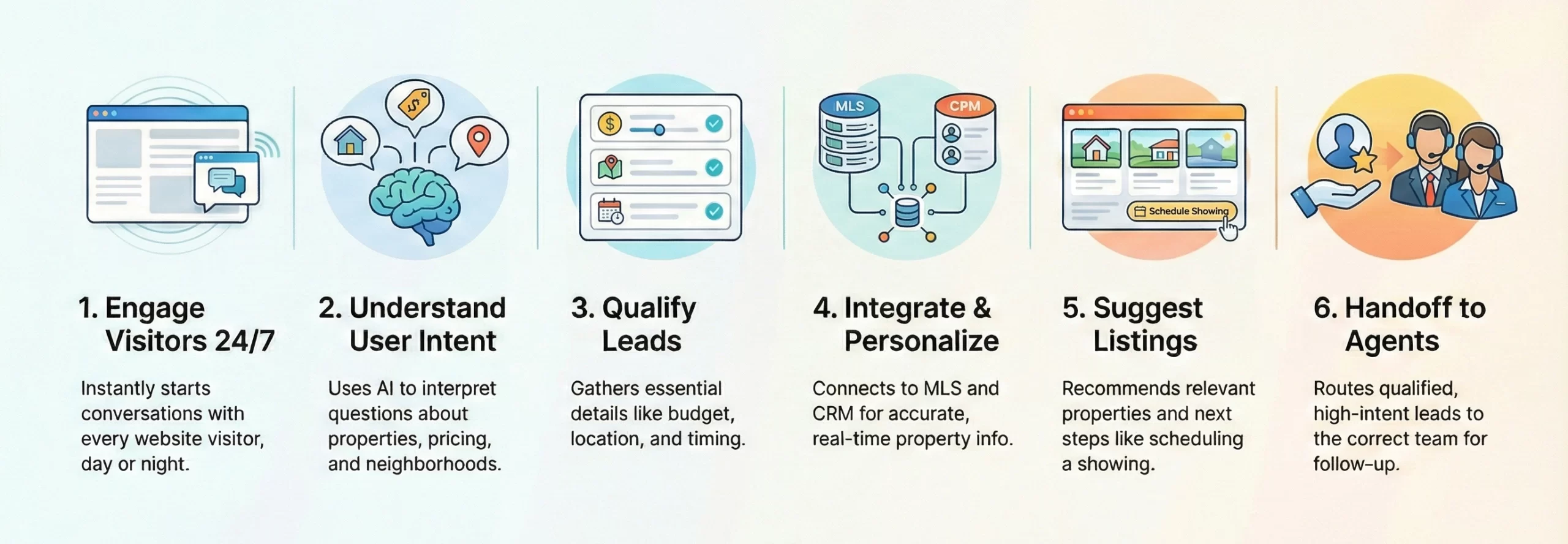
1. Lead Engagement and 24/7 Interaction
The chatbot instantly initiates a conversation when a visitor lands on a real estate website or digital property listing, responds to inquiries about buying, selling, or renting, and engages users in natural language. This immediate engagement ensures no lead goes unanswered, even outside business hours.
2. Understanding User Intent and Query Processing
Roof AI applies natural language understanding to interpret user language, preferences, and intent. It can handle varied questions about property details, neighborhood information, price ranges, financing options, and process-related queries.
3. Lead Qualification and Data Collection
As the conversation progresses, the chatbot gathers essential details such as property interests, budget range, location preferences, and timing. It then qualifies leads by assessing intent and priority, so the most promising prospects are identified early.
4. MLS and CRM Integration for Personalization
Roof AI can integrate with MLS data feeds and CRM systems to pull real-time property information and synchronize leads directly into existing agent workflows. This ensures responses are accurate and agents receive enriched lead data for follow-up.
5. Suggested Listings and Next Steps
Based on the user’s preferences, the chatbot can suggest relevant property listings, provide links to detailed pages, and offer options like scheduling a showing or connecting with an agent. This streamlines the lead journey from inquiry to actionable interest.
6. Routing and Handoff to Human Agents
Once a lead is qualified or indicates readiness for deeper engagement, Roof AI routes the conversation or captured data to the appropriate sales or brokerage team, ensuring a smooth transition from automated engagement to human follow-up.
AI Chatbots Increase Real Estate Lead Conversion by Up to 33% Globally
The global generative AI market in real estate was valued at USD 437.65 million in 2024 and is projected to reach USD 1,302.12 million by 2034, growing at 11.52% CAGR from 2024 to 2034. This growth is driven by demand for AI automation that boosts lead engagement, response speed, and conversion efficiency.
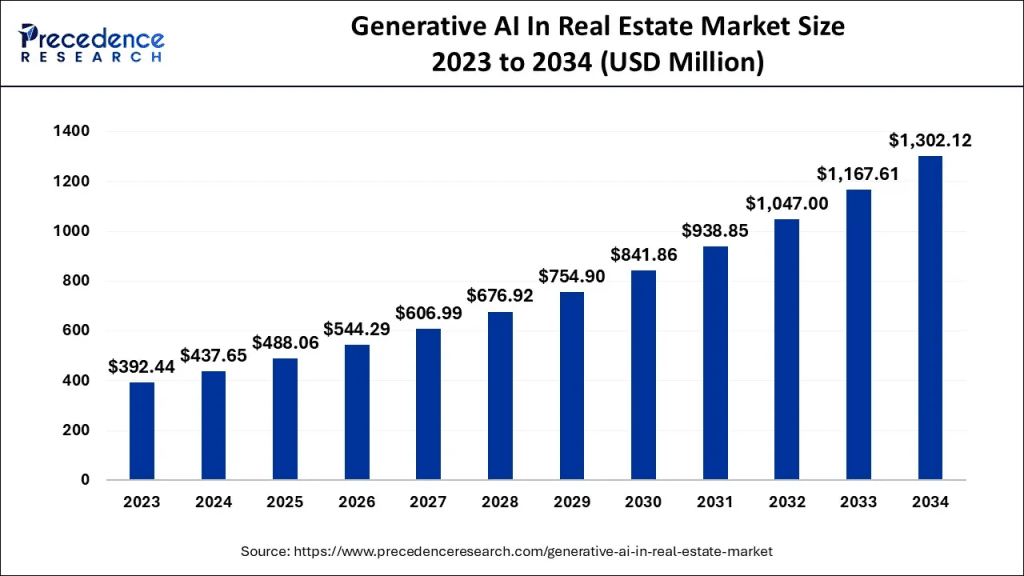
Industry data confirms this trend. AI-powered scheduling increases appointments by 33.5%, and one company reports a 9% lead-to-appointment conversion rate with AI chatbots. Leads engaging within 5 minutes convert up to 6 times more, emphasizing the importance of instant, AI-driven interactions.
Why Speed and Automation Matter in Property Lead Conversion
Modern property buyers and renters expect immediate responses, and manual follow-ups often fail to meet this demand.
- Instant engagement reduces lead drop-off: AI chatbots respond in real time, capturing interest before users leave or explore competitors.
- Automated scheduling accelerates decision-making: Smart scheduling workflows convert inquiries into appointments without human delays.
- Consistent qualification improves lead quality: Structured conversations collect intent, budget, and timelines early in the funnel.
How AI Property Chatbots Enable Higher Conversion Rates
AI property chatbots are designed to translate engagement speed into measurable business outcomes.
- Always-on conversational availability: Chatbots engage prospects 24/7, ensuring no inquiry is missed across time zones or off-hours.
- Context-aware lead nurturing: AI-driven conversations adapt based on user intent, maintaining relevance throughout the interaction.
- Seamless transition from chat to action: Qualified leads are guided toward property listings, appointments, or agent handoffs without friction.
The growing adoption of AI chatbots in real estate reflects a clear shift toward faster engagement, higher conversion rates, and more efficient lead handling. For businesses looking to build an AI property chatbot like Roof AI, aligning technology with market demand and proven outcomes is key to long-term success.

How Are AI Property Chatbots Changing Real Estate Lead Management?
AI property chatbots are transforming real estate lead management by replacing slow, manual processes with real-time, intelligent engagement. This shift allows businesses to capture intent earlier, qualify leads more accurately, and improve conversion outcomes across digital channels.
1. Instant Engagement at the Point of Interest
AI property chatbots respond to inquiries the moment a user shows interest, eliminating delays that often cause lead drop-off. Immediate interaction helps capture intent while prospects are actively exploring properties.
2. Improved Lead Qualification Through Guided Conversations
Structured conversational flows collect key details such as budget, location preference, and timelines. This enables better lead prioritization before human agents step in, improving overall sales efficiency.
3. Automated Lead Nurturing
Chatbots maintain consistent communication through automated responses and follow-ups. This ensures prospects remain engaged throughout their decision journey without repetitive human effort.
4. Centralized Lead Data and Interaction History
All conversations are logged in a single system, creating a unified view of lead behavior and preferences. This improves handoffs, reduces information loss, and supports data-driven sales decisions.
5. 24/7 Lead Capture and Availability
AI property chatbots operate continuously, engaging prospects outside standard business hours. This expands lead capture opportunities and supports global or high-traffic real estate operations.
Key Features of an AI Property Chatbot like Roof AI
An AI property chatbot like Roof AI offers smart automation to manage inquiries, qualify leads, and deliver real-time property information across digital channels. This section outlines the core features that drive performance and user engagement.

1. AI-Powered Lead Capture and Engagement
The chatbot engages visitors using real-time conversational triggers driven by on-page behavior and direct questions. For example, when a visitor asks “Is this property still available?”, the AI captures intent, preferences, and contact details while keeping the interaction natural and uninterrupted.
2. NLP-Powered Property Search
The chatbot enables buyers to search listings through human-like conversational queries. For example, a user can type “Find a modern home near good schools with a large backyard,” and the AI interprets lifestyle intent, priorities, and constraints to surface relevant properties.
3. Context-Aware and Adaptive Conversations
The chatbot maintains conversation memory and intent continuity across topic changes. For instance, a buyer can move from pricing questions to school information and then to scheduling a tour without restarting the conversation or repeating preferences.
4. 24/7 Conversational Qualification and Routing
The chatbot qualifies prospects around the clock based on readiness and interest. For example, when a late-night visitor asks about financing options, the AI scores intent and routes the lead to the appropriate agent before business hours begin.
5. Personalized Property Recommendations
The chatbot delivers dynamic recommendations based on real-time conversational signals. If a buyer mentions “pet-friendly condos under budget,” the AI refines suggestions instantly to match affordability, location, and lifestyle needs.
6. CRM and MLS Integration for Smart Data Flow
The chatbot syncs every interaction with CRM and MLS systems in real time. For example, when a buyer requests a viewing, the AI updates the lead profile and pulls live listing data so agents receive full context instantly.
7. Automated Follow-Ups and Lead Nurturing
The chatbot drives engagement through behavior-based follow-ups. If a user browses listings and pauses, the AI sends a prompt like “Would you like similar homes in this area?” to re-engage interest and move the conversation forward.
8. Real-Time Agent and Service Matching
The chatbot matches leads using intent-driven routing logic. For example, when a buyer searches for luxury properties downtown, the system connects them to an agent who specializes in that neighborhood and price segment.
9. Behavioral Profiling and Performance Insights
The chatbot analyzes conversation patterns and engagement signals to surface actionable insights. Repeated questions about pricing, commute times, or availability signal high intent and help teams prioritize outreach and optimize sales strategies.
How to Build an AI Property Chatbot like Roof AI?
Building an AI property chatbot like Roof AI automates lead management, boosts customer engagement, and streamlines real estate operations. Our developers follow a proven development process to deliver scalable, reliable chatbot solutions.

1. Consultation
We start with an in-depth consultation to understand business goals, target audience, lead workflows, and conversion objectives. This phase helps our developers align the chatbot’s conversational scope, qualification logic, and engagement strategy with real-world real estate use cases.
2. Market and Use Case Definition
Our team identifies core user scenarios and conversation intents such as property search, pricing queries, and agent routing. We translate these insights into clear functional requirements that guide how the chatbot should interact across buyer, seller, and investor journeys.
3. Conversation Design and User Flow Mapping
We design natural conversation paths that reflect how real buyers ask questions and shift topics. Our developers structure flows to support context retention, intent switching, and progressive data capture without interrupting the user experience.
4. AI Conversation Logic and Intent Modeling
We define intent classification and response logic to ensure an accurate understanding of user inputs. This step focuses on mapping how the chatbot interprets queries, follows up intelligently, and handles ambiguous or multi-part questions.
5. Data Integration and Knowledge Structuring
We organize property data, FAQs, and business rules into structured knowledge sources. This allows the chatbot to deliver accurate answers, surface relevant listings, and maintain consistency across conversations and channels.
6. Human Oversight and Control Design
Our developers implement human-in-the-loop workflows that allow agents to review conversations, intervene when needed, and refine responses. This balance ensures automation enhances trust rather than replacing human judgment.
7. Testing Across Real Buyer Scenarios
We test the chatbot against realistic conversation scenarios including incomplete queries, topic jumps, and edge cases. This helps validate response accuracy, conversational flow, and overall reliability before launch.
8. Launch and Continuous Optimization
After deployment, we monitor conversation performance and lead outcomes to guide improvements. Ongoing optimization ensures the chatbot adapts to changing user behavior, market conditions, and business priorities over time.
Cost to Build a Roof AI-like Property Chatbot
The cost to build a Roof AI-like property chatbot helps businesses plan budgets and feature priorities for successful development. This breakdown covers development stages, technology choices, and scalability considerations.
| Development Phase | Description | Estimated Cost |
| Consultation & Use Case Discovery | Chatbot goal alignment, property workflows analysis, and lead qualification requirements | $5,000 – $10,000 |
| Conversation Flow & Intent Design | Intent mapping and dialogue design for buyer, renter, and seller interactions | $8,000 – $15,000 |
| AI/NLP Logic Planning | Natural language understanding logic for property queries and user intent detection | $16,000 – $28,000 |
| Knowledge Base & Data Structuring | Property data organization, FAQs, listings, and response training content | $10,000 – $15,000 |
| Chatbot UX & Channel Design | Conversational UX design for web, mobile, and messaging platforms | $6,000 – $12,000 |
| Lead Qualification & Routing Logic | Automated lead scoring, routing rules, and CRM-ready data capture | $8,000 – $16,000 |
| Integration Planning | Third-party integration logic with CRMs, listing systems, and calendars | $7,000 – $14,000 |
| AI Testing & Conversation Tuning | Response accuracy testing, fallback handling, and intent refinement | $6,000 – $12,000 |
| Compliance & Data Privacy Setup | User data handling, consent flows, and privacy compliance readiness | $5,000 – $10,000 |
| Deployment & Optimization | Live deployment, performance monitoring, and conversational optimization | $5,000 – $10,000 |
Total Estimated Cost: $58,000 – $108,000
Note: Development costs for an AI property chatbot can vary based on conversation complexity, supported languages, data sources, and integration depth. Advanced lead intelligence, personalization, and continuous AI tuning may increase the overall budget.
Consult with IdeaUsher to get a customized cost estimate and a clear development roadmap for building a high-conversion AI property chatbot like Roof AI tailored to your real estate business goals.
Challenges and Solutions in Building an AI Property Chatbot
Building an AI property chatbot comes with challenges like data accuracy, system integration, and user engagement. Our developers address these issues through strategic planning, robust testing, and continuous optimization to ensure reliable performance.

1. Handling Unstructured and Inconsistent Property Data
Challenge: Property listings, pricing, and availability originate from multiple systems in inconsistent formats, making it difficult to deliver accurate and reliable chatbot responses.
Solution: Our developers create structured data normalization pipelines that clean, standardize, and continuously sync property information to ensure consistent, dependable AI-driven conversations.
2. Accurate Intent Detection
Challenge: Users ask property-related questions in informal, fragmented, and ambiguous language, increasing the risk of incorrect intent interpretation.
Solution: We design intent hierarchies and contextual understanding logic that interpret user behavior across messages, enabling accurate intent recognition and smooth multi-turn conversations.
3. Maintaining Real-Time Data Accuracy
Challenge: Property pricing and availability change frequently, and outdated information can quickly damage user trust and conversation credibility.
Solution: Our team implements real-time data synchronization workflows that continuously update chatbot knowledge, ensuring responses always reflect current listings, pricing, and transaction status.
4. Designing Meaningful Conversational Flows
Challenge: Poorly structured conversations lead to confusion, frustration, and early user drop-off during chatbot interactions.
Solution: We focus on goal-oriented dialogue design that guides users toward clear actions while preserving natural language flow and maintaining engagement throughout the conversation.
How to Ensure Accuracy and Trust in an AI Property Chatbot?
Building an AI property chatbot requires more than conversational capability. Accuracy, regulatory compliance, and user trust must be embedded into the system from the earliest design stages to ensure reliable real-world performance.

1. Designing for High-Accuracy AI Responses
Accuracy starts with clearly defined intents, structured property data, and controlled response logic. We focus on context-aware understanding, fallback handling, and continuous validation to ensure the chatbot delivers reliable and relevant answers across varied user queries.
2. Data Privacy and Compliance Controls
Property chatbots often process sensitive user and transaction data. Our developers design privacy-first data flows, consent mechanisms, and configurable compliance rules to align with regional data protection and real estate regulations.
3. Human Oversight and AI Governance
To prevent blind automation, we incorporate human-in-the-loop oversight that allows teams to review, correct, and guide AI behavior. This ensures accountability while maintaining automation efficiency.
4. Transparent and Explainable Interactions
Trust increases when users understand system behavior. We design chatbots with clear communication cues, predictable responses, and escalation paths that reinforce confidence and reduce frustration.
5. Continuous Monitoring and Performance Optimization
AI performance can degrade as user behavior evolves. Our approach includes ongoing monitoring, feedback analysis, and iterative refinement to keep the chatbot accurate, compliant, and aligned with business goals over time.
Conclusion
Creating an AI property chatbot like Roof AI is about more than just technology. It starts with understanding how people search for properties and what questions they actually ask. When built with care, a Roof AI-like Property Chatbot can handle routine queries, guide users through listings, and support your sales team without feeling impersonal. The goal is to offer helpful conversations, not robotic replies. By focusing on user needs, data accuracy, and smooth integration, you can build a solution that genuinely adds value to your real estate business.
Looking to Launch Your Own AI Property Chatbot?
We help real estate businesses build AI-powered chatbots that qualify leads, automate inquiries, and improve customer engagement across digital channels. Our solutions are designed for performance, accuracy, and business growth.
Why Work With Our Team?
- Real Estate Automation Experts: Our ex-FAANG/MAANG develops AI chatbots for property sales and rentals, understanding real estate workflows, buyer behavior, and lead management to deliver relevant automation solutions.
- Personalized Development Approach: We don’t use one-size-fits-all models. Every chatbot is customized to match your brand voice, business objectives, and customer engagement strategy for better results.
- Smart Integrations: We seamlessly integrate your chatbot with CRM systems, property listing databases, and third-party tools to ensure real-time data access and smoother operations.
- Scalable Infrastructure: Our solutions are built on flexible architecture that supports business growth, allowing your platform to handle increased traffic and expanding market reach effortlessly.
Browse our case studies to see how we’ve delivered successful AI solutions for various enterprises across different industries.
Contact us today to start building an AI property chatbot that drives leads and boosts conversions.


FAQs
A.1. Differentiate through niche targeting, unique features, and superior user experience. Focus on automation, personalization, and fast response time. Clear branding and strong value messaging help attract real estate businesses effectively.
A.2. You need NLP frameworks, cloud infrastructure, CRM integration, and API connectivity with property databases. Machine learning models enable smart responses while backend systems ensure real-time data access for accurate property information delivery.
A.3. The chatbot engages visitors instantly, qualifies leads, and provides personalized property recommendations. By responding 24/7, it reduces response time, captures user intent, and guides prospects through the buying or renting journey efficiently.
A.4. Continuous monitoring, user feedback analysis, and regular training updates are essential. Optimizing conversation flows and adding new data sources helps improve accuracy, user experience, and overall chatbot performance over time.


