 (+971) 8007 4267
 (+91) 946 340 7140
 (+1) 628 432 4305

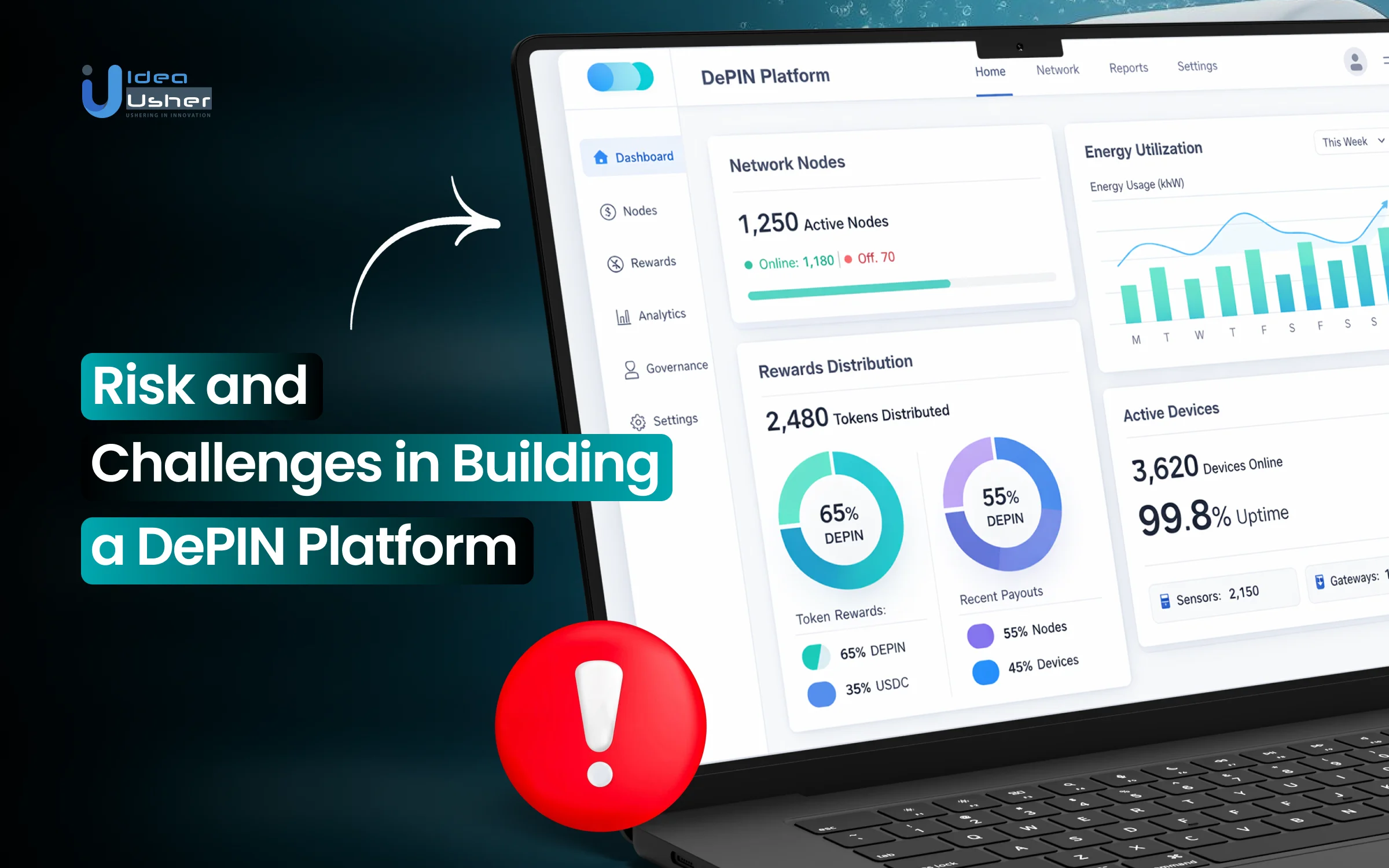
Earlier, centralized infrastructure layers were considered reliable because failures stayed hidden behind contracts and closed systems. As outages became more frequent and operational costs climbed, the underlying fragility started to surface. DePIN gained attention as a practical response to these structural weaknesses. By distributing ownership and accountability, it can improve resiliencebut also introduces complexity across new operational and economic layers.
For businesses planning to build a DePIN platform, understanding these risks early becomes critical, since hardware reliability, incentive alignment, and regulatory obligations remain just as real in decentralized environments. These issues often emerge only after meaningful capital is committed and networks begin to scale, making early risk awareness essential for long-term viability.
Over the years, we’ve developed numerous DePIN solutions that use IoT-based data pipelines and cryptographic proof layers. Given our expertise in this space, we’re sharing this blog to discuss the risks and challenges of building a DePIN platform.
Key Market Takeaways for DePIN Platforms
According to SNS Insider, the blockchain market is entering a high-velocity growth phase, expanding from USD 18.59 billion in 2024 toward a projected USD 988.83 billion by 2032. DePIN platforms are emerging as a core driver of this growth by decentralizing real-world infrastructure such as compute, storage, and mapping through token-based incentives. By shifting ownership to distributed contributors, this model directly supports rising AI and IoT workloads while reducing dependency on expensive centralized providers.

Source: SNS Insider
Within this landscape, Render Network and Theta Network illustrate how DePIN translates into practical utility. Render enables decentralized GPU compute by allowing contributors to monetize idle hardware for AI rendering and graphics workloads, offering cost-efficient alternatives to cloud GPUs.
Theta applies a similar incentive-driven approach to video delivery, distributing streaming bandwidth across a global node network to improve scalability and efficiency compared to traditional centralized platforms.
Ecosystem partnerships are further accelerating DePIN adoption across industries. A notable example is IoTeX collaborating with NATIX Network to power AI-driven, drive-to-earn mapping within connected device ecosystems.

What Is a DePIN Platform?
A DePIN platform is a decentralized network where people contribute real-world infrastructure, such as compute, storage, or connectivity, and are rewarded through cryptographic verification. Instead of a single operator owning everything, the platform uses smart contracts to prove service delivery and pay participants based on actual usage.
Why DePIN Risk Profiles Differ from SaaS or DeFi?
DePIN risk profiles differ because the system relies not only on software but also on physical hardware operated by real participants. Smart contracts may work correctly but power loss, network instability, and faulty devices can still quietly disrupt service.
This blend of cryptographic logic and physical infrastructure usually makes risk harder to model and slower to resolve.

1. Trust in Atoms vs. Trust in Bits
SaaS: Trust is placed in a corporate entity, such as AWS or Salesforce and their SLAs. The risk is contractual and financial.
DeFi: Trust is placed in transparent, auditable code via smart contracts. The risk is a bug or an economic exploit.
DePIN: Trust must be placed in thousands of anonymous strangers’ physical hardware and their local conditions. The risk is multifaceted.
- Is the device real?
- Is it working correctly?
- Is its internet connection stable?
- Did a power outage in Dallas just take down your network’s critical segment?
The Unique Challenge: DePIN must build cryptographic trust in physical objects and actions. This is a problem neither SaaS nor pure DeFi has to solve.
2. Logistics vs. Licenses
SaaS: Scaling is instantaneous. Need more capacity. Click a button and spin up more cloud instances. The primary constraint is budget.
DeFi: Scaling is often a code upgrade. Throughput limits are set by the underlying blockchain.
DePIN: Scaling is a physical logistics operation. It requires manufacturing, shipping, and individuals plugging in devices worldwide. Growth is measured in months, not milliseconds, and is constrained by supply chains and real-world human behavior.
The Unique Challenge: The cold start problem is exponentially harder. You must bootstrap a two-sided marketplace supply and demand while managing a global hardware rollout.
3. Service Outage vs. Financial Loss
SaaS: Failure means downtime. A server goes down, and users cannot access the service until it is restored.
DeFi: Failure typically means financial loss. A bug causes funds to be drained or locked.
DePIN: Failure can result in a physical service disappearing. A wireless network goes dark. A storage network loses data. A sensor grid goes blind. The consequences extend beyond digital inconvenience into real-world operational disruption.
The Unique Challenge: Risk management is not just about protecting capital. It is about ensuring continuous physical service delivery across a decentralized, unpredictable fleet of nodes.
4. Dual Jurisdiction
SaaS: Navigates data laws such as GDPR and CCPA, along with industry-specific compliance.
DeFi: Grapples with financial securities regulations and evolving crypto policy.
DePIN: Gets hit from both sides plus a third. You must comply with:
- Digital Regulations: Crypto securities laws and data privacy
- Physical Regulations: FCC spectrum rights, electrical grid codes, hardware safety certifications such as CE and FCC, and import export duties
- Local Jurisdictions: A node in a homeowner’s garage may violate HOA rules or local zoning laws
Risks and Challenges in Building a DePIN Platform
We have built and operated many DePIN platforms across various infrastructure models, so we have seen where issues typically arise in production. Most challenges do not come from the blockchain layer alone but from how hardware, incentives, and operations interact over time.

1. The Ghost Network Risk
How do you prove a physical device is real, online, and performing valid work?
Without strong verification, networks can be flooded with ghost nodes that simulate hardware. These nodes drain rewards and erode trust. This Sybil-style attack on physical infrastructure is a core DePIN vulnerability.
Our Solution:
We implement cryptographic Proof of Physical Work.
- Our architects design systems that use Secure Element signatures and, where applicable, Zero-Knowledge attestations.
- Every unit of work, such as data stored or bandwidth delivered, is signed at the hardware level and verified on chain without exposing sensitive operational data. This creates a trustless yet truthful network.
2. The Two-Sided Cold Start Problem
A DePIN needs hardware providers and paying users to grow together in the same regions. Providers hesitate without demand. Users hesitate without coverage. This chicken-and-egg problem becomes harder when logistics and geography are involved.
Our Solution:
We build dynamic AI-informed incentive engines. Our team develops algorithmic reward mechanisms that analyze early demand signals and actively bootstrap supply in target locations.
By simulating network growth and designing partner onboarding strategies, we help create the momentum needed to form a self-sustaining flywheel.
3. The Brick Wall Risk
Contributors take real financial risk when purchasing specialized hardware. If token economics break or technology evolves, they may be left with unusable devices. This leads to community backlash and legal exposure that purely digital platforms never face.
Our Solution:
We advocate hardware-agnostic architecture and open standards. Our developers build middleware and firmware layers that abstract hardware specifics.
This allows networks to support multiple vendors and device types. The result is hardware that retains utility beyond a single protocol, protecting contributors and future-proofing the ecosystem.
4. The Regulatory Double-Bind
DePIN platforms face two regulatory fronts at once. One is digital asset regulation, such as the SEC frameworks or MiCA. The other is physical infrastructure compliance, including FCC rules, safety standards, and local regulations. A failure on either side can halt the entire network.
Our Solution:
We follow a compliance-by-design approach shaped by experience in regulated industries. Token models are designed with legal review in mind. KYC and AML gateways are built into fiat flows.
Data handling is structured to align with GDPR and similar frameworks, even in decentralized systems. We build for longevity, not shortcuts.
5. The Liability Labyrinth
In a centralized infrastructure, failures are handled through contracts and support teams. In DePIN, infrastructure is owned by thousands of independent operators. Responsibility for outages, data loss, or physical incidents becomes unclear. This uncertainty blocks enterprise adoption.
Our Solution:
We engineer programmable on-chain reputation and slashing systems. These mechanisms generate decentralized reliability scores and automate compensation through cryptographically enforced pools.
Provider behavior is aligned with performance through code. This creates transparent guarantees that enterprises can trust when entering B2B agreements.
How DePIN Proves Physical Work Without Central Control?
DePIN platforms verify physical performance by enabling hardware to prove its work through cryptographic signatures that can be verified by the network. Instead of relying on a single monitor, nearby nodes can compete and truthfully report service quality over time.

The Oracle Problem for Atoms
In traditional systems, an AWS server either responds or it does not. In DePIN, you are dealing with thousands of independent operators who could be:
- Running legitimate hardware
- Spoofing signals from virtual machines
- Gaming location data for rewards
- Providing subpar but technically online service
Centralized monitoring creates a single point of failure and undermines the premise of decentralization.
Here is how modern DePINs solve this.
1. Cryptographic Proof of Physical Work
Zero-Knowledge Location Proofs
Instead of broadcasting, I am at these coordinates, nodes generate cryptographic proofs that answer specific questions without revealing the underlying data.
- Prove you are within this 10 km radius without revealing the exact location
- Prove you have maintained coverage for one hour without continuous GPS streaming
Secure Hardware Attestation
Trusted Execution Environments and secure hardware elements create unforgeable signatures.
- Each data packet is cryptographically signed at the hardware level
- The signature chain proves sensor to hardware to network
- Tampering breaks the chain, making spoofing economically infeasible
2. Peer-to-Peer Verification Networks
The Challenger Responder Model
This decentralized approach turns network participants into mutual verifiers.
Network Flow
- Node A claims it is providing 5G coverage in Sector X
- Random Node B nearby attempts to use this service
- Node B submits proof of quality and availability
- Consensus nodes verify the challenge response
- Node A is rewarded or penalized based on proof
The brilliance lies in incentives. Verifiers are rewarded for catching cheaters and lose stake for false challenges.
Cross Validation Consensus
When multiple nodes operate in the same area, their data naturally converges and begins to validate itself. Ten weather sensors in one city should report similar conditions over time. Any statistical outlier can be flagged for review, and consistent agreement across nodes provides strong evidence of legitimate physical performance.
3. Economic Game Theory and Cryptoeconomics
Staking with Slashing Conditions
Every provider stakes tokens that can be slashed or redistributed for:
- False performance claims
- Extended downtime
- Data inconsistency
- Failed verification challenges
The key insight is simple. The cost of cheating must always exceed the potential reward. This aligns incentives without central oversight.
Reputation-Based Weighting
Nodes gradually build reputation scores based on consistent and verified performance over time. These scores can affect reward multipliers, verification frequency, and the stake required to maintain it. High-reputation nodes may face fewer random checks, which quietly reduces network overhead while still preserving overall security.
4. Multi-layered Proof Architecture
Modern DePINs rely on a tiered verification system.
| Layer | Method | Frequency | Purpose |
| Layer 1 | Heartbeat plus hardware signature | Continuous | Basic online status |
| Layer 2 | Zero-knowledge proof of work | Periodic such as hourly | Work verification |
| Layer 3 | Peer challenges | Randomly one to five percent of nodes daily | Anti-cheat enforcement |
| Layer 4 | Statistical analysis | Continuous backend | Pattern detection |
How DePIN Platforms Prevent Self-Dealing and Fake Demand?
DePIN platforms combat fraud by linking rewards to real-world work that can be cryptographically verified rather than claimed. If someone tries to fake demand or pay themselves, the system usually forces real economic costs through burns, staking, and slashing, which can quickly outweigh any reward.

Understanding the Attack Vectors
1. Self-Dealing
A single entity acts as both the supplier node operator and the consumer data buyer. They pay themselves to use their own services, claiming rewards for usage that does not truly exist.
Take, for example, a decentralized storage network like Filecoin. Without safeguards, a node operator could store meaningless data on their own nodes and claim rewards for providing storage. This would drain emissions meant for legitimate providers and create a false sense of adoption.
2. Fake Demand Generation
An attacker floods the network with fake low-cost transactions to simulate organic demand. This manipulates incentive algorithms and misdirects resources.
Consider a decentralized wireless network like Helium. A malicious actor could simulate thousands of fake devices connecting to their hotspot, making it appear in demand. This would divert token rewards and hardware deployment to locations with no real users, crippling network utility.
The Defense Toolkit
1. The Burn and Mint Equilibrium BME
How it works: Users pay for services in stablecoins or fiat. The protocol burns a corresponding amount of the native token, and nodes earn newly minted tokens based on the burn rate.
Why it works
Faking demand requires spending real external capital to burn tokens. The cost of the attack becomes economically unsustainable.
For instance, the Helium Network transitioned to a version of this model, HIP 51, making it irrational to spoof coverage purely for token rewards.
2. Cryptographic Proof of Useful Work
Networks require proofs of valuable physical work, not just uptime.
In the Filecoin network, storage providers must continuously prove that they store unique client data via cryptographic challenges such as Proof of Replication and Proof of Spacetime. You cannot simply store your own data because it must be verifiably useful to the network.
3. Decentralized Oracle and Challenge Mechanisms
Randomized nodes audit others through challenge-response protocols.
The Helium network uses validators and a challenge mechanism in which nearby hotspots are randomly assigned to verify each other’s radio coverage. This makes it difficult to consistently fake location or activity at scale.
4. Staking, Slashing, and Reputation Systems
Node operators must stake tokens, which are slashed for fraudulent activity. A persistent reputation score directly impacts rewards.
In Filecoin, providers post substantial collateral that is slashed if they fail to prove storage integrity. This makes fraud far more expensive than honest participation and naturally aligns long-term incentives.
How Does Hardware Lifecycle Impact the DePIN Platform Scalability?
Hardware lifecycle management can quietly decide whether a DePIN network scales or stalls. If devices are hard to source, deploy, or maintain, the network may slowly lose density and trust as it grows.
When provisioning updates and retirement are automated, the platform can scale predictably and stay technically reliable.
1. Procurement and Onboarding
The challenge: Users must access the right hardware. A single proprietary device creates supply bottlenecks, while unvetted alternatives cause fragmentation and support issues.
Scalability impact: Slow or expensive onboarding limits supply growth. If it takes months for a node operator in Brazil to receive a compatible device, network density in that region stays near zero.
Modern solution: Hardware certification programs and open kits. Mature DePINs publish open specifications and certify multiple manufacturers. Some adopt Hardware as a Service models where users rent capacity, lowering capital barriers and accelerating adoption.
2. Deployment and Provisioning
The challenge: Hardware has no value until it is installed and configured. Manual setup becomes a major failure point for non-technical users.
Scalability impact: High setup failure rates do not just reduce node count. They erode trust and block organic growth.
Modern solution: Zero-touch provisioning. Devices automatically authenticate, discover the network, and configure themselves at first power-up. This approach is essential for scaling beyond early adopters.
3. Maintenance and Diagnostics
The challenge: At a small scale, issues can be handled manually. At a global scale, even a small failure rate generates an unmanageable operational load.
Scalability impact: Support costs grow with node count, draining resources and reducing network reliability.
Modern solution: Predictive analytics and over-the-air updates. Telemetry anticipates failures before downtime occurs, while secure OTA updates enable fixes and upgrades without requiring device recalls.
4. Performance and Reward Verification
The challenge: The network must verify that devices are performing real physical work rather than simulating activity.
Scalability impact: Weak verification invites fraud and erodes token value. Excessively heavy verification becomes too costly to operate at scale.
Modern solution: Lightweight cryptographic proofs. Efficient proofs of physical work or location maintain trust while keeping verification costs low and decentralized.
5. Decommissioning and Refresh
The challenge: Hardware ages, disconnects, or becomes obsolete. Inactive devices linger as ghost nodes if not managed properly.
Scalability impact: A network filled with non-functional but staked nodes misallocates rewards, overstates coverage, and loses competitiveness.
Modern solution: Automated heartbeat checks and graceful exits. Devices must regularly prove liveness or be removed. Upgrade incentives and trade-in programs support controlled hardware refresh cycles.
Top 5 DePIN Platforms in the USA
We conducted focused research and identified a few DePIN platforms with genuinely unique infrastructure models. These networks can quietly solve real problems across storage, computing, and energy while staying technically sound.
1. Uplink

Uplink is building a decentralized wireless network that enables individuals and businesses to deploy mesh or cellular infrastructure and earn crypto rewards for delivering real connectivity. It experiments with alternative incentive mechanics and rollout strategies compared to traditional telecom and earlier DePIN wireless models.
2. DIMO

DIMO creates a decentralized vehicle data network that enables car owners to connect their vehicles and securely share telemetry data. This data powers mobility applications while giving users ownership and rewards for their contributions.
3. Grass Network

Grass Network converts unused internet bandwidth into a decentralized infrastructure layer for data collection and AI inference. Users contribute excess network capacity through lightweight software and earn rewards in return.
4. Fuse Energy

Fuse Energy is an energy-focused DePIN that enables peer-to-peer energy generation and trading. By incentivizing renewable energy contributors, it explores decentralized models for energy distribution that reduce reliance on traditional centralized utilities.
5. Parasail Network

Parasail Network focuses on the infrastructure and staking layer that supports DePIN ecosystems. It helps bootstrap networks by incentivizing hardware deployment and long-term participation.
Conclusion
Building a DePIN platform is not just about writing smart contracts and hoping nodes show up. You are engineering infrastructure that must withstand failure and regulatory scrutiny while remaining economically sound. If this is done carefully, the system can verify real work and reward it in a way that holds up in the physical world. For enterprises, this model can steadily unlock value from shared infrastructure without owning it provided risk is designed into the platform from day one.
Looking to Develop a DePIN Platform?
IdeaUsher can help you design a DePIN platform that is technically sound and ready for real-world usage from day one. We may architect secure verification layers and token mechanics that align incentives with measurable network contribution.
With over 500,000 hours of coding experience and a team of ex-MAANG/FAANG developers, we transform your DePIN concept into a robust, fraud-resistant, and scalable platform.
- Proof-of-Physical-Work systems that prevent spoofing & ensure trust
- Burn-and-Mint tokenomics designed for real utility, not speculation
- Geospatial incentive engines to optimize supply where demand is highest
- Seamless fiat on-ramps so your customers never see the blockchain
Take a look at our recent projects to see our depth of execution.


FAQs
A1: DePIN becomes riskier because capital is locked into physical assets that cannot be rolled back on the chain. Once hardware is deployed, costs are sunk, and uptime depends on real operators and environments. This means failure can quietly spread across geographies and timeframes rather than manifesting as a single smart contract bug.
A2: They can meet enterprise standards if reliability is enforced by protocol logic rather than trust. Cryptographic service proofs and economic penalties can steadily align operator behavior with uptime goals. When redundancy is engineered properly the network can behave predictably even under partial failure.
A3: Interoperability matters because it limits long-term dependency on a single device or vendor. When nodes can switch hardware without breaking incentives, providers may stay committed during market shifts. This also helps the network evolve without forcing full redeployment cycles.
A4: Most DePIN systems eventually need custom infrastructure because physical signals do not fit neatly into standard chains. Verification layers and data pipelines must often run off-chain before settling on-chain. Without this design bottleneck, trust assumptions can quietly increase over time.


