 (+971) 8007 4267
 (+91) 946 340 7140
 (+1) 628 432 4305

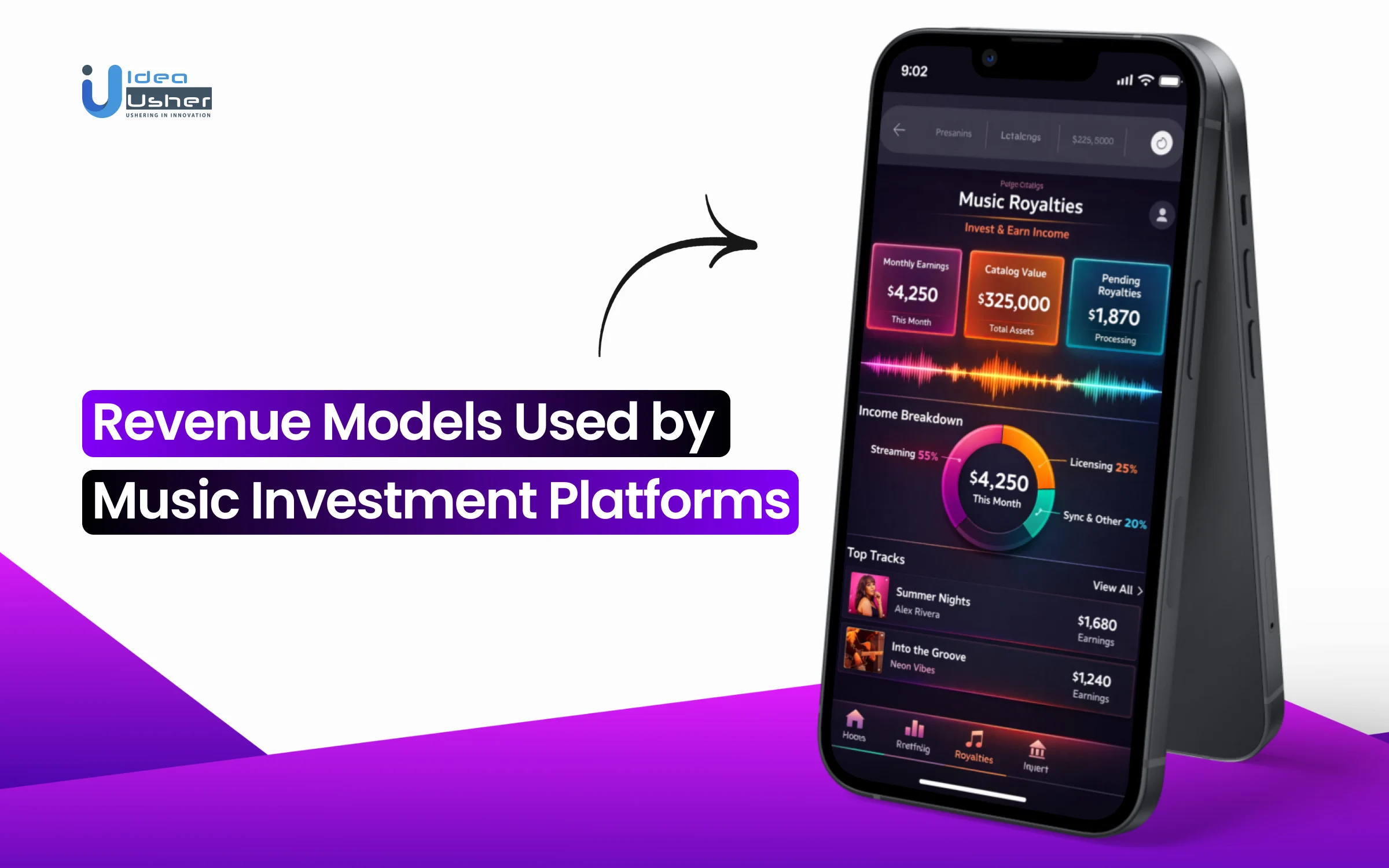
For years, investing and music operated independently, each following its own logic and rhythm. Streaming slowly changed that by turning every listen into measurable revenue. Once income became traceable, the financial side of music started to feel real and investable. This naturally led to the rise of music investment platforms built on structured systems.
These platforms often generate revenue through transaction fees and royalty processing charges. Some may also rely on asset management fees or secondary trading spreads. Behind the scenes, automated payouts and reporting systems quietly support these revenue flows.
Over the past decade, we’ve developed numerous music investment solutions, powered by royalty data orchestration systems and distributed ledger infrastructure. As IdeaUsher has this expertise, we’re writing this blog to discuss the revenue models used by music investment platforms. Let’s start!
Key Market Takeaways for Music Investment Platforms
According to Mordor Intelligence, the global music industry is entering a structurally strong growth phase. Market forecasts show expansion from USD 33.32 billion in 2025 to nearly USD 50.20 billion by 2030, driven largely by subscription streaming, predictable royalty flows, and expanding international audiences. This consistency has shifted how music IP is perceived. Catalogs and long-tail royalties are increasingly viewed as income-generating assets rather than purely creative outputs, especially as investors look beyond volatile equities and low-yield fixed income.

Source: Mordor Intelligence
This shift is creating clear momentum for music investment platforms. Royalties tend to be less sensitive to interest rate cycles and macroeconomic shocks, making them attractive in uncertain markets.
As a result, demand is rising for platforms that can turn complex rights structures into investable products. Transparent performance data, standardized contracts, and automated payout systems are no longer optional. They are the foundation for attracting non-institutional investors at scale.
Within this landscape, Royalty Exchange and anotherblock illustrate two credible but distinct approaches to the same thesis. Royalty Exchange focuses on auction-based access to full or partial royalty streams, typically appealing to sophisticated investors comfortable with larger ticket sizes.
Anotherblock takes a Web3-native route, breaking streaming rights into smaller digital units so fans and retail investors can participate directly in song-level ownership.

What Is a Music Investment Platform?
A music investment platform is a digital system that enables investors to gain exposure to music rights and recurring royalty income from songs and catalogs. It transforms complex royalty flows into structured financial assets that can be tracked and evaluated over time. This approach allows participation in music revenue without directly owning or managing the underlying rights.
Types of Music Investment Platforms
Music investment platforms usually fall into a few clear categories based on how rights and revenue are structured. Some may focus on fractional royalty access while others might support direct rights trading or artist-backed funding models. A few platforms also increasingly use programmable ownership systems to manage payouts efficiently and transparently.

1. Royalty Fractional Ownership Platforms
These platforms divide music royalties into smaller financial units that investors can purchase. Income from streaming and licensing is distributed proportionally to ownership shares. This model lowers entry barriers while keeping revenue tracking transparent, as seen in platforms like Royal.
2. Music Rights Marketplaces
Music rights marketplaces enable the buying and selling of full or partial rights to songs and catalogs. They provide valuation data, historical royalty performance, and structured transactions. This makes music rights behave more like tradable financial assets, which is the core approach of SongVest.
3. Artist Funding & Fan Investment Platforms
These platforms connect artists with supporters who provide upfront capital in exchange for a share of future revenue. The structure aligns artist growth with investor returns. Royalty flows are automated once the music is released, a model followed by platforms such as ANote Music.
4. Catalog Acquisition & Portfolio Platforms
Portfolio-focused platforms bundle multiple music catalogs into managed investment vehicles. Diversification reduces dependence on a single song or artist. Returns are generated through aggregated royalty income over time, similar to how Hipgnosis Songs Fund operates.
5. Tokenized Music Investment Platforms
Tokenized platforms represent music rights as digital assets using distributed ledger systems. Ownership, payouts, and transfers are executed programmatically. This structure improves transparency while simplifying rights management and settlement, as demonstrated by Bolero Music.
Successful Revenue Models for Music Investment Platforms
Most successful music investment platforms earn revenue from transaction fees on asset purchases and sales, and this revenue scales with activity. Some platforms may also charge ongoing management fees on administered music assets, creating predictable, recurring revenue.

1. Transaction-Based Marketplace Model
The transaction-based model operates as a financial intermediary, generating revenue from fees on primary offerings and secondary-market trades. This dual revenue stream creates a scalable engine that grows with platform activity.
Primary Market Fees
When a new catalog or song share is listed, platforms typically charge a listing fee of 1 to 5 percent or a success fee of 5 to 15 percent of capital raised. For instance, when a $500,000 music catalog is sold, the platform can earn $25,000 to $75,000 in immediate revenue.
Secondary Market Commissions
Scalability increases once peer-to-peer trading begins. Each trade typically carries a 2-10% commission, split between buyers and sellers. If a platform facilitates $50 million in annual secondary trading at a 4 percent commission, it generates $2 million in recurring revenue with minimal additional cost.
Numerical Evidence and Platform Examples
- Royalty Exchange has reportedly facilitated over $200 million in transactions since launch. With 5 to 10 percent fees on primary sales and 2.5 percent from both buyers and sellers on secondary trades, estimated annual revenue likely exceeds $15 to $20 million based on volume.
- Tangy Market follows a high-volume strategy by charging a flat 3 percent transaction fee. This lower-margin approach scales efficiently as user participation increases, particularly through mobile-first investing behavior.
2. Asset Under Management Fees
Platforms that use the AUM model function as specialized music asset managers rather than simple marketplaces. Revenue is generated from annual management fees ranging from 0.5 to 2.5 percent of total assets under management.
Platforms such as ANote Music and Bolero Music allow investors to invest in curated music portfolios, eliminating the need to select individual songs.
The Numbers Behind the Model
A platform managing $100 million in music assets at a 1.5 percent fee generates $1.5 million in predictable annual revenue. As catalogs appreciate and new capital flows in, AUM grows organically.
ANote Music reported managing approximately €15 million in assets in its early years. At a 1-2% management fee, this equates to €150,000-€300,000 in annual recurring revenue, excluding transaction income.
Value Proposition and Scalability
This model works because it addresses core investor concerns:
- Professional due diligence on catalogs
- Centralized royalty collection across global DSPs
- Built-in diversification through pooled exposure
The key advantage is predictable recurring revenue that does not rely on market trading activity. As performance credibility grows, AUM can scale substantially, similar to traditional asset management firms.
3. Hybrid Transaction and AUM Model
The most advanced platforms combine transaction fees with AUM-based revenue, balancing short-term cash flow with long-term stability.
SongVest is a strong example. The platform charges 5 to 10 percent on initial offerings and also earns 0.5 to 1 percent annually for royalty administration, compliance, and reporting.
Financial Mathematics of Hybrid Models
A realistic revenue scenario for a hybrid platform:
- Primary offerings: 50 offerings at $200,000 each equals $10 million in volume
7.5 percent fee generates $750,000 - Secondary trading: $30 million in annual trades at 3 percent equals $900,000
- AUM fees: $25 million under management at 1 percent equals $250,000
Total annual revenue reaches approximately $1.9 million, spread across diversified sources.
Platform Performance Evidence
Hybrid strength is reflected in investor confidence. JKBX, formerly Jukebox, raised $8.5 million in a 2023 Series A round, with investors citing revenue diversification and scalability as key drivers.
Industry analysts estimate that mature hybrid platforms can achieve 30 to 40 percent gross margins, with strong operating leverage as technology costs stabilize and transaction volumes expand.
4. Royalty Administration & Data Infrastructure Fees
Some music investment platforms generate revenue by positioning themselves as royalty infrastructure providers rather than pure marketplaces. In this model, income is earned by charging rights holders and investors for ongoing royalty collection, reconciliation, and reporting services.
Platforms such as SoundRoyalties and Stem operate adjacent to this model by monetizing the complexity of royalty flows rather than asset trading itself.
Investment platforms adopting this approach typically charge fixed monthly fees or usage-based pricing tied to the number of tracks, catalogs, or DSP integrations managed.
Revenue Characteristics
A platform administering 20,000 active tracks may charge $3 to $10 per track annually for reporting, audit-ready statements, and automated payout reconciliation. At scale, this can translate into $60,000 to $200,000 in high-margin recurring revenue, independent of market volatility.
6. Secondary Liquidity & Market-Making Services
Liquidity itself has become a monetizable product. Advanced platforms increasingly offer structured liquidity services that go beyond basic peer-to-peer trading.
Platforms such as JKBX are exploring controlled liquidity windows, buyback programs, and automated pricing mechanisms that stabilize trading and improve investor confidence.
Revenue Streams
Market-making spreads. Liquidity facilitation fees. Premium access to early liquidity rounds. Platforms may earn 1-3% spreads by matching buyers and sellers or by temporarily warehousing inventory during liquidity events.
Economic Impact
If a platform facilitates $40 million in controlled liquidity events annually with a 2 percent spread, it generates $800,000 in revenue without relying on continuous daily trading. This model also improves asset price stability, indirectly supporting higher primary market valuations.
How Regulatory Constraints Shape Music Investment Monetization?
Navigating the music investment landscape is not just about picking hits. It is about mastering a complex regulatory orchestra where securities laws, copyright frameworks, and financial compliance interact to define what is monetizable. For platform operators and investors alike, understanding these constraints is not optional. It is the foundation for sustainable, scalable monetization.

1. Securities Regulations & Investment Contract
The moment a platform sells fractional ownership with the expectation of profits derived from others’ efforts, it enters securities territory. This triggers a cascade of legal and operational requirements.
Key Impacts on Monetization
| Section | Regulatory Constraint | Monetization Impact |
| 1.1 Registration vs. Exemption Dilemma | Choice between SEC registration or exemptions such as Regulation A+, Regulation D, or Regulation CF. | Exemptions cap fundraising and investors, while registration increases cost and time to market. |
| 1.2 Secondary Trading Limitations | Initial restrictions on secondary trading under most exemptions. | Liquidity is delayed through seasoning periods before transfers are allowed. |
| 1.3 Accredited Investor Barriers | Reg D Rule 506(c) limits participation to accredited investors only. | Smaller investor pool forces trade offs between deal size and reach. |
For example, a platform operating under Regulation CF faces a five million dollar annual fundraising cap, which can leave substantial investor demand unmet during large catalog acquisition windows.
2. Copyright Law Complexities
You cannot monetize rights that are not clearly owned. Copyright law creates both opportunity and risk for music investment platforms.
Critical Constraints
- Territorial Fragmentation: Copyright protection is jurisdiction-specific. Platforms must secure rights on a territory-by-territory basis or accept limited geographic monetization.
- Work-for-Hire Minefields: Accurately classifying compositions versus sound recordings and identifying all co-writers and publishers are essential. A single missing agreement can invalidate monetization for an entire catalog.
- Termination Rights Timebombs: Under Sections 203 and 304 of the U.S. Copyright Act, artists can reclaim rights decades after transfer. Platforms investing in legacy catalogs face valuation uncertainty as termination windows approach.
3. Financial Compliance & AML Obligations
Music investment platforms function as financial intermediaries first and entertainment businesses second.
KYC and AML Overhead
Know Your Customer requirements add friction to investor onboarding. Every participant must be screened against sanctions and politically exposed person databases, which can reduce conversion rates.
Payment Processing Complexity
Moving capital between global investors and rights holders may trigger money transmitter licensing requirements across multiple jurisdictions.
Tax Reporting Burden
Platforms must issue 1099 forms or international equivalents for royalty distributions. This requires a scalable accounting infrastructure that grows with investor volume.
Compliance expenses can consume 15 to 25 percent of operating budgets before a single royalty dollar is distributed.
How Platforms Are Innovating Within These Constraints
Strategy 1: Regulatory Arbitrage
Forward-looking platforms are incorporated in favorable jurisdictions while maintaining access to major investor markets.
Examples
EU MiFID II Framework: Some European platforms leverage more flexible crowdfunding structures before expanding into the U.S. market.
Crypto-native jurisdictions: Platforms based in Switzerland or Singapore use progressive digital-asset frameworks to tokenize music rights andalign with U.S. compliance requirements.
Strategy 2: Technology as a Compliance Advantage
Leading platforms convert regulatory friction into defensible infrastructure.
Innovations
| Innovation | Purpose |
| Automated Compliance Engines | AI systems monitor regulatory changes across multiple jurisdictions in real time. |
| Blockchain-Based Provenance | Immutable records ensure a transparent, auditable chain of title. |
| Regulatory Sandbox Participation | Platforms test new models under supervised regulatory frameworks. |
Strategy 3: Tiered Offering Structures
Advanced platforms design multiple investment products for different investor profiles.
Common Structure
- Retail Tier: Regulation CF offerings under five million dollars with simplified disclosures.
- Accredited Tier: Regulation D offerings with deeper financial modeling and projections.
- Institutional Tier: Customized legal and governance structures support private placements.
- Secondary Market: ATS registration enables controlled peer-to-peer trading within regulatory limits.
How Is Revenue Transparency Maintained for Regulators & Partners?
In the high-stakes symphony of music investing, transparency is the conductor, ensuring every unit of revenue flows accurately to its rightful owner. For regulators, partners, and investors, the question is not just whether platforms track revenue, but also how they maintain a verifiable record chain that withstands scrutiny from global regulators to individual shareholders.
Sophisticated music investment platforms achieve this by combining technical infrastructure, regulatory discipline, and partner-level visibility into a single operating model.

1. Technical Infrastructure
Modern platforms operate on triple-entry accounting systems where every transaction is recorded simultaneously by the platform, the rights holder, and an independent, immutable verification layer.
Core technologies enabling this include:
Blockchain-based royalty ledgers
Smart contracts automatically execute royalty splits the moment revenue is recognized. Each transaction is timestamped, cryptographically signed, and visible to all authorized participants.
API-first architecture
Direct integrations with Digital Service Providers such as Spotify, Apple Music, and YouTube pull streaming data through official APIs rather than manual reports, eliminating reporting gaps and timing mismatches.
Distributed data lakes
Centralized repositories ingest revenue data from more than one hundred global collection societies, including ASCAP, BMI, GEMA, and JASRAC. This data is normalized into standardized formats for reconciliation and cross-validation.
2. Regulatory Compliance Frameworks
Transparency is not only technical. It is also legal, procedural, and auditable. Platforms maintain overlapping verification systems to satisfy regulators across jurisdictions.
For financial regulators:
- Quarterly and annual filings: Public platforms publish detailed financial statements showing revenue sources, investor payouts, and platform fees.
- SOC 2 Type II certification: Independent audits validate security, processing integrity, availability, confidentiality, and privacy controls.
- Form D disclosures: Ongoing filings document fundraising activity and investor eligibility under Regulation D exemptions.
For international compliance:
- GDPR and CCPA adherence: Clear policies govern how investor and partner data is collected, processed, and retained.
- MiFID II transaction reporting: European investor activity is documented at the transaction level.
- AML audit logs: End-to-end records trace investor funds from onboarding to royalty distribution, creating a defensible compliance trail.
3. Partner-Facing Transparency
Different stakeholders require different levels of transparency, and mature platforms design access accordingly.
For artists and rights sellers:
- Always-on dashboards: Real-time streaming and revenue metrics across platforms and territories.
- Automated royalty statements: Standardized statements that align with collection society reporting formats.
- Dispute resolution portals: Structured ticketing systems that allow sellers to review and question royalty calculations with full data context.
For institutional investors:
- API access to raw data: Direct programmatic access enables independent modeling and valuation analysis.
- Third-party audit rights: Contracts enable institutions to engage independent auditors to verify revenue.
- Waterfall distribution documentation: Clear breakdowns of payment hierarchies explain exactly who gets paid, in what order, and under what conditions.
Top 5 Music Investment Platforms
We spent time examining how music royalties are structured and how investors interact with these platforms. What stood out was that each music investment platform addresses ownership transparency and payout automation in slightly different ways.
1. Royalty Exchange

Royalty Exchange operates as an auction-based marketplace where investors purchase existing music royalty income streams. Buyers can review historical earnings before bidding and receive direct royalty payouts once ownership is transferred. The platform emphasizes transparency by exposing catalog-level data and payout history.
2. SongVest

SongVest allows investors to purchase fractional royalty shares, called SongShares, in individual songs. Revenue is distributed based on streaming and licensing performance. The platform lowers entry barriers by offering small minimum investments. This makes royalty participation accessible without requiring full catalog ownership.
3. ANote Music

ANote Music focuses on regulated music royalty investments backed by real revenue streams. Investors purchase catalog shares and receive payouts tied to verified royalty performance. The platform operates in a structured, compliant manner with investor protections. This appeals to users seeking institution-grade music assets.
4. Sonomo

Sonomo enables investment in individual tracks or diversified music portfolios. The platform emphasizes transparent reporting and automated royalty distributions. Investors can spread risk across multiple songs or genres. This portfolio-based approach supports more stable long-term returns.
5. Tangy Market

Tangy Market offers a mobile-first experience for investing in music royalties. Investors earn income through quarterly payouts and track performance via dashboards. The app focuses on simplicity and passive income exposure. This design targets new investors entering the alternative asset space.
Conclusion
Music investment platforms are no longer experiments; they are becoming dependable financial systems. What once felt new is now defined by recurring revenue streams and stronger operational discipline. Businesses that invest early in solid architecture, data intelligence, and compliance-ready design may steadily place themselves at the core of the alternative asset economy. With the right technical partner, a platform can quietly grow beyond a marketplace and become a full-scale financial ecosystem.
Looking to Develop a Music Rights Investment Marketplace?
IdeaUsher can help you design a music rights investment marketplace with a strong legal and technical foundation. We carefully integrate royalty data pipelines, valuation logic, and secure transaction layers that scale with demand.
- Deep-Tech Expertise: With over 500,000 hours of coding experience, our team of ex-MAANG/FAANG developers builds secure, scalable platforms—from predictive royalty ledgers to blockchain-based smart contracts.
- Full-Stack Specialization: We handle everything, front-end trading dashboards, back-end royalty processing, legal-tech wrappers, and global payout integrations.
- Proven Delivery: Check out our latest projects to see how we turn complex concepts into investor-ready marketplaces.


FAQs
A1: Developing a music investment platform typically starts with defining which rights are investable and how revenue will flow. You may need systems for rights verification, royalty ingestion, and investor onboarding. A robust backend should ensure data accuracy and automate payouts. When done, the platform can grow without losing trust.
A2: The cost depends on platform scope and regulatory depth. A basic MVP may focus on core royalty tracking and payouts. More advanced platforms can include valuation models, dashboards, and secondary trading. Costs usually rise as compliance automation and data integrations increase.
A3: Music investment platforms typically earn through transaction fees and asset management charges. Some may also generate revenue from premium analytics and reporting tools. Over time, recurring income can come from servicing royalties at scale. This model can remain stable if volumes grow steadily.
A4: Key features often include fractional ownership, transparent earnings dashboards, and automated royalty distribution. Platforms may also support investor reporting and historical performance tracking. Rights validation systems help maintain data integrity. Together, these features allow users invest with clarity and confidence.


