 (+971) 8007 4267
 (+91) 946 340 7140
 (+1) 628 432 4305

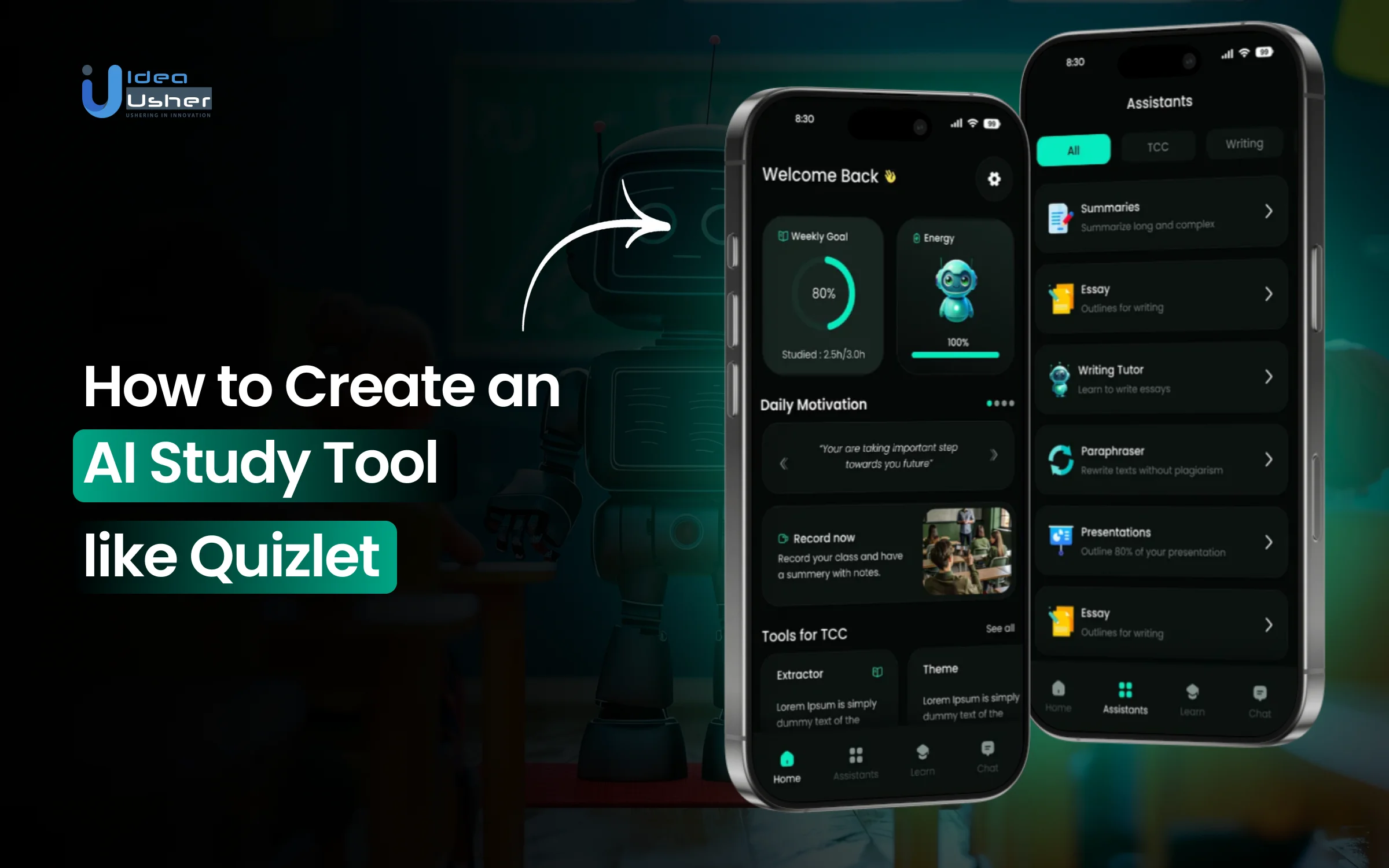
Studying isn’t just about memorizing facts; it’s about staying motivated, organizing information, and learning in ways that actually stick. Yet many students struggle with overwhelming workloads, scattered notes, and study methods that don’t match how they learn best. These challenges are increasing demand for a Quizlet-like AI Study Tool that can personalize practice, simplify revision, and make learning more efficient and engaging.
AI-enhanced study platforms combine adaptive algorithms, smart retrieval practice, and real-time feedback to personalize learning. They generate tailored flashcards, quizzes, and explanations, highlight weak areas, and simulate test environments, transforming studying into a guided, intuitive process that builds confidence and improves learning outcomes.
In this guide, we’ll explore how to create an AI study tool similar to Quizlet, the key features it needs, and the technology behind its adaptive learning experience. This blog will walk you through the complete roadmap for building a scalable, student-friendly AI learning tool.

What is an AI Study Tool, Quizlet?
Quizlet is a leading global digital learning platform that uses AI to make studying faster and more efficient. It offers flashcards, practice tests, adaptive learning modes, and AI-generated study guides built from a learner’s notes or documents. This platform serves a large user base across K-12, higher ed, and professional learning, and deep integration of generative AI. Quizlet operates as a scalable, data-driven edtech platform.
It is popular among students and teachers because it is easy to use, saves time, and improves learning outcomes. Students benefit from instant content creation, personalized study paths, and engaging practice tools, while teachers use Quizlet to rapidly build materials and reinforce instruction. Its low friction, collaborative content, and intelligent AI features make it a go-to study companion in classrooms and independent learning.
- Massive scale of user-generated content: Quizlet hosts more than 500 million study sets created by learners worldwide, giving users broad subject coverage without needing to start from scratch.
- Course-Powered Quizlet: A feature that lets students organize and share materials by institution and course, while AI creates personalized study guides and curriculum-based practice questions.
- Rizzlet, Quizlet’s AI wingman: An experimental AI tool that helps students form a community by connecting them with study partners and social matches based on shared academic interests and campus affiliation.
- Multilingual and global reach: Quizlet supports multiple languages and is used in over 130 countries, making it one of the most globally adopted study platforms.
A. Business Model: How Quizlet Operates
Quizlet is a scalable freemium edtech platform that boosts engagement with user-generated content, broad access, and AI tools to expand its global user base.
- Freemium platform core: Offers essential study tools for free to attract and retain a large user base, expanding reach and increasing long-term stickiness.
- User-generated content network: Millions of user-created study sets power the platform, lowering content creation costs and strengthening network effects.
- AI and adaptive learning integration: Combines generative AI with adaptive study modes to deliver personalized learning and deepen engagement.
- Cross-segment reach: Serves K–12 students, college learners, and teachers across more than 130 countries, supporting both individual study and classroom use.
- Platform-wide engagement focus: Emphasizes high usage and retention to unlock monetization opportunities and reinforce its competitive position in edtech.
B. Revenue & Pricing Model: How Quizlet Makes Money
Quizlet uses a hybrid monetization model built on recurring subscriptions, advertising revenue, and flexible pricing tiers that support both individual and institutional users.
1. Quizlet Plus Subscription Revenue (Primary Monetization)
- Annual Plan – $44.99/year
- Most cost-efficient option for long-term users.
- Includes all premium features: AI-powered flashcards, personalized study paths, advanced practice modes, offline access, and ad-free studying.
- Renews automatically unless cancelled at least one day before the renewal date.
- Saves users ~$24.89 per year compared to paying monthly.
- Ideal for students and professionals who need continuous access.
- Monthly Plan – $9.99/month
- Flexible, cancel-anytime subscription for users not ready to commit annually.
- Includes full access to Quizlet Plus premium and AI features.
- Total yearly cost: $119.88, making it significantly more expensive than the annual plan.
- Useful for short-term course needs or testing premium features.
2. Free Tier With Advertising
- Free users get basic study tools and access to the massive library of user-generated sets.
- Monetized via targeted ads, leveraging Quizlet’s large Gen-Z–heavy traffic base.
3. Group, Family & Classroom Licensing
- Discounted multi-user plans for families, study groups, and teachers.
- Institutional (school/district) licensing adds predictable, bulk recurring revenue.
- Supports adoption at scale while increasing retention.
4. Additional Monetization Experiments
- Occasional premium content packs or curated study materials.
- Brand partnerships and contextual advertising pilots.
Types of AI Models Used in AI Study Tools like Quizlet
AI study tools use a mix of advanced models to understand text, personalize practice, and generate smart study prompts. Together, these models make learning faster, more adaptive, and more accurate.
| AI Model Type | Purpose in Study Tools | How It Enhances Learning |
| Natural Language Processing (NLP) | Extract meaning from notes, PDFs, and lesson materials. | Create clean summaries, identify key concepts, and generate accurate flashcards from complex academic text. |
| Generative Language Models | Produce quizzes, flashcards, explanations, and study guides. | Deliver personalized content with context-aligned outputs that adapt to different difficulty levels and study needs. |
| Adaptive Learning Algorithms | Adjust difficulty and study recommendations based on performance. | Improve mastery by offering tailored questions and revision pathways that reflect individual learning progress. |
| Optical Character Recognition (OCR) Models | Convert scanned documents, images, and handwritten notes into text. | Enable students to upload class materials and transform them into usable study items for efficient learning. |
| Knowledge Graph Models | Map relationships between concepts and topics. | Enhance deeper understanding by connecting related ideas through concept-based study and smarter recommendations. |
How an AI Study Tool Works?
AI study tools analyze content, track learning progress, and generate personalized practice to boost retention. They combine data-driven insights with smart algorithms to make studying more efficient and effective.

1. User Uploads or Inputs Study Material
Learners begin by uploading PDFs, handwritten notes, textbook images, or typing content directly. Behind the scenes, OCR models convert images into readable text, while NLP models prepare the content for deeper interpretation by structuring and segmenting the data.
2. AI Extracts & Cleans the Content
During processing, NLP models analyze sentence structure, remove noise, and standardize formatting. These models help the system recognize headings, definitions, lists, and paragraph patterns, ensuring the extracted material is clean and ready for precise concept detection.
3. AI Identifies Key Concepts and Learning Points
At this stage, Knowledge Graph models and topic classification systems identify relationships between terms, categorize content by subject, and highlight essential concepts. These models help the tool understand context depth and academic relevance before generating study materials.
4. AI Generates Study Materials Automatically
Once concepts are mapped, Generative Language Models produce quizzes, tests, summaries, and flashcards. They interpret academic meaning and create study items that feel clear, structured, and context-aligned. Semantic similarity checks prevent duplicate or redundant flashcards.
5. Adaptive Algorithms Personalize the Study Flow
After learners interact with generated content, Adaptive Learning Algorithms monitor accuracy, timing, recall strength, and behavior patterns. These algorithms adjust question difficulty, study frequency, and content recommendations to create a personalized learning journey that improves over time.
6. Learners Study, Revise & Improve With Feedback
Generative models and NLP-based feedback systems evaluate responses, explain mistakes, and guide learners toward mastery. Knowledge graphs support deeper context linking, while adaptive logic updates future study suggestions, helping users build strong retention and exam readiness.
How 86% of Students Using AI Study Tools Creates a Massive Market Opportunity?
The online quiz makers market was valued at USD 1.2 billion in 2024 and is projected to reach USD 3.5 billion by 2033, with a 12.5% CAGR. Driven by high student demand and widespread AI use in studies, AI-powered flashcards, quizzes, and study platforms are now essential tools for academic success.

86% of students worldwide use AI in studies, with 54% using it weekly and 24% daily, per the Digital Education Council’s 2024 survey of 3,839 students across 16 countries. This shows AI tools are now essential, creating big market opportunities for platforms offering quiz, flashcards, and personalized learning.
A. 92% of Students Use AI Study Tools – Up from 66% in 1 Year
92% of students use AI tools in 2025, up from 66% in 2024 (HEPI Survey 2025). This 26-point increase shows AI platforms have achieved mainstream acceptance.
- The 39% year-over-year growth rate and usage by 9 out of 10 UK students show the market is accelerating and that AI study tools have become essential academic infrastructure, creating strong conditions for new platform launches.
- Assessment usage surged to 88%, up from 53% in 2024, a 66% increase. Students now rely on AI for concept explanations, article summaries, and research ideas, making these features core to quiz and flashcard platforms.
- 85% better long-term retention after 30 days when students use AI-powered flashcards, demonstrating substantial improvements in memory and study efficiency.
B. Students Score 23% Higher and Retain More Using AI Study Tools
Students using AI-powered study tools score 23% higher on exams through AI-generated flashcards, personalized quizzes, and instant feedback.
- Stanford University research shows AI-generated flashcards boost retention by 65%, giving platforms strong academic credibility and supporting premium pricing backed by trusted evidence rather than company claims.
- Georgia State University reported major gains, including 16% more students earning B or higher in gateway courses, plus a 5% retention increase, 3% re-enrollment boost, and a 7-point rise in four-year graduation rates.
- Performance data builds a competitive moat by improving content delivery, gap detection, and recommendations. As usage grows, network effects strengthen, further discouraging new competitors.
C. Platforms Hit 60M Users and $139M Revenue, Proving Market Potential
Leading AI study platform Quizlet has 60 million monthly users and 500+ million study sets. The platform grew revenue by 672% in six years from $18M (2018) to $139M (2025).
- The freemium model drives strong conversion rates and supports nine-figure revenue, powered by more than 500 million user-generated study sets that strengthen community growth, reduce acquisition costs, and provide valuable data for improving AI-generated content.
- High-stakes exam usage confirms product-market fit, with 700,000 students using one AI platform during the May 2025 AP season out of 1.3 million test-takers, contributing to 5 million total users and proving strong demand for AI tools across exams like SAT, ACT, AP, GRE, MCAT, and LSAT.
- Daily engagement shows habit formation, with 24% of students using AI study tools every day and 54% weekly, driving strong retention, higher lifetime value, and word-of-mouth growth as students rely on these platforms consistently.
- The market is expanding rapidly, rising from 55 million to 139 million dollars in two years, a 153% increase, supported by 86% global adoption and 92% adoption in the UK, leaving major opportunities for tools with better AI accuracy, specialized subjects, collaboration, or institutional integration.
Key Gaps in Existing AI Study Tools You Can Capitalize On
AI study tools like Quizlet are transforming learning, with nearly half of students and teachers using AI weekly by 2025. Despite their popularity, gaps remain for enterprises to create more complete, competitive platforms.

1. Limited Critical Thinking Support
Many current tools excel at generating answers and summaries, but research shows that heavy reliance on AI may reduce independent critical thinking and problem-solving skills among learners, rather than strengthen them.
Opportunity: Build features that encourage learners to think before reviewing AI responses, such as prompt justification exercises and evidence-checking workflows.
2. Insufficient Deep Context Understanding
Existing AI generators often struggle to maintain concept continuity when converting long lessons or complex materials into quizzes or flashcards. Students may receive fragmented or oversimplified content.
Opportunity: Use semantic context linkage models and concept graphs to preserve information coherence over extended content.
3. Weak Integration With Teaching Practice
AI tools generally provide standalone support rather than actively integrating with classroom workflows or learning science strategies like adaptive review or feedback loops that reflect actual student mastery curves.
Opportunity: Introduce features that track student progress against learning outcomes and provide pedagogically sound recommendations.
4. Format and Source Flexibility Limitations
Although modern tools can generate study items from text, few handle multimodal content (like images, tables, or diagrams) reliably, especially when uploaded in mixed formats.
Opportunity: Develop advanced multimodal parsers that convert visual, tabular, and narrative content into coherent study items.
5. Limited Real-Time Feedback & Error Diagnosis
While AI tools often generate content, they seldom offer real-time feedback that diagnoses misconceptions, explains reasoning, or tailors follow-up exercises based on specific mistakes.
Opportunity: Implement adaptive feedback systems that learn from student answers to provide highly targeted remediation.
Key Features of Quizlet-like AI Study Tool
A Quizlet-like AI study tool combines smart automation with personalized learning features that help students study faster and more effectively. These features streamline content creation, boost engagement, and deliver adaptive support tailored to every learner’s needs.

1. AI-Generated Study Materials
An AI study tool can convert text, notes, or PDFs into structured learning assets using natural language processing pipelines. It generates flashcards, summaries, and practice questions that reduce manual prep time while increasing cognitive efficiency through automated content transformation and semantic pattern detection.
2. AI Quiz & Test Generator
The platform generates quizzes and assessments automatically using concept extraction techniques that identify key ideas from study materials. Users receive personalized tests that adapt to difficulty trends, enabling fast knowledge checks supported by real-time question synthesis.
3. Adaptive Learning Engine
The platform uses a machine-learning-based adaptive engine that personalizes study paths by analyzing accuracy, pace, and memory decay. This system strengthens long-term retention through spaced review cycles and dynamic difficulty adjustments aligned with individual learner performance.
4. Automated Practice Testing
AI produces instant practice tests using multiple question formats. The generator identifies key concepts, formulates concept-aligned questions, and evaluates responses for mastery. This supports efficient exam preparation through continuous, automated assessment calibrated to the learner’s knowledge state.
5. AI Tutoring & Explanations
A conversational AI tutor delivers explanations, concept breakdowns, and study guidance using contextual understanding powered by intent recognition models. It identifies misconceptions, provides targeted hints, and supports inquiry-based learning. This helps students develop conceptual clarity through interactive, on-demand academic support.
6. Gamified Study Modes
Gamified modes introduce competitive learning, fast recall challenges, and interactive drills. These features enhance motivation and reinforce memory consolidation. The game layer blends cognitive training principles with responsive design supported by real-time interaction logic, enabling sustained engagement during repetitive study tasks.
7. Collaborative Learning Tools
The platform enables shared study sets, classroom activities, and synchronous learning sessions. Educators and students can collaborate, track progress, and work through materials collectively. This fosters community-based learning supported by real-time coordination and synchronized data exchange for transparent performance insights.
8. Visual & Diagrammatic Learning
Users can create labeled diagrams, image-based flashcards, and spatial learning aids. Visual modes support multimodal cognition architectures by pairing terms with graphics, improving comprehension of anatomy, processes, and technical systems through structured visual mapping.
9. Multi-Subject Support
The platform supports a wide range of subjects through scalable content architecture and domain-adaptible AI models. Learners can study science, languages, mathematics, humanities, and professional skills using tailored resources, ensuring versatile academic coverage aligned with diverse curriculum standards.
10. AI Concept Visualization Generator
This feature converts complex ideas into auto-generated diagrams, flowcharts, and concept maps using knowledge graph modeling. Learners receive dynamic visual explanations that evolve as their understanding grows, creating a deeply intuitive learning experience that bridges abstract theory with interactive visual reasoning.
11. Personalized Cognitive Skill Profiling
The system evaluates learning behavior to build a cognitive performance profile that identifies strengths, weaknesses, recall speed, and comprehension patterns. It then adapts study materials to the user’s cognitive style, offering precision-aligned recommendations that enhance efficiency beyond standard adaptive learning systems.
12. Predictive Study Outcome Analytics
An advanced analytics module forecasts learner outcomes using predictive modeling techniques, showing which topics may require additional study before assessments. This feature provides actionable insights that help users plan study sessions strategically, improving performance through anticipatory learning support.
How to Create an AI Study Tool like Quizlet?
Creating a Quizlet-like AI study tool combines smart content, adaptive learning, and intuitive design to improve student performance. Our developers follow a scalable process integrating AI, automation, and advanced features to offer personalized learning at scale.

1. Consultation
Our developers consult with clients to define objectives, success metrics, and learner expectations before project development begins. We analyze study behaviors and platform requirements to establish a clear blueprint supported by structured discovery workflows that guide the development of a high-performing AI study ecosystem.
2. Product Discovery & Planning
We outline user journeys, platform capabilities, and content interactions by mapping functional and non-functional requirements. This planning helps us design predictable learning flows and data-informed experience models that align with the goals of a full-scale AI-powered study platform.
3. UI & UX Design
Our designers craft an interface optimized for focus, clarity, and ease of interaction. We apply cognitive aware layouts and interaction-driven UX principles to ensure learners engage seamlessly with flashcards, quizzes, and AI features within a polished and intuitive environment.
3. AI Feature Architecture Planning
We define how AI will interpret notes, generate content, and personalize learning. Our developers design a structured reasoning pipeline supported by context-parsing logic to ensure all AI outputs maintain accuracy, relevance, and alignment with real learning objectives.
4. AI Personalization Logic Development
Our developers design the system that adapts learning paths to individual users by analyzing behavior signals and study patterns. We implement profile-driven adaptation rules that help the AI create personalized recommendations and study flows aligned with each learner’s evolving performance.
5. AI Training Data Strategy
To enhance performance, we identify the datasets, annotation rules, and evaluation criteria needed for effective AI behavior. We craft model refinement loops that support continuous accuracy improvement while ensuring the system adapts to diverse subjects and learning scenarios.
6. Feature Development & Integration
We build core modules for flashcards, quizzes, collaboration, and AI generation. Our team integrates these features using modular development patterns that enable fast responses, stable processing, and uninterrupted learning cycles across varied study modes and device environments.
7. Content Management Development
We implement secure user management, structured content organization, and efficient study set handling. Our developers ensure smooth authentication flows and optimized content indexing to support rapid access, personalized recommendations, and scalable data operations for all learner types.
8. AI Evaluation and Refinement Framework
We create a dedicated framework that monitors AI outputs for accuracy, clarity, and relevance. Using iterative validation cycles, we refine the AI’s response patterns to ensure study materials feel trustworthy and consistently aligned with educational standards.
9. QA Testing
We validate functionality, usability, and AI accuracy through systematic testing. Our QA team evaluates model outputs, interaction consistency, and behavior level performance checks to ensure the platform feels stable, trustworthy, and ready for real learner engagement.
10. Deployment & Launch
After final testing, we deploy the platform with a focus on stability, onboarding readiness, and real-time performance monitoring. This ensures users experience a fully functional, production-ready AI study tool that supports smooth adoption and scalable growth from day one.
Cost to build a Quizlet-like AI Study Tool
The cost to build a Quizlet-like AI study tool varies based on features, tech stack, integrations, and AI automation needed. Understanding these helps budget and select the right development approach for a scalable, high-performing platform.
| Development Phase | Description | Estimated Cost |
| Consultation | Align goals, define scope, and map initial workflows using structured discovery insights. | $3,000 – $6,000 |
| Product Discovery & Planning | Outline features, user journeys, and refine platform direction with clear planning frameworks. | $6,000 – $12,000 |
| UI & UX Design | Create intuitive layouts and interaction flows for a seamless study experience. | $5,000 – $10,000 |
| AI Design & Planning | Structure AI behavior, content logic, and personalization through context-aware design. | $13,000 – $25,000 |
| AI Training Data Strategy | Define datasets, annotation rules, and evaluation criteria using data-centric methods. | $18,000 – $30,000 |
| Core Feature Development | Build flashcards, quizzes, study modes, and collaboration tools with modular feature engineering. | $20,000 – $32,000 |
| AI Integration and Intelligent Features | Implement study generation, adaptive learning, and tutoring features using intelligent processing logic. | $12,000 – $20,000 |
| CMS Development | Build authentication, content handling, and profiles through optimized data flows. | $5,000 – $9,000 |
| Testing | Validate performance, accuracy, and usability with systematic testing cycles. | $6,000 – $12,000 |
| Deployment & Launch | Prepare production setup and ensure smooth onboarding via stable deployment processes. | $3,000 – $6,000 |
Total Estimated Cost: $64,000 – $126,000
Note: Development costs depend on project scale, AI complexity, dataset quality, platform expectations, customization, regulations, and optimization cycles.
Consult with IdeaUsher for a personalized cost estimate, development roadmap, and expert guidance to build an AI-driven study platform aligned with your vision and goals.
Cost-Affecting Factors to Consider during Development
Several key technical, design, and AI-driven elements directly influence the overall cost of developing a Quizlet-like AI study tool.
1. Complexity of AI Features
Advanced capabilities such as personalization, content generation, and adaptive learning increase development costs due to specialized AI logic and extensive data processing requirements.
2. Volume & Structure of Learning Content
Costs rise when supporting large subject libraries, diverse formats, or multimodal content due to enhanced content handling systems and scalable data workflows.
3. UI & UX Design Requirements
Custom interfaces, interactive study modes, and accessibility features require additional design time and precision-driven experience modeling, influencing overall budget.
4. Integration & Interoperability
Connecting with third-party tools, authentication systems, or external content sources affects pricing because of additional integration layers and compatibility testing.
5. Security & Data Compliance
Ensuring safe user data handling, privacy protection, and compliance with global standards adds expenses due to stringent security implementation and validation processes.
Challenges & How Our Developers Solve These?
Building a Quizlet-like AI study tool involves challenges around data accuracy, personalization, scalability, and user experience. Our developers overcome these with structured workflows, solid architecture, and AI-driven solutions that ensure reliable performance and effective learning.

1. Building Accurate AI Content Generation
Challenge: AI sometimes misinterprets context, creating study materials that feel unclear or incomplete, especially when handling mixed subject inputs or dense academic text.
Solution: We improve accuracy by applying context-aware refinement cycles, validating key concepts, and adjusting generation rules. Our team trains the system with structured examples, ensuring consistently clear and meaningful study materials across every subject category.
2. Identifying Important Concepts for Quizzes & Flashcards
Challenge: AI often misjudges what is essential, making it difficult to pinpoint definitions, key terms, and core relationships across different subjects and writing styles.
Solution: We apply concept ranking logic that analyzes emphasis patterns and academic relevance. This helps the system understand context depth, highlight meaningful ideas, and generate questions and flashcards that genuinely support targeted learning.
3. Extracting Clean Information from PDFs & Notes
Challenge: AI struggles to interpret messy layouts, mixed formatting, and scattered text in uploaded PDFs or handwritten class notes, leading to incomplete or inaccurate study outputs.
Solution: We enhance extraction using structured parsing workflows that clean content, detect segments, and reorganize information. This allows our system to interpret varied formats and convert academic materials into accurate, usable study inputs.
4. AI Behavior Across Multiple Scenarios
Challenge: AI features may behave unpredictably when tested with different question types, writing styles, or learning patterns.
Solution: We run scenario-based validation tests that expose the AI to varied study contexts. Our developers analyze patterns, adjust logic, and refine outputs, ensuring the AI behaves reliably across all learning scenarios.
Conclusion
Creating a Quizlet-like AI Study Tool comes down to understanding learners’ needs and aligning them with thoughtful design, reliable technology, and adaptive intelligence. When each feature is built to support clarity, efficiency, and personalization, the result is a platform that genuinely helps students study with confidence. By focusing on scalable development practices and meaningful user experiences, you can build a tool that grows with its audience. A well-structured approach ensures the solution remains effective, relevant, and ready to support diverse learning goals. This foundation helps maintain long-term value and trust.
Launch Your AI-Powered Study Tool With IdeaUsher!
At IdeaUsher, we help brands develop modern study tools equipped with generative AI, NLP, and automated content creation. Whether you want flashcards, quizzes, smart recommendations, or AI tutoring, we bring your Quizlet-style vision to life.
Why Work With Us?
- AI and NLP Capabilities: We build intelligent flashcard generators, quiz creators, and personalized study recommendations using advanced AI models.
- Custom Feature Development: We create modules such as spaced repetition, progress tracking, smart assignments, and chat-based tutoring.
- Scalable Architecture: Our platforms are engineered to support large user bases and multi-institution deployments.
- User-Centered Design: We craft intuitive, engaging learning experiences for students of all levels.
Browse our portfolio to discover how we have developed successful AI-driven solutions for clients across various sectors.
Get in touch for a free consultation and let us help you build a powerful, Quizlet-style learning platform.


FAQs
A Quizlet-style tool should include flashcard creation, smart practice recommendations, automated quiz generation, and progress tracking. Integrating AI enhances these features by understanding user behavior, refining content suggestions, and personalizing study experiences for better learning efficiency.
AI models analyze text, identify key concepts, and convert them into concise question and answer pairs. This automation reduces manual effort, improves study accuracy, and provides learners with structured content aligned with their subject requirements and difficulty preferences.
Natural language processing helps the system understand user inputs, summarize content, categorize topics, and create relevant study materials. It enables the tool to deliver meaningful explanations, contextual prompts, and personalized quizzes that reflect actual learning goals.
You can differentiate by offering features such as automatic content imports, personalized learning paths, progress insights, or AI tutoring. Strong design, fast performance, and high-quality study materials also help build trust and attract long-term users.


