 (+971) 8007 4267
 (+91) 946 340 7140
 (+1) 628 432 4305

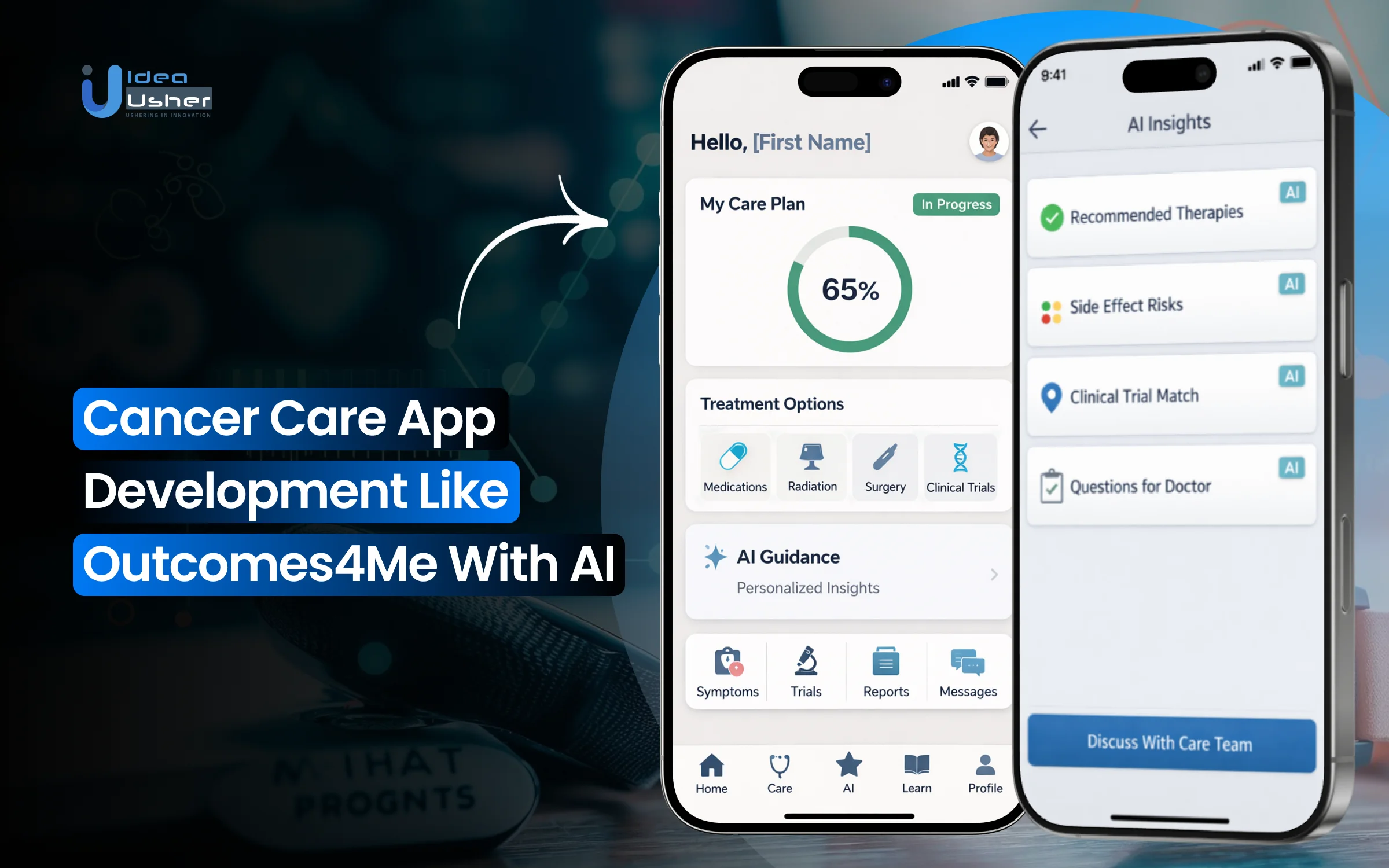
Cancer care generates overwhelming information when patients and caregivers are least equipped to process it. Treatment options, clinical guidelines, side effects, and care pathways often arrive fragmented across providers, reports, and appointments. These gaps drive interest in oncology healthcare app development that helps patients understand their condition, make informed decisions, and navigate care with clarity and confidence.
As digital care tools evolve, the focus shifts from presenting information to helping patients understand it. Platforms like Outcomes4Me show how AI translates complex clinical data into personalized context based on diagnosis, treatment stage, and individual needs. Making this approach work properly depends on medical accuracy, explainability, privacy safeguards, and UX choices that support patients without replacing clinical judgment.
In this blog, we explain cancer care app development like Outcomes4Me with AI by breaking down core features, system architecture, and design considerations involved in building responsible, patient-focused digital tools for oncology care.
What is an Oncology Healthcare App, Outcomes4Me?
Outcomes4Me is an oncology healthcare app and patient-empowerment platform designed to help people with cancer better understand and navigate their care. It’s a free, direct-to-patient digital tool that combines clinical evidence, personalized guidance, and support resources in one place, all with the aim of helping users make informed decisions alongside their medical team.
The app’s mission is to empower cancer patients by turning complex oncological information into understandable, actionable insights. It uses artificial intelligence (AI) and machine learning to interpret clinical guidelines and tailor them to each user’s unique situation
- End-to-End AI-Driven Platform: Outcomes4Me is an artificial intelligence-powered patient empowerment platform that supports users throughout their cancer journey, from diagnosis to treatment navigation.
- Integrates Clinical Practice Guidelines Into Patient-Friendly Format: The platform is the first direct-to-patient system to fully integrate the official NCCN Clinical Practice Guidelines® and uses AI to translate technical recommendations into understandable, personalized treatment insights.
- Proprietary Data & Insight Generation: The platform uses proprietary datasets and patented analytical technology to generate precise, actionable insights, helping patients contextualize treatment options using real-world evidence patterns.
- Federated Learning-Like Approach for Privacy-Aware Insight: The platform uses federated learning-style methodologies to generate patient-centric insights while preserving individual data privacy by avoiding centralization of raw health data.
- Genomic & Clinical Trial Matching Algorithms: Outcomes4Me uses advanced algorithms to match users with relevant clinical trials and genomic testing opportunities based on diagnosis, stage, biomarker information, and other personalized data.
- Real-Time Symptom Trend Analytics: The symptom tracking feature uses trend analysis algorithms to detect patterns over time, providing patients and clinicians with insights into treatment and side effect progression.
A. Business Model: How It Operates
Outcomes4Me operates a digital health platform for personalized cancer care. It connects patients with data-driven insights, clinical trials, and options.
1. Free Direct-to-Patient Platform: The core app and platform are entirely free for individuals living with cancer. Patients do not pay any fees to access personalized treatment guidance, symptom tracking, clinical trial matching, or educational resources. This free model is deliberate, not temporary.
2. AI-Driven, Evidence-Based Care Navigation: The platform uses AI and machine learning to interpret clinical guidelines and real-world data, providing personalized insights for each patient based on their diagnosis.
3. Extensive Data and Technology Backbone: Outcomes4Me integrates:
- NCCN Clinical Practice Guidelines in Oncology
- Genomic interpretation
- Symptom trends
- Clinical trial data
- Patient-reported health records
This integration results in an evidence-based decision support tool for patients, providers, and partners.
4. Healthcare and Life Sciences Partnerships: Outcomes4Me has established commercial partnerships with pharmaceutical companies and other healthcare stakeholders to help them reach appropriate patients with timely, relevant information. This enterprise-focused use case complements the free patient app.
5. Data-Driven Shared Value Creation: The platform captures real-world patient insights and aggregated data, informing partners about treatment patterns, unmet clinical needs, and therapy effectiveness. This creates value for research and commercialization stakeholders.
B. Revenue Model: How It Generates Money
Outcomes4Me is free for patients but it generates revenue through partnerships, licensing, and data services. It collaborates with healthcare organizations to support patient-focused digital oncology solutions.
1. Enterprise & Life Sciences Partnerships: Outcomes4Me collaborates with pharmaceutical and life sciences companies, offering tailored analytics, patient engagement tools, and real-world insights supporting drug development, clinical trial recruitment, and patient support.
2. Sponsored and Branded Services: The platform integrates partner-sponsored content, educational modules, and clinical trial awareness programs promoting specific therapies, diagnostics, or genetic tests, serving as lead generation channels.
3. Outcome and Evidence-Based Insights: Outcomes4Me monetizes real-world data and outcomes analytics to support evidence generation, including post-market studies, treatment effectiveness research, and decision analytics for providers and partners.
4. International Expansion and Enterprise Licensing: The company plans to grow revenues through international expansion, new enterprise contracts, and innovative business models. Potential offerings include white-label solutions, data licensing, and curated insights for healthcare systems and payers.
How the Oncology Healthcare App Works?
The oncology healthcare app analyzes patient data to deliver personalized cancer insights. It guides treatment decisions, clinical trial matching, and symptom tracking through secure, evidence-based digital tools for oncology patients.
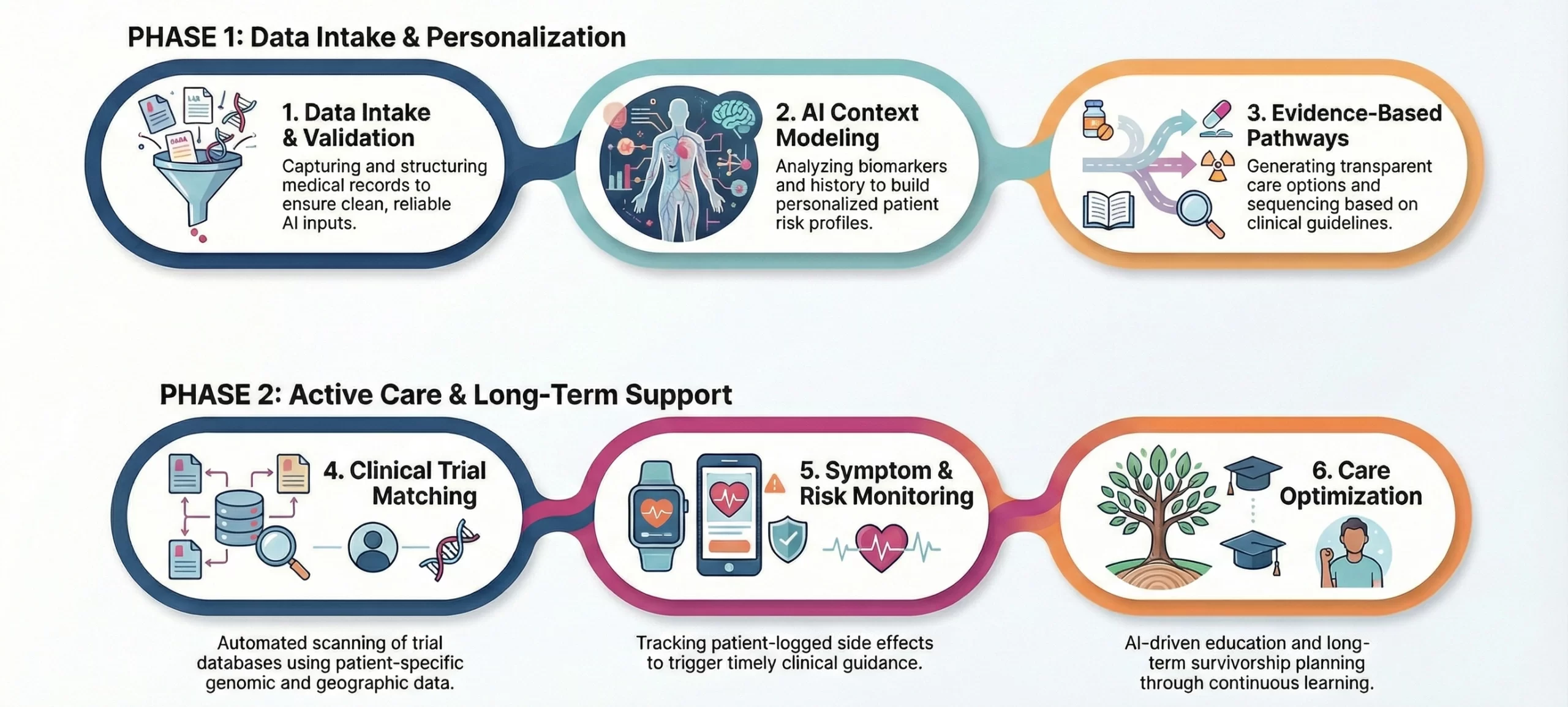
1. Patient Onboarding & Medical Data Intake
The app begins by capturing structured patient inputs such as cancer type, stage, diagnosis date, prior treatments, and location. Patients securely upload pathology reports, lab results, genomic tests, and prescriptions. This data forms the foundational clinical context required for accurate AI personalization.
2. Medical Data Structuring & Validation
Uploaded records are parsed, standardized, and mapped into structured medical formats. The system validates data completeness, flags inconsistencies, and preserves original documents. This step ensures AI models operate on clean, reliable inputs rather than raw, unstructured medical files.
3. AI Context Modeling
AI models analyze diagnosis, biomarkers, treatment history, and demographic factors to build a patient-specific context layer. This determines risk profiles, treatment relevance, and eligibility logic, ensuring all recommendations are personalized rather than generic oncology guidance.
4. Evidence-Based Care Pathways & Treatment Insights
Using curated medical knowledge and guidelines, AI generates personalized care pathways that explain standard-of-care treatments, alternatives, sequencing, and expected outcomes. The system emphasizes transparency by showing why options are relevant instead of issuing opaque recommendations.
5. Clinical Trial Matching & Scanning
AI continuously scans clinical trial databases and matches patients using eligibility criteria, biomarkers, treatment history, and geographic constraints. Relevant trials are surfaced with clear explanations, reducing patient confusion and improving real-world trial discovery rates.
6. Symptom Monitoring, PROs & AI-Driven Guidance
Patients log symptoms, side effects, and quality-of-life metrics. AI tracks trends over time, identifies potential risk signals, and provides timely guidance or escalation prompts based on predefined, client-approved clinical thresholds.
7. AI Assistant & Long-Term Care Optimization
Patients interact with an AI assistant for contextual education and guidance. De-identified data feeds continuous learning loops, refining AI accuracy, supporting survivorship planning, and improving long-term care recommendations without compromising privacy.
Why is the Oncology Healthcare App gaining popularity?
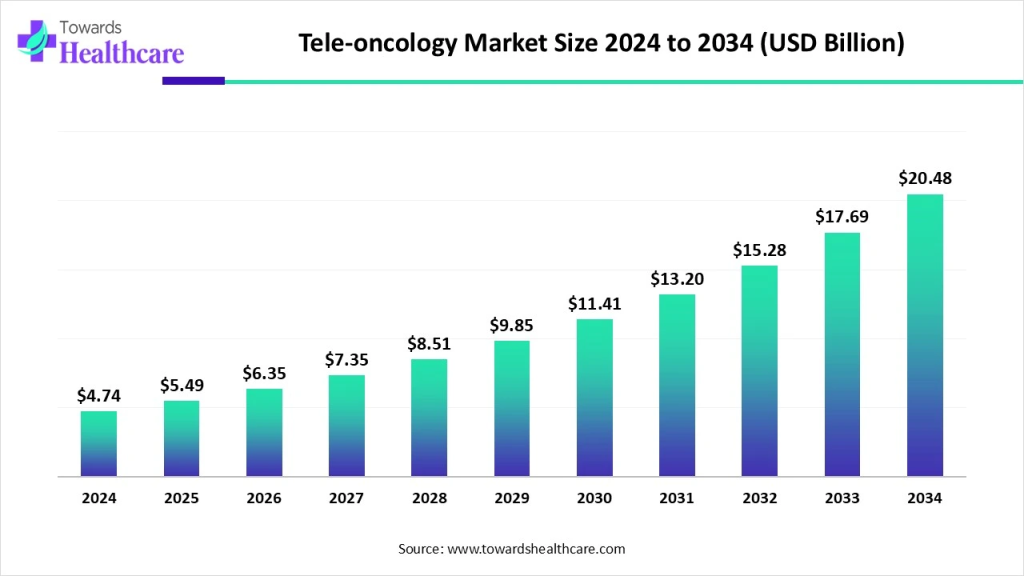
The global tele-oncology market size was US$ 4.74 billion in 2024, grew to US$ 5.49 billion in 2025, and is projected to reach around US$ 20.48 billion by 2034. The market is expanding at a CAGR of 15.76% between 2025 and 2034. This growth reflects rising adoption of AI-powered oncology apps, virtual cancer care models, and remote clinical decision support across global healthcare systems.
Clinical performance is a key driver of adoption. In large-scale screening, AI has delivered measurable detection gains. A German study of 463,094 mammograms found that AI-assisted radiologists detected 17.6% more cancers with no increase in false positives, increasing detection rates from 5.7 to 6.7 per 1,000 women—strengthening clinician trust in AI-assisted oncology tools.
Patient adoption data reinforces this growth. A 2024–2025 survey found that 80.5% of oncology patients believe AI will improve cancer care, with the highest comfort levels in AI-assisted screening (80.2%) and supportive care. This confidence is translating into real usage like AI-powered platforms like Outcomes4Me, which surpassed 400,000 users by 2025, signaling strong demand for patient-facing oncology apps that enhance understanding while preserving clinician oversight.
How AI Improves Cancer Care App Functionality?
AI enhances cancer care app functionality by analyzing complex clinical and patient data. It delivers personalized treatment insights, smarter recommendations, predictive support, and improved decision-making across the digital oncology care journey.

1. Personalized Treatment Navigation
The platform analyzes a patient’s unique medical data against clinical guidelines and research databases, generating a personalized, easy-to-understand care plan. This identifies the most relevant standard and experimental treatment options for their specific cancer profile.
2. Intelligent Symptom Management
The platform continuously monitors patient-reported symptoms to detect concerning health patterns early. It provides evidence-based self-care advice and sends automated alerts to clinicians to enable proactive intervention, improving safety and quality of life.
3. Automated Medical Record Decoding
AI parses complex health records and pathology reports to extract and structure critical data. It translates medical jargon into plain language, empowering patients with a clear understanding of their own diagnosis, biomarkers, and treatment history.
4. Enhanced Clinical Trial Matching
The platform matches a patient’s full clinical and genomic profile against thousands of trial eligibility criteria. This rapidly surfaces the most relevant research opportunities, overcoming the significant barrier of manual searches for patients and oncologists.
5. Proactive Administrative & Logistical Support
The app anticipates and automates non-clinical tasks that consume patient energy. It schedules medication reminders, organizes upcoming appointments, prepares questions for the oncologist, and helps manage insurance or billing documentation, reducing stress and cognitive load.
Core Features of Cancer Care App like Outcomes4Me
A cancer care app leverages digital health technology and AI for secure data management, personalized insights, and clinical accuracy. These features improve care coordination, patient confidence, and scalable access to evidence-based oncology support.

1. AI-Powered Personalized Care Pathways
AI dynamically generates individualized cancer care pathways using diagnosis, stage, biomarkers, comorbidities, and patient preferences. Unlike static plans, pathways continuously adapt to treatment response, symptom patterns, and real-world outcomes, enabling precision-driven, patient-specific care navigation.
2. Evidence-Based Treatment Matching
The app uses AI to map patient profiles against NCCN, ASCO, and peer-reviewed oncology guidelines. It highlights standard-of-care, alternative, and emerging options, transparently showing evidence strength, helping patients understand why a treatment is recommended.
3. Symptom Tracking & AI-Driven Side Effect Management
Patients log symptoms in real time while AI detects severity trends, escalation risks, and intervention timing. Unlike simple trackers, the system predicts adverse events early and provides actionable guidance aligned with clinical best practices and oncologist-defined thresholds.
4. Clinical Trial Matching Using AI
AI scans global clinical trial databases, matching patients using eligibility criteria, genomics, treatment history, and geography. It surfaces high-relevance trials others miss, explains inclusion logic, and reduces trial discovery friction for both patients and providers.
5. Genomic & Biomarker Interpretation Support
The platform translates complex genomic reports into clear, actionable insights. AI links mutations and biomarkers to targeted therapies, immunotherapy response likelihood, and trials, bridging the gap between molecular diagnostics and real-world treatment decisions.
6. Treatment Decision & Risk Stratification
AI models analyze survival data, toxicity risks, and patient-reported outcomes to compare treatment scenarios. This supports shared decision-making by balancing efficacy, quality of life, and long-term impact, rather than relying on survival statistics alone.
7. Medication Management & Adherence Monitoring
The app tracks oral oncology medications, schedules, and interactions using AI-driven adherence insights. It identifies missed doses, predicts non-adherence risk, and provides personalized nudges, critical for modern cancer therapies managed outside clinical settings.
8. AI Health Assistant / Oncology Copilot
An AI oncology copilot answers patient questions in plain language, contextualized to their diagnosis and treatment stage. Unlike generic chatbots, responses are grounded in oncology-specific data, guidelines, and the patient’s evolving clinical profile.
9. Patient-Reported Outcomes (PROs) Collection
Structured PRO collection captures quality-of-life, pain, fatigue, and functional data. AI transforms subjective inputs into clinical-grade insights, enabling earlier intervention, improved outcomes, and real-world evidence generation beyond traditional clinical visits.
10. Survivorship & Long-Term Care Planning
AI-driven survivorship plans address recurrence monitoring, late-effect risks, lifestyle guidance, and mental health. The app evolves post-treatment care over the years, supporting the full cancer journey, not just active therapy phases.
11. Medical Records Aggregation & Smart Summaries
The app aggregates EHRs, lab reports, imaging, and pathology into a unified timeline. AI generates concise summaries, flags critical changes, and eliminates fragmented data silos that commonly delay or complicate oncology care decisions.
Oncology Healthcare App Development Process
Oncology healthcare app development combines clinical expertise, AI, and secure technologies for compliant, patient-focused solutions. Our developers follow a strategic, agile, and regulation-aligned approach to build scalable oncology applications.
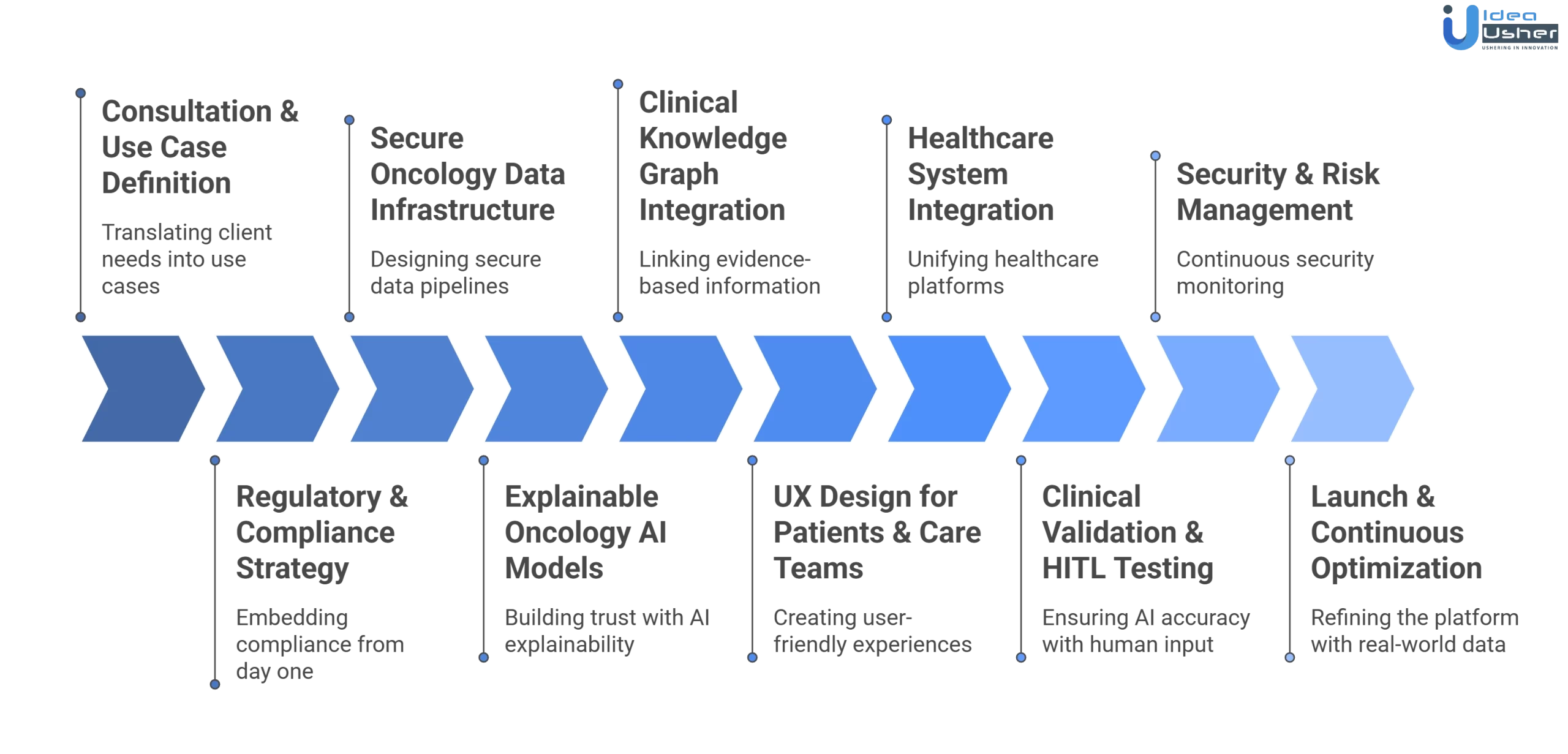
1. Consultation & Use Case Definition
We begin by translating our client’s oncology requirements into clear, build-ready use cases. Based on inputs, documentation, and consultations provided by the client, our developers define feature scope, workflows, and technical priorities to align the app with the client’s business goals and clinical intent.
2. Regulatory & Compliance Strategy
Our team embeds HIPAA, GDPR, SOC 2, and FDA SaMD readiness into the architecture from day one. By prioritizing compliance early, we help our clients avoid costly rework and accelerate clinical and enterprise adoption.
3. Secure Oncology Data Infrastructure
We design secure, scalable data pipelines for EHRs, genomics, lab results, and patient-reported outcomes. Our developers use FHIR standards, encryption, and role-based access to protect sensitive cancer data while enabling AI-driven insights.
4. Explainable Oncology AI Models
We build AI models for NLP, prediction, and decision support with explainability at the core. Our systems include confidence scores, traceable evidence sources, and audit logs so clinicians and patients can trust AI-generated recommendations.
5. Clinical Knowledge Graph Integration
We create and maintain a continuously updated oncology knowledge graph linking guidelines, peer-reviewed research, drug labels, and clinical trials. This ensures our AI outputs remain evidence-based, transparent, and clinically defensible.
6. UX Design for Patients & Care Teams
Our designers and developers collaborate to create emotionally sensitive, low-friction user experiences. We prioritize accessibility, multilingual support, and cognitive simplicity to make complex oncology information understandable and usable.
7. Healthcare System Integration
We build core modules such as personalized care pathways, symptom monitoring, clinical trial matching, and AI assistants. Our developers integrate EHRs, labs, and genomics platforms to deliver a unified, end-to-end cancer care experience.
8. Clinical Validation & HITL Testing
We test AI outputs with oncologists and real patients through structured human-in-the-loop workflows. This allows us to validate accuracy, minimize bias, and ensure AI supports clinical decision-making without replacing human judgment.
9. Security & Risk Management
We conduct rigorous security testing, performance optimization, and model risk assessments. Our developers continuously monitor system health, data drift, and AI reliability to maintain safe, scalable oncology-grade performance.
10. Launch & Continuous Optimization
We launch in phases and use real-world patient data and outcomes to refine the platform. Our AI models continuously improve through learning loops, ensuring the app evolves alongside advancements in cancer treatment and care.
Cost to Build Cancer Care App Like Outcomes4Me With AI
Building a cancer care app like Outcomes4Me with AI depends on clinical scope, regulatory requirements, data complexity, and AI sophistication. Understanding these cost drivers helps healthcare leaders plan scalable, compliant oncology platforms.
| Development Phase | What We Deliver | Estimated Cost |
| Use-Case & Requirement Mapping | Translate client oncology requirements into technical workflows, features, and scalable development specifications | $8,000 – $15,000 |
| Compliance-Ready Architecture Planning | Design secure, HIPAA-aligned system architecture supporting future regulatory and clinical expansion | $10,000 – $18,000 |
| Oncology Data Infrastructure Setup | Build secure pipelines for EHR, lab, genomics, and patient-reported data ingestion | $13,000 – $17,000 |
| AI Model Development & Integration | Develop and integrate AI models for recommendations, NLP, predictions, and decision support | $20,000 – $32,000 |
| Clinical Knowledge System Integration | Implement structured medical content, guidelines, trials, and evidence sources into the platform | $15,000 – $20,000 |
| UX/UI Design for Cancer Care | Design accessible, emotionally considerate interfaces optimized for oncology patient and care workflows | $10,000 – $15,000 |
| Core Feature Development | Build care pathways, symptom tracking, trial matching, messaging, and AI assistant modules | $30,000 – $60,000 |
| System Integrations & APIs | Integrate third-party APIs, EHR systems, lab platforms, and external data services securely | $12,000 – $16,000 |
| Testing, QA & Security Validation | Perform functional testing, AI validation, security checks, and performance optimization | $10,000 – $14,000 |
| Launch, Monitoring & Optimization | Deploy production systems, monitor performance, and optimize AI and application workflows | $10,000 – $12,000 |
Total Estimated Cost: $62,000 – $124,000+
Note: Costs vary based on feature complexity, compliance requirements, AI sophistication, third-party integrations, and long-term scalability needs.
Consult with IdeaUsher to get a tailored cost estimate aligned with your business goals, technical scope, and regulatory expectations.
Challenges & How Our Developers Will Solve Those?
Cancer care app development involves complex clinical workflows, sensitive patient data, and strict regulations. Our developers address these challenges through secure architectures, clinically validated logic, and oncology-focused development practices.
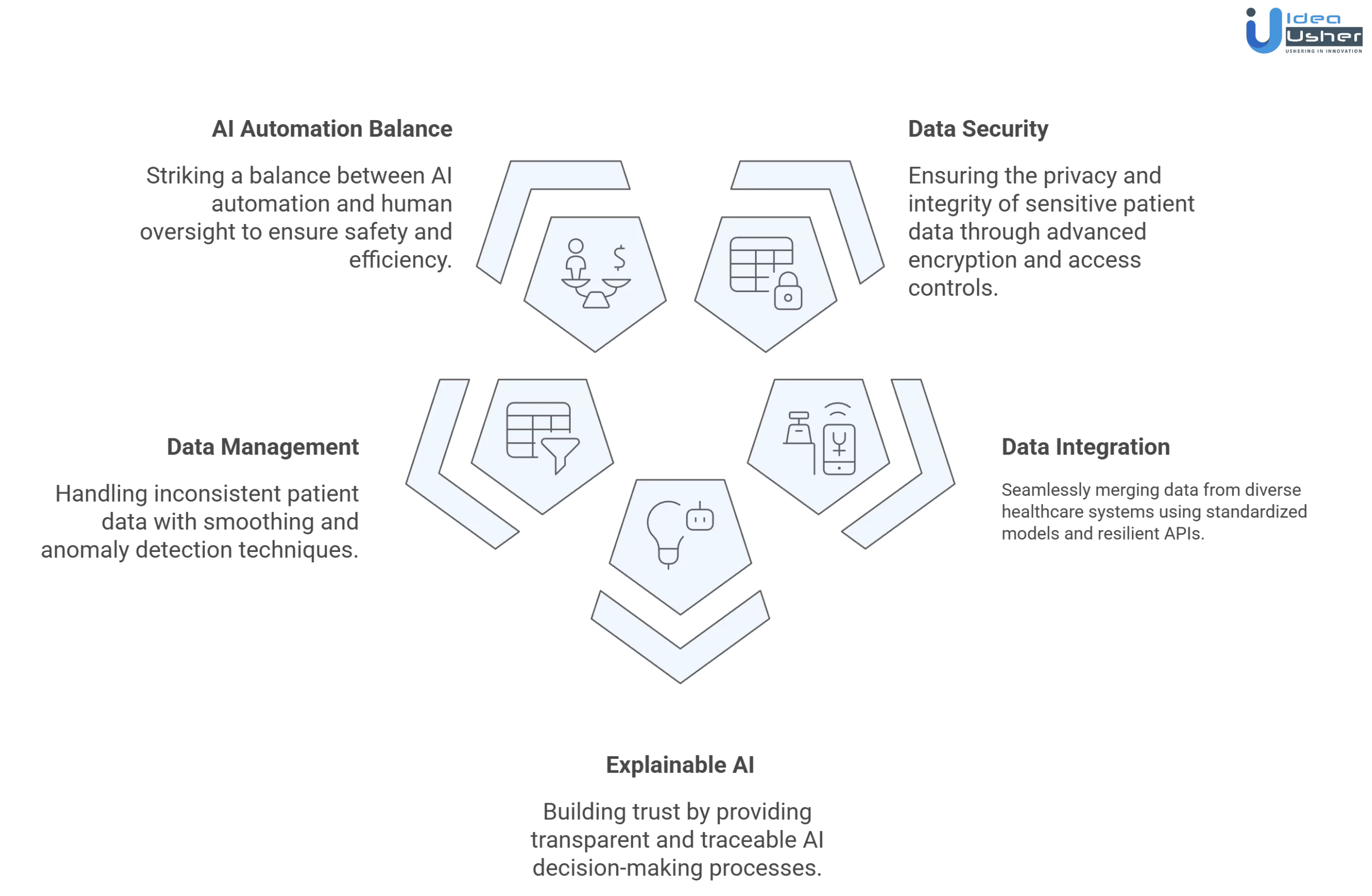
1. Sensitive Oncology Data Securely
Challenge: Cancer care apps process EHRs, genomic reports, pathology results, and patient-reported data, all subject to strict privacy regulations and breach risks.
Solution: We implement end-to-end encryption, role-based access control, secure key management, and audit logging. Our developers follow HIPAA-aligned architecture and ensure data isolation across environments to prevent unauthorized access.
2. Healthcare Data Integration Challenges
Challenge: EHR systems, lab platforms, and genomics providers use different standards, formats, and APIs, leading to inconsistent or incomplete data ingestion.
Solution: We normalize data using FHIR-compliant models, build resilient API adapters, and implement validation layers to handle missing, delayed, or conflicting medical data without breaking core workflows.
3. Explainable & Trustworthy AI
Challenge: Black-box AI models reduce clinician and patient trust, especially in oncology where decisions have life-altering consequences.
Solution: We prioritize explainable AI by surfacing confidence scores, evidence sources, and decision logic. Every AI-generated insight includes traceability back to clinical guidelines or structured data inputs.
4. Noisy Patient Data Management
Challenge: Patients may enter inconsistent, delayed, or subjective symptom data, reducing AI prediction accuracy.
Solution: We apply data smoothing, anomaly detection, and adaptive prompting. Our systems guide users toward structured inputs while models account for uncertainty instead of assuming perfect data quality.
5. AI Automation with Human Oversight
Challenge: Over-automation can introduce safety risks, while under-automation reduces AI’s value.
Solution: We design human-in-the-loop workflows where AI flags insights, escalates risks, and defers final decisions to clinicians or predefined client-approved logic paths.
How Do We Validate AI Accuracy and Safety in an Oncology Healthcare App?
AI accuracy and safety are validated through clinical benchmarking, continuous performance monitoring, and regulatory-aligned testing. These processes ensure AI outputs remain reliable, explainable, and safe for real-world healthcare use.
1. Human-in-the-Loop Clinical Review
Every AI output is reviewed through predefined human-in-the-loop workflows. Subject-matter experts and client-approved reviewers evaluate recommendations, ensuring accuracy, contextual relevance, and alignment with intended clinical use before production deployment.
2. Grounding AI Outputs in Verified Sources
Models are constrained to curated medical knowledge, evidence-based guidelines, and validated data sources. This reduces hallucinations and ensures AI insights remain traceable, explainable, and aligned with accepted oncology standards.
3. Multi-Layer Model Testing and Benchmarking
We perform offline validation, scenario-based testing, and performance benchmarking across diverse datasets. Accuracy, consistency, and failure modes are measured before models are exposed to real-world patient interactions.
4. Bias Detection and Performance Monitoring
AI outputs are continuously evaluated across demographics and clinical variations. We monitor for skewed performance, unintended bias, and inconsistent behavior, allowing thresholds or logic to be adjusted without retraining entire systems.
5. Controlled Rollouts and Feature Gating
New AI capabilities are released gradually using staged rollouts and feature flags. This minimizes risk, allows real-world observation, and ensures safe fallback mechanisms are always available.
6. Clear Scope and Guardrails
AI functionality is strictly limited to decision support and informational assistance. Guardrails prevent diagnostic claims or autonomous medical decisions, keeping usage aligned with safety, compliance, and ethical boundaries.
Conclusion
Building a cancer care app inspired by Outcomes4Me requires clarity on clinical value, patient trust, and ethical use of data. The role of AI is to support decisions, personalize education, and reduce friction in complex care journeys. Thoughtful oncology healthcare app development balances regulatory compliance, evidence-based guidance, and compassionate design. When these elements align, the platform becomes more than software. It becomes a reliable companion for patients, caregivers, and clinicians navigating diagnosis, treatment options, and long-term survivorship with confidence and consistency across diverse care settings and patient needs.
Build an AI-Powered Oncology Healthcare App with Us!
We bring deep expertise in AI & healthcare solution development, and apply that experience to build patient-facing cancer care platforms like Outcomes4Me. Leveraging our ex-FAANG/MAANG engineers and AI specialists, we design oncology apps that translate complex clinical data into personalized, explainable insights, while maintaining strict regulatory and clinical alignment.
Why Work With Us?
- Oncology & Clinical AI Expertise: Platforms designed around real-world cancer care workflows and evidence-based medicine
- Explainable AI Models: Transparent, trustworthy AI aligned with clinical decision support standards
- Patient-Centric UX: Apps built for cancer patients, caregivers, and care teams—not generic health users
- Regulatory-Ready Architecture: HIPAA, GDPR, and healthcare-grade security by design
Explore our portfolio to see how we design and deliver AI solutions and products for enterprises across diverse industries.
Contact us for a free consultation and start building your AI-powered oncology app today.


FAQs
A.1. A successful cancer care app includes personalized treatment insights, symptom tracking, clinical trial matching, secure messaging, and educational resources. AI helps tailor content while ensuring accuracy, usability, and alignment with evidence-based oncology standards.
A.2. AI improves oncology healthcare app development by analyzing patient data, personalizing care recommendations, and simplifying complex medical information. It supports better engagement, informed decision-making, and scalable delivery while maintaining clinical accuracy and patient safety.
A.3. Cancer care apps ensure accuracy by sourcing content from clinical guidelines, peer-reviewed research, and oncology experts. Regular medical reviews and AI model validation help maintain trust and reliability across patient education and treatment insights.
A.4. Yes, developers can integrate cancer care apps with EHRs and hospital systems using secure APIs. These integrations enable data sharing, treatment tracking, and coordinated care while requiring strict compliance with healthcare data regulations.