 (+971) 8007 4267
 (+91) 946 340 7140
 (+1) 628 432 4305

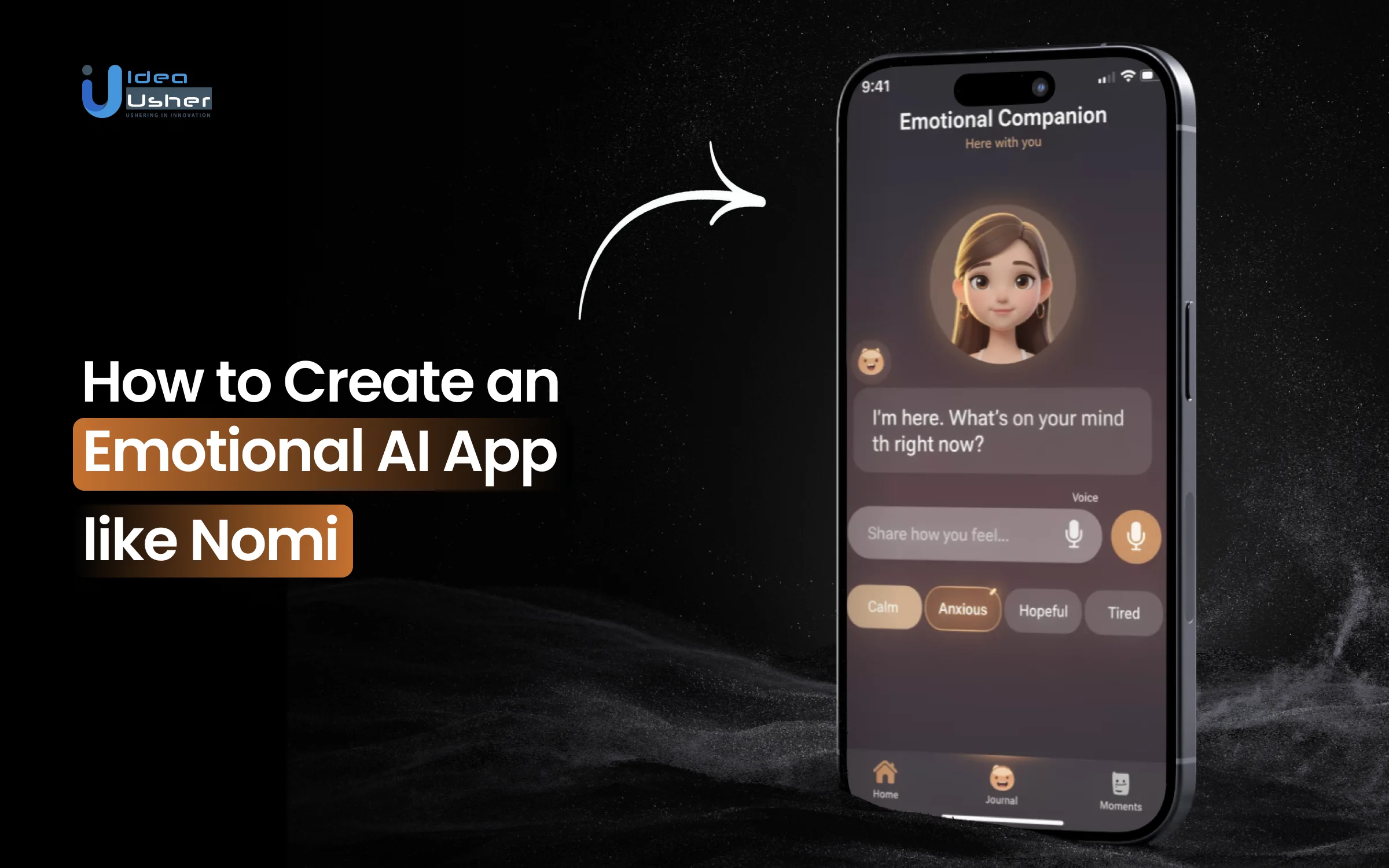
As people spend more time online, many still feel unheard or emotionally disconnected despite using dozens of apps every day. Quick replies, automated prompts, and surface-level interactions rarely address how someone actually feels in the moment. This disconnect is pushing users toward a Nomi-like emotional AI app, one designed to listen with context, respond with care, and hold conversations that feel supportive rather than scripted.
The key distinction of emotional AI lies in its ability to understand both words and feelings. These systems can offer comfort, encouragement, or thoughtful dialogue by recognizing tone, remembering past interactions, and adjusting responses over time when it matters most. This makes emotional AI feel less like a tool and more like a supportive digital presence across wellness and everyday use.
In this blog, we’ll explore how to build an emotional AI app similar to Nomi, the core features it requires, and the technologies behind emotionally aware interactions. This guide will help you understand the roadmap to developing AI experiences that genuinely connect with users.

What is an Emotional AI App, Nomi?
Nomi by Glimpse.ai is an emotional AI companion platform focused on persistent, relationship-driven interaction. It combines emotional intelligence, human-level memory, contextual awareness, and creative reasoning to generate personalized AI companions. The platform supports multimodal communication including text, voice, AI-generated visuals, customizable identities, proactive engagement, and long-term memory to maintain continuity across conversations.
It offers emotionally consistent, memory-aware companionship instead of short-lived chatbot interactions. Users value its ability to remember context, adapt personalities, support creative and emotional use cases, and provide a judgment-free, immersive experience that feels personal, evolving, and socially engaging over time.
- Dual-layer memory architecture using short-term conversational memory for coherence and long-term memory for persistent relationship, preference, and personality retention
- AI companions are modeled as continuous digital identities with stable behavioral traits rather than stateless or session-based assistants.
- Real-time AI-generated selfies that reflect companion context, activities, and appearance to enhance perceived presence
- Photorealistic avatar system with extensive customization to support emotional realism and visual attachment
- Voice interaction that dynamically adapts tone, pacing, and expression based on emotional context
- Media and link understanding that allows Nomis to interpret user-shared photos, content, and references within a conversation
- Open-ended narrative and roleplay systems enabling co-creation of complex, imaginative or emotional scenarios
A. Business Model: How It Operates
Nomi operates a consumer emotional AI business model centered on persistent relationships, identity continuity, and high-frequency personal engagement rather than transactional AI usage.
- Builds long-term user retention by positioning AI companions as evolving digital beings with memory, personality, and emotional consistency
- Product architecture is designed around daily conversational touchpoints, emotional bonding, and narrative continuity to maximize engagement time
- Personalization systems including identity shaping, memory retention, and adaptive behavior function as the core moat rather than raw model capability
- Platform encourages solo, group, and creative interaction modes to expand use cases beyond one-to-one chat
- Community-driven discovery and sharing reinforce network effects without reliance on external platforms
B. Revenue Model: How It Generates
Nomi monetizes emotional engagement through recurring access to deeper memory, richer interaction, and expanded expressive capabilities.
- Subscription revenue unlocks enhanced long-term memory depth, higher interaction limits, voice conversations, and advanced personalization.
- Monetization is directly tied to relationship continuity, where higher tiers preserve more emotional history and behavioral nuance.
- Optional in-app purchases extend experiential depth through visual realism, roleplay expansion, and creative expression features.
- Affiliate and creator referral programs convert community advocacy into scalable customer acquisition.
- Revenue strategy avoids advertising, aligning monetization with trust, privacy, and emotional safety.
Funding Information
Nomi, developed by Glimpse.ai, Inc., is an early-stage, capital-efficient AI company that has raised over $4 million through multiple small funding rounds, including seed and angel investments. The latest public funding in late 2023 shows a focus on sustainable growth and product development, not rapid expansion.
What Responsible Emotional AI Platforms Must Get Right Early?
Responsible emotional AI platforms should prioritize user safety, ethics, and personalization early on. Implementing moderation, privacy, and transparency from the start ensures trustworthy, sustainable, and supportive interactions.

1. Transparent AI Signaling
Platforms should use subtle reminders, onboarding disclosures, and periodic prompts to ensure users engage responsibly. This transparency preserves emotional authenticity while preventing harmful delusion and maintaining reality-testing during extended AI interactions.
2. Crisis Detection & Human Intervention
Emotional AI must detect suicidal ideation, self-harm, abuse, or mental health crises using advanced sentiment analysis. Platforms should combine escalation workflows with human review to ensure duty-of-care beyond automated safeguards.
3. User Control Over Relationship Dynamics
Users should have configurable emotional intensity, topic limits, conversation pacing, and memory deletion options. Platforms must support data portability, character customization, and interaction preferences while enforcing ethical safeguards to ensure safe, personalized experiences.
4. Balanced Content Moderation For Safety
Multi-layered moderation using keyword filters, semantic analysis, and AI ethics prevents harmful content while supporting authentic emotional expression. Human review of edge cases and clear guidelines ensure safe, responsible, and continuously refined platform interactions.
5. Age-Appropriate Safeguarding
Platforms for minors must include restricted content, parental controls, educational framing, and age-appropriate interaction boundaries. Age verification, data retention limits, and COPPA compliance ensure safety, while tailored tiers protect developmental and emotional well-being.
Why 85% of Users Form Emotional Connections With AI Companions?
The global emotion AI market size was estimated at USD 2.1375 billion in 2024 and is projected to reach USD 13.3971 billion by 2033, growing at a 22.9% CAGR from 2025 to 2033. This growth reflects rising user acceptance of emotionally adaptive digital interactions across consumer applications.

A key driver behind this expansion is user behavior. 85% of AI companion app users report forming emotional connections with their AI companions, confirming that emotional AI delivers meaningful, relationship-driven engagement rather than short-term novelty.
A. Long-Term Engagement Through Memory and Personalization
A global usage study shows that over 50% of AI companion users interact with their AI daily, highlighting habitual engagement patterns.
- 69% of free users and 82% of premium users engage with their AI companion daily, showing strong habitual behavior across monetization tiers
- Users exchange an average of 70 messages per day with AI companions, reflecting deep conversational involvement
- Persistent recall of past conversations allows the AI to reference shared experiences, making interactions feel emotionally aware rather than repetitive or scripted.
- Adapting responses to user preferences, communication style, and emotional cues reduces friction and encourages longer, more meaningful interactions.
B. Emotional AI Companions Drive High Session Depth
User behavior data indicates that average session durations on AI companion platforms reach up to 90 minutes per day, rivaling social media engagement.
- 55% of AI companion users interact with their AI every day, reinforcing consistent emotional engagement
- A UK-based survey found nearly 10% of users rely on AI for emotional support weekly, with 4% doing so daily
- Ongoing storylines and character consistency keep users engaged beyond short exchanges, increasing emotional investment during extended sessions.
- Recognizing mood shifts and adjusting tone helps conversations feel supportive, reducing interaction fatigue while maintaining immersion.
- Longer daily interaction times indicate deeper emotional involvement, which is closely linked to stronger retention and higher lifetime value.
The high levels of user engagement and emotional attachment indicate that there is strong receptivity to well-designed AI companions. Thoughtful implementation of memory, personalization, and immersive interactions can naturally foster long-term retention, suggesting promising potential for anyone planning to build and launch an emotional AI app in today’s market.
Why Emotional AI Requires a Different Product Mindset Than Chatbots?
Emotional AI demands a mindset focused on relationship building, memory retention, and ethical engagement. Unlike chatbots, it prioritizes long-term emotional connection, trust, and user well-being over transactional task completion.

1. Relationship Architecture vs Task Completion
Emotional AI models relationships over time, remembering preferences, past vulnerabilities, and inside jokes, unlike chatbots. Success is measured by relationship depth and emotional investment rather than task completion or functional efficiency.
2. Memory Persistence For Authentic Connection
The Emotional AI app uses memory graphs to store conversations, preferences, and emotional context, unlike stateless chatbots. Vector databases enable dynamic retrieval, while hierarchical scoring and forgetting mechanisms balance authenticity with computational costs.
3. Trust via Vulnerability Reciprocity
Emotional AI builds trust through reciprocal self-disclosure, gradually revealing personality and emotions. Designers use bounded vulnerability algorithms to show appropriate emotional range, ensuring engaging, immersive interactions without overwhelming users or mimicking chatbot-style instant expertise.
4. Temporal Consistency & Character Coherence
Maintaining personality coherence uses AI principles and character cards defining values and responses. Emotional AI tracks development, aligns with relationship dynamics, and resolves conflicts to preserve authenticity, unlike chatbots that reset context each session.
5. Ethical Boundaries to Prevent Manipulation
Product teams must encourage healthy detachment, set usage limits, and ensure parasocial awareness. Emotional AI requires transparency, crisis protocols, anti-addiction measures, and ethical review to prevent exploitative reinforcement harming user mental health.
Key Features of Nomi-like Emotional AI App
Nomi-like emotional AI apps combine personalization, memory continuity, and expressive interaction to deliver human-centered digital companionship. These key features showcase how emotionally adaptive AI is shaping modern user engagement experiences.

1. Human-Level Short-Term & Long-Term Memory
The emotional AI app uses short-term memory to maintain natural conversational flow and long-term memory to retain personal details, preferences, and shared history. This memory layering enables continuity, emotional recall, and relationship evolution across sessions.
2. Emotional & Contextual Awareness
The platform applies emotional intelligence and contextual reasoning to interpret tone, intent, and emotional cues. Responses adapt dynamically based on conversation history, emotional state, and situational context, creating interactions that feel empathetic rather than mechanically generated.
3. Customizable AI Companions
Users can create personalized AI companions by shaping personality traits, interests, communication style, and visual identity. These configurations influence long-term behavior, allowing the AI to develop a consistent identity that aligns with individual user expectations.
4. Shared Notes & Backstory Tools
Shared notes and backstory systems act as behavioral anchors, allowing users to define important memories, boundaries, and identity elements. This structured input guides long-term personality development and ensures behavioral consistency over extended interactions.
5. Multimodal Interaction
A Nomi-like app supports multimodal communication, combining text, voice, and expressive responses. Voice interactions incorporate emotional inflection and pacing, while text maintains conversational coherence, enabling richer and more immersive engagement.
6. Photorealistic Companion & AI-Generated Selfies
The platform includes photorealistic avatars and AI-generated selfies that reflect context, mood, or activities. Visual presence reinforces emotional realism and strengthens the perception of a continuous, present digital companion.
7. AI Art Generation
Integrated AI art generation allows users and companions to co-create visual content. This feature supports creative expression, storytelling, and imaginative scenarios, expanding interaction beyond dialogue into shared visual experiences.
8. Image & Link Understanding
The AI can process user-shared images and links, extracting contextual meaning to inform the conversation. This capability enables situational awareness, relevance, and deeper engagement based on real-world references and shared media.
9. Multiple Companions & Group Chats
The platform supports multiple AI companions with independent memories and personalities. Group chat functionality enables multi-agent interaction, creating complex social dynamics and collaborative conversations within a single shared environment.
10. Proactive Messaging & Companion Initiation
A Nomi-like emotional AI can initiate conversations using proactive messaging, referencing past interactions or emotional cues. This behavior reinforces presence, continuity, and relationship depth rather than relying solely on user-initiated prompts.
How to Create an Emotional AI App like Nomi?
Creating a Nomi-like emotional AI app involves combining adaptive AI models, long-term memory systems, and empathetic interaction design. Our developers follow a structured approach that highlights the technical and experiential foundations behind emotionally responsive AI platforms.

1. Consultation
We begin with deep product consultation to understand emotional use cases, target audience, and relationship depth. Our developers define companion roles, interaction boundaries, memory expectations, and ethical considerations, ensuring the emotional AI is purpose-driven and aligned with long-term user engagement goals.
2. Emotional Experience Design
Our team designs the emotional interaction model, mapping how the AI listens, responds, remembers, and adapts. We focus on emotional consistency, conversational flow and identity continuity to ensure interactions feel personal, supportive, and relational rather than transactional or purely functional.
3. Memory Architecture Planning
We plan a dual-layer memory system that separates conversational context from persistent personal memory. Our developers define what the AI should remember, forget, or reinforce over time, enabling realistic relationship growth while maintaining control, relevance, and emotional coherence.
4. Companion Identity & Personality Modeling
We structure AI companion identities by defining personality traits, communication styles, and behavioral rules. This step ensures each companion develops a stable identity that evolves gradually through interaction while maintaining predictable emotional patterns and user-defined boundaries.
5. Multimodal Interaction Design
Our developers design multimodal interaction flows covering text, voice, and visual expression. We ensure each mode reinforces emotional presence and context awareness, allowing users to communicate naturally while preserving continuity across different interaction formats.
6. Visual Presence & Expressive Elements
We integrate visual presence concepts such as avatars, selfies, and expressive imagery. These elements are designed to reflect context, mood, or activity, reinforcing emotional realism and strengthening the perception of a present, responsive digital companion.
7. Proactive Behavior & Engagement Logic
We define proactive engagement rules that allow the AI to initiate conversations thoughtfully. Our developers design triggers based on time gaps, emotional signals, or shared history to reinforce presence without overwhelming or disrupting user comfort.
8. Privacy, Boundaries & Emotional Safety
We prioritize emotional safety and user control by defining consent, boundaries, and memory governance. This step ensures users can guide relationship depth, manage sensitive information, and trust the platform as a safe, judgment-free environment.
9. Testing Emotional Consistency
Our developers test for emotional consistency and continuity across sessions. We evaluate how memory, tone, and behavior align over time, ensuring the AI responds coherently, respects established identity, and maintains relationship realism.
10. Launch & Optimization
After launch, we focus on continuous optimization using real interaction data and behavioral insights. Our developers refine emotional responses, memory behavior, and engagement patterns to improve authenticity, retention, and long-term relationship quality as users interact with the platform.
Cost to Build Nomi-like Emotional AI App
The cost to build a Nomi-like emotional AI app depends on features, AI complexity, memory systems, and scalability requirements. These factors help plan a realistic development budget and timeline.
| Development Phase | Description | Estimated Cost |
| Consultation | Consultation with clients to define emotional use cases, roles, memory, and ethical boundaries. | $5,000 – $8,000 |
| Emotional Experience Design | Designing emotion-aware conversations, consistent tone, and realistic relationship dynamics for natural interactions. | $12,000 – $18,000 |
| Memory Architecture Planning | Structuring short-term and long-term memory logic to support continuity, recall, and evolving relationships. | $16,000 – $30,000 |
| Companion Identity & Personality Modeling | Creating stable AI identities with personality traits and adaptive behavioral patterns. | $15,000 – $28,000 |
| Multimodal Interaction Design | Designing text, voice, and visual interaction flows for immersive communication. | $13,000 – $21,000 |
| Visual Presence & Expressive Elements | Developing avatars and expressive visuals that enhance emotional realism and presence. | $12,000 – $18,000 |
| Proactive Engagement Logic | Defining context-aware triggers that allow the AI to initiate meaningful conversations. | $10,000 – $16,000 |
| Privacy, Boundaries & Emotional Safety | Implementing user control, consent, and safety mechanisms to protect trust and well-being. | $12,000 – $15,000 |
| Testing & Emotional Consistency | Testing emotional continuity, memory accuracy & response stability across sessions. | $6,000 – $10,000 |
| Launch & Optimization | Refining behavioral models and engagement logic using post-launch interaction insights. | $7,000 – $10,000 |
Total Estimated Cost: $67,000 – $126,000
Note: Development costs depend on emotional depth, memory complexity, compliance, and customization. Ongoing optimization and personalization also affect the final investment.
Consult with IdeaUsher for a tailored cost estimate and strategic plan to develop a scalable, emotionally intelligent AI app aligned with your goals.
Cost-Affecting Factors to Consider
Several technical, design, and operational elements influence the overall cost of developing an emotional AI app like Nomi, shaping both initial investment and long-term scalability.
1. Emotional Intelligence Depth
Higher emotional intelligence depth increases design and testing effort, as nuanced tone adaptation, empathy modeling, and emotional consistency require extensive iteration and validation.
2. Memory Complexity and Retention
Implementing short-term and long-term memory systems raises costs due to planning memory rules, relevance filtering, recall accuracy, and long-term behavior alignment.
3. Level of Personalization
Greater companion customization in personality, appearance, and interaction style increases development time needed to maintain identity stability and adaptive behavior.
4. Multimodal Interaction Scope
Supporting text, voice, and visual interactions expands development effort, requiring cohesive experience design and synchronization across multiple communication formats.
5. Privacy & Emotional Safety Controls
Strong privacy, consent, and boundary management frameworks add cost due to careful design, validation, and safeguards for emotionally sensitive interactions.
6. Scalability & Performance Requirements
Designing for high user concurrency and responsiveness increases infrastructure planning and optimization work, especially for real-time emotional interactions.
Suggested Tech Stacks for Emotional AI App Development
Selecting the right tech stack is crucial for building scalable and responsive emotional AI apps. Recommended tools and frameworks ensure robust performance, seamless interactions, and a foundation for long-term app growth.
| Category | Suggested Technologies | Purpose |
| Conversational Intelligence | Large language models, conversation orchestration layers | Enable emotion-aware conversations that remain natural, relevant, and coherent across ongoing interactions. |
| Emotional Modeling & Sentiment Analysis | Emotion recognition systems, sentiment analysis models | Help the AI interpret user emotions and mood shifts to respond with empathy and appropriate tone. |
| Memory Architecture | Semantic memory systems, vector-based storage | Support long-term memory and continuity by retaining conversations, preferences, and personal details. |
| Personality & Identity Engine | Behavioral modeling frameworks, rule-based systems | Maintain consistent companion identity while allowing gradual personality evolution. |
| Proactive Engagement Logic | Event-driven behavior engines | Allow AI-initiated conversations based on timing, context, and interaction history. |
| Multimodal Understanding | Image and content interpretation models | Enable understanding of photos, links, and shared content within conversations. |
| Voice Emotion Processing | Voice analysis and expressive speech systems | Deliver emotion-inflected voice interactions that feel natural and engaging. |
| Visual Presence & Generation | Avatar systems, AI image generation | Strengthen emotional presence through avatars and AI-generated visuals. |
Challenges & How Our Developers Will Solve Those?
Developing emotional AI and AI personality platforms involves technical, ethical, and user engagement challenges. Our developers address these with advanced solutions, ensuring reliable, safe, and immersive experiences for users.

1. Maintaining Emotional Consistency Over Time
Challenge: Emotional AI often loses tone alignment, personality stability, and emotional memory over long conversations, weakening relationship realism and user trust.
Solution: Our developers design personality anchors, emotional state tracking, and memory alignment rules to ensure responses consistently reflect established behavior and relationship history.
2. Balancing Short-Term and Long-Term Memory
Challenge: Poor memory balance causes either irrelevant recall or loss of meaningful personal context, breaking conversational continuity and emotional depth.
Solution: We implement selective memory retention, relevance scoring, and decay logic so critical emotional memories persist while low-value details fade naturally.
3. Avoiding Repetitive or Predictable Conversations
Challenge: Emotional AI risks repeating phrasing, patterns, or reactions, reducing engagement and making interactions feel scripted.
Solution: Our team introduces contextual variation layers, emotional state shifts, and creative response paths that generate diverse yet personality-consistent conversations.
4. Managing Emotional Boundaries and User Safety
Challenge: Deep emotional interactions can cross personal boundaries or create discomfort without clear user control mechanisms.
Solution: We embed user-defined boundaries, consent-driven memory rules, and behavioral safeguards to maintain emotional safety and respectful engagement.
Revenue Models of Emotional AI App
Monetizing emotional AI apps requires aligning revenue models with user trust and long-term engagement. Sustainable strategies balance emotional connection, ethical design, and value-driven monetization without disrupting personalized user experiences.

1. Freemium Conversion Through Feature
The emotional AI platform uses tiered access with free core companionship and paid features like voice, images, and extended memory. Conversion relies on balanced upgrade incentives, encouraging voluntary monetization without coercive paywalls that undermine emotional trust.
2. Premium Subscription with Relationship Progression
Monetization aligns with relationship stages through tiered plans, unlocking deeper personalization and immersive features. Emotional investment increases willingness to pay, while annual discounts, loyalty rewards, and grandfather pricing improve retention and maximize customer lifetime value.
3. Virtual Goods & Character Customization
In-app purchases support self-expression through avatar customization, personality traits, environments, and limited characters. Using exclusivity and seasonal mechanics, microtransactions diversify revenue beyond subscriptions, reduce churn impact, and enhance personalized relationship experiences.
4. API Licensing & Enterprise Applications
B2B expansion includes licensing emotional AI for wellness, education, therapy, and customer service. White-label solutions reduce infrastructure costs, while enterprise contracts and partnerships deliver high-margin recurring revenue and diversified income beyond subscriptions.
Conclusion
Building an emotional AI experience requires more than advanced algorithms. It demands thoughtful design, ethical clarity, and a deep understanding of human communication. A Nomi-like Emotional AI App succeeds when memory, emotional awareness, and personalization work together to create trust and continuity. From defining emotional roles to managing long-term costs and safeguards, every decision shapes how users connect with the product. When developed with intention and responsibility, emotional AI can become a meaningful digital presence rather than just another application.
Why Partner with Us for Emotional AI App Development?
We design and build emotional AI systems that prioritize continuity, emotional awareness, and ethical interaction. Our approach focuses on creating experiences that feel personal, consistent, and responsible from the first conversation onward.
- Emotional Intelligence Architecture: We implement sentiment analysis, adaptive response logic, and tone calibration to support emotionally aware conversations that evolve naturally over time.
- Long-Term Memory Engineering: Our systems are designed to retain relevant user context securely, enabling continuity across sessions without compromising privacy or performance.
- Ethical Interaction Frameworks: We embed emotional boundaries, consent-driven memory, and moderation safeguards to reduce dependency risks and ensure responsible AI behavior.
- Scalable AI Infrastructure: The architecture supports growth in users, conversations, and memory depth while maintaining response quality and system reliability.
Explore our portfolio to see how we deliver a range of AI solutions for enterprises across industries.
Connect with our experts to discuss how we can help you bring your emotional AI product to market with confidence.


FAQs
Key features include adaptive conversation, memory retention, sentiment analysis, personalized responses, and safe engagement. Competitive apps focus on seamless human-like interactions that build trust, emotional connection, and long-term user engagement.
User retention depends on meaningful personalization, memory continuity, and evolving interaction quality. Emotional AI apps succeed when users feel understood over time rather than experiencing repetitive or shallow conversations.
Memory allows emotional AI systems to remember user preferences, past conversations, and emotional patterns. This continuity helps create more natural interactions, strengthens user trust, and makes conversations feel progressive instead of repetitive or disconnected.
Ethical considerations include data privacy, emotional dependency risks, content moderation, and transparent boundaries. Clear safeguards ensure the AI supports users responsibly while avoiding manipulation, overattachment, or misuse of sensitive personal information.