 (+971) 8007 4267
 (+91) 946 340 7140
 (+1) 628 432 4305

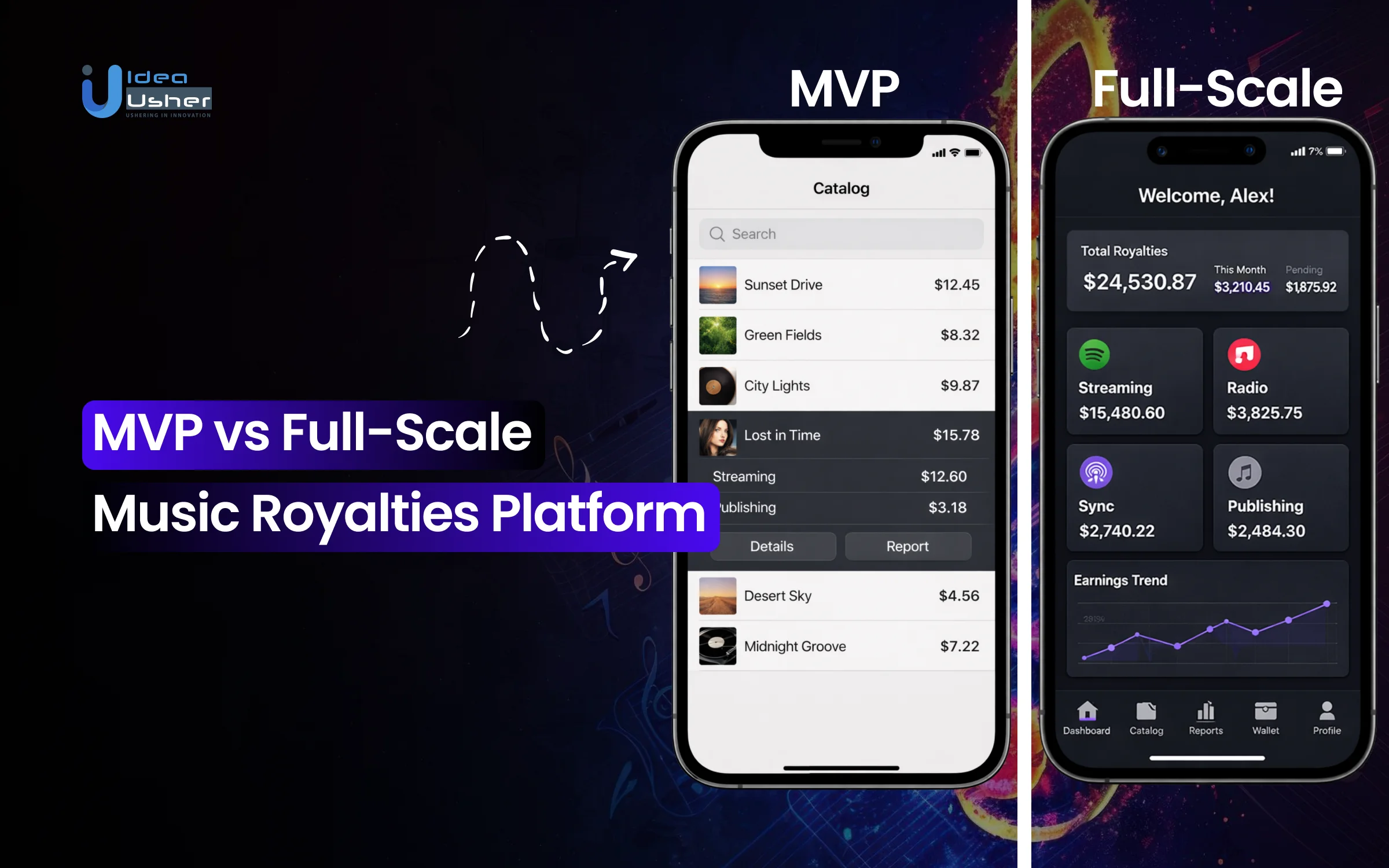
Building a music royalties platform often starts with a fundamental choice between speed and completeness. Teams need to validate demand, workflows, and revenue logic quickly, while also accounting for the long-term complexity of rights management and payouts. This tension is at the center of the MVP vs Full-Scale Music Royalties Platform decision, where early experimentation must be weighed against the requirements of a production-ready system.
An MVP approach typically focuses on a limited set of royalty sources, simplified user roles, and basic payout logic to validate assumptions and gather feedback. A full-scale platform requires broader rights coverage, automated reporting, compliance workflows, and infrastructure designed to support accuracy and scale over time. The difference is not just feature depth, but how systems evolve without breaking as usage grows.
In this blog, we compare an MVP vs Full-Scale Music Royalties Platform by outlining their scope, development effort, and operational implications, helping you understand when to start lean and when a more complete build is necessary.

Understanding Music Royalties Platforms and Their Core Purpose
A music royalties platform centrally tracks, calculates, reports, and distributes royalties from music use, supporting the industry by ensuring rights holders get accurate payments based on usage.
At its core, the platform connects music usage and ownership data to calculate accurate payouts. Usage comes from streaming services, broadcasters, social media, and digital stores, while ownership data identifies rights holders and their shares, enabling proper royalty distribution.
A. Core functions of a music royalties platform
A credible music royalties platform typically performs several essential functions:
- Royalty data ingestion: The platform collects large volumes of usage data from multiple sources. This data often arrives in different formats and reporting standards.
- Rights and ownership management: The system stores information about songwriters, performers, publishers, and labels. It defines splits, territories, and rights types such as mechanical, performance, and neighboring rights.
- Royalty calculation logic: The platform applies predefined rules to calculate payouts. These rules depend on usage type, licensing agreements, regional laws, and contractual terms.
- Reporting and transparency: Users access detailed reports that explain where royalties come from, how the platform calculates them, and when payouts occur.
- Payment distribution: The platform processes payouts to rights holders using secure and auditable workflows.
B. Why this foundation matters before choosing MVP or full scale?
Understanding these core functions clarifies why the difference between an MVP vs full-scale music royalties platform extends beyond feature count. The decision influences data accuracy, compliance readiness, scalability, and long-term operational cost.
An MVP usually has limited functionalities, focusing on a single royalty type, few data sources, or simple ownership. A full platform handles complex ownership, large data, multiple territories, and strict reporting.
By defining what a music royalties platform must accomplish at a foundational level, this section establishes a clear baseline. It enables evaluation of MVP and full-scale approaches based on operational requirements rather than assumptions or surface-level features.
What Defines an MVP Music Royalties Platform?
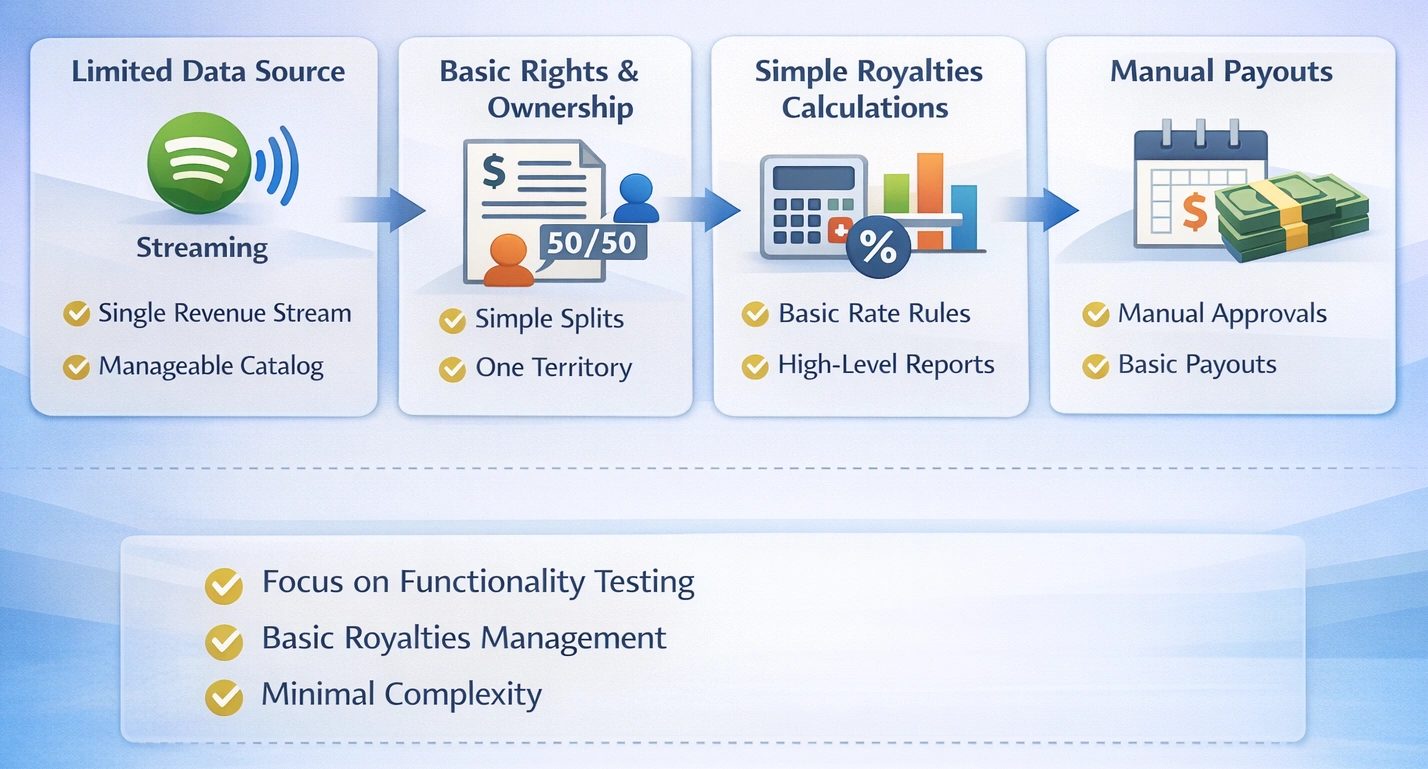
An MVP music royalties platform is a basic royalty management system designed to test functionality, workflows, and data handling with minimal complexity. Its main goal is to ensure core royalty operations work correctly before expanding features or infrastructure.
Instead of focusing on scale or advanced features, an MVP validates core royalty logic and system behavior. It supports a limited set of scenarios to ensure calculations, data flow, and reporting work correctly before adding broader coverage or complexity.
A. Core characteristics of an MVP music royalties platform
An MVP music royalties platform typically includes a focused set of capabilities:
- Limited data source integration: The platform ingests royalty data from one or a small number of sources, such as a single streaming service or distributor.
- Simplified rights and ownership structures: Ownership data usually supports basic splits and avoids complex scenarios like multi-territory rights, fractional ownership changes, or layered licensing agreements.
- Basic royalty calculation logic: The system applies straightforward calculation rules that reflect a narrow range of royalty types or contract terms.
- Essential reporting features: Reports provide high-level visibility into earnings, usage volume, and payout summaries rather than detailed breakdowns or historical analysis.
- Manual or semi-automated payout processes: Payment workflows may rely on manual approval steps or external payment tools instead of fully automated distribution.
B. What an MVP music royalties platform intentionally exclude?
An MVP music royalties platform deliberately avoids advanced functionality that increases system complexity and long-term maintenance effort. These exclusions align with environments where royalty workflows remain narrow in scope and operational risk stays low.
- Royalty tracking is limited to a single revenue stream, such as digital streaming or direct licensing
- Catalogs with a manageable number of works and clearly defined ownership splits
- Rights management focused on one territory or a small group of regions with similar licensing rules
- Reporting requirements centered on earnings visibility rather than audit-ready documentation
- Payment workflows that tolerate manual review and external payout processing
This level of limitation supports validation of core royalty logic without introducing compliance-heavy features or large-scale automation. It enables controlled testing of data accuracy and payout calculations before expanding system scope.
What Defines a Full-Scale Music Royalties Platform?
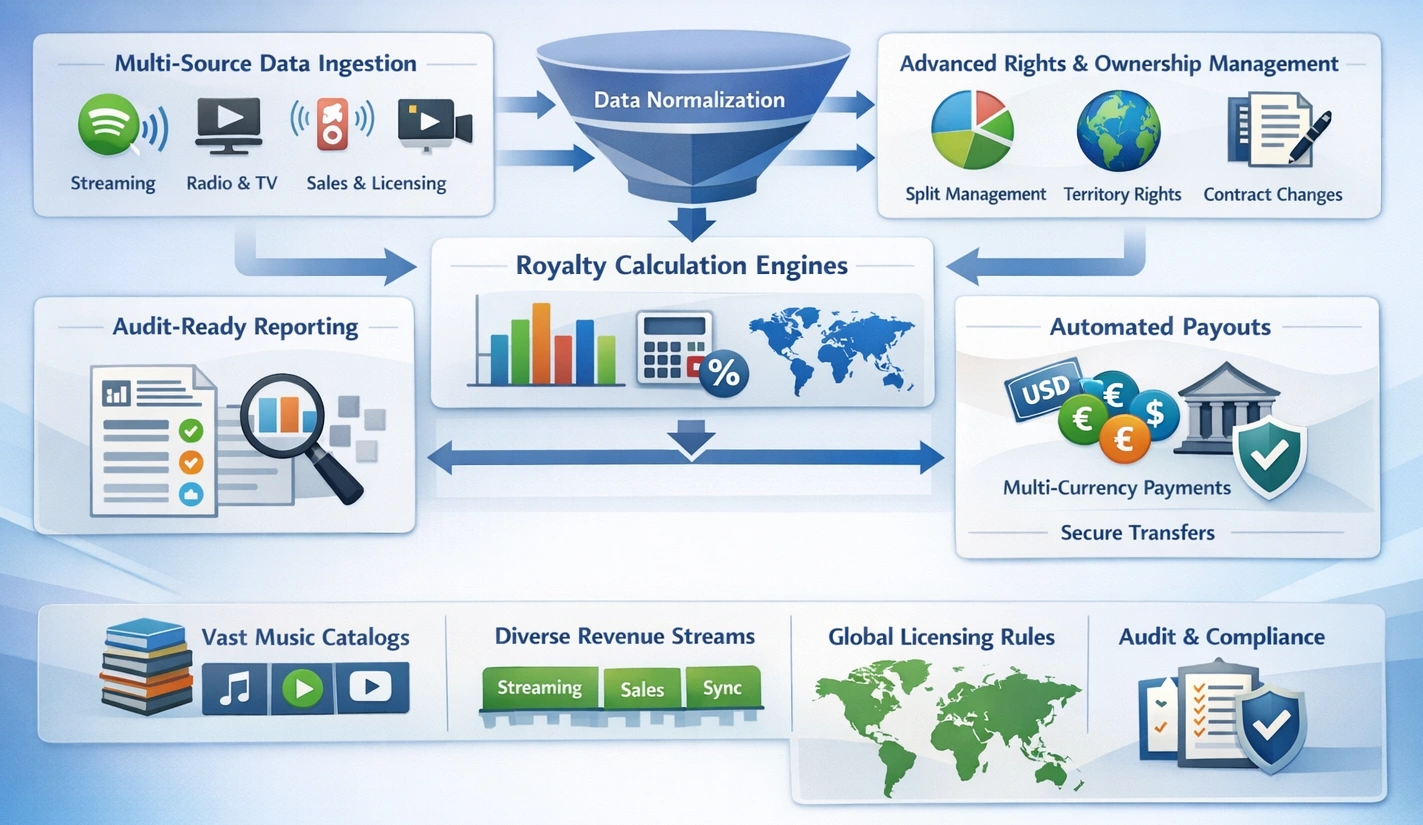
A full-scale music royalties platform manages end-to-end royalty operations for large catalogs, multiple rights types, and diverse revenue sources. Built as a production-grade system, it ensures long-term use, regulatory compliance, and high-volume data processing.
Unlike limited implementations, a full-scale platform manages royalty workflows at scale while maintaining accuracy, transparency, and operational efficiency. It supports complex ownership models and adapts to evolving licensing rules and market requirements.
A. Core capabilities of a full-scale music royalties platform
A full-scale music royalties platform includes a broad and integrated set of capabilities:
- Multi-source data ingestion and normalization: The platform processes usage data from streaming services, broadcasters, social platforms, sales, and licenses, standardizing inconsistent formats into a unified data model.
- Advanced rights and ownership management: The system supports complex ownership structures, including fractional splits, time-based ownership changes, sub-publishing arrangements, and territory-specific rights.
- Comprehensive royalty calculation engines: The platform applies sophisticated calculation rules that reflect diverse royalty types, contractual variations, rate cards, and regional regulations.
- Audit-ready reporting and reconciliation: Reports provide detailed breakdowns at track, territory, source, and rights-holder levels. Reconciliation tools help identify discrepancies and resolve reporting conflicts.
- Automated and scalable payout workflows: The system executes payouts across multiple currencies and payment methods while maintaining traceability and approval controls.
B. Operational environments suited for full-scale platforms
A full-scale music royalties platform operates in environments where royalty processing involves continuous data inflow, contractual variation, and strict accountability across stakeholders.
- Catalogs spanning thousands or millions of recordings with frequent metadata updates and ownership revisions
- Revenue streams covering streaming, broadcast, physical sales, sync licensing, user-generated content, and direct deals
- Rights structures that change over time due to transfers, acquisitions, or contractual renegotiations
- Territory-specific licensing rules that require differentiated calculation logic and reporting formats
- Payment obligations that demand multi-currency support, tax handling, and traceable payout histories
These conditions require systems that maintain data integrity, enforce calculation consistency, and support audit-level transparency across the royalty lifecycle.
Key Differences Between MVP and Full-Scale Music Royalties Platforms
The difference between an MVP and a full-scale music royalties platform shapes how data is processed, rights are managed, and royalties are reported. This section outlines how each approach impacts platform structure and operational readiness.
1. Scope and Feature Coverage
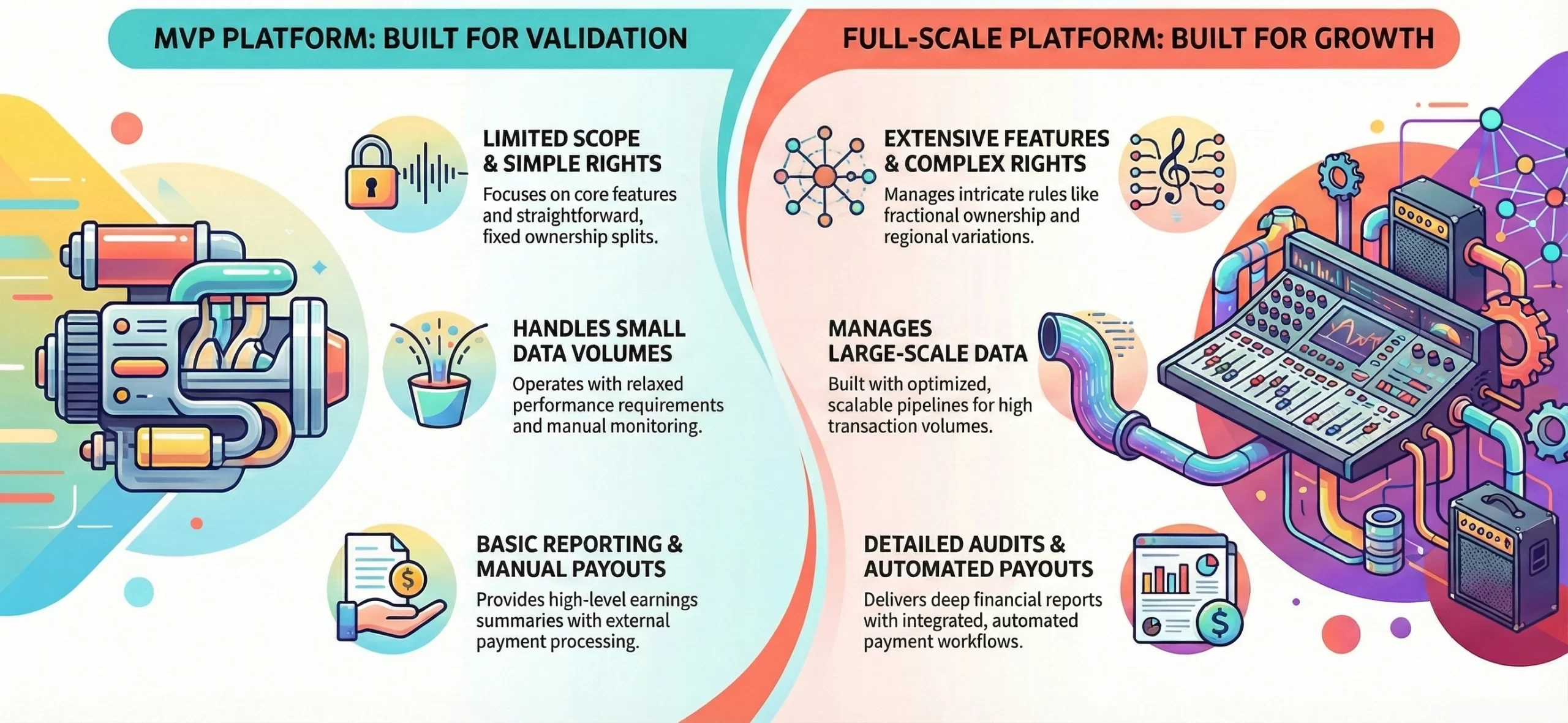
An MVP music royalties platform focuses on core features to process royalties within a limited scope. It supports basic data ingestion, simplified rights management, and high-level reporting to validate essential functions without addressing every operational scenario.
A full-scale music royalties platform offers extensive features for managing complex royalty operations, including advanced rights, multiple revenue streams, configurable calculations, and detailed reports. This broader scope supports long-term operational needs over short-term validation.
2. Data Volume and Performance Handling
An MVP platform processes relatively small volumes of royalty data and often operates with relaxed performance requirements. It may rely on simple batch processing and manual monitoring to manage data ingestion and calculations.
A full-scale platform handles continuous inflows of large data sets from multiple sources. It supports optimized data pipelines, scalable processing infrastructure, and performance monitoring to ensure timely calculations and reporting even under high transaction volume.
3. Rights Complexity and Ownership Management
An MVP music royalties platform usually supports straightforward ownership models with fixed splits and minimal variation. It avoids complex scenarios such as ownership changes over time or territory-based rights differences.
A full-scale music royalties platform manages intricate rights structures that include fractional ownership, time-bound agreements, sub-licensing, and regional variations. It tracks ownership history and applies rights logic accurately across all applicable use cases.
4. Reporting Depth and Financial Transparency
An MVP platform provides basic reporting focused on earnings summaries and usage totals. These reports help verify calculation logic but do not support deep analysis or audit requirements.
A full-scale platform delivers detailed, configurable reports that break down royalties by track, territory, source, and rights holder. It supports reconciliation, dispute resolution, and financial transparency across reporting periods.
5. Automation, Payouts and Operational Control
An MVP music royalties platform often relies on manual or semi-automated payout processes. Approval workflows and payment execution may occur outside the platform using external systems.
A full-scale music royalties platform automates payout workflows, supports multiple currencies, and enforces approval controls. It maintains clear payout histories and operational logs to support accountability and financial governance.
6. Scalability and Long-Term Platform Maintenance
An MVP platform prioritizes speed of development over long-term scalability. It supports controlled growth but requires architectural changes as operational demands increase.
A full-scale platform is designed for sustained growth and ongoing maintenance. It supports system upgrades, regulatory changes, and expanding data volume without disrupting core royalty operations.
How $752M Paid Streaming Subscribers Drive Fractional Music Ownership Returns?
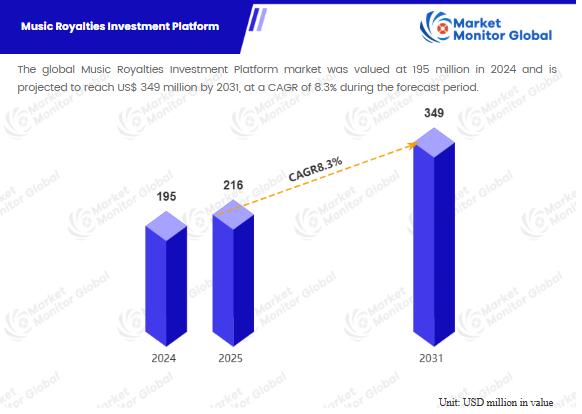
The global market for music royalties investment platforms is projected to reach approximately US$349 million by 2031, expanding at a compound annual growth rate of about 8.3 percent. This growth highlights increasing interest in music royalties as a structured income stream and a growing appetite for alternative, asset-backed investment opportunities.
Paid music streaming subscriptions are rising globally, with 752 million paid users and 818 million total subscribers in 2024, as almost 85 million new users join annually. This growth boosts royalty transaction volume, increasing data throughput and payout complexity.
A. Independent Artist Growth Increasing Platform Complexity
The rapid rise of independent artists has reshaped how music royalties platforms operate. As creators retain greater control over their catalogs, platforms must support more direct, frequent, and fragmented royalty workflows.
- Self-managed catalog ownership: Independent artists maintaining master and publishing rights heighten need for platforms that facilitate direct royalties, split management, and payouts.
- Operational reliance on platforms: Without label infrastructure, creators depend on royalty platforms for reporting, compliance handling, and cross-territory royalty administration.
- Multi-source income aggregation: Royalties increasingly originate from streaming, social platforms, licensing, and performance usage, requiring centralized aggregation and consolidated financial visibility.
- Global-first distribution patterns: Independent releases reach international markets by default, introducing territory-based complexity that platforms must manage accurately at scale.
B. Why This Growth Supports Full-Scale Platform Evolution?
As participation and royalty volume increase, music royalties platforms benefit from revenue models that scale with long-term activity rather than short-term performance spikes.
- Recurring revenue tied to active catalogs: Platforms generate sustained income through subscriptions, administration fees, or royalty management percentages linked to active artists and catalogs.
- Transaction-driven monetization: Payout processing, withdrawals, and currency handling create consistent transaction-level revenue as royalty activity grows.
- Demand for financial intelligence tools: Earnings analytics, reporting dashboards, and forecasting features become essential as creators manage music as a long-term financial asset.
- Long-term platform retention: Mature catalogs continue generating royalties over time, encouraging prolonged platform usage and compounding operational value.
Together, streaming growth and independent artist expansion reinforce the need for full-scale music royalties platforms. While MVP systems may validate early workflows, sustained market growth increasingly requires scalable infrastructure, automated processing, and robust reporting capabilities to support evolving royalty ecosystems.
Operational Factors That Influence Platform Choice
Several operational factors shape whether an organization operates effectively with an MVP music royalties platform or requires a full-scale system. These factors relate to data behavior, rights structure, and operational maturity rather than feature preference.

1. Catalog size and metadata stability
Catalog size directly affects system requirements. Smaller catalogs with stable metadata and infrequent updates place limited strain on royalty processing workflows. As catalogs expand and release activity increases, metadata corrections, ownership updates, and version control become more frequent and require stronger system controls.
2. Revenue stream diversity and predictability
Platforms handling a single or predictable revenue stream operate with fewer calculation and reconciliation challenges. As revenue sources diversify across streaming, broadcast, licensing, and user-generated content, systems must normalize varied reporting formats and apply different calculation logic consistently.
3. Rights complexity and change frequency
Stable ownership structures reduce operational risk and simplify royalty processing. Frequent ownership changes, time-bound agreements, and territory-specific rights increase calculation complexity and demand systems that track historical changes accurately.
4. Reporting obligations and compliance pressure
Basic reporting supports internal validation and payout verification. External reporting obligations, partner audits, and regulatory requirements introduce the need for detailed, traceable, and reproducible financial records across reporting periods.
5. Operational maturity and process readiness
Early-stage operations often rely on manual oversight and controlled workflows. As operations mature, dependency on manual intervention introduces risk, delays, and inconsistencies. Mature environments require automation, monitoring, and structured controls to maintain accuracy at scale.
Technical Considerations for MVP vs Full-Scale Development
Technical decisions vary significantly when building an MVP vs full-scale music royalties platform, influencing architecture, integrations, and data handling. This section outlines the technical factors that shape development complexity and long-term stability.
| Technical Dimension | MVP Music Royalties Platform | Full-Scale Music Royalties Platform |
| System Architecture | Narrow architecture where ingestion, calculation, and reporting often share dependencies | Modular architecture that separates ingestion, processing, calculation, reporting, and payouts |
| Data Model Design | Simplified schemas built for current use cases with limited flexibility | Extensible data models that support versioning, historical states, and future expansion |
| Ownership Change Handling | Ownership updates often require manual recalculation or data correction | Ownership changes apply with effective dates while preserving historical royalty accuracy |
| Calculation Rule Management | Hard-coded or minimally configurable royalty logic | Configuration-driven or rule-based logic that adapts to contracts, territories, and revenue types |
| Data Processing Strategy | Sequential batch processing with limited concurrency | Parallelized processing pipelines built for high-volume and overlapping reporting cycles |
| Integration Robustness | Assumes stable formats and predictable delivery from data sources | Designed to handle delayed files, corrected reports, and inconsistent source data |
| Error Detection and Recovery | Relies on manual identification and reprocessing | Uses automated validation, anomaly detection, and targeted reprocessing |
| Observability and Monitoring | Basic logging primarily for debugging | Continuous monitoring, metrics, and alerts for operational control |
| Long-Term Maintainability | Accepts technical shortcuts to accelerate early delivery | Prioritizes maintainability to support long-term system evolution |
Cost Comparison of MVP vs Full-Scale Music Royalties Platform
Cost planning differs widely between an MVP vs full-scale music royalties platform, driven by feature depth, compliance scope, and scalability needs. This section outlines how development choices influence overall investment requirements.
1. MVP Platform Development
An MVP music royalties platform prioritizes validating core royalty workflows with a controlled scope and limited technical complexity. Development costs reflect a focus on speed, essential functionality, and manageable operational risk.
| Cost Dimension | Description | Estimated Cost |
| Core Platform Development | Implementation of basic data ingestion, simplified rights management, royalty calculation, and summary reporting | $30,000 – $60,000 |
| Data Modeling and Setup | Design of simple schemas for works, ownership splits, and usage records | $5,000 – $10,000 |
| Initial Integrations | Integration with one or two royalty data sources using fixed reporting formats | $5,000 – $15,000 |
| Testing and Validation | Validation of core calculation logic and limited scenario testing | $5,000 – $10,000 |
| Infrastructure Setup | Basic cloud infrastructure for development and early production use | $3,000 – $8,000 |
| Project Management and Coordination | Planning, coordination, and delivery oversight for a short development cycle | $5,000 – $10,000 |
Total Estimated Cost: $62,000 – $118,000+
This cost range reflects building a focused MVP that validates core royalty workflows while keeping the platform ready for structured growth.
What this cost covers
- Core royalty workflows including limited data ingestion, simplified rights management, and basic royalty calculations
- Clean and extensible data models designed to support future ownership complexity
- Integration with one or two royalty data sources using stable reporting formats
- Foundational reporting for earnings visibility and calculation validation
- Basic infrastructure setup suitable for early users and controlled data volume
- Targeted testing to confirm data accuracy and processing logic
Consult with IdeaUsher helps development teams plan MVPs with scalability. The platform is designed for smooth transitions into a full-scale music royalties platform after user adoption and data growth, avoiding major rework.
2. Full-Scale Music Royalties Platform Development
A full-scale music royalties platform manages long-term royalty operations across large catalogs, various revenue streams, and complex rights. Development costs account for scalability, automation, and compliance needs.
| Cost Dimension | Description | Estimated Cost |
| Core Platform Development | Modular system design covering ingestion, processing, calculation, reporting, and payouts | $80,000 – $100,000 |
| Advanced Data Modeling | Extensible schemas supporting historical ownership, territory rules, and metadata versioning | $20,000 – $40,000 |
| Multi-Source Integrations | Integration with multiple data providers, handling corrections, delays, and format variations | $30,000 – $70,000 |
| Calculation Engine and Rule Management | Configuration-driven royalty logic across contracts, territories, and revenue types | $25,000 – $50,000 |
| Testing, Validation, and QA | Extensive scenario testing across ownership changes, territories, and reporting cycles | $20,000 – $40,000 |
| Infrastructure and DevOps Setup | Scalable infrastructure, monitoring, backups, and deployment pipelines | $15,000 – $35,000 |
| Security and Access Controls | Role-based access, audit logs, and data protection measures | $10,000 – $20,000 |
| Project Management and Delivery Oversight | Coordination of extended development timelines and multiple workstreams | $15,000 – $30,000 |
Total Estimated Cost: USD 120,000 to 180,000+
This cost range reflects the development of a production-grade music royalties platform built for scale, compliance, and long-term operational stability.
What this cost covers
- Modular platform architecture supporting ingestion, processing, calculation, reporting, and payouts
- Advanced data models for complex ownership structures, historical changes, and territory-based rights
- Integration with multiple royalty data sources, including handling of corrections and delayed reports
- Configurable royalty calculation logic across contracts, regions, and revenue streams
- Extensive testing and validation across ownership, territory, and reporting scenarios
- Ongoing readiness for platform evolution, regulatory changes, and operational growth
Consult with IdeaUsher to define scope, validate cost assumptions, and align technical architecture with operational goals for long-term royalty operations with high data volume and compliance requirements.
Strategic Takeaways for Building a Music Royalties Platform
Building a music royalties platform involves balancing speed, accuracy, and long-term scalability. The following takeaways summarize the strategic patterns that emerge when comparing MVP and full-scale approaches.
- Start with validation, not completeness: Early platforms succeed by confirming royalty logic and data accuracy before expanding scope or automation.
- Design data models for change, not stability: Ownership structures, contracts, and territories evolve over time, making flexible data modeling essential.
- Treat scalability as a progression, not a switch: Platforms benefit from gradual expansion that aligns with real operational pressure rather than anticipated complexity.
- Align technical depth with operational maturity: Automation, monitoring, and compliance features become valuable only when data volume and risk justify them.
- Plan MVP architecture with a full-scale future in mind: Clean separation of core components reduces rework when transitioning to broader platform capabilities.
Conclusion
Choosing between an MVP and a full product is less about speed and more about clarity. An MVP vs Full-Scale Music Royalties Platform decision depends on audience readiness, regulatory needs, and long term vision. An MVP helps validate demand and workflows with controlled risk, while a full scale platform supports scale, automation, and broader partnerships. When you understand what must be proven first versus what can evolve later, the choice becomes practical, measured, and aligned with sustainable growth rather than assumptions that guide responsible product investment decisions over time carefully.
Build Your Music Royalties Platform with IdeaUsher!
Building a music royalties platform requires aligning business goals, technical architecture, and scalability. IdeaUsher develops the platform in phases, validating core workflows early while preparing for future growth.
- Focus on clean and extensible data models during MVP development to support future ownership and rights complexity
- Implement flexible royalty calculation logic that can adapt to new revenue streams and contract structures
- Design platform architecture to avoid growth constraints as data volume and usage increase
- Enable smooth transition to a full-scale system through expanded integrations and improved data handling
- Strengthen rights management and introduce targeted automation without requiring disruptive reengineering
Explore our portfolio to see how we have supported music and fintech startups in launching robust digital platforms.
Connect with our team to discuss the right approach for building your music royalties platform.


FAQs
A.1. An MVP focuses on core royalty workflows to validate demand and user behavior, while a full-scale music royalties platform includes advanced automation, compliance layers, and scalability required for long-term operations and broader market participation.
A.2. You should build an MVP when validating market interest, testing royalty distribution logic, or onboarding early users. It allows faster launch, lower development cost, and clearer feedback before committing to complex features and regulatory-heavy infrastructure.
A.3. A full-scale platform is only required at launch if you target institutional partners, high transaction volumes, or strict compliance markets. Otherwise, starting with an MVP helps reduce risk while shaping the product based on real usage.
A.4. MVP development costs remain controlled by limiting features and integrations. A full-scale music royalties platform requires higher investment due to security, reporting, compliance, and scalability needs that support sustained growth and operational reliability.