 (+971) 8007 4267
 (+91) 946 340 7140
 (+1) 628 432 4305

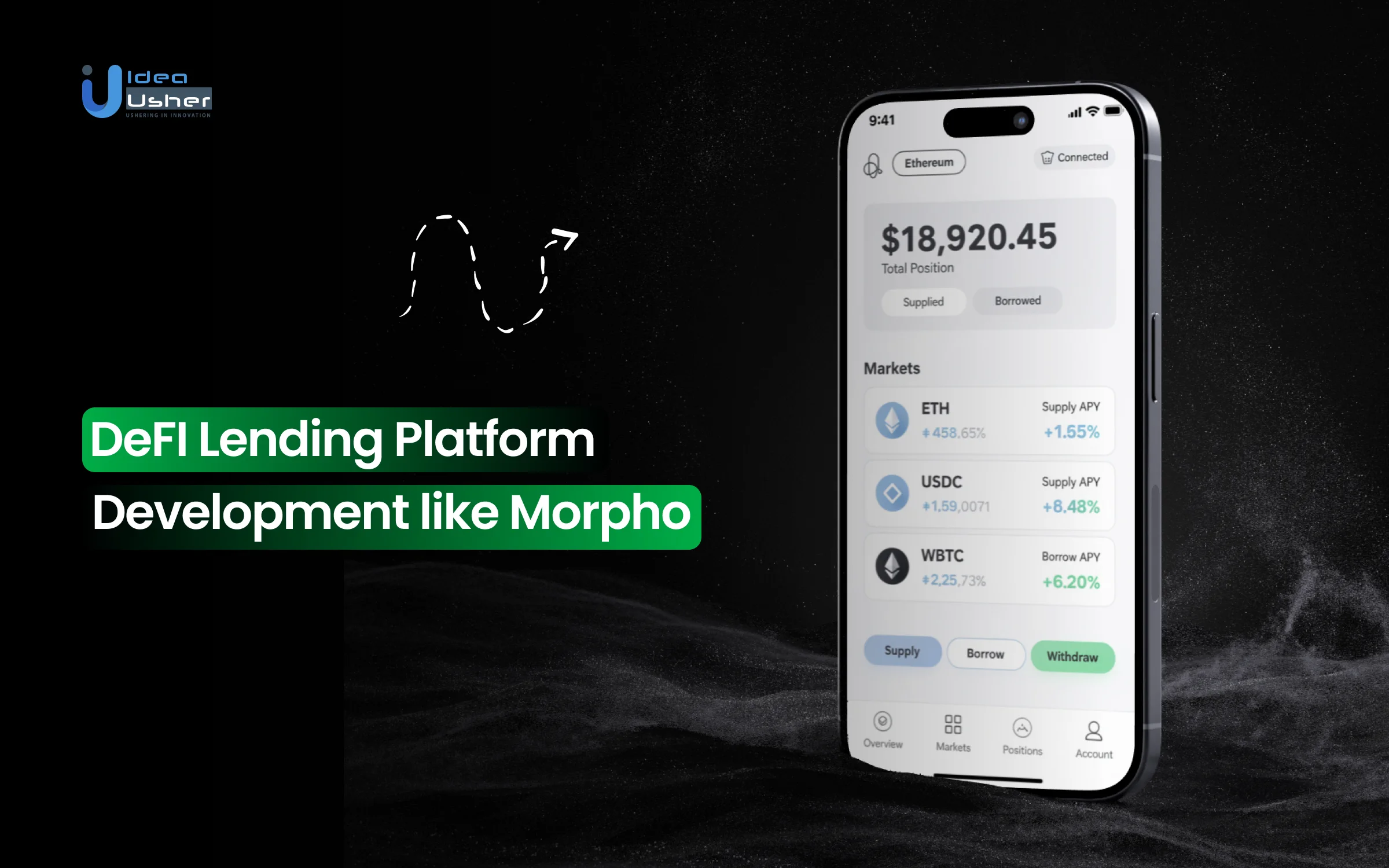
DeFi lending does not always need deeper liquidity pools to become more efficient. In some cases, inefficiencies come from how capital is matched, priced, and utilized within the protocol itself. This shift in thinking has driven interest in peer-to-peer and optimized lending models, shaping how teams approach morpho lending protocol development, where improving capital efficiency is as important as managing risk.
Rather than relying solely on pooled liquidity, protocols inspired by Morpho introduce mechanisms that match lenders and borrowers more directly while still leveraging existing DeFi infrastructure. Interest rate optimization, fallback liquidity, and dynamic matching logic all play a role in maintaining stability without sacrificing efficiency. Design decisions around these mechanisms determine how well the protocol performs across different market conditions.
In this blog, we explain DeFi lending platform development like Morpho by breaking down the core protocol mechanics, architectural choices, and execution considerations involved in building efficient, scalable, and resilient on-chain lending systems.
What is the DeFi Lending Platform, Morpho?
Morpho is a decentralized, non-custodial DeFi lending protocol enabling permissionless borrowing and lending through over-collateralized loans on Ethereum and EVM-compatible chains. Unlike pooled liquidity models, Morpho introduces a peer-to-peer matching layer that directly connects lenders and borrowers, improving capital efficiency with higher yields for lenders and lower rates for borrowers.
This DeFi lending platform features a modular, permissionless architecture with isolated markets and configurable parameters: collateral assets, LLTVs (liquidation loan-to-value ratios), interest rate models, and oracle sources. Core primitives include Morpho Markets for lending pairs and Morpho Vaults, which automatically allocate capital across markets based on risk strategies. Governed by the MORPHO DAO, these design choices make Morpho a flexible lending infrastructure.
- Decentralized Lending & Borrowing: Users can lend out digital assets (like USDC, ETH, etc.) to earn interest or borrow assets by providing over-collateralized crypto as security.
- Non-Custodial: Morpho doesn’t hold or control users’ funds; all assets are secured by trustless smart contracts on the blockchain.
- Peer-to-Peer Matching: Unlike traditional DeFi lenders that simply pool all assets together, Morpho tries to match lenders and borrowers directly whenever possible. This can improve yields for lenders and lower borrowing costs compared with standard lending pools.
- Fallback to Liquidity Pools: If a direct match isn’t available, Morpho seamlessly routes funds into established lending pools like Aave or Compound to keep capital productive.
A. Business Model – How It Operates
Morpho operates as a permissionless DeFi lending infrastructure focused on improving capital efficiency rather than acting as a single pooled lending app. Its model is built to serve users, developers, and institutions through modular, composable primitives.
- Peer-to-Peer Matching Layer: Matches lenders and borrowers directly when possible, tightening interest rate spreads compared to pool-only lending.
- Permissionless Isolated Markets: Anyone can deploy independent lending markets with custom collateral, LLTVs, interest models, and oracle configurations.
- Vault-Based Capital Allocation: Morpho Vaults aggregate lender capital and automatically allocate it across markets based on curated risk strategies.
- Non-Custodial & DAO-Governed: All assets remain in smart contracts, with protocol parameters governed by the MORPHO DAO.
B. Revenue Model – How It Generates Money
Morpho’s revenue model is intentionally lightweight and modular, prioritizing adoption and ecosystem growth over immediate protocol fees.
- No Active Protocol Fees: The core protocol does not currently take a cut of lending or borrowing interest.
- Vault-Level Fees: Vault curators can charge performance and/or management fees on yields generated for depositors.
- Ecosystem & Integrator Fees: Interfaces, distributors, and partners can earn fees by offering Morpho-powered lending products.
- Governance-Controlled Fee Switch: DAO governance can enable protocol-level fees per market, directing revenue to the Morpho treasury.
- Token-Aligned Value Capture: Increased protocol usage and fee activity across vaults indirectly strengthens the MORPHO token’s economic value.
How Morpho Re-Architects DeFi Lending Using P2P Matching?
Morpho redefines DeFi lending by adding a peer-to-peer matching layer on top of protocols. It directly connects lenders and borrowers to optimize rates while maintaining pooled liquidity security.

1. Pool Inefficiency in Traditional Lending Models
Traditional DeFi lending suffers from spread inefficiencies where lenders earn less than what borrowers pay, with the difference captured as protocol revenue. This creates suboptimal rates for both sides: lenders accept lower yields while borrowers pay premium rates despite sufficient counterparty availability.
2. Morpho’s Dual-Layer Architecture
Morpho operates through a smart matching engine that sits between users and underlying protocols. This meta-layer continuously scans for compatible lender-borrower pairs, creating direct credit lines when matches exist, while automatically falling back to the underlying pool for unmatched positions.
3. P2P Matching Engine Mechanics
The system maintains a real-time order book of supply and demand positions. When a lender’s supplied asset matches a borrower’s requested loan at compatible rates, Morpho creates a direct P2P position, bypassing pool intermediation and allowing both parties to share the efficiency gains through improved rates.
4. Liquidation Mechanism Integration
Liquidations occur through the underlying protocol’s mechanisms, with Morpho’s layer automatically rebalancing matched positions during liquidation events. This ensures P2P positions maintain the same security guarantees as direct pool participation.
5. L2-Native Optimizations
On Layer-2, Morpho’s matching engine achieves sub-second position updates with minimal gas costs. This enables more frequent rebalancing and finer-grained rate optimization, making P2P matching economically viable for smaller positions previously excluded by gas constraints.
6. Tokenomics & Incentive Alignment
The MORPHO token governs protocol upgrades and fee parameters while incentivizing liquidity provision to underserved markets. A portion of efficiency gains accrues to token holders, aligning ecosystem growth with value capture.
How Does Liquidation Work in the DeFi Lending Platform Morpho?
Liquidation in Morpho is deliberately designed to optimize capital efficiency without redefining risk enforcement. Instead of introducing a separate liquidation system, Morpho aligns its peer-to-peer layer with the liquidation logic of the underlying lending protocol, ensuring solvency while preserving P2P benefits.
1. Liquidation Inherited From Base Protocol
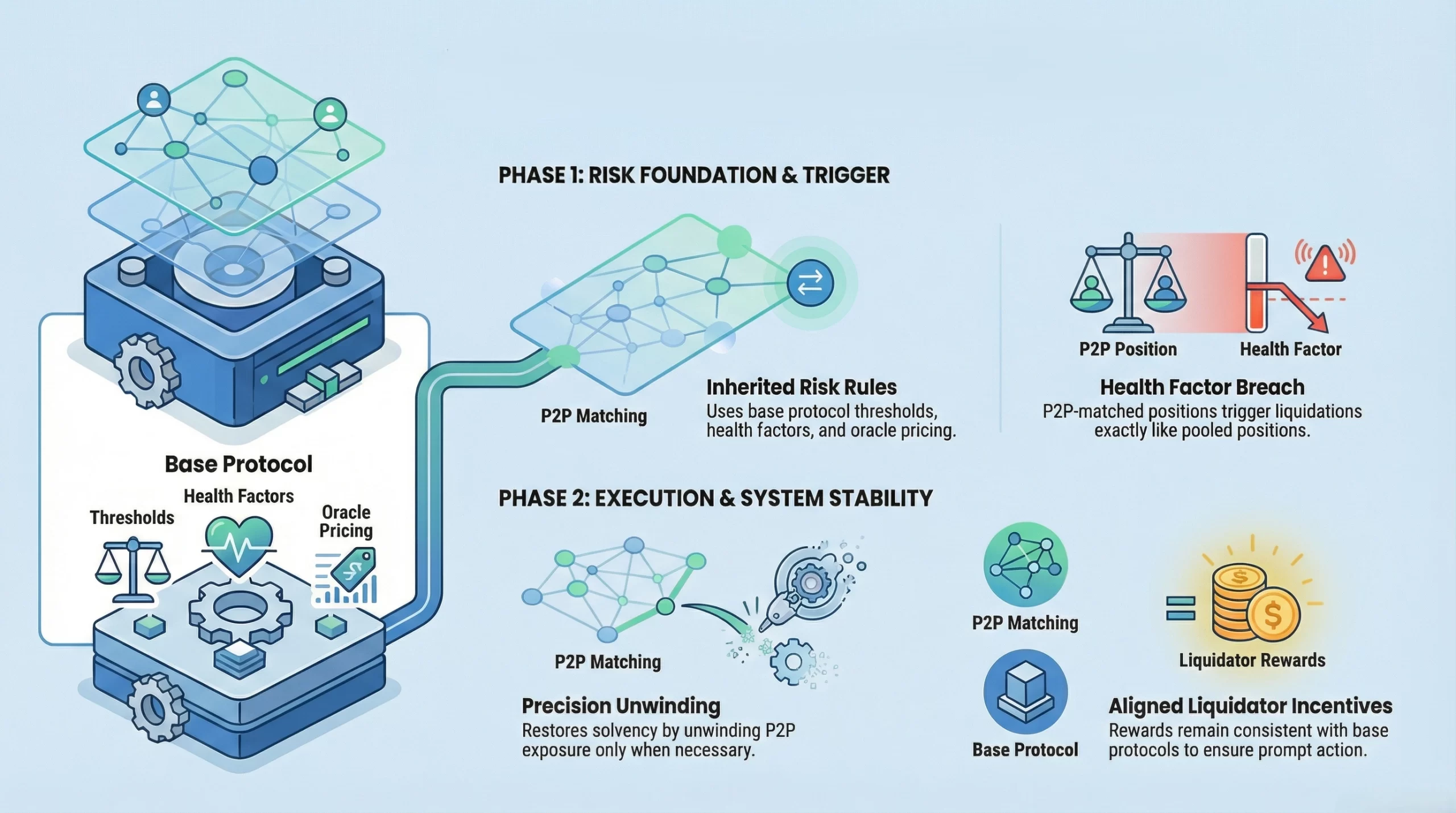
Morpho does not implement its own liquidation rules. All collateral thresholds, health factors, oracle pricing, and penalties are inherited from the underlying protocol. P2P-matched positions remain fully subject to base protocol liquidation conditions, ensuring no deviation from established risk guarantees.
2. P2P Positions Remain Liquidatable
When matched peer-to-peer, Morpho maintains synchronized internal accounting mirroring the base protocol’s debt and collateral state. If a borrower’s health factor falls below the threshold, the matched position is treated identically to a pooled position, allowing liquidators to act without P2P-specific logic.
3. Liquidation Preserves P2P Matching
During liquidation events, Morpho prevents race conditions or accounting mismatches between matched and unmatched liquidity. Partial liquidations preserve remaining matched positions where possible, fully unwinding P2P exposure only when required to restore solvency.
4. Minimizing Systemic Risk
By delegating liquidation enforcement to proven base protocols, Morpho avoids duplicating complex risk logic and reduces audit surface area. The P2P layer optimizes rate distribution, not credit enforcement. This ensures capital efficiency improvements never compromise liquidation reliability, even during extreme volatility.
5. Liquidator Incentive Alignment in a P2P
Even with peer-to-peer matching, liquidator incentives remain consistent because liquidation rewards are calculated using the base protocol’s rules. This ensures liquidators are economically motivated to act promptly, preventing stalled liquidations or solvency gaps caused by reduced incentives in P2P-matched positions.
Why DeFi Lending Platform Gaining Popularity?
The global Decentralized Finance (DeFi) market is projected to hit USD 616.1 billion by 2033, increasing from USD 21.3 billion in 2023 with a CAGR of 40% from 2024 to 2033. This swift growth is driven by rising demand for permissionless financial services, yield-generating products, and on-chain credit markets.
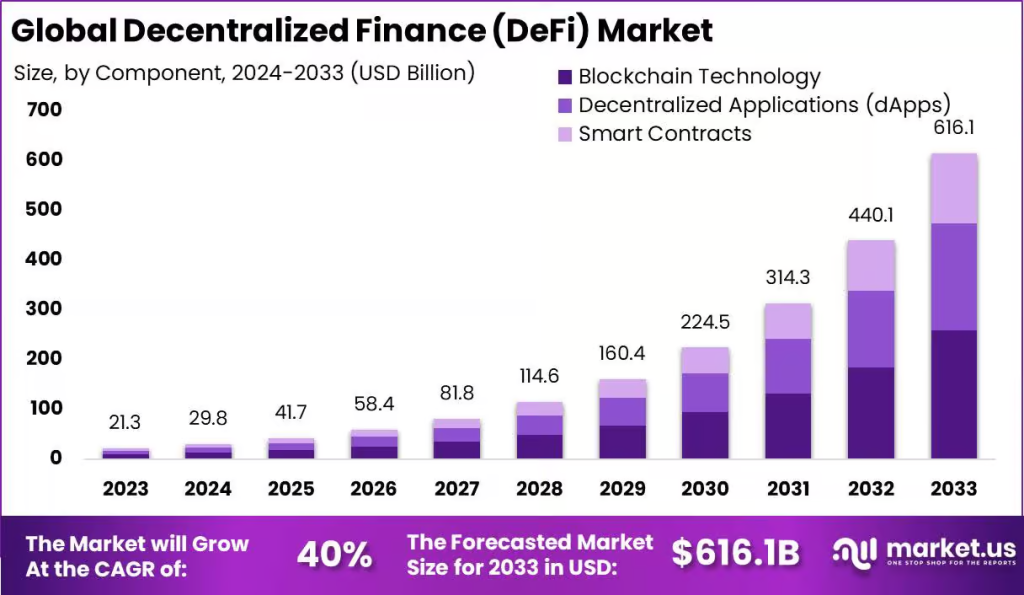
Within this broader expansion, the DeFi lending segment is gaining a larger share of the ecosystem. Over a 13-month period, lending protocols increased their contribution from 16.6 percent to 21.3 percent of total DeFi TVL, highlighting stronger user reliance on decentralized borrowing and yield-driven lending markets.
The rapid adoption of Morpho highlights this trend. Its hybrid model blends peer-to-peer matching with pooled liquidity, improving capital efficiency and driving strong user growth.
- Scale & Capital: Morpho achieved $6.8 billion TVL (January 2026) with total deposits surpassing $13 billion, representing ~5.2% market share among top lending protocols by late 2025.
- User Adoption & Strategy: User base grew from 67,000 to 1.4 million in 2025, capturing 44% of monthly active users in DeFi lending (H2 2025). The “DeFi mullet” strategy onboarded mainstream users via CEX integrations (Coinbase, Crypto.com, Gemini).
- Institutional & RWA Focus: Strategic focus on regulated institutions and RWAs drove collateral deposits to $400 million (Q3 2025), with partnerships including Société Générale-Forge.
- Governance & Risks: MORPHO token supply is 1 billion, with 35.8% in DAO treasury. Key risks include reliance on major integrators and technical complexity of upcoming upgrades.
The success of protocols like Morpho underscores a key driver of DeFi lending’s popularity: the ability to offer capital-efficient yields and accessible credit by innovating on traditional models, attracting both retail and institutional capital into the on-chain economy.
Core Features of DeFi Lending Platform Like Morpho
Morpho lending protocol development focuses on peer-to-peer matching, improved capital efficiency, and secure fallback liquidity. These features enable optimized interest rates while maintaining protocol stability, transparency, and compatibility with established DeFi lending infrastructure.

1. Peer-to-Peer (P2P) Matching Engine
A continuous bilateral matching algorithm operates as a stateful off-chain order book with on-chain settlement. It identifies counterparty complementarity, directly matching lender supply with borrower demand to create isolated credit lines that bypass intermediary pools and eliminate spread inefficiencies.
2. Hybrid Pool Fallback System
A fail-safe liquidity layer redirects unmatched capital to protocols, guaranteeing 100% capital utilization with baseline yield. The system continuously monitors the P2P order book, dynamically reallocating funds based on real-time matching probability and gas-cost optimization.
3. Rate Optimization & Spread Distribution
The protocol employs dynamic spread-splitting, algorithmically distributing efficiency gains between matched peers. Distribution weights adjust based on market tightness and counterparty scarcity, using a Vickrey-style auction model to approximate market-clearing prices without front-running risks.
4. Gas-Efficient Order Book
The system uses zk-SNARK-verified order batching and Merkle root settlements for viable micro-transactions. Gasless order placement and cancellations enable sub-second matching cycles on L2s, turning gas into a negligible settlement fee and enabling trade granularity previously exclusive to centralized order books.
5. Protocol Abstraction & Integration
The platform acts as a meta-layer, interacting with underlying protocols via standardized adapter contracts. This abstraction captures battle-tested collateral logic, oracle feeds, and liquidation triggers from established protocols, inheriting their security while innovating on capital allocation.
6. Position Manager & Smart Router
Each user interacts with a stateful smart contract wallet (position manager) holding assets and debt positions. This manager autonomously executes optimal routing: fulfilling P2P matches at superior rates or defaulting to the underlying pool, managing complex state without user intervention.
7. Liquidation Relay Mechanism
During liquidation events, the platform’s relayer first attempts to unwind the P2P match internally, allowing the peer lender to acquire collateral at a discount. If this fails, it broadcasts the liquidation publicly, ensuring solvency without creating novel liquidation risks.
8. Governance-Minimized Architecture
Governance is restricted to parameter curation: allowlisting protocols or adjusting fee splits. Interest rates are discovered, not set, minimizing attack surfaces and friction. Critical upgrades use time-locked, multi-sig mechanisms for adapter updates, keeping core matching logic immutable.
9. Ecosystem Interoperability & Integration
The platform mints standard ERC-4626 vault shares or wrapped aTokens/cTokens to represent user positions, ensuring seamless DeFi ecosystem integration. Yield aggregators, leverage farmers, and portfolio managers integrate without custom code, treating it as another liquidity source.
10. Cross-Chain & Layer-2 Native Design
The architecture is built for a multi-chain world. The off-chain matching engine is chain-agnostic, sourcing liquidity across L2s and alternative L1s. Settlement occurs on the chain where the underlying pool resides, using canonical bridges and cross-chain messaging to create a unified liquidity network.
11. Real-Time Market & Rebalancing
An AMM module provides continuous liquidity for hard-to-match assets, using a curve bonding mechanism funded by protocol fees to offer near-instant matches at slightly less optimal rates. This CLOB-AMM balance ensures user experience isn’t sacrificed for perfect efficiency.
Morpho Lending Protocol Development Process
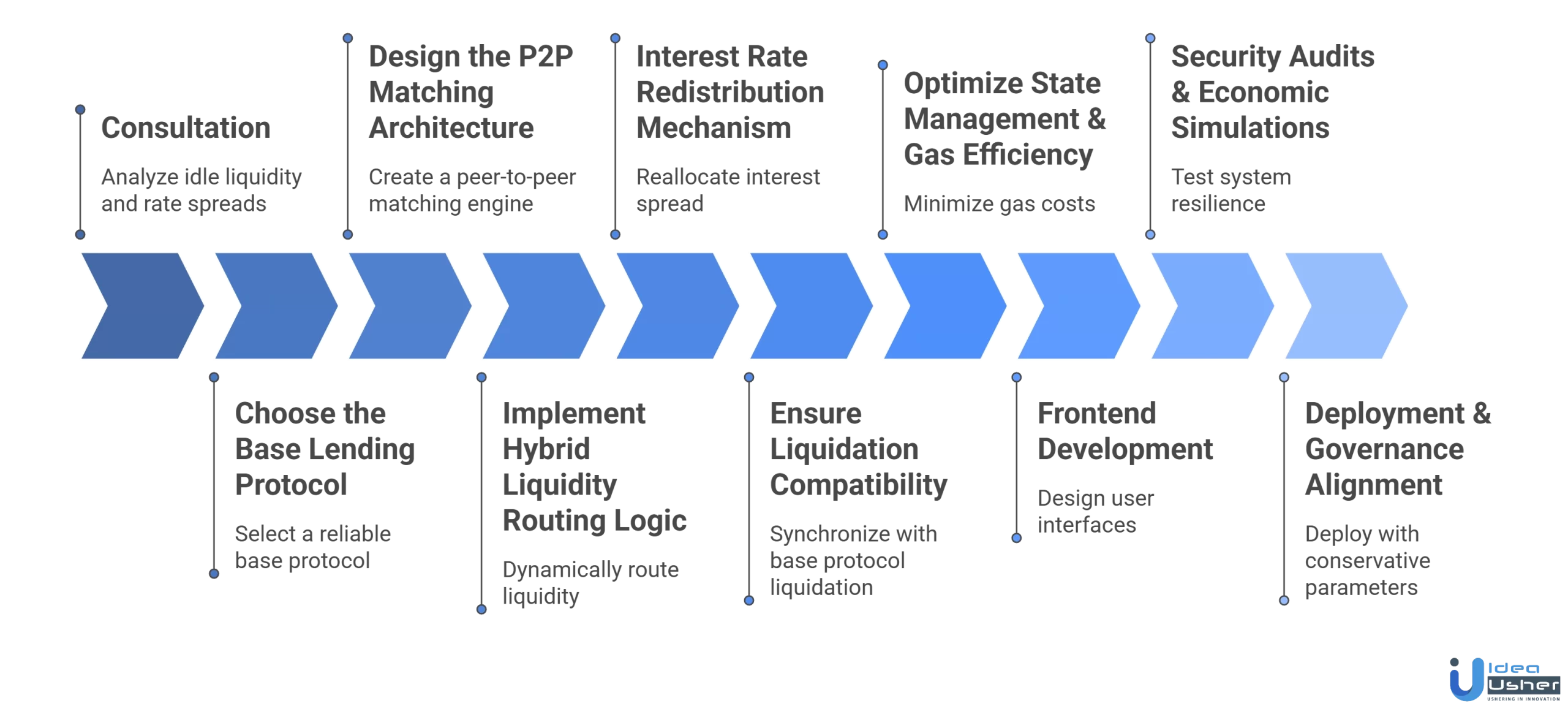
Morpho lending protocol development requires a precise balance between peer-to-peer efficiency and protocol-level risk controls. Our developers follow a structured approach that ensures secure smart contracts, optimized capital utilization, and seamless integration with underlying lending pools.
1. Define the Capital Efficiency Objective
We start by clearly defining the capital efficiency problem the protocol aims to solve. Our developers analyze idle liquidity, rate spreads, and utilization inefficiencies in pooled lending systems, then translate these findings into measurable targets such as improved APY, reduced borrowing costs, and higher utilization.
2. Choose the Base Lending Protocol
We carefully evaluate and select a base lending protocol that provides deep liquidity, reliable oracles, and proven liquidation mechanisms. Our developers treat this base layer as the settlement and risk foundation, ensuring all P2P activity inherits its security guarantees.
3. Design the P2P Matching Architecture
Our developers design a peer-to-peer matching engine that operates above the base protocol. We define matching priority rules, partial fill logic, and rematching behavior, ensuring fair allocation while keeping on-chain logic deterministic and auditable.
4. Implement Hybrid Liquidity Routing Logic
We build routing logic that dynamically determines whether liquidity should be matched peer-to-peer or routed to the underlying pool. Our developers ensure users always earn yield or access liquidity, even when P2P matches are unavailable or incomplete.
5. Interest Rate Redistribution Mechanism
We implement redistribution logic that reallocates the base protocol’s interest spread between matched lenders and borrowers instead of introducing new interest rates. This allows our developers to improve rates without altering underlying risk assumptions.
6. Ensure Liquidation Compatibility
Our developers design matched positions to remain fully compatible with the base protocol’s liquidation framework. We synchronize health factors, collateral thresholds, and oracle pricing to ensure P2P matching never interferes with solvency enforcement.
7. Optimize State Management & Gas Efficiency
We optimize storage layouts, rematching triggers, and batch updates to keep gas costs predictable. Our developers focus on minimizing state churn during high activity while preserving accurate accounting for matched and unmatched positions.
8. Frontend & UX for Hybrid Positions
We design user interfaces that clearly communicate blended rates, matching status, and fallback behavior. Our developers prioritize transparency, allowing users to understand how much of their position is P2P-matched versus pool-based, without exposing protocol complexity.
9. Security Audits & Economic Simulations
Beyond code audits, we run extensive economic simulations to test rematching behavior under liquidity shocks, rate volatility, and oracle delays. Our developers validate that capital efficiency gains do not introduce hidden systemic risk.
10. Deployment & Governance Alignment
We deploy the protocol with conservative parameters, asset caps, and rematching limits. Our developers align governance processes with the base protocol to adapt smoothly to parameter updates, upgrades, and long-term ecosystem changes.
Cost of Morpho DeFi Lending Platform Development
The cost of Morpho lending protocol development depends on peer matching complexity, security requirements, and integration depth with base protocols. Budgets vary based on smart contract scope, audits, and long-term scalability planning.
| Development Phase | What Our Developers Deliver | Estimated Cost |
| Capital Efficiency & Financial Modeling | Capital efficiency objectives, P2P optimization logic, rate-spread redistribution models, utilization simulations | $12,000 – $22,000 |
| Base Lending Protocol Selection & Integration | Base protocol evaluation, integration strategy, compatibility checks for liquidation, oracles, and governance | $8,000 – $15,000 |
| P2P Matching Architecture Design | Matching priority rules, partial fill logic, rematching strategies, deterministic on-chain design | $15,000 – $25,000 |
| Hybrid Liquidity Routing Logic | P2P vs pool routing mechanisms, fallback handling, liquidity guarantees | $12,000 – $22,000 |
| Interest Rate Redistribution Engine | Spread redistribution logic, blended rate calculation, rate fairness enforcement | $10,000 – $18,000 |
| Liquidation Compatibility | Health factor alignment, liquidation inheritance, oracle synchronization with base protocol | $10,000 – $18,000 |
| State Management & Gas Optimization | Storage optimization, rematching efficiency, batching logic, gas predictability | $10,000 – $20,000 |
| Frontend Development | P2P vs pool visibility, blended APY/APR display, real-time position tracking | $15,000 – $30,000 |
| Security Audits & Economic Simulations | Smart contract audits, rematching stress tests, liquidity shock simulations | $25,000 – $45,000 |
| Deployment & Governance Alignment | Conservative launch parameters, asset caps, governance hooks, upgrade planning | $8,000 – $15,000 |
Total Estimated Cost: $64,000 – $125,000+
Note: Building a Morpho-like DeFi lending platform is not about cloning an existing protocol. It requires precision financial engineering, a deep understanding of pooled risk models, and carefully optimized P2P execution.
Consult with IdeaUsher to assess your morpho lending protocol development use case and get a tailored development roadmap. Our developers prioritize correctness, safety, and long-term protocol viability, not shortcuts.
Challenges & How Our Developers Solve Them?
Morpho lending protocol development involves challenges across efficiency, security, and liquidity management. Our developers solve these through rigorous protocol design, audited smart contracts, and scalable architectures that support stable performance and predictable outcomes.
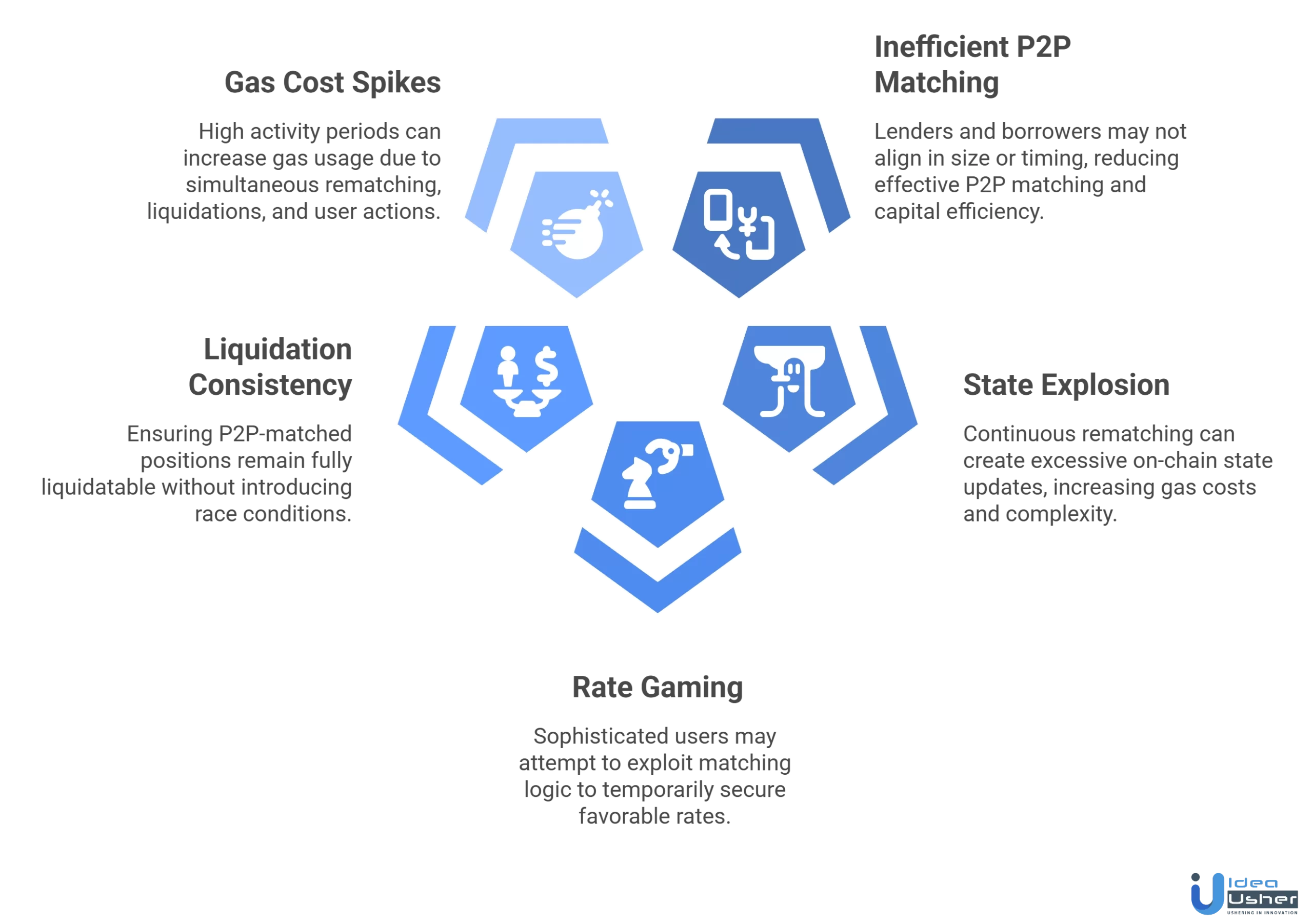
1. Inefficient P2P Matching
Challenge: In early stages or during market imbalance, lenders and borrowers may not align in size or timing, reducing effective P2P matching and capital efficiency.
How Our Developers Solve It: We design adaptive matching rules with partial fills and dynamic rematching. Unmatched liquidity seamlessly falls back to pools, while parameters are tuned post-launch using live utilization data.
2. State Explosion From Frequent Rematching
Challenge: Continuous rematching can create excessive on-chain state updates, increasing gas costs and complexity, especially during volatile periods.
How Our Developers Solve It: We optimize storage layouts, batch rematching operations, and introduce threshold-based triggers so rematching occurs only when it materially improves rates or utilization.
3. Rate Gaming and Matching Manipulation
Challenge: Sophisticated users may attempt to exploit matching logic to temporarily secure favorable rates or disrupt redistribution mechanics.
How Our Developers Solve It: We enforce deterministic matching rules, cooldown periods, and invariant checks that prevent opportunistic rematching while preserving fair rate distribution.
4. Liquidation Consistency Across Pool
Challenge: Ensuring P2P-matched positions remain fully liquidatable without introducing race conditions or accounting mismatches.
How Our Developers Solve It: We inherit liquidation logic directly from the base protocol and rigorously synchronize health factors and collateral accounting to maintain consistent liquidation behavior.
5. Gas Cost Spikes During Market Stress
Challenge: High activity periods can increase gas usage due to simultaneous rematching, liquidations, and user actions.
How Our Developers Solve It: We design gas-efficient execution paths, prioritize critical actions, and minimize non-essential state updates to keep the protocol functional under stress.
How Interest Rates Work in a DeFi Lending Platform like Morpho?
Interest rates in a Morpho-like DeFi lending platform are not set independently. Instead, they are derived, optimized, and redistributed through a peer-to-peer layer built on top of an existing pool-based money market.

1. Base Pool Rates as Reference
The platform anchors all pricing to the underlying lending protocol’s utilization-based interest rates. These pool rates define the upper and lower bounds for borrowing and lending, ensuring rate formation remains aligned with proven risk models.
2. Peer-to-Peer Rate Matching
When lenders and borrowers are directly matched, the protocol reallocates the interest spread between them. Lenders earn more than pool APY, while borrowers pay less than pool APR, without altering base risk assumptions.
3. Blended Rates for Partial Matches
If a position is only partially matched peer-to-peer, interest rates are calculated as a weighted blend of P2P rates and pool rates. This ensures consistent pricing accuracy as matching conditions change dynamically.
4. Dynamic Rematching Logic
As liquidity supply and borrowing demand fluctuate, the protocol continuously rematches positions. This dynamic adjustment allows interest rates to automatically improve or revert to pool levels without manual intervention or user action.
5. Rate Neutrality and Resistance
The protocol enforces rate neutrality by preventing users from influencing interest outcomes through timing or position reshuffling. Deterministic matching rules and spread redistribution ensure rate optimization cannot be gamed or exploited.
Conclusion
Building a DeFi lending platform like Morpho requires more than technical execution. It involves understanding capital efficiency, peer matching logic, and risk isolation at a protocol level. A well-planned architecture balances performance, transparency, and composability while remaining adaptable to market conditions. When teams focus on sound incentives and clear governance, morpho lending protocol development becomes a disciplined product exercise rather than an experiment. The real value lies in delivering predictable outcomes for lenders and borrowers while maintaining protocol integrity across evolving decentralized ecosystems without compromising security or long-term resilience.
Build a Capital-Efficient DeFi Lending Platform with IdeaUsher
We leverage deep expertise in advanced DeFi protocols to build Morpho-like lending platforms focused on capital efficiency and optimized interest rates. By implementing peer-to-peer matching layers, improving liquidity utilization, and reducing pool-based inefficiencies, we help enterprises create next-generation lending platforms that maximize returns for lenders and borrowers.
Why Partner with IdeaUsher?
- Advanced Lending Models: We design hybrid P2P and pool-based lending architectures that maximize capital utilization and improve yields.
- Protocol Customization: From interest rate optimization logic to matching algorithms, we tailor every component to your platform’s goals.
- DeFi-Native Security & Compliance: Our solutions are built with secure smart contracts, robust governance frameworks, and risk mitigation strategies.
- Future-Ready Architecture: We ensure your platform is modular, upgradeable, and ready to integrate with evolving DeFi protocols.
Take a look at our past DApp and blockchain projects to see how we help innovators bring complex financial products to life.
Reach out to us for a free strategy call on Morpho lending protocol development that delivers smarter capital efficiency and better returns for users.


FAQs
A.1. Morpho improves capital efficiency by matching lenders and borrowers peer to peer while still leveraging base protocols. This hybrid approach allows better interest rates, reduced inefficiencies, and controlled risk exposure without rebuilding core lending infrastructure.
A.2. Major risks include liquidity fragmentation, oracle failures, and smart contract vulnerabilities. Teams must also evaluate market risks from sudden rate changes and ensure fallback mechanisms function correctly during high volatility or low matching conditions.
A.3. Peer-to-peer matching directly connects lenders and borrowers at mutually beneficial rates. This reduces reliance on pooled liquidity, minimizes idle capital, and improves overall yield efficiency while maintaining access to fallback liquidity pools.
A.4. Liquidity is managed through a combination of peer-matched positions and underlying pool liquidity. When matching fails, positions automatically fall back to base pools, ensuring continuity while preserving capital efficiency during normal market conditions.