 (+971) 8007 4267
 (+91) 946 340 7140
 (+1) 628 432 4305

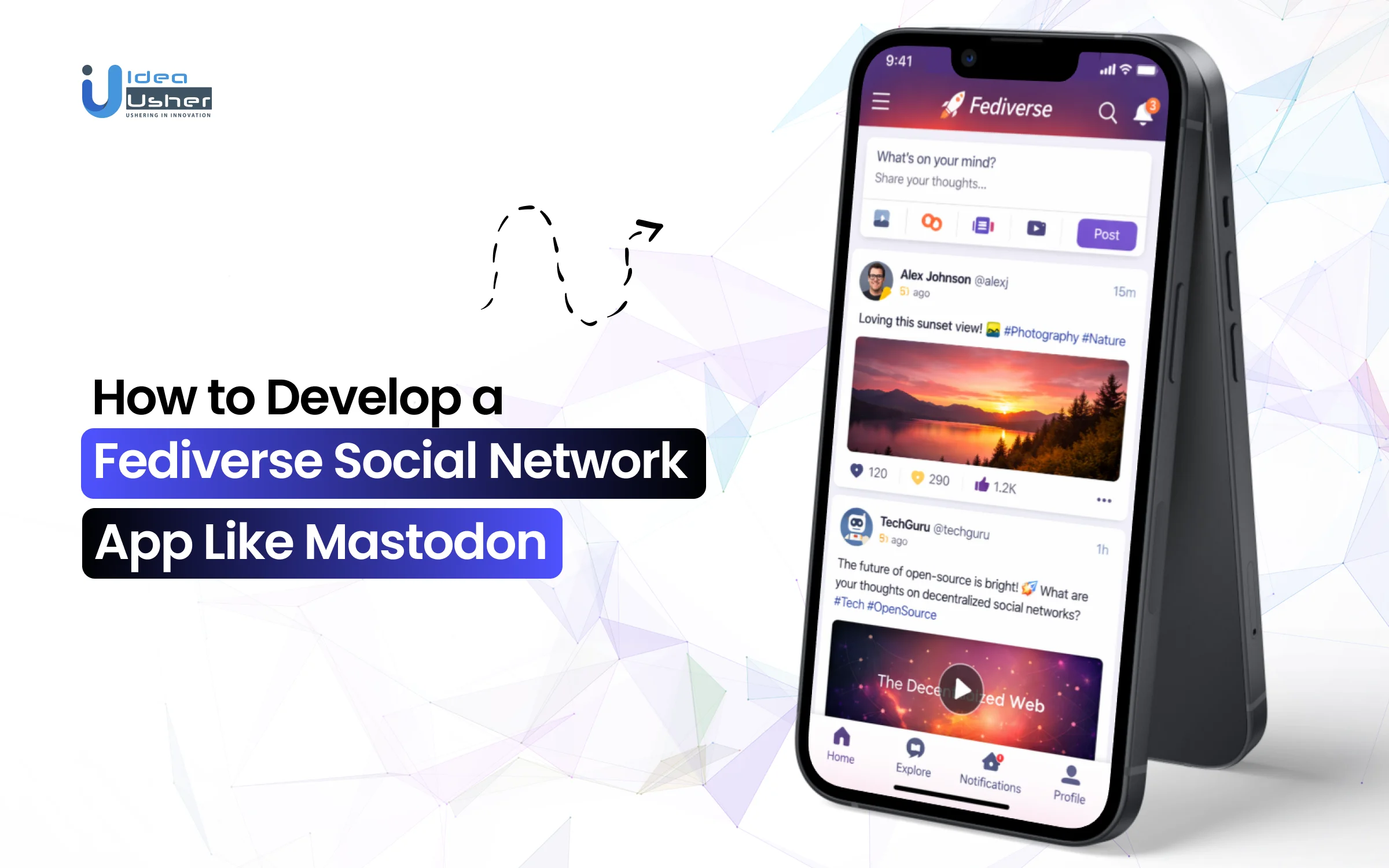
Social networks built on centralized platforms often limit how communities control their data, moderation policies, and platform governance. Decentralized alternatives are gaining attention across developers and online communities are shifting interest in Mastodon-like fediverse social network app development, where independent servers can interact through shared protocols while maintaining their own rules and moderation systems.
Community autonomy thrives on federated social networks, but this model introduces unique technical challenges. Server federation, identity management, content distribution, moderation controls, and protocol compatibility must work together as the network expands. Platforms succeed when these systems enable decentralized communication, strong performance, and effective community governance.
In this blog, we explain how to develop a fediverse social network app like Mastodon by examining core features, architectural considerations, and practical steps involved in building scalable and interoperable decentralized social platforms.

What is a Fediverse Social Network App, Mastodon?
Mastodon is a free and open-source, decentralized microblogging social network that forms part of the Fediverse, wheremultiple independently operated servers (“instances”) interconnect through the ActivityPub protocol, enabling users across different servers and platforms to interact as part of one federated social network.
Core Concepts
- Decentralisation: Mastodon operates without a single corporate owner. Thousands of independent servers, or instances, run by individuals or organizations support the network.
- The Fediverse: The “federated universe” connects services using the ActivityPub protocol. Members on one Mastodon server can follow and interact with those on any Mastodon server or on platforms like Pixelfed (Instagram alternative) or PeerTube (YouTube alternative).
- Ownership and Control: Members select servers by community rules, moderation policies, or interests (such as technology, art, or regional groups). Members who disagree with a server’s policies can migrate accounts and followers to another server.
What does Fediverse mean in Modern Social Networking?
The Fediverse (a portmanteau of “federated” and “universe”) refers to a global network of independent, interconnected social media servers in modern social networking that can communicate with each other using open standards like ActivityPub.
Unlike traditional “walled garden” platforms (like X or Facebook), where you can only interact with users on that same site, the Fediverse allows users on different platforms to follow and message each other seamlessly.

A. How it Works (The Email Analogy)
The most common way to understand the Fediverse is by comparing it to email:
- Interoperability: Just as a Gmail user can send an email to a Yahoo user because they use the same protocol (SMTP), a Mastodon user can follow a Threads user or comment on a PeerTube video without needing a new account for each.
- Decentralisation: There is no “owner” of the Fediverse. It is made up of thousands of independent servers (often called instances) run by individuals, organisations, or communities.
- Unique Addressing: Your identity is tied to your specific server, appearing as @[email protected].
B. Key Benefits for Modern Users
- Ownership & Portability: If you don’t like your current server’s rules or if it shuts down, you can often migrate your account and followers to a different server.
- No Algorithms or Ads: Most Fediverse platforms use strictly chronological feeds, avoiding the engagement-driven algorithms and targeted advertising common in mainstream social media.
- Community-Led Moderation: Each server sets its own rules. This allows for niche communities with specialized moderation policies rather than one-size-fits-all corporate rules.
C. The Role of AI in the Fediverse
AI integration helps bridge the gap between small, independent communities and the massive scale of modern digital interaction.
- Scalable Moderation: Small servers lack staff for 24/7 monitoring. AI tools act as a “first line of defense,” flagging or removing explicit content, spam, and hate speech in multiple languages.
- Intelligent Discovery: Without a central “master algorithm,” users struggle to find relevant content. Decentralized platforms now offer user-controlled AI to summarize threads and recommend accounts based on personal interests, not corporate profit.
- Privacy-Preserving Personalization: Federated Learning lets AI improve user experience locally, creating personalized feeds without sending sensitive data to corporate servers.
- Trust and Safety Metrics: AI calculates “reputation scores” for servers. If an instance spreads AI-generated spam or deepfakes, others can use AI to automatically “defederate” and protect their communities.
- Deepfake Detection: As generative AI enables more convincing fakes, Fediverse protocols standardize AI-driven authentication and deepfake detection to protect discourse integrity.
Why are Fediverse Social Network Apps Growing Rapidly?
The Decentralized Social Network Market is forecasted to grow from USD 18.5 billion in 2025 to USD 141.6 billion by 2035, with a CAGR of 22.6%. This rapid growth prompts businesses to develop Fediverse apps like Mastodon to foster interoperable communities, give users control over their data, and access the expanding Fediverse ecosystem.

This growth is supported by real-world momentum. For businesses and developers considering entry, the following indicators demonstrate that the market is thriving and ready for high-quality solutions:
- The “Network Effect” via ActivityPub: Meta integrated Threads with ActivityPub, expanding Fediverse reach to 175M+ monthly active users. New apps can plug into this global audience instead of starting from zero.
- Massive User Migration Waves: Mastodon gained 2.5M+ users in a single quarter during major “digital migrations.” This surge shows a large “platform-ready” user base actively seeking decentralized alternatives.
- Explosive Infrastructure Growth: Active servers or instances now exceed 10,000, marking a 100% increase in decentralized infrastructure in two years. This backbone supports resilient and commercial-scale Fediverse apps.
- Superior User Retention through Data Sovereignty: Fediverse users own their digital identity and social graph instead of staying in “walled garden” ecosystems. This control increases “stickiness,” strengthens long-term engagement, and reduces churn.
- Untapped Commercial Potential: The ecosystem still lacks premium, industry-specific Fediverse apps for professional networking, creator communities, and enterprise tools. Startups that build now can secure a strong “first mover” advantage.
The Fediverse is currently in its “Goldilocks” zone and the technology has matured, the audience is migrating, and the competition for high-quality, branded experiences is still wide open. For businesses, building a Fediverse app today isn’t just about joining a trend; it’s about claiming a stake in the $141 billion future of the social web.

How ActivityPub Powers Fediverse Interoperability?
ActivityPub is the World Wide Web Consortium (W3C) standard that serves as the “common language” of the Fediverse. Much like email protocols allow a Gmail user to message an Outlook user, ActivityPub allows a user on Mastodon to follow a creator on Pixelfed or comment on a video on PeerTube.

A. The “Inbox and Outbox” Mechanism
ActivityPub treats social interactions as a series of digital letters moved between Actors. Every user profile on an ActivityPub-compliant server is an “Actor” with two primary endpoints:
- The Outbox: When you perform an action (post a status, like a photo, or follow a user), your server wraps that action into an Activity Object and places it in your Outbox.
- The Inbox: To deliver that action, your server sends a POST request to the Inboxes of your followers’ servers. Those servers then process the activity and update their local feeds.
B. Core Technical Pillars of Interoperability
The protocol’s success in connecting diverse platforms (microblogs, video hosts, and image galleries) stems from three technical foundations:
- ActivityStreams 2.0 (Vocabulary): This is the “dictionary” of the Fediverse. It defines standardized terms for actions (like Create, Follow, Announce) and objects (like Note, Video, Image). Because everyone uses the same dictionary, a “Like” from a microblog is understood perfectly by a video platform.
- JSON-LD (Data Format): All messages are sent as Linked Data. This allows servers to include extra information (like custom emojis or poll data) that other servers can either use or safely ignore if they don’t support that specific feature.
- HTTP Signatures (Security): To prevent spoofing, every message sent between servers is cryptographically signed. This ensures that when your server receives a “Follow” request from @[email protected], it can verify that it truly came from that specific server.
C. Client-to-Server vs. Server-to-Server
ActivityPub actually defines two distinct protocols that work together to create the seamless experience found in modern apps:
| Protocol Layer | Purpose | Real-World Example |
| Client-to-Server (C2S) | How your phone app talks to your specific server. | Posting a photo from your mobile app to your Pixelfed account. |
| Server-to-Server (S2S) | How your server talks to every other server in the network. | Your Pixelfed server “federating” that photo to your followers on Mastodon. |
The “Bridge” Era of 2026
The interoperability landscape has expanded in 2026. ActivityPub remains the dominant protocol for the Fediverse, while tools like Bridgy Fed bridge ActivityPub and the AT Protocol (used by Bluesky). This enables Mastodon users to interact with Bluesky users as if they were on the same network, creating a unified, global conversation.
Key Features of a Mastodon-Like Fediverse App
A Mastodon-like fediverse social network app includes decentralized servers, federated communication, customizable communities, and strong privacy controls. These features enable users across instances to interact seamlessly while maintaining independence and community moderation.

1. User Profiles and Cross-Instance Identity
The identity is anchored to a specific domain in the Fediverse but remains visible globally. A user’s handle (e.g., @[email protected]) acts as a portable, verified address across the entire network.
- Domain-Based Branding: Organizations can host their own instance, ensuring that every employee profile is automatically “verified” by the domain itself.
- The “Email-Style” Portability: Users can migrate their entire profile, including followers and following lists, to a different instance without losing their social graph.
- Business Depth: This eliminates the need for expensive “Blue Check” verification systems. The server’s domain is the verification, significantly increasing trust for corporate and professional users.
2. Decentralized Timelines and Post Visibility
Unlike centralized apps that use “Black Box” algorithms, Mastodon-like fediverse social network app offer three distinct, chronological views of the network.
- The Home Timeline: The home timeline is the main workspace, showing a chronological feed of followed accounts. This provides a high-signal experience for members and promotes long-term retention by removing algorithmic frustration.
- The Local Timeline: The local timeline streams all public posts from members on the same server, fostering neighborhood and community. Niche instances like “FinTech Professionals” keep focused, relevant dialogue.
- The Federated Timeline: The federated timeline shows posts from the local server and remote posts followed by local members, offering a window into the Fediverse and enabling discovery across many domains.
- Visibility Scopes: Each post has a “privacy flag” (Public, Unlisted, Followers-only, Mentioned-only). This allows toggling between “Broadcast Mode” for marketing and “Private Mode” for secure internal use.
3. Instance Discovery and Server Selection
The “entry point” to the Fediverse is choosing a server. This creates a market where servers compete on performance, culture, and moderation quality rather than locking users in.
- Niche Market Entry: Entrepreneurs can launch “themed” instances (e.g., for Green Energy Investors or Biotech Professionals), attracting high-signal users immediately.
- Custom Governance: Each instance owner sets their own rules, allowing for specialized communities that are not subject to the generic, often ineffective, policies of a global tech giant.
- Practical Example: A “Legal Tech” instance can enforce strict professional conduct rules that would be impossible to scale on a platform like X or Facebook.
4. Cross-Server Following and Conversations
Interoperability is the core value of Mastodon-like fediverse social network app. A user on a “Photography” server can follow and reply to a user on a “Coding” server as if they were on the same site.
- ActivityPub Synchronization: Servers exchange “Activities” (Posts, Likes, Follows) in real-time using JSON-based delivery.
- Seamless Engagement: From a UI perspective, the complexity of cross-server communication is hidden. Users simply hit “Reply,” and the backend handles the delivery to the remote server’s inbox.
- Strategic Growth: Your platform doesn’t need to reach “critical mass” on day one. By federating, your users immediately gain access to millions of existing users across the Fediverse.
5. Automated Defederation and Domain Blocking
Safety in a decentralized world is handled via “Fediblocking.” Server admins can unilaterally cut ties with servers that harbor spam or toxic content.
- The “Kill Switch” for Toxicity: If a remote server is identified as a source of spam, an admin can “Suspend” the entire domain, instantly protecting every user on their local instance.
- Tiered Restrictions: Admins can choose to “Silence” a server (hiding its posts from public timelines) instead of a full block, allowing for nuanced moderation.
- Investor Safety: This architecture isolates your platform from the “Bad Neighborhoods” of the internet, ensuring your brand and users stay within a high-quality ecosystem.
6. Content Moderation and Trust Controls
Moderation is local and human-driven for a Mastodon-like fediverse social network app. Users have granular tools to curate their own experience, while admins manage the broader community standards.
- Content Warnings (CW): Users can collapse “sensitive” or “spoiler” content behind a warning, fostering a more respectful and controlled discourse.
- Shared Blocklists: Admins can import community-curated lists of problematic servers, allowing for “crowdsourced” safety that keeps operational costs low.
- Pro-Tip: For investors, this model moves the high cost of content moderation from a central HR expense to a community-distributed function.
7. Media Sharing for Images, Video, and Links
A modern Mastodon-like fediverse social network app must support rich media while managing the storage costs associated with hosting distributed content.
- S3-Compatible Storage: To scale, these platforms use object storage (like AWS S3 or Google Cloud Storage) to handle high volumes of images and video without slowing down the server.
- Media Proxying: To protect user privacy, remote media is often cached and served via a proxy, preventing remote servers from tracking your users’ IP addresses.
- Metadata Integrity: Automated alt-text and accessibility features are often built into the media upload flow, making the platform naturally compliant with global accessibility standards.
8. Real-Time Notifications and Engagement Tools
High engagement requires instantaneous feedback. Using WebSockets and background workers, the platform delivers “Likes,” “Boosts,” and “Mentions” across the network.
- Push Notifications: By integrating with mobile push services (FCM/APNS), the platform ensures users stay engaged even when they are not in the app.
- The “Boost” Mechanism: Unlike “Retweets,” “Boosts” are the primary way content goes viral in an algorithm-free world, relying on human curation rather than engagement-hacking code.
- Engagement Analytics: While decentralized, admins can still track local engagement metrics to understand community health and growth without infringing on individual privacy.
Step-by-Step Development of a Mastodon-like Fediverse Social Network App
Building a Mastodon-like Fediverse social network app involves developing a decentralized platform where independent servers connect through open protocols. The process includes designing federation architecture, user features, moderation systems, and scalable infrastructure.

1. Planning Network and Server Model
Architect a governance framework that defines instance-level autonomy versus protocol standards. Choose between niche, single-tenant servers or “flagship” multi-tenant models to balance decentralized user growth with sustainable operational costs and clear community guidelines.
2. UI/UX Design Across Instances
Prioritize a “home-instance” UX that surfaces global Fediverse content without sacrificing local community feel. Design discovery tools that pull remote metadata seamlessly, ensuring that cross-instance follows and interactions feel like a unified, singular ecosystem.
3. Setting Up Infrastructure and Instance Deployment
Deploy containerized instances using Docker and Kubernetes to ensure rapid, reproducible scaling across global regions. Implement a robust PostgreSQL database for metadata and Redis for real-time job processing to maintain performance during high-traffic viral events.
4. Integrating the ActivityPub Protocol
Implement the ActivityPub “Actor” model to manage decentralized profiles and content delivery. Map out JSON-LD schemas carefully to ensure your server correctly interprets “Create,” “Follow,” and “Undo” activities from diverse, third-party Fediverse implementations.
5. Building Federation and Server Communication
Architect asynchronous delivery pipelines using background workers like Sidekiq to handle high-volume, server-to-server POST requests. Use HTTP Signatures for secure authentication, ensuring that every federated message is cryptographically verified before reaching the local database.
6. Implementing Moderation and Trust Mechanisms
Deploy a tiered moderation stack that combines automated keyword filters with community-driven “blocklists.” Strategic depth requires providing admins with granular tools to silence or suspend malicious domains, effectively isolating bad actors from the local ecosystem.
7. Implementing Security and Privacy Controls
Prioritize end-to-end data integrity by implementing robust Oauth2 flows and granular privacy settings for posts. Use authorized fetch mechanisms to prevent unauthorized scraping and ensure that “private” mentions remain visible only to the intended recipients.
8. Building Instance and Community Search
Develop decentralized indexing tools that allow users to find relevant instances and niche communities. Implementing an opt-in “Instance Directory” with searchable tags ensures new members can find their cohort without relying on a central authority.
9. Optimizing Federation Performance and Scaling
Optimize database queries for high-concurrency “fan-out” where a single post triggers thousands of remote deliveries. Implement intelligent caching layers and media-proxy servers to reduce bandwidth costs while maintaining lightning-fast media loading across the network.
10. Testing Cross-Instance Interactions and Launch
Execute rigorous interoperability testing using a “sandbox” of local and remote instances to validate protocol compliance. A successful launch relies on a controlled beta with trusted admins to stress-test decentralized synchronization before scaling globally.

Mastodon-Like Fediverse Social Network App Development Cost
Building a federated Mastodon-like fediverse social network app based on ActivityPub requires a unique investment in server-to-server communication infrastructure and decentralized data management. Unlike centralized apps, your budget must account for the high “fan-out” costs of pushing data to thousands of independent instances.
| Development Phase | MVP (Entry Level) | Enterprise (Pro Level) | Key Deliverables |
| Governance & Fediverse Strategy | $4,000 – $7,000 | $15,000 – $30,000 | Instance rulebook, federation policy, and server-model architecture. |
| ActivityPub Core Integration | $20,000 – $35,000 | $90,000 – $180,000 | Inbox/Outbox implementation, Actor model, and JSON-LD signing. |
| Infrastructure & Instance Deployment | $12,000 – $22,000 | $60,000 – $120,000 | Docker/K8s orchestration, PostgreSQL/Redis setup, and media proxy. |
| Federated Moderation Engine | $7,000 – $12,000 | $40,000 – $85,000 | Domain blocking tools, shared blocklist APIs, and report management. |
| UI/UX & Discovery | $10,000 – $20,000 | $50,000 – $90,000 | Multi-column web dashboard, mobile apps, and instance directory. |
| Security & Privacy Audits | $6,000 – $12,000 | $35,000 – $70,000 | Oauth2 implementation, cryptographic verification, and pen-testing. |
| Optimization & Launch | $4,000 – $8,000 | $20,000 – $45,000 | Sidekiq queue tuning, caching layers, and cross-instance beta testing. |
| Total Estimated Cost | $63,000 – $116,000 | $310,000 – $480,000+ | A fully federated, protocol-compliant social ecosystem. |
Critical Cost Drivers in 2026
Operating within the Fediverse in 2026 involves specific technical overheads that scale with the density of your connections rather than just your internal user count.
- Asynchronous “Fan-out” Infrastructure: Servers deliver posts from accounts with large followings to thousands of remote instances. This process requires significant background processing power (Sidekiq/Redis), often costing $1,500 to $5,000 monthly for high-traffic enterprise nodes.
- Media Proxy and Storage Egress: To protect privacy, federated servers proxy and cache images from other instances. In busy networks, media egress and storage fees for cached content range from $0.04 to $0.10 per GB, making efficient media-cleanup scripts essential.
- Cryptographic Verification Overhead: Servers cryptographically sign and verify every message using HTTP Signatures. This process adds a computational tax on the CPU and can increase server hosting costs by 10% to 20% compared to traditional social apps.
- Decentralized Indexing & Search: The Fediverse complicates search as data remains scattered. Building a “Discovery Engine” to crawl federated instances and respect privacy tags requires specialized search architecture (Elasticsearch/Meilisearch), costing $800+ monthly in resources.
- Moderation Data Feeds: Instances subscribe to “Trust & Safety” data feeds to automatically block malicious domains. These professional-grade blocklist subscriptions cost $2.00 to $5.00 per 1,000 monthly active members and are vital for maintaining instance reputation.
Major Challenges in Building a Fediverse Social Network App
Developing a Mastodon-like fediverse social network app involves challenges such as federation management, scalability, moderation, and data security. Our developers solve these through robust architecture, advanced protocols, efficient moderation systems, and scalable infrastructure.

1. Scaling ActivityPub Deliveries
Challenge: Sending a single post to thousands of remote servers (Fan-out) can create massive background job backlogs and delayed notifications.
Solution: Our developers implement Sidekiq/Redis concurrency clusters and “Delivery Retries.” This ensures that even if remote servers are slow, your local user experience remains fast and message delivery is guaranteed.
2. Global Media Storage Costs
Challenge: To show remote posts, your server must “cache” their images and videos, leading to exponential storage growth and high infrastructure costs.
Solution: We architect Auto-Expiring Media Caches linked to S3-compatible storage. Our system automatically purges remote media that hasn’t been accessed recently, keeping your storage footprint lean and your costs predictable.
3. Handling “Thundering Herds” on Viral Posts
Challenge: When a local post goes viral globally, thousands of remote servers will simultaneously query your instance for metadata and media.
Solution: Our team deploys Reverse Proxy Caching (Nginx/Varnish) and Content Delivery Networks (CDNs). This offloads the traffic from the application layer, ensuring your instance stays online during high-traffic viral events.
4. Inconsistent Cross-Instance Moderation
Challenge: A “blocked” user on a remote server can still interact with your users if their server doesn’t honor your rules.
Solution: We build Domain-Level Defederation Tools. Our developers implement automated filters that can “silence” or “suspend” entire remote domains, giving the admins total control over which external communities can interact.
5. User Discovery and Global Search
Challenge: ActivityPub does not have a built-in “Global Search,” making it difficult for users to find trending content outside their server.
Solution: We integrate Opt-in Relays and Indexers. By connecting to trusted data relays, our developers create a high-speed search index that allows users to find global content without compromising decentralization.
Strategic Revenue Models for Fediverse Apps
The monetization of Fediverse platforms such as Mastodon, Pixelfed, or PeerTube is shifting from purely donation-based models to sophisticated, value-aligned revenue streams. Because these platforms lack a central “Ad Manager,” monetization must be built into the server’s utility or the creator’s direct relationship with their audience.
1. Tiered Membership and “Pro” Subscriptions
Many server administrators are moving beyond basic donations (Patreon/Open Collective) toward a “Freemium” model.
- The Model: Users join for free, but pay a monthly fee (e.g., $5–$15) for premium platform benefits.
- Value-Added Deliverables: Larger file upload limits, exclusive “supporter” badges, access to private “VIP” instances, or early access to new federated features.
- Strategic Depth: This creates predictable Monthly Recurring Revenue (MRR) while maintaining the server’s open-access mission for the broader public.
2. Verified “Branded” Instances for Organizations
Enterprise and media organizations are increasingly willing to pay for “White-Glove” hosting of their own instances to ensure data sovereignty.
- The Model: A “Community-as-a-Service” model where you host and moderate a dedicated server for a brand (e.g., a university or a news outlet).
- Value-Added Deliverables: Automatic verification of all employees, custom domain handles (e.g., @[email protected]), and guaranteed uptime with high-level security audits.
- Strategic Depth: This leverages the Identity-as-a-Service value of the Fediverse, where the brand pays for the credibility of a sovereign, official presence.
3. Ethical, Contextual Sponsorships
Since traditional tracking-based ads are culturally rejected in the Fediverse, platforms are adopting “Contextual Sponsorships” that resemble podcast ads.
- The Model: A server admin partners with a brand to place a static, non-tracking banner or a weekly “Sponsored Post” in the local timeline.
- Value-Added Deliverables: High-alignment placements that don’t mine user data. For example, a tech-focused instance sponsoring a privacy-first VPN.
- Strategic Depth: By focusing on Direct Relationships with sponsors, admins can command higher CPMs than programmatic ads because the audience is highly targeted and the trust level is greater.
4. Integrated Micropayments and Web Monetization
The 2026 technical landscape sees the rise of Web Monetization Standards (like the Interledger Protocol) being baked directly into ActivityPub.
- The Model: Users who have a “Payment Pointer” in their profile receive tiny, automated micropayments as followers scroll past or interact with their content.
- Value-Added Deliverables: Real-time revenue for both the creator and the instance owner, where a small percentage of the stream is diverted to cover server hosting costs.
- Strategic Depth: This creates a “Streaming Revenue” effect that rewards high-quality content without requiring a paywall, keeping the community open while remaining financially viable.
5. Managed Marketplace and Transaction Fees
Niche Fediverse instances (like those for artists or crafters) are integrating peer-to-peer commerce directly into the social feed.
- The Model: A “Fediverse Marketplace” where users can list products, and the instance owner takes a small transaction fee (1%–5%) for facilitating the secure exchange.
- Value-Added Deliverables: Escrow services, verified seller badges, and integrated shipping tools within the instance UI.
- Strategic Depth: This aligns the Success of the Community with the revenue of the server, as the admin is incentivized to help their members sell more goods.
Comparison of Fediverse Monetization Approaches
| Feature | Donation-Based | Subscription (Freemium) | Branded Hosting |
| Predictability | Low (fluctuates monthly) | High (MRR-driven) | Very High (Contractual) |
| Scalability | Hard (dependent on altruism) | Medium (growth-linked) | High (B2B margins) |
| User Reception | Positive (no friction) | Mixed (perceived “gatekeeping”) | High (perceived “authority”) |
| Main Revenue Source | Patreon, Ko-fi, LiberaPay | Stripe, In-app purchases | Enterprise Service Agreements |
Conclusion
Developing a Mastodon-like fediverse social network app is an exciting venture into the future of social connectivity. By building on open web standards like ActivityPub, you empower users with true interoperability and data ownership. Though the development requires a focus on federation protocols and decentralized architecture, the payoff is immense: you are not just creating an app, but joining a global movement toward a more ethical and community-driven web. Ultimately, your contribution helps dismantle centralized control, fostering a richer, more diverse online ecosystem where every community can thrive on its own terms.
Why Choose IdeaUsher for Fediverse Social Network Development?
Building a Mastodon-like platform involves mastering the fediverse’s complexities, where federation, moderation, and interoperability create freedom and technical challenges.
We develop blockchain-driven products for various industries, focusing on performance systems, model integration, and scalable infrastructure. Our expertise enables us to create fediverse social networks that balance decentralization, moderation, and cross-instance communication.
Our ex-FAANG and MAANG engineers bring over 500,000+ hours of hands-on blockchain development experience, allowing us to architect ActivityPub-based platforms aligned with community governance, federation protocols, and sustainable growth strategies.
Why Hire Us:
- Federation & Open Source Expertise: We engineer interoperable social ecosystems, deploy ActivityPub, and deliver smooth cross-instance content as your network connects with thousands of federated instances worldwide.
- Custom Moderation Solutions: We create moderation tools, blocking systems, and governance dashboards to help your platform maintain healthy, scalable communities.
- Full-Cycle Ownership: We handle infrastructure, federation, privacy, and scalable design to make your fediverse social network advanced and launch-ready.


FAQs
A.1. ActivityPub acts as the industry standard protocol for the Fediverse. It provides client to server and server to server APIs for creating and delivering content. By implementing this protocol, apps can instantly interact with users across platforms like Mastodon, PixelFed, and Lemmy.
A.2. Developers typically build Fediverse servers with high performance backends such as Ruby on Rails, Go, or Rust paired with the PostgreSQL database. Redis manages heavy background job processing for federation, while Docker simplifies deployment of multi component server environments.
A.3. Fediverse moderation operates through decentralized governance. Each server admin defines local rules and can block or silence external instances that host harmful content. Developers must provide tools that allow moderators to filter keywords, review reports, and manage instance-level moderation.
A.4. The Fediverse uses Linked Data Signatures to verify the authenticity of posts and activities. When a server receives an activity, it checks the sender’s public key to confirm identity. This cryptographic layer prevents spoofing and protects data integrity across the network.


