 (+971) 8007 4267
 (+91) 946 340 7140
 (+1) 628 432 4305

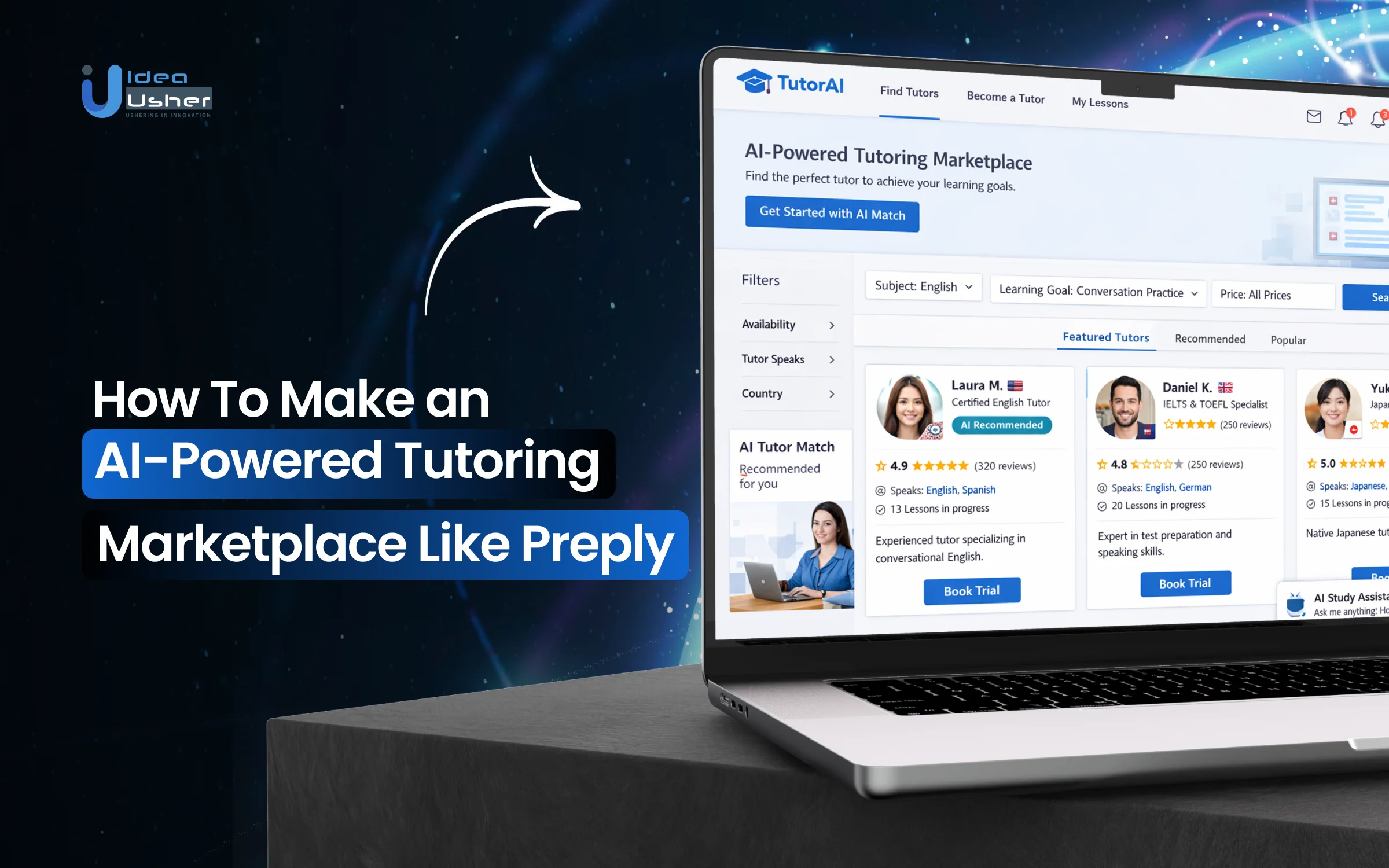
Online learning expanded quickly, but trust could not keep pace. Students often hesitated because they were unsure if a tutor would truly match their pace and expectations. Tutors also struggled to gain visibility in crowded marketplaces with limited differentiation. That is why the popularity of AI-powered tutoring marketplaces is steadily increasing because they can reduce guesswork, improve match accuracy, and personalize outcomes before the first session begins.
These systems analyze behavioral signals, session history, and learning progress to predict compatibility with measurable confidence. They may also recommend structured learning paths that adapt dynamically as performance data evolves. What once depended on trial and error has gradually become a predictive data-driven system that feels more transparent and reliable.
We’ve developed numerous AI-powered tutoring marketplaces that leverage technologies such as advanced recommender system architectures and adaptive learning intelligence frameworks. Given our expertise in this space, we’re sharing this blog to discuss the steps to develop an AI-powered tutoring marketplace like Preply.
Why AI Tutoring Marketplaces Are Scaling Fast in 2026?
According to Mordor Intelligence, the online tutoring market size in 2026 is estimated at USD 12.61 billion, up from USD 10.91 billion in 2025, with projections reaching USD 26.03 billion by 2031. This trajectory represents a robust 15.58% CAGR over the 2026–2031 period.

Source: Mordor Intelligence
This growth is fueled by the maturation of Agentic AI. Unlike the static tools of the past, 2026 marketplaces use AI to anticipate learner needs, match them with the perfect human mentor, and automate the logistical “heavy lifting.” For decision-makers, this means high-quality, personalized education is finally scalable, combining human empathy with algorithmic efficiency.
The Shift From EdTech Apps to AI-Driven Marketplaces
The market has moved past “content-heavy” apps that offer only static videos. Today’s learners are migrating toward Human-AI Hybrid models. While apps provide data, they cannot provide the “Why” or the emotional encouragement needed to bridge complex proficiency gaps.
AI-driven marketplaces like Preply solve the “Frustration Wall” by acting as an intelligent concierge. Instead of a student navigating a library alone, AI identifies specific gaps and connects them with a human specialist. This shift has turned marketplaces into high-retention environments, outperforming the high “churn” rates of traditional, gamified apps.
Market Demand for Personalized Online Tutoring
Modern learners demand Hyper-Personalization. In 2026, professionals no longer seek general “Spanish”; they want “Negotiation-level Spanish for the Tech Sector.” Marketplaces meet this by leveraging a global, diverse workforce of tutors that no single company could hire in-house.
- Real-Time Adaptation: AI scans micro-behaviors during lessons, like hesitation on a specific verb, and alerts the tutor to pivot.
- Outcome Data: Personalized paths have boosted completion rates by up to 70%. By proving effectiveness through data, marketplaces can justify premium pricing for niche subjects like coding or specialized finance.
Revenue Potential in AI-Powered Learning Platforms
The financial appeal of these platforms lies in high-margin, recurring revenue. Successful marketplaces have moved from simple “pay-as-you-go” transactions to sophisticated Subscription-SaaS models.
- B2B Contracts: Platforms now sell “Outcome-as-a-Service” to corporations, providing verifiable proof of employee skill acquisition.
- Operational Efficiency: AI tools have cut tutor prep time by 40%, allowing the platform to maintain healthy commissions while keeping student costs competitive.
- Automated Upsells: Add-on features, such as 24/7 AI practice bots, create high-margin revenue streams that supplement the core human-to-human lessons.

What Makes Preply’s Business Model So Profitable?
Preply’s profitability stems from a high-velocity marketplace architecture that balances global labor supply with recurring consumer demand. By 2026, the platform solidified its unicorn status with a $1.2 billion valuation.
This success is driven by a transition from simple transactions to an EBITDA-positive subscription ecosystem. The model extracts value at every stage of the learner journey while maintaining near-zero content production costs.
Commission-Based Marketplace Model Explained
The core revenue engine uses a tiered commission structure to incentivize long-term tutor activity. Unlike flat-fee platforms, Preply employs a sliding scale that rewards volume.
- The Trial Advantage: Preply takes a 100% commission on the first trial lesson. This covers customer acquisition costs and allows the platform to offer a free replacement guarantee if the match is not perfect.
- Tiered Retention: For subsequent lessons, commissions start at 33% and drop to 18% as tutors complete more hours. This creates a lock-in effect, as experienced tutors earn a higher marginal profit the longer they remain on the platform.
Subscription and Lesson Credit Monetization
Preply shifted from one-off payments to a 28-day subscription cycle. Students commit to monthly bundles of 4, 8, 12, or 20 hours.
This model stabilizes cash flow and significantly increases Lifetime Value (LTV). The subscription format builds a consistent learning habit, which reduces the marketing spend needed for re-engagement. By using a “use it or lose it” approach for credits at the end of the billing cycle, the platform also monetizes breakage effectively.
Tutor Acquisition and Retention Strategy
Preply maintains a supply of over 100,000 tutors by acting as a comprehensive business-in-a-box. The strategy focuses on eliminating the administrative friction of freelance teaching.
- Labor Arbitrage: By connecting students in high-income regions with tutors in lower-cost areas, Preply offers competitive rates to learners while providing tutors with earnings that exceed their local market averages.
- The Preply Academy: To ensure quality, the platform provides AI-powered teaching assistants. These tools automate lesson plans and homework, making the platform more efficient for tutors than working independently.
Key Revenue Metrics Behind Marketplace Growth
Growth is managed through a data-first approach to marketplace health. Key performance indicators focus on the matching engine’s efficiency.
| Metric | Strategic Significance |
| Match Rate | The speed at which a new student books their first trial. |
| Trial-to-Subscription | Percentage of students committing to a 28-day plan. |
| Tutor Utilization | Percentage of a tutor’s available hours actually booked. |
| Net Revenue Retention | Growth of revenue from existing student-tutor pairs. |
By optimizing these metrics, Preply achieved a 50%+ year-over-year growth rate by early 2026. Using AI to improve the match rate ensures that student acquisition costs are converted into long-term subscription revenue with maximum efficiency.
Core Features Your AI Tutoring Marketplace Must Have
To compete with established giants, your AI tutoring marketplace must transcend the traditional directory model. A marketplace’s value is defined by its ability to reduce cognitive load through automation and provide a high-fidelity learning environment. The goal is to create a seamless synergy between human instruction and algorithmic support.
1. Smart Matching Engine
A basic keyword search is no longer sufficient. Modern marketplaces use Vector-based Matching to pair students with tutors based on deep compatibility. This engine analyzes the linguistic nuances in a student’s goal description and matches them to a tutor’s specific pedagogical history and communication style.
- Psychographic Alignment: The AI evaluates factors such as a student’s preferred pace, industry background, and tone to suggest tutors who align with their personality.
- Dynamic Availability: The system uses predictive scheduling to suggest tutors who are not just free but consistently available during the student’s peak learning hours across different time zones.
2. Personalized Learning Paths
The curriculum is now a living organism. Your platform must utilize Adaptive Sequencing to ensure that every lesson builds on the last with surgical precision.
AI analyzes data from every interaction, such as how long a student pauses on a slide or which grammar points they repeatedly miss, and automatically recalibrates the syllabus. This dynamic scaffolding ensures the student stays in the zone of proximal development, where the material is challenging enough to engage but not so difficult that it causes burnout.
3. Integrated Virtual Classroom
The virtual classroom must be an all-in-one ecosystem, not a fragmented collection of tabs. High-performance marketplaces integrate WebRTC-based video directly into the browser, eliminating software downloads.
- Interactive Overlays: Built-in digital whiteboards, shared document editors, and real-time coding environments allow for simultaneous collaboration.
- AI Assistance: Real-time transcription and live insight pop-ups can suggest relevant vocabulary or corrective hints to the tutor during the conversation, acting as a co-pilot for the live session.
4. Progress Analytics
Transparency is the primary driver of retention. Decision-makers and parents demand Measurable ROI for every hour spent on the platform.
Your analytics dashboard should move beyond simple hours completed. It must offer Predictive Mastery Insights that show exactly when a student is likely to reach their proficiency goal based on their current trajectory.
Heatmaps of strengths and weaknesses provide a visual roadmap for the student, while at-risk alerts notify tutors when a student’s engagement metrics drop, enabling proactive intervention.
5. Payments and Automated Payout System
A global marketplace requires a frictionless financial infrastructure. This means supporting Multi-Party Settlement and localized payment methods like UPI, Pix, and digital wallets.
- Escrow Services: Funds should be held in a secure escrow and only released once a lesson is confirmed, protecting both parties.
- Automated Commissions: The system must handle complex global tax compliance and VAT reporting automatically. For tutors, instant payout options that allow them to withdraw earnings immediately after a lesson serve as a major competitive advantage in talent acquisition.
6. Ratings, Reviews, and Trust Signals
Trust is the marketplace’s currency. Because five-star reviews have become commodified, your platform should implement Verified Competency Badges.
Instead of just subjective comments, these signals can be backed by data, such as top 5% for Medical English or 300+ hours taught with 90% retention. Integrating Social Proof, such as LinkedIn endorsements or verifiable success stories, creates a robust reputation system that rewards high-quality educators and simplifies the decision-making process for new users.
Advanced AI Capabilities That Create Market Edge
To lead the sector, your tutoring marketplace must integrate AI as a core layer of intelligence. The goal is to solve the two biggest hurdles in online education: finding the right mentor and preventing high dropout rates. Competitive advantage belongs to platforms that use proactive AI to manage the student journey from start to finish.
1. AI-Based Tutor Recommendation Algorithms
Traditional search relies on basic tags, but advanced marketplaces use Semantic Vector Search. This technology converts student goals and tutor histories into mathematical coordinates to find the most compatible matches.
- Deep Compatibility: If a student needs to pass a medical board exam in Quebec, the algorithm prioritizes tutors who have specifically coached students through that licensing process.
- Success Prediction: The system tracks which pairings lead to the longest subscriptions and uses that data to predict and suggest matches with the highest probability of success.
2. NLP-Driven Language Assessment Tools
Natural Language Processing allows platforms to perform instant, objective evaluations of a student’s proficiency without requiring a human instructor for every diagnostic.
- Automated Placement: Tools like OpenAI’s Whisper analyze recorded speech to determine a learner’s CEFR level instantly. This ensures students start at the right level, saving the tutor from wasting the first lesson on basic assessments.
- Micro-Correction: During practice, NLP tools flag phonetic errors or grammar patterns from a student’s native tongue. This provides immediate feedback that a tutor can reinforce in the next live session.
3. Generative AI for Lesson Planning Assistance
Generative AI acts as a force multiplier for tutors. It allows them to provide premium, custom materials without spending hours on unpaid administrative preparation.
- Content Generation: Tutors can use AI to instantly create role-play scenarios, vocabulary lists, or quizzes tailored to a student’s specific career, such as marketing or engineering.
- Level Adjustment: AI can instantly recalibrate the reading level of a news article or technical document to match a student’s exact vocabulary range, ensuring the material is always accessible.
4. AI Chatbots for 24/7 Student Support
Retention depends on the support provided between lessons. AI chatbots have evolved from simple FAQ tools into sophisticated Instructional Assistants.
- Concept Clarification: If a student forgets a grammar rule during late-night study, the AI provides an immediate, context-aware explanation based on the tutor’s previous lessons.
- Behavioral Nudging: Using student data, the bot sends personalized reminders. If a student misses three days of practice, the AI sends a tailored challenge to re-engage them and maintain their learning momentum.
5. Adaptive Testing and Skill Gap Detection
Standardized tests are being replaced by Cognitive Diagnostic Models. These identify exactly where a student’s understanding is failing.
- Dynamic Difficulty: As a student takes a quiz, the AI adjusts the difficulty of the next question in real time. This provides a precise measurement of the student’s current proficiency ceiling.
- Skill Mapping: The AI builds a knowledge graph for each learner. If a student struggles with complex tenses, the AI may trace the root cause back to a weakness in auxiliary verbs and flag this specific gap for the tutor to address.
How to Build an AI Tutoring Marketplace Like Preply?
Building a high-performance tutoring marketplace is an exercise in sophisticated ecosystem engineering. When we develop platforms like Preply for our clients, we move beyond basic profiles to create an intelligent infrastructure that scales human expertise.
Our approach delivers a business-in-a-box for tutors and a personalized success path for students, ensuring every line of code serves the goal of measurable learning outcomes.

1. Niche Selection
We help you bypass broad competition by identifying high-value verticals where specialized demand outstrips supply. By focusing on segments like executive coaching, medical certifications, or technical bootcamps, we ensure your platform gains immediate traction and commands premium pricing.
2. MVP vs. Full Scale
Our team determines the optimal launch velocity based on your capital and market goals. We can deploy a high-fidelity MVP using robust APIs to prove your matching logic quickly, or architect a custom, full-scale ecosystem designed to support thousands of concurrent, high-performance sessions.
3. Scalable Architecture
We engineer a modular, three-tiered architecture with distinct interfaces for students, tutors, and admins. Built on resilient microservices, our backends ensure low-latency global performance and seamless integration of localized payment gateways and data compliance protocols as you expand.
4. AI and Data Pipelines
We transform your directory into an intelligent marketplace by embedding AI into the core journey. This includes vector-based matching for surgical precision and data pipelines that feed into an AI-driven “Learning Record Store” to automate progress tracking and generative lesson planning.
5. Launch and Acquisition
Our framework solves the liquidity challenge by seeding the platform with a curated founding class of elite educators. We then drive growth through high-intent SEO and automated referral loops, creating a self-sustaining engine that reduces long-term marketing overhead.
Technology Stack Required for AI Tutoring Marketplace
To build a platform that matches the performance of leaders like Preply, we utilize a modern, high-concurrency stack designed for low latency and intelligence. Our architecture ensures that as your user base grows from hundreds to millions, the experience remains seamless for every learner and tutor.

1. Frontend and Backend Frameworks
We employ a decoupled architecture to ensure maximum flexibility and speed.
Frontend:
We use Next.js or React for the web interface. These frameworks allow for server-side rendering (SSR), which is essential for SEO (helping students find your platform) and fast initial load times. For mobile, we leverage Flutter or React Native to maintain a single codebase across iOS and Android while offering native-level performance.
Backend:
Our go-to is Node.js (NestJS) or Python (Django). Node.js excels at handling the real-time, event-driven requirements of chat and scheduling, while Python provides the robust libraries needed for deep AI integration and complex data processing.
2. AI/ML Tools and Model Integration
Intelligence is embedded directly into the workflow using an LLM-agnostic approach.
Orchestration:
We use LangChain or LlamaIndex to manage complex AI workflows, such as retrieving specific lesson context for a chatbot.
Matching Engine:
We implement Vector Databases like Pinecone or Weaviate. By converting tutor bios and student goals into mathematical vectors, we perform semantic searches that go far beyond simple keyword matching.
Models:
We integrate the most efficient model for the task, GPT-4o for deep pedagogical planning, Whisper for speech-to-text assessments, and smaller, faster models like Llama 3 for real-time grammar hints.
3. Cloud Infrastructure and DevOps Setup
We build on the “Big Three” cloud providers to ensure global availability.
Infrastructure:
We utilize AWS (Amazon Web Services) or Google Cloud Platform (GCP). By using Kubernetes (EKS/GKE), we containerize your application, allowing it to scale automatically during peak learning hours (e.g., evenings and weekends).
DevOps:
We implement CI/CD pipelines using GitHub Actions or GitLab CI. This ensures that every update is automatically tested and deployed without downtime, while Terraform allows us to manage our infrastructure as code for consistency and security.
4. Video Streaming & Communication APIs
The “Virtual Classroom” is the heart of the marketplace. We prioritize ultra-low latency.
WebRTC Integration:
We use Vonage Video API (formerly TokBox) or Agora to power the live lessons. These APIs are built for high-quality, 1-on-1 and group video with built-in features like screen sharing and recording.
Real-Time Collaborative Tools:
For interactive whiteboards and shared document editing, we integrate WebSockets (via Socket.io) or specialized collaborative APIs such as Pusher to ensure all participants see updates in real time.
5. Data Security and Compliance Standards
Education platforms handle sensitive data and must meet rigorous global standards.
Privacy Compliance:
We ensure every build is GDPR (Europe) and CCPA (California) compliant. For platforms serving minors, we strictly adhere to COPPA and FERPA regulations.
Data Protection:
All data is encrypted at rest (AES-256) and in transit (TLS 1.3). We implement Role-Based Access Control (RBAC) and Multi-Factor Authentication (MFA) to protect tutor earnings and student records, while using automated vulnerability scanning to stay ahead of potential threats.
Cost to Develop an AI Tutoring Marketplace Like Preply
Developing a tutoring marketplace is a multi-phased investment. In today’s market, “AI-first” is no longer optional; it is the core engine for matching and retention. Costs vary significantly based on whether you are building a lean prototype or a production-grade ecosystem with custom-trained models.
1. MVP Development Cost Breakdown
Estimated Range: $40,000 – $85,000
An MVP focuses on the “Golden Loop”: finding a tutor, booking, and conducting a live session. At this stage, we recommend using pre-built APIs to keep costs down while validating your niche.
- Core Platform (Web/Mobile): $30,000 – $50,000 (Next.js/React + Node.js)
- Essential Features: $10,000 – $20,000 (Calendars, Stripe Connect, Basic Search)
- Video Integration: $3,000 – $10,000 (Agora or Vonage API implementation)
- Basic AI Integration: $5,000 – $10,000 (Simple GPT-4o wrappers for chatbot support)
2. Full-Scale Marketplace Cost Estimation
Estimated Range: $150,000 – $500,000+
Scaling to a platform capable of handling thousands of concurrent global sessions requires custom infrastructure. This level of investment moves beyond basic features to focus on high-fidelity user experiences and proprietary tools.
- Advanced Custom Backend: $70,000 – $120,000 (Microservices architecture)
- Mobile Apps (iOS & Android): $60,000 – $100,000 (Flutter/React Native or Native builds)
- Custom Virtual Classroom: $40,000 – $80,000 (Integrated whiteboards, code editors, and real-time overlays)
- Complex Logistics: $30,000 – $50,000 (Global tax compliance, multi-currency payouts, and referral engines)
3. AI Integration and Infrastructure Costs
Estimated Range: $50,000 – $150,000 (Initial Build)
AI costs are split between the engineering hours required for integration and the ongoing “token” or compute fees for running the models.
- Vector Search & Matching: $20,000 – $40,000 (Pinecone/Weaviate implementation for semantic discovery)
- NLP Assessment Tools: $15,000 – $35,000 (Speech-to-text diagnostics and automated placement)
- RAG & Knowledge Bases: $20,000 – $50,000 (Retrieval-Augmented Generation for 24/7 tutor-aligned chatbots)
- Monthly Cloud/GPU Fees: $1,500 – $10,000+ (Scaling with user volume)
4. Ongoing Maintenance and Scaling Costs
Estimated Annual Budget: 15% – 25% of the original build cost
AI isn’t a “build and forget” asset. Ongoing maintenance ensures models don’t drift and the infrastructure scales smoothly.
- Technical Support: $2,000 – $8,000/month (Bug fixes and uptime monitoring)
- Model Retraining: $3,000 – $15,000/quarter (Improving AI performance based on actual user data)
- API Usage Fees: $500 – $5,000+/month (Payments to OpenAI, Anthropic, or video providers)
5. Factors That Influence Total Budget
The final figure depends on strategic choices made during the discovery phase.
- Team Location: US/UK teams ($150–$300/hr) vs. India/Eastern Europe ($40–$90/hr).
- Data Readiness: If we have to clean and label your historical data for the AI, expect an additional 20%–40% increase in data pipeline costs.
- Compliance Needs: Adding HIPAA (Healthcare), SOC2, or COPPA (Children’s Privacy) typically adds 15%–25% to the security and QA budget.
Real Business Challenges in AI Tutoring Marketplaces
Building an AI-driven marketplace involves more than just writing code; it requires solving the “human” friction points that occur when scaling a global network. As the market moves toward outcome-driven tutoring, overcoming these structural and technical hurdles is the difference between a high-growth unicorn and a struggling directory.

1. Solving the Cold-Start Marketplace Problem
A marketplace only provides value when there are enough tutors to satisfy students and enough students to keep tutors busy. This “chicken-and-egg” problem is even harder with AI, as algorithms require initial data to work.
- Contextual Bootstrapping: We use metadata (subject, location, and professional background) to make initial “educated” matches before behavioral data exists.
- Vertical Seeding: We recommend launching in a “micro-niche”—such as “Python for Data Scientists”—to reach a high density of users quickly.
- Incentive Buffers: Early tutors are often given guaranteed minimums or 0% commission periods to ensure they remain active while student traffic scales up.
2. Maintaining Tutor Quality at Scale
Quality control becomes a massive bottleneck as you grow. Relying solely on manual interviews is impossible at scale, so we implement an AI-Assisted Quality Loop.
- TutorBench Standards: We implement evaluation frameworks that go beyond answer correctness to assess pedagogical skills such as clarity, constructive feedback, and the ability to simplify complex topics.
- Shadow Monitoring: AI scans session transcripts (with consent) to detect red flags, such as tutors talking too much or failing to use interactive tools, triggering a manual review.
- Skill Badging: Automated “Mastery Badges” are awarded based on student progress data rather than just hours taught, ensuring the best educators rise to the top of search results.
3. Data Privacy and AI Bias Risks
In 2026, global privacy regulations such as the GDPR and the EU AI Act have created a “compliance-first” environment. Failure to manage data properly can result in significant fines and loss of user trust.
- Privacy-Preserving Tech: We utilize Federated Learning and Differential Privacy to train your matching models without ever needing to move raw, sensitive student data across borders.
- Bias Auditing: Alguse Federated Learning and Differential Privacy to train your matching models without ever movingorithms can accidentally favor certain accents or demographics. We run “bias-stress tests” to ensure your matching engine is optimized for learning outcomes, not just demographic similarities.
- Transparency Dashboards: We provide “Explainable AI” interfaces so students can see why a certain tutor was recommended, removing the “black box” feel of the platform.
4. Managing Cross-Border Payments
Global tutoring marketplaces face high transaction fees and fragmented banking networks. By 2026, the goal is to make international payments feel local.
- Localized Payment Rails: We integrate with systems like UPI (India), Pix (Brazil), and SEPA (Europe) to bypass expensive credit card networks and intermediary banks.
- Stablecoin Settlements: To avoid 3%–6% currency conversion losses, many modern platforms use regulated stablecoins for instant, low-cost “payout-on-completion” to tutors in volatile economies.
- Automated Tax Compliance: Our builds include real-time VAT/GST calculation and automated “purpose code” generation to ensure payments clear customs without manual intervention or delays.
Case Study: Architecture Behind Platforms Like Preply
Success in the tutoring sector isn’t just about the interface; it is about the flywheel created by a robust, interconnected architecture.
Preply’s dominance comes from its ability to turn data into a competitive moat. When we analyze this architecture for our clients, we examine how the interplay among user behavior, AI, and financial incentives creates a self-sustaining growth machine.
How the Marketplace Flywheel Works
The Flywheel Effect occurs when each new user makes the platform more valuable for everyone else. In a platform like Preply, this is driven by three main gears:
- Supply Liquidity: As more tutors join, students find better matches and competitive pricing through the Tutor Search and recommendation filters.
- Data Density: More lessons generate more data on what makes a successful match. This refines the Ranking Algorithm, leading to higher trial to subscription conversion rates.
- The Reinvestment Loop: High conversion rates increase revenue, which is reinvested into student acquisition, bringing more tutors to the platform to meet the demand.
AI’s Role in Student Retention
Retention is the hardest metric to maintain in EdTech. Preply uses AI to move from a reactive service to a proactive mentor. This infrastructure prevents the forgetting curve and keeps students engaged between live calls.
| Feature | Description | Student Benefit |
| Lesson Insights | Generates a short recap after each class with summary grammar feedback and key vocabulary from the transcript. | Helps students quickly review mistakes and reinforce important concepts. |
| Daily Exercises | Creates five minute practice tasks based on the previous lesson and weak areas. | Builds consistent learning habits and improves retention. |
| Scenario Practice | Uses AI avatars for guided real time simulations of practical situations. | Increases confidence through safe structured conversation practice. |
| Integrated Classroom Workspace | Provides split-screen video whiteboard and live chat with instant flashcard updates. | Enables seamless collaboration and immediate vocabulary reinforcement. |
Lessons for New EdTech Founders
Based on the Preply model, founders should prioritize architecture over simple content.
- Don’t Build a Library, Build a Matchmaker: The real value is the algorithm that connects the right human to the student at the right time.
- Empower the Tutor: Use tools such as the Teaching Assistant to automate administrative tasks. When tutors spend less time on notes and more on teaching, your platform’s Lesson Success Rate increases.
- Own the Outcome: The most profitable marketplaces prove students are learning. Invest in Progress Analytics that provide students and corporate clients, via Preply Business, with verifiable proof of skill growth.
How to Differentiate Your AI Tutoring Startup?
In a market dominated by generalist platforms, differentiation is achieved through vertical specialization and outcome-based features. To stand out, your startup must solve the specific pain points that large, horizontal marketplaces overlook, moving from broad access to guaranteed mastery.
1. Targeting Niche Skill Segments
Generic tutoring is a race to the bottom on price. High-growth startups differentiate by owning a specific, high-stakes vertical.
High-Value Specialization:
Focus on fields with mandatory certifications or steep learning curves, such as Medical USMLE Prep, AI Engineering, or Legal English for International Arbitration.
Role-Based Matching:
Instead of matching by subject, match by professional outcome. A student shouldn’t just find a “Python tutor” but a “Python for Quantitative Finance Expert” who understands the industry context.
2. Building a Corporate Training Variant
Enterprise clients are shifting from “buying courses” to “buying skills.” By 2026, the corporate market demands platforms that integrate directly into the workflow.
Learning in the Flow of Work:
Build integrations for Slack or Microsoft Teams so employees can access “just-in-time” AI coaching without leaving their daily tools.
B2B Dashboards:
Offer HR departments real-time visibility into Skill Gap Analytics. This allows companies to see exactly how their tutoring investment is closing specific technical gaps across their workforce.
3. Offering AI Micro-Credentials and Assessments
The value of a tutoring session is multiplied when it results in a verifiable credential. This turns your platform from a help center into a career accelerator.
AI-Verified Mastery:
Use AI to conduct continuous, skills-based assessments rather than one-off tests. These “Efficacy Imperative” tools provide objective proof of a student’s level, making your badges trusted by employers.
Blockchain-Backed Portfolios:
Issue micro-credentials that students can display on LinkedIn. These serve as permanent, portable evidence of their progress, encouraging them to return to your platform to complete the next “level” of their skill tree.
4. Gamification and Community-Driven Learning
To combat the isolation of online learning, differentiate through social mechanics that drive daily engagement.
Skill-Based Leaderboards:
Implement Badge-Based Quizzes and progress bars to turn learning into a competitive, rewarding experience. This gamification significantly boosts completion rates compared to traditional video-only formats.
Peer Learning Hubs:
Create “Study Circles” where students at the same level can collaborate. AI can act as a moderator in these hubs, surfacing relevant questions or facilitating peer-to-peer code reviews to foster a sense of belonging and accountability.
KPIs Investors Look for in AI Tutoring Marketplaces
Investors are specifically looking for platforms where AI is not just a feature, but a tool that lowers operating costs and scales revenue per employee.

1. CAC vs LTV in Tutoring Platforms
The relationship between Customer Acquisition Cost (CAC) and Lifetime Value (LTV) is the primary indicator of a startup’s long-term viability.
The 3:1 Gold Standard:
For a healthy marketplace, your LTV should be at least 3x to 4x your CAC. In high-specialization niches like medical or executive coaching, investors often look for 5:1 ratios due to higher price points.
Payback Period:
Investors want to see a CAC Payback of under 12 months. If a student does not become profitable within a year, the model is often considered too risky for aggressive scaling.
Organic Efficiency:
A key differentiator is the percentage of organic versus paid users. AI-native companies are expected to acquire new customers at significantly higher rates by using AI-driven SEO and personalized viral loops.
2. Retention and Engagement Metrics
High churn is the EdTech killer. Investors use engagement data to predict whether a platform is a one-time fix or a lifelong learning partner.
Net Revenue Retention:
Aim for 110%+ NRR. This means that even without new customers, your revenue grows because existing students are buying more hours or upgrading to premium AI features.
The Reasoning Engagement Rate:
Beyond simple logins, investors track active learning minutes. Students engaged in two-way AI conversations are 7.5 times more likely to take action than those receiving static messages.
Session Rebook Rate:
A critical marketplace metric. If more than 70% of students book a second lesson with the same tutor, it proves your matching algorithm is functioning effectively.
3. Marketplace Liquidity Indicators
Liquidity measures how easily a student can find a tutor and how quickly a tutor can find work. Without balance, the marketplace collapses.
Search-to-Book Ratio:
This tracks the efficiency of your AI matching. In a high-performing marketplace, a student should find and book a trial within 3 to 5 minutes of their initial search.
Tutor Utilization (Occupancy Rate):
The target is approximately 45% to 50%, with a long-term goal of reaching 80%+. If tutors aren’t working enough, they leave; if they work too much, quality drops.
Provider Lead Time:
This measures how long it takes for a new tutor to get their first booking. If this exceeds 7 days, your supply will churn before the platform can monetize it.
4. Revenue Per Active User Benchmarks
Average Revenue Per User helps investors understand your pricing power and the value of your AI add-ons.
Global ARPU Benchmarks:
The predicted average revenue per online learner is approximately $218 annually, though this varies by region, such as $140 in China versus higher tiers in the US.
AI Feature Upsell:
Investors look for expansion revenue from non-human services. This includes subscriptions to AI Practice Avatars, Digital Flashcard Pro, or Verified Certification paths, which carry nearly 90% gross margins.
Efficiency Multiplier:
Top-performing AI startups are averaging $1.13M in Revenue per Full-Time Employee. This is nearly 5x higher than traditional SaaS benchmarks, driven by AI-automated support and admin.
Why Partner With Idea Usher to Build Your Platform?
Choosing the right development partner is the most critical decision in your startup journey. At Idea Usher, we engineer scalable, AI-driven ecosystems designed to dominate.
With over 500,000 hours of coding experience, our team of ex-MAANG developers brings elite technical rigor to every project, ensuring your platform is built on a world-class foundation.
Our Experience in AI and EdTech

Our portfolio spans from on-demand eLearning to complex LMS platforms. This deep domain expertise allows us to anticipate market shifts and build features that solve real pedagogical challenges from day one.
End-to-End Marketplace Development
We manage your project’s entire lifecycle, from initial validation to final deployment. Our process begins with a high-fidelity MVP to test core matching logic, followed by a transition into a full-scale microservices architecture. This holistic approach ensures your student, tutor, and admin interfaces are perfectly synchronized across web and mobile.
AI Model Integration Expertise
Intelligence is in our DNA. We specialize in embedding advanced AI into the core user journey, including vector-based matching engines and RAG for 24/7 tutor-aligned chatbots. Whether it is integrating Whisper for speech-to-text or fine-tuning LLMs for personalized lesson planning, we ensure your AI drives measurable student success.
Post-Launch Scaling and Support
Our partnership does not end at launch. We provide continuous monitoring and optimization to handle model drift and ensure your infrastructure scales gracefully as your user base grows. From automated error detection to performance tuning and regular security audits, our team ensures your platform stays fast, secure, and ahead of the competition.
Conclusion
Building an AI-driven tutoring marketplace requires a strategic blend of high-performance architecture, surgical matching algorithms, and a seamless user experience. By moving from a specialized niche to a scalable, AI-integrated ecosystem, you can transform a simple directory into an intelligent learning destination. Success lies in balancing human expertise with automated efficiency, ensuring that every line of code drives measurable student outcomes and sustainable tutor growth.
Looking to Make an AI-Powered Tutoring Marketplace Like Preply?
At IdeaUsher, we can help you design and build an AI-powered tutoring marketplace that goes far beyond a basic directory model. We would architect a scalable matching engine using advanced recommender systems and behavioral data modeling to improve tutor-student compatibility.
With over 500,000 hours of coding experience and a powerhouse team of ex-MAANG developers, we bring the same technical rigor used by the world’s tech giants to your startup.
Why Partner with Idea Usher?
- Precision Matching: We build vector-based AI engines that pair students and tutors based on deep compatibility, not just keywords.
- AI Native Features: Our builds include real-time Lesson Insights, automated transcripts, and AI-driven Scenario Practice avatars.
- Global Ready Infrastructure: We ensure your platform is HIPAA-, GDPR-, and COPPA-compliant, with multi-currency, cross-border payment rails.
- Scalability at Core: We use a microservices architecture to ensure your platform can handle 10 users or 10 million users with the same low latency.
Check out our latest projects to see the kind of work we can do for you.


FAQs
A1: Start by selecting a niche and a modern stack like Next.js or Flutter. Develop a core matching engine, integrate a video API such as Agora, and set up secure payment methods. Launching a high-quality MVP first allows you to validate your model with real users before adding complex AI features.
A2: An MVP typically costs between $40,000 and $85,000 for essential booking and video tools. Scaling to a full marketplace with advanced AI and custom mobile apps can range from $150,000 to $500,000. Expect annual maintenance and cloud costs to be 15% to 25% of your initial build budget.
A3: Yes, especially when maintaining an LTV to CAC ratio of 3:1 or higher. Profitability scales as AI automates administrative tasks and delivers high-margin add-ons such as automated assessments. These non-human revenue streams allow you to grow without a linear increase in tutoring costs.
A4: Focus on AI-driven SEO and high-stakes niches like professional certifications to lower acquisition costs. Use social proof through verified progress analytics and referral programs to build trust. Implementing organic viral loops within the platform ensures a steady flow of new learners at a sustainable scale.


