 (+971) 8007 4267
 (+91) 946 340 7140
 (+1) 628 432 4305

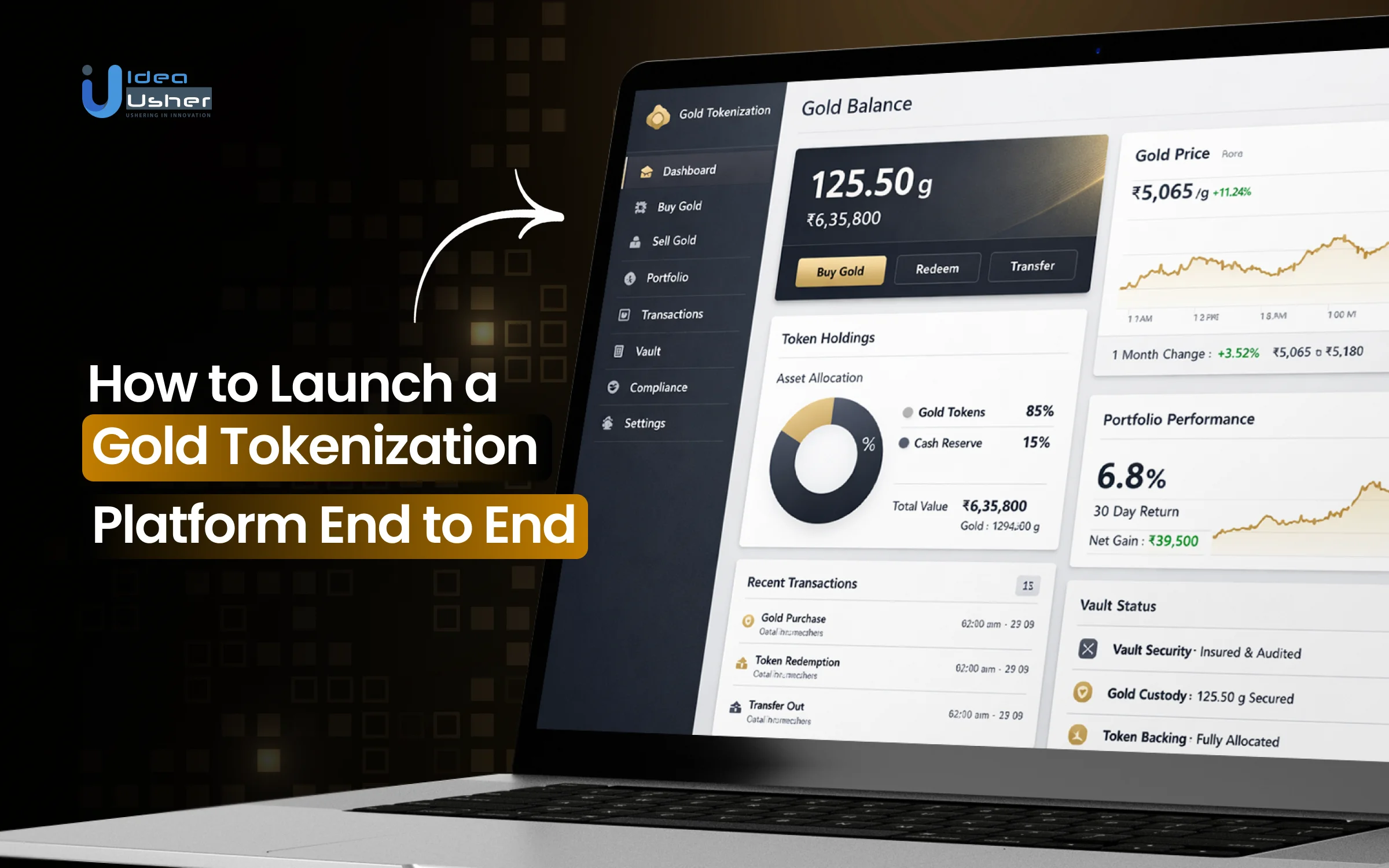
Gold has always carried trust, but it often struggles to keep pace with modern markets. During periods of rapid price movement, investors may experience friction from slow settlement and limited liquidity. That realization quietly pushed demand toward gold tokenization platforms that could keep gold relevant in a real-time financial world. Tokenization addressed this gap by enabling fractional ownership and real-time transfers secured by audited reserves.
On-chain proof of reserve kept the supply verifiable while smart contracts managed minting and burning. Integrated custody and redemption flows made settlement predictable. Compliance layers ensured controlled participation without slowing the system.
We’ve built numerous gold tokenization platforms powered by blockchain infrastructure and cryptographic proof-of-reserve. As IdeaUsher has these years of expertise, we’re sharing this blog to discuss the steps to develop a gold tokenization platform. Let’s start! ,
Key Market Takeaways for Gold Tokenization Platforms
According to DimensionMarketResearch, the global tokenization market is entering a clear scaling phase, with projections indicating USD 3.9 billion in 2025 and growth to nearly USD 18.8 billion by 2034. Within this shift, real-world asset tokenization is no longer experimental, and gold is emerging as one of the most commercially credible entry points.

Source: DimensionMarketResearch
Its long-standing role as a store of value complements blockchain benefits such as round-the-clock access and fractional ownership, making participation simpler for a wider investor base.
Gold tokenization platforms are gaining traction because they significantly improve access to and use of bullion. By lowering minimum investment sizes to grams or smaller, these platforms unlock liquidity that traditional physical gold markets struggle to offer.
Tokenized gold can move across exchanges, wallets, and DeFi protocols, enabling global trading and transfers with far less friction than physical custody.
Market depth is also becoming evident at scale. Leading products such as PAX Gold and Tether Gold together represent well over a billion dollars in tokenized reserves, signalling that the category has moved beyond proof of concept.

What Is a Gold Tokenization Platform?
A gold tokenization platform is a digital system that converts physical gold stored in regulated vaults into blockchain-based tokens that represent verified ownership of that gold. Each token is backed by real reserves, allowing gold to be held, transferred, or redeemed digitally while preserving its intrinsic value.
The platform combines custody, compliance, and smart contracts to make gold more liquid, transparent, and programmable without breaking its link to physical assets.
Key Features of Gold Tokenization Platforms
After developing numerous gold tokenization platforms, certain patterns become very clear. Users consistently gravitate toward features that make gold feel liquid, transparent, and reliable without exposing them to operational complexity.
1. Digital Gold Wallet
From experience, the digital wallet is where user trust begins. Users want a clean interface where balances update instantly, and transfers feel as smooth as crypto while still representing real gold in custody. Platforms like Aurus reflect this preference by letting users hold and transfer gold tokens directly through a dedicated wallet experience.
2. Fractional Ownership
Fractional ownership consistently drives adoption because users prefer flexibility over bulk holdings. Being able to buy or sell precise amounts of gold makes portfolio management feel practical rather than restrictive. Paxos addresses this well through PAXG, which allows ownership of fractional portions of LBMA-grade gold bars without minimum-weight constraints.
3. Proof of Reserves Dashboard
One feature users repeatedly request is visible proof that their gold exists. A proof-of-reserves dashboard builds confidence by linking audited vault data to on-chain records. Kinesis has shown how exposing reserve reports directly to users strengthens long-term trust in gold-based tokens.
4. Instant Mint and Burn
Users expect the system to stay balanced without manual intervention. Instant minting when gold is purchased and burning when gold is redeemed keeps supply aligned at all times. Tether applies this mechanism in XAUt so users never have to question whether circulating tokens exceed physical reserves.
5. Physical Gold Redemption
Even digital-first users want reassurance that physical redemption is possible. Clear redemption workflows allow users to convert tokens back into bullion with traceability. Platforms such as Perth Mint meet this expectation by supporting structured redemption processes from digital holdings to physical gold.
6. Compliance-Enabled Transfers
Compliance works best when users barely notice it. Identity checks completed once allow transfers to remain smooth while still respecting jurisdiction rules. Goldfinch-inspired compliant asset models show how enforcement can happen quietly at the token layer without disrupting the user experience.
7. DeFi Utility Access
The most advanced users want their gold to work for them. DeFi access allows tokenized gold to be used as collateral or within yield strategies. Digix demonstrated early demand for this by enabling DGX holders to integrate gold into lending and collateralization flows, transforming gold into an active financial asset.
How Does a Gold Tokenization Platform Work?
A gold tokenization platform quietly links real gold in regulated vaults to smart contracts that issue digital tokens only after custody is confirmed. You can securely hold or transfer these tokens on-chain, with proof of reserves continuously verified by oracle systems.

1. Vault and Audit Layer
This layer establishes real-world trust.
Secure Custody
Platforms partner with London Bullion Market Association-certified vaults operated by institutional providers. Each gold bar is allocated, insured, and tracked with a unique serial number. The gold is never commingled or abstracted.
Proof of Reserve Engine
Modern platforms move beyond static audit PDFs. They rely on decentralized oracle networks such as Chainlink to continuously verify reserves.
Vault inventory systems stream signed data to the blockchain. A Proof of Reserve smart contract publicly compares total gold held in custody with total tokens in circulation. Any mismatch triggers an automated alert and halts minting.
This creates continuous transparency rather than periodic trust.
2. The Compliance and Tokenization Engine
This layer merges legal enforcement with smart contract logic.
Regulatory Onboarding: Before purchasing tokens, users complete KYC and AML verification. Their verified identity is cryptographically linked to their wallet while preserving privacy.
Smart Contract Minting Flow
When a user buys gold using fiat or crypto:
- Funds are settled
- Physical gold is allocated at the vault
- The oracle confirms allocation
- The minting contract issues the exact number of tokens to the user’s verified wallet
Minting cannot occur without confirmed custody.
Compliance First Token Design: Leading platforms adopt ERC-3643. These identity-bound tokens enforce regulatory rules at the protocol level. Every transfer checks the compliance status of the sender and receiver before execution.
This ensures compliance persists after issuance, not just at onboarding.
3. The User and Market Layer
This is where tokenized gold becomes usable financial capital.
Trading and Liquidity: Users can hold, send, or trade gold tokens 24/7. Tokens are divisible down to extremely small units, enabling fractional and micro-level ownership.
Unlocking Utility
Tokenized gold goes beyond simple storage, becoming usable within modern financial systems. Gold tokens can serve as collateral in decentralized lending protocols or be used to earn yield in regulated lending pools. This approach can gradually transform gold from a passive reserve into a productive balance sheet asset.
Redemption and Settlement
When a user wants physical delivery:
- Tokens are sent to a burn address
- Tokens are permanently destroyed on-chain
- The smart contract instructs the vault to release the equivalent gold
- Insured logistics deliver the gold to the user
This burn-to-release mechanism guarantees the one-to-one peg is mathematically enforced.
How to Develop a Gold Tokenization Platform?
A gold tokenization platform should begin with regulated vault custody that reliably syncs physical reserves to smart contracts. The system must securely mint and burn tokens through audited logic, while compliance layers can continuously enforce identity and jurisdiction rules.
We have built several gold tokenization platforms over the years, and this is the approach we consistently follow.

1. Custody and Vault Setup
We begin by integrating LBMA-certified vault partners and defining custody, insurance, and audit responsibilities. Secure API connections are built with vault inventory systems so physical gold balances remain continuously verifiable.
2. Proof of Reserves Layer
We implement oracle-driven reserve verification using Chainlink Proof of Reserve or custom networks. Vault data is synced with smart contracts to control minting and automatically halt issuance if reserve conditions are not met.
3. Smart Contract Core
We develop gold-backed smart contracts that support minting, burning, fractional ownership, and redemption. The architecture is designed to be upgrade-safe while preserving asset integrity and liquidity.
4. Compliance Framework
We embed identity and regulatory controls directly into the token layer. This includes ERC-3643-based identity binding, KYC and AML integrations, and jurisdiction-aware transfer restrictions.
5. User and Admin Interfaces
We build intuitive user interfaces for wallets, balances, transactions, and redemptions. In parallel, we create admin dashboards for managing supply, compliance actions, and audit visibility.
6. Monetization and Integrations
We finalize the platform by enabling fee models and ecosystem integrations. DeFi connectivity and multi-chain deployment strategies are implemented to support growth and long-term liquidity.
What Minimum Amount of Gold Is Required to Launch a Tokenization Platform?
This is one of the most critical and most misunderstood questions for anyone entering the digital gold space. The short answer is simple. There is no single fixed regulatory minimum. The real minimum is not defined by ounces alone. It is characterized by structural credibility, liquidity, and operational viability.

To understand this properly, it helps to look at how real platforms entered the market.
- PAX Gold launched with an estimated 15-20 million dollars in fully allocated gold, providing immediate liquidity and institutional confidence.
- Meld Gold in Australia took a different approach, starting with strategic mining partnerships and tokenizing batches valued at approximately $ 5- $10 million during its initial rollout.
- A more community-driven project, such as Auric Network, began with a treasury-backed model that required roughly 1-2 million dollars in gold to bootstrap its decentralized ecosystem.
The takeaway is clear. Your launch amount is shaped by three pillars, not just gold volume.
1. The Economic Viability Minimum
This is the practical business floor. Using PAX Gold as a benchmark, the platform launched with enough reserves to support trading on major exchanges such as Binance and Kraken. That level of liquidity is essential to prevent slippage and enable arbitrage. A launch with only a few bars simply cannot support this.
Industry benchmark for a viable MVP
Most experts agree that a minimum launch treasury of 1 to 5 million dollars in allocated and audited gold is required. This level of backing provides a meaningful liquidity pool, establishes credibility with early adopters, and creates a buffer to operate while scaling.
2. The Regulatory and Partnership Minimum
Vaults, banks, and regulators do not think in ounces. They think in risk, compliance, and reputational exposure.
Tier one vault providers such as Brink’s, used by PAX Gold in London, typically require annual minimum commitments starting around 50,000 to 100,000 dollars or more. Your reserve size must justify these fixed costs.
- Financial regulators take a similar stance. Meld Gold operates under Australia’s strict financial services framework, where initial reserve size is carefully reviewed to ensure redemption obligations can be met at all times.
- Even decentralized platforms like Auric Network require strong reserve backing to satisfy banking partners for fiat on- and off-ramps.
To be taken seriously, a seven-figure reserve in USD terms is often the unofficial entry point.
3. Full Reserve Versus Fractional Reserve
Every credible gold token platform follows the same trust model. Full reserve backing is non-negotiable. Each token must represent direct ownership of physical gold held in custody.
- PAX Gold ties each token to one fine troy ounce of a London Good Delivery bar.
- Meld Gold issues tokens representing one gram of gold sourced from partner mines.
- Auric issues tokens representing fractional ownership of the pooled allocated gold.
Reputable platforms avoid fractional reserve models. They introduce regulatory risk, trust breakdowns, and redemption uncertainty that can cripple a launch before it scales.
The Smart Launch Strategy
You do not need to tokenize an entire national reserve on day one. Successful platforms scale deliberately.
- Phase one: Backed by 1 to 5 million dollars in gold, often used to validate custody, smart contracts, and redemption flows with a controlled audience.
- Phase two: Backed by 10 million dollars or more, enabling exchange listings and broader market access, as seen with Meld Gold.
- Phase three: Backed by 100 million dollars or more, allowing the token to function as collateral and infrastructure across the digital finance ecosystem, as demonstrated by PAX Gold today.
So What Is the True Minimum?
Forget counting bars. Think in terms of launching a credible business.
- Absolute practical minimum: Around 1 million dollars in allocated gold, sufficient for an MVP and early validation.
- Recommended viable minimum: 5 million dollars or more, providing real liquidity, regulatory comfort, and partnership readiness.
- Institutional trust minimum: 15 million dollars or more, enabling immediate exchange listings and institutional confidence.
What Happens When On Chain Demand Exceeds Physical Gold Reserves?
This scenario is the ultimate stress test for any gold tokenization platform. It separates structurally sound systems from fragile ones and directly determines long-term trust. This is not a theoretical concern. It is a core architectural challenge that defines platform integrity.
Here is what actually happens when on-chain demand threatens to exceed vault holdings, and how serious platforms are engineered to prevent failure.

The 1:1 Full-Reserve Smart Contract
The primary defense against overissuance is programmatic enforcement. In a well-designed system, it must be technically impossible for thetoken supply to exceed physical gold reserves.
This protection is enforced by a Proof-of-Reserve oracle.
Take PAX Gold as the reference model. Its smart contracts are directly linked to the Chainlink oracle network, which continuously verifies gold balances held in Brink’s vaults. The logic follows a strict rule.
If the verified vault balance is lower than the total token supply, minting is automatically disabled.
The moment new token creation would outpace incoming gold, the mint function freezes. No new tokens can exist until insured gold is physically deposited and the oracle updates the on-chain reserve data.
The Secondary Market Safety Valve
When minting is paused due to reserve limits, market economics take control.
Consider a scenario where Meld Gold experiences a surge in buying pressure, but its monthly mine allocation has already been fully tokenized.
What happens next is critical.
A secondary market premium emerges. The token begins trading above spot gold prices on exchanges such as Coinbase or Kraken.
This creates a powerful arbitrage incentive.
- For token holders, selling on the open market becomes more attractive than redeeming for physical delivery.
- For arbitrage participants, physical gold can be sourced elsewhere at spot price, deposited into the platform vault, tokenized, and sold at a premium.
This activity naturally rebalances the system. Gold flows into the vault, supply expands responsibly, and the price premium disappears as equilibrium is restored.
Can the Vault Be Drained?
The inverse risk is a sudden surge in redemptions, similar to a bank run. Reputable platforms design explicit controls to manage this.
When a user redeems tokens for physical gold on platforms such as Auric Network, those tokens are immediately burned. Total token supply decreases in lockstep with physical outflow, preserving the 1-to-1 backing.
The gold is then released for delivery.
Several safeguards further stabilize the system.
- Redemption minimums and fees discourage small scale or speculative withdrawals. For example, PAXG requires redemption in large bar sizes.
- Logistical settlement delays naturally stagger gold outflows due to shipping and verification timelines.
- Liquidity buffers are maintained by serious platforms, sometimes exceeding 100 percent collateralization, to manage reporting and settlement timing differences.
The Catastrophic Failure Mode
If a platform violates full-reserve principles and issues unbacked tokens, a collapse becomes inevitable. This is not a failure of tokenization technology. It is a failure of governance.
Unbacked tokens become promises without proof. Once exposed, trust collapses instantly, prices fall toward zero, and legal consequences follow.
The critical safeguard is transparency. Real platforms deploy real-time Proof of Reserve dashboards and immutable audit trails that make such failures immediately visible and therefore preventable.
How Leading Platforms Engineer Stability?
| Layer | Mechanism | Example in Action |
| 1. Technical Enforcement | Smart contracts and oracles prevent overminting. | PAX Gold only mints tokens after oracle verified vault confirmation. |
| 2. Economic Incentives | Market premiums drive arbitrage and rebalance supply. | Meld Gold attracts new gold deposits when exchange premiums appear. |
| 3. Operational Governance | Custody, audits, and governance secure reserves. | Auric Network uses on-chain audits and multi-signature control. |
How Much Revenue Can a Gold Tokenization Platform Generate?
The revenue potential of a gold tokenization platform is not speculative. It is driven by transparent, scalable fee models that increase in line with assets under management and transaction volume. While private operators rarely disclose full profit figures, realistic projections can be built by analyzing public fee structures, reported AUM, and standard industry practices.
1. Minting and Redemption Fees
This is the most direct revenue stream. Fees are charged when users convert fiat or crypto into gold tokens and again when tokens are redeemed for physical gold or cash.
Industry rate: Typically 0.5-2% per transaction.
Example and projection
PAX Gold applies a 1.0 percent fee on minting and redemption. With AUM consistently near $ 500 million, even a conservative 20 percent annual turnover yields meaningful revenue.
500M AUM × 20 percent turnover × 1 percent fee = 1 million dollars annually from this stream alone.
This revenue scales linearly with adoption.
2. Custodial Storage Fees
This is the most stable and predictable income source. The platform charges users an annual fee to store and insure physical gold securely.
Industry rate: Typically0.5-1.5% per year, calculated on thegold value.
Example and projection
Major custodians such as Brink’s charge platforms roughly 0.5 percent annually. Platforms then apply a small markup to end users.
A platform managing 100 million dollars in AUM at a blended 0.8 percent annual storage fee generates:
100M AUM × 0.8 percent = 800,000 dollars in recurring annual revenue.
Kinesis Money publicly applies a 0.45 percent annual management fee, validating this model at scale.
3. Transaction Fees
Once tokens circulate, the platform can capture value from transfers and trading activity.
Fee model: Either a small fixed fee or a percentage per transfer, typically 0.1-0.2%.
Scale example
If a platform processes 1 billion dollars in annual secondary trading volume, which is modest by crypto standards, and charges a 0.15 percent transaction fee, the result is:
1B volume × 0.15 percent = 1.5 million dollars in annual revenue.
As the token becomes a settlement and payment instrument, this layer compounds rapidly.
4. Advanced Financial Services
This is where mature platforms unlock outsized margins by transforming gold from a passive asset into productive capital.
DeFi integration and yield sharing
Platforms such as Auric Network enable gold tokens to be used as loan collateral. The platform earns revenue by capturing a share of interest yield or lending spreads.
Institutional services
White-label tokenization for miners, banks, and ETFs creates enterprise revenue through licensing, onboarding fees, and long-term platform access. Meld Gold’s miner partnerships demonstrate this model in action.
Example potential
A platform facilitating 50 million dollars in gold-backed loans at a 4 percent average yield, while retaining 25 percent of the yield, generates:
50M × 4 percent × 25 percent = 500,000 dollars in annual revenue.
This layer scales disproportionately with institutional adoption.
Top 5 Gold Tokenization Platforms in the USA
We conducted focused research and identified a few gold-standard tokenization platforms that stand out for their technical depth and structural clarity. Each approach to custody and on-chain control is slightly different and may suit different platform goals.
1. Paxos Gold (PAXG)

Paxos Gold is one of the most established gold tokenization platforms available to U.S. investors. Each PAXG token represents one fine troy ounce of physical gold held in LBMA-approved vaults. The platform stands out for its strong regulatory alignment under New York financial laws and its focus on transparency through on-chain verification of reserves.
2. Tether Gold (XAUt)

Tether Gold offers a tokenized form of physical gold that trades easily across major crypto exchanges. Each XAUt token is backed by one troy ounce of gold stored in professional vaults. While the platform operates globally, it has significant adoption among U.S. users due to its liquidity, familiarity, and integration with existing crypto trading infrastructure.
3. Securitize

Securitize is a U.S.-based tokenization platform that enables institutions to issue compliant real-world asset tokens, including gold-backed products. Rather than offering a single gold token, it provides the full issuance, compliance, and investor management stack. This makes it a preferred choice for enterprises looking to launch regulated gold token platforms in the United States.
4. Polymath

Polymath focuses on helping issuers create legally compliant asset-backed tokens within regulated markets. Its infrastructure supports gold tokenization by embedding identity, transfer restrictions, and regulatory logic directly into smart contracts. The platform is commonly used by issuers seeking to tokenize gold while remaining aligned with U.S. securities regulations.
5. DigiShares

DigiShares provides a flexible tokenization framework that supports gold and other real-world assets. The platform is often used for white-label gold token launches, combining investor onboarding, compliance workflows, and asset lifecycle management. Its modular approach makes it suitable for U.S.-focused firms aiming to build customized gold tokenization platforms.
Conclusion
Gold tokenization platforms mark a practical shift in how asset-backed finance can operate at scale. They enable businesses to unlock liquidity, transparency, and programmable value from a commodity that already carries global trust. With a sound technical foundation, a clear compliance approach, and a development partner like IdeaUsher, enterprises can confidently build secure, scalable platforms that are designed for long-term relevance.
Looking to Develop a Gold Tokenization Platform?
At IdeaUsher, we can architect a gold tokenization platform that securely links vaulted gold with on-chain issuance and auditable supply logic. The system will handle identity-bound tokens, reserve proofs, and regulated mint-burn flows, so assets should move efficiently across markets.
We build beyond the basics:
- Real-Time Proof of Reserves – Bridge vaults to the blockchain with oracle-grade precision.
- Bank-Grade Compliance by Design – Implement ERC-3643 for identity-bound, regulator-ready tokens.
- DeFi-Ready Yield Engines – Transform static gold into a productive, interest-bearing asset.
- Atomic Redemption Logic – Ensure flawless physical delivery with fail-safe smart contracts.
We transform your vision into a market-ready platform engineered for scalability, compliance, and investor trust.


FAQs
A1: A gold tokenization platform is developed by first defining custody and reserve verification workflows. Smart contracts are then designed to issue tokens that map directly to vaulted gold and may include compliance logic. The system can be completed with wallet integration, exchange connectivity, and secure redemption flows.
A2: Core features typically include proof-of-reserves, token minting and burning, and identity-aware transfers. Platforms often support physical redemption, real-time settlement, and audit visibility. Some may also enable programmable use cases such as collateralization or enterprise integrations.
A3: The platform works by locking physical gold with a regulated custodian and issuing equivalent digital tokens on the chain. Each transaction updates ownership records in real time while reserves remain verifiable. When redemption is requested, tokens are burned, and gold is released from the vault.
A4: Development costs can vary based on the level of compliance, the blockchain selected, and the integration of custody. A basic platform may start with a focused feature set, while enterprise builds can be more extensive. Long-term costs should be evaluated against the scope of security regulations and scalability needs.


