


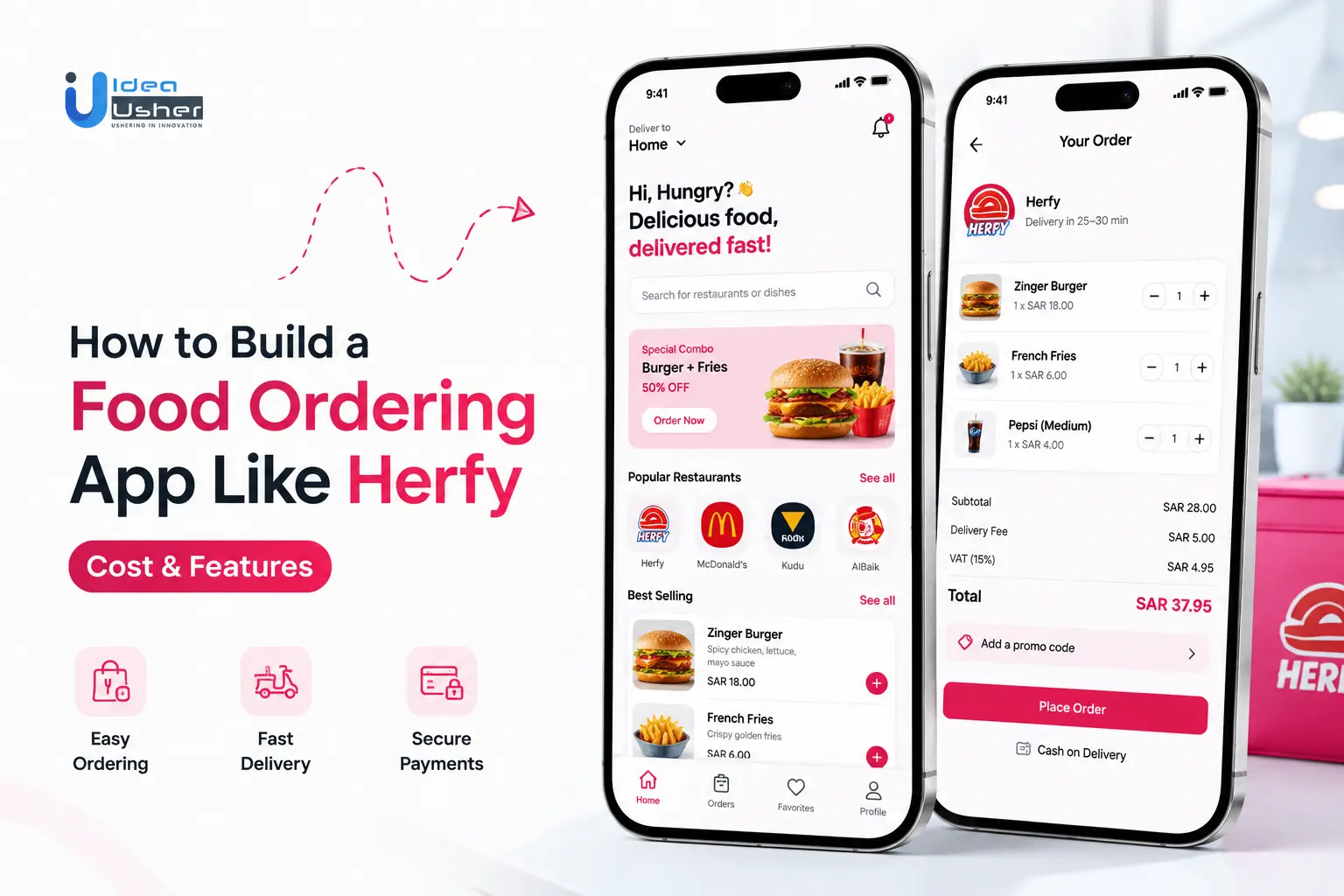
Every regional restaurant chain eventually hits the same wall. Aggregators like HungerStation, Keeta, and Jahez bring order volume, but they also take a 15-30% commission on every single order, and they own the customer relationship. Herfy, Saudi Arabia’s homegrown fast-food chain, sidestepped that problem by building its own branded ordering app instead of relying solely on marketplaces.
The Herfy App, which has crossed 1 million downloads and holds a 4.7-star rating on Google Play, lets customers browse burgers, sandwiches, kids’ meals, salads, and sides, apply offers, choose home delivery or pickup from any Herfy branch across the Kingdom, track an order, pay by cash or card, and find the nearest location. It’s a solid example of a single-brand ordering app done right, and it’s a useful reference point for any restaurant chain, cloud kitchen, or QSR brand thinking about owning its digital ordering channel rather than renting it from a marketplace.
Below is what actually goes into building an app like Herfy: the features, the architecture, the tech stack, realistic costs, and a few operational mistakes worth avoiding.
Why Restaurant Brands Are Building Their Own Ordering Apps
Aggregators are genuinely good at discovery. If you want new customers finding you for the first time, HungerStation or Keeta will do that job better than a standalone app ever will. But the cost adds up over time. A restaurant chain running meaningful volume through third-party marketplaces is paying commission on every repeat order too, not just the ones that came from discovery, and the aggregator ends up owning the email address, the phone number, and the order history, not the restaurant. It’s worth seeing how aggregators like Talabat actually generate revenue to understand exactly how much of that value gets captured on the platform side rather than the restaurant’s.
A branded app changes that math. Once someone downloads it, every order after the first is close to commission-free (aside from standard payment processing fees), the brand keeps first-party data it can use for retargeting and loyalty, and the whole ordering experience, from menu layout to offers to branch selection, is controlled end to end instead of sitting inside a generic aggregator template next to a dozen competitors. There’s a broader case for this in our piece on the benefits of a dedicated app for restaurant businesses, but the short version is: owning the relationship beats renting the reach, at least on repeat orders.
None of this means dropping aggregators. Most large chains, and Herfy appears to be one of them based on how customers describe using both the official app and platforms like HungerStation and Keeta for delivery, run a hybrid setup. The proprietary app handles pickup, direct ordering, and loyalty; aggregator listings handle delivery reach and new-customer discovery. The branded app protects margin on repeat, high-frequency orders, and lets aggregators keep doing the expensive part: last-mile logistics and customer acquisition.
The Market Opportunity: Why Now
Timing matters here, particularly in the GCC. Saudi Arabia’s food delivery sector isn’t in early-adoption mode anymore; it’s core infrastructure for the food service industry now, in a way that’s similar to how delivery app development in the UAE matured a few years ahead of it.
A few numbers worth knowing if you’re putting together a business case:
- Saudi food delivery gross booking value landed in the mid-SAR-20-billions in 2025, across tens of thousands of restaurant locations and well over 100,000 monthly active riders, according to Redseer’s 2026 market report. Digital ordering now covers close to a fifth of total foodservice spend in the Kingdom.
- Mordor Intelligence puts the broader Saudi delivery-app ecosystem (food, grocery, and on-demand combined) at roughly USD 9-10 billion in 2026, growing at a mid-teens compound annual rate through the early 2030s.
- Pure food ordering is growing faster than delivery as a category overall; some estimates put the segment’s annual growth rate near 18% through the end of the decade.
- Smartphone penetration in Saudi Arabia has more than doubled over the past decade, and IMARC Group notes internet reach is now near-universal, with mobile speeds running roughly double the global average. Most of the old “our market isn’t ready yet” excuses no longer apply.
- Vision 2030 initiatives, including a 2026 national push on AI adoption across sectors, are lowering the technology barrier for smaller and mid-sized food brands trying to compete with better-funded platforms.
None of this means the market is uncrowded. It means it’s shifting away from pure discount-driven competition and toward brands that can actually deliver a fast, reliable, owned ordering experience. That’s the gap a Herfy-style app is built to fill.
Core Features: What a Herfy-Style App Actually Needs
A single-brand restaurant app is a simpler build than a multi-restaurant marketplace like Uber Eats, but it still spans three connected surfaces: the customer app, the restaurant’s operations backend, and an admin panel tying it all together.
Customer-Facing App
- Digital menu with real categorization. Burgers, sandwiches, combos, kids’ meals, sides, and limited-time offers, each with decent imagery, customization (extra cheese, no onions, meal upsizing), and calorie or allergen info where it’s relevant.
- Order modes that aren’t delivery-only. Home delivery, in-store pickup, and drive-thru pre-order should all be first-class options. Herfy’s own listing highlights both delivery and pickup as core flows, and in a market where drive-thru culture is strong, that matters more than it might elsewhere.
- Branch locator with live status. GPS-based nearest-branch search, operating hours, and whether that specific branch currently supports delivery or pickup right now, not just in general.
- Cart and checkout with saved addresses, saved cards, split cash/card payment, and a clear order summary before the customer confirms.
- Account registration by Saudi mobile number with OTP verification. It’s a small detail, but it’s what local users expect, and it cuts down on fake accounts and abandoned carts far more than email sign-up does.
- Digital receipts that are VAT-compliant and, where applicable, aligned with ZATCA e-invoicing requirements. This sits in the backend more than the UI, but it needs to be planned for from the start; retrofitting tax compliance into a live payment flow is painful.
- Real-time order tracking, from confirmation through prep to dispatch or ready-for-pickup, ideally with a push notification at each stage rather than just at the end.
- A dedicated deals section for offers and promo codes. Promotional offers remain one of the strongest drivers of app engagement for QSR brands specifically.
- One-tap reordering of a previous cart. This is unglamorous but it’s genuinely one of the highest-converting features in the entire category; skipping it is a common and costly oversight.
- Loyalty and rewards, whether that’s points per order, tier-based perks, or a simple punch-card “buy 9 get 1 free” mechanic. This is the single strongest lever for repeat-order frequency, and it’s where a branded app usually earns back its build cost over time.
- Full Arabic/English bilingual support with proper RTL layout. This isn’t optional for the Saudi or wider GCC market, and it’s much cheaper to build in from day one than to retrofit later.
For a wider view beyond a single-brand build, our list of essential features of food delivery apps covers the marketplace side too, which is worth knowing even if you’re not building an aggregator.
Restaurant / Operations Backend
The restaurant side needs an order management dashboard so in-store staff can accept, prepare, and mark orders ready, ideally synced with the point-of-sale system so nobody has to re-key an order that already exists digitally. Menu and inventory management should let item availability, pricing, and combos update centrally across every branch without an app store resubmission each time. And branch-level configuration, covering hours, delivery radius, minimum order value, and quickly marking an item sold out, needs to be manageable per location, not just set globally and hoped for.
Admin Panel
At the admin layer, you want centralized analytics (order volume by branch, peak hours, best-sellers, average order value, cart abandonment), customer relationship tools for segmenting push notifications and campaigns, offer and coupon management with expiry dates and branch-specific eligibility, and enough support/ticket visibility to see and respond to a delayed or problem order in near real time, not the next morning.
Delivery/Logistics Layer
This is where brands make a real strategic choice, and it’s probably the single decision that shapes the rest of the build:
- Own delivery fleet with a dedicated rider app. Full control over the delivery experience and cost, but a genuinely significant operational lift.
- Hybrid model. In-house delivery for a limited radius around each branch, aggregator partnerships covering everything beyond that.
- Pickup-and-dine-in only. No delivery infrastructure at all; the app is purely a fast, frictionless ordering and loyalty tool, and delivery is left entirely to third-party platforms.
Most regional chains launching their first branded app start with option 2 or 3, then add fleet-management complexity later once order volume actually justifies the overhead of hiring, routing, and paying riders directly.
A Real Lesson From Herfy’s Reviews: Ops Matter More Than Features
It’s worth being blunt about something Herfy’s own user reviews keep surfacing: order delays, unresponsive support during delivery issues, and slow refunds are the recurring complaints, not the app’s interface or how the menu is laid out. Several reviewers say outright that they’d rather order Herfy through a third-party aggregator than through the brand’s own app, specifically because those platforms handle delivery problems faster.
That’s a useful lesson for anyone building something similar. The app itself is maybe 30% of the customer experience. The other 70% happens after the order is placed: kitchen prep time, dispatch coordination, live support during a delay, refund turnaround. A well-designed app sitting on top of a slow or unresponsive fulfillment process will produce exactly the kind of reviews Herfy has been getting, no matter how good the UI is. Budget for the ops tooling and support workflows as seriously as you budget for the customer-facing screens, or the app will look great in the store listing and fall apart in the reviews section.
Recommended Tech Stack
| Layer | Recommended Options | Why |
|---|---|---|
| Customer & staff mobile apps | Flutter or React Native | A single codebase for iOS and Android cuts development time by 30-40% versus fully native builds, without giving up much on performance for what an ordering app actually needs |
| Backend / API | Node.js or Django (Python), built with a microservices-friendly structure | Both handle real-time order flows well and have mature libraries for payments, notifications, and geolocation |
| Database | PostgreSQL for transactional data, Redis for caching, session, and live order status | Reliable for financial data, with good support for the read-heavy browsing patterns most menu apps see |
| Real-time tracking | WebSockets or Firebase Cloud Messaging | Needed for live order status and rider location without constant polling |
| Payments | Mada (essential for KSA), plus Apple Pay, STC Pay, and card processing through a PCI-compliant gateway | Mada is the dominant domestic card scheme in Saudi Arabia; an app that skips it will lose orders at checkout |
| Maps & geolocation | Google Maps Platform | Branch locator, delivery radius calculation, and rider tracking if a fleet is part of the build |
| Cloud infrastructure | AWS or Google Cloud with auto-scaling | Handles order spikes around meal times without paying for that capacity the rest of the day |
| Push notifications | Firebase Cloud Messaging / OneSignal | Order status updates and promotional campaigns |
| Admin dashboard | React or Vue.js web app | Kept separate from the mobile codebase, built for data-dense internal use rather than a consumer-facing feel |
| Security & authentication | OAuth 2.0 and JWT, plus role-based access control | Protects customer accounts and payment data, and separates what a branch manager can see from what head office can see |
| Analytics & monitoring | Firebase Analytics or GA4, plus a lightweight monitoring tool like Grafana | Tracks conversion, cart abandonment, and crash rates, and flags performance issues before they show up as bad reviews |
| AI/personalization (optional, phase two) | A recommendation layer built on order history, or a managed service like AWS SageMaker | Menu personalization and demand forecasting are increasingly standard rather than novel, especially with Saudi Arabia’s 2026 national push on AI adoption across sectors, but they’re worth adding after the core ordering flow is solid, not before |
If a brand already runs a POS system in-store, which most established chains do, budgeting for a proper POS integration layer from the start avoids the error-prone habit of manually re-entering app orders at the counter. That manual step is one of the most common causes of the delay complaints Herfy’s reviews keep mentioning.
Step-by-Step Development Process
- Discovery and scoping (1-2 weeks). Decide which order modes launch first (pickup, delivery, or both), how many branches are in scope, and whether delivery will be in-house, aggregator-only, or hybrid. This one decision affects cost more than almost anything else in the build.
- UX/UI design (2-3 weeks). Menu browsing, cart flow, and checkout should be designed and usability-tested before a single line of production code gets written. Checkout friction is where food ordering apps tend to lose people.
- Backend and API development (4-8 weeks, running alongside frontend work). Order management, menu and inventory services, payment integration, POS sync if it applies.
- Mobile app development (6-10 weeks). Customer app first, staff/restaurant app second, rider app third if it’s in scope at all.
- Payment gateway and Mada integration, plus security testing. A PCI-DSS compliance review is essential before any live card data touches the system.
- QA across devices and both Arabic/English RTL layouts. Menu and checkout flows in particular need real testing in both languages, not a quick visual check.
- Pilot launch at a handful of branches. Validate order accuracy, kitchen-to-dispatch timing, and how fast support actually responds before rolling out further. This is where the operational lessons from Herfy’s reviews get tested for real.
- Full rollout, with app store optimization, loyalty program activation, and a launch promotion to drive that first wave of downloads.
- Post-launch monitoring, tracking cart abandonment, reorder rate, and support ticket volume as the real signals of whether it’s working.
A realistic timeline for a full-featured single-brand ordering app, built by an experienced team, runs 12-20 weeks for an MVP and 4-7 months for a full platform with POS integration, loyalty, and multi-branch admin tooling.
What It Costs to Build
There’s no single number here, and it’s worth saying why: two businesses can both ask for “an app like Herfy” and get quotes $150,000 apart, because they’re not actually describing the same build. A single-branch pilot with pickup only and no POS sync is a different project than a multi-branch platform with a rider app, inventory sync, and Arabic-first UX from day one. Scope, not vendor markup, is what moves the number most.
The biggest single cost driver is how many of the four “sides” of the platform you’re actually building: customer app, restaurant/staff app, admin dashboard, and rider app. Our full guide on food delivery app development cost and process breaks this down in more detail if you want the line-item version.
By Build Complexity
| Build Type | Typical Cost (USD) | Typical Cost (SAR) | What’s Included |
|---|---|---|---|
| White-label / templated app | $8,000 – $20,000 | SAR 30,000 – 75,000 | Ready-made ordering template, basic branding, one payment method, minimal customization |
| Focused MVP (single order mode, one payment method, basic admin) | $25,000 – $45,000 | SAR 94,000 – 169,000 | Customer app, basic order management, one payment gateway, no rider app |
| Mid-range platform (pickup + delivery, loyalty, multi-branch admin, POS integration) | $50,000 – $100,000 | SAR 188,000 – 375,000 | Everything above plus real-time tracking, promo engine, analytics dashboard, POS sync |
| Full platform with in-house delivery fleet | $100,000 – $200,000+ | SAR 375,000 – 750,000+ | Everything above plus a dedicated rider app, dispatch/routing logic, and driver management tools |
| Ongoing annual maintenance | 15-20% of initial build cost | Same ratio | Bug fixes, OS updates, security patches, minor feature iteration |
A white-label build is worth mentioning honestly: it’s the cheapest way to get something live, and it can be the right call for a single-location test. But heavy customization of a white-label platform tends to cost more in the long run than building custom once you’re past a handful of branches, since you’re paying to work around someone else’s architecture instead of building your own.
By Development Module
If you’re trying to figure out where the budget actually goes rather than just the total, it roughly breaks down like this for a mid-to-full platform:
| Module | Typical Cost (USD) | Typical Cost (SAR) |
|---|---|---|
| Customer app (menu, cart, checkout, loyalty, notifications) | $25,000 – $55,000 | SAR 94,000 – 206,000 |
| Restaurant/kitchen operations (order dashboard, POS sync, branch controls) | $18,000 – $45,000 | SAR 68,000 – 169,000 |
| Delivery and rider management (rider app, dispatch, live tracking) | $15,000 – $40,000 | SAR 56,000 – 150,000 |
| Backend, cloud infrastructure, and third-party integrations | $30,000 – $80,000 | SAR 113,000 – 300,000 |
| QA, security testing, and launch | $10,000 – $25,000 | SAR 38,000 – 94,000 |
On top of the build itself, budget for cloud hosting and CDN ($300-$2,000/month depending on order volume), mapping API usage, SMS/notification costs, and payment processing fees. These recurring costs typically run 30-40% of the total three-year cost of ownership, which is the number founders most often underestimate when they focus only on the upfront quote.
A tightly scoped MVP, one order mode, one payment method, a handful of pilot branches, and expanding based on actual usage data rather than assumptions, is consistently the most capital-efficient path. It’s roughly the same phased approach the big aggregators themselves used before they became national platforms.
Monetization Beyond the Obvious
A branded app’s return isn’t just “avoided commission.” The stronger gains tend to show up elsewhere:
- Loyalty mechanics reliably lift repeat-order frequency compared to one-off aggregator orders, where there’s no ongoing relationship to reinforce.
- Push notifications and in-app promotions are a marketing channel that costs nothing per send, unlike paid visibility on aggregator platforms.
- First-party order data shows which items, combos, and time slots actually drive revenue, which feeds into everything from menu engineering to picking the next branch location.
- A branded channel isn’t exposed to a competitor’s business decisions. Commission structures and search-ranking rules on third-party platforms change whenever the platform wants them to; your own app doesn’t have that risk.
Common Pitfalls to Avoid
- Treating delivery logistics as an afterthought. Herfy’s own reviews make the point clearly: a polished app on top of slow, poorly coordinated fulfillment produces worse reviews than a plainer app backed by reliable operations.
- Skipping POS integration to save budget. Manual re-entry at the counter is a leading cause of delays, wrong orders, and the kind of support friction that shows up as one-star reviews.
- Underinvesting in Arabic RTL design. A translated-but-not-truly-localized interface is obvious to Arabic-first users almost immediately, and it costs trust.
- Not planning for demand spikes. Ramadan, national holidays, and weekend evenings can multiply order volume overnight. An architecture that isn’t built to auto-scale will show it exactly when it matters most; cloud infrastructure sized for an average Tuesday will buckle on the nights that actually drive revenue.
- Treating address accuracy as someone else’s problem. Inconsistent addressing is a real source of late and misdelivered orders in denser Saudi cities. Letting customers pin their exact location on a map, rather than typing a text address, fixes more delivery complaints than almost any other single feature.
- Leaving VAT and e-invoicing compliance until after launch. Retrofitting ZATCA-aligned digital receipts into a live payment flow is far more expensive than building it in from the start; treat it as a launch requirement, not a post-launch cleanup task.
- Launching without a real refund and cancellation workflow. Slow refunds are one of the most common, and most avoidable, sources of frustration in food ordering apps generally.
- Building all four platform sides at once. Phase it: customer app, then admin and restaurant tools, then a rider app if you actually need one. That keeps early cost and risk manageable while you find out whether demand is real.
How Idea Usher Can Help
Idea Usher’s food delivery app development services cover custom ordering, delivery, and restaurant-tech platforms end to end, from the customer-facing app and Mada/payment integration through POS-synced restaurant dashboards and, where needed, dedicated rider apps with live dispatch. We’ve shipped multi-branch food and delivery platforms for regional chains, including staff-augmented builds for enterprise QSR brands, and every build is designed around the operational realities, kitchen timing, dispatch, refunds, that actually determine whether an app earns five stars or one.
If you’re scoping a branded ordering app for your restaurant chain or cloud kitchen brand, book a free consultation and we’ll walk through feature scope, timeline, and a realistic cost estimate for your specific market.

Frequently Asked Questions
Is a white-label app or a custom build better for something like Herfy?
White-label gets you live faster and cheaper, and it’s a reasonable way to test demand at a single location. Once you’re operating across multiple branches and want real POS integration, loyalty logic, or brand-specific UX, custom development pulls ahead. Heavily customizing a white-label platform to get there often ends up costing more than building custom from the start, so it’s worth deciding early which path you’re actually on.
Do I need my own delivery fleet to launch an app like Herfy?
No. Plenty of successful single-brand apps launch pickup-only or with a hybrid model: in-house delivery within a small radius of each branch, aggregator partnerships for everything beyond that. A dedicated rider app and fleet-management system can come later, once order volume actually justifies it.
Should I still list on HungerStation, Keeta, or Jahez if I build my own app?
In most cases, yes. Aggregators are still valuable for new-customer discovery and delivery reach that would be expensive to replicate on your own. A branded app is best positioned to capture repeat orders and loyalty, not to replace every aggregator listing from day one.
How long does it take to build an MVP version of an app like Herfy?
A focused MVP, customer app, one order mode, one payment gateway, basic admin tools, typically takes 12-16 weeks with an experienced development team.
What’s the single most important integration for a Saudi-market ordering app?
Mada payment support. It’s the dominant domestic card network in Saudi Arabia, and an app that skips it will lose a meaningful share of potential orders right at checkout.
What ongoing costs should I expect after launch?
Budget 15-20% of the initial build cost per year for maintenance: bug fixes, OS updates, and security patches. On top of that, cloud hosting and CDN typically run $300-$2,000 a month depending on order volume, plus mapping API usage, SMS costs, and payment processing fees. Together, these recurring costs usually add up to 30-40% of the total three-year cost of ownership, which is the part most founders underestimate when they’re only looking at the upfront build quote.
Is Flutter or React Native better for a food ordering app?
Both are viable and roughly comparable here. The more important decision is usually the backend architecture and how well POS integration is handled; that’s where most of the operational complexity, and most of the risk of order delays, actually lives.


