 (+971) 8007 4267
 (+91) 946 340 7140
 (+1) 628 432 4305

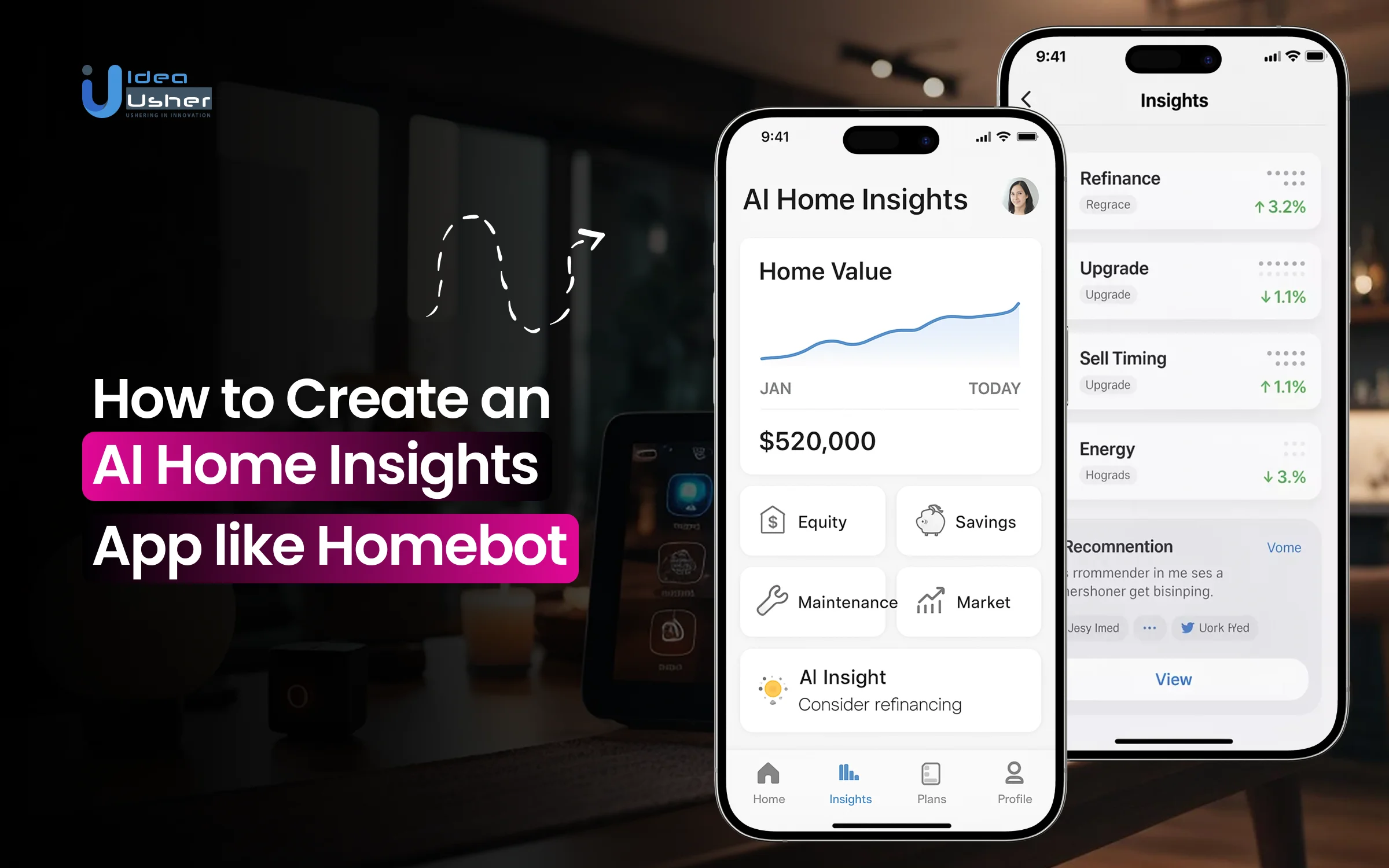
Homeownership generates constant data around property values, mortgage balances, market trends, and equity, yet much of it remains fragmented and hard to interpret. Updates often arrive without context, leaving homeowners unsure what the numbers mean for their financial position. This gap defines the need for a Homebot-like AI home insights app, where data is translated into clear, personalized insights rather than static information.
An AI home insights app brings together property, financial, and market data into a single intelligence layer. Instead of responding to one-time queries, the system continuously analyzes changes, generates relevant insights, and delivers them in context over time. Achieving this requires careful data aggregation, insight modeling, personalization logic, and reliable update mechanisms to maintain accuracy and trust.
In this blog, we explain how to create an AI home insights app like Homebot by breaking down the core features, system architecture, and design considerations involved in delivering actionable home and financial insights at scale.

What is an AI Home Insights App, Homebot?
Homebot is a data-driven platform that delivers personalized homeownership insights to homeowners, real estate agents, lenders, and mortgage professionals. It offers real-time home value tracking, equity reports, refinancing insights, and market opportunities to boost engagement and client value. Professionals can nurture relationships, prioritize high-intent leads, and provide tailored equity strategies for smarter homeownership and growth.
Designed for wealth-building and client engagement, this platform provides reports on home equity, purchasing power, mortgage options, market trends, and cash-out scenarios. Its analytics, signals, and personalised reports help professionals stay engaged, boost repeat and referral business, and support informed financial decisions during homeownership.
Business Model
Homebot operates a B2B SaaS, client-enablement business model that helps real estate and mortgage professionals deliver continuous value to homeowners through personalised financial and property insights. The platform strengthens long-term relationships by turning homeownership data into ongoing engagement.
- Client Engagement Platform: Homebot acts as a digital touchpoint that professionals use to stay connected with homeowners through recurring, personalised insights.
- Data-Driven Relationship Nurturing: The platform transforms home value, equity, and market data into actionable insights that support smarter homeowner decisions.
- Partner-Led Distribution Model: Real estate agents and lenders sponsor homeowner access, allowing Homebot to scale through professional networks rather than direct consumer acquisition.
- Lifecycle Value Focus: Homebot supports homeowners across buying, owning, refinancing, and selling phases, extending client lifetime value for professionals.
Revenue Model
Homebot follows a subscription-based monetisation model with tiered pricing designed around client volume, professional role, and feature access. Revenue grows as partners expand their homeowner reach, unlock advanced tools, and invest in higher value plans.
- Tiered SaaS Subscriptions: Professionals pay monthly subscription fees based on plan level and client capacity. Entry plans for real estate agents typically start around $25 per month for up to 500 clients, with additional client blocks available at incremental fees.
- Role-Based Pricing Structure: Pricing scales by user type and feature needs. Mortgage lenders, title partners, and enterprise users often subscribe at higher tiers (e.g., $125–$200 per month) with larger client allowances and enhanced engagement tools.
- Freemium and Co-Sponsored Access: Homebot offers freemium plans for agents when access is sponsored by a lender. Users can start with limited clients for free before transitioning to paid plans as engagement grows.
- Add-On and Expansion Revenue: Additional services such as branded experiences, premium insights, onboarding support, and custom reports create upsell opportunities and drive incremental revenue above base subscriptions.
How an AI Home Insights App Homebot Works?
Homebot works by aggregating property data, market trends, and financial information to deliver personalized home insights. The platform helps users track equity, value changes, and financial opportunities efficiently.

1. Client Data Onboarding and Profile Creation
Homebot starts by onboarding homeowners through agent or lender databases. The platform creates individual profiles using property addresses, loan details, and ownership data to establish a personalised home insights foundation.
2. Property, Mortgage, and Market Data Intelligence
The system aggregates public records, MLS data, mortgage information, and local market trends. This data layer powers dynamic home valuations, equity calculations, and location-specific context for each homeowner.
3. Personalised Insight and Scenario Generation
AI models generate tailored insights such as home value changes, equity growth, refinance potential, and buying power. Users explore what-if financial scenarios that update automatically as market and loan conditions change.
4. Automated Insight Delivery and Engagement
The platform delivers personalised monthly digests and timely notifications to homeowners. These updates maintain consistent engagement while positioning insights as ongoing financial guidance, not one-time reports.
5. Behavioral Tracking and Predictive Intent Scoring
The system tracks how users interact with insights, searches, and alerts. AI converts these behaviors into predictive intent signals like likelihood to sell or refinance readiness. These signals help professionals focus outreach on high-probability opportunities at the right moment.
6. Professional Action and Optimization
Agents and lenders act on intent signals through timely, contextual outreach. The platform continuously refreshes data, insights, and predictions to support long-term homeowner engagement and decision-making.
Homeowners Have $302,000 Average Equity But 40% Underestimate Their Wealth
The global generative AI market in real estate was valued at USD 437.65 million in 2024 and is projected to reach USD 1,302.12 million by 2034, growing at 11.52% CAGR from 2024 to 2034. This growth is driven by demand for AI automation that boosts lead engagement, response speed, and conversion efficiency.

The average mortgage-holding homeowner has about $302,000 in equity. American homeowners have gained nearly $150,000 in wealth, yet 40% believe they have over $250,000 in equity, and 27% think it exceeds $ 250,000.
Why Equity Awareness Is Driving AI Home Insights Adoption?
A large equity gap exists between actual homeowner wealth and perceived value. AI home insights apps emerge to close this gap by translating complex property and financial data into understandable, personalised insights.
- Low visibility into home equity growth: Many homeowners lack clear, ongoing visibility into how appreciation and loan paydown increase their net worth over time.
- Complexity of financial and property data: Equity, mortgage terms, and market trends remain difficult to interpret without structured, personalised analysis.
- Missed financial opportunities: Underestimated equity prevents homeowners from exploring refinancing, selling, or reinvestment options at the right time.
How AI Home Insights Platforms Unlock Hidden Homeowner Value?
AI home insights platforms convert raw housing and financial data into actionable intelligence that helps homeowners understand and act on their true wealth position.
- Personalised equity and value: AI continuously updates home value and equity positions using current market and loan data.
- Scenario-based financial clarity: Homeowners explore what-if scenarios such as selling, refinancing, or buying power based on real equity levels.
- Confidence-driven decision making: Clear, data-backed insights empower homeowners to make informed financial decisions instead of relying on assumptions.
The growing gaps between actual home equity and homeowner awareness highlight the need for intelligent insight platforms. AI home insights apps bridge this gap by transforming complex data into clear, actionable understanding that enables better financial decisions and long-term wealth planning.
Key Features of an AI Home Insight App like Homebot
An AI home insights app like Homebot delivers personalized property data, market trends, and financial insights to homeowners. These features help users make informed decisions and track home value effectively.

1. Personalised Home Equity and Value Insights
The platform delivers personalised estimates of home value and equity using market data, loan balances, and appreciation trends. Homeowners receive clear snapshots of net worth growth, while professionals use these insights to guide informed conversations and timely outreach.
2. Predictive Behavioral Signals
AI analyses homeowner behavior, engagement patterns, and market signals to surface intent indicators such as Likelihood to Sell or refinance readiness. These predictive signals help professionals prioritise outreach based on real homeowner momentum rather than assumptions.
3. Automated Monthly Client Digest Reports
The app automatically sends monthly, personalised reports that summarise home value changes, equity growth, and market movement. Consistent delivery keeps homeowners engaged and positions professionals as trusted advisors without requiring manual follow-ups.
4. Interactive Branded Home Search Experience
Homeowners access a branded home search interface with live listings, saved searches, and local market views. The experience keeps users within the professional’s ecosystem while capturing search behavior that signals buying or selling intent.
5. Refinance and Loan Suggestion Engine
The platform evaluates current mortgage details against rate trends and equity positions to surface refinance or cash-out opportunities. AI presents clear scenarios (e.g., lower monthly payment or debt consolidation) that support data-driven financial decisions.
6. Real-Time Listing and Engagement Alerts
Professionals receive alerts when clients view listings, update searches, or show valuation spikes. These real-time signals enable timely, relevant outreach that aligns with homeowner intent and increases conversation-to-conversion effectiveness.
7. Client Activity Tracking and Behavioural Analytics
The system tracks homeowner interactions across reports, searches, and scenarios. Professionals view engagement trends and interaction history to understand interest levels and tailor communication with context rather than generic messaging.
8. Customised Financial and Forecasting Tools
Homeowners explore what-if scenarios such as selling timelines, buying power, or equity usage. The app dynamically updates projections based on market shifts, helping users plan confidently while reinforcing the platform’s long-term financial relevance.
9. Mobile Access with Push Notifications
Mobile access allows homeowners to track value changes, equity growth, and opportunities on demand. Push notifications surface meaningful updates, ensuring consistent engagement without overwhelming users with unnecessary alerts.
10. Organised Key Client Lists for Priority Outreach
The platform automatically groups homeowners into intelligent segments based on intent, equity position, and activity. These prioritised lists help professionals focus time on high-value conversations that align with real market readiness.
How to Create an AI Home Insights App like Homebot?
Creating an AI home insights app like Homebot requires data-driven architecture, intelligent analytics, and user-focused design for accurate property insights. Our developers follow proven development frameworks to ensure scalable and reliable platform delivery.

1. Consultation
We begin by consulting with clients to understand user goals, data availability, compliance needs, and engagement challenges. This phase defines the product vision and identifies high-value AI insight opportunities across the homeownership lifecycle.
2. User Journey and Insight Mapping
Our developers map homeowner, agent, and lender journeys to identify where insights create the most value. We design flows that connect data inputs to actionable financial insights rather than static reports or generic dashboards.
3. Data Source Identification and Structuring
We identify critical data sources such as property records, loan details, market trends, and behavioural signals. Our team structures this data to ensure accurate valuation models and reliable forecasting from the earliest platform iterations.
4. AI Insight and Prediction Design
We design AI logic to generate personalised valuations, equity tracking, intent signals, and scenario forecasts. The focus stays on explainable AI outputs that users can trust and professionals can confidently act upon.
5. AI Explainability and Trust Calibration
We design AI outputs with transparent reasoning by showing contributing factors behind valuations, forecasts, and intent signals. Our developers focus on explainable insights, confidence indicators, and clear assumptions so users trust recommendations and act decisively.
6. User Experience and Personalisation Design
We design intuitive experiences that adapt content based on homeowner behavior and financial context. Our developers prioritise relevant, personalised insights while avoiding information overload that reduces long-term engagement.
7. Core Platform Development
Our team builds the logic that powers insight generation, client reporting, alerts, and segmentation. We ensure the platform supports scalability, consistent performance, and long-term client engagement workflows.
8. Validation and Accuracy Testing
We validate valuation accuracy, insight relevance, and prediction reliability using real-world scenarios. This step shows how insights perform across market shifts and ensures the platform maintains data integrity and user trust.
9. Launch, Monitoring, and Continuous Improvement
After launch, we monitor engagement patterns, feedback, and insight performance. Our developers continuously refine models and workflows to improve relevance, accuracy, and sustained homeowner engagement over time.
Cost to Build a Homebot-like AI Home Insight App
Building a Homebot-like AI home insight app involves costs influenced by features, data sources, and technology choices. Understanding these factors helps plan budgets and development timelines effectively.
| Development Phase | Description | Estimated Cost |
| Consultation and Discovery | Define product vision, user personas, business goals, and AI-driven insight opportunities | $6,000 – $12,000 |
| User Journey and Insight Mapping | Design homeowner and professional journeys focused on actionable financial insights | $8,000 – $16,000 |
| Data Source Identification and Structuring | Organise property, mortgage, and market data to support accurate valuations and forecasting | $12,000 – $22,000 |
| AI Insight and Prediction Design | Develop logic for home value models, intent signals, and predictive homeowner insights | $18,000 – $30,000 |
| AI Explainability and Trust Calibration | Ensure transparent reasoning behind insights to build user confidence and trust | $8,000 – $14,000 |
| UI/UX Design | Create adaptive interfaces that deliver relevant, personalised insight experiences | $15,000 – $25,000 |
| Core Platform Development | Build scalable systems for insights delivery, alerts, and long-term engagement workflows | $35,000 – $65,000 |
| Validation and Accuracy Testing | Validate data accuracy and insight reliability across real-world market scenarios | $10,000 – $18,000 |
| Launch and Initial Optimisation | Launch platform and optimise models for performance, relevance, and engagement | $8,000 – $15,000 |
Total Estimated Cost: $60,000 – $108,000
Note: Development costs depend on data access, coverage, compliance, AI sophistication, and personalization. Advanced modelling, explainability, and ongoing refinement also impact investment.
Consult with IdeaUsher for a personalized cost estimate and development roadmap to build a high-performing, AI-powered home insights platform tailored to your business goals.
Challenges and Solutions in Building an AI Home Insights App
Building an AI home insights app like Homebot presents challenges in data accuracy, personalization, and system scalability. Our developers apply structured strategies and technical expertise to address these challenges efficiently.

1. Inconsistent Property and Mortgage Data Sources
Challenge: Property values, mortgage balances, and public records often arrive incomplete, outdated, or misaligned, reducing valuation accuracy and weakening homeowner trust.
Solution: We standardise ingestion rules, validate data across multiple sources, and apply confidence scoring to ensure reliable home value and equity insights.
2. Maintaining Accuracy Across Rapid Market Fluctuations
Challenge: Housing prices, interest rates, and buyer demand shift quickly, causing static models to deliver outdated or misleading financial insights.
Solution: We design adaptive models that refresh inputs frequently and recalibrate outputs, ensuring current, market-responsive home insights remain accurate.
3. Generating Trust in AI-Based Financial Recommendations
Challenge: Homeowners hesitate to act on AI suggestions when valuations or forecasts lack clear reasoning or visible assumptions.
Solution: We surface contributing factors, ranges, and context behind each recommendation to deliver transparent and explainable AI insights.
4. Preventing Insight Fatigue and User Disengagement
Challenge: Frequent notifications and dense reports overwhelm users, leading to declining engagement and ignored insights over time.
Solution: We prioritise relevance using behavioral signals and deliver context-aware, limited insight updates that respect user attention.
How to Phase AI Home Insight App Development for Faster Market Entry?
A phased development strategy for an AI home insight app enables faster market entry by focusing on essential features first. This method supports efficient resource planning and steady product improvement.

1. Define a Narrow, High-Impact MVP Scope
We start by limiting the MVP to essential home insights such as valuation, equity tracking, and basic reporting. This focus allows faster development, quicker validation with real users, and early feedback without unnecessary complexity.
2. Prioritise Insight Accuracy Over Feature Volume
Our developers concentrate on data quality, valuation logic, and insight reliability before expanding features. Accurate outputs build trust early and prevent costly revisions once users depend on the platform for financial decisions.
3. Launch with Manual Backstops Where Needed
We support early AI workflows with controlled manual reviews for uncommon properties or low-confidence data. This approach speeds market entry while maintaining insight accuracy during initial adoption.
4. Validate Engagement Before Expanding Intelligence
We analyse how homeowners interact with reports, alerts, and scenarios after launch. These insights guide which AI signals and features deliver real value and deserve deeper investment.
5. Add Predictive Signals in Iterative Phases
We introduce intent scoring and forecasting after stabilising core insights and engagement flows. This phased rollout improves model accuracy and reduces false positives that could damage user trust.
6. Scale Workflows After Market Fit Confirmation
Once the MVP demonstrates consistent engagement and value, we expand automation, personalisation, and performance optimisation to support growth without destabilising the platform.
Conclusion
Creating a Homebot-like AI home insights app is about empowering homeowners with clear, meaningful information. When you combine accurate property data, smart analytics, and a user-friendly interface, you help people make confident decisions about their homes. A successful Homebot-like AI home insights app should prioritize trust, transparency, and personalized insights that evolve with each user’s needs. By aligning technical development with real homeowner expectations, you can build a platform that feels supportive, reliable, and genuinely useful throughout every stage of the homeownership journey for long term value creation.
Build Your AI Home Insights Platform With IdeaUsher!
We help businesses develop data-driven home insights apps that provide meaningful value to homeowners and real estate professionals. Our approach focuses on accuracy, personalization, and seamless user experience.
Why Choose Our Team?
- Strong Data Engineering: We integrate verified property databases, market trends, and financial data sources to ensure your platform delivers reliable and accurate insights to users.
- AI Personalization: Our models analyze user behavior and property data to generate tailored recommendations, helping users make informed financial and real estate decisions.
- Secure Frameworks: We follow strict security standards and compliance guidelines to protect sensitive user data and maintain platform trust.
- End-to-End Support: From ideation and design to development, testing, and launch, we provide complete project support at every stage.
Our portfolio reflects our experience in building high-performance digital platforms across multiple sectors.
Schedule a consultation to explore how we can help you successfully launch your AI home insights app.


FAQs
A.1. A Homebot-like AI home insight app should offer property value tracking, market trends, equity insights, personalized recommendations, mortgage updates, and financial projections to help homeowners make informed decisions about their property investments with confidence long-term planning goals.
A.2. AI analyzes market data, user behavior, and property metrics to deliver tailored insights. This helps homeowners understand equity growth, refinancing options, and selling opportunities based on accurate predictive analytics for better decisions overall outcomes consistently.
A.3. You need property listings, market trends, mortgage rates, public records, and user financial data. Reliable data sources help deliver accurate valuations, equity insights, and personalized recommendations to users consistently over time.
A.4. Attract users through content marketing, partnerships with realtors, email campaigns, and referral programs. Clear value messaging helps homeowners understand how your app supports smarter property and financial decisions.


