 (+971) 8007 4267
 (+91) 946 340 7140
 (+1) 628 432 4305

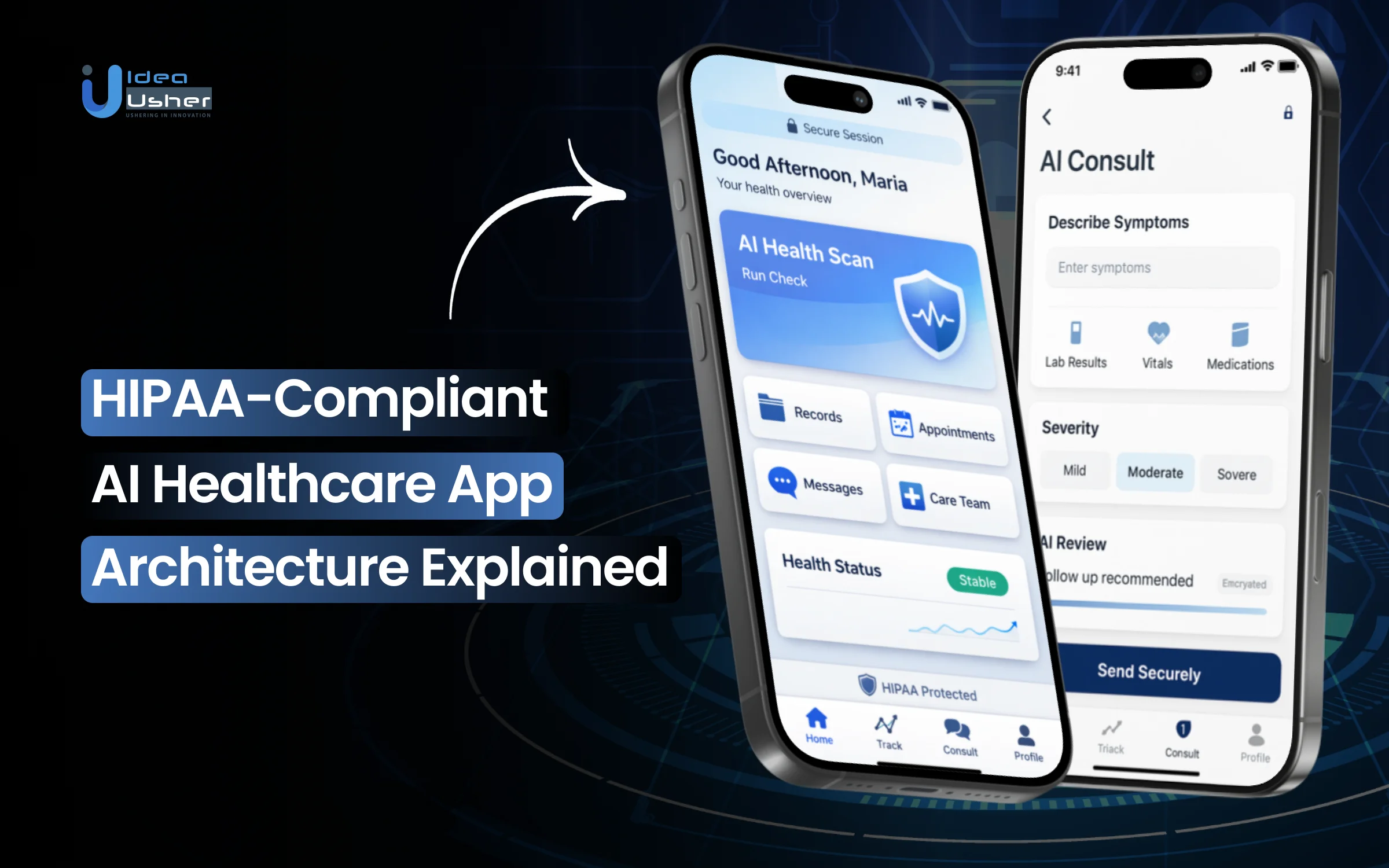
Healthcare has quietly moved into everyday software where prescriptions appear on phones and lab results arrive instantly. AI healthcare apps now make suggestions and monitor risk using deeply personal signals. That data moves continuously through models, APIs, and cloud systems that patients never see. Trust can weaken quickly when health information feels uncontrolled.
This is why HIPAA compliance and monitoring of the risks associated with highly personal data have become a necessity for AI healthcare apps, as sensitive data is constantly processed and shared. These systems must remain secure, traceable, and accountable at every layer.
We’ve built several HIPAA-compliant AI healthcare solutions that leverage technologies such as HL7 FHIR and privacy-preserving AI architectures. As IdeaUsher has this expertise, we’re sharing this blog to discuss the steps to develop a HIPAA-compliant AI healthcare app.
Key Market Takeaways for HIPAA-Compliant AI Healthcare Apps
According to Grandview Research, the AI healthcare market is moving fast, and the numbers make that clear. Valued at USD 36.67 billion in 2025 and projected to exceed USD 500 billion by 2033, growth is driven by providers seeking improved efficiency and outcomes without increasing clinical risk. In this environment, HIPAA-compliant AI apps are becoming a priority rather than an optional upgrade.

Source: Grandview Research
What is pushing adoption forward is trust. HIPAA-compliant AI healthcare apps focus on strong encryption, detailed audit trails, role-based access controls, and clear Business Associate Agreements to protect PHI.
Tools such as AI-driven patient engagement and ambient clinical documentation are gaining traction because they reduce workload while still respecting privacy boundaries. More than half of healthcare professionals want AI support, but only when governance and compliance are built in from day one.
Platforms like Luma Health show how this can work in practice. Its AI supports scheduling, reminders, intake, and secure messaging while maintaining certifications such as SOC 2 Type II and ISO 27001 with end-to-end encryption.
By minimizing direct PHI exposure, AI-driven automation and strict compliance can coexist in modern healthcare systems.

What Is a HIPAA-Compliant AI Healthcare App?
A HIPAA-compliant AI healthcare app is a digital health application that uses artificial intelligence while strictly protecting patient health information in accordance with HIPAA regulations. It ensures that all medical data is encrypted, access is role-based, audit logs are maintained, and AI systems operate as clinical support rather than as independent decision-makers.
In practice, this means the app can assist with tasks such as symptom analysis, triage, and documentation while safeguarding patient privacy and ensuring accountability.
Key Features of a HIPAA-Compliant AI Healthcare App
When patients and clinicians interact with healthcare AI, they should not feel like they are navigating a compliance checklist. They should experience technology that is both powerful and private. Beyond backend security protocols, these seven user-facing features demonstrate how compliant AI can quietly deliver safer, more human healthcare experiences.

1. Conversation-Level De-identification
What patients experience
A virtual assistant that understands I am having chest discomfort, but internally processes it as Patient reports thoracic discomfort. The AI provides medically accurate guidance without storing names, locations, or other direct identifiers.
Why it matters
Most systems either force clinical language or risk exposing PHI. This approach allows natural conversation while a real-time privacy filter protects identity. Care feels personal without exposing personal data.
2. Role-Based AI Personas
What clinicians experience
A single platform that behaves differently based on user role. Nurses see medication workflows, billing teams see coding assistance, and physicians see diagnostic insights within the same app.
Why it matters
This goes beyond permission settings. The AI understands context and delivers only role-appropriate intelligence. The minimum necessary access rule becomes intuitive rather than restrictive.
3. Chain-of-Thought Transparency
What users experience
A Show reasoning option beside AI recommendations that reveals clear steps. The system explains how lab values, medical history, and clinical guidelines influenced the output.
Why it matters
Healthcare decisions no longer feel like black boxes. Patients gain clarity, clinicians gain verification, and administrators gain audit-ready logic. Trust is built through visibility.
4. Human-in-the-Loop Confirmation Gates
What users experience
When AI suggests a high-impact action such as adjusting medication or referring a specialist, the system pauses. A confirmation screen requests human approval before execution.
Why it matters
AI becomes a collaborative assistant rather than an autonomous authority. Clinical accountability remains human-led while AI provides analytical support. Safety becomes visible by design.
5. Protected Conversation Records
What patients experience
Chat history secured by biometric authentication. Sensitive topics like mental health or sexual health can be locked behind additional PIN protection within the same app.
Why it matters
Patients gain real control over how their data is accessed and protected. Privacy is no longer abstract. It is tangible and user-managed.
6. Automatic Audit Trail Generation
What clinicians experience
Every interaction automatically creates a compliance-ready log. Access records are available instantly, clearly showing who accessed what and when.
Why it matters
Compliance no longer interrupts care delivery. Audit trails form passively through regular use. Organizations remain protected without added administrative burden.
7. Zero-Data-Retention Conversations
What users experience
A visible private mode indicator shows when conversations will not be retained after the session ends. AI processes the request without storing interaction history.
Why it matters
Data minimization becomes something users can see and trust. Sensitive questions can be asked with confidence while still receiving clinically useful responses.
How Does a HIPAA-Compliant AI Healthcare App Work?
A HIPAA-compliant AI healthcare app first removes patient identifiers from data, ensuring the AI can only see a safe clinical context. The model then processes this information inside a secure environment with audit logs and access controls, while clinicians can actively review critical outputs.

1. The Privacy Gateway
Before data reaches the AI, it flows through a Privacy Gateway that scans text, voice or image inputs in real time. This layer may detect sensitive identifiers early and ensure that only safe clinical context proceeds.
The action
It instantly redacts or tokenizes the 18 Protected Health Information identifiers defined by HIPAA, such as names, dates, and medical record numbers.
For example,
“Schedule a follow-up for Mr. John Smith (DOB: 05/21/1975)” becomes “Schedule a follow-up for <PATIENT_ID> (DOB: <DATE_TOKEN>).”
The result: The AI model receives the necessary clinical intent, such as scheduling a follow-up, without ever accessing raw, identifiable patient data. The mapping between tokens and real identities exists only within your isolated and secure environment.
2. The BAA-Locked AI Core
A compliant system cannot rely on public AI endpoints. Compliance requires a formal Business Associate Agreement with the AI infrastructure provider.
Enterprise platforms such as Microsoft Azure OpenAI Service or Google Cloud Vertex AI provide environments backed by signed BAAs. This legally binds them to HIPAA safeguards.
The action
All AI queries are routed to dedicated and isolated instances. These environments are configured for zero data retention, meaning prompts and responses are not stored or reused for model training.
The result: The AI core operates inside a legally and technically isolated silo, ensuring patient data is never exposed or repurposed.
3. Retrieval-Augmented Generation with Guardrails
To generate accurate and clinically relevant responses, the AI must access medical knowledge and patient context. This is achieved through Retrieval-Augmented Generation with strict controls.
How it works: When a clinician asks a question, the system securely queries a de-identified vector database to retrieve relevant information from approved sources such as EHR excerpts or clinical guidelines. That context is then passed to the AI to generate a grounded and cited response.
The security: The vector database stores information as non-reversible mathematical embeddings rather than plain text. Access is enforced by role-based controls, so each user only retrieves context appropriate to their role.
4. The Immutable Audit Trail
Every interaction must remain explainable to support compliance, safety, and liability. A write-once, read-many logging system quietly records each AI action and may preserve decision context, keeping reviews and audits clear and reliable.
The action
The system captures the AI’s reasoning steps, the data sources consulted, and confidence scores behind recommendations. If a medication change is suggested, the audit log shows exactly why and based on which evidence.
The result: This creates a forensic-grade record that supports regulatory audits, malpractice defense, and the patient’s right to an explanation.
5. Human-in-the-Loop Gates
The AI is designed to support clinicians while human judgment stays firmly in control. The system identifies high-risk triggers, such as prescribing medication or changing diagnosis codes, and may pause actions until a licensed professional reviews and approves them.
The action: When triggered, the AI recommendation is paused and routed to a licensed clinician for explicit review and approval within the system.
The result: Patient safety is preserved, clinical accountability remains intact, and ethical standards are enforced by design.
How to Develop a HIPAA-Compliant AI Healthcare App?
Developing a HIPAA-compliant AI healthcare app begins by treating the AI as a regulated system rather than ordinary software. PHI flow through prompts and inference must be carefully controlled, while deterministic guardrails and human review are added to reduce risk.
We have built multiple HIPAA-compliant AI healthcare apps, and this is the process we follow in practice.

1. AI-Focused HIPAA Risk Modeling
We start by analyzing how PHI moves through AI prompts, inference logic, and responses. Our team identifies hallucination risks, confidence failures, and exposure points unique to AI systems, then models realistic compliance breakdown scenarios. This allows us to design safeguards around AI behavior before any model is deployed.
2. PHI Redaction and Rehydration
We implement a redaction layer that removes identifiers before data reaches the AI model. Patient data is tokenized so the system can reason without seeing real identities, and responses are rehydrated only after inference within a secure boundary. This ensures PHI never directly interacts with non-compliant AI services.
3. BAA-Locked AI Infrastructure
Our infrastructure is built entirely on HIPAA-eligible services with BAAs in place across hosting, inference, and logging. We disable data retention and training flags, configure isolated VPCs, and enforce strict access controls. This keeps PHI contained within approved environments at all times.
4. Deterministic AI Guardrails
AI outputs are always reviewed by deterministic control layers. We apply confidence thresholds, policy checks, and clinical rules before any action is taken, with human-in-the-loop controls for overrides. This keeps AI supportive and predictable rather than autonomous.
5. Immutable AI Audit Trails
We create encrypted, tamper-resistant audit systems that log reasoning metadata, decision paths, and human approvals. These records support compliance reviews and incident investigations, making AI behavior transparent and explainable over time.
6. Compliance Stress Testing
Before deployment, we simulate breach scenarios, red-team prompt-injection attacks, and vector-leakage risks. Third-party audits validate these controls under real-world conditions, ensuring the system remains HIPAA-compliant even under pressure.
Does HIPAA Apply to AI-Generated Insights if No Raw PHI is Stored?
Yes, it does. If an AI system uses PHI, even briefly, to generate health insights, those outputs remain protected and must be handled carefully. The insight may appear abstract, but it can still represent identifiable health information and should be treated as PHI under HIPAA.

Why HIPAA Still Applies
HIPAA protects more than obvious identifiers like names or medical record numbers. It also covers health information that can reasonably be linked to an individual, even when generated by AI.
Examples of AI-generated information that can still be PHI include
- AI-generated summaries, such as patient care overviews
- Clinical predictions, such as readmission risk percentages
- Treatment recommendations, such as dosage guidance
- Risk assessments, such as disease progression likelihood
Even if raw PHI is processed briefly and then deleted, the output is often still protected. When an AI produces a conclusion about a person’s health, that conclusion becomes health information under HIPAA.
Consider symptom-checking apps such as Buoy Health or Ada Health. Even if an app claims it does not store raw symptom inputs, the resulting assessment that assigns a probability to a condition is still health information.
If that insight can be linked back to a user through an account, device identifier, or associated metadata, it qualifies as PHI. The insight itself is the protected data.
The Three-Part Test for AI-Generated Insights
Ask these questions for every AI output.
1. Can it be linked back to an individual?
If the insight includes any of the 18 HIPAA identifiers directly or indirectly, or could reasonably be associated with a specific person, it is PHI.
Example: An insight stating that a 45-year-old female in San Diego needs follow-up on an abnormal mammogram from last Tuesday could identify the patient, even without a name.
2. Was it created using PHI?
If the AI processed PHI at any point to generate the insight, even temporarily, the output is subject to HIPAA protections.
Example: An AI analyzes encrypted lab results and produces a health risk score. The score is protected because it was derived from PHI.
3. Is it maintained by a covered entity or business associate?
If the system is operated by a healthcare provider, health plan, clearinghouse, or a technology partner working on their behalf, HIPAA applies to the insights produced.
The Architecture Myth
A common AI architecture looks like this,
Raw PHI → Vector Embeddings → AI Processing → Insights
The misconception is that deleting raw PHI and keeping only mathematical vectors removes HIPAA obligations.
Embeddings can still represent sensitive health information and may be reversible or linkable. More importantly, the insights derived from those embeddings are clearly PHI when linked to individuals.
Four Real-World Scenarios That Clarify the Boundary
Scenario 1: The Anonymized Dashboard
An AI generates population health insights, such as “37% of diabetic patients in Clinic A have uncontrolled HbA1c.” Even if combined with other data to identify individuals, it may still constitute PHI.
HIPAA Status: Likely a “Limited Data Set” requiring specific safeguards.
Scenario 2: The Individual Risk Score
An AI assigns each patient a “cardiovascular risk score” from 1-100, stored without names.
HIPAA Status: Definitely PHI. The score itself is health information tied to individuals.
Scenario 3: The Fully Synthetic Dataset
An AI generates entirely synthetic patient records for research, with no connection to real patients.
HIPAA Status: Not PHI IF properly created with differential privacy guarantees and no re-identification risk.
Scenario 4: The De-identified Insight
An AI produces a general finding: “Patients taking Medication X with Condition Y often experience Side Effect Z.”
HIPAA Status: Not PHI IF truly aggregated and impossible to link to individuals.
The Critical Compliance Checklist for AI-Generated Insights
If your AI healthcare app produces insights, you should
- Conduct formal determinations to classify which insights are PHI
- Apply encryption and security controls equal to raw PHI
- Maintain audit logs for access to AI-generated outputs
- Include AI outputs explicitly in business associate agreements
- Enforce role-based access controls for insights
- Define retention and deletion policies for AI outputs
- Prepare breach response plans that treat insight exposure as PHI incidents
The Emerging Regulatory Focus on AI Outputs
Recent guidance from the HHS Office for Civil Rights makes it clear that HIPAA applies across the full AI lifecycle. Regulators are increasingly examining
- Whether AI outputs are sufficiently de-identified
- How organizations control access to AI-generated insights
- Whether patients can access and request corrections to AI-generated health information about themselves
Is Anonymized Data Automatically Exempt from HIPAA in AI Healthcare Apps?
Anonymized data can be exempt from HIPAA, but only when re-identification is mathematically impossible, and that standard is rarely met in practice. In AI healthcare apps, models may quietly learn identity through patterns, so anonymization must be applied very carefully. Most teams should assume HIPAA still applies unless expert review clearly proves the risk is very small.
The Regulatory Reality: Two Different Standards
| De-Identified Data (HIPAA) | Anonymized Data (Global Standard) |
| Removes 18 specific identifiers | Makes re-identification impossible |
| Allows statistical certification | Requires mathematical guarantees |
| Permitted under HIPAA Safe Harbor | Often exceeds HIPAA requirements |
| May still carry residual risk | Considered truly “non-PHI” |
Why “Anonymization” is a Misunderstood Term in Healthcare AI
1. The Myth of Simple Data Scrubbing
Many developers believe removing names and dates equals anonymization. In reality, AI models can often re-identify individuals from seemingly anonymous data through:
- Pattern recognition (unique health trajectories)
- Data linkage attacks (combining with public datasets)
- Inference attacks (deducing identity from rare conditions)
Example: A dataset shows “45-year-old female with rare genetic disorder XYZ, treated at Boston teaching hospital.” Even without name or DOB, this likely identifies the individual in a small patient population.
2. The AI-Specific Re-identification Risks
Modern AI introduces novel re-identification vectors:
- Model Memorization: AI models can memorize and potentially reveal training data
- Embedding Proximity: Similar patients cluster in vector space, creating identification patterns
- Membership Inference: Attackers can determine if specific individuals were in the training data
- Synthetic Data Leakage: Poorly generated synthetic data may mirror real patients too closely
HIPAA’s “Safe Harbor” Method
HIPAA defines de-identification through the removal of 18 identifiers:
- Names
- Geographic subdivisions smaller than a state
- Dates (except year) related to an individual
- Telephone numbers
- Fax numbers
- Email addresses
- Social Security numbers
- Medical record numbers
- Health plan beneficiary numbers
- Account numbers
- Certificate/license numbers
- Vehicle identifiers and serial numbers
- Device identifiers and serial numbers
- URLs
- IP addresses
- Biometric identifiers
- Full-face photos
- Any other unique identifying number, characteristic, or code
Even after removing these, the data must have no reasonable basis to believe it can be used to identify an individual.
The AI-Specific Challenge: Emergent Identifiability
AI systems may create identifiability by learning unique health patterns that function like a digital fingerprint. Even without direct identifiers, these patterns can still point to one person. Data that appears anonymous may therefore remain identifiable.
An AI model trained on de-identified EHR data learns to recognize unique combinations of:
- Disease progression patterns
- Medication response curves
- Comorbidity timelines
- Lab value trajectories
These patterns can become health biometrics, and they may be as unique as a fingerprint. An anonymous health journey can still reflect a single person when viewed through AI models. This makes identification more likely than it first appears.
When Does Anonymization Actually Work for AI?
Case 1: Properly Implemented Techniques
These methods can create truly anonymous data for AI training:
| Technique | How It Works | Best For |
| Differential Privacy | Adds mathematical noise to queries | Population-level insights |
| Synthetic Data Generation | Creates artificial datasets with statistical similarity | Model training, testing |
| Federated Learning | Trains models locally; only shares weights | Multi-institutional collaboration |
| k-Anonymity | Ensures each record is indistinguishable from k-1 others | Published research datasets |
Case 2: Aggregated Insights Only
If your AI system only outputs aggregated statistics (e.g., “30% of patients experience side effect X”), and you’ve verified no individual can be identified from these aggregates, you may have anonymous outputs.
Case 3: Expert Determination
HIPAA’s alternative to Safe Harbor: A qualified expert statistically/mathematically determines that the re-identification risk is “very small.” This requires:
- Formal risk assessment methodology
- Consideration of anticipated threats
- Documentation of methods and results
- Ongoing re-evaluation
The Practical Reality for AI Healthcare Apps
Most AI healthcare applications cannot rely on truly anonymous data because clinical value depends on individual-level context. Personalized care requires linking symptoms history and outcomes to a real person for safe decisions.
Model accuracy also drops when data is heavily anonymized and real time care needs identifiable patients. Continuous learning depends on traceability because quality improvement requires feedback from known outcomes.
Your Compliance Checklist: Navigating the Gray Area
If You Claim Anonymization:
- Formal Risk Assessment – Documented analysis of re-identification risk
- Statistical Guarantees – Mathematical proof of anonymity
- Third-Party Validation – External expert verification
- Ongoing Monitoring – Regular re-identification testing
- Transparent Documentation – Clear explanation of methods
- Legal Review – Attorney verification of HIPAA status
- Breach Preparedness – Plan for potential re-identification events
Red Flags That Suggest You’re Not Anonymous:
- Individual-level predictions or recommendations
- Patient-specific treatment suggestions
- Records containing rare conditions or combinations
- Longitudinal data (health journeys over time)
- Geographic specificity (even at county level)
- Data that could be linked with public records
Top 5 HIPAA-Compliant AI Healthcare Apps in the USA
We closely examined how AI operates within regulated healthcare environments and what truly holds up in real-world clinical use. After careful research, we found a set of HIPAA-compliant AI healthcare apps that quietly stand out through secure design and thoughtful clinical integration
1. K Health

K Health uses AI to analyze patient symptoms and medical history while keeping clinicians in the loop for final decisions. The platform is HIPAA compliant with encrypted data handling and strict access controls, making it suitable for virtual primary care at scale. It balances automation with licensed medical oversight.
2. Luma Health

Luma Health focuses on patient engagement through AI-powered scheduling, reminders, intake, and secure messaging. It operates under HIPAA compliance with audit trails and role-based access, helping healthcare providers reduce no-shows and administrative burden without exposing PHI.
3. Amwell

Amwell integrates AI into telehealth workflows for triage, routing, and clinical decision support. The platform is HIPAA-compliant and widely used by U.S. health systems, ensuring that protected health data is securely managed across virtual visits and care coordination.
4. Synthflow

Synthflow provides HIPAA-compliant AI analytics and workflow automation for healthcare settings, enabling teams to analyze clinical and operational data securely to improve decision-making and population health initiatives without exposing patient information.
5. Notable Health

Notable Health uses AI to automate patient intake, scheduling, documentation, and follow-ups across healthcare workflows. Built with HIPAA-compliant infrastructure, it helps providers reduce administrative load while securely handling sensitive patient information.
Conclusion
HIPAA-compliant AI healthcare architecture is not only about securing data but also about shaping how intelligence behaves within regulated care systems. When compliance is designed into how models access PHI, make decisions, and log reasoning, it can quietly reduce legal exposure while building real clinical trust. This approach may also support sustainable scale and monetization without friction. Teams that architect AI this way usually position themselves as long-term healthtech leaders rather than short-term experimenters.
Looking to Develop a HIPAA-Compliant AI Healthcare App?
IdeaUsher can help you design a HIPAA-compliant AI healthcare app by embedding privacy controls directly into the architecture. We carefully handle PHI with secure data flows, audited inference, and role-based access so clinical risk stays low.
With over 500,000 hours of coding experience and ex-MAANG/FAANG developers who speak HIPAA, FHIR, and AI, we engineer:
- “Forgetful” AI Pipelines → Data processed, never retained
- Privacy Gateways → PHI redacted before AI ever sees it
- Immutable Audit Logs → Full “reasoning” trails for regulators
- Agentic Safeguards → Human-in-the-loop gates for clinical safety
Check out our latest projects to see how we build intelligence you can certify—and patients can trust.


FAQs
A1: You can use public AI APIs only in limited cases where the provider formally supports healthcare workloads. The provider must sign a BAA and clearly state that patient data is not retained or used for model training. Without these guarantees, the risk remains high, and the setup should generally be avoided for regulated clinical use.
A2: Encryption is necessary, but it is never sufficient on its own. AI systems must also control how data is accessed during inference and how outputs are logged and reviewed. Proper governance requires audit trails, role-based access, and controlled context exposure so PHI is never over-shared.
A3: Vector databases can be used safely if they are deployed with the right controls. Data should be encrypted at rest and in transit, with strict access controls in place. When hosted inside BAA-covered infrastructure and paired with careful embedding design, they can operate reliably in healthcare settings.
A4: Most AI healthcare apps rely on predictable recurring models rather than ads or data resale. Revenue may come from subscriptions, enterprise licenses or white-label deployments for providers. Over time, AI-driven efficiency can also quietly reduce operational costs, which improves margins.


