 (+971) 8007 4267
 (+91) 946 340 7140
 (+1) 628 432 4305


A single misplaced decimal can distort an entire tax position, and when transaction volumes expand across ERPs and payment systems, manual review cycles can gradually become unreliable. Finance teams may work carefully, yet high-frequency data often creates hidden exposure that is difficult to detect early.
More and more businesses have started relying on AI tax compliance apps because these systems can process thousands of transactions in seconds, consistently validate them against encoded statutory rules, and automatically detect anomalies before filings are submitted. They can also apply updated tax logic immediately and generate structured audit trails without operational fatigue. Instead of replacing professionals, it serves as an intelligent second layer that continuously enhances regulatory oversight.
We’ve developed numerous AI tax compliance solutions, powered by neuro-symbolic AI architectures and deterministic tax rule engines. As IdeaUsher has this expertise, we’re sharing this blog to discuss the top features to include in an AI tax compliance app.
Key Market Takeaways for AI Tax Compliance Apps
According to Technavio, the AI-driven tax and legal compliance market is projected to expand by USD 4.44 billion between 2024 and 2029, growing at a CAGR of 14.7%, as regulatory environments worldwide become increasingly complex. Industries such as BFSI, healthcare, and e-commerce are leading the adoption to reduce operational costs and strengthen compliance controls.
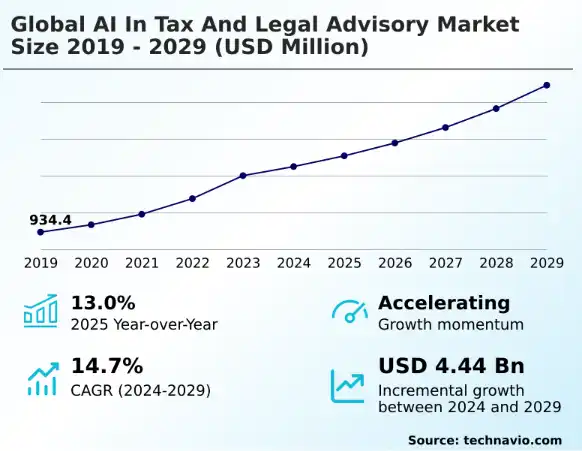
Source: Technavio
AI tax compliance apps are gaining traction because they offer real-time monitoring, predictive risk scoring, and automated return preparation under tightening regulatory scrutiny.
These platforms use machine learning to detect anomalies, track nexus exposure, and dynamically update tax logic, significantly reducing preparation cycles for growing businesses.
Notable platforms such as Kintsugi and Sovos Intelligence illustrate how the market is evolving toward full-lifecycle automation. Strategic collaborations between providers and accounting networks are further accelerating adoption, enabling firms to scale AI-driven tax services with greater consistency and control.

What Is an AI Tax Compliance App?
An AI tax compliance app is a software system that can intelligently review transactions and apply encoded tax regulations before you file returns. It may automatically classify entries, validate calculations through a deterministic rules engine, and continuously monitor risk exposure across your financial data. Instead of relying only on manual review, you can use it to consistently reduce compliance errors and proactively strengthen audit readiness.
How Does an AI Tax Compliance App Work?
An AI tax compliance app works by intelligently reading your financial data and mapping it against encoded tax regulations in real time. It can automatically classify transactions, validate calculations through a deterministic rules engine, and continuously check for compliance gaps before filings are submitted.
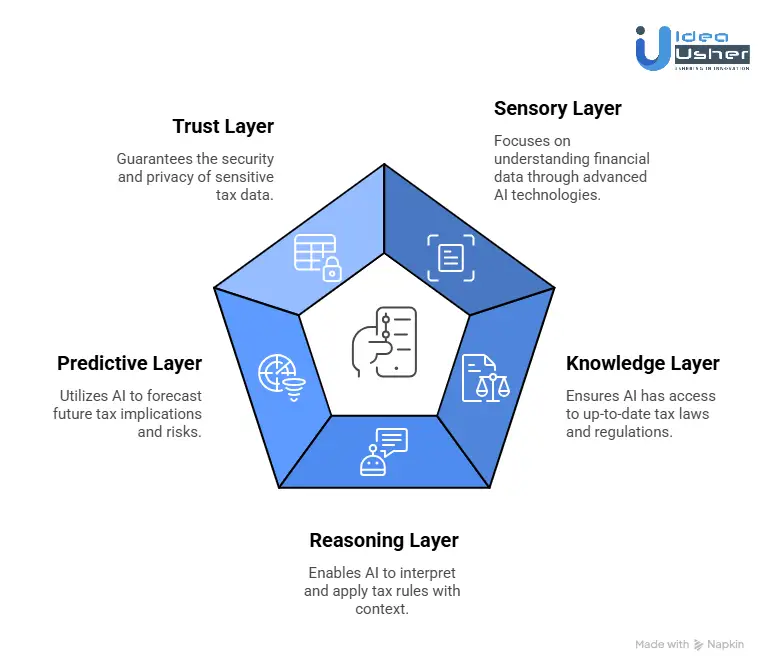
1. The Sensory Layer
Before any tax calculation can happen, the AI needs to understand your financial world. This is where most traditional software fails: it requires manual data entry or perfect, standardized inputs.
The Technology: Multimodal AI + Computer Vision
Modern AI tax apps use computer vision models trained on millions of invoices, receipts, and financial documents. But here’s the critical upgrade. They don’t just read text, they understand context.
2. The Knowledge Layer
Tax laws aren’t static. They change weekly, vary by jurisdiction, and are filled with nuance that even human experts trip over.
The Technology: Retrieval-Augmented Generation
This is the secret sauce that prevents AI “hallucinations.” Instead of relying on the AI’s internal memory, which can be wrong or outdated, the system uses a two-step process.
- Step 1: When you ask a question or upload data, the AI first searches a trusted knowledge base containing every relevant tax law, ruling, and precedent, updated in real time.
- Step 2: It retrieves the specific passages that apply to your situation and feeds them to the large language model, instructing it: “Answer based ONLY on these documents. If the answer isn’t here, say you don’t know.”
3. The Reasoning Layer
This is where AI tax apps truly separate themselves from traditional software that simply follows fixed rules. Instead of blindly applying predefined logic, the system can evaluate the context around each transaction and interpret intent before assigning treatment.
It may dynamically adjust classifications and deductions based on supporting data, so the outcome is technically aligned with regulatory guidance rather than just formula-driven.
The Technology: Agentic Orchestration + Chain-of-Thought Processing
Instead of a single AI model trying to do everything, the system deploys multiple specialized “agents” that work together.
- The Classification Agent: Categorizes transactions
- The Research Agent: Checks for applicable exemptions
- The Nexus Agent: Tracks where you’re doing business
- The Risk Agent: Scans for audit triggers
- The Reconciliation Agent: Matches documents to bank statements
These agents communicate, debate, and reach consensus, much like a team of human accountants.
4. The Predictive Layer
Here’s where AI transcends automation and enters the realm of strategic advisory.
The Technology: Predictive Analytics + Anomaly Detection
The AI doesn’t just look backward at what happened. It analyzes patterns across millions of data points to forecast what will happen and what might go wrong.
5. The Trust Layer
Tax data is one of the most sensitive assets your business holds, and you would naturally worry about how an AI handles it.
A well-designed AI tax system should run in a private environment where your data never mixes with other clients’ data and where no shared model is trained. It can securely process encrypted information in isolated instances so your confidential records remain protected at every stage.
The Technology: Private LLM Instances + Confidential Computing
Enterprise-grade AI tax apps don’t use public models like ChatGPT accessed through a browser. Instead:
- Private Instances: A dedicated copy of the AI runs in your secure environment. Your data never mixes with other clients’ data.
- Ephemeral Memory: The AI uses your data to generate your return, then “forgets” it. Your transactions never train the base model.
- Zero-Knowledge Architecture: Even the AI provider cannot see your data. Everything is encrypted, and the AI works on encrypted information without ever decrypting it.
What Are the Top Features to Add in an AI Tax Compliance App?
An AI tax compliance app should include intelligent document ingestion, real-time anomaly detection, and a regulatory research engine that can interpret statutes in real time. It must proactively monitor nexus exposure and automatically validate every calculation against encoded tax rules.
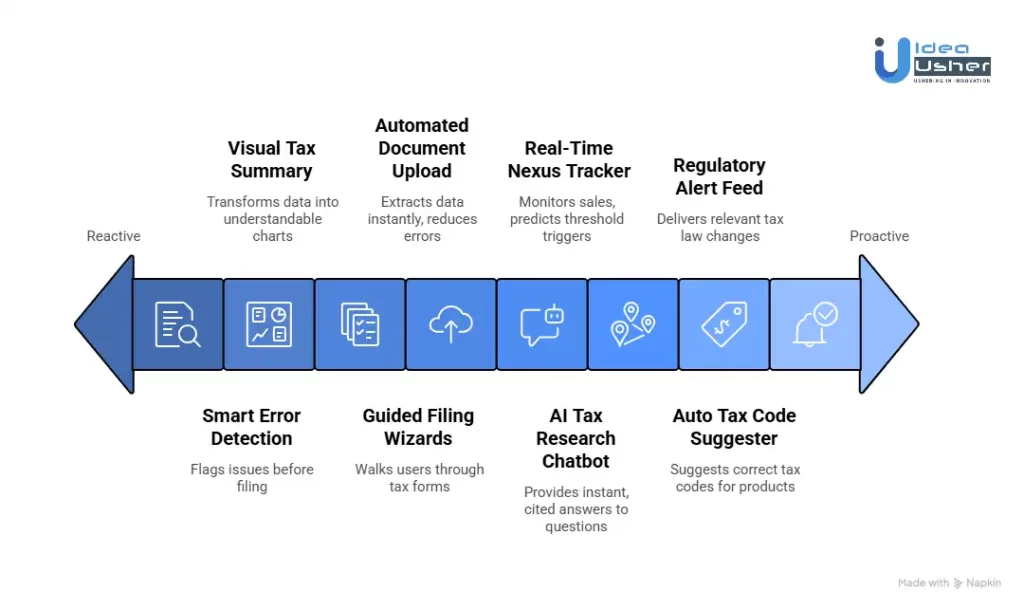
1. Automated Document Upload
Manual data entry is error-prone, soul-crushingly tedious, and the #1 source of tax filing mistakes. During peak season, professionals spend hundreds of hours typing numbers from PDFs into spreadsheets.
The Solution: A drag-and-drop interface that accepts any document format, PDFs, smartphone photos, scanned copies, even blurry email attachments, and instantly transforms them into structured, verified data.
How Users Experience It:
Sarah, a CPA during tax season, receives 50 client documents daily. She drags a folder containing 1099s, W-2s, and rental income statements into the app. Within seconds:
- The AI extracts every relevant field with 99%+ accuracy
- Low confidence fields, a smudged number, and an ambiguous label are highlighted in yellow
- Sarah reviews only the flagged items, spending 30 seconds instead of 30 minutes
- Verified data auto-populates the appropriate returns
Why It Stands Out:
The magic is not just in the extraction; it is in how the system handles edge cases. A crumpled receipt from a client’s phone. The AI straightens, enhances, and reads it. An invoice is missing a tax ID. The AI searches public records to find it. A foreign language document. The AI translates and categorizes simultaneously.
User Value Proposition: “Turn 10 hours of data entry into 15 minutes of review.”
2. AI Tax Research Chatbot
Tax research means digging through thousands of pages of complex code, outdated PDFs, and conflicting interpretations. Even experienced professionals waste hours searching for answers.
The Solution: A chat interface where users ask natural language questions and receive instant, cited answers drawn from real-time, authoritative sources.
How Users Experience It:
A tax partner is reviewing a complex K-1 form from an investment partnership. She types:
“Can you analyze this K-1 and tell me if the foreign income reported here qualifies for the foreign tax credit under Section 901, considering the recent IRS guidance on passive income?“
The AI responds within seconds:
- Extracts all relevant data from the uploaded K 1
- Retrieves the specific IRS revenue rulings and tax court cases that apply
- Analyzes whether the income meets the “foreign sourced” and “passive vs. active” tests
- Delivers a plain language answer with confidence scores
- Provides clickable citations to every source used
She can then ask follow-up questions, request a memo draft, or ask the AI to explain the reasoning step by step.
Why It Stands Out:
This is not a generic chatbot. It is trained specifically on tax law, updated daily, and designed to cite sources with the same rigor a human expert would. Every answer includes confidence scores and traceability links, essential for audit defense.
User Value Proposition: “From hours of research to seconds of conversation.”
3. Real-Time Nexus Tracker
Businesses unknowingly trigger tax obligations in new jurisdictions by crossing sales thresholds and do not learn until they receive a penalty notice years later.
The Solution: An interactive dashboard that monitors sales activity across every jurisdiction in real time, forecasts when thresholds will be hit, and proactively alerts users before obligations trigger.
How Users Experience It:
- A growing e-commerce company sells handmade goods across state lines. The Nexus Tracker dashboard shows:
- A map of the US with states color-coded by current nexus status
- A live counter showing sales in California: $487,000 of the $500,000 threshold
A predictive alert: “At current growth rates, you will trigger California filing requirements in 18 days. Would you like to pre-register?“
The user clicks “Simulate” to model different scenarios, such as “What if we pause California advertising?” “What if we open a warehouse in Texas?” The AI instantly recalculates nexus implications for each choice.
Why It Stands Out:
Most nexus tools are reactive; they tell you after you have crossed the line. This feature is predictive, giving businesses weeks or months of advance notice to plan strategically.
User Value Proposition: “Never face a surprise tax bill again.”
4. Smart Error Detection Scanner
Errors slip through. A transposed digit, a duplicate entry, a missing signature, or small mistakes trigger audits, penalties, and client headaches.
The Solution: An AI scanner that continuously monitors all tax data for anomalies, discrepancies, and missing information, flagging issues before filing.
How Users Experience It:
A small business owner uploads their quarterly financials. The scanner runs silently in the background, then surfaces:
- “We’ve detected three potential issues:”
- “Your reported meals expense is 35% higher than the industry average for your revenue. This may trigger scrutiny. Here are three documentation best practices.”
- “A duplicate invoice from Vendor X appears in both February and March. Would you like to review?”
- “You’re missing a W-9 for a new contractor who was paid over $600. Here’s a request template you can send immediately.”
Each issue includes an interactive checklist and one-click fixes.
Why It Stands Out:
The scanner does not just find math errors. It compares your data against industry benchmarks, historical patterns, and known audit triggers used by tax authorities. It is like having an auditor on your side, working to protect you.
User Value Proposition: “File with confidence, knowing an AI has already audited your return.”
5. Visual Tax Summary Dashboard
Tax data is dense, numeric, and overwhelming. Business owners sign returns without truly understanding their tax position.
The Solution: A dynamic, interactive dashboard that transforms complex tax data into intuitive visualizations, pie charts, trend lines, and scenario comparisons that anyone can understand at a glance.
How Users Experience It:
- A business owner logs in and sees:
- A pie chart showing tax liability by category: income tax, payroll tax, sales tax
- A line graph tracking quarterly tax payments against projected liability
- A “What If” slider that lets them adjust retirement contributions and instantly see the impact on refunds
- A refund meter showing estimated vs. actual based on real-time data
They click on any chart element to drill down into the underlying transactions. They export visuals for board presentations or client meetings.
Why It Stands Out:
This feature democratizes tax understanding. The CFO gains strategic insights, the business owner gains clarity, and the tax professional gains a visual communication tool to explain complex concepts.
User Value Proposition: “Finally, tax data you can actually understand at a glance.”
6. Auto Tax Code Suggester
The Problem: Misclassifying products with incorrect HS codes, VAT rates, or sales tax categories results in overpayments, underpayments, and customs delays. For high-volume businesses, manual classification is impossible.
The Solution: An AI that suggests the correct tax codes for any product based on description, images, or SKU numbers, with one-click application and bulk editing tools.
How Users Experience It:
An international dropshipper imports 500 new products monthly. They upload a spreadsheet with product descriptions:
- “Women’s cotton sweater, machine washable”
- “Stainless steel water bottle, 32oz, insulated.”
- “Wireless earbuds with charging case”
The AI instantly suggests:
- HS Code 6110.30 for the knitted sweater of man-made fibers
- HS Code 7323.93 for the bottle tableware of stainless steel
- HS Code 8518.30 for the earbuds, headphones and earphones
Each suggestion includes confidence scores and the reasoning behind it. The user can accept in bulk, override individually, or request alternatives.
Why It Stands Out:
The AI learns from user corrections. If a user consistently overrides certain suggestions, the system adapts. Over time, it becomes tailored to that business’s specific product catalog and preferences.
User Value Proposition: “Perfect classification for every product, every time.”
7. Guided Filing Wizards
Tax forms are intimidating. Users get stuck on unfamiliar questions, miss critical fields, and struggle with jurisdiction-specific requirements.
The Solution: Step-by-step interactive wizards that walk users through every filing requirement, with contextual help, live validation, and direct submission to tax authorities.
How Users Experience It:
A freelancer is filing their first estimated quarterly tax payment. The wizard:
- Asks simple questions: “Did you have any clients outside your state?” “Did you purchase any equipment this quarter?”
- Auto-populates fields based on connected bank accounts and prior filings
- Validates each entry in real-time, highlighting errors before they proceed
- Explains complex questions in plain language with examples
- Shows progress with a clear status bar and estimated time remaining
- Offers “What If” simulations: “See how paying an extra $500 now affects your refund.”
- Files directly with the IRS or state portal with one click
Why It Stands Out:
The wizard adapts to user expertise. Beginners see more explanations and hand-holding. Experts can skip ahead, collapse sections, and move at their own pace. It is the same engine, tailored to the user.
User Value Proposition: “Filing any return, anywhere, with zero intimidation.”
8. Regulatory Alert Feed
Tax laws change constantly. Keeping up is a full-time job, one that most business owners and even many professionals do not have time for.
The Solution: A personalized newsfeed that delivers relevant tax law changes directly to users, with actionable insights and one-click compliance steps.
How Users Experience It:
A tax professional logs in and sees their customized feed:
- “New: Q3 2024 Federal Tax Update” – The IRS has increased standard mileage rates. Click to automatically update all client deductions.
- “Action Required: California SALT Deduction Cap” – A new ruling affects how you report state taxes for high-income clients. Here’s what to do.
- “Deadline Alert: Extended Filing for Disaster Areas” – Clients in three affected zip codes have automatic extensions. Click to notify affected clients.
Each alert includes:
- A plain language summary
- The official source document
- One-click actions to apply changes
- Options to share with clients or team members
Why It Stands Out:
This is not a generic RSS feed. The AI filters millions of regulatory updates to show only what matters to each user, based on their jurisdictions, industries, client types, and past activity. It learns what they ignore and what they act on, getting smarter over time.
User Value Proposition: “Never miss a deadline or deduction again.”
Can an AI Tax Compliance App Handle Multi-Country Tax Operations?
Yes, an advanced AI tax compliance app can handle multi-country operations if it is properly architected. Many platforms now connect with multiple tax authorities and continuously update regulatory logic. However, you must verify whether it truly executes compliant filings or only supports research and planning.
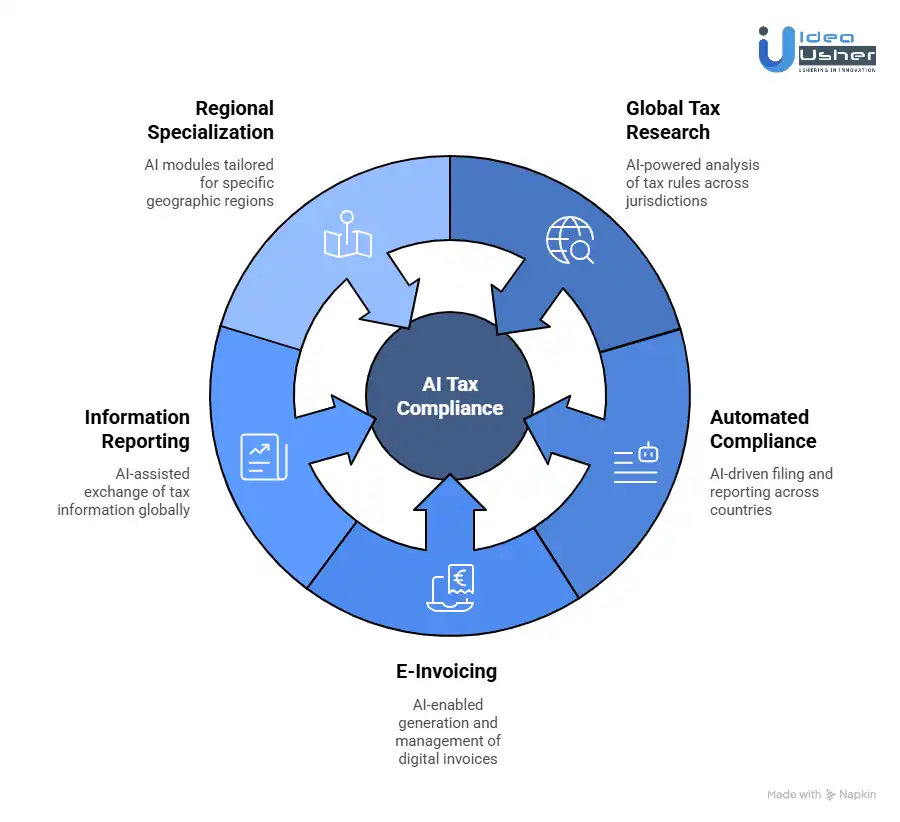
1. Global Tax Research and Intelligence
The foundation of multi-country compliance is understanding what rules apply where. AI platforms now excel at this foundational layer.
Blue J and IBFD have partnered to deliver instant AI-powered international tax research across 220+ jurisdictions. Their platform allows tax professionals to:
- Evaluate permanent establishment (PE) risk when entering new markets
- Assess compliance with global minimum tax rules (OECD BEPS 2.0, Pillar Two)
- Compare transfer pricing requirements across jurisdictions
- Get answers to natural language queries in seconds, complete with citations to treaties and case law
DhruvAI.tax, launched by Dhruva Consultants in the UAE, continuously updates itself with the latest tax regulations and free zone nuances via automated feeds and built-in audit mechanisms. While currently focused on the UAE, the firm is already developing tailored modules for Saudi Arabia and Qatar, demonstrating how regional expansion is built into modern AI tax platforms.
China Economic Information Service’s TaxIQ goes even further, building a data foundation covering 115 countries and regions with macroeconomic and tax policy data. It enables:
- Multi-country tax system comparison
- Industry-specific tax burden analysis
- Proactive risk alerts for cross-border transactions
2. Automated Compliance and Filing
Beyond research, true multi-country tax apps handle the actual compliance work.
Sphere provides an AI-native compliance engine that automates global indirect tax filings, including VAT, GST, and sales tax. The platform integrates directly with 100+ tax authorities to help finance teams maintain compliance across borders. Its AI engine continuously codifies international tax rules, delivering automated, accurate cross-border compliance.
Avalara serves over 43,000 customers across 75+ countries. Their platform handles:
- VAT automation for European Union sales
- Sales tax compliance for US operations tracking thousands of different rates and regional rules
- Cross-border solutions that flag tariffs and calculate customs duties for the rest of the world
Kingdee Cloud Tax Management automates processing of VAT, sales tax, income tax, and other complex calculations, with built-in support for multi-country reporting formats and e-invoice generation.
The platform aggregates tax data from multiple entities and jurisdictions into a single, unified hub, enabling the tracking of taxable profits and the generation of cross-border analytical reports.
3. E-Invoicing and Real-Time Reporting
The global shift toward mandatory e-invoicing creates new complexity and new opportunities for AI.
Sovos offers Sovi AI, embedded across their Tax Compliance Cloud for e-invoicing, tax, and information reporting compliance across 80+ countries. The AI suite detects fraud using self-learning algorithms and continuously analyzes global tax mandates and transaction-level details in real time.
Covoro YouCloud has unveiled an Agentic AI UAE E-Invoicing solution designed for the GCC market, with FTA-aligned infrastructure that supports seamless ERP integration and real-time compliance.
While regionally focused, the platform demonstrates how AI agents can handle jurisdiction-specific requirements while maintaining enterprise-grade scalability.
4. Automatic Exchange of Information
For financial institutions and multinational enterprises, cross-border information reporting is a massive compliance burden.
Newgen’s AI-first Automatic Exchange of Information (AEOI) solution automates FATCA, CRS, and Country-by-Country Reporting (CbCR) compliance. The platform handles:
- Guided onboarding across jurisdictions
- Smart reporting with XML, Excel, and manual submission modes aligned with global schema guidelines
- End-to-end data exchange, including package generation, encryption, and transmission to tax authorities
- Centralized compliance reporting across all jurisdictions
Real-World Capabilities: What’s Possible Today?
| Capability | What Leading AI Apps Deliver | Example Providers |
| Tax Research | 115-220+ jurisdictions covered | Blue J + IBFD, TaxIQ |
| Indirect Tax Filing | 75-100+ countries with direct authority integration | Avalara, Sphere |
| E-Invoicing | 80+ countries with mandate-specific formats | Sovos, Covoro YouCloud |
| Information Reporting | Global FATCA/CRS/CbCR compliance | Newgen |
| Regional Specialization | GCC-specific modules with expansion roadmaps | DhruvAI.tax |
What Full Multi-Country Coverage Looks Like
When a modern AI tax compliance app claims to “handle” multi-country operations, it typically delivers:
Unified Data Hub: Aggregation of tax data from multiple entities and jurisdictions into one platform, enabling consolidated reporting and analytics.
Dynamic Regulatory Updates: Real-time tracking of tax law changes across all covered jurisdictions, with automatic adjustment of compliance logic.
Multi-Format Output: Built-in support for jurisdiction-specific reporting formats, e-invoice schemas (like PINT-AE for UAE), and filing requirements.
Risk Monitoring: Proactive detection of inconsistencies across borders through standardized validation rules and real-time anomaly alerts.
Scenario Modeling: The ability to simulate cross-border transactions, mergers, or restructurings to understand tax implications before acting.
What Level of Human Oversight Is Required in an AI Tax Compliance App?
An AI tax compliance app should automate calculations and data validation while keeping review authority with a human expert. It must intelligently flag complex or uncertain cases so professionals can carefully approve outputs. You may rely on AI for efficiency, but final accountability must always remain with a qualified human.
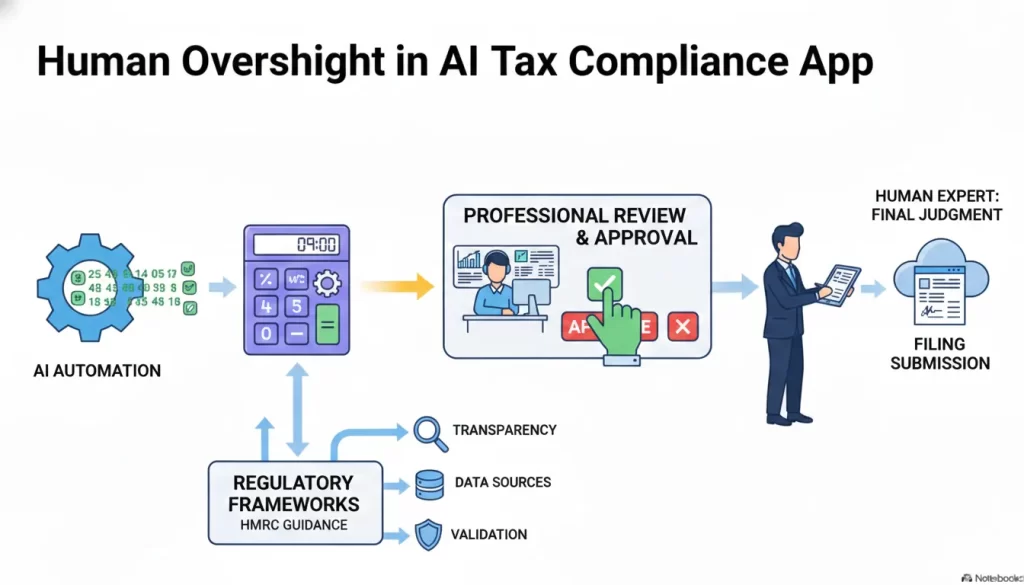
The Regulatory Foundation
HMRC’s January 2026 guidance establishes five mandatory principles for AI in tax software, with human oversight as a core requirement:
| Principle | What It Means for Oversight |
| Transparency | Users must know when AI is being used, understand its limitations, and see how human review is applied to outputs |
| Reliable Source Data | AI must be trained on authoritative sources (legislation, case law, official publications) not generic web content |
| Human Oversight | Software must prompt users to review outputs, allow corrections, flag complex scenarios, and recommend professional advice |
| Security & Privacy | GDPR compliance, privacy by design, and secure development lifecycles are non-negotiable |
| Ethical AI | Continuous auditing for bias, fairness, and accuracy with immutable audit trails |
The message is clear. AI is an assistant, not an authority. Tax authorities will hold users not software vendors, accountable for filing accuracy. This shifts the oversight question from “Can we trust the AI?” to “How do we design workflows that ensure human judgment at the right moments?”
The Oversight Spectrum
Not all tax tasks require the same level of human involvement. Modern AI tax platforms operate along a spectrum of oversight:
Level 1: Fully Automated with Audit Trails
At this level, the AI handles low-risk, repetitive tasks such as data ingestion, transaction categorization, and routine calculations without requiring manual approval. Every action is logged with immutable audit trails, so nothing happens invisibly. Oversight is built through exception alerts and scheduled compliance checks that quietly ensure control without slowing operations.
Level 2: Supervised Automation
Here, the AI prepares outputs such as draft tax returns or exemption validations, but submission authority remains with a human reviewer.
The system is designed to pause at predefined checkpoints where users can edit, validate, and formally authorize filings. Built-in approval workflows and editable interfaces ensure oversight is active and deliberate.
Level 3: Human Led with AI Assistance
In complex areas such as transfer pricing or cross-border structuring, the AI serves as a research and modeling assistant rather than a decision-maker.
It generates structured analysis, cites authority, and simulates scenarios, but final judgment sits firmly with experienced professionals. Oversight at this level means AI supports thinking, yet never replaces professional discretion.
Level 4: Human Only
Certain functions, such as signing returns or representing clients before tax authorities, require licensed accountability and cannot be delegated to software.
AI may provide background data or document preparation, but it cannot execute or assume responsibility for regulated actions. Oversight here is absolute because legal and ethical liability rests entirely with the human professional.
How Leading Platforms Implement Human Oversight
Avalara’s Agentic Tax Platform
Avalara’s recently launched Avi platform exemplifies how enterprise-grade AI tax software builds oversight into its DNA. The platform operates on a simple principle: automation should never mean a loss of control.
The Workflow:
- Analysis – AI agents ingest transaction data, identify jurisdictions, apply rules, and calculate liabilities
- Preparation – Agents generate tax returns and supporting documentation
- Human Review – Finance teams inspect, edit, and approve every return
- Filing & Confirmation – Once authorized, agents file returns and store audit-ready trails
Scott McFarlane, CEO of Avalara, emphasizes: “Our customers have trusted us to protect their data and compliance processes for decades, and Avalara’s new AI agents operate within that same secure and auditable framework“.
Key Oversight Features:
- Built-in checkpoints at every stage
- Complete visibility into agent actions
- Audit trails linking every number to its source transaction
- Nothing is filed without explicit human approval
Thomson Reuters CoCounsel
Thomson Reuters launched CoCounsel for tax professionals as “agentic AI” capable of planning, reasoning, and completing multi-step tasks with limited supervision. Yet the company stresses that outputs remain “guided and validated by professionals to ensure quality and accountability”.
Elizabeth Beastrom, President of Tax and Accounting Professionals at Thomson Reuters, explains: “The future of accounting is about expertise, judgment and consultation—and with agentic AI, that future is here today“.
Real-World Perspective:
Zachary Iannotta, CPA at HBK CPAs & Consultants, notes: “CoCounsel doesn’t replace our expertise; it amplifies it. It saves us countless hours of manual work and allows us time to hone in on the more thought-intensive tasks we perform to enhance, strengthen, and optimize the way we serve our clients“.
Extend’s Document Processing:
For tax document processing, Extend’s platform achieves 99%+ accuracy by combining AI extraction with human review workflows. When confidence scores fall below thresholds, documents are automatically routed to human reviewers who verify and correct extracted data. Those corrections then train the system, creating a continuous improvement loop.
The Approach:
- Configure confidence thresholds that trigger human review
- Create review interfaces showing extracted data alongside original documents
- Track review metrics to identify improvement opportunities
- Use reviewer feedback to continuously train models
The Research Foundation
Before any oversight occurs, the AI must be built on the right foundation. Crowe’s AI implementation guide emphasizes that modern tax research platforms use Retrieval-Augmented Generation RAG restricted to authoritative tax sources.
What This Means:
- If you ask a non-tax question, the system will not attempt to answer, source data is intentionally scoped
- Citations always tie back to a reliable authority (legislation, case law, official guidance)
- Hallucination risk is dramatically reduced
This design aligns with HMRC’s requirement that AI be trained on “official HMRC publications, primary legislation, and established case law,” not generic web content.
Top 5 AI Tax Compliance Apps
We carefully studied the current AI tax compliance landscape to understand which platforms truly address real regulatory challenges. During this research, we identified several AI tax compliance apps that offer technically distinct architectures and specialized compliance engines.
1. TaxGPT
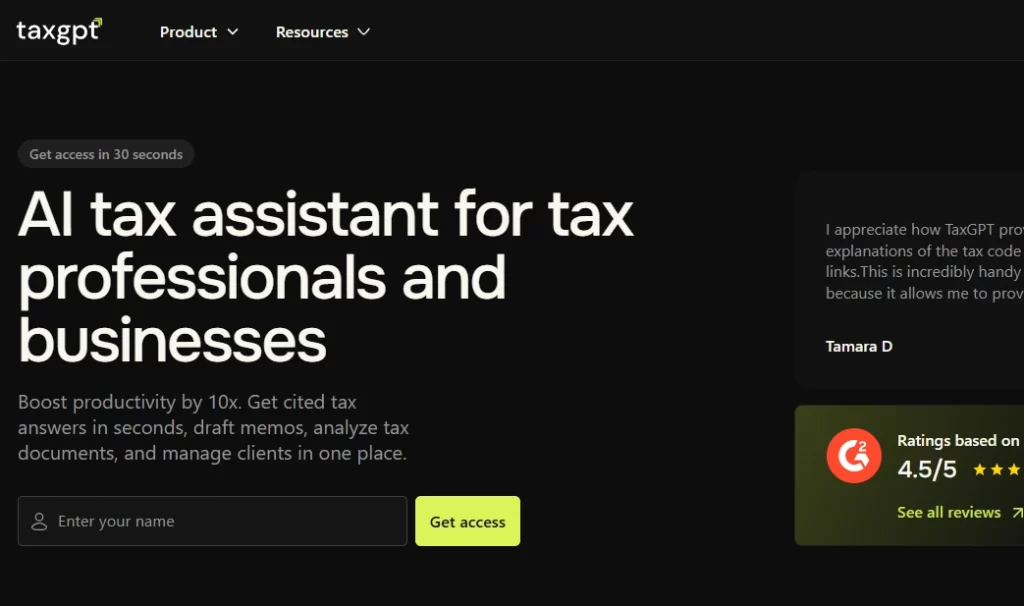
TaxGPT is an AI-powered tax research and compliance assistant that helps professionals interpret regulations, analyze tax forms, and draft technical memos quickly and accurately. It uses large language models trained on tax law to answer complex queries in seconds. For accountants and advisors, it can significantly reduce research time while improving documentation quality.
2. Sphere

Sphere is an AI native global tax compliance engine designed for sales tax, VAT, and GST automation across multiple jurisdictions. It connects to transaction systems and automatically calculates liabilities while managing filing obligations. Businesses expanding internationally can use it to stay compliant without building an internal tax infrastructure.
3. Thomson Reuters CoCounsel Tax

CoCounsel Tax is an AI-powered assistant built for professional tax practitioners. It reviews documents, extracts insights, and supports research and drafting within structured compliance environments. Firms benefit from faster turnaround while maintaining audit defensibility.
4. ChatFin

ChatFin provides AI-driven automation for tax reporting and compliance analytics. It helps finance teams detect anomalies, prepare structured reports, and monitor regulatory changes in real time. The platform is suited for businesses that want continuous compliance intelligence rather than periodic filing support.
5. Vyapar TaxOne
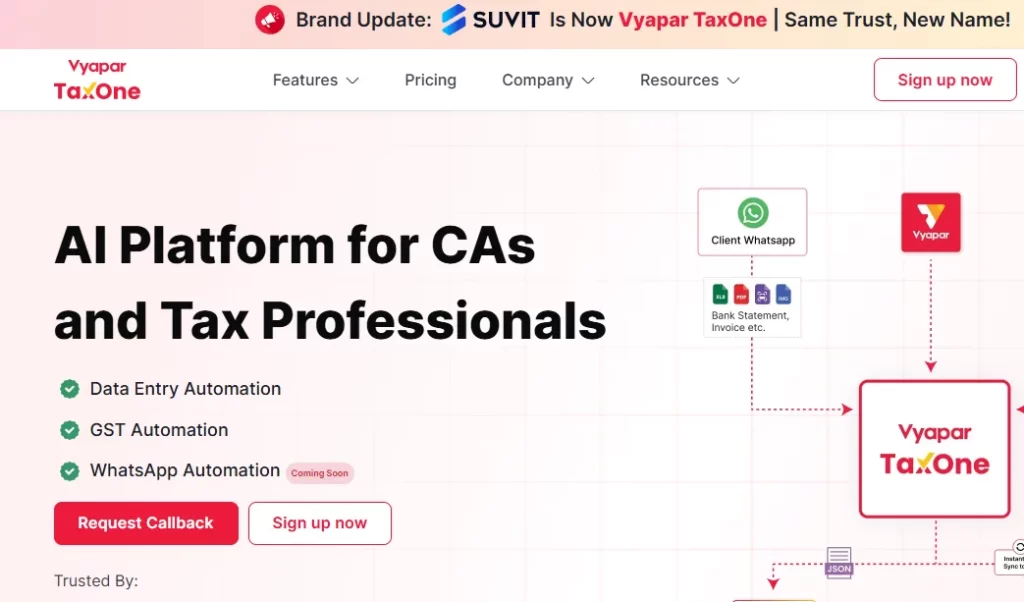
Vyapar TaxOne focuses on GST and TDS compliance automation for Indian businesses and accounting professionals. The platform uses AI-based reconciliation and data extraction to process invoices and match returns efficiently. It helps reduce filing errors and supports faster compliance with evolving Indian tax requirements.
Conclusion
AI tax compliance apps are moving beyond automation and becoming intelligent compliance systems that can actively interpret regulations and manage risk. For enterprise owners and fintech founders, this could become a strong revenue opportunity when built on explainable AI, agentic workflows, retrieval augmented generation, and secure infrastructure. Idea Usher helps design and integrate these AI-driven tax platforms with enterprise-grade security and scalable architecture, enabling compliance to operate reliably at scale.
Looking to Develop an AI Tax Compliance App?
IdeaUsher can design a compliance-first AI tax architecture that aligns with corporate tax and VAT regulations from day one. Our team will carefully build a neuro-symbolic engine in which AI handles classification, while deterministic logic performs validated calculations and risk checks.
Why partner with us?
- Elite Team: Ex-MAANG/FAANG developers who have built at scale.
- Proven Track Record: 500,000+ hours of coding experience, we’ve solved the hard problems so you don’t have to.
- AI Specialists: From RAG architectures to Multimodal AI, we build the “brains” behind the compliance.
Check out our latest projects to see the kind of high-performance apps we can build for you.


FAQs
A1: Traditional tax software mainly applies fixed rules to predefined fields and waits for structured inputs. An AI tax compliance app can intelligently read unstructured data, classify transactions contextually, and predict potential risk patterns before filing.
A2: AI tax compliance apps can substantially reduce routine advisory work by automating classification, reconciliation, and risk detection. However, strategic structuring, litigation defense, and complex cross-border planning still typically require human judgment and regulatory interpretation.
A3: Retrieval augmented generation forces the system to fetch verified statutes, circulars, or regulatory guidance before producing an answer. If no validated source is retrieved, the system can safely withhold a response and prevent speculative reasoning.
A4: Enterprise-grade AI tax platforms typically operate in isolated cloud environments, with encrypted data pipelines and controlled model access. When implemented correctly with strict access control and audit logging, enterprise tax data can remain strongly protected and compliant.