 (+971) 8007 4267
 (+91) 946 340 7140
 (+1) 628 432 4305

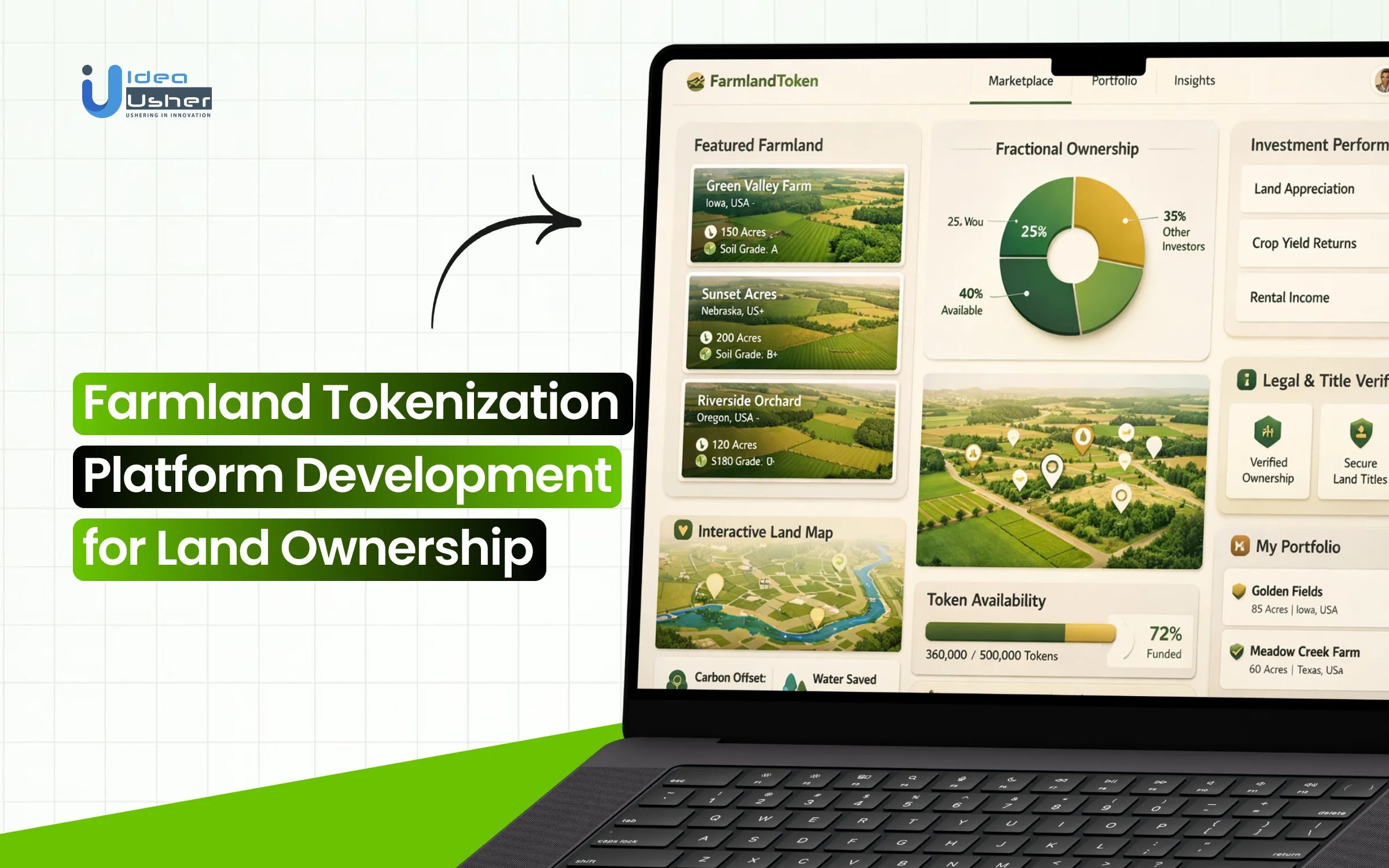
Farmland ownership has traditionally been defined by high capital requirements, long holding periods, and limited liquidity. While the asset itself is productive and stable, access to ownership has remained restricted to a small group of investors and operators. This gap is driving interest in building a farmland tokenization platform, where land ownership can be represented digitally and shared through fractional, blockchain-based structures.
Turning farmland into a tokenized asset introduces challenges that go beyond simple digitization. Ownership rights, land records, revenue distribution, regulatory compliance, and ongoing asset management all need to be reflected accurately on-chain. Smart contracts must align with legal land titles and off-chain documentation, while the platform must support transparent ownership tracking and value distribution over time.
In this blog, we explain farmland tokenization platform development for land ownership by breaking down core system components, architectural considerations, and the practical steps involved in building a compliant and scalable platform for tokenized agricultural assets.
What is a Farmland Tokenization Platform for Land Ownership?
A farmland tokenization platform for land ownership is a blockchain-based digital system that converts real farmland or land rights into digital tokens, where each token represents a fractional share of ownership or value of the land. These tokens can be bought, sold, or traded on digital markets, enabling fractional land ownership and more accessible investment in farmland, while legally linking the digital token to the real-world land asset.
What Does Farmland Tokenization Mean in Practice?
Farmland tokenization describes how agricultural land is digitally divided into smaller, investable units rather than being owned by a single party. Instead of purchasing an entire farm, individuals can participate by holding digital tokens that correspond to a specific portion of the land’s value or associated rights.
This approach allows farmland to be fractionalized, making ownership and investment more flexible and scalable. The underlying blockchain technology ensures that ownership records remain transparent, traceable, and resistant to manipulation. In practical terms, this structure works as follows:
- Consider a farmland property valued at $1,000,000 covering 100 acres.
- Instead of being sold to a single buyer, the land is digitally divided into 1,000 tokens, each priced at $1,000.
- Every token represents 0.1% ownership or economic interest in the farmland, equivalent to 0.1 acres in value terms.
- An investor purchasing 10 tokens would invest $10,000, giving them 1% exposure to the land’s value and returns.
- If the farmland generates $50,000 annually through leasing or crop revenue, a 1% token holder would be entitled to approximately $500 per year, excluding platform fees.
- All ownership records and transactions are securely maintained on the blockchain, ensuring transparency and easy transfer of token ownership.
Farmland Tokenization Platforms vs Generic RWA Tokenization Platforms
Farmland tokenization platforms address agriculture-specific asset structures and risks, unlike generic RWA platforms. This comparison highlights why purpose-built solutions better support tokenized farmland ownership.
| Comparison Dimension | Farmland Tokenization Platform | Generic RWA Tokenization Platform |
| Asset Nature | Productive, biological land asset that generates value through agricultural output | Primarily static or contract-based real-world assets |
| Asset Lifecycle | Ongoing biological cycles (planting, growth, harvest, regeneration) | Fixed lifecycle defined by contracts, maturity dates, or leases |
| Value Creation Logic | Crop yield, soil productivity, water access, and sustainable land management | Interest payments, rental income, or asset appreciation |
| Revenue Structure | Variable, yield-based, and seasonal income streams | Fixed or predictable cash flows tied to contractual terms |
| Smart Contract Design | Requires custom logic for seasonal distributions, yield variability, and operator agreements | Designed for standardized payments, coupons, or rent distribution |
| Data Requirements | Agricultural data such as acreage, soil type, crop history, yield metrics, and water usage | Basic asset metadata, ownership records, and payment schedules |
| Risk Modeling | Climate risk, weather variability, pest exposure, commodity price fluctuations | Credit risk, market volatility, counterparty or tenant risk |
| Compliance Complexity | Subject to land-use laws, agricultural regulations, and foreign ownership restrictions | Primarily governed by financial, securities, or asset-transfer regulations |
Why Farmland Tokenization Platform Gaining Popularity?
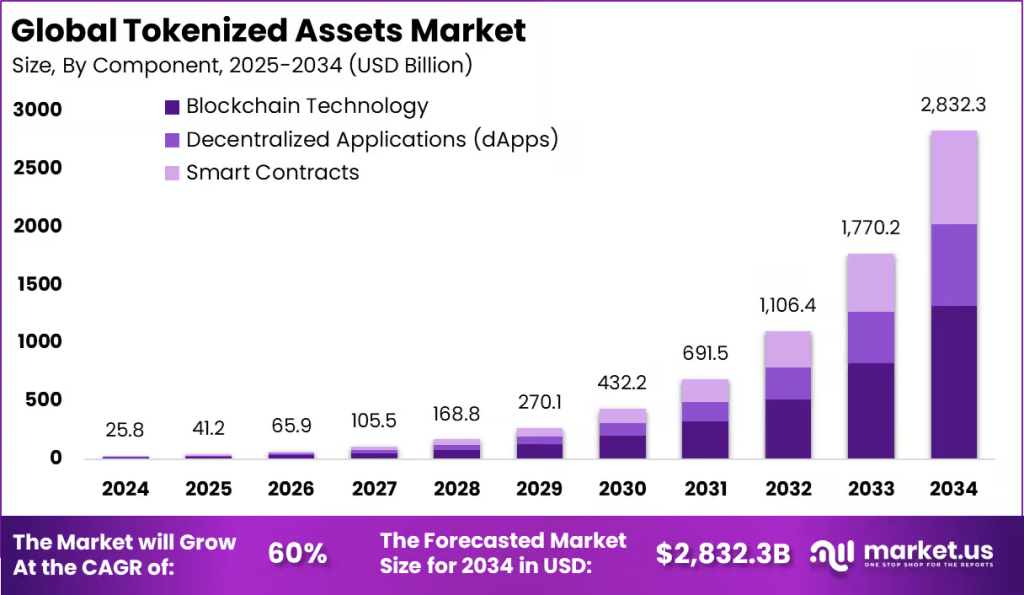
The Global Tokenized Assets Market is projected to reach approximately USD 2,832.3 billion by 2034, up from USD 25.8 billion in 2024, with a CAGR of 60% from 2025 to 2034. This growth reflects increasing institutional and investor interest in tokenizing real assets like farmland for liquidity, transparency, and market participation.
This momentum is especially relevant for farmland, an asset well-suited for tokenization due to its scale, stability, and long-term performance. Boston Consulting Group projects that tokenized illiquid assets, including farmland, could reach $10–$16 trillion by 2030, highlighting the opportunity for agricultural digitization platforms.
Farmland has shown strong long-term performance, delivering 10.84% average annual returns between 1992 and 2020 with lower volatility than the S&P 500. Platforms like AcreTrader reflect this stability, achieving an 18% net IRR and 21% annualized appreciation on a 169-acre Indiana farm exit in 2024.
Agrotoken, a leading South American platform, has facilitated over $70 million in transactions and tokenized over 230,000 tons of grain, onboarding more than 1,000 farmers. This illustrates how tokenized agricultural assets function as liquid, investable instruments across borders.
Platforms like AcreTrader, Agrotoken, and GrainChain demonstrate that farmland tokenization is no longer theoretical. It is rapidly evolving into a scalable digital infrastructure layer connecting investors, farmers, and global markets while redefining how agricultural assets are owned, financed, and managed.
How Land Ownership Works in a Farmland Tokenization Platform?
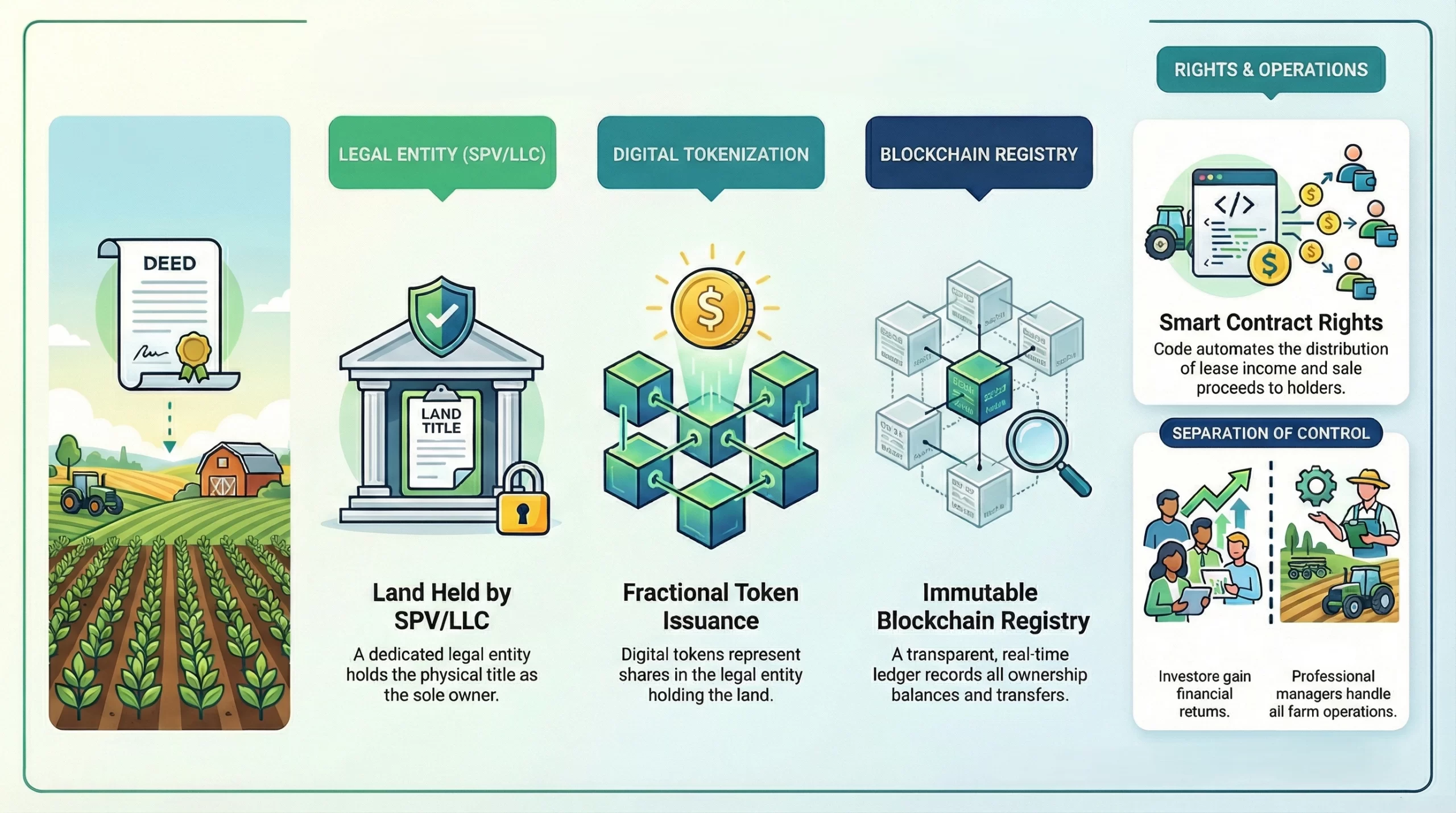
The ownership structure in farmland tokenization is a carefully engineered hybrid of traditional law and blockchain technology. It separates financial benefits from physical control to create an efficient, compliant investment vehicle.
1. Legal Structure and Asset Holding
The physical farmland is never directly owned by thousands of individual token holders. Instead, it is legally purchased and held by a dedicated legal entity, typically a Special Purpose Vehicle (SPV) or Limited Liability Company (LLC). This entity is the sole name on the official land title, providing a clean, single owner of record.
2. Token as a Digital Representation of Ownership
Investors purchase digital security tokens issued on a blockchain. These tokens do not constitute a direct property deed. Legally, they represent a fractional beneficial interest in the SPV/LLC that holds the title. Economically, they function like shares in a company whose sole asset is the farmland.
3. On-Chain Registry and Immutable Proof
The platform maintains an immutable, transparent registry of ownership on the blockchain. This ledger records every token holder’s address and balance, acting as the definitive, real-time record of who owns what share of the underlying legal entity. It cannot be altered or forged.
4. Rights and Responsibilities of Token Holders
Token holders’ rights are explicitly coded into smart contracts and outlined in legal offering documents. These rights typically include a proportionate share of the economic benefits (like lease income or sale proceeds) but expressly exclude direct control over farm operations, management decisions, or physical access to the land.
5. Separation of Ownership and Operation
This is the fundamental principle. Financial ownership (via tokens of the SPV) is democratized and distributed globally. Operational control remains with a vetted, professional farm manager or tenant farmer who leases the land from the SPV. This ensures agricultural expertise runs the farm while investors receive passive returns.
Core Features of Farmland Tokenization Platform
A farmland tokenization platform brings together blockchain technology and agricultural assets to enable secure, transparent land digitization. These features support compliant ownership, efficient investment access, and streamlined management of tokenized farmland assets.

1. Blockchain-Powered Ownership Ledger
A tamper-resistant digital ledger records farmland ownership, token allocations, and transfers in real time. This ensures transparent provenance, prevents double ownership, and creates a verifiable link between on-chain tokens and off-chain land titles.
2. Smart Contract Automation Engine
Smart contracts automate token issuance, ownership transfers, revenue distribution, and rule enforcement. They replace manual processes with deterministic logic, reducing operational risk while ensuring that payouts, permissions, and obligations execute exactly as predefined.
3. Fractional Token Issuance and Management
This module enables farmland to be divided into standardized digital units representing proportional ownership or economic rights. It defines token supply, pricing logic, ownership limits, and lifecycle events, making large farmland assets accessible to smaller investors.
4. Investor Dashboard and Wallet Integration
A unified interface allows investors to view holdings, track performance, receive distributions, and manage transactions. Wallet integration enables secure custody of tokens while providing real-time visibility into ownership, income, and asset-level metrics.
5. Farmer–Investor Communication Portal
A dedicated communication layer enables structured updates, reporting, and announcements between operators and investors. This improves trust, reduces information asymmetry, and ensures stakeholders remain aligned on performance, risks, and operational decisions.
6. Automated Yield Distribution Mechanism
This mechanism automatically calculates and distributes agricultural returns to token holders based on actual yield outcomes and ownership proportions. It supports variable, season-based payouts, ensuring revenue allocation remains accurate, transparent, and directly linked to real farm performance.
7. Land and Asset Data Registry
A structured registry stores critical land data such as location, acreage, zoning classification, soil type, and legal identifiers. This ensures every tokenized asset is backed by verifiable, auditable land information tied to the real-world property.
8. Crop Planning and Commodity Marketing
A structured framework supports crop selection, rotation planning, and market timing decisions. It integrates pricing data, demand forecasts, and forward contracts to optimize revenue outcomes while aligning production strategies with land capability and market conditions.
9. Agricultural Performance Tracking System
This system captures operational data such as crop type, yield history, planting cycles, and production outcomes. It enables performance-based transparency, allowing investors to evaluate farmland value beyond price appreciation alone.
10. Soil Health and Carbon Credit Tracking
This feature monitors soil organic matter, nutrient levels, and carbon sequestration performance. It enables farmland to participate in carbon credit markets, turning soil improvement into a measurable, monetizable asset while supporting long-term land productivity.
Farmland Tokenization Platform Development for Land Ownership
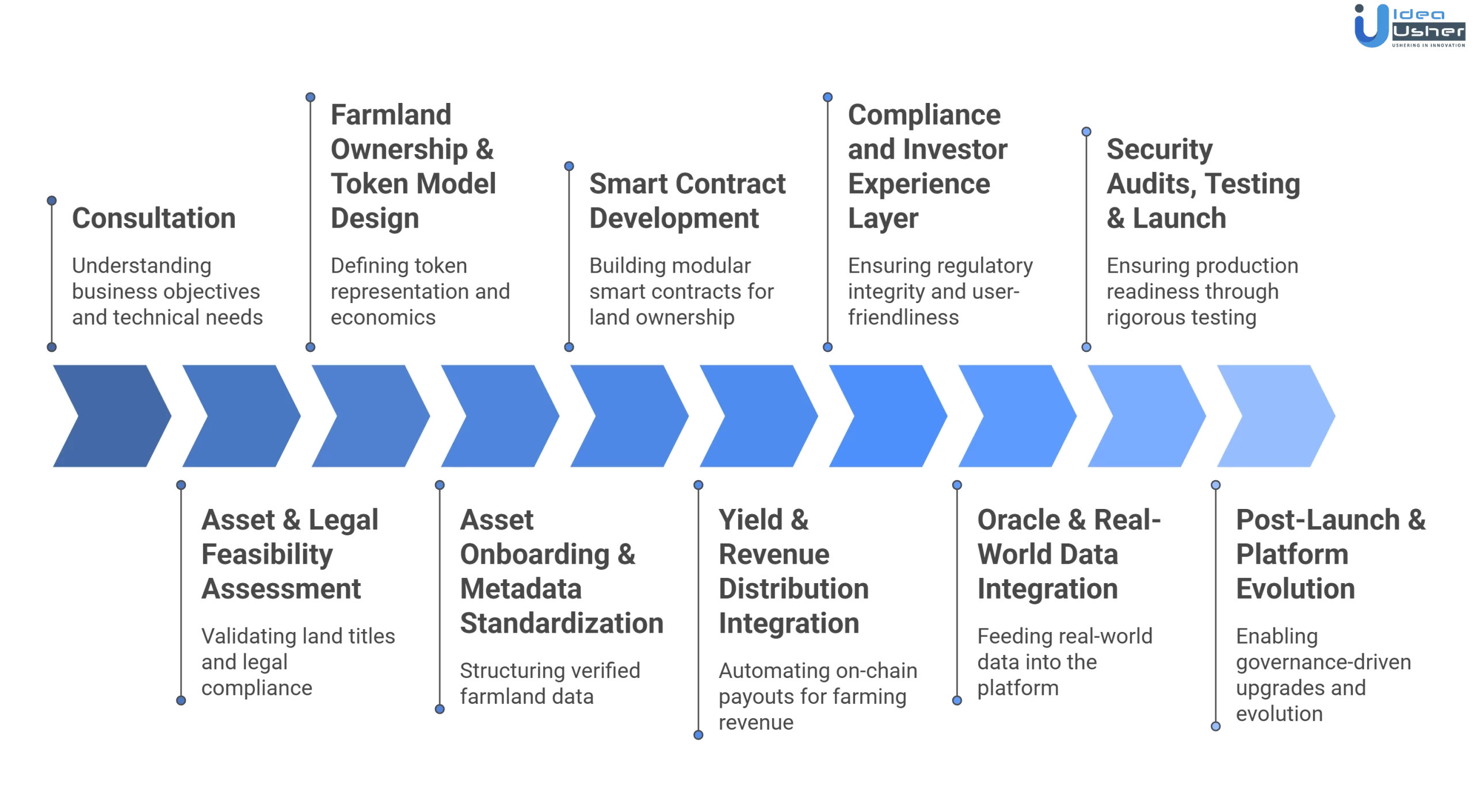
Farmland tokenization platform development for land ownership enables secure, blockchain-based digitization of agricultural assets, enhancing transparency and liquidity. Our developers follow proven frameworks to build compliant, scalable platforms for digital land ownership.
1. Consultation and Requirement Discovery
We begin by consulting our clients to understand business objectives, jurisdictional scope, farmland asset structure, compliance needs, and target users. This phase defines technical requirements, regulatory constraints, and platform expectations before any architecture decisions are made.
2. Asset & Legal Feasibility Assessment
We begin by validating land titles, ownership history, and jurisdiction-specific agricultural laws. Our team ensures the farmland is legally tokenizable, investor participation is permitted, and on-chain ownership aligns with enforceable off-chain legal structures.
3. Farmland Ownership & Token Model Design
We design the ownership and token model by defining what each token represents, total supply logic, fractionalization rules, and transfer constraints. Our developers ensure the token economics remain compliant, transparent, and scalable.
4. Asset Onboarding & Metadata Standardization
We onboard farmland assets by structuring verified metadata, including land details, valuation reports, yield history, and legal references. This standardized data layer becomes the foundation for smart contracts, compliance checks, and investor transparency.
5. Smart Contract Architecture Development
Our developers build modular smart contracts that handle land ownership, fractional transfers, yield distribution, lock-in periods, and governance controls. Contracts are designed for upgradeability, regulatory enforcement, and long-term asset lifecycle management.
6. Yield & Revenue Distribution Integration
We integrate real-world farming revenue into the platform by validating off-chain income and triggering automated on-chain payouts. Our logic accounts for variable yields, delays, and seasonal fluctuations without compromising investor trust.
7. Compliance and Investor Experience Layer
We embed compliance through KYC, jurisdiction-based access controls, and wallet allowisting, while building intuitive investor dashboards that display ownership, yield performance, payouts, and legal documents, ensuring regulatory integrity alongside a transparent, user-friendly experience.
8. Oracle & Real-World Data Integration
We integrate trusted data sources to feed yield results, weather data, and risk events into the platform. Our oracle architecture ensures accurate, tamper-resistant inputs for smart contracts and investor reporting.
9. Security Audits, Testing & Launch
Before launch, we conduct rigorous smart contract audits, compliance testing, and scenario simulations. Our developers validate edge cases such as crop failure, delayed yields, and dispute handling to ensure production readiness.
10. Post-Launch Governance & Platform Evolution
After deployment, we enable governance-driven upgrades, new farmland onboarding, revaluation workflows, and regulatory updates. Our architecture ensures the platform evolves without disrupting ownership, compliance, or investor confidence.
Farmland Tokenization Platform Development Cost
Farmland tokenization platform development cost depends on technology stack, compliance scope, asset complexity, and security requirements. These factors help businesses plan scalable, efficient solutions aligned with long-term operational and investment goals.
| Development Phase | Estimated Cost | What Our Developers Will Do |
| Consultation & Requirements | $5,000 – $10,000 | Define business requirements, technical scope, regulatory considerations, and platform architecture aligned with farmland tokenization objectives. |
| Legal & Asset Feasibility | $8,000 – $15,000 | Assess land ownership constraints, jurisdictional regulations, and technical feasibility for compliant farmland tokenization. |
| Ownership & Token Design | $10,000 – $20,000 | Design token economics, ownership structures, supply mechanics, and revenue rights mapping farmland to digital tokens. |
| Asset Onboarding Setup | $8,000 – $15,000 | Create onboarding workflows and standardized metadata for farmland attributes and legal documentation. |
| Smart Contract Development | $20,000 – $40,000 | Develop smart contracts for token issuance, transfers, governance, ownership restrictions, and lifecycle management. |
| Yield & Payout Integration | $10,000 – $20,000 | Implement automated yield calculation and proportional revenue distribution linked to token ownership. |
| Compliance & Investor UX | $15,000 – $30,000 | Integrate KYC, access controls, audit trails, and investor dashboards for compliant participation. |
| Oracle & Data Integration | $8,000 – $18,000 | Connect external data sources such as yield, weather, and pricing through secure Oracle systems. |
| Testing, Audit & Launch | $12,000 – $25,000 | Perform testing, coordinate security audits, resolve issues, and deploy the platform to production. |
| Governance & Platform Growth | $5,000 – $12,000 / month | Maintain platform, implement upgrades, support governance features, and adapt to regulatory changes. |
Total Estimated Cost: $58,000 – $124,000+
Note: Farmland tokenization platform development cost depends on platform scope, compliance requirements, blockchain choice, smart contracts, and long-term scalability needs.
Consult with IdeaUsher to assess your requirements, define the right architecture, and estimate costs aligned with your business and regulatory goals.
Challenges & How Our Developers Solve Them?
Farmland tokenization platform development presents challenges around compliance, asset validation, and scalability. Our developers address these complexities through secure architecture, regulatory alignment, and proven blockchain frameworks to deliver reliable, investment-ready solutions.

1. Fragmented and Inconsistent Land Records
Challenge: In many regions, farmland records exist across physical deeds, local registries, and semi-digitized government portals, often with mismatches.
Solution: We build a land-verification workflow that reconciles multi-source records, flags inconsistencies early, and only allows tokenization after legal certainty is programmatically confirmed and documented.
2. Complex Agricultural Land Ownership Laws
Challenge: Farmland often has stricter ownership rules, such as prohibitions on non-residents, corporations, or foreign investors.
Solution: We encode jurisdiction-specific ownership constraints directly into smart contracts and access layers, ensuring restricted investors are technically prevented from holding or transferring farmland tokens.
3. Linking Legal Land Rights to On-Chain Tokens
Challenge: A token does not automatically equal ownership in court. Improper structuring breaks enforceability.
Solution: We design platforms where tokens represent rights through SPVs, trusts, or contractual wrappers, ensuring on-chain ownership is legally enforceable off-chain under local land laws.
4. Variable and Unpredictable Farmland Yields
Challenge: Unlike rental assets, farmland income depends on seasons, weather, and crop outcomes, which breaks fixed payout assumptions.
Solution: We architect yield distribution systems that support delayed payouts, partial distributions, and zero-yield seasons without contract failures or misleading investor expectations.
5. Challenges in Verifying Yield Data
Challenge: Farming income often relies on manual reporting, creating risks of data inaccuracies, disputes, or manipulation that undermine trust in yield-based distributions.
Solution: We integrate controlled data pipelines using verified operator inputs, audit logs, and oracle validation layers that ensure yield data is traceable, tamper-resistant, and reviewable.
Business Models for Farmland Tokenization Platforms
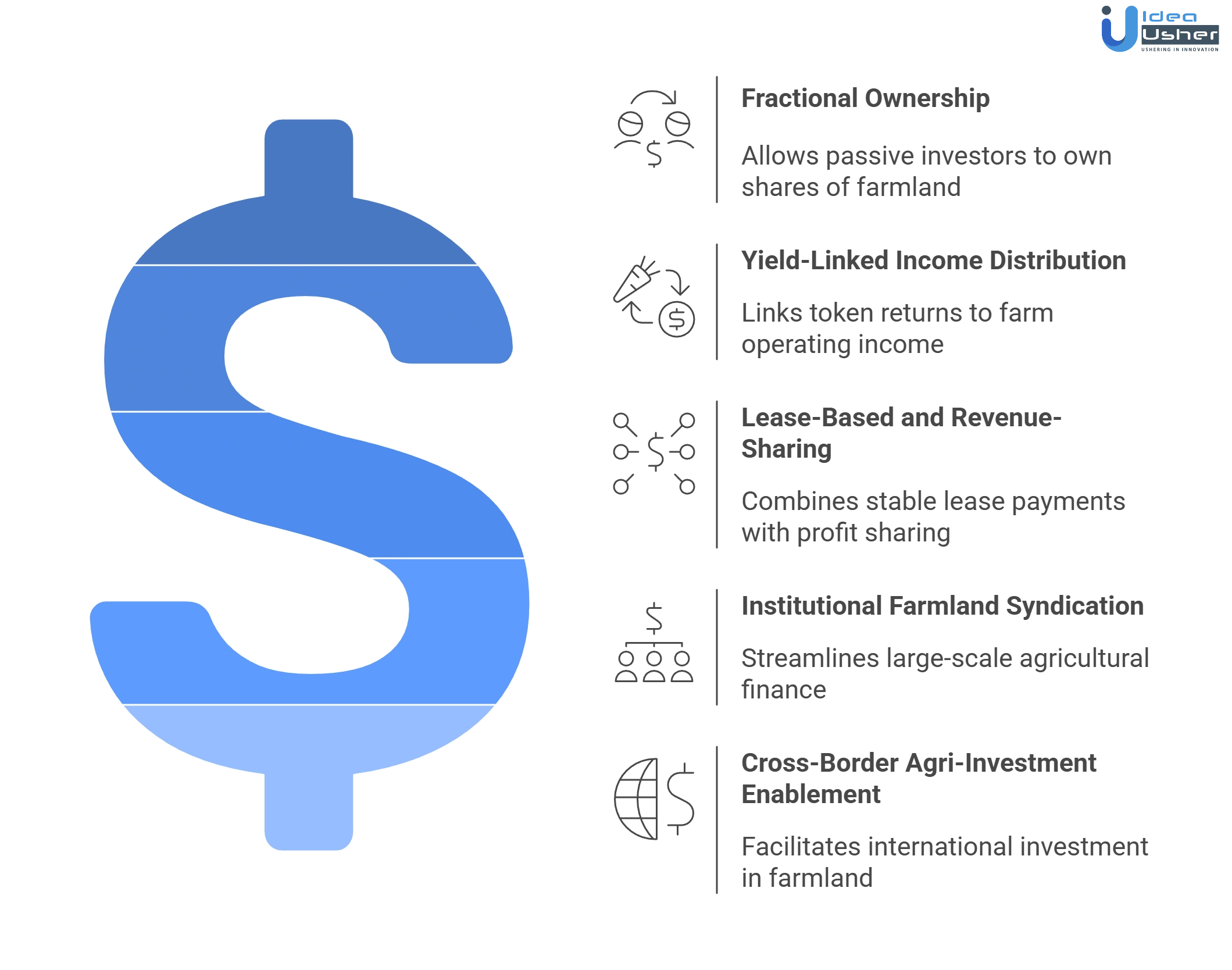
Farmland tokenization platforms adopt diverse business models to balance asset security, income generation, and investor accessibility. These approaches define how agricultural assets are structured, monetized, and managed within blockchain-based investment ecosystems.
1. Fractional Ownership for Passive Investors
This model broadens farmland investment access. A platform acquires farms, transfers them to legal entities like LLCs, and issues tokens representing ownership shares. Investors gain fractional interest with returns from land appreciation and lease income through passive management.
2. Yield-Linked Farming Income Distribution
Tokens are linked to an active farm’s operating income rather than land. Investors purchase tokens representing annual harvest revenue shares. Returns depend on crop yield, commodity prices, and farming efficiency, offering higher income potential with increased operational risk.
3. Lease-Based and Revenue-Sharing Land Models
This hybrid model offers asset security and income generation. The platform tokenizes farmland and leases it to experienced operators. Token holders receive stable lease payments and often operational profit shares, with professional farming expertise reducing risk.
4. Institutional Farmland Syndication via Tokenization
This model brings blockchain efficiency to large-scale agricultural finance. Rather than traditional, paperwork-heavy syndication, funds or developers tokenize multi-million dollar farms or portfolios. Tokens offered to institutional investors enable faster capital raising, greater liquidity, and transparent governance.
5. Cross-Border Agri-Investment Enablement
Tokenization addresses restrictive foreign land ownership laws. A platform creates local legal entities to hold land titles and issues tokens representing economic benefits to international investors, attracting global capital while complying with regulations and broadening the investor base.
How to Choose and Evaluate the Right Model?
The optimal farmland tokenization model depends on your investment objectives, risk tolerance, and desired exposure:
- Stable, asset-backed returns: Prioritize Fractional Ownership or Lease-Based and Revenue-Sharing models, which emphasize land value preservation and predictable income streams.
- Higher income potential: Consider Yield-Linked Farming Income Distribution models, which offer upside from strong yields and favorable commodity prices, while carrying greater operational risk.
- Portfolio diversification at scale: Look toward Institutional Farmland Syndication platforms that provide access to professionally managed, multi-asset farm portfolios.
- International market access: Seek compliant Cross-Border Agri-Investment Enablement platforms that navigate foreign ownership restrictions through local structures.
How Farmland Tokenization Platforms Handle Crop Failure and Zero-Yield Risks?
Farmland tokenization platforms mitigate crop failure and zero-yield risks through diversified assets, insurance mechanisms, and professional farm management. These strategies help protect investor returns while ensuring long-term stability across tokenized agricultural investments.
1. Smart Contracts for Zero-Yield Scenarios
Farmland tokenization platforms recognize zero-yield seasons as a normal agricultural outcome. Smart contracts avoid hardcoded payout assumptions and keep land ownership tokens valid even when the platform generates no revenue.
2. Verified Off-Chain Yield Data Integration
The platform confirms crop performance using verified off-chain inputs such as operator reports, audit records, and trusted data feeds, preventing false yield reporting and ensuring distributions occur only when real farming income exists.
3. Delayed and Partial Yield Distribution Logic
Farmland tokenization platforms support delayed and partial distributions instead of fixed payout schedules and allow income distribution only after harvest completion, sale realization, or seasonal reconciliation.
4. Ownership Protection During Crop Failure
Crop failure does not affect land ownership itself. Token holders retain their ownership or economic rights, while smart contracts simply record the absence of yield rather than triggering penalties or ownership dilution.
5. Insurance and Risk Mitigation Integration
Some platforms integrate agricultural insurance or reserve pools to absorb losses during extreme crop failure. These mechanisms help stabilize investor expectations without misrepresenting agricultural risk or guaranteeing artificial returns.
Top Farmland Tokenization Platforms in the Market
Farmland tokenization platforms are transforming agricultural land ownership through blockchain, enabling fractional investment, improved liquidity, and transparent asset management. Below are leading platforms shaping the evolution of tokenized farmland markets.
1. Agrarium
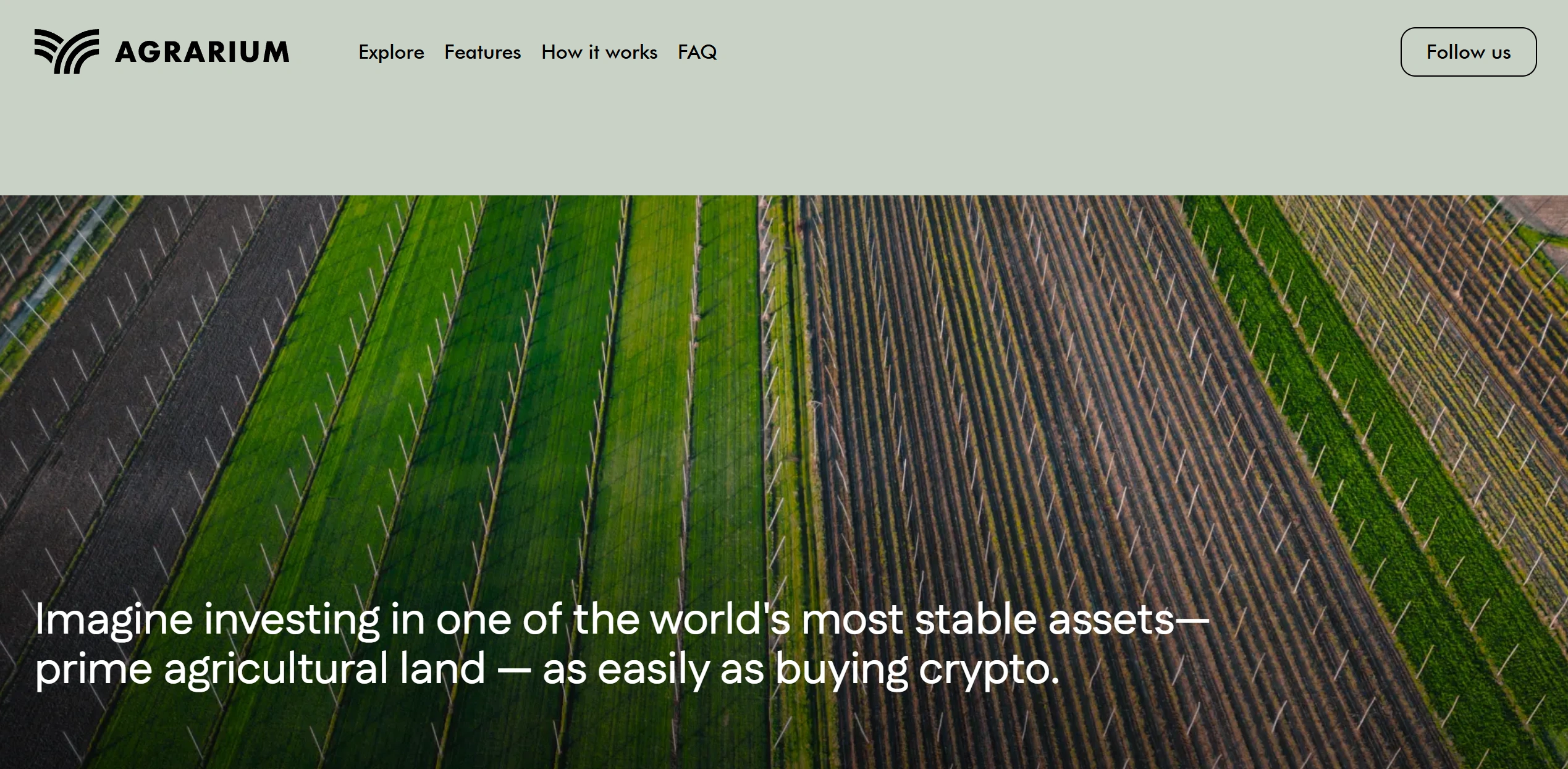
Agrarium is a blockchain-based farmland tokenization platform enabling fractional ownership of premium agricultural land. It focuses on asset-backed stability, passive income potential, and long-term land appreciation through legally structured, tokenized ownership shares.
2. Landtoken
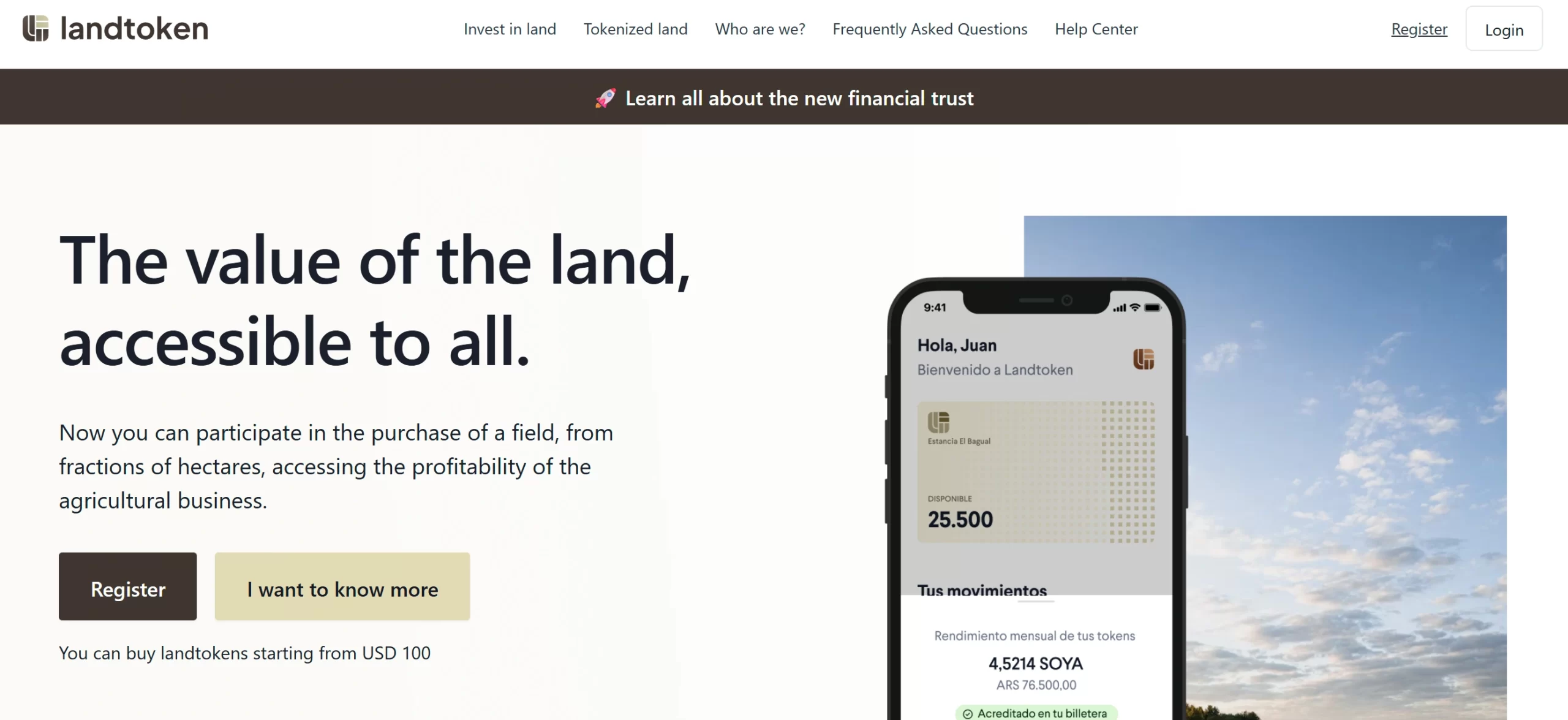
Landtoken tokenizes arable land to democratize farmland ownership and converts land parcels into digital tokens to improve accessibility, liquidity, and transparency for investors seeking agricultural real estate exposure.
3. Landshare
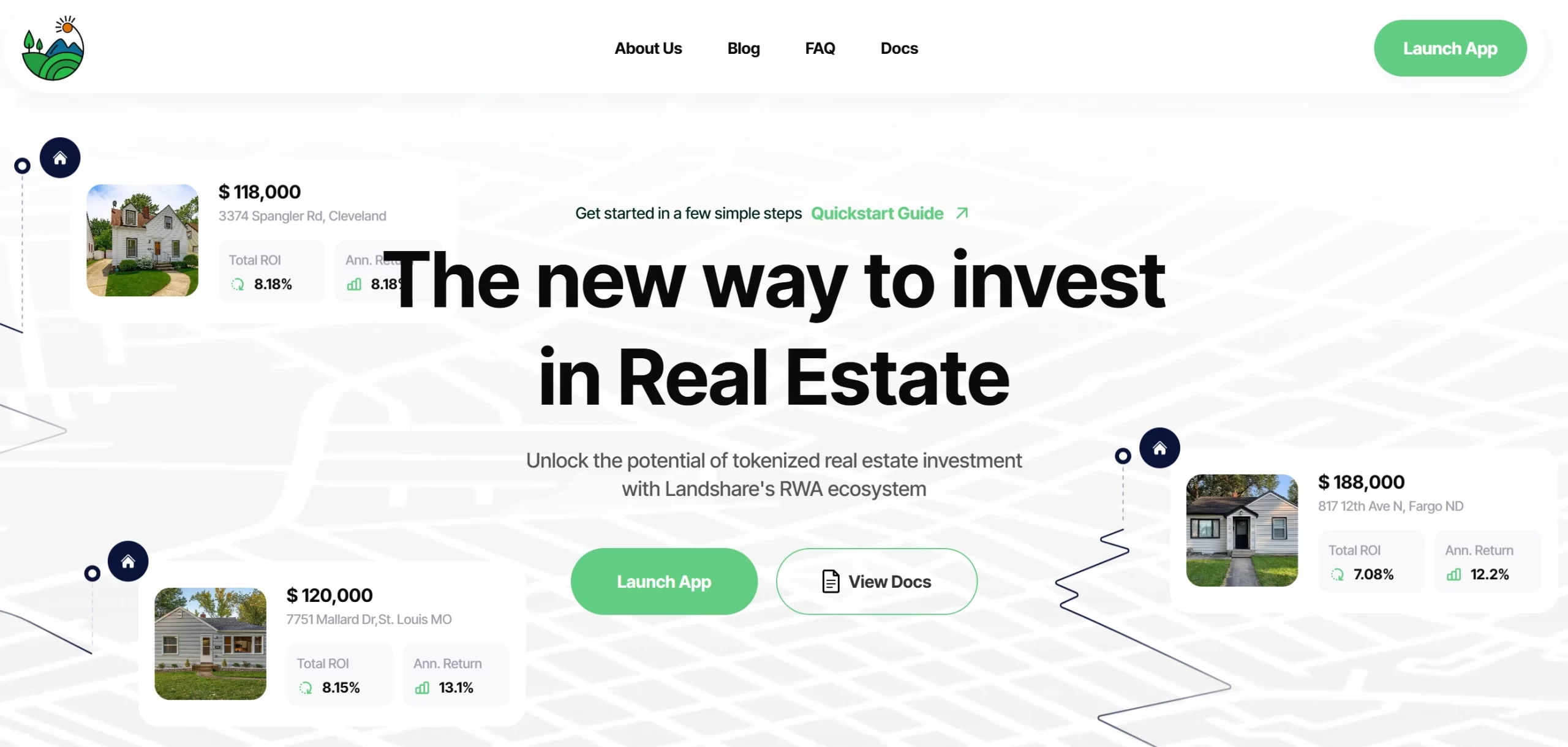
Landshare offers tokenized farmland investments designed for passive income generation. Combining real-world agricultural assets with DeFi mechanisms, the platform enables fractional ownership, yield distribution, and enhanced liquidity through blockchain-based investment structures.
4. AgroBloc
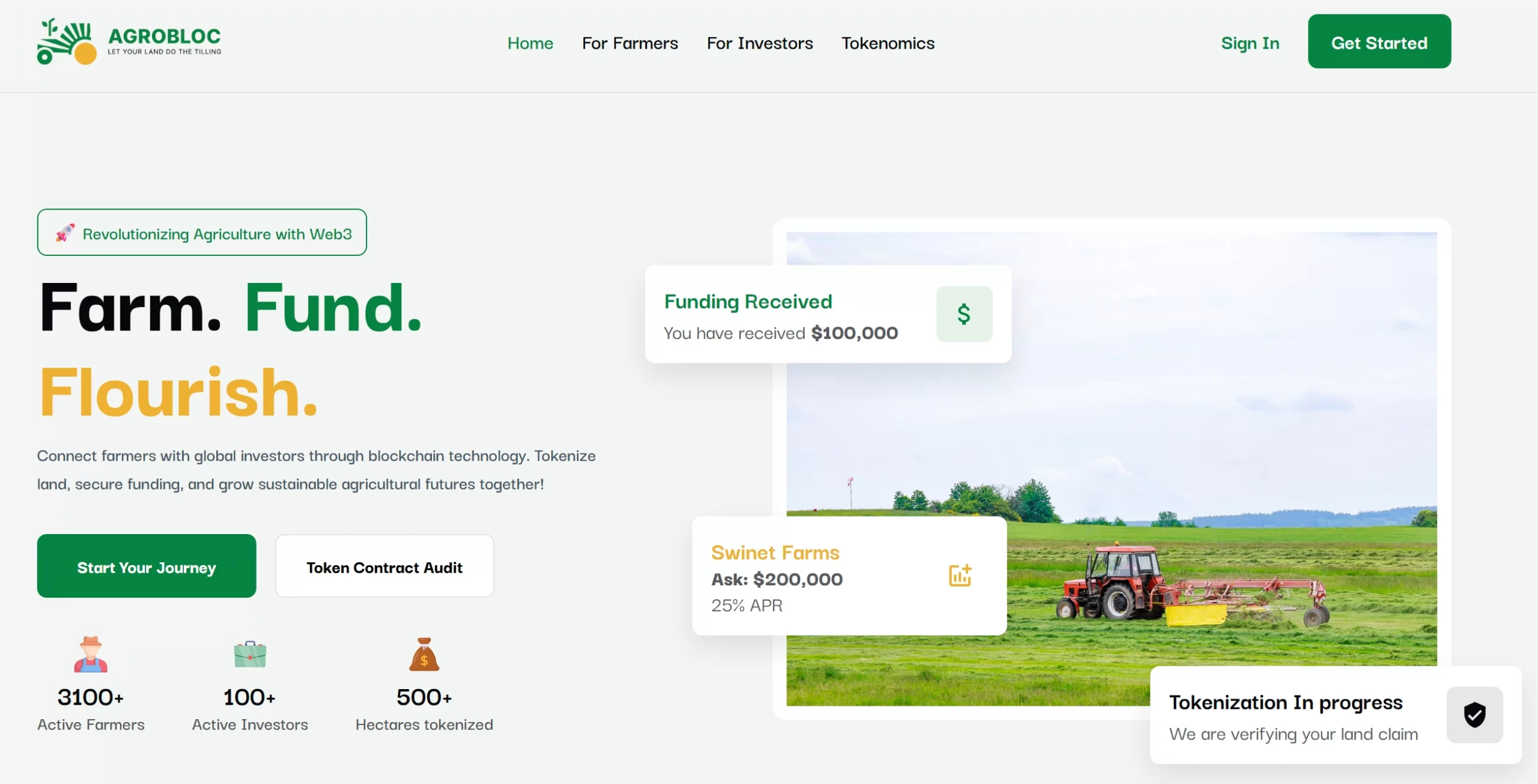
AgroBloc uses blockchain to tokenize agricultural assets and improve traceability, enabling landowners, farmers, and investors to digitize assets, increase supply chain transparency, and support fractional farmland ownership through decentralized infrastructure.
5. Landbitt
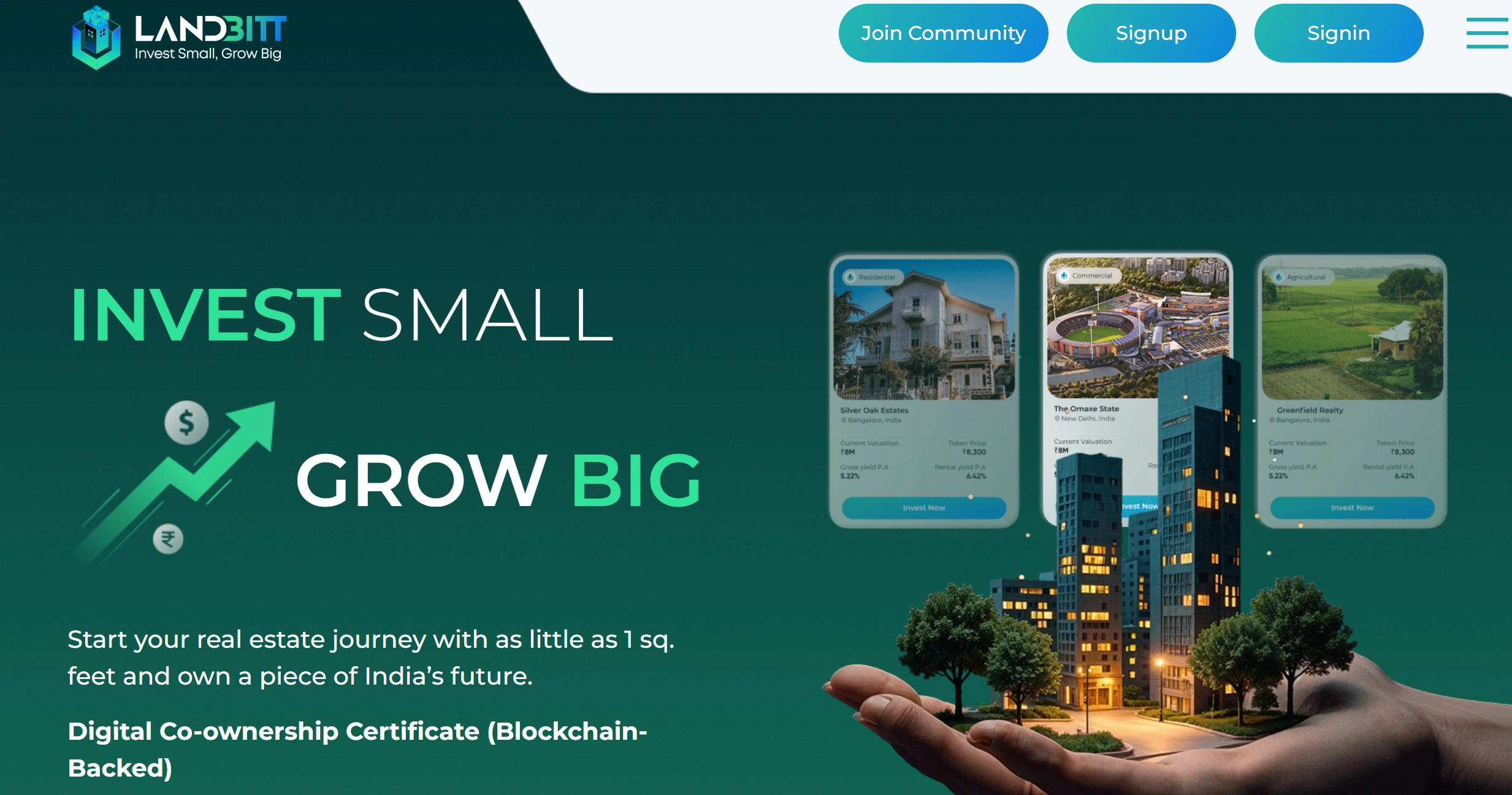
Landbitt is a PropTech-driven platform that tokenizes land parcels, including agricultural land, into blockchain-based ownership units. It emphasizes fractional investment, digital land records, and secure property transactions through decentralized infrastructure.
Conclusion
Farmland tokenization reshapes how people think about owning, valuing, and accessing agricultural land. By converting land into compliant digital tokens, ownership becomes more transparent, divisible, and secure, while respecting legal and regulatory boundaries. This approach encourages broader participation without diluting the significance of land stewardship. Farmland tokenization platform development stands at the center of this shift, aligning technology with trust, governance, and long-term sustainability. When designed thoughtfully, such platforms support farmers, investors, and communities while preserving land as a productive, enduring asset for future generations across evolving agricultural economies.
Partner with IdeaUsher for Farmland Tokenization Platform Development
We bring deep expertise in blockchain engineering, tokenization frameworks, and decentralized application development. Leveraging this foundation, our ex-FAANG/MAANG developers build secure, compliant farmland tokenization platforms tailored for digital land ownership and investment.
Why Work With Us?
- Agriculture-Focused Tokenization Expertise: We understand farmland-specific structures, including leases, yield distribution, and land-backed ownership models.
- Custom Platform Development: From legal structuring to token economics and user experience, we build solutions tailored to farmland investment needs.
- Compliance-Driven Architecture: Our platforms are designed with jurisdictional land laws, investor protections, and regulatory requirements in mind.
- Scalable & Secure Systems: We deliver enterprise-grade platforms built to scale with growing investor demand and evolving agricultural markets.
Explore our work to see how we help businesses launch reliable blockchain platforms for real-world agricultural assets.
Connect with us today for a free consultation and start building your farmland tokenization platform with confidence.


FAQs
A.1. Farmland tokenization platform development involves creating a digital system that converts agricultural land into blockchain-based tokens. These tokens represent fractional or full ownership while ensuring legal compliance, secure transactions, and transparent ownership records.
A.2. Farmland valuation is based on soil quality, location, crop yield potential, water access, and market demand. Accurate third-party assessments ensure tokens reflect fair land value and protect both landowners and investors.
A.3. Yes, tokenization enables fractional ownership by dividing land value into smaller digital units. This allows multiple investors to participate while maintaining clear ownership records and defined rights through smart contract logic.
A.4. Ownership rights are embedded within smart contracts and linked to legal documentation. This structure defines usage rights, revenue distribution, transfer conditions, and dispute handling while aligning with chain records with off-chain legal agreements.