

Key Takeaways
- Enterprise developers are critical for cloud migrations, AI initiatives and large-scale system integration projects.
- System integrators increasingly use staff augmentation to access specialized talent faster and scale delivery teams on demand.
- Key expertise includes enterprise applications, cloud infrastructure, data engineering, security and API integrations.
- Successful enterprise projects require flexible hiring models, rapid onboarding and access to pre-vetted specialists.
- How Idea Usher help system integrators access specialized enterprise developers for integration, modernization and digital transformation projects.
The biggest constraint on enterprise delivery is no longer winning projects but it is finding the specialized talent required to execute them. This shift is reshaping enterprise developer hiring as system integrators face growing pressure to deliver cloud migrations, AI implementations, data modernization programs and large-scale transformation initiatives within increasingly aggressive timelines.
Traditional hiring focused on building permanent teams around predictable workloads but modern enterprise projects require rapid access to specialized talent, including cloud architects, data engineers, AI specialists, DevOps engineers, cybersecurity experts, and enterprise developers. The goal is no longer simply filling roles, but creating a flexible talent strategy that supports faster delivery, specialized expertise, and scalable execution.
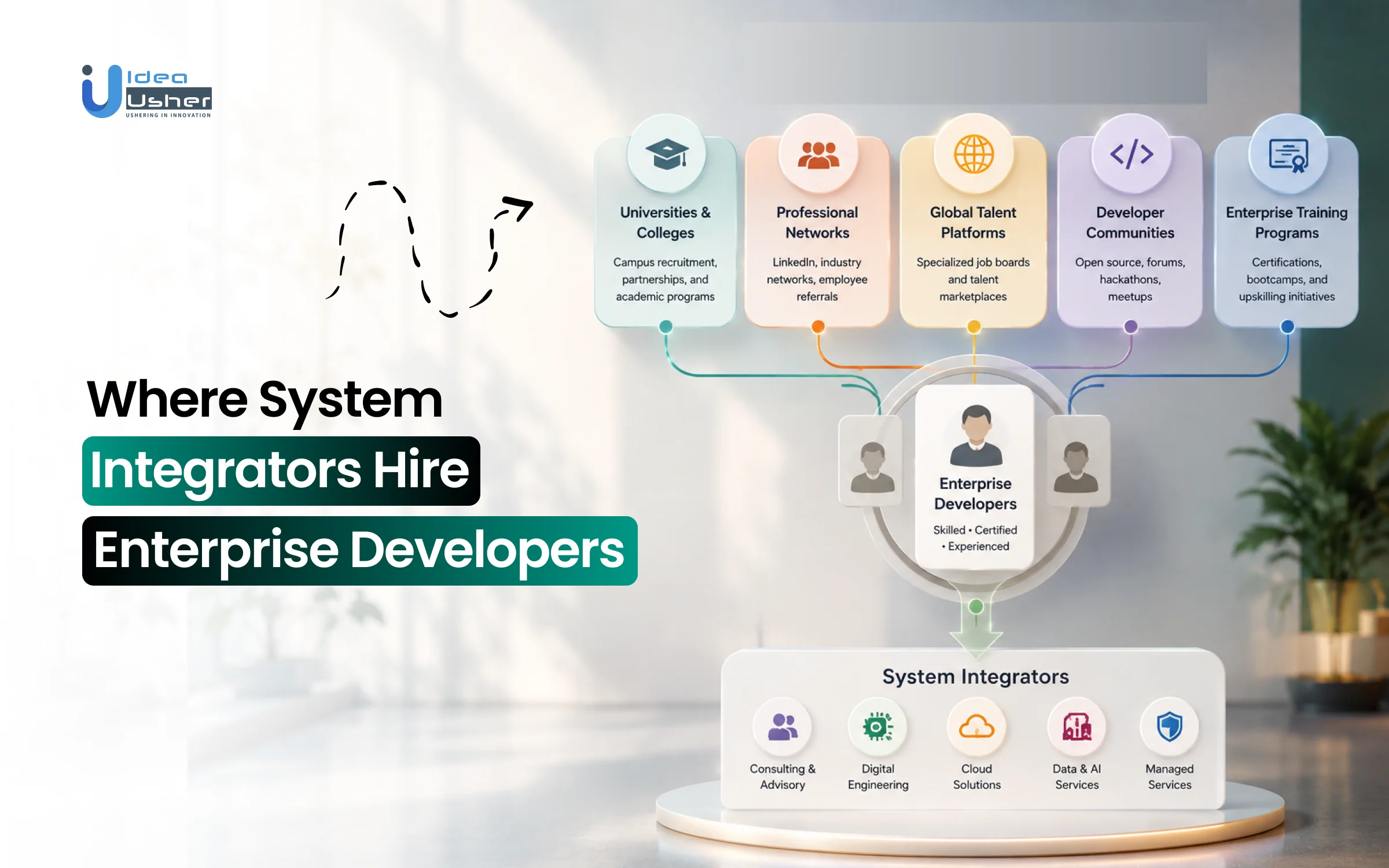
In this blog, we explore where System Integrators hire enterprise developers, the sourcing and hiring models they rely on, key talent acquisition strategies and how Idea Usher helps organizations access specialized enterprise development talent at scale in an increasingly competitive market.
Why System Integrators Need Enterprise Developers
The global system integration market is projected to grow from USD 421.4 billion in 2025 to USD 1,228.6 billion by 2033, at a CAGR of 14.8%. Large organizations represent the overwhelming engine of this expansion, capturing 73.1% of all system integration spending.
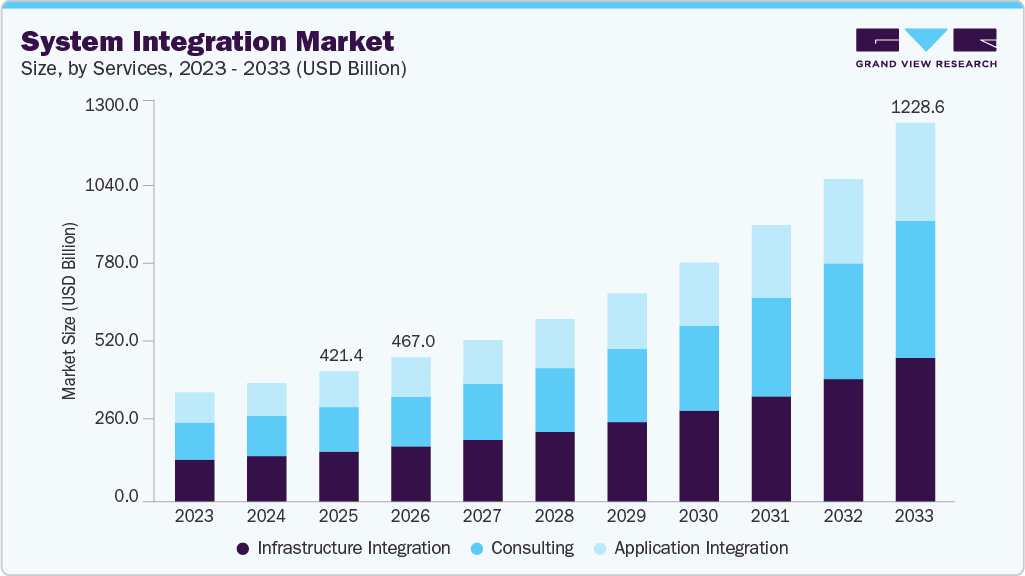
This growth is driven by enterprise efforts to modernize legacy systems and connect fragmented operations across increasingly complex multi-cloud environments. Yet integration remains challenging, with 47% of projects exceeding budgets by more than 20% due to hidden technical dependencies.
That’s where system integrators play a critical role in enterprise digital transformation by connecting applications, technologies, and infrastructure into unified operating environments. Beyond implementation, they often require specialized development talent to support large-scale integrations, regulatory compliance, and complex enterprise architectures.
A. What Does a System Integrator Do?
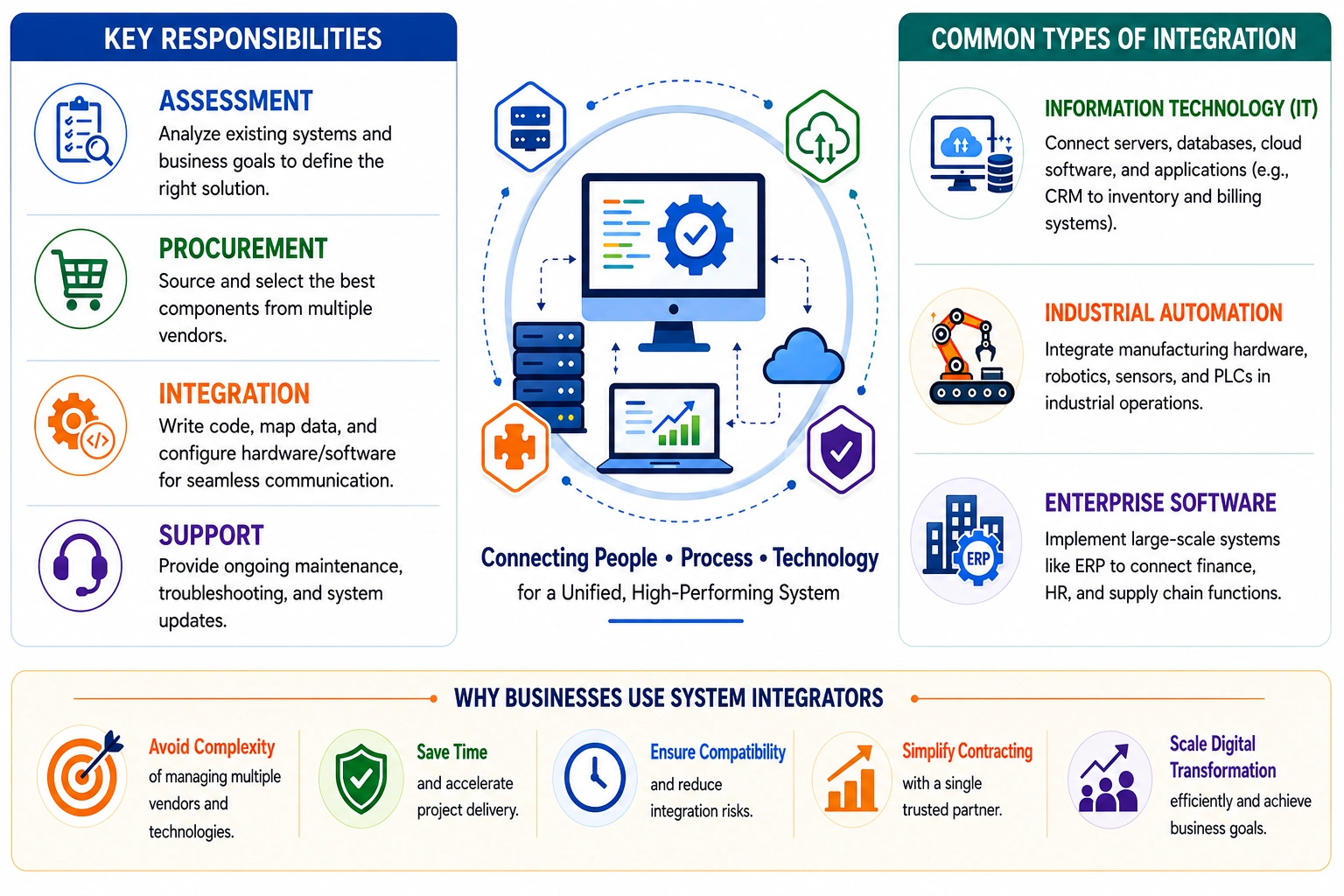
A system integrator is an individual or company that builds comprehensive IT or operational systems by combining hardware, software, and networking products from multiple vendors. They ensure that distinct, disconnected subsystems work together seamlessly as a single, unified, and functional whole.
Key Responsibilities
As enterprise projects grow in scale and complexity, enterprise developer hiring increasingly revolves around supporting the broad responsibilities system integrators manage throughout the technology lifecycle.
- Assessment: Analyzing a company’s existing systems and business goals.
- Procurement: Sourcing the right combination of components from various vendors.
- Integration: Writing code, mapping data, and configuring hardware/software so the different parts communicate flawlessly.
- Support: Providing ongoing maintenance, troubleshooting, and system updates.
Common Types of Integration
Successful enterprise developer hiring requires understanding the specific integration environments developers will support. The following categories represent the most common types of integration across modern enterprises.
- Information Technology (IT): Connecting on-premises servers, databases, cloud software, and applications (e.g., linking a CRM tool to inventory and billing systems).
- Industrial Automation: Combining manufacturing hardware, robotics, sensors, and programmable logic controllers (PLCs) on a factory floor.
- Enterprise Software: Implementing large-scale systems like Enterprise Resource Planning (ERP) to connect an organization’s finance, HR, and supply chain departments.
Why Businesses Use Them
Instead of purchasing and managing separate technologies from multiple manufacturers which can be time-consuming and prone to compatibility issues, businesses hire system integrators. This outsources vendor management, simplifies contracting, and guarantees that digital transformation projects are efficiently scaled and deployed.
B. Sourcing & Structural Realities for System Integrators
Effective enterprise developer hiring requires evaluating talent beyond coding skills alone. The table below highlights key operational differences between general software talent and developers equipped for complex enterprise integration environments.
| Operational Metric | Standard Software Generalists | Dedicated Enterprise Developers |
| Average Sourcing Lifecycle | 3 to 5 Weeks | 12 to 16 Weeks (Traditional Internal HR) |
| Legacy Architecture Competency | Low (Focused on isolated, greenfield apps) | High (Mainframe, SAP, ERP, and ESB translation) |
| Average Cost of a Technical Mis-Hire | Minimal localized sprint delay | $20,000 to $30,000+ in recruitment and project drag |
| Deployment Speed (Staff Augmentation) | 14+ Days (Unvetted contractors) | 7 to 10 Days (Pre-vetted talent partner) |
C. Growing Demand for Enterprise Software Expertise
The demand for enterprise integration expertise is accelerating as organizations adopt composable architectures, replacing monolithic legacy systems with modular, interconnected platforms. As a result, software and digital integration has become the fastest-growing service segment, accounting for 40.83% of total market revenue.
Modern enterprises are no longer deploying isolated software solutions. They operate interconnected ecosystems where data must move seamlessly between legacy on-premises infrastructure and multi-cloud environments. With 94% of enterprises now running hybrid or multi-cloud services, demand continues to grow for engineers skilled in data portability, system orchestration, and cross-platform integration.
D. Challenges of Hiring Enterprise Developers In-House
Attempting to source, vet, and retain specialized integration engineers through standard corporate talent pipelines introduces severe operational friction.
- Extended Sourcing Inertia: Finding a qualified senior enterprise developer or niche infrastructure specialist is exceptionally difficult. Traditional internal human resource cycles take an average of 4.2 months (12 to 19 weeks) from the initial job posting to the developer’s first active sprint day.
- Active Project Roadmap Blockages: A 4-month delay is highly damaging to project timelines. At a standard two-week sprint velocity, an empty engineering seat represents 8 consecutive missed sprints of delayed feature deployment, causing system integrators to miss critical delivery milestones and incur steep SLA financial penalties.
- The Global Talent Scarcity Trap: The worldwide technology market faces a systemic deficit of middle and senior-level infrastructure engineers. With 45% of employers actively struggling to find qualified technical candidates, elite integration developers routinely balance 3 to 5 competing offers simultaneously, causing local offer acceptance rates to drop significantly.
E. Skills Modern Enterprise Projects Require
Modern enterprise integration requires a highly specialized blend of legacy engineering, cloud infrastructure, and zero-trust security compliance to ensure seamless integration, scalability, compliance, and long-term operational resilience.
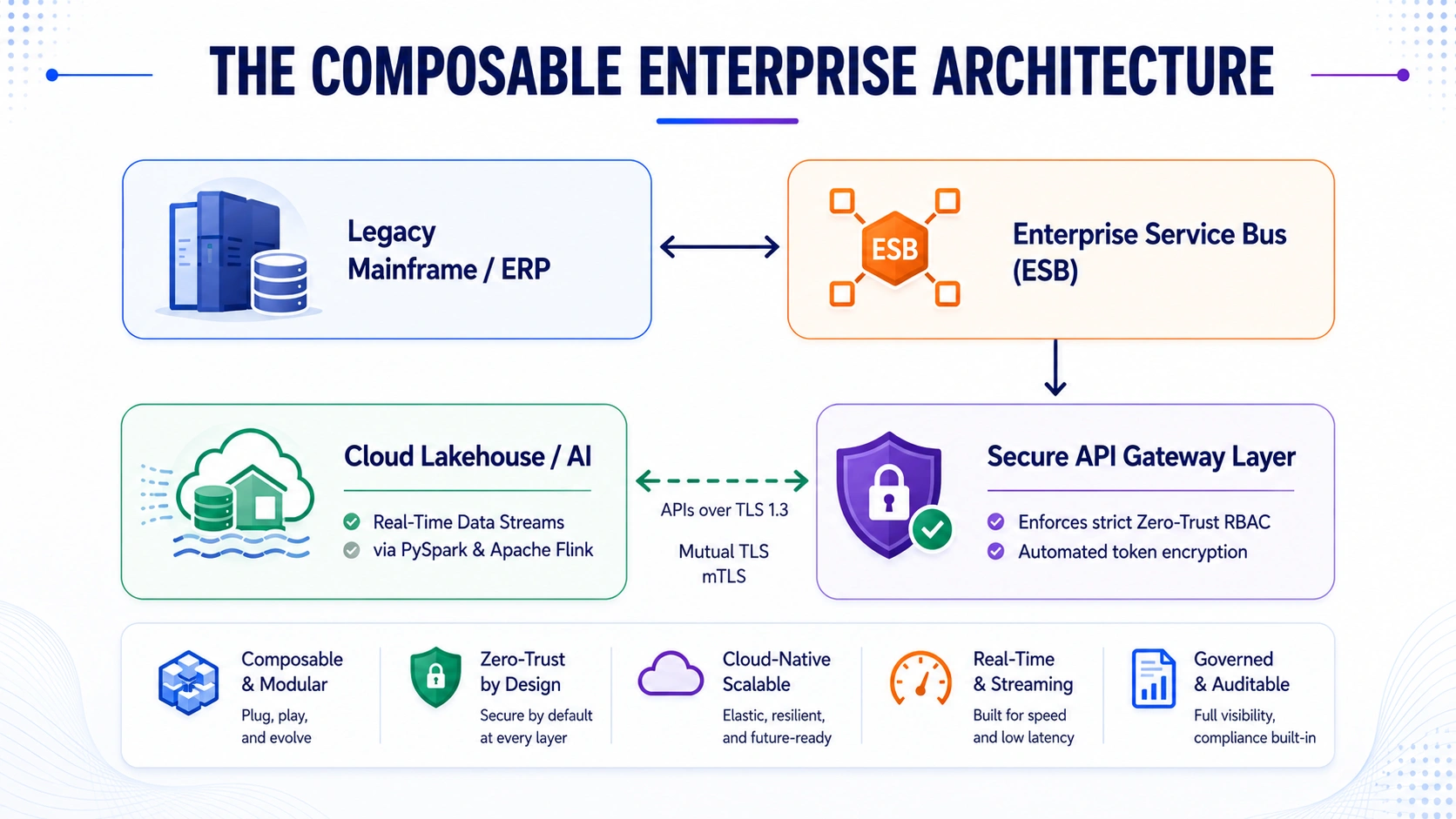
To scale large-scale projects successfully, engineering squads must master three critical technical domains:
- Legacy Systems & ERP Interoperability: Production-scale experience with legacy systems, including mainframes, custom SAP modules, and Oracle databases. Ability to translate data into modern data platforms without disrupting active transaction logs or compromising transaction integrity.
- Real-Time Data Streaming: Hands-on expertise building and optimizing high-throughput distributed streaming architectures using Apache Spark, PySpark, Apache Flink, and Kafka for real-time processing and multi-system synchronization.
- Enterprise Security & Governance: Proven implementation of RBAC, column-level data masking, and automated data lineage logging within integration pipelines. Experience supporting compliance with GDPR, HIPAA, and SOC 2 Type II requirements.
Where Do System Integrators Hire Enterprise Developers?
SIs are under pressure to modernize legacy systems and deliver multi-cloud architectures with the global system integration market surpassing $49.41 billion. As software and digital integration drive 40.83% of market revenue, finding engineers with expertise in both legacy platforms and cloud technologies remains a major challenge.
To fulfill these complex, high-stakes client contracts, SIs balance a mix of traditional and agile sourcing channels, navigating significant trade-offs in speed, risk, and specialized expertise.
The Enterprise Developer Hiring Ecosystem
As enterprise transformation initiatives become increasingly complex, organizations must carefully evaluate how they source technical talent. Different hiring models offer varying levels of flexibility, expertise, scalability, and operational efficiency, making the choice of staffing strategy a critical factor in project success.
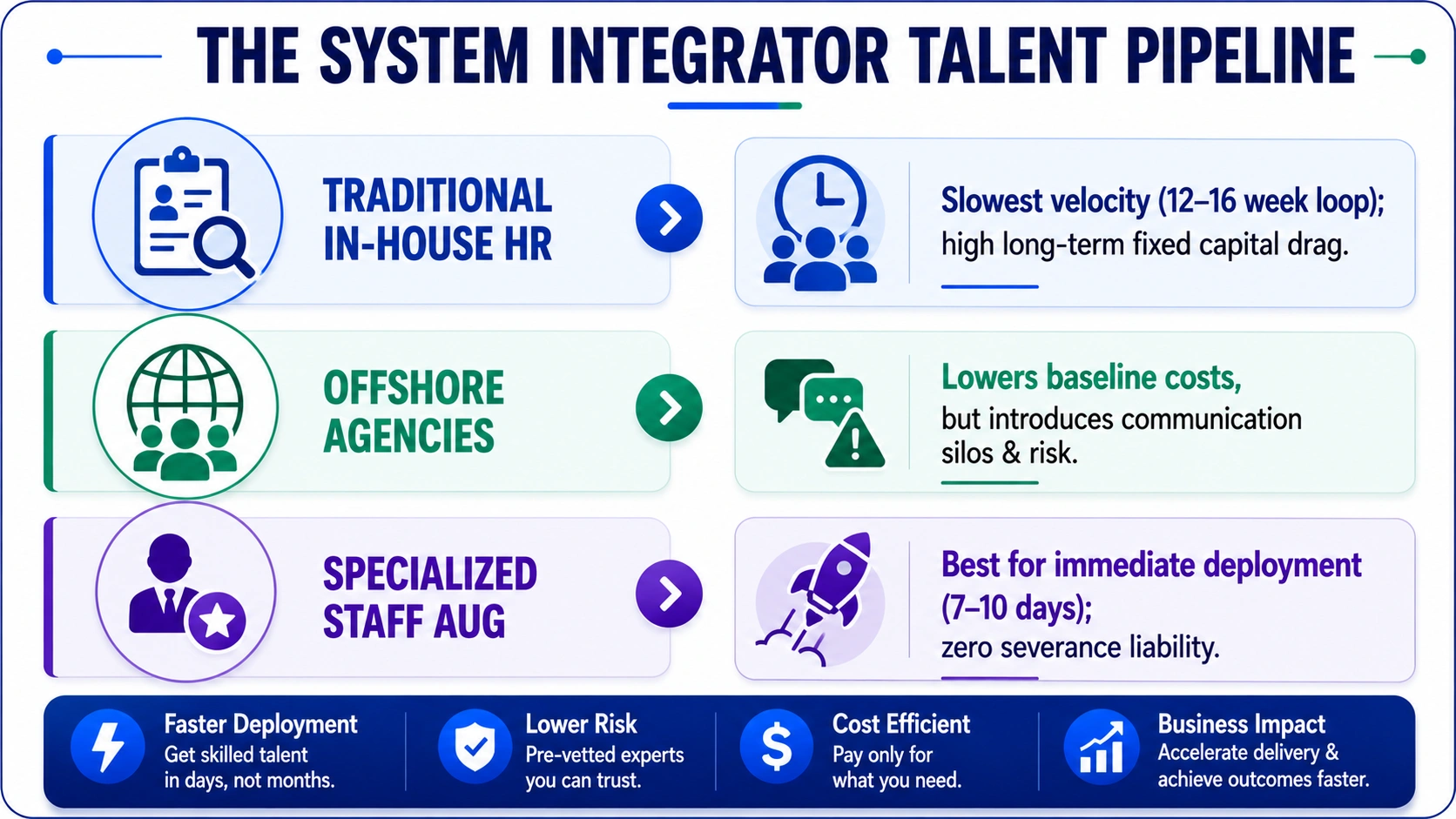
The table below compares the most common enterprise developer hiring approaches used for project devs staffing, highlighting how each model performs across speed to market, scalability, cost efficiency, and enterprise readiness.
| Hiring Model | Speed to Market | Scalability Agility | Cost Efficiency | Enterprise Expertise Adherence |
| Traditional Recruitment | Low (Requires 12–16 weeks to source) | Low (High severance liability) | Low (Massive fixed overhead) | High (Dedicated internal alignment) |
| Freelance & Contracting | Medium (Quick ad-hoc matching) | Medium (Highly fluid availability) | High (Low base overhead costs) | Low (Lacks robust compliance training) |
| Offshore Development | Medium (Requires agency setup loops) | High (Rapid cohort onboarding) | High (40%–60% regional savings) | Medium (Varies heavily by provider) |
| Staff Augmentation | High (Project-ready in 7–10 days) | High (0% severance friction) | High (Variable OpEx model) | High (Pre-vetted platform masters) |
While all four sourcing channels can support enterprise delivery, their effectiveness varies depending on project complexity, compliance requirements, budget constraints, and delivery timelines. Understanding these trade-offs helps system integrators choose the right hiring strategy for each engagement.
1. Traditional In-House Recruitment
The process of utilizing internal corporate human resource teams to post open requisitions, vet candidate profiles, and hire full-time employees (FTEs).
- Long-Term Strategy Alignment: This channel is ideal for securing foundational technical directors and architects who will retain structural system knowledge over multiple years.
- Severe Talent Acquisition Friction: Because elite integration developers are in high demand, internal HR teams suffer from massive acquisition inertia, taking an average of 12 to 16 weeks to successfully clear and onboard a single senior engineer.
- The Vacancy Drag Penalty: In high-volume environments, an empty engineering seat during a four-month recruitment process translates to roughly 8 consecutive missed development sprints, stalling roadmaps and triggering strict SLA financial penalties.
2. Independent Contractors and Freelance Registries
Engaging individual software generalists on an ad-hoc, hourly, or per-project basis via public developer networks and marketplace channels.
- Fluid Workforce Flexibility: SIs leverage freelancers to quickly handle sudden localized workload spikes, minor script requirements, or temporary frontend layout updates.
- Fragmented Bandwidth Realities: Because independent contractors frequently juggle multiple concurrent client contracts, their immediate day-to-day availability remains highly unpredictable.
- Governance & Compliance Drag: Freelancers generally lack rigorous enterprise security and data privacy training, introducing compliance liabilities when forced into zero-trust corporate environments governed by GDPR, HIPAA, or SOC2 Type II frameworks.
3. Offshore Software Agencies
Outsourcing defined development packages or scaling up secondary engineering pods in lower-cost geographic technical hubs.
- Significant Budget Optimization: Partnering with offshore networks allows SIs to optimize development budgets, driving direct 40% to 60% baseline savings on standard software tasks.
- Operational Execution Risk: This channel introduces structural friction, including communication silos across distant time zones, cultural workflow differences, and a total lack of direct day-to-day oversight over coding methodologies.
- The Complexity Barrier: While highly effective for generic standalone applications, offshore outsourcing carries substantial risks for intricate corporate transformations that require direct, safe manipulation of live legacy transaction systems.
4. Specialized Staff Augmentation Partners
Rather than taking on permanent payroll risks or navigating sluggish hiring loops, SIs increasingly rely on dedicated tech talent partners to inject elite expertise.
- Rapid Mobilization: This framework bypasses standard top-of-funnel recruitment pipelines completely, providing a project-ready deployment window of just 7 to 10 days.
- Direct Native Integration: Augmented developers integrate seamlessly into your internal git-branched code governance, report directly to your in-house tech leads, and write code natively within your secure tenant.
- Targeted Skill Injection: SIs leverage this model to instantly source niche infrastructure specialists such as PySpark data engineers, Apache Flink streaming specialists, and MLOps automation experts to clear severe backlog bottlenecks.
Why Staff Augmentation Is Becoming the Preferred Choice
Building enterprise-grade technical architectures requires specialized enterprise developer hiring that traditional recruitment often cannot deliver fast enough. Sourcing, validating, and onboarding infrastructure engineers has become a critical bottleneck for technology leaders.
Research from SHRM, Gartner, and Deloitte indicates that a vacant senior engineering role can cost organizations an average of $500 per day in lost productivity and project delays. Over a typical multi-month hiring cycle, vacancy costs can exceed $22,000 before recruiting and onboarding expenses are included.
To reduce hiring delays and maintain delivery velocity, systems integrators and enterprise technology leaders are increasingly adopting Enterprise Staff Augmentation instead of expanding permanent headcount.
A. The Capital & Velocity Allocation Matrix
Enterprise developer hiring is no longer measured solely by recruitment success. Deployment speed, hiring overhead, and resource efficiency directly impact project economics. The table below compares both approaches.
| Workforce Metric | Traditional In-House Sourcing | Enterprise Staff Augmentation |
| Median Time-to-Fill (Tech Roles) | 52 to 76 Days (Up to 6 months for senior architects) | 7 to 10 Days (Project-ready deployment) |
| Internal Team Resource Strain | 23.3 to 24.9 Hours of technical interview time per hire | Zero Drag (Pre-vetted by talent partner) |
| Upfront Recruitment Overhead | $6,200 to $8,000 in vetting, sourcing, and placement fees | $0 (Absorbed entirely by partner OpEx) |
| Fully Loaded Cost Multiplier | 1.4x Base Salary (Benefits, payroll taxes, tooling) | Flat Monthly Rate (Predictable, fluid project cost) |
B. Faster Access to Specialized Talent
The technology sector faces a significant talent shortage, with 87% of technology leaders struggling to find skilled developers. Demand for specialized infrastructure architects is projected to exceed 1.2 million unfilled roles.
As a result, top-tier developers remain available for a median of only 10 days, while traditional hiring processes often struggle to move quickly enough. Staff augmentation removes much of this sourcing friction, enabling faster access to qualified talent.
Specialized talent partners maintain pools of pre-vetted engineers with expertise in areas such as PySpark, Apache Flink, and MLOps. This enables organizations to place project-ready talent into active sprints within 7–10 days, significantly reducing sourcing delays.
C. Reduced Hiring and Onboarding Costs
The true cost of internal headcount expansion extends far past baseline payroll expectations. Landmark corporate benchmarking reports show that the raw sourcing overhead for a single technical professional ranges between $6,200 and $8,000.
Once an offer is accepted, the fully loaded cost multiplier scales rapidly to 1.4x base salary due to long-term financial liabilities, including:
- Recruitment & Vetting Fees: Sourcing channels and screening applications.
- Mandatory Benefits Packages: Health, retirement, and insurance coverages.
- Regional Payroll Taxes: Localized corporate tax compliance obligations.
- Specialized Tooling Allowances: High-performance hardware and enterprise software licenses.
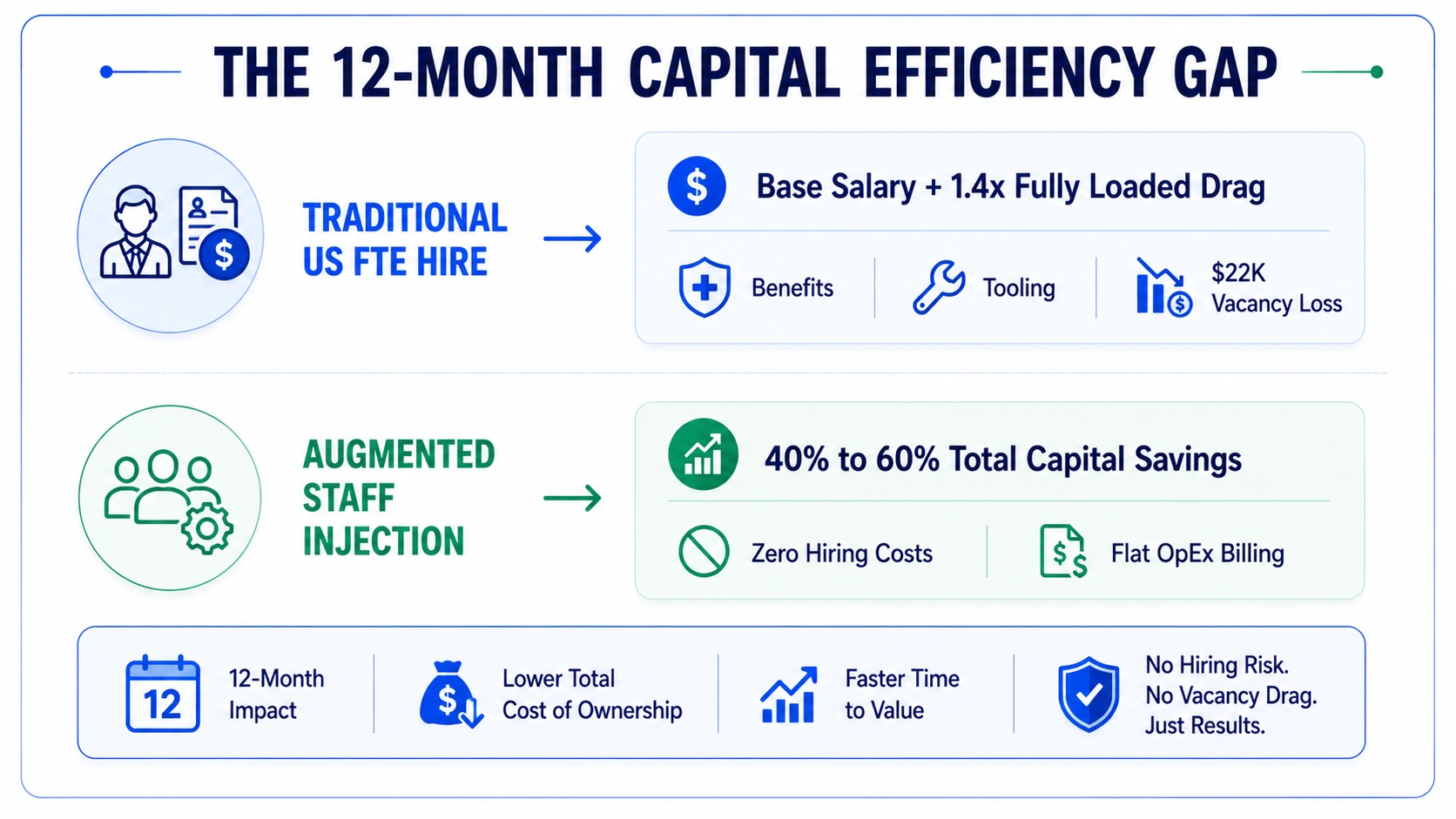
Staff augmentation transforms these rigid, permanent capital liabilities into fluid, predictable operational expenditures (OpEx), driving a documented 40% to 60% reduction in total long-term project costs.
D. Flexible Team Scaling for Project Demands
Enterprise modernization initiatives rarely follow a linear path. Large-scale migrations and integration projects often require rapid increases in engineering capacity during implementation, followed by significantly lower staffing needs once systems are deployed and stabilized.
- Scale Resources to Project Phases: Support high-demand implementation stages such as data migration, API gateway development, and schema modernization without long-term staffing commitments.
- Avoid Underutilized Headcount: Reduce the cost of maintaining a large permanent workforce after intensive deployment and integration phases are complete.
- Elastic Engineering Capacity: Quickly expand engineering teams to address backlog bottlenecks, accelerate delivery, and meet project milestones.
- Seamless Post-Launch Downsizing: Scale resources down after production rollout without severance costs, organizational disruption, or workforce restructuring.
- Align Costs with Demand: Match engineering capacity to actual project requirements, improving resource utilization and operational efficiency.
E. Lower Delivery Risks for Enterprise Programs
The administrative burden of technical vetting represents a massive drain on core internal teams. According to latest 2026 talent tracking data from Ashby, a single technical hire requires an average of 17.6 interview events, consuming up to 24.9 hours of internal engineering time to evaluate specialized data and product management capabilities.
Forcing your senior in-house architects to spend dozens of hours reviewing code tests and screening candidates pulls them away from high-leverage data strategy, actively introducing project delays.
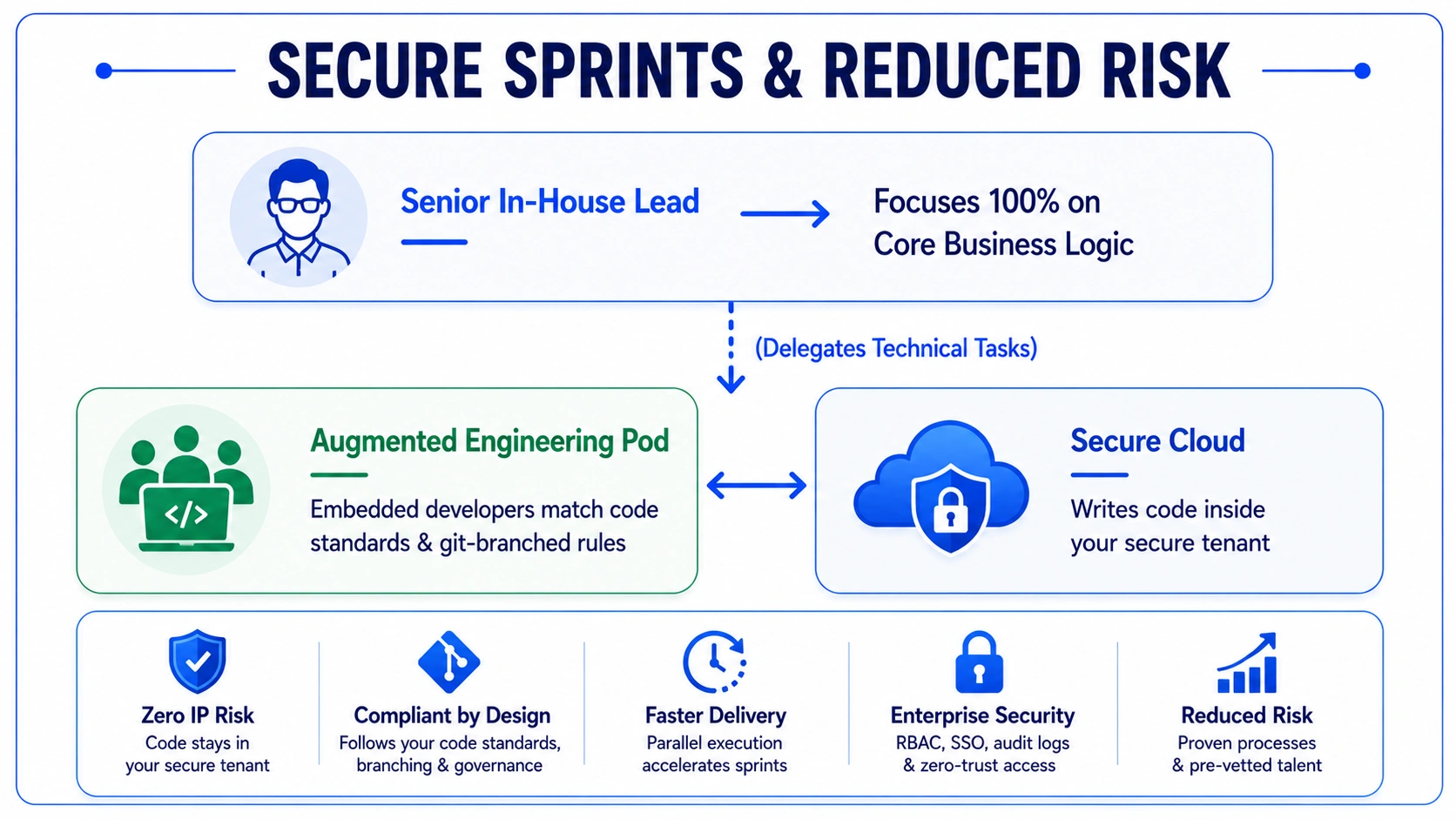
Partnering with an established talent firm shifts this evaluation risk entirely to the provider. Because augmented developers are pre-screened for technical capability and security compliance, they embed natively into your internal git-branched workflows, report directly to your leads, and deliver high-yield code immediately, ensuring your high-stakes enterprise transformations launch safely, securely, and on schedule.
What Enterprise Developers Bring to Complex Projects
Enterprise digital transformations demand specialized expertise beyond traditional software development. Integrating modern cloud platforms with legacy systems requires engineers who can manage complex architectures, data flows, and operational dependencies.
Research from Bain shows that 70%–88% of digital transformation initiatives fail to achieve their original objectives. In many cases, the challenge is not application development itself, but the lack of specialists capable of securing, optimizing, and scaling enterprise-grade systems.
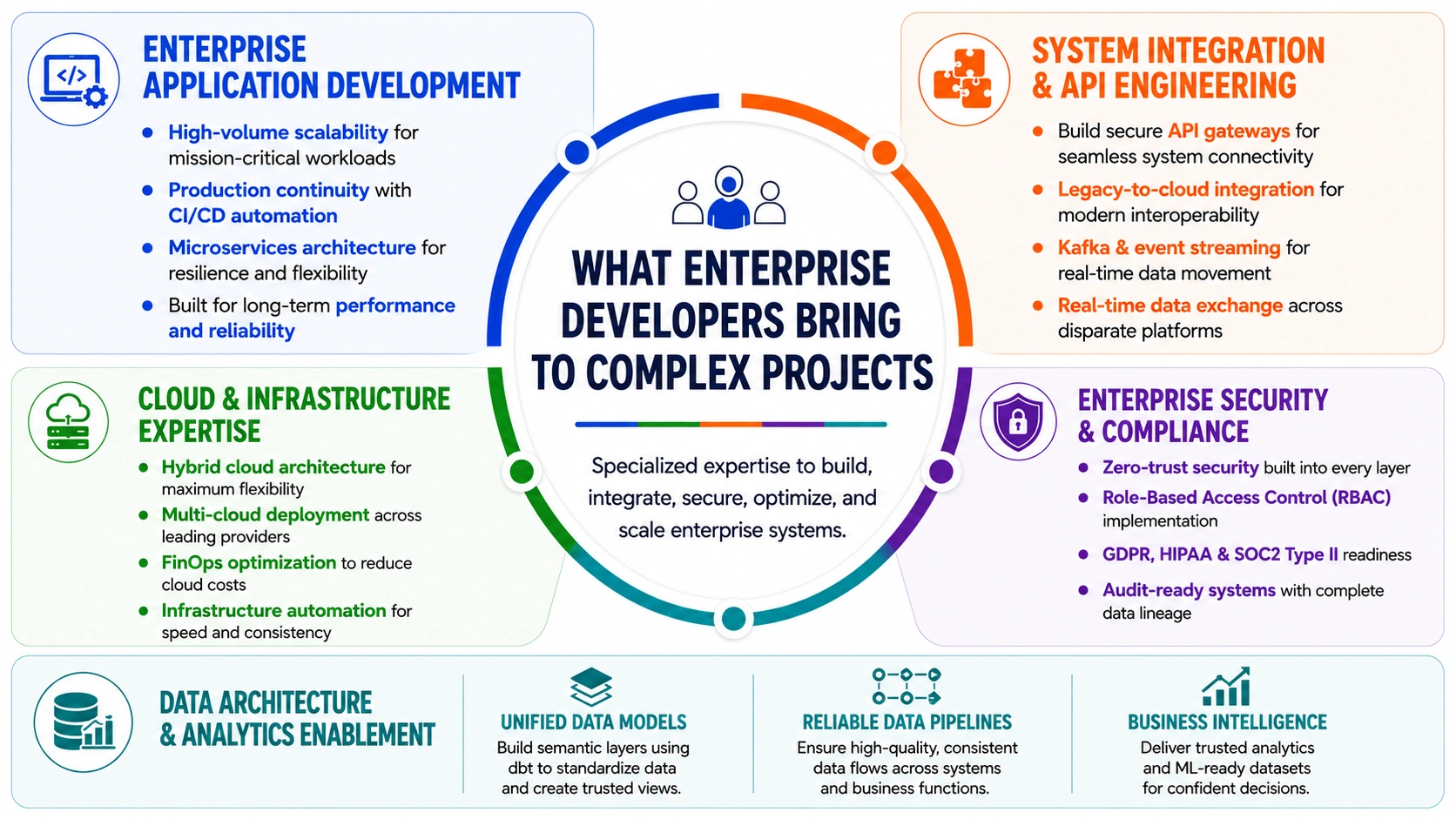
Enterprise Value Delivery Framework
Enterprise developers deliver strategic value beyond coding by shaping architecture, optimizing infrastructure, ensuring security, and enabling scalable systems that drive reliable, efficient, and successful digital transformation outcomes.
The table below contrasts the architectural output of standard software developers against the enterprise developer hiring by dedicated enterprise infrastructure specialists.
| Technical Domain | Software Generalist Approach | Dedicated Enterprise Developer Output |
| Application Scope | Greenfield builds, basic CRUD features, isolated single-tenant logic. | High-availability microservices handling massive concurrent transaction volumes. |
| Integration & API | Tightly coupled webhooks; standard point-to-point data transfers. | Decoupled API gateways, asynchronous event-streaming architectures. |
| Cloud Infrastructure | Simple cloud provisioning; high dependency on manual server setups. | Multi-region orchestration, infrastructure-as-code, FinOps cost tuning. |
| Security & Compliance | Basic encryption protocols; reactive software patch management. | Zero-trust RBAC governance, column-level data masking, immutable auditing. |
A. Enterprise Application Development
Enterprise developers build for long-term survival, engineering software designed from day one to withstand brutal production workloads.
- High-Volume Scalability: They replace fragile monolithic scripts with modular, thread-safe microservices that process tens of thousands of simultaneous requests without memory leaks or compute drops.
- Production Continuity: By utilizing advanced continuous integration (CI/CD) pipelines and git-branched code governance, they ensure that system enhancements are pushed live without causing corporate application downtime.
B. System Integration and API Engineering
Modern corporate logic relies entirely on the fluid movement of data across multiple fragmented software platforms.
- Asynchronous Event Streaming: Developers deploy robust distributed message buses using Kafka, Apache Spark, and RabbitMQ to enable real-time data streaming across disparate global ecosystems.
- Legacy-to-Cloud Interoperability: They specialize in building highly secure, bi-directional API gateways that bridge old mainframes and custom SAP modules with modern web applications smoothly, completely eliminating data sync errors.
C. Cloud and Infrastructure Expertise
As computing environments scale, managing data portability across distinct clouds requires highly specialized orchestration.
- Hybrid & Multi-Cloud Architecture: With market research revealing that 73% of large enterprises now operate hybrid estates, engineers design applications that run identically across on-premise private hardware and public hyperscalers.
- FinOps Compute Optimization: Enterprise developers actively tune underlying runtime configurations, adjust database caching layers, and automate system container sizes to drastically lower monthly cloud infrastructure expenditures.
D. Enterprise Security and Compliance Management
Because integration networks are prime targets for cyber threats, enterprise developers embed compliance directly into the software source code.
- Zero-Trust Security Injection: Engineers construct strict cryptographic authentication blocks, implement granular Role-Based Access Controls (RBAC), and deploy robust prompt-injection filters across every API endpoint.
- Regulatory Alignment Audit Readiness: They build automated metadata tracking networks that record absolute data lineage, guaranteeing total system audit readiness for strict regulatory compliance, including GDPR, HIPAA, and SOC2 Type II.
E. Data Architecture and Enterprise Analytics Enablement
Data is only valuable if it can be reliably accessed by downstream business intelligence layers and executive decision-makers.
- Universal Semantic Layering: Developers utilize dbt Core/Enterprise to transform raw, highly fragmented database rows into clean, heavily documented, and unified data views.
- Eliminating Operational Silos: By defining strict schema standardizations across separate company divisions, they eliminate duplicate tables, clear pipeline backlogs, and ensure machine learning models draw from verified corporate datasets.
Enterprise Projects That Require Dedicated Developers
Enterprise software operates in high-risk environments where systems manage large transaction volumes, sensitive customer data, and mission-critical business processes. In these environments, software development and modernization require specialized expertise rather than ad hoc execution.
According to Gartner, global enterprise software spending has surpassed $6.15 trillion, while 95% of billion-dollar organizations rely on complex, highly integrated system architectures. As these environments grow in scale and complexity, organizations increasingly depend on dedicated specialists to maintain performance, security, and system reliability.
Enterprise Deployment Friction & Architecture Mapping
Successful enterprise developer hiring requires aligning talent with highly specialized project environments. The matrix below outlines the technical domains where dedicated engineering pods deliver the greatest operational value.
| Complex Project Domain | Defining Industry Metric | Primary Technical Bottleneck | Mission-Critical Deliverable |
| AI & Machine Learning | 80.8% YoY growth in generative AI platform spending | Model hallucinations, inefficient token utilization, limited context retrieval | High-performance RAG architectures and secure multi-agent AI pipelines |
| High-Scale SaaS | Global SaaS market exceeds $465 billion | Multi-tenant latency, database bottlenecks, memory leaks | Distributed, auto-scaling microservices with 99.99% uptime |
| ERP & CRM Integration | Global ERP market valued at $83.2 billion | Custom-code mismatches and integration complexity; 55% of implementations exceed budget | Secure bi-directional API gateways and low-latency data replication |
| Advanced Data Platforms | 85% of enterprise analytics projects face delays due to fragmented data architectures | Data silos, unindexed datasets, missing semantic layers | Centralized dbt Core frameworks and high-throughput Apache Flink pipelines |
| Cloud Migrations | Cloud IaaS spending growing at 40% YoY | Legacy dependencies, fragmented architectures, cloud cost inefficiencies | Automated Infrastructure as Code (IaC) and resilient multi-region deployments |
Enterprise software differs from standard applications through greater architectural complexity and operational risk. High-volume, sensitive, mission-critical systems require dedicated specialists to ensure performance, security, and reliability.
A. Enterprise AI & Machine Learning Platforms
Deploying AI in production requires far more than model development. Organizations need dedicated AI engineers to implement parameter-efficient fine-tuning (PEFT), secure RAG architectures, and build scalable vector databases that improve accuracy and minimize hallucinations in business-critical applications.
Example: Predictive Healthcare Logistics SaaS
Scenario: A healthcare software provider wants to add an AI module that predicts patient admission surges and forecasts medical supply shortages weeks in advance.
Why Dedicated Developers Matter: The project requires specialized ML Engineers, Data Scientists, and Compliance Specialists to develop predictive models, protect sensitive patient data, and meet healthcare regulatory requirements.
B. Large-Scale SaaS Product Development
Enterprise SaaS platforms must support massive transaction volumes, global user bases, and strict availability requirements. Dedicated backend engineers optimize data partitioning, multi-tenant isolation, and containerized infrastructure to maintain performance at scale.
Example: Multi-Tenant FinTech Core Banking Platform
Scenario: A financial institution is building a cloud-native banking platform capable of processing more than 50,000 transactional ledger writes per second.
Why Dedicated Developers Matter: The project demands dedicated Database Engineers and Performance Specialists to build highly available services, optimize throughput, and enforce strict tenant-level data isolation.
C. ERP & CRM Integrations
Integrating ERP and CRM platforms is one of the highest-risk modernization initiatives enterprises undertake. Dedicated integration specialists design API gateways, data mapping frameworks, and asynchronous integration layers that connect legacy and modern systems without disrupting business operations.
Example: Global Supply Chain ERP Modernization
Scenario: A manufacturer needs to integrate a legacy SAP ERP environment with a cloud-based CRM platform to synchronize inventory and order data in real time.
Why Dedicated Developers Matter: Dedicated Integration Architects are required to manage custom SAP schemas, legacy infrastructure dependencies, and high-volume transaction flows while preserving data accuracy.
D. Data Engineering & Analytics Platforms
Enterprise analytics depends on reliable, scalable data infrastructure. Dedicated data engineers build streaming pipelines, data governance frameworks, and centralized metadata layers that provide a consistent source of trusted information.
Example: Real-Time Telecommunications Churn Analytics Engine
Scenario: A telecom provider wants to combine billing, network, and support data into a real-time analytics platform capable of identifying customer churn risks instantly.
Why Dedicated Developers Matter: Dedicated Data Engineers leverage technologies such as PySpark and Apache Flink to process large-scale streaming data and deliver accurate, real-time insights.
E. Cloud Migration & Modernization Initiatives
Cloud modernization requires more than moving workloads from one environment to another. Dedicated cloud engineers design migration strategies, implement Infrastructure as Code (IaC), and optimize cloud architecture for reliability, security, and cost efficiency.
Example: Legacy Retail Monolith to Cloud Microservices Migration
Scenario: A retail enterprise plans to migrate its on-premises POS and inventory platform to a cloud-native microservices architecture.
Why Dedicated Developers Matter: Dedicated Cloud Engineers and DevOps Specialists identify application dependencies, automate infrastructure deployment, and execute phased migrations that minimize operational disruption.
Enterprise Roles System Integrators Can Access Through Idea Usher
Finding enterprise developers is rarely the challenge for system integrators. The real difficulty lies in identifying professionals with the right expertise, experience, and ability to integrate seamlessly into existing delivery teams.
Idea Usher helps system integrators scale delivery by providing an elastic engineering team of pre-vetted enterprise professionals who join quickly and contribute from day one, offering flexible staff augmentation to meet evolving project requirements.
Enterprise Talent Available for Every Project Stage
Idea Usher has more than 250 experienced enterprise software developers for different types of enterprise solutions, outlining responsibilities and ideal use cases to help system integrators quickly identify the right talent for projects.
| Role | Key Responsibilities | Best Suited For |
| Enterprise Software Developers | Design and develop scalable business applications, backend systems, and enterprise platforms | SaaS products, ERP systems, CRM platforms, workflow automation solutions |
| Solution Architects | Define technical architecture, integration strategies, and technology roadmaps | Digital transformation initiatives, enterprise modernization projects |
| Cloud and DevOps Engineers | Build cloud infrastructure, automate deployments, and optimize system performance | Cloud migration, multi-cloud environments, infrastructure modernization |
| AI and Data Engineers | Develop data pipelines, analytics platforms, machine learning solutions, and AI integrations | Enterprise AI projects, business intelligence systems, predictive analytics |
| QA Automation Specialists | Implement testing frameworks, automated quality assurance, and performance testing | Large-scale software deployments and mission-critical applications |
| Project Managers and Technical Leads | Coordinate teams, manage delivery timelines, and ensure project alignment | Multi-team enterprise programs and complex integration initiatives |
These roles form the foundation of enterprise delivery. The following sections explain how Idea Usher enables efficient deployment, flexible scaling, long-term continuity, and seamless collaboration across complex system integration projects.
1. Rapid Team Deployment and Onboarding
Enterprise projects often run on tight timelines where hiring delays can disrupt delivery and client commitments. Idea Usher provides quick access to experienced developers, architects, and engineers, enabling system integrators to fill skill gaps efficiently and accelerate project execution without compromising quality.
2. Flexible Staff Augmentation Models
Every enterprise engagement demands a tailored staffing approach. Some projects need a few specialized developers to support existing teams, while others require a dedicated engineering unit. Idea Usher provides flexible models, enabling system integrators to scale resources based on project scope, timelines, and budgets.
3. Dedicated Developers for Long-Term Engagements
For multi-phase enterprise programs, consistency and domain expertise are essential. Idea Usher provides dedicated developers aligned with project goals, technical standards, and business needs, ensuring continuity, reducing onboarding time, and improving overall delivery efficiency.
4. Seamless Integration With Existing Teams
Successful staff augmentation requires more than talent. Developers must integrate seamlessly into existing workflows, tools, and governance structures. Idea Usher’s professionals collaborate effectively with internal teams and stakeholders, ensuring smooth integration, consistent productivity, and accountability from the very beginning.
How Idea Usher Handles the Entire Solution Delivery Lifecycle
As enterprise projects grow in complexity, managing delivery often becomes a bigger challenge than writing code. Idea Usher provides a fully integrated engineering team that takes ownership of architecture, execution, and compliance, enabling your leadership to focus on business growth and strategic priorities.
The framework below outlines the continuous, end-to-end operational layers managed by Idea Usher to transition complex enterprise requirements into high-performance production assets.
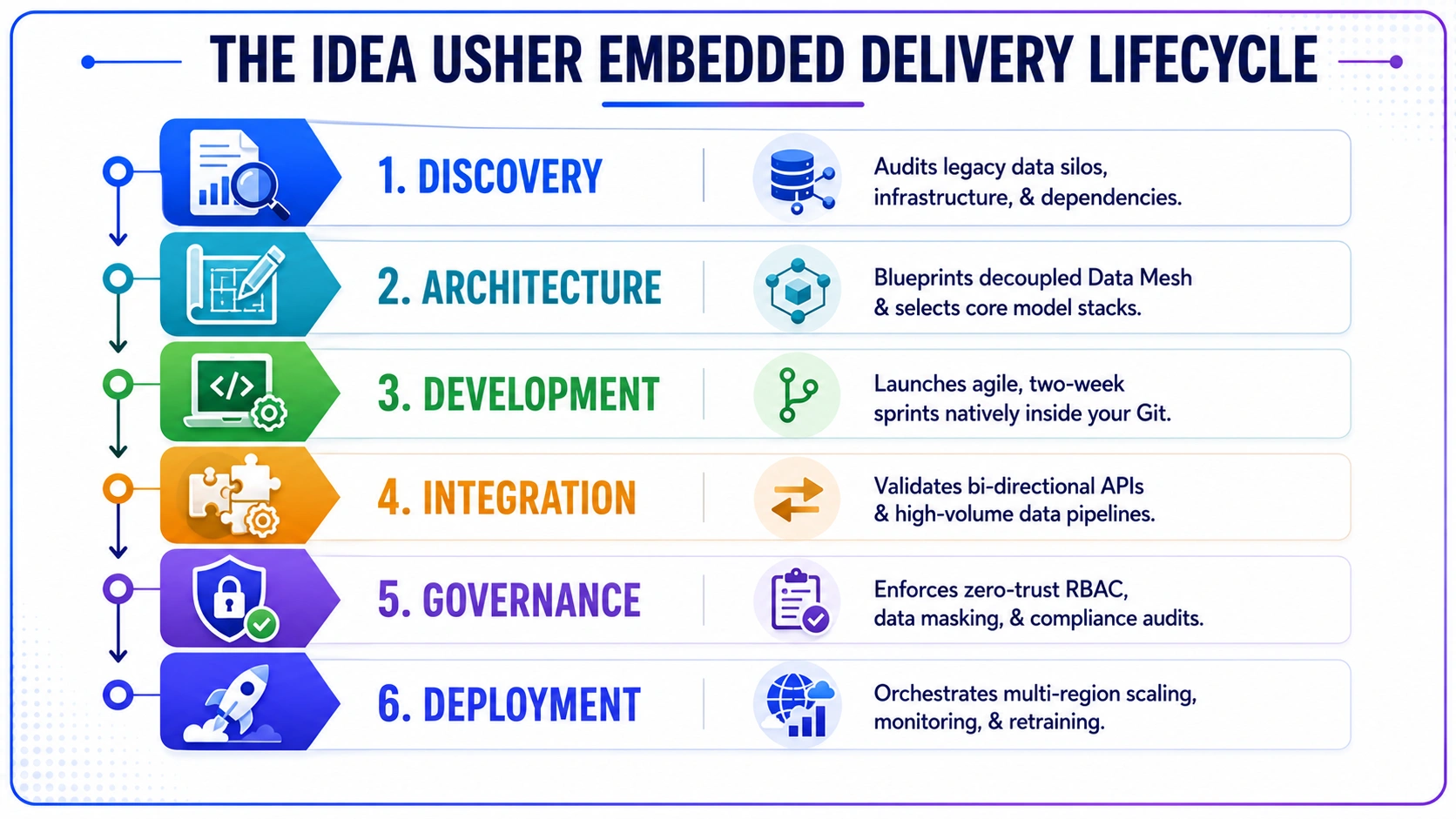
1. Discovery and Technical Requirement Analysis
We begin by eliminating the risk of building on a fractured foundation. Our dedicated technical analysts and architects execute top-down discovery workshops to map out your technical ecosystem before any code is authored.
- Legacy Auditing: We dissect your current legacy infrastructure and database schemas to uncover hidden processing bottlenecks.
- Data Readiness Matrix: We analyze data formats, cleanliness, and velocity across departments to ensure compatibility with modern analytical or AI frameworks.
- Dependency Mapping: We isolate and document all critical upstream and downstream software dependencies to guarantee zero downstream disruptions.
2. Architecture Design and Technology Selection
Enterprise software must be engineered to survive massive concurrent workloads while avoiding expensive vendor lock-in.
- Decoupled Architecture: We blueprint modern, modular Data Fabric or Data Mesh topographies that connect separate systems smoothly without forcing expensive data duplication.
- Platform Selection: We evaluate open-weight versus closed commercial platforms, balancing API token latency, computing overhead, and long-term licensing costs.
- Future-Proof Planning: Every technical blueprint is designed to scale horizontally across multi-cloud environments, ensuring the infrastructure grows alongside your enterprise.
3. Development and Sprint Execution
Our delivery pods embed directly within your organization, operating as a natural, highly communicative extension of your engineering department.
- Native Integration: Augmented developers write code directly within your secure cloud tenant and adapt completely to your native GitLab, GitHub, or Jira workflows.
- Sprint-Based Delivery: We break down complex technical backlogs into transparent, two-week sprint cycles focused on delivering functional, production-ready software components.
- Dedicated Product Management: Every pod includes an active Product Manager who optimizes development priorities, tracks milestones, and provides continuous, transparent executive reporting.
4. Integration and Quality Assurance
Connecting modern cloud applications with legacy enterprise software requires meticulous data harmonization and stress testing.
- Bi-Directional API Engineering: We construct highly secure, asynchronous API gateways that allow data to flow instantly between systems without breaking core databases.
- Automated Schema Validation: We deploy strict validation logic directly into the ingestion lines, cutting off corrupted or mismatched inputs before they reach live environments.
- Stress & Regression Testing: Our QA specialists simulate real-world traffic spikes and high transaction volumes to guarantee your platform satisfies stringent SLAs.
5. Security, Compliance, and Governance
Operating in highly regulated industries demands that data security be woven directly into the application’s source code.
- Zero-Trust Identity Access: We implement strict cryptographic authentication blocks and granular Role-Based Access Controls (RBAC) across all data nodes.
- Data Masking & Privacy: We build dynamic, column-level data masking and prompt-injection filters to safely isolate proprietary corporate data and protected information.
- Immutable Auditing: Our developers establish automated metadata tracking networks that generate comprehensive data lineage logs, ensuring absolute compliance readiness for strict GDPR, HIPAA, and SOC2 Type II reviews.
6. Deployment, Monitoring and Support
The delivery lifecycle does not end at product launch. We provide continuous operational infrastructure to ensure long-term stability and optimization.
- CI/CD Pipeline Automation: We manage automated continuous integration and continuous deployment registries, pushing seamless updates without causing corporate system downtime.
- Real-Time Drift Monitoring: Our MLOps and DevOps engineers monitor live production systems 24/7, tracking performance metrics, data drift, and compute footprints.
- Automated Fallbacks & Retraining: If system accuracy or performance drops below designated thresholds, our automated pipelines instantly alert technicians, trigger retraining sequences, or route traffic to validated fallbacks to keep your business running smoothly.
Conclusion
The success of modern system integration projects increasingly depends on access to specialized technical talent at the right time. A strategic approach to enterprise developer hiring enables organizations to quickly fill skill gaps, scale teams on demand, and maintain project momentum. With pre-vetted engineers, flexible staff augmentation models, and end-to-end delivery support, Idea Usher helps system integrators build high-performing teams capable of executing complex enterprise initiatives while ensuring quality, scalability, and long-term business success.
FAQs
A.1. System integrators commonly hire enterprise developers through staff augmentation partners, specialized technology consulting firms, and dedicated development providers. These channels offer faster access to experienced professionals with enterprise-scale project expertise.
A.2. Staff augmentation allows system integrators to quickly fill technical skill gaps without lengthy recruitment cycles. It provides flexibility to scale teams based on project requirements while maintaining control over delivery processes.
A.3. Enterprise developers should possess expertise in application development, system integration, cloud infrastructure, security, and data engineering. Strong collaboration skills and experience with large-scale business systems are equally important.
A.4. System integrators can scale teams faster by partnering with providers that maintain pre-vetted talent pools. This approach reduces hiring delays and enables rapid deployment of developers, architects, and specialized engineers.