


Key Takeaways
- Businesses are embedding AI loan origination platforms to offer seamless financing directly within their apps, marketplaces, and digital products.
- Modern platforms combine AI underwriting, automated document processing, Open Banking, identity verification, and real-time risk assessment.
- Building a successful solution requires modular APIs, secure infrastructure, regulatory compliance, AI models, and scalable cloud architecture.
- These platforms improve loan approvals, customer experience, operational efficiency, and conversion rates, creating strong opportunities in embedded finance.
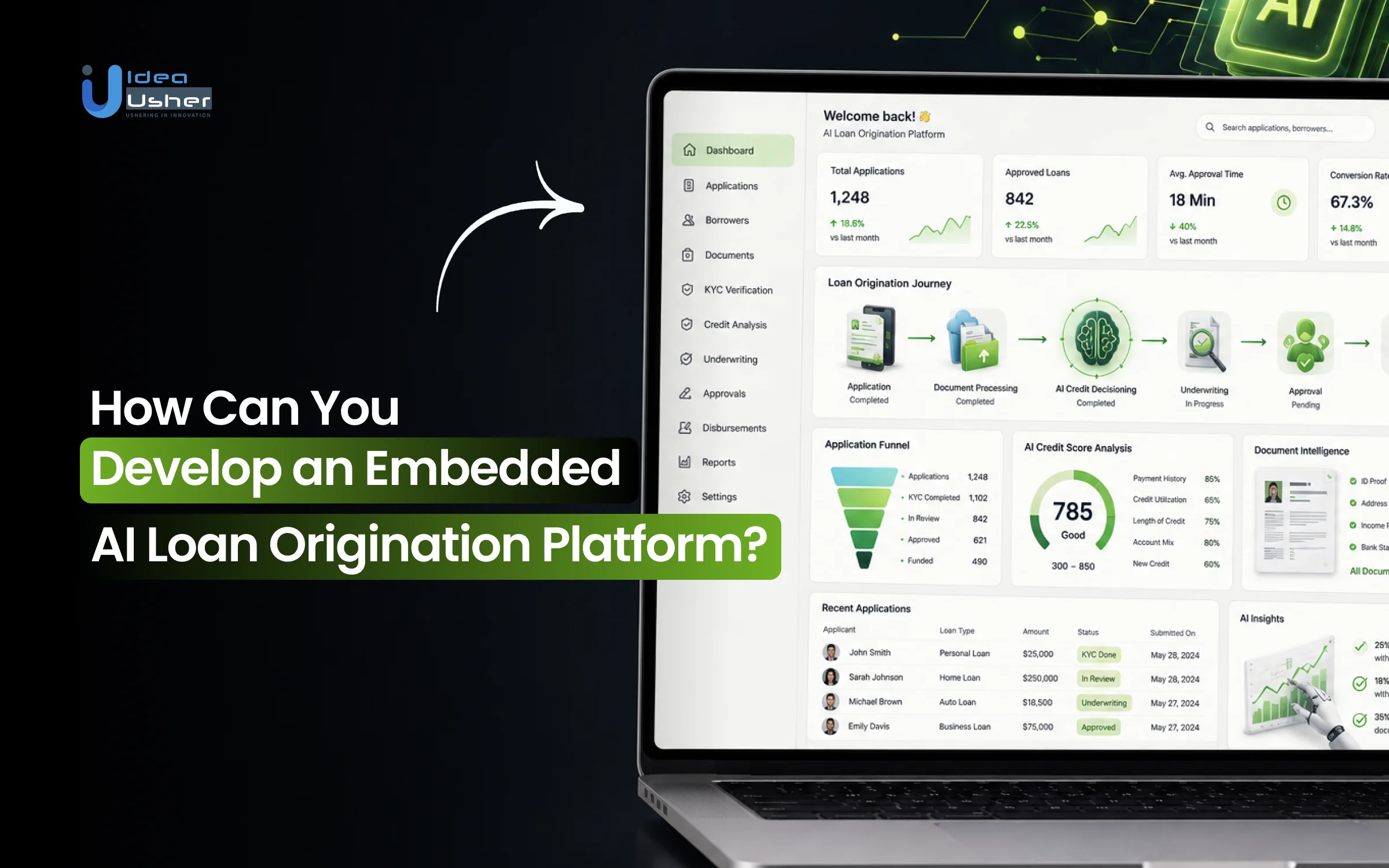
For decades, getting a loan meant visiting a bank or being redirected to a lender’s website before the application process could even begin. That approach is quickly changing as businesses look for ways to offer financing without interrupting the customer journey. Embedded AI loan origination platforms are becoming more common because they allow users to apply for and receive loan decisions without leaving the app or platform they’re already using. Whether someone is shopping online, paying for healthcare, or using a B2B service, financing becomes part of the experience instead of a separate process. Behind the scenes, AI verifies applicants, reviews documents, assesses risk, and helps lenders make faster decisions.
Embedded AI is transforming loan origination by making lending faster, more accurate, and far less dependent on manual processes. Having worked on AI-powered lending platforms, we’ve seen how the right technology can simplify complex workflows and improve the overall lending experience. In this blog, we’ll explore how an embedded AI loan origination platform works, the essential features it needs, and what it takes to build one successfully.
Market Potential of Embedded AI Lending
According to Mordor Intelligence, the Embedded Lending Market is projected to grow from USD 467.34 billion in 2025 to USD 955.45 billion by 2031, at a CAGR of 12.57%. As more businesses bring financing into their own digital products, embedded lending is becoming a key growth opportunity. It allows companies to offer loans at the moment customers need them, creating a smoother experience while opening up new revenue streams without building a traditional lending business.

Source: Mordor Intelligence
Investors analyzing this sector look closely at structural performance indicators:
- Sustained compound annual growth rate: The market displays consistent double-digit expansion, frequently averaging around 14% to 16% globally.
- Shift toward software platforms: Embedded lending solutions account for over 50% of overall embedded finance transaction volume.
- Geographic acceleration: Adoption across Asia-Pacific and Latin America is compounding fast due to mobile-first commerce adoption.
Upstart showcases what AI-driven origination looks like at scale. Operating as an AI lending platform that partners with banks and credit unions, Upstart generates annual revenues exceeding $1.1 billion. Their core value proposition centers on utilizing alternative data points to approve borrowers who traditional FICO scores turn away, all while maintaining strict risk controls.
Business Adoption Drivers
Software companies and digital platforms embed credit engines because it transforms static software into a transactional ecosystem. Adding credit capabilities turns a basic SaaS subscription model into a revenue generator fueled by payment processing fees, origination fees, and interest-sharing agreements.
Core Value Drivers
- Conversion rates at checkout: Presenting customized credit offers at the exact moment of purchase removes buying friction and increases average order value.
- Data-driven risk assessment: AI models process real-time cash flow, seller ratings, inventory turnover, and platform activity to assess default risk dynamically.
- Automated origination pipelines: Modern AI engines ingest bank statements, parse tax documentation, verify identity, and calculate debt-to-income ratios in seconds. This slashes processing costs by over 60% compared to legacy manual workflows.
Blend demonstrates the financial impact of powering originations for major institutions. By providing white-label, cloud-based software that automates loan origination for mortgage and consumer credit, Blend generates over $150 million in annual revenue. Their system strips days out of the traditional processing cycle, showing how infrastructure providers build software margins off institutional lending flows.
High-Adoption Verticals
While consumer Buy-Now-Pay-Later products initially popularized point-of-sale financing, B2B sectors are where the most valuable opportunities exist today. Enterprise platforms handling high transaction volumes are primed for embedded credit integration.
| Industry Vertical | Primary Embedded Lending Use Case | Key Data Inputs for AI Underwriting |
| B2B E-Commerce & Marketplaces | Net-30 terms automation, merchant cash advances | Daily sales velocity, refund rates, customer reviews |
| SaaS & Enterprise Platforms | Recurring revenue financing, capital expense loans | Monthly Recurring Revenue (MRR), churn rates, CAC payback |
| Supply Chain & Logistics | Freight invoice factoring, inventory financing | Bill of lading history, carrier performance, route data |
| Gig Economy & Creator Platforms | Instant payout advances, micro-equipment loans | Platform earnings history, completion rates, rating scores |
B2B Marketplaces
Commercial buyers expect net-30 or net-60 payment terms. B2B platforms using AI lending give buyers flexible terms instantly while paying sellers immediately. The platform earns a spread on the financing, and the risk engine continually monitors merchant inventory and order history.
Vertical SaaS Solutions
Software designed for specific industries, such as construction management platforms, restaurant POS systems, or medical practice software, holds deep operational data. By layering an AI credit engine over this operational data, these platforms approve loans faster and with lower default rates than traditional retail banks.

How Does Embedded AI Loan Origination Work?
An embedded AI loan origination platform brings lending directly into the digital products people already use. Instead of asking customers to leave an app or visit a bank, it lets them apply for a loan and receive a decision within the same experience. AI works behind the scenes to collect information, evaluate eligibility, review documents, and support faster approvals. The result is a simpler borrowing process for customers and a more efficient lending workflow for businesses.

1. Data Collection & Application
The origination process starts at the moment of intent inside a software interface. Instead of asking applicants to fill out long forms, the AI engine pulls existing account history alongside external financial data. This reduces manual effort while giving lenders the information they need to evaluate applications more quickly.
Automated Ingestion Channels
- Open Banking APIs: Ingests bank statements and ledger transactions directly.
- Platform Metrics: Pulls store revenue, order volume, and customer retention metrics.
- Identity Verification: Cross-references government IDs using computer vision.
By aggregating these inputs instantly, the system eliminates traditional friction while building a comprehensive profile of the borrower.
2. Risk Assessment & Decisions
Once the data enters the system, machine learning models evaluate credit risk in real time. The AI compares real-time financial health against historical default patterns rather than relying strictly on outdated credit scores. The model assigns a dynamic risk score and calculates custom loan offers:
- Credit Limit Calculation: Determines maximum loan capacity based on verified income.
- Pricing Engine: Assigns interest rates calibrated to the specific risk tier.
- Automated Decisioning: Approves standard applications in seconds while routing edge cases for manual review.
3. Approval, Disbursement & Monitoring
After an applicant accepts the offer, the platform executes digital contracts and initiates funding immediately. Post-disbursement AI monitoring continuously tracks borrower financial health. If platform revenue drops, the system adjusts repayment terms to prevent defaults before they happen.
| Stage | Action Executed by AI Platform | Processing Time |
| Agreement | Generates digital signatures and loan documents | Instant |
| Disbursement | Triggers automated ACH transfers or direct payment routing | Under 60 seconds |
| Monitoring | Tracks platform revenue to adjust repayment schedules dynamically | Ongoing |
Key Features of an Embedded AI Loan Origination Platform
Modern embedded lending platforms are built with modular services that handle different parts of the loan origination process. Some manage applications, while others assess risk or connect with funding partners. Bringing these components together creates a seamless lending experience for users while giving businesses the flexibility to scale and improve the platform over time.

1. Dynamic Borrower Onboarding
Users initiate loan requests directly within their daily digital environment, such as a checkout screen or merchant portal. Dynamic forms auto-populate stored user profile details, while AI validates inputs in real time to prevent simple data entry errors. Contextual loan offers appear based on recent account activity, eliminating the need for standalone credit applications.
Blend simplifies onboarding by drawing data directly from linked accounts. This cuts manual input and drives completion rates significantly higher.
2. Automated Document Processing
Borrowers upload required documentation like tax forms or bank statements directly into the workflow. Computer vision and large language models scan files, parse text, and verify authenticity in seconds. The software automatically extracts income figures and flags tampered or incomplete documents without human input.
- How users interact with it: Applicants upload PDFs or snapshot images directly from their phones.
- What happens behind the scenes: Optical character recognition extracts ledger items, validates bank balances, and feeds raw financial metrics straight into the underwriting model.
FinBox Atlas Origin automates document classification and extraction. It instantly processes unformatted financial records without requiring staff to review files manually.
3. AI Risk & Credit Decisioning
Applicants receive instant credit offers based on deep data analysis. The risk engine processes traditional bureau scores alongside alternative signals like platform sales velocity, customer reviews, and bank cash flow patterns. This generates an accurate risk profile and calculates customized interest rates.
| Traditional Credit Evaluation | AI Embedded Underwriting |
| Relies on static FICO scores | Analyzes real-time revenue and cash flow |
| Slow manual review cycles | Instant automated approvals |
| High decline rates for thin-file applicants | Approves creditworthy borrowers using alternative data |
Upstart uses machine learning models trained on millions of repayment events. This enables instant loan approvals for a large percentage of applicants while maintaining strict risk controls.
4. Embedded KYC & Fraud Detection
Users verify their identity seamlessly without exiting the platform. The application runs automated background checks against global watchlist databases, verifies government-issued IDs, and performs facial liveness verification. Device intelligence tools simultaneously scan for suspicious IP addresses, proxy networks, and fraudulent behavior patterns.
- Identity Checks: Real-time database checks verify government IDs and social security details.
- Fraud Prevention: Device profiling identifies physical location anomalies and bot networks.
- Compliance: Automated background screening runs against sanctions lists and watchlists instantly.
Socure uses predictive AI models to verify digital identities in milliseconds, drastically cutting onboarding friction and preventing synthetic identity fraud.
5. Intelligent Workflow Automation
Underwriters and platform managers rely on intelligent orchestration engines to manage incoming applications. Rather than using static rigid rules, the AI engine routes complex or borderline applications to specific risk officers while completely automating straightforward approvals.
Zest AI provides automated workflow orchestration that lets lenders build, test, and deploy customized AI underwriting models with full regulatory auditability.
6. Native APIs & SDK Integrations
Developers and product teams use flexible APIs and software development kits to embed lending options into their apps with minimal code. These integrations connect internal databases, credit bureaus, banking networks, and payment rails directly to the platform interface.
- Quick Implementation: Pre-built UI components allow teams to launch lending features in weeks rather than months.
- Connected Infrastructure: APIs pull live bank data through partners like Plaid and push disbursements out via instant payment networks.
Stripe Capital offers white-label financing infrastructure. Platforms can deploy business loans directly to their merchant base through clean, lightweight APIs.
7. Live Analytics & Risk Monitoring
Lenders and capital partners use interactive dashboards to track portfolio performance, monitor default rates, and spot operational bottlenecks. Machine learning models continuously review active loans, alerting managers to early risk signals long before a borrower defaults.
- Pipeline Overview: Live monitoring of application volumes, conversion rates, and approval speeds.
- Portfolio Health: Tracking repayment trends, delinquency rates, and overall risk exposure.
- Model Optimization: Continuous tracking of AI decision accuracy to refine underwriting parameters.
FinBox Sentinel provides credit operators with real-time analytics dashboards. It offers immediate visibility into portfolio risk, loan performance, and system efficiency.
How to Develop an Embedded AI Loan Origination Platform?
Building an embedded AI lending platform is about creating a system that is both intelligent and reliable. It needs to deliver fast loan decisions while meeting strict financial and regulatory requirements. When AI, identity verification, and real-time data work together, businesses can offer a smooth lending experience directly within their existing digital platform.

1. Define Lending Model
Start by identifying the exact financing scenario your software will support. Consumer Buy-Now-Pay-Later products, SMB working capital, and supply chain factoring all have distinct compliance needs, risk profiles, and funding requirements.
- Consumer BNPL: Prioritizes instant low-friction approvals, device intelligence, and micro-ticket risk scoring.
- B2B Working Capital: Focuses on real-time cash flow analysis, bank account connections, and merchant sales history.
- Invoice Factoring: Requires invoice verification APIs, carrier tracking integrations, and buyer credit checks.
Investor Note: Defining your primary lending use case early determines which banking partners you need and how you structure your loan management system.
2. Design Loan Origination Workflow
Map every step of the borrowing journey from the moment a user sees a credit offer to the final loan repayment. Focus on automating repetitive tasks so human intervention is only required for exceptions or high-risk cases.
- Trigger: Offer displays based on user behavior or cart value.
- Data Fetch: System pulls account profile data and prompts for permission to view linked financial accounts.
- Automated Risk Check: Machine learning models evaluate creditworthiness in real time.
- Offer Generation: Platform presents custom loan amounts, repayment terms, and interest rates.
- Contract & Payout: Digital signatures trigger instant loan funding via payment APIs.
3. Build Modular API Architecture
Build the platform with independent microservices connected through APIs so each component can operate on its own. This approach makes the system easier to maintain and scale as your business grows. It also allows you to add new lending partners, upgrade AI models, or introduce new features without disrupting the rest of the platform.
4. Integrate AI Models and Data Sources
An effective underwriting engine starts with the right data. By connecting to credit bureaus, open banking providers, and trusted financial sources, the platform can build a clearer view of each applicant. AI then reviews uploaded documents, verifies key information, and supports faster lending decisions. This speeds up the approval process while reducing manual effort for lending teams.
5. Ensure Compliance and AI Governance
Financial software must meet strict regulatory standards around consumer protection and data security. Build audit trails directly into your decisioning systems so every automated credit decision can be explained to regulators and applicants.
- Identity & Fraud: Integrate automated KYC checks, sanctions list screening, and anti-money laundering protocols.
- Explainable AI: Use interpretable machine learning models to generate specific reason codes for adverse credit decisions.
- Data Privacy: Encrypt sensitive financial data at rest and in transit using bank-grade security protocols.
6. Test Real-World Lending Scenarios
Before deploying capital, test the platform against diverse historical borrowing data and simulated market downturns. Verify that fraud detection algorithms catch bad actors without blocking legitimate creditworthy applicants.
| Test Focus | Objective | Key Success Metric |
| Underwriting Accuracy | Validate credit risk model predictions | Low default rate across test portfolios |
| API Stress Testing | Ensure system stability during peak traffic | Sub-second response times for risk scoring |
| Fraud Prevention | Spot synthetic identities and suspicious IPs | High fraud capture rate with minimal false positives |
7. Deploy and Continuously Improve Models
Launching the platform is only the first step. To keep lending decisions accurate, you need to monitor how the AI models perform and update them as customer behavior and market conditions change. Repayment data and real-world outcomes help improve underwriting over time, allowing the platform to make better decisions as it processes more applications.
Cost to Develop an Embedded AI Loan Origination Platform
Building an embedded AI lending platform requires an upfront investment that depends on what you want the system to do. The overall cost is influenced by the features you include, the level of AI automation, and the compliance requirements your platform must meet. A well-designed solution can reduce operational costs over time while supporting faster loan processing and future growth.
Development Cost by Platform Complexity
The overall financial scope breaks down into three distinct tiers based on feature depth and architectural capabilities. The single biggest price jump occurs when transitioning from pre-trained risk models to building and training proprietary machine learning models on custom historical data.
| Platform Tier | Estimated Cost Range | Typical Timeline | Core Deliverables & Capabilities |
| Minimum Viable Product (MVP) | $60,000 – $120,000 | 3 to 5 months | Basic onboarding, pre-trained AI risk models, standard bureau integrations, basic KYC checks |
| Mid-Scale Platform | $120,000 – $250,000 | 5 to 9 months | Custom machine learning risk scoring, automated OCR document processing, dynamic workflows, bank connector APIs |
| Enterprise-Grade Solution | $250,000 – $500,000+ | 9 to 14+ months | Bespoke underwriting engines, multi-lender capital orchestration, real-time fraud engines, multi-jurisdiction compliance |
Key Factors That Influence Development Cost
Budget allocations shift based on specific technical, regulatory, and integration requirements:
- Custom AI Model Development ($30,000 – $90,000): Training custom risk and underwriting models on proprietary datasets requires specialized data engineering and data science resources.
- Financial Data & Credit Bureau Integrations ($15,000 – $40,000): Connecting to credit bureaus, bank data aggregators like Plaid, and alternative data networks involves significant development time and setup fees.
- KYC, AML & Fraud Infrastructure ($10,000 – $30,000): Integrating real-time identity verification, facial liveness detection, and global watchlist screening tools adds essential security layers.
- Security, Compliance & Audit Frameworks ($20,000 – $50,000): Implementing end-to-end data encryption, SOC 2 compliance standards, and explainable AI audit trails requires rigorous testing and technical overhead.
- Cloud Infrastructure & AI Analytics ($15,000 – $35,000 setup): Building scalable microservices architecture with real-time portfolio monitoring dashboards adds to foundational development costs.
How to Optimize Development Costs
To maximize ROI and avoid budget overruns, platforms can adopt modular build strategies that balance speed to market with technical depth.
- Launch with a Targeted MVP: Start by building a streamlined platform focused on one core lending product before expanding into complex multi-product offerings.
- Leverage Pre-Trained Models First: Utilize established AI risk and OCR models during early stages, transitioning to fully custom models once loan volume generates sufficient training data.
- Adopt an API-First Infrastructure: Use third-party SDKs and APIs for non-core features like identity verification and bank data connectivity to save months of custom coding.
- Prioritize Modular Workflows: Build independent microservices so new features, banking partners, or scoring models can be added without rebuilding core systems.
APIs Every Embedded Loan Origination Platform Needs
Building an embedded AI loan origination platform doesn’t mean developing every component from scratch. Most modern platforms integrate trusted third-party services for identity verification, credit checks, payments, and compliance. This speeds up development, reduces complexity, and helps businesses launch a reliable lending solution much faster.
1. Identity & Credit Intelligence APIs
Identity and credit intelligence tools act as the first line of defense during borrower onboarding. These APIs handle identity verification, confirm business registration, and evaluate credit risk in real time before funds are committed.
- eKYC & KYB Verification: Pulls official government registry data to verify individual identities and business ownership.
- Credit Bureau Integrations: Accesses traditional credit files to analyze past repayment history and existing debt obligations.
- Account Aggregators & Open Banking: Securely connects to borrower bank accounts to review live transaction logs, daily account balances, and recurring expenses.
- Document Processing & Fraud Analysis: Uses computer vision and OCR to extract financial figures from bank statements while flagging doctored or altered files.
Ocrolus illustrates how deep document analysis APIs power modern underwriting flows. Generating over $90 million in annual revenue, Ocrolus provides AI-driven document automation APIs that parse unformatted bank statements and tax records with higher precision than manual reviews, helping lenders approve borrowers faster.
2. Payment & Digital Agreement APIs
Once credit evaluation completes, payment and execution APIs execute contracts and move capital instantly. These tools eliminate manual paperwork and ensure automated repayment scheduling.
| API Category | Functional Role in Lending Engine | Key Benefit |
| Loan Disbursement APIs | Pushes approved loan funds directly to borrower accounts via instant payment rails | Cuts funding delays from days to seconds |
| eSign & eStamp Services | Legally binds borrowing agreements with digital signatures and tax stamps | Completes contracts inside the platform interface |
| eNACH & AutoPay APIs | Sets up recurring debit authorizations for auto-deducting monthly repayments | Reduces manual collection efforts and default risk |
3. Banking & Lending Infrastructure APIs
Banking infrastructure services connect embedded lending portals directly to institutional lenders and primary recordkeeping systems. These integrations automate ledger tracking, risk modeling, and balance sheet updates. Taktile offers a prime example of decisioning engine infrastructure. Generating around $12 million in revenue, Taktile provides low-code credit decisioning APIs that allow lenders to build, adjust, and deploy complex underwriting logic without rewriting backend code.
4. CRM, Analytics & Communication APIs
To maintain engagement and ensure high repayment rates, platforms rely on communication, customer relation, and monitoring tools to track the full loan lifecycle.
- CRM Systems: Syncs borrower profiles, loan states, and interaction histories into platforms like Salesforce or HubSpot.
- Omnichannel Messaging: Sends automated loan updates, payment reminders, and OTPs via SMS, email, or WhatsApp.
- Event Webhooks: Triggers immediate system actions whenever a loan status updates, such as notifying sales teams when an offer is accepted.
Embedded AI Loan Origination vs Traditional Lending Economics
Embedded AI lending is changing how loan products are delivered. Instead of asking customers to visit a bank or move through a separate application process, businesses can offer financing directly within the platforms people already use. This creates a smoother borrowing experience, reduces operational effort, and helps lenders reach customers at the right moment.
CAC & Conversion Rates
Traditional lenders often spend heavily to attract borrowers before the loan application even begins. Embedded AI lending takes a different approach by offering financing within the platforms customers are already using. Reaching users when they are ready to make a purchase or business decision leads to higher conversion rates and lowers customer acquisition costs.
| Performance Metric | Traditional Lending Channels | Embedded AI Lending Platforms |
| Customer Acquisition Cost (CAC) | $250 – $1,200+ per borrower | $20 – $80 per borrower |
| Application Completion Rate | 15% – 30% due to lengthy forms | 65% – 85% via pre-filled platform data |
| Offer Acceptance Rate | 20% – 35% | 50% – 70% with contextual offers |
Parafin shows how embedded financing delivers capital efficiently to small businesses. Operating as an embedded capital platform for platforms like Square and Mindbody, Parafin generates over $30 million in annual revenue. Their model uses live payment and transaction data to extend pre-approved capital directly to merchants, eliminating standard borrower acquisition costs.
Processing & Approval Efficiency
Legacy lending relies on physical documentation, manual income checks, and human underwriters. This drives processing costs up significantly while delaying loan approvals for days or weeks. AI-driven origination automates these steps, running checks in seconds and lowering operational expense per loan.
- Legacy Processing Cost: $1,500 – $3,200 per loan file driven by manual document verification and physical underwriting hours.
- Embedded AI Processing Cost: $100 – $350 per loan file handled through automated OCR, instant API checks, and algorithmic underwriting.
- Time-to-Decision: Slashing review times from 5–10 business days down to less than 60 seconds for straight-through approvals.
YouLand demonstrates the impact of AI decisioning in real estate and bridge lending. Generating around $15 million in annual revenue, YouLand uses AI algorithms to analyze property data, evaluate borrower risk, and issue real estate loan approvals in hours rather than weeks, vastly reducing manual underwriting overhead.
Scalability & ROI
Scaling a traditional lending business usually means hiring more loan officers, underwriters, and compliance managers. Embedded AI platforms scale through code and API integrations. A software platform can triple its annual lending volume without significantly expanding its operational team.
Investor Advantage: High fixed software costs combined with near-zero marginal originations cost yields expanding profit margins as portfolio transaction volumes scale up.
- Marginal Operating Costs: Doubling loan volume requires minimal additional infrastructure spend.
- Dynamic Risk Control: Machine learning models adapt to changing market conditions, lowering default rates across the portfolio.
- Monetization Depth: Software platforms gain secondary revenue streams from origination fees, interest splits, and platform engagement uplift.
Top 5 Embedded AI Loan Origination Platforms in the USA
We looked at some of the leading embedded AI loan origination platforms available today to understand what makes them successful. Each platform approaches digital lending differently, but they all focus on making loan origination faster, more accurate, and easier to scale. Reviewing these solutions can help you identify the features and AI capabilities worth considering before building your own platform.
1. Blend

Blend powers digital lending for more than 300 financial institutions across the U.S., helping banks and mortgage lenders automate borrower onboarding, document collection, identity verification, and underwriting workflows. Its AI-powered Intelligent Origination platform reduces manual processing while improving compliance and customer experience, making it one of the most widely adopted digital loan origination solutions in the market.
2. Upstart

Upstart is one of the leading AI-native lending platforms, having facilitated over $57 billion in loan originations through a network of 100+ bank and credit union partners. Its AI models analyze 2,500+ variables beyond traditional credit scores, enabling lenders to achieve 41% more approvals, 33% lower average interest rates, and 91% fully automated loan originations, making it a benchmark for AI-powered underwriting.
3. nCino

nCino provides a cloud-based loan origination platform used by 2,700+ financial institutions worldwide. Built on Salesforce, it supports consumer, commercial, and small business lending with AI-driven workflow automation, document management, relationship management, and real-time decision support, helping banks modernize lending while improving operational efficiency.
4. Finastra Originate

Finastra serves over 8,100 financial institutions across 130+ countries, making it one of the largest providers of banking software globally. Its Originate platform streamlines consumer, commercial, and mortgage lending through configurable workflows, automated compliance, AI-assisted decision support, and extensive third-party integrations that accelerate loan processing.
5. LoanPro

LoanPro offers an API-first lending platform covering loan origination, servicing, collections, and payments. Designed for embedded finance and modern lenders, it supports AI-ready workflows, configurable lending products, automated calculations, identity verification, and seamless integration with third-party underwriting and decisioning tools.
Build an Embedded AI Loan Origination Platform in the IdeaUsher
Building an embedded AI loan origination platform requires the right technical partner to turn complex financial workflows into scalable software. Partnering with a specialized development team ensures your platform combines rigorous regulatory compliance, sub-second underwriting engines, and seamless API integrations.

End-to-End Platform Development
From initial strategy to launch, IdeaUsher manages every stage of platform creation. The engineering team designs modular systems, creates smooth borrowing workflows, and builds custom machine learning models directly into your product. Everything connects seamlessly with banking APIs, payment networks, and risk databases. The end product is a secure, scalable platform built specifically to support growing transaction volumes and capital deployment.
AI-Powered Lending Built for Scale
IdeaUsher builds platforms engineered to handle heavy loan volumes while maintaining performance and security. Key operations run automatically in the background to cut down processing delays:
- Identity Verification: Real-time KYC and fraud detection tools screen applicants instantly.
- Document Processing: Machine learning algorithms pull data from bank statements and tax filings automatically.
- Underwriting Engines: AI evaluates risk profiles and generates tailored loan offers in seconds.
- Cloud Architecture: API-first systems scale up seamlessly as your user base expands.
Why Businesses Choose IdeaUsher
IdeaUsher brings deep fintech and engineering expertise to complex software projects. The team includes senior developers and engineers with experience building secure products for regulated industries. By pairing ex-MAANG technical talent with specialized fintech experience, IdeaUsher helps startups and enterprises launch compliant, high-performing AI lending platforms built for long-term profit.
Conclusion
Developing an embedded AI loan origination platform is about making lending a natural part of the customer journey instead of a separate process. With the right technology and thoughtful planning, businesses can automate loan approvals, improve operational efficiency, and deliver a better borrowing experience. As demand for embedded finance continues to grow, investing in intelligent lending infrastructure can create long-term value for both businesses and their customers.
Things to Know About Embedded AI Loan Origination Platforms
A1: An Embedded AI Loan Origination Platform lets businesses offer loans directly inside their own apps or websites. Customers can apply, verify their identity, receive a lending decision, and access funds without being redirected to a separate banking portal. AI handles much of the work behind the scenes, making the process faster for borrowers while helping lenders reduce manual effort and deliver a smoother digital experience.
A2: Traditional lending often involves multiple manual steps and requires customers to interact directly with a bank. Embedded AI lending brings financing into the customer’s existing journey, whether that’s an eCommerce checkout, a fintech app, or a marketplace. AI speeds up identity verification, document review, and underwriting, allowing borrowers to receive decisions much faster while helping lenders improve efficiency.
A3: Any business that wants to make financing part of its customer experience can benefit from embedded AI lending. It’s especially valuable for fintech companies, eCommerce platforms, B2B SaaS providers, healthcare businesses, marketplaces, and banks. By offering loans at the point of need, these businesses can increase conversions, improve customer retention, and unlock new revenue opportunities without building a traditional banking operation.
A4: Modern loan origination platforms use a combination of AI technologies to automate different stages of lending. OCR extracts information from financial documents, computer vision verifies identities, machine learning evaluates credit risk, and fraud detection models identify suspicious activity. Many platforms are also beginning to use LLMs to review documents and assist customer support, helping lenders process applications more efficiently while maintaining accuracy.


