 (+971) 8007 4267
 (+91) 946 340 7140
 (+1) 628 432 4305

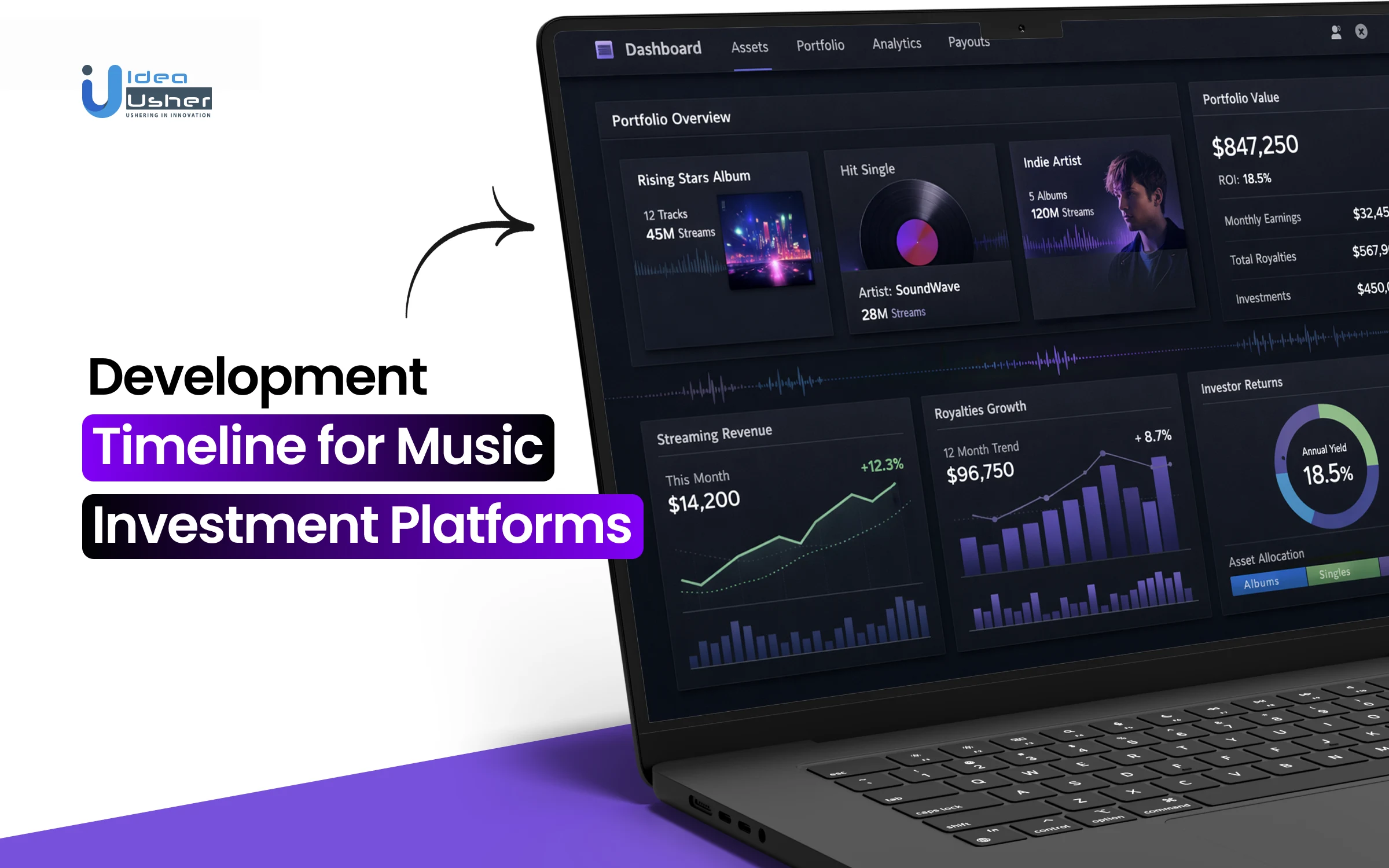
Behind every strong music investment idea lies excitement mixed with hesitation. The market may look ready, and the numbers may feel right, yet the path to launch often seems unclear. Teams soon realize that timing and sequencing matter as much as the idea itself when building music investment platforms. This becomes very real when financial logic must align cleanly with creative ecosystems.
The real challenge is usually not tools but knowing how they should come together over time. Licensing flows, royalty tracking payments, and compliance must be built in the right order. A clear development timeline can steadily turn complexity into forward momentum.
Over the years, we’ve built numerous music investment solutions, powered by royalty ingestion engines & rights graph modeling systems. Given our expertise, we’re writing this blog to discuss the development timeline for music investment platforms. Let’s start!
Key Market Takeaways for Music Investment Platforms
According to FutureMarketInsights, the global music and streaming services market is entering a decisive growth phase, with revenues projected to rise from USD 32.4 billion in 2025 to USD 118.1 billion by 2035 at a 13.8 percent CAGR. This scale of expansion is reshaping how royalties are viewed from a financial perspective. What was once delayed artist income is increasingly treated as a predictable cashflow asset, supported by global streaming penetration, stronger per-user monetization, and the continued growth of publishing and neighboring rights.

Source: FutureMarketInsights
In parallel, the music royalty investment segment is gaining traction as an alternative asset class. Dedicated royalty investment markets are expected to grow at nearly double-digit rates as investors seek income streams that remain resilient amid equity market volatility.
Music consumption patterns tend to be stable across economic cycles, making royalty income attractive to investors seeking yield with lower correlation to traditional markets.
Platform innovation is accelerating adoption. Music royalty investment platforms now fractionalize large and opaque catalog deals into accessible, track-level or catalog-level investments.
Examples include Royal and Bolero, which use blockchain-based infrastructure to tokenize future royalty streams, automate distributions, and improve transparency. By aligning artist financing needs with investor demand for stable returns, these platforms are converting.

What Are Music Investment Platforms?
Music investment platforms are digital marketplaces that enable investors to purchase fractional ownership in music rights and earn income from streaming, licensing, and performance royalties. Instead of relying on traditional labels or private deals, these platforms use structured royalty data, contracts, and payout engines to turn songs and catalogs into investable assets.
They track usage across DSPs, automatically calculate earnings, and distribute revenue transparently to rights holders and investors.
Key Features of Music Investment Platforms
Music investment platforms enable users to own fractional interests in music and track royalties transparently. Earnings can be distributed automatically while performance stays visible in real time. This structure helps users understand value with confidence.
1. Fractional Music Ownership Interface
Music investment platforms enable users to purchase fractional ownership interests in songs or catalogs through a guided interface. Investors can view ownership percentages, minimum buy-ins, and projected income before investing, as on Royalty Exchange, where royalty interests are structured into clearly defined investment units.
2. Royalty Earnings Dashboard
A core feature users interact with is the royalty earnings dashboard, which shows income from streaming, performance, and licensing. Platforms like ANote Music present transparent earnings reports and historical payouts so users always know how their investments are performing.
3. Catalog Discovery & Asset Profiles
Users explore assets through detailed catalog profiles that show artist context, genre trends, and historical revenue before investing. This mirrors how JKBX structures music catalogs as investment-grade assets with contextual data to support decision-making.
4. Automated Payout & Wallet Management
Once invested, users expect payouts to happen automatically without manual intervention. Platforms integrate wallet and payout systems that distribute royalties based on ownership shares, similar to how SongVest enables users to track balances and receive earnings seamlessly.
5. Secondary Marketplace
Liquidity is addressed through secondary marketplaces where users can buy or sell music shares over time. Royal demonstrated this interaction by allowing users to trade ownership stakes directly on the platform.
7. Performance Analytics & Forecast Insights
Beyond raw earnings, users interact with analytics that explain why an asset performs as it does. This insight layer is central to platforms like BeatBread, where performance data helps users assess future royalty potential.
8. Contracts & Ownership Records
Users need legal clarity around what they own and how revenue is distributed. Music investment platforms surface digital contracts and ownership records directly in the interface, similar to how Pex supports rights verification and ownership transparency.
Development Timeline for Music Investment Platforms
We take a time-efficient approach to developing music investment platforms for our clients, planning compliance, infrastructure, and intelligence in parallel rather than in isolation. This phased roadmap outlines how we reduce execution risk, shorten time-to-market, and deliver a legally sound, scalable platform.

Phase 1: Foundation & Compliance (Months 1–3)
Goal: Legal air-tightness and architectural blueprint.
| Component | Scope | Timeline |
| Rights & IP Validation Logic | Design systems to validate ownership and rights before asset onboarding | 4–6 weeks |
| Legal Asset Wrappers | Build SPVs or trusts to hold music assets legally | Parallel |
| Conflict Check Database | Cross-verify ownership using ASCAP, BMI, and MLC records | Parallel |
| Regulatory & SEC/FINRA Filing | Configure Reg CF or Reg A+ compliance workflows that shape user onboarding | 8–12 weeks (parallel) |
Phase 2: Core Infrastructure (Months 3–7)
Goal: Building the pipes that move data and money.
| Component | Scope | Timeline |
| Royalty Ledger System | Create immutable royalty tracking and payout calculations | 8–10 weeks |
| Distributor & PRO Integration | Ingest royalty data via APIs or CSVs from distributors and PROs | Parallel |
| Virtual Wallet Ledger | Handle micro-cent precision accounting for investor payouts | Parallel |
| Smart Contract Ownership Logic | Implement fractional ownership using token standards | 6–8 weeks |
| Dividend Trigger Automation | Auto-distribute royalties when funds hit the master wallet | Parallel |
| Security Audits | Third-party audits for smart contracts and payout logic | Parallel |
Phase 3: Intelligence Layer (Months 6–10)
Goal: Competitive advantage through predictive analytics.
| Component | Scope | Timeline |
| Predictive Valuation Engine | Forecast future royalty income and asset value | 12–16 weeks |
| Historical Data Ingestion | Process 100M+ streaming and revenue records | Parallel |
| Model Training | Build decay curves and longevity scoring models | Parallel |
| Social & Sentiment Signals | Adjust valuation using TikTok and Instagram trend signals | Parallel |
| Continuous Optimization | Models improve continuously after launch | Ongoing |
Phase 4: Marketplace & Ecosystem (Months 9–14)
Goal: Liquidity and investor experience.
| Component | Scope | Timeline |
| Secondary Market Engine | Enable asset resale via order book or AMM model | 10–12 weeks |
| Volatility Circuit Breakers | Prevent extreme price swings during high activity | Parallel |
| Investor Dashboards | Display holdings, earnings, and performance | 6–8 weeks |
| Tax Reporting Automation | Generate investor tax documents such as 1099 or K-1 | Parallel |
| Real-Time Analytics | ROI visuals and streaming performance heatmaps | Parallel |
This timeline is a realistic estimate based on similar platforms we have built, not a fixed promise. The total estimated development window typically ranges from 12 to 16 months, depending on regulatory scope and data complexity. For a more accurate, project-specific timeline, feel free to connect with us for a free consultation.
Key Timeline Constraints in Music Investment Platforms
Music investment platforms may take longer because rights verification must occur before any asset logic can run safely. Regulatory choices should be made early since they may quietly reshape onboarding wallets and reporting flows.

1. Rights Fragmentation and Ownership Clarity
Timeline Impact: Adds 2 to 4 Months to the Initial Phase
| Standard Fintech Platform | Music Investment Platform |
| Customer owns their account with clear KYC and AML verification | The asset itself must be verified for clean ownership before minting |
| Simple asset registration | Complex rights mapping across writers, publishers, performers, and labels |
| Weeks for the legal framework | Months for rights verification infrastructure |
Why does this delay your launch
Before a single marketplace feature is built, the platform must implement a rights verification engine that cross-references:
- Global Repertoire Databases
- Performance Rights Organizations such as ASCAP, BMI, and SESAC
- Label and publisher records
- Historical split sheets and contractual documents
Without this layer, platforms risk creating toxic assets, meaning fractional ownership in songs with disputed or incomplete rights. These assets can trigger lawsuits, forced delistings, and even full platform shutdowns.
2. Regulatory Pathway Selection
Timeline Impact: Adds 3 to 6 Months and Can Force Complete Rework
This single decision accounts for nearly 40% of your platform architecture, including onboarding, wallets, custody, and reporting flows.
The hard truth
Teams that postpone regulatory decisions until later phases often discover that their onboarding logic, compliance workflows, and financial architecture are incompatible with the chosen framework. This results in full rebuilds of core systems, adding months of delay and high cost.
3. Royalty Data Latency and Inconsistency
Timeline Impact: Adds 1 to 3 Months to Backend Development
The problem most teams underestimate
- Spotify reports streaming data with a two to three-month delay
- YouTube follows different revenue recognition cycles
- Performance Rights Organizations may report the same performance differently
- Retroactive corrections are common, including revised reports for past periods
Timeline effect
| Phase | Without Data Handling | With Proper Data Architecture |
| Backend royalty ledger | 1 month | 2.5 months |
| Investor dashboard | 3 weeks | 6 weeks |
| Reconciliation system | Not included | +1.5 months |
The required solution
Platforms must design a versioned and auditable royalty ledger that supports:
- Multiple data sources with conflicting schedules
- Retroactive recalculations without eroding investor trust
- Clear separation between estimated earnings and actual settled revenue
4. Micro Transaction Precision Requirements
Timeline Impact: Adds 1 to 2 Months to Financial Engineering
Streaming royalties operate at extreme precision:
- A single stream may generate 0.003 dollars
- An investor holding 0.1 percent earns 0.000003 dollars
- This scales across millions of streams and thousands of investors
Development extension breakdown
- Standard payment system: 4 to 6 weeks
- Music royalty micro payment engine: 10 to 14 weeks
Why does this take longer
- Custom accounting logic for fractional cent accumulation
- Rounding rule governance defines when and how rounding occurs
- Expanded audit trails required for regulatory review
- Stress testing at scale, often simulating ten million micro transactions per day
5. Marketplace Liquidity and Secondary Trading Design
Timeline Impact: Adds 2 to 4 Months in Final Stages
Once secondary trading is introduced, the platform becomes a regulated exchange rather than a static marketplace.
Additional development layers required
- Order matching engines, typically 1.5 to 2 months
- Price discovery mechanisms, roughly 3 to 4 weeks
- Circuit breakers and volatility controls, 4 to 6 weeks
- Regulatory reporting for secondary trades, 1 to 2 months
These systems are non-negotiable if the platform aims to support liquidity while maintaining investor protection and regulatory compliance.
When Should the Secondary Market Feature Be Developed?
The secondary market is both the highest-leverage upside and the most dangerous premature-scaling risk in a music investment platform. Launch it too early, and you create an empty marketplace that damages credibility.
Launch it too late, and you miss the liquidity window that defines long-term platform relevance. Timing this correctly is a strategic decision, not a technical milestone.

Signal 1: Primary Market Success Threshold
The benchmark: at least 70 percent of offerings fully funded
If your primary market struggles to clear inventory, your secondary market will collapse immediately. Investors only trade assets they believe others want.
Case example: Royalty Exchange waited until it had facilitated more than $250 million in primary transactions before introducing robust secondary trading. Market confidence came first.
Minimum viable threshold:
- At least 50 successfully funded catalogs
- Average offering size above $50,000
- Investor retention of 60 percent or higher after purchase
Signal 2: Investor Base Critical Mass
Liquidity requires diversity, not concentration.
- Minimum requirement: 500 active investors with varied preferences
- Ideal range: 2,000 or more investors holding diversified portfolios
- Gold standard: 5,000 plus investors with observable trading behavior
Platform-level parallel: Anghami waited to reach over one million active users on its streaming platform before expanding into artist-investment features. Density precedes liquidity.
Warning sign: if the top ten investors control more than 80 percent of the assets, you lack the required ownership distribution for meaningful secondary trading.
Signal 3: Portfolio Maturation Timeline
Rule: No secondary trading before assets are seasoned.
Immediate flipping destroys price discovery and reframes the platform as speculative rather than investment-focused.
Recommended structure:
- Minimum lock-up period of 90 to 180 days
- Ideal first trade window at 6 to 12 months post-offering
This allows for at least two to three royalty distribution cycles, establishing early performance patterns.
Observed approach: SongVest enforces a 180-day minimum holding period before secondary trading is enabled, protecting valuation integrity.
Signal 4: Price Discovery Infrastructure Is Proven
Before launching secondary trading, ask one question.
Can investors reasonably value assets between royalty distributions
Required infrastructure includes:
- Live or monthly royalty accrual reporting
- A database of comparable catalog transactions
- Performance benchmarks across genres and eras
- Clear indicators of investor demand
If royalties are reported quarterly but trading is daily, you introduce an information imbalance that damages trust and market fairness.
Signal 5: Regulatory and Compliance Foundation
Secondary trading increases regulatory exposure immediately.
Must be in place before launch:
- Clear SEC or FCA positioning for Reg A plus or Reg CF structures
- KYC and AML systems that support ownership transfer
- Tax reporting workflows, including capital gains documentation
- State-level compliance for multi-jurisdiction trading
Cautionary example: StartEngine faced regulatory pressure when secondary trading capabilities advanced faster than compliance readiness.
How Often Should Valuation Models Be Recalibrated Post-Launch?
Music catalogs behave very differently from traditional financial assets. Their value is constantly reshaped by:
Platform algorithm shifts, such as Spotify discovery updates or TikTok trend cycles
- Cultural momentum, including sudden virality or meme-driven consumption
- Legislative changes affecting copyright or streaming payouts
- Technological disruption through new formats and distribution channels
A valuation model calibrated only at launch becomes materially inaccurate within months, and in some cases, within weeks.

1. Continuous Micro Adjustments (Daily or Weekly)
What gets adjusted: streaming velocity signals, viral momentum multipliers, short-term demand coefficients
Platforms such as Royalty Exchange and Songvest rely on near-real-time DSP data. When Olivia Rodrigo’s Vampire experienced a major TikTok-driven spike, any model that failed to adjust quickly would have systematically undervalued comparable catalogs.
Implementation layer includes:
- API ingestion from Chartmetric, Soundcharts, or Viberate
- Real-time social and short-form video sentiment tracking
- Dynamic reweighting for emerging formats like YouTube Shorts versus long-form video
Key takeaway: Micro adjustments protect platforms from short-term valuation drift.
2. Quarterly Strategic Recalibration
What gets reassessed: genre multipliers, catalog decay curves, regional weighting, royalty rate assumptions
In Q4 2023, Latin music streams grew at double-digit rates while several rock subgenres declined. Platforms that skipped quarterly recalibration risked overpricing stagnating genres and underpricing growth segments.
Regional dynamics amplify this risk. Anghami, as a dominant Middle Eastern DSP, materially influences Arabic catalog valuations. Changes to its market share or payout structure must be reflected quarterly to maintain accuracy.
Key takeaway: Quarterly recalibration aligns valuations with macro listening behavior.
3. Annual Structural Overhauls
What gets redesigned: core valuation logic, discount rate frameworks, long-term risk models
Annual overhauls are non-negotiable because:
- Market multiples shift meaningfully over time
- New data sources emerge, including spatial audio or Web3 signals.
- Regulatory environments evolve through royalty settlements and PRO rules
The experience of Hipgnosis Songs Fund highlights this risk. Growth assumptions built during the pandemic era streaming surges failed to hold as consumption patterns normalized. Platforms that did not structurally revisit their models faced significant valuation gaps.
Key takeaway: annual overhauls prevent systemic mispricing.
The Trigger-Based Recalibration Framework
Beyond scheduled intervals, resilient platforms recalibrate in response to external events.
Black Swan Events (Immediate Recalibration)
When Taylor Swift removed her catalog from Spotify, valuation logic around artist leverage changed overnight. Platforms had to immediately adjust artist loyalty and control risk multipliers across pop catalogs to reflect the growing power of top-tier creators over distribution.
Platform Algorithm Changes (Within 30 Days)
Spotify’s Loud and Clear transparency report revealed new realities about how streams translate into earnings at scale. Platforms responded by updating stream-to-revenue conversion models across millions of tracks to realign projected cash flows with actual payout behavior.
Major Catalog Transactions (Within 14 Days)
The $500 million catalog sale by Bruce Springsteen reset market expectations for legacy rock assets. Valuation engines quickly recalibrated 1970s and 1980s rock catalog multiples to prevent underpricing comparable catalogs.
Legislative Changes (Within 90 Days)
The implementation of the Music Modernization Act altered how mechanical royalties were calculated and distributed. Platforms were required to overhaul royalty computation logic to stay compliant while ensuring investor yield projections remained accurate.
Industry-Specific Recalibration Frequencies
| Music Category | Micro Adjustments | Quarterly Recalibration | Annual Overhaul | Why This Frequency |
| Current Pop Hits | Daily | Mandatory | Critical | Extreme volatility and trend dependent consumption |
| Classic Rock | Monthly | Recommended | Essential | Stable demand but highly sensitive to cultural moments |
| Sync Heavy Catalogs | Weekly | Mandatory | Critical | TV and film placement cycles and political or licensing shifts |
| Jazz and Classical | Quarterly | Recommended | Important | Slow evolution with gradually changing streaming behavior |
| Regional and Local | Weekly | Mandatory | Critical | Hyper local trends and diaspora driven listening patterns |
Top 5 Examples of Music Investment Platforms
We conducted market research and identified several music investment platforms that treat music rights as structured financial assets. Each platform uses a different technical approach to ownership, payouts, and risk control, which could suit different investor profiles.
1. Royalty Exchange

Royalty Exchange is one of the most established music investment platforms in the United States, built around an auction-based marketplace for music royalties. It allows investors to acquire income streams from songs, catalogs, and publishing rights with full historical performance data.
2. SongVest

SongVest focuses on fractional ownership of music royalties, making it easier for smaller investors to participate in music assets that were once limited to high-net-worth buyers. Investors purchase SongShares tied to specific tracks or catalogs and earn a proportional share of royalties over time.
3. Royal.io

Royal.io positions music as an investable digital asset by letting investors and fans buy limited ownership stakes in songs. These stakes are linked to streaming royalties and are often released directly by artists.
4. Sonomo

Sonomo offers a portfolio-driven approach to music investing by allowing users to buy individual songs or diversified royalty baskets. This structure helps investors reduce risk by spreading exposure across multiple tracks and genres.
5. Public

Public has expanded beyond traditional stocks to include music royalties as an alternative investment option. By integrating royalties into a familiar investing interface, the platform lowers the barrier for retail investors exploring non-correlated assets.
Conclusion
Music investment platforms are quietly changing how intellectual property is engineered to generate returns. When the development timeline is well planned, the system can reduce legal exposure and unlock revenue more predictably, while investor trust grows steadily. If you treat music as a financial asset with clear data flows and controls, you will likely stay ahead of the market. With the right architecture and execution partner, the platform can scale securely, remain compliant, and stay profitable.
Looking to Develop a Music Investment Platform?
IdeaUsher can help you design a music investment platform where royalties behave like structured financial assets and do not lose media revenue. Our team will architect compliant data pipelines, smart contracts, and investor dashboards that reliably track ownership and payouts at scale.
Why Choose Idea Usher?
- 500,000+ hours of coding expertise led by ex-MAANG/FAANG developers
- Deep industry insight into music rights, blockchain micro-transactions, and AI-driven valuation models
- Full-cycle development, from regulatory compliance and smart contracts to investor dashboards and secondary market liquidity engines
Check out our latest projects to see how we engineer innovation, from concept to launch.


FAQs
A1: In most cases, the build can take around nine to fifteen months, depending on how deep the compliance layer goes and how complex the asset logic becomes. A focused roadmap should gradually move from core infrastructure to investor features so the system can mature without delays. With clear technical ownership, the timeline will usually stay predictable.
A2: Blockchain is not strictly required, but it can strongly improve how ownership and settlements are handled. Many platforms initially launch with centralized ledgers and later adopt blockchain once transaction volumes grow. This approach can keep early development efficient while still allowing transparency to improve over time.
A3: Yes, the platform can support both groups if the access model is designed carefully from the start. Tiered permissions and automated compliance checks can allow retail users to participate safely while institutions operate at higher limits. This structure should scale smoothly as capital inflow increases.
A4: Accurate payouts usually come from disciplined data ingestion and deterministic calculation logic. The platform can reconcile verified sources against contractual rules and then apply payouts through automated ledgers. This process should reduce disputes and keep the organization audit-ready at all times.


