 (+971) 8007 4267
 (+91) 946 340 7140
 (+1) 628 432 4305

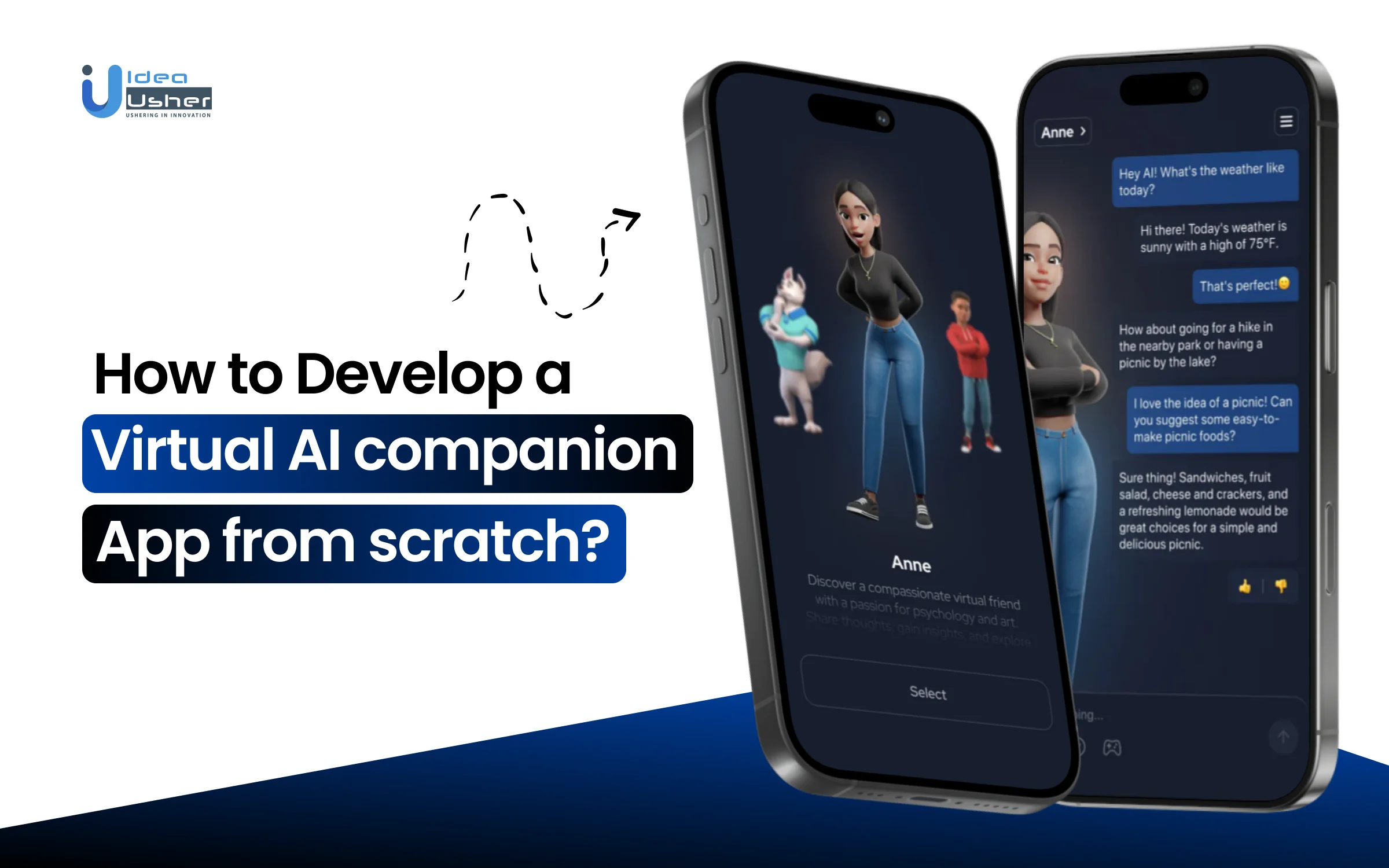
People are spending more time talking to screens than to people, and many of those conversations feel shallow or purely functional. There is a widening gap between constant digital access and real emotional presence, especially during quite stressful moments. Virtual AI companion apps can begin to fill that gap by offering persistent conversations, adaptive responses, and personality continuity.
With modern language models, a system can listen carefully, remember past interactions, and adjust tone over time. Context awareness, emotional cues, and long-term memory can help the companion respond relevantly rather than repeat itself. This kind of experience can slowly build trust and familiarity.
Over the years, we’ve developed numerous virtual AI companions platforms powered by long-term semantic memory frameworks and behavioral signal processing. As IdeaUsher has this expertise, we’re writing this blog to discuss the steps to develop a visual AI companion app. Let’s start!
Key Market Takeaways for Virtual AI Companion Apps
According to Gminsights, the market for virtual AI companion apps has grown rapidly, reaching an estimated USD 14.1 billion in 2024, with strong momentum expected over the next decade. This expansion is driven by unmet mental health needs, rising social isolation, and major advances in generative AI that enable digital companions to feel more responsive, supportive, and personal than earlier chatbot models.

Source: Gminsights
User adoption reflects this shift. Tens of millions of people now interact regularly with AI companions, often engaging in long, daily conversations that resemble ongoing relationships rather than one-off queries.
Features such as emotional check-ins, reflective discussions, and mood awareness have proven especially sticky, helping users feel understood and supported in ways that extend beyond simple entertainment, particularly in the post-pandemic landscape.
Newer platforms are pushing the category further by emphasizing empathy, personalization, and immersive interaction. Apps like Pi and Kindroid focus on natural, nonjudgmental dialogue, long-term memory, and even voice or visual presence, appealing to users seeking meaningful platonic or romantic connections.

What Is a Virtual AI Companion App?
A virtual AI companion app is a digital experience designed to feel less like software and more like a presence. Instead of simply responding to commands, it engages users in ongoing conversation, adapts to their personality, and builds continuity over time.
These apps are designed to provide companionship, emotional support, motivation, and guidance via text, voice, or visual avatars. What sets them apart is their ability to remember preferences, notice patterns, and respond in ways that feel personal rather than generic. Over time, the interaction begins to resemble a relationship, one that can feel supportive, familiar, and consistent.
How Virtual AI Companions Differ from Chatbots & Assistants?
To understand why AI companions feel so different, it helps to compare them to technologies we already know.
Chatbots: Built for Transactions
Chatbots are designed for speed and efficiency. They answer questions, resolve issues, or guide users through simple processes.
- Purpose: Solve a specific problem
- Memory: Short-term or session-based
- Interaction style: Reactive and impersonal
- Relationship: None. Each interaction stands alone.
Once the task is done, the conversation effectively ends.
AI Assistants: Tools That Execute
AI assistants are more capable, but still fundamentally utilitarian. They are excellent at handling tasks and following instructions.
- Purpose: Execute commands and manage routines
- Memory: Limited to preferences and settings
- Interaction style: Efficient, neutral, and directive
- Relationship: User-to-tool
They make life easier, but they are not meant to feel emotionally present.
AI Companions: Designed for Relationship
AI companions operate on a completely different axis. Their value comes from continuity, emotional awareness, and personality.
- Purpose: Support, connect, and grow with the user
- Memory: Long-term, including past conversations and emotional context
- Interaction style: Proactive, adaptive, and expressive
- Relationship: Ongoing and two-way
Instead of asking, “What do you want me to do?” a companion might ask, “How are you feeling today?”
This shift from tool to relationship is what makes AI companions feel new.
Types of Virtual AI Companion Apps
AI companions are not a single category. They are shaped by the human need they are designed to serve.
1. Emotional Wellness & Mental Health
These companions create a safe, private space for emotional expression. Users can talk openly without fear of judgment, practice coping techniques, or simply feel heard. Rather than replacing therapy, these apps often serve as consistent emotional support between moments of real-world help.
Example: Woebot uses evidence-based techniques like cognitive behavioral therapy to help users manage anxiety, stress, and mood through short, supportive conversations.
2. Productivity & Life-Coaching Companions
More than reminder tools, these companions function like accountability partners. They understand long-term goals and adjust their tone based on how the user is doing. Progress is not treated as a checklist. It becomes part of an ongoing narrative the companion remembers and responds to.
Example: Replika is often used as a reflective and motivational partner that supports habit-building, journaling, and personal growth.
3. Elder Care & Daily Support Companions
For older adults, companionship can be just as important as functionality. These companions help reduce loneliness through regular conversation while also providing practical support. They can offer reminders, track daily routines, and prompt alerts to caregivers or family members when unusual changes are detected.
Example: Care.Coach provides seniors with an always-available conversational companion that supports daily routines and emotional well-being.
4. Brand & Customer Engagement Companions
Some companies are replacing static apps with conversational brand companions. Instead of generic notifications, users interact with a consistent, brand-aligned personality. Over time, the brand becomes less of a service and more of a relationship.
Example: Duolingo’s in-app AI characters act as learning companions that encourage users and adapt lessons to maintain long-term engagement.
5. Entertainment and Social Companions
In entertainment, AI companions are built for imagination and connection. These can be virtual friends, creative collaborators, or interactive characters. They remember shared jokes, continue storylines, and evolve alongside the user.
Example: Character.AI allows users to interact with AI personalities that support role-play, storytelling, and ongoing social interaction.
How Do Virtual AI Companion Apps Work?
Virtual AI companion apps work by sensing what you say and how you say it while quietly observing context like time and patterns. They can reason over short conversations and long-term memory to respond in a way that should feel consistent and personal.

Layer 1: The Perception Layer
This layer is the companion’s sensory system. Its job isn’t to respond. Its job is to understand what’s really happening.
| Input Channel | What It Captures | Description |
| Language Understanding (What You Say) | Intent and nuance | Interprets meaning beyond words, including intent, emotion, and ambiguity. The same phrase can mean different things depending on timing and context. |
| Voice and Prosody (How You Say It) | Emotional tone | Analyzes pitch, pacing, rhythm, and pauses to detect emotional state beyond the transcript. |
| Visual Context (What You Show) | Situational clues | Interprets images as scenes, using environmental details to infer context and state. |
| Ambient and Permissioned Data (What’s Going On Around You) | Life context | Uses consented signals like sleep and schedule data to understand stress, load, and readiness. |
Layer 2: The Cognition & Memory Layer
This is the core. The Context Snapshot is sent here for deep processing and integration into a lifelong memory bank.
A. The Dual Memory System
This is the critical divergence from a standard chatbot.
Working Memory (The Conversation Buffer): The immediate context of the last few exchanges, held within the LLM’s token limit to maintain conversational coherence.
Long-Term Memory: This is a structured database outside the LLM.
- Vector Database (The “Semantic” Memory): Stores embeddings of important facts, user preferences, and key life events. When you say, “I’m stressed about my presentation,” the system searches this memory to recall, “User’s last presentation was in Q2 and they mentioned their manager was tough.”
- Episodic Memory Store (The “Experiential” Memory): This records not just facts, but experiences with emotional tags. It logs that last Tuesday, after the presentation, the user felt “relieved and proud.” This allows the AI to ask, “Is this presentation stressing you out like the last one did, or does it feel different?”
B. The Reasoning Engine
The LLM now operates with superpowers:
- It receives the Context Snapshot.
- It queries the Long-Term Memory systems for relevant history.
- It fuses all this information like current input, emotional tone, past events, and learned preferences.
- It runs this through a “Persona Kernel”—a set of core rules defining the companion’s fundamental traits (e.g., “generally supportive,” “curiously inquisitive”).
Layer 3: The Persona & Action Layer
Here, reasoned thought becomes personalized response and action.
Dynamic Persona Modulation
The “Persona Kernel” is adjusted in real-time. If the emotional vector from Layer 1 indicates frustration, the system might temporarily boost “patience” and lower “humor” in its response parameters. If it’s joyful, it might increase “enthusiasm.”
Proactive Agent Module
This separate subsystem constantly monitors the memory and integrated data streams. It calculates an “Intervention Score.” If the user hasn’t checked in on a stated goal, or if their bio-data indicates a poor sleep night, this module can flag the Cognition Layer to initiate a caring, proactive check-in.
Multimodal Generation
The final step. The AI generates:
Text: A response that is context-aware, memory-informed, and persona-appropriate.
Voice: Using emotionally-responsive TTS (Text-to-Speech) that can sound warmer or more energetic.
Actions: Triggering a specific module (“Let’s start a 2-minute breathing exercise now”) or logging a note for future follow-up.
The Continuous Feedback Loop
Every interaction is vectorized and stored back into the Episodic Memory. This loop is what allows the companion to say,
“You handled that feedback better than last time—I can tell you’re growing,” creating the profound illusion of a shared, evolving history
How to Develop a Virtual AI Companion App?
To develop a virtual AI companion app, the process should start with a stable persona and a clear memory strategy. Controlled proactivity and emotional state management may then be added to ensure responses remain consistent and safe. Over the years, we have built a range of virtual AI companion apps, and this is our approach.

1. Persona Design
We design the AI persona as a governed system with clear emotional limits and tone ranges. Growth rules are defined early, allowing the personality to evolve gradually without breaking trust. This allows the companion to remain consistent across long usage cycles.
2. Memory Architecture
We separate semantic memory and episodic memory at the architecture level. Conversation history is continuously summarized, and older context is carefully decayed. This keeps interactions coherent while controlling latency and compute cost.
3. Proactivity Layer
We implement controlled proactivity so the AI initiates interaction only when signals warrant it. Observer models track sentiment usage patterns and inactivity windows. Trigger scoring then determines whether an action should occur.
4. Emotional Intelligence
We infer emotional state from text voice and interaction patterns. These signals feed into response-modulation layers that adjust tone, pacing, and creativity. The result is a companion that responds calmly and appropriately across situations.
5. Multimodal Support
We build voice and vision into the core pipeline instead of adding them later. A unified state layer ensures the same personality persists across input modes and languages. This keeps the experience seamless for global users.
6. Monetization and Scale
We design monetization and infrastructure together, leveraging token optimization and caching strategies. Subscription tiers are mapped to system capabilities like memory depth and multimodal access. The platform is then prepared for secure scaling and enterprise deployment.
Successful Business Models for Virtual AI Companion Apps
Virtual AI companion apps operate at the intersection of technology and emotional engagement. Because users often develop long-term, personal relationships with these products, the most successful monetization strategies are those that scale with emotional depth, usage frequency, and personalization.

1. Freemium and Tiered Subscriptions
In Western markets, the subscription-led freemium model has emerged as the most reliable foundation for AI companion businesses. The premise is simple but psychologically powerful.
How the Model Actually Functions
Users begin with a capable but limited companion. The relationship feels real enough to matter, but not complete. Key elements that define intimacy, such as voice conversations, long-term memory, romantic or exclusive interactions, and personalized role-play, are reserved for paying members.
Apps like Replika and Paradot has refined this approach. Replika has historically priced its Pro subscription at around $69.99 per year, while Paradot’s premium tier is priced at $14.99 per month or $99.99 annually.
Why the Economics Work
Subscriptions scale quietly but powerfully. A platform with only 50,000 paying users at $10 per month generates $6 million in annual recurring revenue. The real challenge lies in balance.
2. Microtransactions and Digital Gifts
Where subscriptions monetize continuity, microtransactions monetize timing. Borrowed from mobile gaming, this model has proven especially effective in companionship apps.
Spending Driven by Emotional Peaks
Platforms such as Chai AI and DreamGF allow users to interact freely up to a point, then introduce optional purchases tied to heightened emotional states. Those credits are sold in small bundles, typically priced at $2.99, $4.99, or $9.99.
This matters because emotional spending is impulsive. Users often resist committing to a $15 monthly plan, yet happily spend $3 late at night for comfort, reassurance, or intimacy.
The Scale Advantage
Individually, microtransactions are small. At scale, they are formidable. If 1 percent of a one-million-user base spends just $3 once per week, the platform generates approximately $1.56 million annually.
3. Personality-as-a-Service & Influencer Licensing
A newer but rapidly emerging strategy involves transforming real-world personalities into monetizable AI companions. Platforms license identity, voice, or expertise from individuals who already command trust and attention.
Turning Fandom into Revenue
One of the earliest visible cases was CarynAI, an AI companion modeled after influencer Caryn Marjorie. While extreme, the experiment demonstrated how scarcity, identity, and intimacy dramatically increase willingness to pay.
More sustainable versions of this model are now emerging. A single personality can serve thousands of users simultaneously, turning one-to-one expertise into one-to-many revenue.
Business Structure
Revenue typically combines a licensing or revenue-share agreement with the personality and a subscription or usage-based fee charged to users. The key advantage is built-in distribution.
Why AI Companion Apps Saw 64% Revenue Growth in 2025?
AI companion apps did not grow by accident in 2025. They crossed a psychological and economic tipping point. What was once a novelty, chatbots with personality, became something far more powerful: products people felt attached to, paid for, and returned to daily.
According to reports, the category grew 64 percent year over year in consumer revenue, outpacing the combined growth of fitness, dating, and productivity apps. More importantly, average revenue per paying user increased, not just total installs.

1. The Technology Finally Felt Personal
For years, AI companions sounded clever but disposable. In 2025, that changed.
Memory Became Real, Not Performative
The most important upgrade was not intelligence. It was continuity.
By early 2025, most top-grossing companion apps had adopted persistent vector memory systems, allowing companions to recall events weeks or months later. This solved the long-standing problem of users having to re-explain themselves in every session.
Example: A user mentions job anxiety in January. In March, the companion asks how the interview turned out without being reminded.
Apps that implemented long-term memory saw 30-45% increases in 30-day retention compared with memory-light competitors. Users stayed because the experience accumulated value over time.
Multimodality Went From Gimmick to Expectation
In 2024, voice and image features were novelty experiments. In 2025, they became table stakes. Top apps integrated emotionally responsive voice notes and basic visual understanding. Companions could detect frustration in a voice message or respond appropriately to a shared photo.
Example: Instead of replying with generic text, a companion responds to a tired voice note with slower speech, softer tone, and shorter sentences.
Apps offering multimodal interaction reported 20 percent higher subscription conversion rates, because the experience felt more present and human.
Personality Replaced Generic Intelligence
Developers quietly moved away from massive general models toward smaller, fine tuned systems built around specific personas. Users preferred emotionally consistent companions over ones that were smarter but unpredictable, and apps with clear character identities saw lower churn and average daily engagement exceeding 25 minutes per user.
2. Culture and Timing Did the Rest
Technology-enabled companionship. Society created demand.
The Moment People Realized They Were Attached
When users publicly reacted to losing familiar AI behaviors after major model updates, it revealed something deeper than feature frustration. Search interest surged, and some platforms saw downloads double, making it clear people were responding to the loss of an emotional connection, not a product change.
Big Tech Quietly Legitimized the Category
As major tech companies entered the space or hired heavily from companion-focused startups, stigma faded quickly. Investment followed, funding jumped more than 70 percent year over year, and user reviews shifted from calling the apps experiments to describing them as emotionally supportive.
The Search for a Safe Third Place
Remote work and digital-first communication left many people socially active but emotionally isolated. AI companions filled that gap as always-available, nonjudgmental presences, with usage peaking late at night when human connection was hardest to find.
3. Monetization Finally Matched Emotional Value
For the first time, the business model aligned with why users cared.
Free to Bond, Paid to Go Deeper
Most apps adopted a free to attach, paid to deepen model, where basic chat was free and subscriptions unlocked memory, personalization, and emotional continuity. This drove strong results, with top apps converting 6 to 10 percent of users.
Users Proved They Were Willing to Spend
Revenue per download told the story. Average RPD jumped from $0.52 to $1.18 in a year, driven by subscriptions tied to ongoing emotional engagement rather than ads.
Quality Concentrated the Market
The market quickly became winner-take-all, with the top 10 percent of apps accounting for 89 percent of revenue. Shallow or inconsistent experiences lose users fast, making quality essential rather than optional.
Why Infrastructure Independence Matters in AI Companion Apps?
As pioneers in this space have learned the hard way, unchecked growth on borrowed infrastructure is a trap. Your beloved AI girlfriend, life coach, or storybook character can be erased overnight by a single policy update from an API provider you do not control.
This is “The Great Filter.” It is the moment when a foundational vendor change shatters your product. History is littered with cautionary tales.
Replika’s 2023 “Lobotomy”
In early 2023, Replika, one of the most successful early companions, was forced to drastically alter its AI’s personality and restrict romantic role-play overnight to comply with its provider’s updated safety guidelines.
The result was a user base in revolt, claims of emotional betrayal, and a fundamentally changed product. Their core asset, the intimate and unfiltered relationship, was not truly theirs to control.
The Perpetual Risk for “Wrappers”
Countless smaller apps building on a single API live in constant fear. A pricing change, such as OpenAI’s shift from GPT-3.5 to GPT-4 Turbo, can instantly vaporize their profit margins. An enforcement action on content policy can filter out the very traits that made their character unique.
The Path to API Sovereignty
The antidote is to build not for a single model, but for model-agnostic resilience. The winning strategy for the next generation is to architect an orchestration layer. This is a sophisticated technical core that treats AI models as interchangeable components rather than the foundation.
Hybrid Model Orchestration
Your system is designed to route queries intelligently. Simple, frequent interactions can be handled by a cost-efficient, fine-tuned local model, such as Llama 3 or Mistral running on your own infrastructure. For complex, creative, or emotionally nuanced tasks, it can seamlessly switch to a frontier API such as GPT-4 or Claude.
Own Your Personality’s DNA
Your true intellectual property is not the API calls. It is the unique fine-tuning dataset, the curated conversations, emotional responses, and character traits that give your companion its soul. These are the relational weights. By owning this dataset and the pipelines to apply it to new models, you ensure your core asset is portable and defensible.
The Local-First Advantage
For core companion features such as memory retrieval, emotional tone analysis, and consistency checks, developing proprietary, smaller models creates a critical moat. It reduces crippling dependencies, slashes long-term latency and costs, and guarantees that key functionalities remain available regardless of external API stability.
The Strategic Transition: From Wrapper to IP House
Adopting this architecture enables a fundamental business model shift.
| The “Wrapper” Business (High Risk) | The “Sovereign” Business (Low Risk, Defensible) |
| Product equals prompt engineering on Vendor A’s API | Product equals unique personality IP and orchestration software |
| Moats are first-mover advantage and UX, easily copied | Moats are proprietary datasets, model-agnostic systems, and vertical specialization |
| Valuation based on monthly active users (MAU) | Valuation based on owned IP, technical stack, and predictable margins |
| Crisis when API vendor changes policy or pricing | Resilient, able to migrate core functions to new models with minimal disruption |
This transition moves you from being a tenant to a landlord of your own AI destiny. Your company’s value shifts to what you truly own: your data, your fine-tuning expertise, and a portable, resilient architecture that compounds over time.
The Foundational Question for 2025 and Beyond
The market’s explosive growth is an invitation, but the rules of the game have changed. The first wave rewarded speed and novelty. The next wave will reward resilience, ownership, and strategic depth.
For founders and developers, the critical question is no longer just how to build an engaging AI companion. It is this:
In an ecosystem controlled by giants, is infrastructure independence the only real defensibility for an AI company?
The evidence from the trenches suggests the answer is yes. Building for sovereignty is not merely a technical preference. It is the cornerstone of sustainable entrepreneurship in the age of AI.
Top 5 Virtual AI Companion Apps in the USA
We have conducted in-depth research and reviewed how people use these tools in real-world situations. We found that several virtual AI companion apps offer robust features and can reliably support long-term interaction.
1. Soulmate AI

Soulmate AI is designed for users seeking emotionally rich, relationship-style conversations. It emphasizes long-term memory, personality consistency, and deeper bonding, making it popular among users seeking a more realistic, emotionally engaging AI companion experience.
2. Talkie

Talkie focuses on immersive conversations with customizable AI characters. Users can chat with fictional personas, explore role-play scenarios, or create their own companions, making it especially appealing for entertainment-driven and story-based interactions.
3. Candy AI

Candy AI offers personalized virtual companions that adapt to user preferences over time. It is commonly used for casual companionship and relationship-style chats, with an emphasis on customization and ongoing conversational engagement.
4. Nastia.ai

Nastia.ai positions itself as a flexible AI companion for friendly, emotional, or relationship-oriented conversations. It appeals to users looking for fewer conversational restrictions and more open-ended dialogue with their virtual companion.
5. Nomi

Nomi focuses on emotionally intelligent conversations and memory-driven interactions. Users can create multiple companions with distinct personalities, making it ideal for those seeking deeper, more nuanced social and emotional conversations.
Conclusion
Virtual AI companion apps are shaping a new class of intelligent software that focuses on continuity and emotional relevance over time. These systems should feel present and dependable rather than transactional. Building them requires strong system architecture, careful safety design, and reliable AI coordination. Teams that invest early may gain a clear advantage by delivering human-centered experiences and sustainable long-term value.
Looking to Develop a Virtual AI Companion App?
IdeaUsher can help you plan the system architecture so your virtual AI companion app runs reliably at scale. You can work with our engineers to build a memory-handling model, orchestration, and safety layers that perform efficiently.
With over 500,000 hours of coding expertise, our team of ex-MAANG/FAANG engineers specializes in:
- Proactive AI agents that engage users meaningfully
- Multimodal empathy (voice, vision, emotional adaptation)
- Enterprise-grade scalability & privacy
Check out our latest projects to see how we turn AI companions from chatbots into trusted digital partners.


FAQs
A1: To build a virtual AI companion app, you should start with a clear use case, such as emotional support or a productivity-focused conversation. You must choose a reliable large language model and design conversation flows that feel natural and safe. The backend should support memory management and user profiling, while the frontend should be simple and personal.
A2: Most AI companion apps earn revenue through subscriptions that unlock deeper conversations or memory features. Some platforms may offer paid add-ons, such as voice interaction or custom avatars. Over time, premium personalization should drive long-term revenue more reliably.
A3: A strong AI companion app typically includes natural language chat, emotional awareness, and long-term memory. It should support context retention and adaptive responses that evolve with the user. Privacy controls must be in place to ensure users feel safe when interacting regularly.
A4: The cost of development can vary widely based on complexity and scale. A basic version may focus on core chat and memory features at launch. Ongoing investment should be expected for model tuning, cloud computing, and moderation systems.


