 (+971) 8007 4267
 (+91) 946 340 7140
 (+1) 628 432 4305

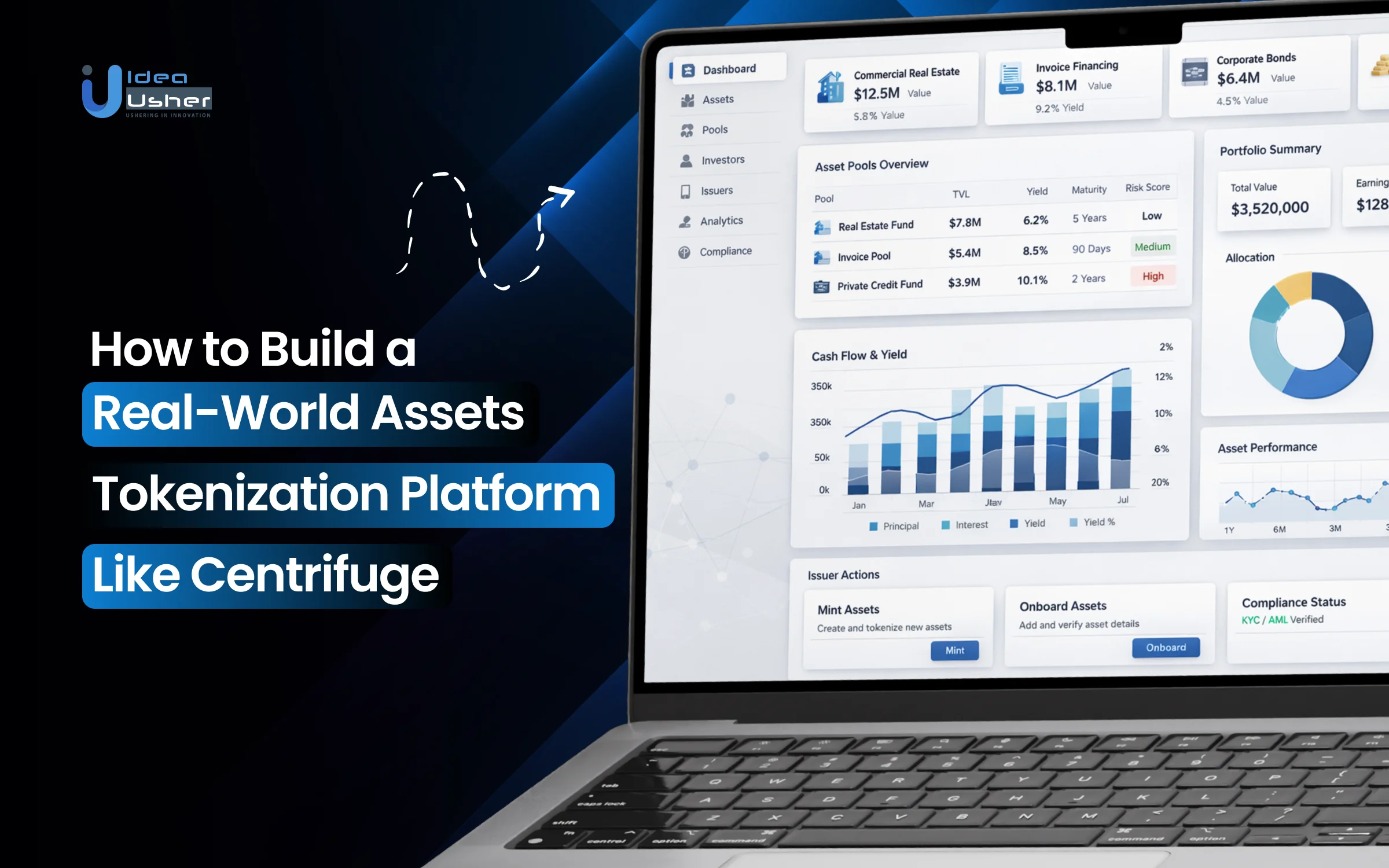
Real-world asset tokenization shifts blockchain development into regulated, cash-flow-driven territory. Instead of abstract tokens, platforms must deal with legal ownership, off-chain documentation, investor rights, and predictable yield distribution. These realities define what it takes to build an RWA tokenization platform like Centrifuge, where on-chain logic must faithfully reflect real-world financial structures rather than simplify them.
As these platforms move into production, complexity concentrates around asset onboarding, risk assessment, compliance enforcement, and lifecycle management. Structures such as SPVs, tranche-based investments, permissioned access, and reporting obligations all need to integrate cleanly with smart contracts and settlement workflows. These protocols succeed when they embed these constraints directly into the system design rather than abstracting them away.
In this blog, we explain how to build a real-world asset tokenization platform like Centrifuge by breaking down core components, architectural decisions, and execution considerations involved in launching a compliant and scalable RWA infrastructure.
What is the RWA Tokenization Platform, Centrifuge?
Centrifuge is an institutional-grade, decentralized blockchain platform that enables real-world assets (RWAs) to be tokenized, managed, and invested on-chain, bridging traditional finance with DeFi liquidity and programmable capital markets.
It provides modular infrastructure, compliance tooling, and on-chain vault standards to convert physical or financial assets into digital tokens, unlock new capital sources, streamline reporting, and enhance transparency, liquidity, and market access for asset managers and investors.
- Modular, Scalable RWA Launchpad: Centrifuge V3 introduces a purpose-built, modular architecture that simplifies deploying institutional-grade tokenized products on-chain.
- Plug-and-Play Infrastructure: Developers and issuers can use pre-built, interoperable components, APIs, and smart contract standards to tokenize assets without building backend systems from scratch.
- Multichain & EVM-Native Design: The protocol operates across Ethereum-compatible networks, enabling asset distribution and liquidity aggregation across multiple chains.
- Whitelabel Toolkit for Institutions: Centrifuge’s Whitelabel solution provides SDKs, modular primitives, and deployment tiers that help institutions launch customized tokenization services faster.
- Cross-Chain Connectivity: Built-in cross-chain capabilities unify real-world asset tokenization across different ecosystems, enhancing interoperability and liquidity reach.
- Governance & Protocol Control: The native CFG token supports decentralized governance, empowering the community to vote on upgrades, parameter changes, and strategic protocol direction.
A. Business Model – How It Operates
Centrifuge operates as a decentralized infrastructure and marketplace layer that enables real-world asset tokenization and connects traditional asset originators with on-chain capital through compliant, programmable financial primitives.
- Infrastructure & Marketplace Layer: Provides the technical, legal, and compliance infrastructure required to tokenize RWAs and deploy them into decentralized capital markets.
- Asset Originators (Borrowers): Businesses tokenize real-world assets such as invoices, real estate, treasuries, or credit instruments to raise on-chain liquidity.
- Investors (Lenders): Institutional and DeFi investors supply stablecoin capital to tokenized asset pools and earn yield based on asset performance.
- Protocol Governance (CFG Holders): CFG token holders govern protocol upgrades, fee structures, and strategic decisions through decentralized voting.
- Asset Structuring & Pooling: Assets are tokenized (historically via NFTs), pooled, and structured into risk-segmented tranches (senior and junior) to serve different investor profiles.
- Compliance-First Design: Built-in legal frameworks, KYC, and investor eligibility checks enable institutional participation and regulatory alignment.
B. Revenue Model – How It Makes Money
Centrifuge’s revenue model is based on capturing protocol-level fees from the growing volume of institutional, high-value assets flowing through its tokenization and RWA financing infrastructure.
- Protocol Fees: Fees generated from value locked and transacted across tokenized asset pools, especially institutional-grade products.
- Transaction & Origination Fees: Charged for asset onboarding, token minting, pool creation, and on-chain financial transactions.
- Asset & Fund Management Fees: Earned through managed tokenized funds and incubated entities (e.g., Anemoy) operating on top of Centrifuge’s infrastructure.
- Institutional Product Monetization: Focus on capturing fees from high-TVL products such as tokenized treasury and credit funds rather than early-stage experimental assets.
- Treasury & Ecosystem Value Capture: The Centrifuge Network Foundation holds CFG tokens and receives ecosystem funding to support long-term protocol development and sustainability.
How Centrifuge Tokenizes Real-World Assets?
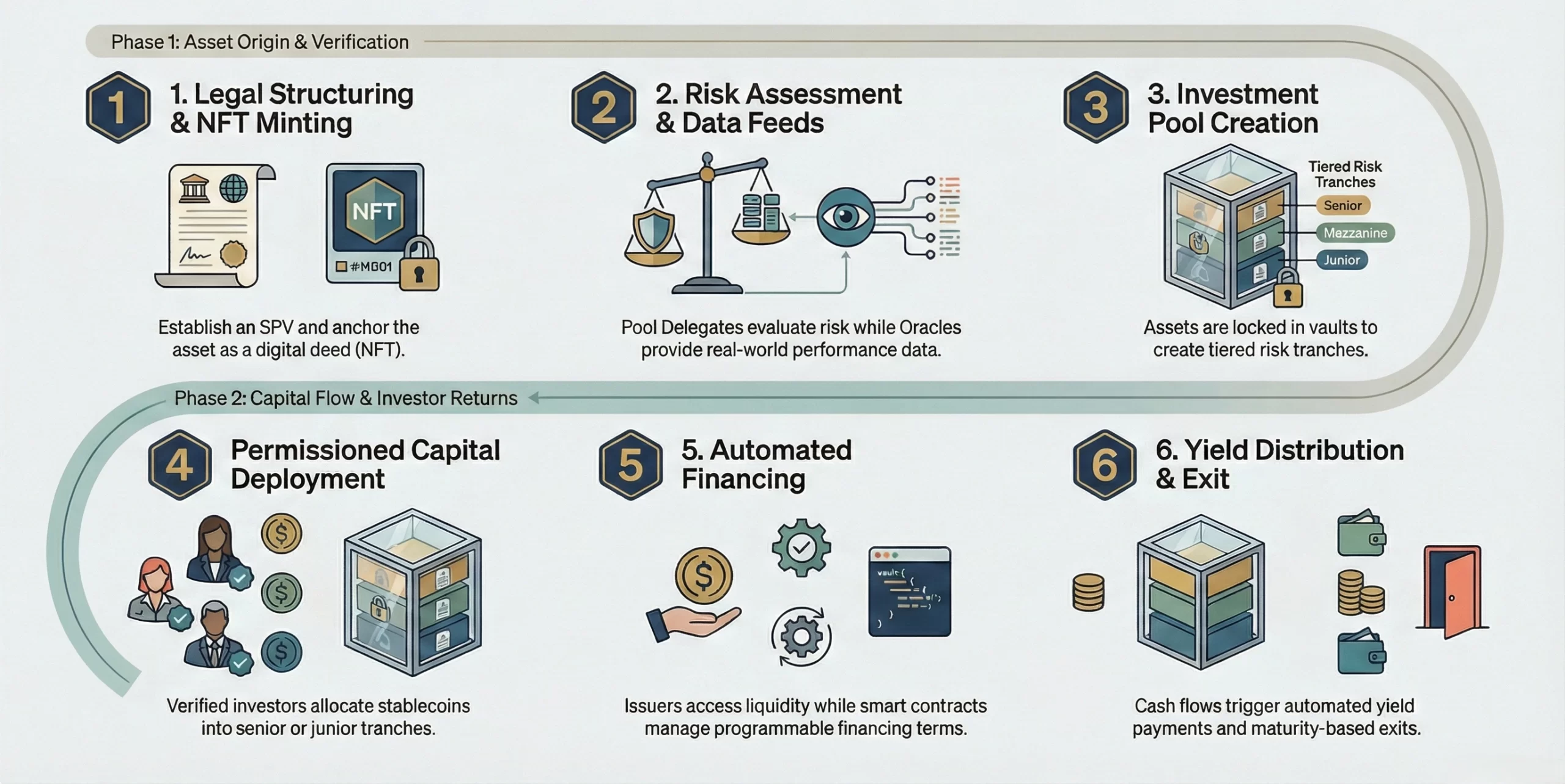
Centrifuge enables real-world asset tokenization by connecting legally structured off-chain assets with DeFi liquidity through smart contracts, compliant onboarding, and automated financing mechanisms.
A. For Issuers (Borrowers)
Issuers are businesses or institutions that want to unlock liquidity from real-world assets without relying on traditional banks.
- Asset Structuring and Due Diligence: The issuer works with legal experts to establish an SPV or trust that legally owns the asset, while a Pool Delegate evaluates asset quality, cash flows, and overall risk profile.
- On-Chain Tokenization of the Asset: Once verified, the asset is anchored on the Centrifuge Chain, where the SPV’s ownership or claim is represented as an NFT acting as the on-chain digital deed.
- Investment Pool Creation and Capital Access: The issuer creates an investment pool via Tinlake or a whitelabel app, structures risk tranches, locks the asset NFT in a smart contract vault, and receives stablecoin funding from investors.
Issuer motivation: Access global, low-cost DeFi liquidity with transparent terms, faster settlement, and programmable financing structures.
B. Builder Role on Centrifuge
Builders create the trust and service layer on Centrifuge, enabling compliant asset onboarding, reliable data flows, and scalable real-world asset operations across the protocol.
- Pool Delegation and Asset Underwriting: Pool Delegates source assets, perform due diligence, assess risk, configure pool parameters, and actively manage asset performance, earning fees for maintaining asset quality and transparency.
- Oracle Data Provision and Verification: Oracle providers such as Chainlink deliver verified off-chain data including payment confirmations, NAV updates, and performance metrics to ensure smart contracts reflect real-world asset conditions.
- Compliance and Infrastructure Services: Infrastructure partners supply KYC/AML tooling, transfer agent services, and legal frameworks, embedding regulatory compliance directly into onboarding, transfers, and pool operations.
Builder motivation: Earn recurring fees by providing verification, risk management, compliance, and data services critical to RWA trust.
C. For Investors (Lenders)
Investors interact with Centrifuge through a permissioned DeFi experience designed to mirror institutional-grade finance.
- Discovery and Permissioned Onboarding: Investors discover available asset pools through an application and complete required KYC/AML or accreditation checks enforced at the smart contract level before participating.
- Capital Deployment Into Risk Tranches: Investors allocate stablecoins into senior or junior tranches based on risk appetite, with funds locked into pool smart contracts that define yield priority and loss absorption.
- Automated Yield Distribution and Exit Options: As assets generate cash flow, yield payments are distributed automatically to investor wallets, with exits available at pool maturity or through secondary markets where liquidity exists.
Investor motivation: Earn predictable, real-world-backed yields with transparent risk profiles and on-chain enforcement.
Centrifuge is not a single product; it is an ecosystem where issuers, builders, and investors are economically aligned. Legal ownership, risk assessment, data integrity, and capital flows are coordinated through smart contracts, creating a scalable and trust-minimized RWA financing system.
Key Market Takeaways of the Real-World Asset Tokenization
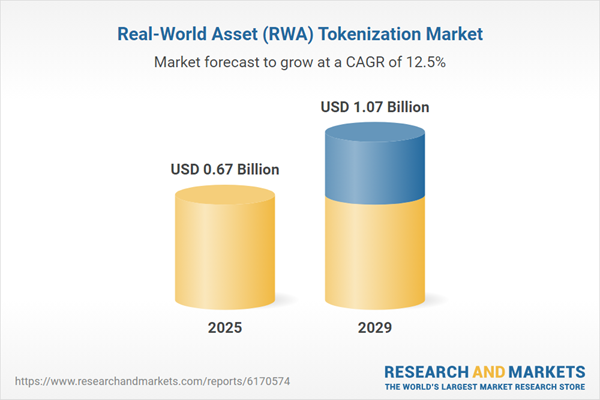
The RWA tokenization market is rapidly growing, expected to increase from $0.59 billion in 2024 to $0.67 billion in 2025 at a 12.9% CAGR. Growth is driven by institutional adoption, demand for on-chain liquidity, and clearer regulations supporting compliant asset tokenization.
The current Total Value Locked in the RWA tokenization market is estimated between $19.2 billion and $21 billion in early 2026. This wide range reflects differences in measurement methods, with growth accelerating from approximately $6 to $8 billion in early 2024 and surging by nearly $2 billion at the start of 2026.
U.S. Treasuries dominate the RWA market by TVL, accounting for roughly 45 percent with over $9.05 billion. Private credit follows as the fastest growing segment at $2 to $6 billion, alongside tokenized gold exceeding $2.9 billion and growing participation from real estate and institutional funds.
Types of Real-World Assets to Tokenize in a Platform like Centrifuge
Tokenizing real-world assets on platforms like Centrifuge unlocks liquidity and transparency. This section explores key asset types suited for on-chain financing, balancing risk, yield potential, and institutional adoption globally today.

1. Institutional Credit Funds (e.g., CLOs)
Institutional credit funds like CLOs can be tokenized by digitizing shares or notes on-chain. This offers fractional access to investment-grade credit, improves liquidity for long-term assets, and ensures transparent reporting, attracting DeFi capital seeking yields.
Example: Janus Henderson via Anemoy – JTRSY Fund
Janus Henderson partnered with Anemoy (built on Centrifuge) to launch the JTRSY token, representing shares in a U.S. Treasury money market fund. This bridges traditional finance with DeFi, meeting demand for low-risk, yield-bearing assets.
2. Private Credit & Diversified Funds
Private credit and diversified lending funds can be tokenized to represent ownership in portfolios of non-bank loans and corporate credit. Tokenization broadens investor access, automates yield via smart contracts, and channels on-chain capital into real-world business finance.
Example: Janus Henderson via Anemoy – JAAA Fund
Janus Henderson via Anemoy on Centrifuge created the JAAA token, representing AAA-rated CLO tranches. This brought investment-grade credit on-chain, growing to $750 million within weeks, validating demand for tokenized institutional credit.
3. Equities (Direct Company Shares)
Tokenized equities are digital shares embedding rights like dividends and voting into smart contracts, enabling fractional ownership, global trading, automated corporate actions, and offering a blockchain-based alternative to traditional equity issuance and cap-table management.
Example: Apollo Global Management via Centrifuge
Apollo Global Management tokenized its Diversified Credit Fund on Centrifuge, backed by $50 million from Grove. This enabled on-chain access to Apollo’s global credit strategies, demonstrating institutional adoption of tokenization.
4. Index Funds
Tokenized index funds digitally represent ownership in a diversified basket tracking a market index. They enable fractional, on-chain exposure to traditional markets, real-time NAV transparency, and easy use of index assets as collateral or liquidity in decentralized finance.
Example: Caesar AI via Centrifuge
Caesar AI became the first company to issue direct equity as digital securities on Centrifuge. Using SEC-registered infrastructure, investors can purchase and trade fractional equity on-chain with full compliance.
5. Energy & Infrastructure Assets
Energy and infrastructure assets such as solar projects can be tokenized to represent ownership or revenue rights. Tokenization enables fractional financing, improves liquidity, supports transparent performance tracking, and broadens access to sustainable infrastructure investments.
Example: Daylight via Centrifuge’s Whitelabel
Daylight used Centrifuge’s Whitelabel platform to create tokenized vaults for energy projects. Investors finance solar and storage infrastructure, earning yield from future energy revenue, demonstrating tokenization for physical infrastructure.
How does an RWA Platform Ensure Asset Valuation Accuracy?
Accurate asset valuation is essential for maintaining trust and stability in RWA platforms and tokenized finance ecosystems. This section explains how data, audits, and verification mechanisms ensure reliable, transparent, and market-aligned real-world asset valuations.
1. Initial Audits & Legal Structuring
Platforms conduct rigorous due diligence, including financial audits and the establishment of legal entities such as Special Purpose Vehicles (SPVs), to definitively link the token to a verified asset, creating a clear legal basis for its value.
2. Real-Time Data via Oracles
Secure blockchain oracles, like Chainlink, are integrated to push verified off-chain data on-chain. This provides transparent, real-time access to key metrics such as NAV updates or payment proofs for continuous valuation.
3. Automated Monitoring of Key Ratios
Smart contracts automatically monitor vital health metrics. They track Loan-to-Value (LTV) ratios and cash flow coverage, triggering alerts or automated actions like collateral top-ups if pre-set risk thresholds are breached.
4. Independent Pool Delegates & Managers
Acting as underwriters, accredited Pool Delegates assess assets and set risk parameters. They earn fees for ongoing pool management, aligning their economic incentive with accurate, long-term asset performance and valuation.
5. Secondary Market Price Discovery
Platforms can facilitate secondary trading of asset tokens on decentralized exchanges (DEXs). This trading provides a transparent, market-driven price signal that continuously reflects collective investor sentiment on the asset’s value.
Core Features of RWA Tokenization Platform like Centrifuge
A real-world asset (RWA) tokenization platform like Centrifuge offers essential capabilities to bring off-chain assets on-chain, enabling transparency, liquidity, compliance, and seamless integration with decentralized finance ecosystems.

1. Real-World Asset Tokenization
Enables conversion of physical and financial assets into blockchain-based digital tokens, representing ownership rights and enhancing transparency, fractional ownership, liquidity, and programmable on-chain trading for diverse asset types like credit, real estate, or treasuries.
2. Configurable On-Chain Vaults & Pools
Offers modular vaults and pools to mint RWA tokens, structure investment logic, manage permissions, and automate lifecycle workflows, empowering issuers with flexible on-chain financial product architectures.
3. Asset Management & Lifecycle Tools
Provides tools for issuance automation, real-time reporting, performance tracking, and operational workflows, reducing friction between traditional asset administration and decentralized ledger transparency.
4. DeFi Liquidity Connectivity
This integration links tokenized assets with DeFi protocols and markets, allowing users to use them as collateral, borrow, and trade across DeFi. It enhances market depth, supports secondary trading, improves price formation, and broadens access to global capital.
5. Cross-Chain & Interoperability Support
Supports multi-network operations and cross-chain interactions, lowering barriers to market access, enhancing scalability, and expanding token utility across DeFi platforms. It also increases liquidity and enables seamless movement of tokenized assets between ecosystems for broader global participation.
6. Compliance & Regulatory Frameworks
Incorporates compliance tooling and modular legal frameworks that support jurisdictional requirements, allowlisting, and investor governance, helping issuers meet regulatory expectations.
7. Investor Access & Transparency
Delivers real-time on-chain data, performance insights, and transparent ownership records, enabling investors to evaluate tokenized portfolios with clear audit trails. This open visibility builds investor trust, reduces fraud risk, and supports informed decision-making in decentralized markets.
8. Risk/Return Structuring & Customization
Supports sophisticated risk-return configurations (e.g., pool tranching) and tailored financial product design, giving investors flexible exposure aligned with specific strategies and risk appetite.
How to Build a Real-World Asset Tokenization Platform Like Centrifuge?
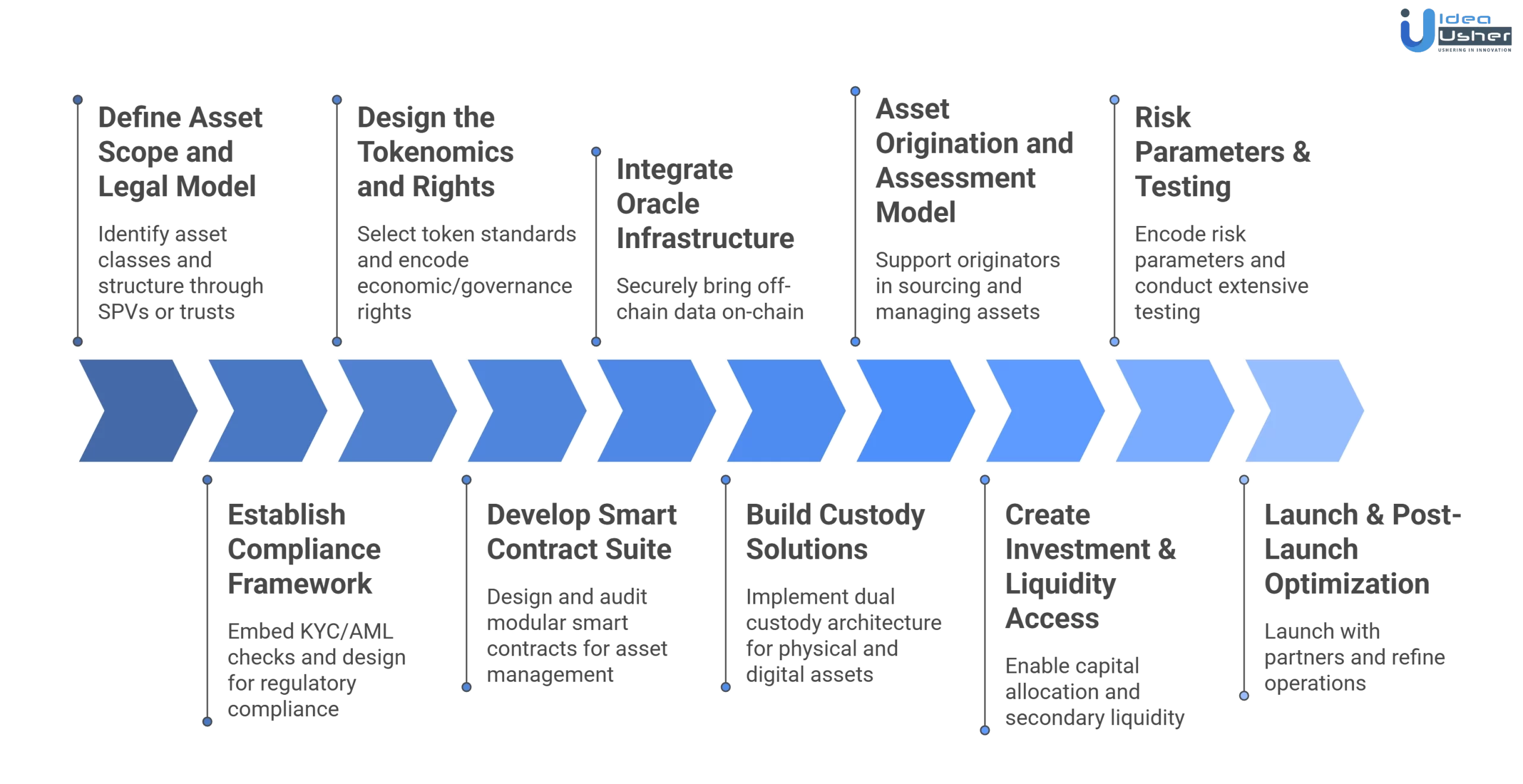
Building a real-world asset tokenization platform like Centrifuge requires secure architecture, regulatory alignment, and scalable blockchain integration. Our developers follow best practices to build compliant, transparent, and efficient RWA platforms for institutional-grade tokenization.
1. Define Asset Scope and Legal Model
Our developers begin by identifying supported asset classes such as invoices, real estate, or funds and structuring each asset through SPVs or trusts to isolate risk and clearly define enforceable legal rights for token holders.
2. Establish Compliance Framework
We embed KYC and AML checks directly into onboarding and token transfer logic, assess whether assets qualify as securities, and design the platform to support regulatory registrations or exemptions such as Reg D or Reg S.
3. Design the Tokenomics and Rights
Our team selects appropriate token standards like ERC-20 or ERC-721 and encodes economic rights such as profit sharing or dividends alongside governance rights like voting directly into immutable, auditable smart contract logic.
4. Develop Smart Contract Suite
We design and audit modular smart contracts for asset vaults, compliant token factories, and automated distribution managers that handle issuance, ownership tracking, and programmable cash flow distribution without relying on manual off-chain processes.
5. Integrate Oracle Infrastructure
Our developers integrate decentralized oracle networks to securely bring off-chain data such as asset valuations, performance metrics, and proof-of-reserves on-chain, ensuring transparency, verifiability, and investor confidence throughout the asset lifecycle.
6. Build Custody Solutions
We implement a dual custody architecture combining regulated physical asset custodians or trustees with secure digital asset custody using multi-signature wallets or institutional-grade custodial infrastructure for tokenized assets.
7. Asset Origination and Assessment Model
Our platform supports accredited originators or pool delegates who source assets, conduct due diligence, structure pools, manage ongoing risk, and earn fees for maintaining asset quality and performance transparency.
8. Create Investment Pools and Liquidity Access
We enable investors to allocate capital into specific asset pools using stablecoins, while supporting secondary liquidity through integrated marketplaces or DeFi protocols to improve capital mobility and investor exit options.
9. Risk Parameters & Protocol Testing
Our developers encode LTV ratios, liquidation triggers, and automated payment waterfalls directly into smart contracts, while coordinating multiple third-party audits and extensive testnet simulations to validate security, compliance behavior, and operational resilience before mainnet launch.
10. Launch & Post-Launch Optimization
We recommend launching with reputable fintechs, funds, or asset originators to establish real-world credibility and refine operational workflows, followed by scaling the ecosystem through onboarding new participants and integrating lending, yield, and liquidity protocols for sustained growth.
Cost to Build a RWA Tokenization Platform like Centrifuge
The cost to build an RWA tokenization platform like Centrifuge depends on the technology stack, compliance needs, and feature complexity. This section outlines key cost factors influencing the development, security, and scalability of real-world asset tokenization platforms.
| Development Phase | What Our Developers Will Do | Estimated Cost |
| Asset Scope and Legal Model | Design asset structures, SPVs, and map enforceable legal rights on-chain. | $8,000 – $12,000 |
| Establish Compliance Framework | Implement KYC/AML, transfer restrictions, and regulatory-compliant onboarding logic. | $10,000 – $15,000 |
| Design the Tokenomics and Rights | Define token standards and encode economic and governance rights. | $13,000 – $19,000 |
| Develop Smart Contract Suite | Build audited contracts for asset vaults, issuance, and cash-flow automation. | $25,000 – $35,000 |
| Integrate Oracle Infrastructure | Integrate decentralized oracles for asset valuation and performance data. | $7,000 – $12,000 |
| Build Custody Solutions | Implement regulated asset custody and secure on-chain token storage. | $5,000 – $8,000 |
| Asset Origination and Assessment Model | Enable asset origination, due diligence workflows, and pool management. | $10,000 – $14,000 |
| Create Investment Pools and Liquidity Access | Build investment pools, redemption logic, and liquidity integrations. | $10,000 – $15,000 |
| Risk Parameters & Testing | Encode risk controls, automate cash flows, and perform audits and testing. | $10,000 – $15,000 |
| Launch & Post-Launch Optimization | Support launch, onboard partners, and optimize ecosystem integrations. | $7,000 – $10,000 |
Total Estimated Cost: $58,000 – $124,000+
Note: Actual costs vary based on asset complexity, jurisdiction, compliance depth, custody requirements, Oracle integrations, and scalability needs defined during discovery and planning scope.
Consult with IdeaUsher for your real-world asset tokenization platform like Centrifuge, validate assumptions, and get a tailored cost and timeline estimate aligned with your asset and compliance goals.
Challenges & Solutions in Building RWA Platform
Building RWA platforms involves challenges around compliance, security, data accuracy, and scalability. Our developers solve these issues through robust architecture, regulatory expertise, and proven blockchain development practices.
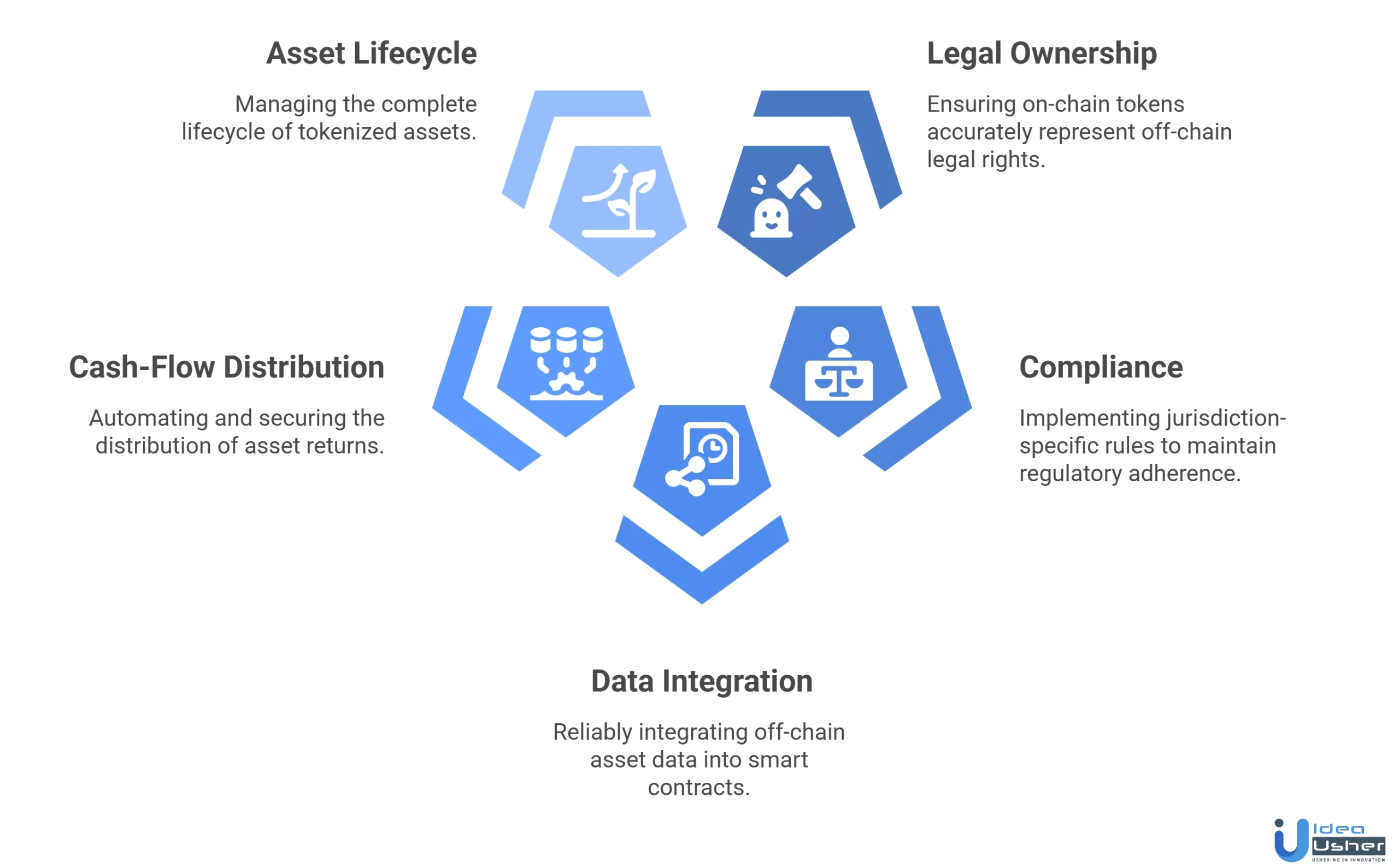
1. Legal Ownership and Token Mapping
Challenge: Smart contracts cannot enforce legal ownership by themselves. Developers often struggle to correctly map off-chain legal rights (SPVs, trusts, receivables) to on-chain tokens without creating legal or technical gaps.
Solution: We work with clearly defined SPV or trust structures and design token contracts that mirror enforceable legal claims, ensuring on-chain ownership always corresponds to off-chain legal entitlement.
2. Jurisdiction-Based Compliance Control
Challenge: Different jurisdictions impose different rules on who can hold, transfer, or redeem tokenized assets. Hardcoding this logic incorrectly can block users or expose the platform to regulatory risk.
Solution: We implement modular compliance layers with wallet allowlisting, role-based permissions, and configurable transfer restrictions, allowing jurisdiction rules to be updated without rewriting core contracts.
3. Off-Chain Data Integration
Challenge: RWA platforms depend on off-chain data like valuations, performance metrics, or proof-of-reserves, which are often delayed, inconsistent, or manually produced.
Solution: We integrate decentralized oracle networks with validation, aggregation, and fallback logic, ensuring that only verified and timely data is consumed by smart contracts.
4. Secure Cash Flow Automation
Challenge: Automating dividends, repayments, and waterfalls is error-prone. A single mistake can misroute funds or break investor trust permanently.
Solution: We design deterministic distribution managers with clearly defined payment priority rules, test them against real-world cash-flow scenarios, and validate edge cases before deployment.
5. Asset Lifecycle Management
Challenge: Assets mature, default, refinance, or get replaced. Many platforms fail to model these lifecycle events correctly, leading to stuck tokens or inconsistent states.
Solution: We build lifecycle-aware smart contracts that support asset updates, maturity handling, early exits, and controlled asset replacement without breaking investor balances.
What are the Biggest Technical Risks in RWA Platforms?
RWA platforms face technical risks related to smart contract security, data integrity, and system scalability. Understanding these risks is essential for building reliable, compliant, and resilient real-world asset tokenization infrastructures.

1. Oracle Failure or Manipulation
Oracles are the critical bridge for off-chain data. If they fail, provide stale data, or are manipulated, the platform’s smart contracts will operate on incorrect information, leading to massive miscalculations in collateral value and liquidation triggers.
2. Smart Contract Vulnerabilities & Bugs
The immutable code governing asset pools, tokens, and payments is a prime target. Exploitable bugs or logic errors can lead to direct theft of funds or the permanent locking of assets, causing catastrophic, irreversible losses.
3. Legal-&-Technical Disconnect (Automation Risk)
Smart contracts automate based on on-chain data, but real-world legal processes (like bankruptcy) are slow and off-chain. This mismatch can cause contracts to act (e.g., liquidate) in ways that conflict with or violate legal proceedings.
4. Data Privacy & On-Chain Exposure
Sensitive commercial data about assets (e.g., exact contract terms) must be verified on-chain without being fully exposed. Designing systems that provide proof of integrity while maintaining necessary confidentiality is a significant technical challenge.
5. Insecure Custody of Underlying Assets
The security of the token depends on the secure, verifiable custody of the real-world asset. Weaknesses in the custodian’s systems or fraudulent activity breaks the essential link between the digital token and its physical collateral.
Conclusion
Building a real-world asset tokenization platform demands more than smart contracts and token standards. It requires a clear understanding of asset onboarding, legal enforceability, data transparency, and investor protection. When these elements work together, tokenized assets gain credibility and liquidity. A well-designed RWA tokenization platform like Centrifuge shows how governance, compliance, and DeFi rails can align without friction. If you approach development with this mindset, you move closer to a platform that institutions trust and users confidently adopt over time through disciplined execution and responsible ecosystem participation practices.
Why Work With IdeaUsher to Build Your RWA Tokenization Platform?
With extensive experience in developing dApps, DeFi ecosystems, and custom blockchain solutions, IdeaUsher helps businesses bridge real-world assets with on-chain finance. Leveraging this expertise, we build scalable and compliant RWA tokenization platforms that transform physical and financial assets into secure, programmable digital tokens.
What Sets Us Apart?
- RWA Tokenization Expertise: We design platforms that tokenize assets with transparency, traceability, and smart contract automation at their core.
- Custom Architecture: Whether you need asset onboarding, on-chain/off-chain data integration, or investor dashboards, we tailor the platform to your business model.
- Compliance-Ready Design: Our solutions are built with regulatory considerations in mind, supporting KYC, investor permissions, and asset verification workflows.
- Scalable Infrastructure: We build platforms that support multiple asset classes and grow alongside your ecosystem without performance bottlenecks.
Check out our past blockchain products to see how we’ve helped companies launch tokenization platforms that drive adoption and liquidity.
Get in touch for a free strategy call and start building an RWA tokenization platform that brings real-world value on-chain.


FAQs
A.1. An RWA tokenization platform can support assets such as invoices, real estate, commodities, bonds, and private credit. The key requirement is verifiable ownership, predictable cash flows, and legal enforceability tied to on-chain tokens.
A.2. Compliance is handled through KYC, AML checks, asset due diligence, and legal structuring. Platforms must align token issuance with jurisdictional laws while ensuring investor rights, reporting standards, and enforceable off-chain asset agreements.
A.3. Core components in the RWA tokenization platform like Centrifuge include asset onboarding workflows, smart contracts for token issuance, investor access controls, reporting dashboards, and integrations with DeFi liquidity pools. Strong governance and data transparency layers are essential for long-term platform credibility.
A.4. These platforms bridge assets to DeFi by tokenizing cash flow rights and enabling their use in lending or liquidity protocols. This connection allows asset originators to access capital while giving investors on-chain exposure to real-world yields.