 (+971) 8007 4267
 (+91) 946 340 7140
 (+1) 628 432 4305

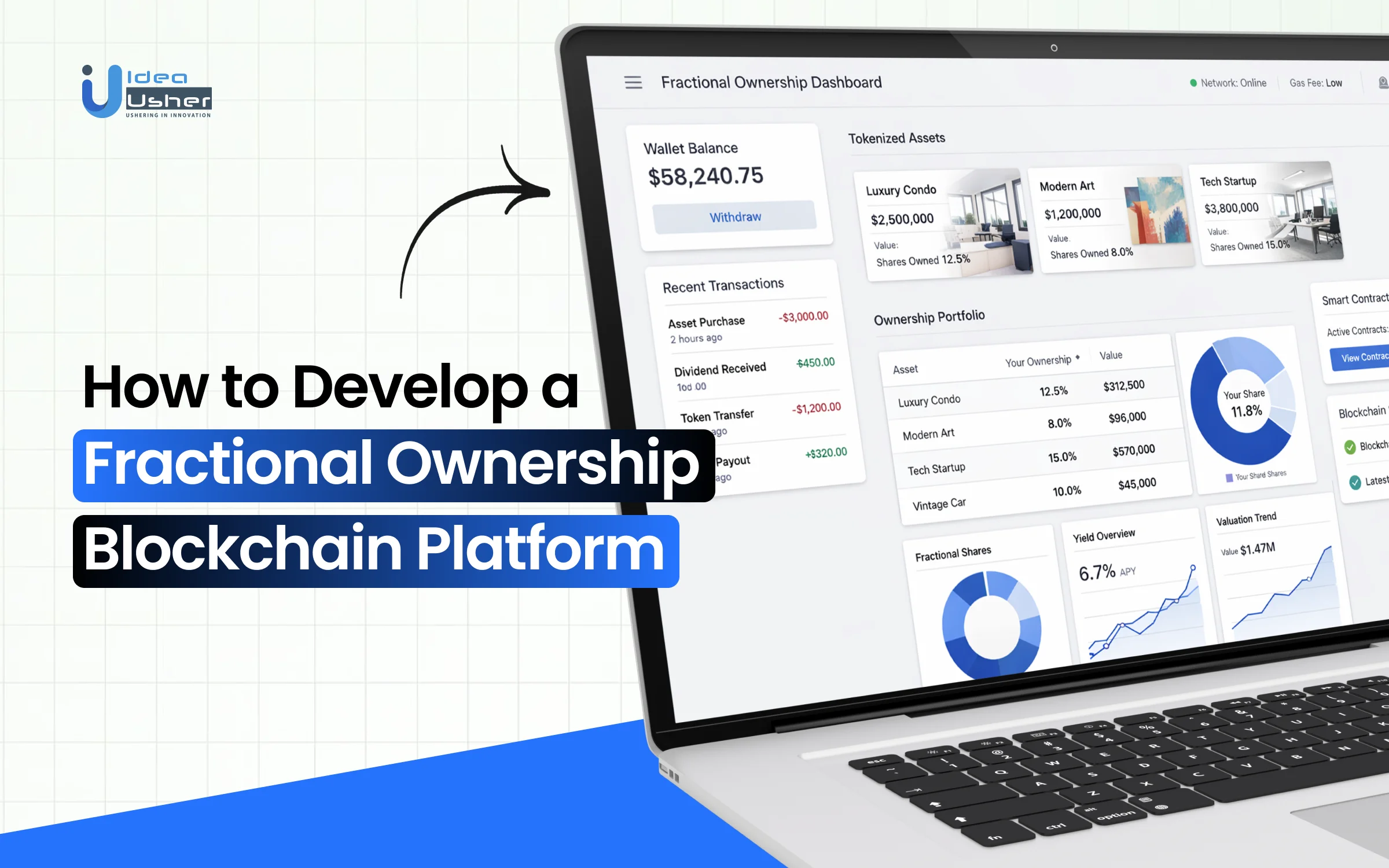
Fractional ownership makes high-value assets more accessible by dividing them into smaller, transferable shares. Instead of full ownership, participants hold proportional stakes in assets such as real estate, collectibles, or income-generating assets. This flexibility also introduces challenges in defining, tracking, and governing ownership, shaping how a fractional ownership blockchain platform must be designed from the beginning.
As fractional ownership moves into real usage, complexity shifts to managing ownership and value over time. Platforms must handle ownership records, transfer rules, compliance requirements, and distributions without creating confusion. Smart contracts need to reflect legal rights, maintain accurate balances, and enforce rules around trading or payouts, while integration with off-chain systems ensures transparency and reliability as participation grows.
In this blog, we explain how to develop a fractional ownership blockchain platform by breaking down the core components, architectural considerations, and practical steps involved in building a system that supports shared ownership at scale while maintaining transparency and control.

What is a Fractional Ownership Blockchain Platform?
Fractional Ownership Blockchain Platform is a digital platform built on blockchain technology that enables multiple investors to co-own high-value assets by dividing them into smaller, tradable digital tokens. Each token represents fractional ownership of the underlying asset such as real estate, art, or other valuable goods and lets investors buy, sell, or trade their share on a decentralized network.
Blockchain ensures transparent, immutable records of ownership and automates transactions and revenue distribution through smart contracts, lowering entry barriers and increasing liquidity for traditionally illiquid assets.
How Fractional Ownership Platforms Convert Assets into Digital Units?
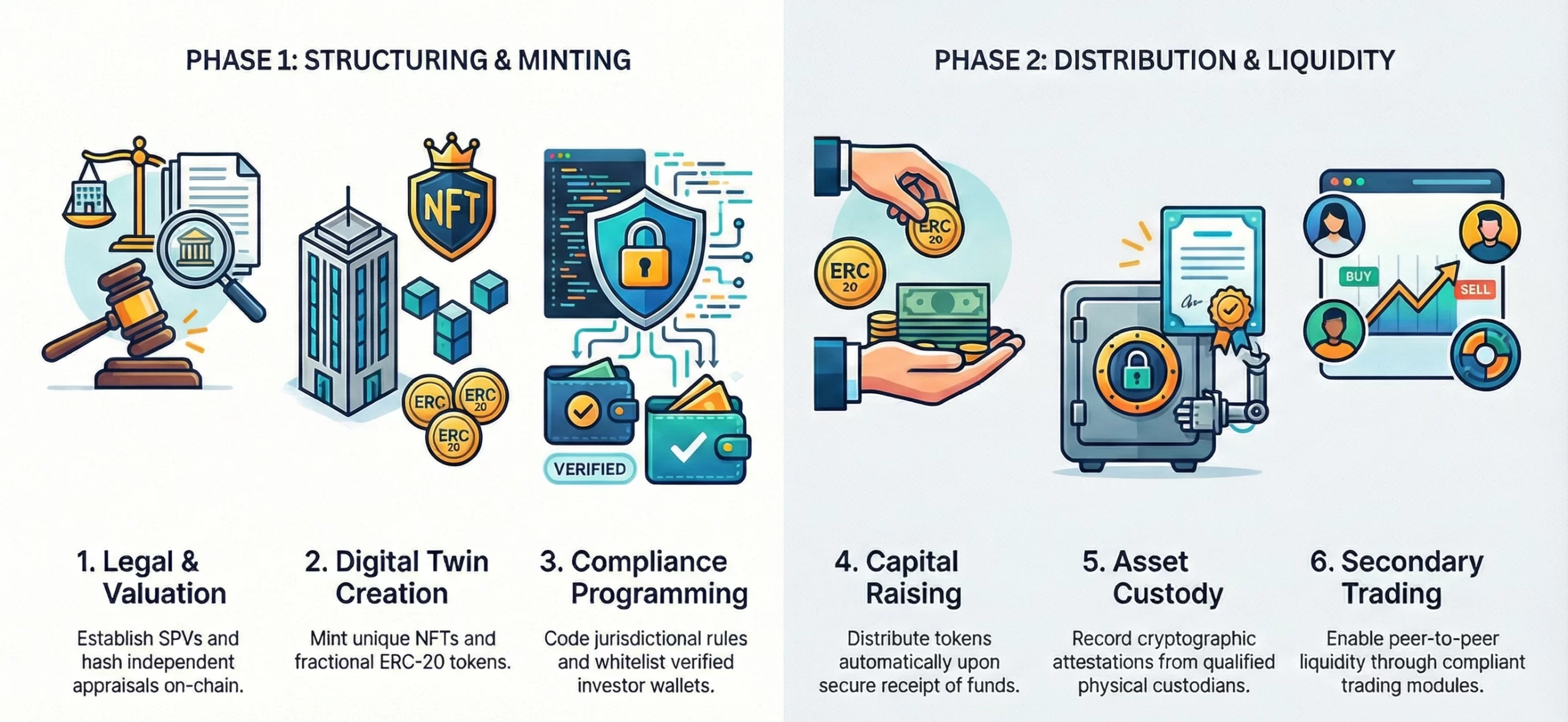
Fractional ownership platforms convert real-world and digital assets into blockchain-based units through tokenization. This process enables shared ownership, improves liquidity, and allows investors to access high-value assets with greater transparency and efficiency.
1. Asset Identification & Legal Structuring
Platforms first establish Special Purpose Vehicles (SPVs) to hold the physical asset legally. This creates a clear legal entity whose ownership can be divided and represented digitally via tokens, ensuring regulatory compliance from inception.
2. Valuation & Due Diligence
Independent, licensed appraisers determine the asset’s fair market value. This valuation report is hashed and stored immutably, providing the foundational price point for calculating the value of each fractional digital share to be issued.
3. Digital Twin Creation & Token Minting
A unique “Digital Twin” NFT is minted as the asset’s on-chain representation. Fractional ownership tokens (typically ERC-20 or ERC-1400) are then programmatically generated, linking directly to this twin and defining the total supply of shares.
4. Compliance Programming & Investor Onboarding
Smart contracts are coded with jurisdiction-specific rules (KYC/AML, accreditation). Investors undergo verification, and their wallet addresses are allowlisted on-chain, ensuring only eligible participants can receive or trade the newly minted digital securities.
5. Capital Raising & Primary Distribution
The tokenized shares are offered to verified investors, often via a smart contract-managed offering. Funds are collected securely, and tokens are distributed automatically upon receipt of payment, completing the primary issuance of digital units.
6. Custody & Asset Management Linkage
The physical asset is placed with a qualified custodian. An on-chain attestation from the custodian is recorded, cryptographically linking the digital tokens to the verified, safeguarded physical asset and its ongoing management.
7. Secondary Market & Liquidity Provision
The platform launches a compliant trading module. Programmed transfer restrictions ensure ongoing regulatory adherence while enabling peer-to-peer trading, thus transforming static ownership into a liquid, investable digital asset with price discovery.
Types of Assets to Tokenize in Fractional Ownership Platforms
Fractional ownership platforms support tokenization of diverse asset classes, enabling shared investment and improved liquidity. Common tokenized assets include real estate, art, collectibles, commodities, and revenue-generating digital assets across global markets.
| Asset Type | What Gets Tokenized | Platform Example |
| Real Estate | Ownership shares in income-producing properties (office buildings, retail centers, warehouses) | RealT, Lofty, Parcl |
| Fine Art & Collectibles | Fractional ownership of paintings, sculptures, rare collectibles, and historical artifacts | Masterworks, Otis, Rally |
| Private Equity & VC Funds | Shares in private companies, venture capital portfolios, or growth-stage businesses | Republic, AngelList, Securitize |
| Music & Entertainment Royalties | Rights to future royalty streams from songs, films, or media content | Royal, ANote Music, SongVest |
| Intellectual Property | Licensing rights, patents, trademarks, or technology portfolios | IPwe, LEXIT, KICK |
| Infrastructure & Renewable Energy | Ownership in solar farms, wind turbines, charging stations, or telecom towers | SunPool, GridShare, Energy Web |
| Credit & Debt Instruments | Fractional ownership of private loans, receivables, or debt portfolios | Centrifuge, Maple Finance, Goldfinch |
| Metaverse & Digital Real Estate | Virtual land parcels, digital assets, or in-game property ownership | The Sandbox, Decentraland, Somnium Space |
Global Market Growth of Fractional Ownership Platform
The Global Fractional Ownership market size was valued at $7.2 billion in 2024, and is forecasted to hit $32.5 billion by 2033, growing at a robust CAGR of 18.4%. This growth highlights strong demand for blockchain platforms that enable secure, compliant, and scalable fractional ownership across high-value real-world and digital assets.
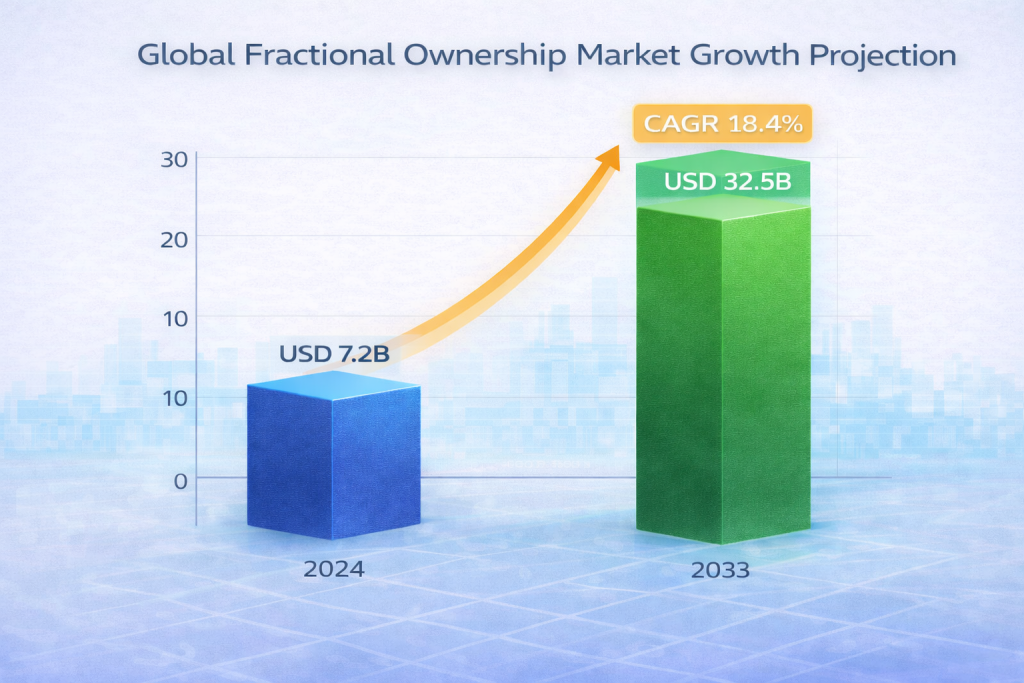
Industry forecasts further reinforce this outlook, with McKinsey and Boston Consulting Group estimating that the broader tokenized asset market could reach between $2 trillion and $16 trillion by 2030, underscoring the long-term scale of fractional ownership platforms.
Private credit leads the RWA space with roughly 58% market share, representing about $14 billion in tokenized value. U.S. Treasuries follow at 34%, accounting for approximately $8.2 billion.
Infrastructure and institutional platforms reinforce this trend. Provenance Blockchain supports nearly $12.5 billion in tokenized assets, largely across loans and private credit.
Institutional adoption continues to accelerate. BlackRock’s BUIDL fund manages between $1.7 billion and $2.9 billion in tokenized treasuries across reporting periods, while Franklin Templeton’s OnChain U.S. Government Money Fundholds around $766 million in tokenized assets.
How Fractional Ownership Solves Liquidity and Access Problems?
Fractional ownership improves liquidity by enabling assets to be divided into tradable digital shares. It lowers investment barriers, expands market access, and allows investors to enter or exit positions more efficiently.
1. The High-Capital Entry Barrier
Traditional asset markets require massive minimum investments, excluding most investors. Fractionalization breaks assets into affordable shares, enabling participation with small capital while maintaining proportional economic rights and ownership benefits.
2. Illiquidity in Private Markets
Unlisted assets like real estate or private equity traditionally lock capital for years. Tokenization creates programmable, compliant secondary markets where shares can trade 24/7, transforming static holdings into potentially liquid digital assets.
3. Lengthy Settlement and Transaction Times
Traditional asset transfers involve slow paperwork, intermediaries, and manual verification. Smart contracts enable near-instant settlement, automatic registry updates, and simultaneous payment, collapsing transaction timelines from weeks to minutes with reduced counterparty risk.
4. Opaque Pricing and Valuation Challenges
Illiquid assets suffer from infrequent, subjective valuations. Programmable oracles can feed verified market data on-chain, while active secondary trading provides continuous price discovery, creating transparent, data-driven valuations for traditionally opaque asset classes.
5. Inefficient Capital Allocation and Diversification
Large ticket sizes force concentrated portfolios, increasing risk. Fractional ownership enables precise capital deployment across multiple assets and sectors, allowing sophisticated diversification strategies previously available only to large institutional investors.
6. Limited Exit Options and Lock-Up Periods
Investors in private assets often lack predefined exit paths. Fractional platforms can embed structured liquidity mechanisms like order books, periodic auctions, or buy-back programs, providing predictable exit opportunities without requiring full asset sales.
Core Features of Fractional Ownership Blockchain Platform
A fractional ownership blockchain platform enables secure asset tokenization, transparent ownership management, and efficient transactions. These features ensure regulatory compliance, investor accessibility, and seamless trading across digital investment ecosystems.

1. Onboarding & Identity Verification
A secure, automated gateway that verifies investor identities and accreditation statuses. It integrates with global compliance providers (KYC/AML) to ensure regulatory adherence before allowing platform access or financial transactions, creating a trusted participant ecosystem from day one.
2. Asset Tokenization Engine
The core technical module that converts physical assets into regulated digital tokens. It handles legal structuring, valuation anchoring, and the minting of fractionalized ownership certificates on-chain, ensuring each token is a verifiable, legally-backed claim on underlying asset value.
3. Multi-Asset Registry & Digital Twin Creation
A centralized, immutable ledger that creates unique digital identities for diverse real-world assets. It stores cryptographically-verified metadata, legal document hashes, and provenance history, serving as the single source of truth for all tokenized assets on the platform.
4. Fractional Shares Marketplace & Trading
A compliant secondary market enabling peer-to-peer trading of tokenized shares. It features order-book mechanics, automated price discovery, and built-in regulatory controls to provide liquidity while enforcing transfer restrictions and investor eligibility rules in real-time.
5. Smart Contract-Driven Ownership & Distribution
Automated, transparent systems that manage shareholder registries and execute financial distributions. Code-defined rules autonomously calculate prorated dividends, revenue shares, and proceeds from asset sales, ensuring precise, timely, and tamper-proof disbursements to all fractional owners.
6. Governance & Voting Framework
On-chain tools that empower token holders to participate in material asset decisions. It enables proposal submission, secure weighted voting based on ownership stake, and the execution of approved actions, decentralizing operational control and aligning stakeholder interests.
7. Oracle Integration & Real-World Data Feeds
Secure bridges that import verified off-chain data onto the blockchain. These oracles provide trustworthy inputs for valuations, performance metrics (like rental income), and compliance statuses, triggering automated smart contract executions based on real-world events and conditions.
8. Payment & Settlement System (Fiat & Crypto)
A multi-currency rail supporting seamless transactions for investments and distributions. It integrates traditional banking for fiat on/off-ramps with digital asset wallets, facilitating instant, low-cost settlements and automating complex, multi-party capital flows and waterfall distributions.
9. Secondary Liquidity & Exit Mechanisms
Structured channels for investors to realize returns, including regulated trading venues, periodic buy-back programs, and full-asset sale processes. These mechanisms provide predefined liquidity paths while protecting the asset’s operational integrity and complying with securities laws.
10. Legal Documentation & Compliance
An integrated system that binds on-chain activity to off-chain legal enforceability. It manages smart contract wrappers, generates compliance reports, automates regulatory filings, and ensures every digital transaction is anchored by corresponding traditional legal agreements and entity structures.
Fractional Ownership Blockchain Platform Development Process
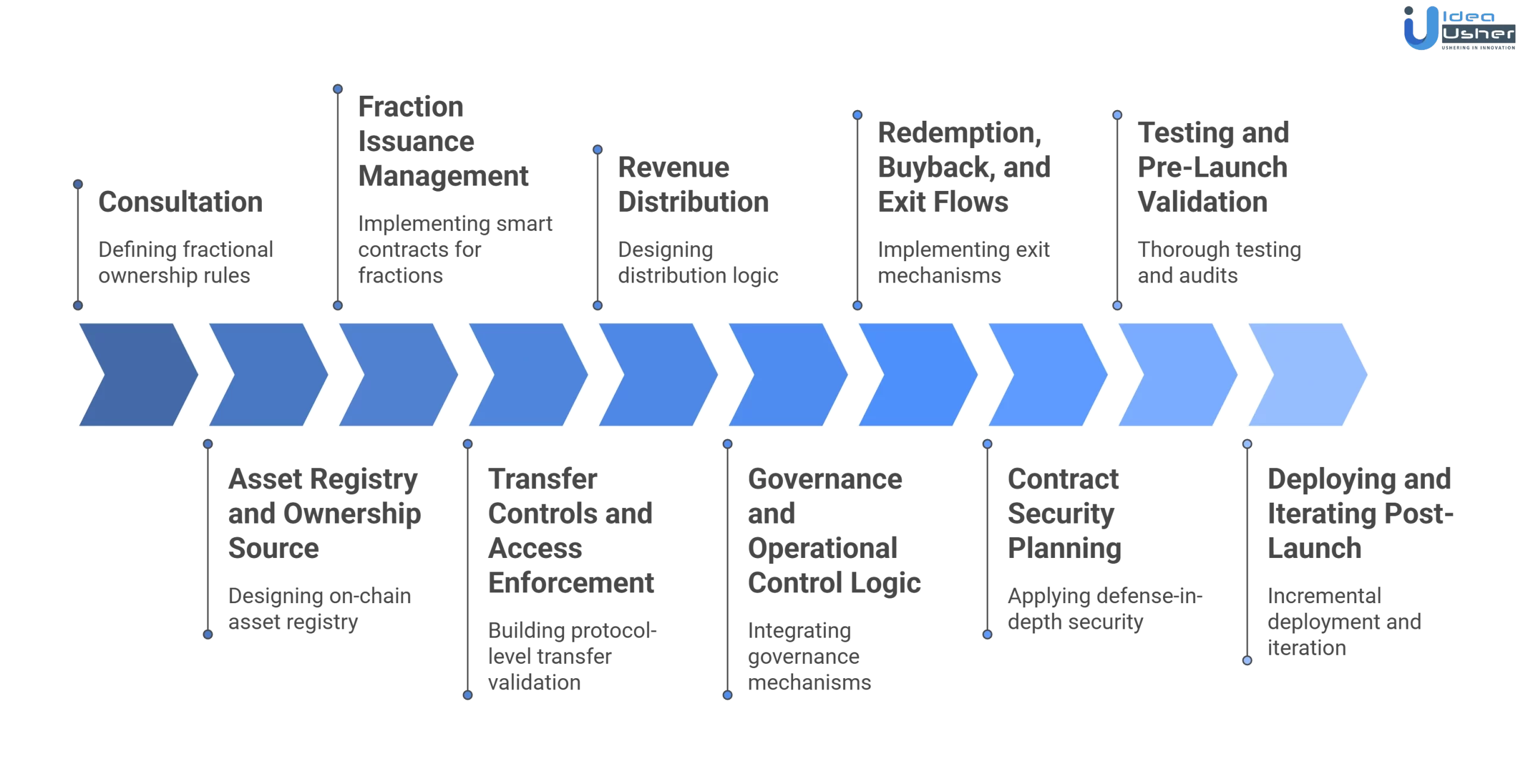
Fractional ownership blockchain platform development requires careful planning, secure architecture, and regulatory alignment to ensure scalability and trust. Our developers follow structured development methodologies to build secure, compliant, and user-focused fractional ownership solutions.
1. Consultation
We begin by defining how fractions are created, fixed, or adjusted over time, including ownership caps, transfer rules, and precision limits, because these decisions directly shape smart contract design and long-term system stability.
2. Asset Registry and Ownership Source
Our developers design a canonical on-chain asset registry that uniquely identifies each asset and maps fractional balances to it, ensuring ownership records remain consistent, upgrade-safe, and independent of application-level logic.
3. Fraction Issuance and Balance Management
We implement smart contracts to issue fractions, track balances, and prevent unauthorized minting or dilution, while maintaining accurate proportional ownership across transfers, distributions, and redemption events.
4. Transfer Controls and Access Enforcement
Our team builds protocol-level transfer validation that enforces ownership limits, eligibility rules, and asset-specific restrictions directly within smart contracts, preventing invalid transfers across wallets and integrations.
5. Revenue Distribution and Accounting
We design distribution logic that calculates each holder’s share based on fractional ownership, reconciles off-chain revenue inputs, and supports predictable, claimable payouts without introducing rounding errors or hidden dependencies.
6. Governance and Operational Control Logic
We integrate governance mechanisms for decisions affecting asset operations and ownership rights, while gating sensitive actions behind controlled roles to prevent governance deadlocks and misuse in production environments.
7. Redemption, Buyback, and Exit Flows
Our developers implement deterministic exit mechanisms that support asset sales, buybacks, and forced liquidations, ensuring fair treatment of minority holders and predictable settlement in both planned and adverse scenarios.
8. Contract Security and Upgrade Planning
We apply defense-in-depth security practices, minimize privileged access, and design controlled upgrade paths that allow the platform to evolve without breaking ownership records or compromising investor trust.
9. Testing and Pre-Launch Validation
We thoroughly test contract interactions, edge cases, and failure scenarios, validate economic correctness, and conduct independent audits before exposing real assets or investor capital.
10. Deploying and Iterating Post-Launch
We deploy contracts incrementally, monitor on-chain behavior and operational metrics, and iterate carefully based on real usage patterns while preserving backward compatibility and system integrity.
Fractional Ownership Blockchain Platform Development Cost
Fractional ownership blockchain platform development cost depends on platform complexity, compliance requirements, technology stack, and feature scope. Understanding these factors helps businesses plan budgets effectively and build scalable, secure investment platforms.
| Development Phase | What Our Developers Will Do | Estimated Cost |
| Fraction Model Design | Define fraction structure, ownership limits, transfer rules, and precision for smart contract behavior. | $4,000 – $6,000 |
| Asset Registry Design | Design an on-chain registry to keep ownership data reliable and upgrade safe. | $6,000 – $9,000 |
| Fraction Issuance Logic | Implement smart contracts for issuing fractions, tracking balances, and preventing unauthorized dilution. | $8,000 – $12,000 |
| Transfer & Access Controls | Enforce ownership caps, eligibility checks, and transfer restrictions directly at the protocol level. | $7,000 – $10,000 |
| Revenue Distribution Logic | Build accounting and payout logic to distribute income proportionally based on fractional ownership. | $8,000 – $12,000 |
| Governance & Controls | Integrate governance flows and controlled operational permissions for asset-level decisions. | $5,000 – $8,000 |
| Redemption & Exit Flows | Develop redemption, buyback, and liquidation mechanisms to support predictable investor exits. | $7,000 – $11,000 |
| Security & Upgradeability | Apply security hardening and controlled upgrade paths for long-term platform stability. | $6,000 – $9,000 |
| Testing & Audit Prep | Test contract behavior, validate edge cases, and prepare the codebase for external audits. | $5,000 – $8,000 |
| Deployment & Support | Deploy contracts, monitor on-chain activity, and provide post-launch support and fixes. | $4,000 – $6,000 |
Total Estimated Cost: $60,000 – $110,000+
Note: Costs may vary depending on asset complexity, compliance requirements, integrations, and scalability needs, with final estimates confirmed after a detailed technical and functional assessment.
Consult with IdeaUsher to get a tailored cost estimate and architecture roadmap for your fractional ownership blockchain platform.
Challenges & How Our Developers Will Solve Those?
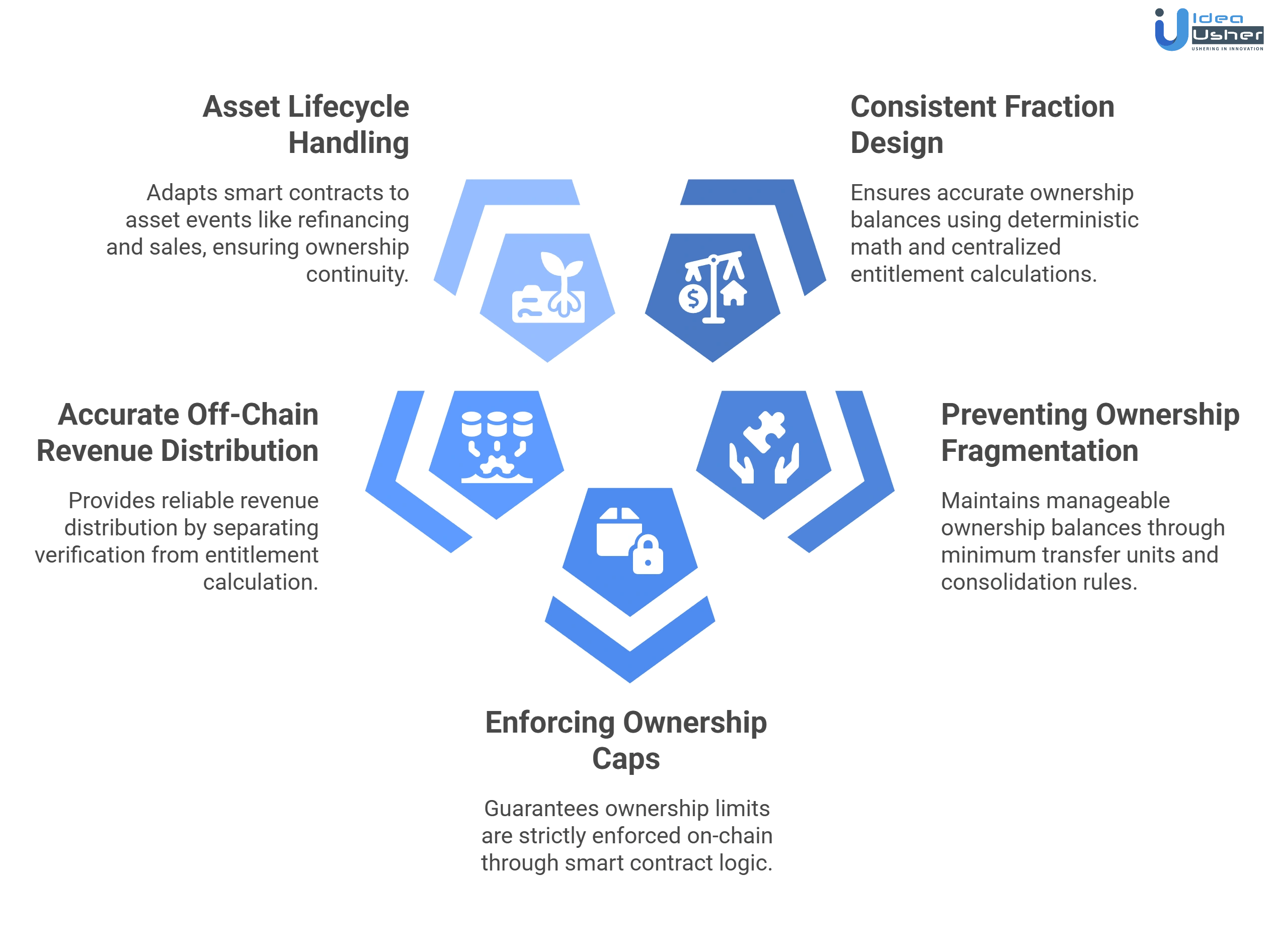
Developing fractional ownership blockchain platforms involves challenges related to compliance, security, scalability, and asset management. Our developers address these challenges through robust architecture, secure smart contracts, and compliance-focused development practices.
1. Consistent Fraction Design
Challenge: Fractional balances often drift over time due to rounding errors, precision loss, or inconsistent accounting between transfers, distributions, and redemptions, leading to ownership disputes.
Solution: We design deterministic ownership math with fixed precision rules and centralized entitlement calculations, ensuring every operation references the same ownership source of truth across the entire contract system.
2. Preventing Ownership Fragmentation
Challenge: Repeated transfers and secondary trades create fragmented balances and unusable “dust” fractions, complicating payouts, governance, and exit handling.
Solution: We enforce minimum transferable units, consolidation-friendly transfer rules, and fraction normalization mechanisms that keep ownership manageable without blocking legitimate liquidity.
3. Enforcing Ownership Caps
Challenge: Ownership limits can be accidentally bypassed during batch transfers, contract interactions, or marketplace integrations, especially when limits are enforced only at the UI layer.
Solution: We enforce ownership caps directly inside smart contract transfer logic, ensuring all ownership constraints are validated on-chain before any balance change occurs.
4. Accurate Off-Chain Revenue Distribution
Challenge: Off-chain revenue inputs often arrive late, incomplete, or inconsistent, making on-chain distribution logic error-prone and difficult to reconcile.
Solution: We design pull-based distribution systems that separate revenue verification from entitlement calculation, allowing payouts only after validated accounting data is securely referenced on-chain.
5. Asset Lifecycle Handling
The challenge: Asset events like refinancing, partial sales, or operational restructuring can invalidate naive smart contract assumptions and break ownership continuity.
Solution: We model asset lifecycle changes as explicit state transitions, ensuring ownership records remain intact while permissible actions adjust dynamically based on the asset’s current state.
Revenue Models of Fractional Ownership Blockchain Platforms
Fractional ownership platforms rarely rely on a single revenue stream. In production, they combine asset-level, protocol-level, and event-driven fees to remain sustainable across market cycles.

1. Asset Origination and Onboarding Fees
Platforms charge asset owners or issuers a one-time fee to structure the asset, deploy fractional ownership smart contracts, and onboard it into a compliant investment environment.
Platform example: Centrifuge and Securitizegenerate early-stage revenue through asset onboarding rather than depending on trading activity.
2. Ongoing Asset Management and Administration Fees
A recurring fee is embedded into asset operations to cover reporting, compliance upkeep, accounting, and ongoing smart contract and platform maintenance.
Platform example: Real estate–focused platforms such as RealT deduct platform fees directly from rental income before distributing returns to fractional owners.
3. Transaction Fees on Fraction Transfers
A protocol-level fee is applied whenever fractional ownership tokens are transferred, ensuring the platform earns revenue from compliant secondary activity.
Platform example: Tokenization platforms like Brickken apply transfer fees directly within smart contract logic rather than relying on marketplace commissions.
4. Revenue Share From Asset Yield or Cash Flow
The platform takes a predefined percentage of asset-generated yield before distributing the remaining income to fractional holders.
Platform example: Yield-driven platforms such as Ondo Finance align platform revenue directly with underlying asset performance rather than charging flat user fees.
5. Enterprise and Issuer Licensing Fees
Platforms license their fractional ownership infrastructure to enterprises, funds, or asset managers instead of operating a public marketplace.
Platform example: Infrastructure-focused providers like Securitize generate predictable revenue through issuer and enterprise licensing agreements.
Top Examples of Fractional Ownership Blockchain Platform
Several fractional ownership blockchain platforms demonstrate how asset tokenization enables shared investment and improved liquidity. These examples highlight real-world implementations transforming access to high-value assets through secure, transparent blockchain infrastructure.
1. RealT
RealT is a blockchain-based real estate investment platform that tokenizes U.S. properties into ERC-20 tokens, enabling global investors to buy fractional ownership, receive proportional rental income on-chain, and trade property shares with low entry costs and automated smart contract settlement.
2. Lofty.ai
Lofty.ai uses blockchain to fractionalize real estate ownership into digital tokens on Algorand, letting users invest in small property shares, diversify portfolios, and earn rental yields. Its low minimum investments, transparent on-chain records, and programmable payouts make property investing more accessible.
3. Smartlands
Smartlands is a UK-focused asset tokenization platform that issues digital tokens representing fractional ownership in real estate and other tangible assets. It emphasizes regulatory compliance, institutional-grade issuance, transparent blockchain records, and lower entry barriers for diversified investment in physical assets.
4. Masterworks
Masterworks acquires blue-chip fine art and issues fractional investment shares to users, letting them co-own iconic paintings. It combines art asset selection, blockchain-inspired ownership records, and long-term appreciation strategies to offer diversified alternative investments.
5. Niftex
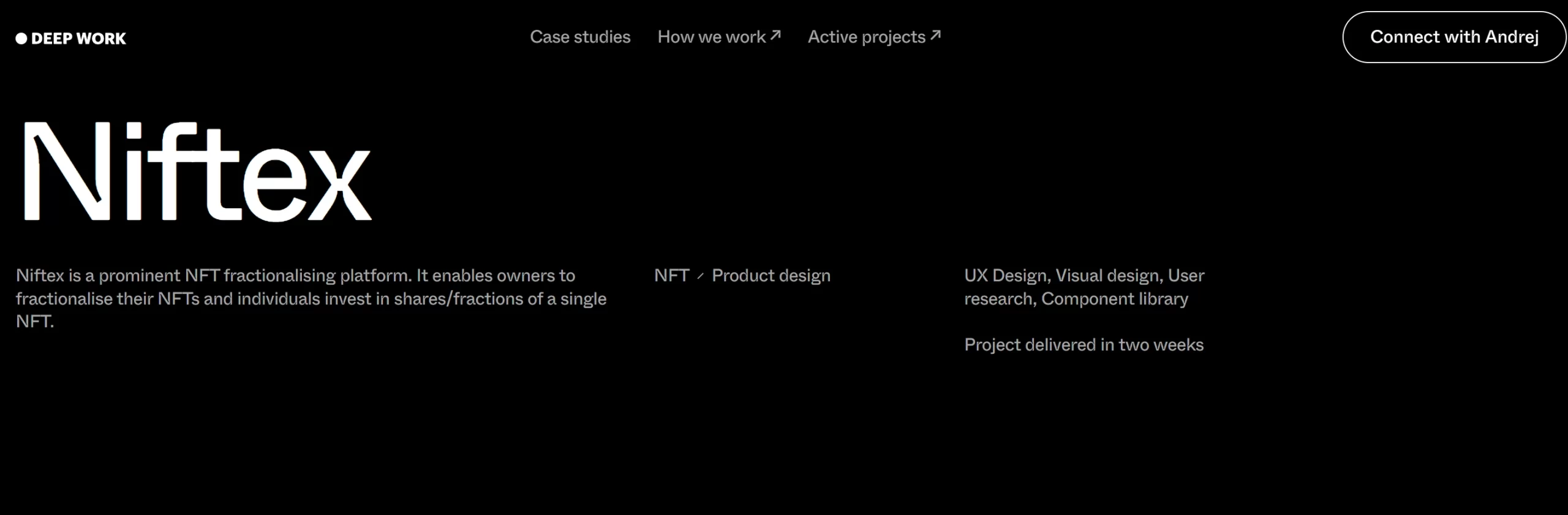
Niftex is a platform that fractionalizes high-value NFTs into smaller fungible pieces using smart contracts, allowing investors to buy, sell, and trade fractional NFT ownership. It enhances liquidity and accessibility for expensive digital collectibles and art tokens.
Conclusion
Building a fractional ownership blockchain platform requires more than tokenizing assets and enabling transfers. The architecture must support legal clarity, secure governance, accurate valuation, and compliant access for participants. When these elements align, fractional models unlock liquidity while preserving investor confidence. Thoughtful fractional ownership blockchain platform development focuses on enforceable rights, transparent distribution logic, and scalable infrastructure. By designing with real asset behavior in mind, the platform can grow responsibly, support diverse asset classes, and maintain trust as user participation and transaction volume increase over time.
Build a Scalable Fractional Ownership Platform with IdeaUsher!
IdeaUsher helps businesses design and develop blockchain platforms that enable secure, transparent, and compliant fractional ownership models across diverse asset classes. We turn complex ownership structures into intuitive, user-friendly blockchain solutions.
Why Choose IdeaUsher?
- Platform-Centric Development: We architect full-fledged fractional ownership ecosystems, not just token issuance.
- Security & Governance Focus: Our solutions prioritize investor protection, access control, and transaction transparency.
- Highly Customizable Frameworks: From ownership logic to distribution and settlement, every component is tailored.
- Proven Blockchain Delivery: We’ve helped multiple enterprises launch reliable, production-ready blockchain platforms.
Explore our portfolio to discover how we’ve built scalable blockchain platforms that enable innovative ownership and asset management models.
Reach out today for a free strategy call and take the first step toward launching a robust fractional ownership blockchain platform.


FAQs
A.1. A fractional ownership blockchain platform divides asset ownership into tradable digital units. Smart contracts manage ownership records, transfers, revenue distribution, and governance, allowing multiple investors to participate while maintaining transparency and enforceable rights.
A.2. Assets with stable value, predictable cash flows, and clear legal ownership work best. Common examples include real estate, private equity, infrastructure projects, and high-value physical assets that benefit from improved liquidity and shared ownership.
A.3. Compliance is enforced through KYC checks, wallet allowlisting, transfer restrictions, and jurisdiction-based rules. These controls are embedded into smart contracts to ensure only eligible participants can hold or trade fractional ownership tokens.
A.4. Key components include token issuance contracts, ownership registries, compliance layers, distribution logic, and governance modules. Together, they ensure accurate ownership tracking, secure transactions, regulatory alignment, and scalable platform operations.