 (+971) 8007 4267
 (+91) 946 340 7140
 (+1) 628 432 4305

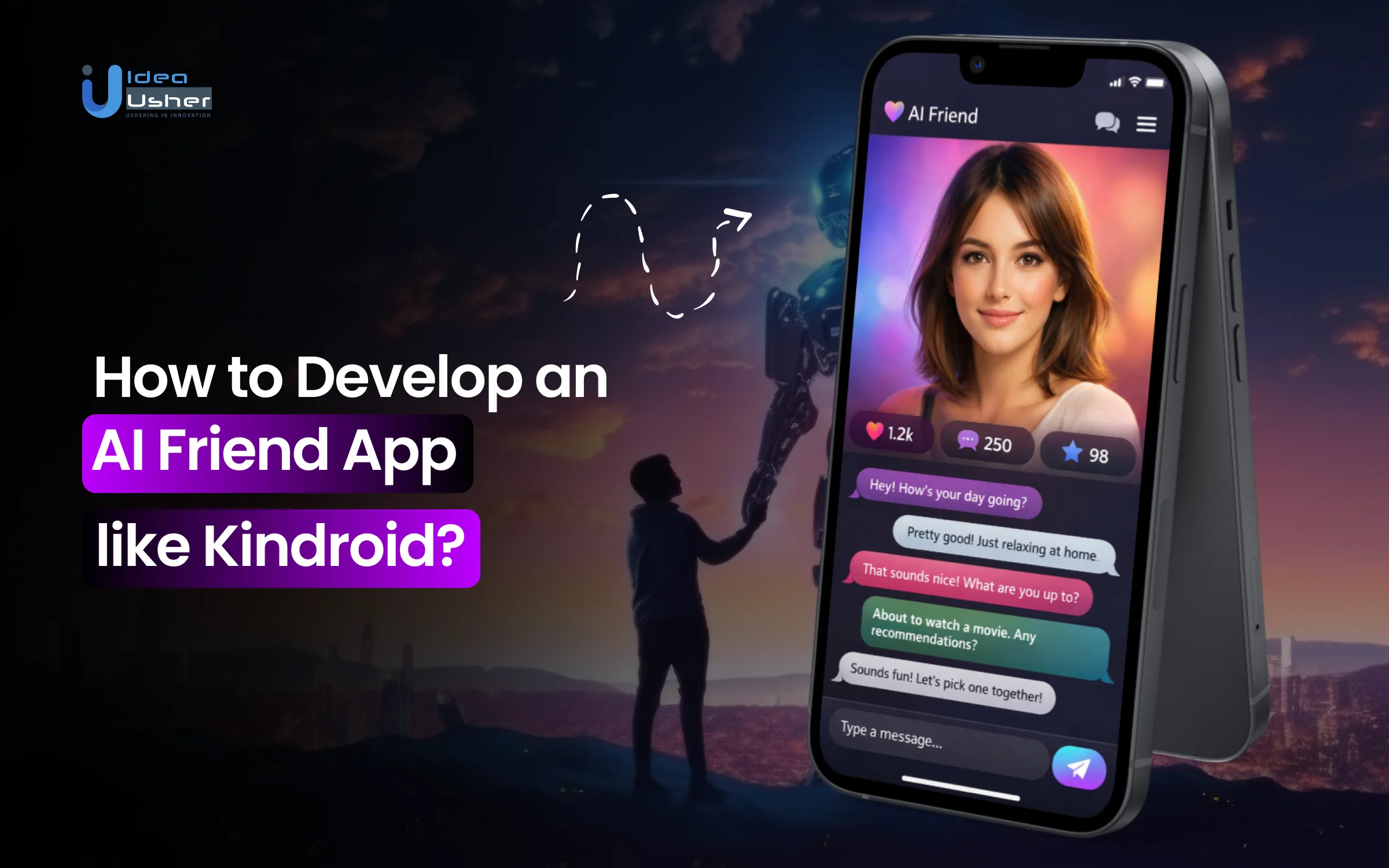
Late at night or during quiet moments, many people look for a conversation that feels calm, present, and free of judgment. Busy digital lives often leave little space for connection, and this gap slowly pushes people toward technology for comfort. An AI friend app like Kindroid can respond in these moments with consistency and emotional awareness. It uses natural language processing to understand intent rather than keywords.
Memory systems retain context across conversations, so interactions feel continuous. Emotional modeling adjusts tone and pacing based on how a user expresses themselves. Over time, the system becomes aligned with the user rather than feeling like a generic chatbot.
Over the years, we’ve built multiple intelligent conversational solutions that leverage advanced technologies such as large language model orchestration and persistent memory architectures. Drawing on this expertise, we’re writing this blog to outline the steps to develop an AI friend app like Kindriod. Let’s start!
Key Market Takeaways for AI Friend Apps
According to BusinessResearchInsights, AI friend apps are rapidly becoming part of mainstream digital social life, as evidenced by their rapid growth. The global AI companion market is estimated at USD 366.7 billion in 2025, expected to rise to USD 501 billion in 2026, and projected to reach USD 972.1 billion by 2035, growing at a 36.6% CAGR from 2026 to 2035.

Source: BusinessResearchInsights
By mid-2025, AI companion apps had reached around 220 million global downloads, with downloads up 88% year over year in the first half of 2025, while about 70–72% of U.S. teens report having tried an AI companion at least once.
What’s driving this adoption is sustained, daily engagement rather than one-off use. Users spend extended time chatting, venting, and role-playing, treating AI friends as always-available social outlets. This behavior has pushed AI friend apps into the same attention category as messaging and social platforms, helping the broader AI companion segment generate approximately USD 82 million in revenue in the first half of 2025 alone.
Replika and Character.ai show how these numbers translate into real traction. Replika positions itself as “my AI friend” and has attracted tens of millions of users globally through customizable, emotionally focused companions.
Character.ai reached around 20 million monthly active users by 2025, with people spending over 90 minutes per day interacting with user-created characters.

What is the Kindroid App?
Kindroid is an AI companion platform/app that lets you create and interact with highly personalized AI characters, often called companions or Kindroids. It’s designed more for conversation, creativity, companionship, roleplay, and emotional interaction than for strictly productivity or task automation.
Instead of generic chatbots, you build AI friends with unique personalities, memories, visuals, and voices that can imagine, remember, and evolve along with you.
Here are some of its standout features,
1. Deep Personalization & Custom AI Characters
Users can create their own AI characters called Kindroids by defining personality traits, backstories, communication styles, and behaviors. Over time, users can further shape these characters by adding preferences, memories, and emotional tendencies, making each Kindroid feel unique and personal.
2. Dynamic Conversational Interaction
Kindroid offers natural, human-like conversations that adapt to the user’s tone and history. The AI recalls past interactions, allowing conversations to feel continuous and evolving rather than restarting from scratch each time.
3. Voice Conversations
Users can interact with their Kindroid through text-to-speech and real-time voice calls. This makes conversations feel more like speaking with a real person than typing messages back and forth.
4. Visual Avatars and AI-Generated Images
The app can generate AI-created images and selfies representing the Kindroid. These visuals help give the character a stronger presence and make interactions feel more immersive than text alone.
5. Internet and Media Understanding
Kindroid can view shared links and images and access online information during conversations. This helps the AI respond with better context and more relevant, up-to-date answers.
6. Memory System
A built-in memory system enables Kindroid to retain key details about the user and prior conversations. This enables more personalized responses and long-term continuity in interactions.
7. Roleplay and Emotional Engagement
Many users interact with Kindroid for roleplay, storytelling, companionship, emotional support, or creative writing. The platform is designed to support expressive and emotionally engaging conversations over time.
AI Features That Can Enhance an AI Friend App
An AI friend app like Kindroid may use adaptive emotional memory to understand how you change over time. It could also adjust its tone dynamically during conversation. This would help the AI feel more stable and personally aware.
1. Contextual Emotional Memory
The AI remembers emotional context, not just facts, allowing it to respond with continuity and empathy. It recognizes mood patterns, past emotional conversations, and sensitive topics, enabling more thoughtful and personalized interactions over time without feeling repetitive or intrusive.
2. Adaptive Conversational Style
The AI dynamically adjusts its tone, pacing, and personality based on the user’s emotional state and conversation context. Whether the user needs encouragement, calm reassurance, or lighthearted banter, the AI responds in a way that feels natural and emotionally appropriate.
3. Well-Being Companion Support
The app gently supports mental and emotional well-being through reflective conversations, mood check-ins, and adaptive coping suggestions. It encourages healthy self-awareness without positioning itself as a therapist, maintaining ethical boundaries while offering comfort.
4. Expressive Multimodal Communication
Beyond text, the AI communicates using voice, images, expressive avatars, and contextual visuals. This multimodal interaction adds emotional richness, making conversations feel more alive and engaging while adapting to user preferences.
5. Role-Adaptive Modes
The AI seamlessly shifts roles like friend, listener, creative partner, or motivator, based on conversational context. Users don’t need to manually switch modes; the AI intuitively adapts to their needs in real time.
6. Dream & Imagination Interaction
The AI engages users in imaginative experiences such as collaborative storytelling, fantasy worlds, and reflective, dreamlike conversations. This feature encourages creativity, emotional expression, and playful exploration.
How Does the Kindroid App Work?
Kindroid lets users create and interact with personalized AI companions. The app combines memory, personality, and advanced language models to build a unique experience. Over time, your AI companion adapts, learns from conversations, and responds in ways that feel natural and consistent.

1. Dynamic Memory Architecture
Kindroid uses a layered memory system designed to preserve continuity. Rather than treating each conversation as a blank slate, the app retains:
- Important personal details users have shared
- Emotional context from previous conversations
- Summarized the narrative history of interactions
This allows the companion to reference past events naturally, respond with emotional awareness, and maintain a believable sense of shared history.
2. Backstory & Key Memories
Every Kindroid is shaped by the backstory and key memories users write. These aren’t cosmetic details; they are the foundation of the companion’s identity.
This information defines:
- Personality traits and values
- Speech style and tone
- Emotional tendencies
- The nature of the relationship with users
Every response the Kindroid generates is filtered through this identity framework, ensuring consistency and depth over time.
3. Advanced Conversational Intelligence
Kindroid is powered by advanced language models built for character-driven interaction rather than simple task execution. The system stays in character, responds with emotional awareness, and maintains narrative consistency throughout conversations. This approach helps interactions feel intentional, expressive, and closely aligned with the personality users have designed.
Ways to Interact: Text, Voice, and Visuals
Kindroid offers multiple interaction modes, each adding another layer of immersion.
Text Chat: The Foundation
The primary interface is a real-time messaging experience where meaningful conversation takes place. Users can:
- Explore deep discussions or casual dialogue
- Regenerate responses to adjust tone or direction
- Use conversation controls to reset or redirect context gently
Text chat is where the relationship grows organically.
Voice Calls: Hearing Your Companion
Kindroid supports real-time voice conversations using natural-sounding speech technology. Users choose a voice style, and the companion speaks with realistic pacing and inflection, creating an experience similar to a phone call.
This mode adds emotional presence and makes interactions feel more immediate and personal.
Visual Avatars & Selfies
One of Kindroid’s standout features is visual generation. Users can design their companion’s appearance through detailed descriptions or reference images. During conversations, they can request images, often called “selfies,” that reflect:
- Their appearance
- Their mood
- The current conversation or setting
These visuals help anchor the personality users have created and make the companion feel tangible.
Users’ Role: Co-Creator, Not Just a User
Kindroid works best when users think of themselves as part of the creative process.
Initial Creation
Users establish the foundation by:
- Writing the backstory
- Defining key memories
- Designing the avatar
Ongoing Shaping
Every interaction reinforces behavior. What users emphasize, correct, encourage, or explore helps refine the companion’s personality over time.
Creative Controls
Tools like pinned memories and response guidance give users real-time influence, allowing them to guide tone, mood, or behavior without breaking immersion.
What is the Business Model of the Kindroid App?
The Kindroid app, developed by LogicWeb Inc., operates on a freemium model and offers personalized AI companion experiences. Users can create digital characters for interactions through text, voice, and images. The app’s revenue primarily comes from tiered subscription models, with no reliance on data sales.

Core Business Model
- Freemium Structure: The free version of Kindroid offers basic features, including unlimited messages with the lite model, one selfie every two hours, 5,000 lifetime audio characters, and two Kindroids.
- Premium Subscriptions: The paid tiers unlock advanced features, including flagship models, four times the memory, 10 Kindroids, 20 groups, custom voices, up to 10 selfies, video calls, and 1 million monthly audio credits.
- Add-on Tiers: Additional tiers, such as Ultra ($24.99/month) and Max ($59.99/month), offer increased memory capacity and support for power users. These are priced at breakeven to cover server costs, with no profit margin.
Revenue Streams
Subscription Revenue
Monthly subscriptions are priced at $13.99-$14.99; quarterly plans at $37.99-$39.99; and annual plans at $139.99-$149.99. The app also offers a 7-day premium trial that automatically converts to a paid plan.
In-App Add-ons
Users can purchase additional audio and video usage through in-app add-ons. This includes premium models such as V3, priced at 1.5 times the cost of V2 per character, with payments processed through app stores or web-based payment methods such as PayPal or credit cards.
Privacy Focus: The app prioritizes privacy, offering end-to-end encryption with no ad-based revenue or data monetization, instead subsidizing free users through higher subscription tiers.
Pricing Tiers Overview
| Tier | Monthly Cost | Key Features |
| Free | $0 | Lite model, 5k lifetime audio chars, 2 Kindroids |
| Standard | $13.99+ | Unlimited flagship, 1M audio/month, 10 Kindroids |
| Ultra | +$24.99 | Enhanced memory context (builds on Standard) |
| Max | +$59.99 | Maximum memory/context (requires Standard + Ultra) |
Financial Performance
- The business operates with cost-covering margins for high-usage subscription tiers. While its core subscriptions are sustainable, add-ons are priced at breakeven due to increasing AI compute costs.
- The app has seen niche success in certain regions, with notable app rankings (e.g., #121 in Entertainment in Fiji), but it has not disclosed public figures for annual recurring revenue (ARR).
- AI companions like CHAI, a competitor, are projected to hit $40M in revenue by 2025, highlighting Kindroid’s potential in the market.
- The app’s business model funds multimodal features, including text, voice, and selfies, with retention being bolstered by rewards, such as the opportunity to generate up to 60k characters of audio per month.
Funding and Growth
Kindroid has raised early-stage backing from Pear VC, with an estimated $1M in funding. It has not made major funding announcements like some peers, such as Kindred AI, which raised $1.2M over four rounds.
The app focuses on growth through app stores (iOS, Android, and web), beta features, and a strong emphasis on privacy, positioning itself as a companion tool rather than an enterprise AI solution.
How to Develop an AI Friend App Like Kindroid?
To develop an AI friend app like Kindroid, you should first define the AI’s personality and backstory to make interactions feel personal and consistent. Then, build a robust memory system that enables the AI to retain context and adapt to user needs over time. We have built many AI friend apps like Kindroid over the years, and this is how we do it.

1. Design AI Personality and Backstory
We begin by creating a unique personality and backstory for the AI, allowing it to adapt to different user preferences. Personality consistency is maintained through defined rules, and we configure the AI’s tone and emotional range to respond naturally to users.
2. Build Memory Infrastructure
Our memory system enables the AI to remember key details over time. We design short-term context management, medium-term summarization, and long-term vector database storage to enhance the AI’s ability to form meaningful connections with users.
3. Implement Dynamic Response System
We focus on making the AI’s responses thoughtful and adaptive. By avoiding generic assistant responses, we set up behavioral constraints and real-time updates to ensure the AI responds naturally to changes in context and user preferences.
4. Develop Multimodal Interaction
We integrate text, voice, image, and video interactions for a rich, immersive experience. Ensuring consistent identity across these channels and maintaining low-latency responses keeps the AI’s interactions smooth and engaging for users.
5. Enable Proactive AI Behavior
We make the AI proactive by setting up triggers that allow it to engage users even when they don’t initiate a conversation. Time and event awareness, along with scheduled outreach, ensure continuous and meaningful interaction with the user.
6. Optimize for Scale and Privacy
We ensure the app is scalable and secure, implementing subscription models, data encryption, and privacy controls. A multi-tenant architecture enables efficient handling of large user bases while keeping the app safe and responsive.
Why 72% of Teens Have Used AI Companion Apps at Least Once?
According to a survey, 72% of teens have used AI companion apps, underscoring how well these tools meet their needs. Many teens likely turn to AI for support, entertainment, or creative exploration. This shift suggests that AI companions are becoming increasingly relevant in daily routines.

How Teens Are Using AI Companions
The survey shows that teen use of AI companions is varied and purposeful, not random. Some of the most common reasons include:
- Curiosity and entertainment (56%): Many teens simply want to see what the technology can do, treating AI companions as something new and interesting to explore.
- Advice and emotional support (44%): A significant share of users turn to AI to talk through personal problems, social conflicts, or moments of stress.
- Creative help (39%): AI companions are often used as brainstorming partners for story ideas, art concepts, or creative projects.
- Reducing feelings of loneliness (38%): For some teens, AI provides a steady presence, something to talk to when they feel isolated or disconnected.
- Schoolwork and learning support (34%): Others use AI as a study aid, tutor, or explanation tool for difficult subjects.
Taken together, these uses show that teens aren’t relying on AI for a single purpose. They’re integrating it into multiple parts of their daily lives.
What Makes AI Companions So Appealing to Teens?
The rise of AI companion apps makes more sense when you consider the realities of adolescence.
A space without judgment
Teen years are filled with uncertainty about identity, friendships, and fitting in. AI companions provide a space to ask questions or share thoughts without fear of being judged, teased, or misunderstood.
Always available, no matter the hour.
Unlike friends, parents, or counselors, AI companions don’t sleep or get busy for a teen feeling anxious late at night or overwhelmed before a test, that constant availability can feel reassuring.
A sense of control and personalization
Many AI companion apps allow users to shape their digital companion’s personality, tone, or appearance. That ability to customize the experience gives teens a feeling of agency that’s often missing elsewhere in their lives.
Low-pressure social practice
Some teens use AI to rehearse conversations, how to apologize, how to ask for help, or how to approach a difficult social situation. It’s a low-stakes way to think things through before facing real-world consequences.
How Much Revenue Can an AI Companion App Generate?
AI companion apps have grown into a high-revenue consumer category, driven by strong emotional engagement and recurring subscriptions. Top platforms now generate eight-figure annual revenue, with leading companies reaching valuations in the billions.
Proven Revenue Models in the AI Companion Market
Most AI companion apps rely on a freemium subscription model. Basic interaction is free, while advanced features like memory, personalization, voice, or exclusive interactions are locked behind paid tiers.
- Replika generated an estimated $40 to $60 million annually at its peak with roughly 10 percent of users converting to paid plans
- Character.AI reached about $200 million in annualized revenue by late 2023, driven by scale and a $9.99 monthly subscription
Subscriptions are often paired with annual discounts to reduce churn and increase lifetime value. Some apps also use in-app purchases to increase spending from highly engaged users.
Pricing Strategy and Revenue per User
Most successful AI companion apps generate Average Revenue Per User between $5 and $20 per month, depending on feature depth and positioning.
Platforms like Nomi and Kindroid lean toward premium pricing, with monthly subscriptions ranging from $9.99 to $29.99. Their growth shows that users are willing to pay rates comparable to streaming or fitness apps when the AI feels emotionally intelligent, consistent, and personal.
Annual spending per user often lands between $120 and $360, placing AI companionship firmly in the essential digital service category rather than novelty entertainment.
Some platforms enhance revenue through hybrid monetization. Talkie, for example, combines subscriptions with in-app purchases that allow users to unlock special interactions or extended usage.
This approach increases total revenue per user and allows highly engaged users, often the top 5 percent, to spend $50 to $100 per month without alienating casual users.
User Conversion, Retention, and Lifetime Value
Revenue success in this market is driven less by raw downloads and more by retention and emotional stickiness. Industry benchmarks suggest the following:
- Free-to-play conversion rates typically fall between 2 and 10 percent
- Monthly retention ranges from 40 to 70 percent, which is far higher than most consumer apps
- Sixty to eighty percent of paying users choose annual plans, creating predictable recurring revenue
- User lifetime value often ranges from $150 to $500, especially for users who convert early
Apps like Chai, which enable users to create and share their own AI characters, benefit from viral growth and community engagement. While their exact revenue numbers are not public, the combination of subscriptions and creator monetization suggests a strong, diversified income stream.
Enterprise and B2B Revenue Opportunities
Consumer subscriptions are only part of the picture. AI companion technology also unlocks meaningful enterprise and institutional revenue streams.
- Employee wellness programs, typically priced at $5 to $15 per employee per month
- Healthcare partnerships, including integrations with telehealth and mental health providers
- Education and training, such as language learning or social skills coaching
- White-label licensing, allowing other companies to embed companion AI into their products
These channels can dramatically increase total revenue while reducing dependence on consumer marketing spend.
Revenue Expectations for New AI Companion Apps
For a new, well-executed entrant, early revenue milestones are achievable with disciplined product development and marketing.
Year 1 realistic scenario:
- 50,000 active users
- 5 percent conversion rate
- $12 average monthly subscription
This results in approximately $30,000 in monthly recurring revenue, or $360,000 or more annually.
By Year 3, successful apps that refine their positioning and improve retention often reach the following:
- 500,000 or more active users
- 6 to 8 percent conversion rates
- $4 to $8 million in annual revenue
At this stage, the business becomes attractive not only to users but also to investors, strategic partners, and potential acquirers.
What Drives Revenue Success in This Category
The highest-performing AI companion apps share several core traits:
- A clear and differentiated emotional or functional value
- Seamless access across web and mobile platforms
- Continuous feature evolution driven by user behavior
- Strong community or creator ecosystems
- Tiered pricing that matches different willingness-to-pay levels
- Trust built through transparent data privacy and security practices
When these elements come together, AI companion apps achieve something rare in consumer technology: deep emotional engagement paired with scalable, recurring revenue.
Why Do AI Companion Apps Must Specialize to Survive?
The first generation of AI companion apps proved something undeniable. People want to talk, reflect, and feel understood, even if the listener is artificial. Products like Replika, Pi, and Character.AI validated that emotional availability alone can drive massive adoption.
But that same strength has become the limit.
General empathy does not translate into lasting utility or premium pricing. When every AI can offer friendly conversation and polite reassurance, the experience becomes interchangeable. At scale, general companionship becomes a commodity.
The next wave is not a broader connection. It is focused on usefulness.
Do Not Build for Everyone. Build for Someone.
The most valuable AI companions will not be generic friends. They will be role-based specialists that show up with purpose.
Examples make this concrete.
- A Chief of Staff for a startup founder, helping think through decisions, tradeoffs, and pressure over time
- A compassionate coach for chronic illness, offering consistency, clarity, and emotional grounding
- A memory mirror for older adults, reinforcing identity, routine, and personal history
These are not chat partners. They are long-term companions with a job to do.
The Business Model Transformation
This vertical strategy fundamentally changes your revenue potential.
General Market (Horizontal): Competing on a $9.99/month consumer subscription is a brutal game of marketing spend and churn management.
Verticalized Market (Specialist): You can justifiably charge $49 to $199/month for a “Pro” tier. You are no longer selling entertainment or casual companionship. You are selling a specialized tool that delivers domain-specific outcomes, saves time, or provides therapeutic support.
The Enterprise Leap (B2B):
This is where the model scales exponentially. A “Chief of Staff for Founders” module can be licensed to startup accelerators like Y Combinator or Techstars for thousands per month.
A “Compassionate Coach for Patients” can be white-labeled and sold to healthcare providers or hospital systems on a per-patient, per-month basis, entering the lucrative digital health reimbursement landscape.
The Pioneers of Verticalization
While still emerging, several players are validating this shift:
- Rocky (by Aescape): It doesn’t position itself as a vague friend. It is explicitly an “AI coach and friend,” blending motivational support with structured frameworks for personal and professional growth. It sits at the intersection of a companion and executive coach.
- Woebot Health: A pioneer in this space, Woebot is not a general companion. It is a verticalized AI for mental health, using principles of Cognitive Behavioral Therapy to deliver structured, therapeutic conversations. Its model is built for integration with healthcare systems.
Conclusion
AI friend apps are becoming a serious class of emotionally intelligent systems. Building a product like Kindroid cannot rely on simply wiring an LLM to a chat interface. It must involve deliberate memory architectures, robust personality modeling, multimodal pipelines and careful safety alignment. If you are a business exploring this space you should expect both technical depth and long-term responsibility. With the right partner, the product can evolve reliably and ethically while still feeling genuinely human.
Looking to Develop an AI Friend App like Kindroid?
IdeaUsher can help you build an AI friend app like Kindroid by providing expert guidance in selecting the right AI models and frameworks. We will ensure the app is scalable and responsive to user needs.
With over 500,000 hours of coding experience and a team of ex-MAANG/FAANG developers, we tackle the real challenges behind AI companions:
- Cascaded Memory Systems – So your AI never forgets a detail.
- Neutral-Aligned AI – Unfiltered, personality-rich, and deeply engaging.
- Multimodal Immersion – Voice, selfies, and real-time interaction in sync.
- Proactive Engagement – An AI that reaches out, remembers, and cares.


FAQs
A1: To develop an AI friend app, start with a clear use case and personality design, as interaction style is critical. You can then select an NLP model and a speech stack that supports context over time. The app should be trained incrementally on safe datasets and securely integrated with a scalable backend.
A2: The cost of developing an AI friend app can vary widely based on complexity and model choice. A basic version could be built efficiently with APIs and cloud services. A more advanced app might require custom model tuning, which can increase costs significantly over time.
A3: An AI friend app can make money through subscriptions that unlock deeper conversations or memory features. It could also offer premium personalization or voice options. Some apps may carefully integrate brands while maintaining user trust.
A4: The features of an AI friend app should focus on conversation quality and emotional awareness. It can include long-term memory, voice interaction, and mood detection. The system should respond naturally and adapt intelligently as the user continues to engage.


