

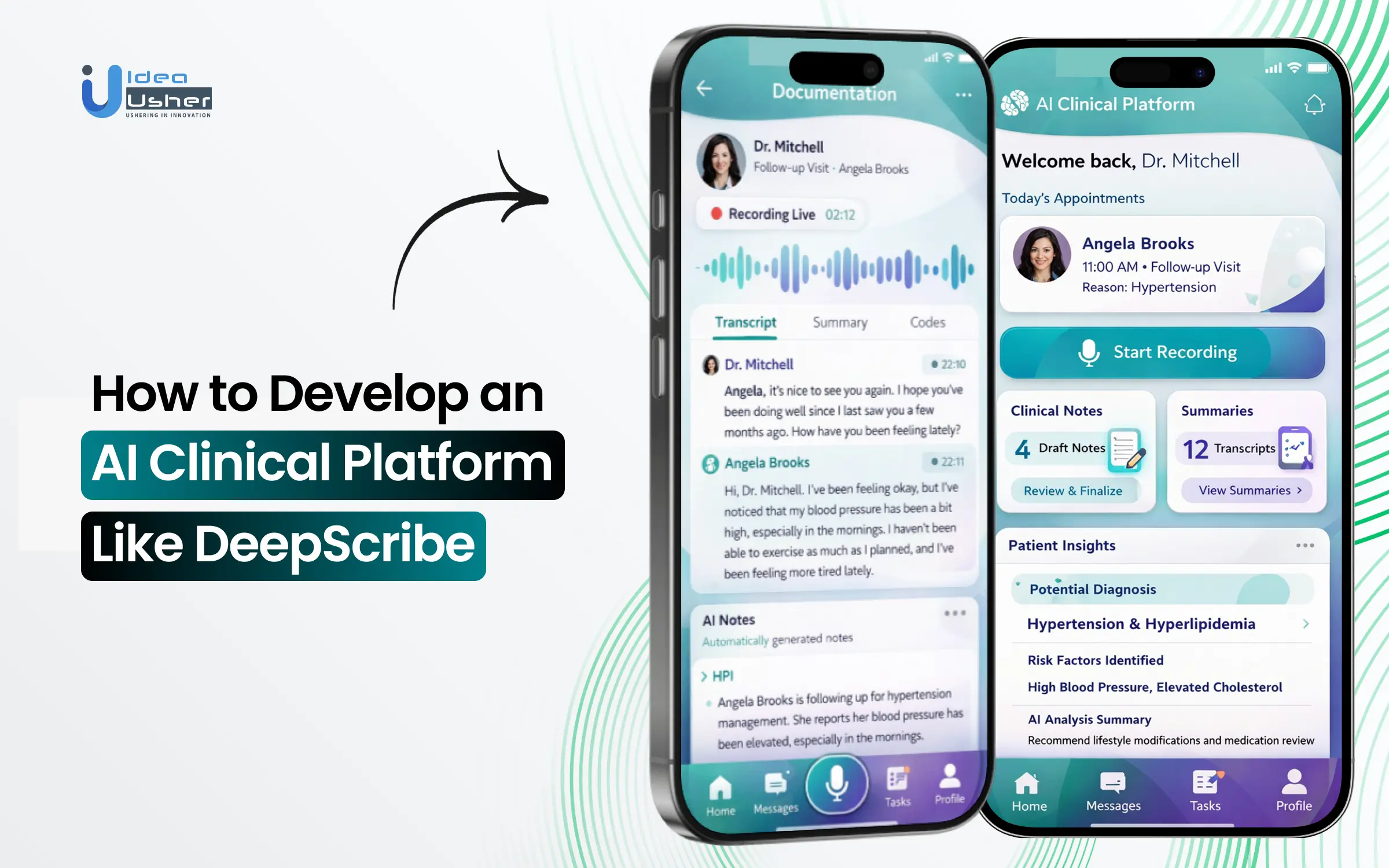
There was a time when clinical conversations ended when the patient walked out, but the real workload had only started. Documentation and coding would often stretch late into the day, and it could gradually reduce clinical efficiency. This gap has now become too large to ignore, and healthcare systems must adopt more scalable workflows. Many clinics have started using AI clinical platforms like DeepScribe to reduce documentation time and improve coding accuracy.
These systems can also capture context from conversations and reliably sync with EHR workflows. Clinicians can stay focused on care while the platform quietly handles notes in the background. This shift could strongly improve productivity and patient interaction quality over time.
Over the years, we’ve developed many AI clinical documentation solutions powered by clinical NLP and EHR interoperability frameworks. As IdeaUsher has this expertise, we’re sharing this blog to discuss the steps to develop an AI clinical platform like DeepScribe.
Why AI Clinical Platforms Are Replacing Manual Charting?
According to QYResearch, the global AI Medical Scribe Tools market is projected to reach US$ 162 million by 2032, growing at a CAGR of 6.2%. This growth stems from a fundamental collapse in traditional healthcare delivery. For years, administrative tasks have been offloaded onto clinicians, creating a structural inefficiency that is no longer fiscally sustainable.
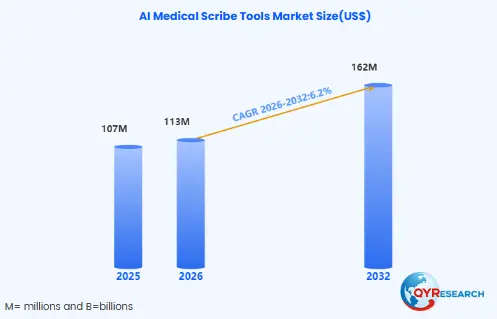
Source: QYResearch
Investors are targeting this space because the value proposition is binary. Health systems must either adopt ambient intelligence or face revenue loss through physician attrition and lower patient volume. Modern AI scribes have evolved from simple dictation into ambient platforms that capture dialogue and synthesize clinical-grade documentation in real-time.
Hidden Costs of Documentation
Manual charting costs go beyond hourly rates. Investors must account for the opportunity cost of reduced patient volume and the administrative bloat required to fix coding errors. When clinicians chart after hours, the organization loses its ability to scale effectively.
- Billing Delays: Manual charting causes a 24 to 48-hour lag in note completion. This slows billing cycles and risks missing details required for high-complexity reimbursement.
- Scribe Overhead: Human scribes involve training costs and high turnover. They also introduce privacy concerns that increase the liability profile of a practice.
- Cognitive Load: Navigating EHRs during visits reduces care quality. It leads to data entry errors that carry significant clinical and legal risks.
Impact on Patient Interaction
Ambient AI enables consultations eye-to-eye. In competitive markets, patient experience is a key differentiator. Platforms like DeepScribe or Nuance DAX operate in the background to remove the computer screen barrier. This eliminates a primary point of friction in patient satisfaction scores.
Technologically, these tools use multi-speaker diarization to filter small talk while capturing clinical data. This allows physicians to focus on diagnostics rather than typing. For an entrepreneur, this represents an experiential upgrade that enhances the brand value of the medical practice.
Demand in Specialty Care
The highest ROI for AI scribes is in specialty care like oncology and cardiology. These fields require clinical nuance that generic models lack. Platforms such as Suki provide specialized, voice-enabled workflows that cater to these unique medical branches and their specific data requirements.
- Specialization Moat: Leaders are developing specialty-specific models. These understand the unique jargon and diagnostic protocols used by expert clinicians.
- Value-Based Care: Specialties require precise HCC code documentation for risk adjustment. AI platforms that suggest these codes during conversation provide an immediate revenue lift.
- PE Scalability: For private equity firms acquiring practices, AI scribes act as a force multiplier. They ensure standardized documentation quality across all locations.
What Makes Platforms Like DeepScribe So Effective?
Premier AI medical scribes bridge the gap between messy dialogue and rigid EHR requirements. For investors, the value lies in software that replicates clinical reasoning at scale. Platforms like DeepScribe leverage deep learning to interpret intent rather than just recording sound, offering a robust solution to documentation burnout.
By automating the encounter-to-note transition, these systems eliminate documentation bottlenecks. This allows organizations to increase patient volume without increasing clinician hours. For entrepreneurs, this is a high-margin SaaS model solving a universal healthcare crisis.
Conversation to Structured Notes
The technical core is the transformation of natural speech into structured data. Multi-speaker diarization identifies the speakers while separating clinical observations from social pleasantries.
Unlike manual dictation, ambient AI captures organic exam flows. Features like Ambient Encounter Capture map data directly to sections like the History of Present Illness (HPI). This ensures notes are consistent, legible, and ready for immediate sign-off.
Context vs. Basic Transcription
Investors must distinguish between speech-to-text and context-aware intelligence. Basic tools generate transcripts requiring heavy editing. Context-aware platforms understand medical relevance. For instance, AI Pre-charting surfaces EHR context before the visit to ground the note in the patient’s history.
If a patient mentions chest pain, the system categorizes it as a cardiac symptom and filters out irrelevant noise. This precision, paired with the Customization Studio to match a doctor’s specific style, drastically reduces review time and drives user adoption.
Specialized AI for Workflows
Generic AI documentation fails in complex medical fields. Top-tier effectiveness is rooted in specialty-specific tuning. An oncology note requires different structures and vocabulary than a pediatric check-up.
- Nuanced Terminology: Advanced models for cardiology or orthopedics understand technical jargon and specific diagnostic protocols.
- Workflow Integration: Specialty AI integrates with EHR templates. Diagnosis Intelligence and Coding Intelligence surface ICD-10 and HCC codes to prevent data fragmentation.
- Actionable Data: AI Coding ensures documentation meets value-based care standards. This specialization creates a competitive moat, making it difficult for generic tools to capture the market.
Core Features Your AI Clinical Platform Must Have
Developing AI clinical platforms like DeepScribe requires focusing on clinical utility and operational flow rather than just recording interfaces. For investors, value lies in a platform’s ability to eliminate administrative friction while maintaining data integrity.
To compete with industry leaders, a professional-grade solution must include these architectural requirements.
1. Ambient Real-Time Documentation
The foundation is an ambient listener that captures natural dialogue without clinician intervention. Using advanced diarization, the technology distinguishes between the doctor, patient, and family. By processing audio in real-time, it generates clinical notes instantly, allowing for immediate sign-off.
DeepScribe and Heidi AI are prime examples of this “hands-free” approach, where documentation is produced within seconds of the visit ending.
2. AI Pre-Charting Insights
High-value platforms prepare clinicians before they enter the exam room. Effective pre-charting scans longitudinal records to surface relevant labs, imaging, and chronic conditions. This ensures the visit is grounded in context, leading to informed diagnostic decisions.
Platforms like Glass Health excel here by combining ambient capture with native clinical decision support to surface these insights before the encounter starts.
3. Automated Medical Coding
For an entrepreneur, the direct path to ROI is automating the revenue cycle. A sophisticated platform must automatically suggest ICD-10, HCC, and E/M codes based on the ambient conversation. This accurately reflects visit complexity in billing, reducing audit risks.
Fathom is a notable leader in this space, offering high levels of autonomous coding that minimize human intervention in the billing workflow.
4. Epic and Athenahealth Integration
A platform’s worth is defined by its ability to communicate with existing infrastructure. Bidirectional integration with systems like Epic and athenahealth is essential. The AI must populate specific data fields within the EHR to maintain a single source of truth.
Nuance DAX Copilot is a benchmark for this, offering deep, enterprise-grade integration that functions natively within large-scale hospital EHR environments.
5. Clinical Voice Recognition
Generic voice-to-text models struggle with dense medical jargon. Clinical-grade platforms require engines trained on millions of medical encounters to correctly identify complex medications and anatomical terms.
Suki has built its reputation on this specialized voice recognition, allowing doctors to use natural commands to navigate workflows with high technical accuracy.
6. Smart Visit Summaries
Beyond formal notes, platforms should provide actionable insights and patient-friendly summaries. These highlights follow-up instructions and medication changes to improve compliance.
Abridge is a leader in this area, specifically focusing on generating summaries that patients can actually understand, which bridges the communication gap between the clinic and the home.
Advanced Capabilities That Differentiate Your Product
To build a market-leading AI clinical platform, you must move beyond basic transcription. Investors prioritize stickiness, which includes features that make software indispensable to a clinician’s daily workflow.
By leveraging advanced machine learning, your product transitions from a passive listener to an active clinical partner, creating a competitive advantage that generic tools cannot replicate.
1. Clinician Behavior Personalization
Every physician has a unique documentation style. A premier platform must learn these preferences, adapting its output to match specific formatting and shorthand.
Platforms like Freed exemplify this by using machine learning to get better at understanding a clinician’s specific phrasing patterns over time. This reduces manual corrections, increasing user retention and brand loyalty.
2. Multi-Specialty AI Models
Generic models fail in high-stakes specialty medicine. To differentiate, you must deploy models tuned for fields like oncology and cardiology that understand specialized diagnostic criteria like RECIST or NYHA classifications.
DeepScribe leads in this area with deep specialty coverage for complex fields, ensuring accuracy that general-purpose scribes lack and making the platform vital for high-revenue specialist groups.
3. Real-Time Decision Support
The next frontier for clinical AI is shifting from retrospective notes to real-time assistance. Advanced platforms can listen to conversations and subtly surface clinical decision support, such as flagging drug interactions.
Glass Health differentiates itself by offering real-time diagnostic insights and suggested history questions during the encounter, transforming the AI into a consultant rather than just a secretary.
4. Value-Based Care Insights
In the shift toward value-based care, data is the most valuable currency. A differentiated platform uses predictive analytics to identify care gaps or rising risk factors before they become acute.
Solutions like Abridge prioritize these insights by highlighting key follow-up instructions and diagnostic details that support long-term population health. For executives, these insights are critical for managing risk-adjusted revenue.
How to Develop an AI Clinical Platform Like DeepScribe?
Building an AI clinical platform like DeepScribe starts with capturing real-time doctor-patient conversations and converting them into structured medical notes using speech recognition and clinical NLP. It should also integrate securely with EHR systems while continuously learning from context to improve accuracy and coding quality.
We have developed multiple AI clinical platforms similar to DeepScribe, and this is how the process usually unfolds.
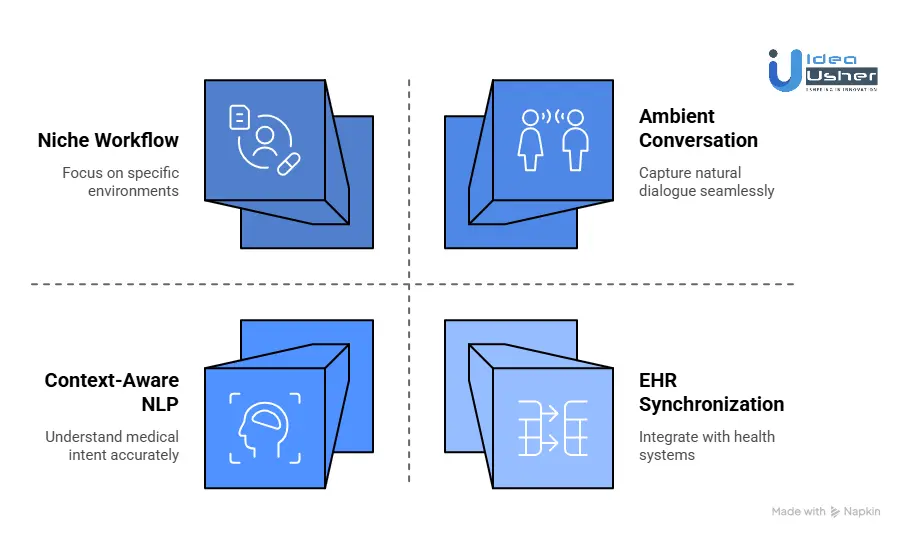
1. Niche Workflow Mapping
We begin by mapping the “day in the life” of your target clinicians. Success depends on solving for specific environments, like the rapid pace of Urgent Care or the complex tracking in Oncology. By focusing on these high-friction areas, we build interfaces that feel like a natural extension of a doctor’s existing routine.
2. Ambient Conversation Design
Our core build features a listener that captures natural dialogue without “wake words” or manual triggers. We implement advanced multi-speaker diarization to separate the voices of the doctor and patient, even in noisy rooms. This ensures the tech stays in the background, allowing the provider to maintain eye contact with the patient.
3. Context-Aware Medical NLP
We move beyond basic transcription by building NLP models that understand medical intent. Our systems filter out small talk to extract only clinically significant data. The AI then maps this information directly into structured SOAP note sections like the History of Present Illness (HPI), ensuring the output is ready for immediate review.
4. Seamless EHR Synchronization
A platform is only as strong as its integration. We build bidirectional sync with major systems like Epic and athenahealth so data flows into the patient chart without manual copy-pasting. This “write-back” functionality populates discrete data fields, keeping the EHR as the single, updated source of truth.
5. Specialty-Specific AI Training
To ensure accuracy, we train models on massive datasets of specialized medical encounters. This allows the AI to correctly identify complex jargon and diagnostic protocols for fields like Cardiology or Neurology. By using specialty-tuned models, we provide a level of precision that generic AI tools simply cannot match.
6. HIPAA and Data Compliance
Security is our foundation. We implement a security-first architecture featuring end-to-end encryption and SOC 2 Type II compliance. By ensuring full HIPAA adherence and using HITRUST-certified cloud environments, we guarantee that all protected health information remains secure and de-identified during processing.
Cost Breakdown of an AI Clinical Platform like DeepScribe
Building enterprise-ready AI clinical platforms requires significant capital, balancing cutting-edge machine learning with the stringent requirements of healthcare. For clients entering this market, the investment is divided between the rapid development of the initial engine and the long-term “moat” of data accuracy and regulatory trust.
MVP vs Full-Scale Costs
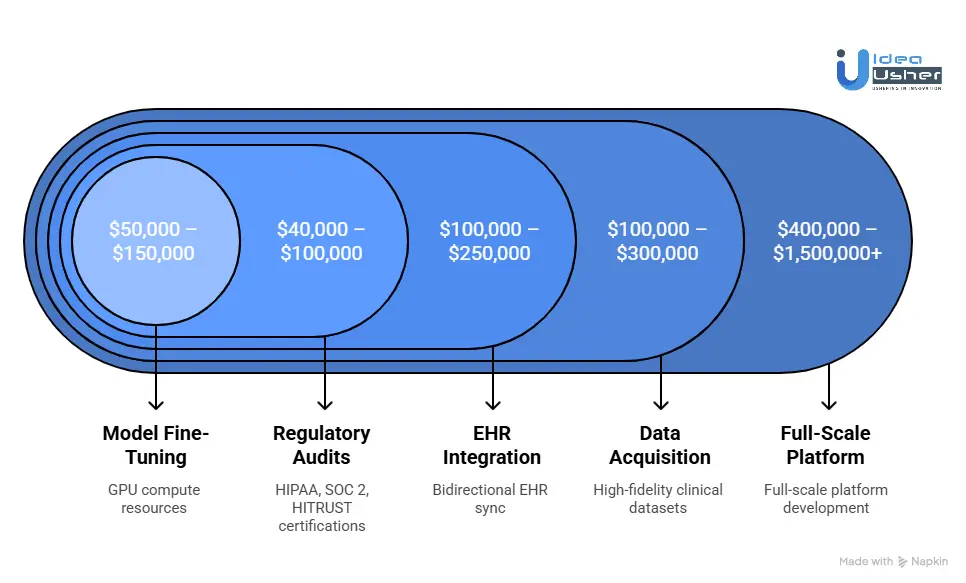
The distance between a functional prototype and a market-ready tool is wide. An MVP typically focuses on a single specialty with basic “text-dump” EHR functionality, while a full-scale platform handles multi-speaker diarization and complex background noise.
| Phase | Estimated Cost (USD) | Timeline |
| MVP Development | $50,000 – $150,000 | 3 – 5 Months |
| Full-Scale Platform | $400,000 – $1,500,000+ | 9 – 18 Months |
Strategic Insight: Most of the “Full-Scale” cost goes into perfecting the Customization Studio experience, allowing individual clinicians to tune the AI to their specific shorthand and note-taking habits.
Training & Data Costs
The intelligence of the platform is defined by its exposure to real-world medical dialogue. Generic datasets won’t suffice for specialty-specific accuracy.
- Data Acquisition: Expect to spend $100,000 – $300,000 to license high-fidelity, de-identified clinical datasets.
- Model Fine-Tuning: Customizing LLMs for medical precision costs roughly $50,000 – $150,000 in GPU compute resources and data science labor.
- Validation: Clinical testing to prevent “hallucinations” in Diagnosis Intelligence or medication dosages adds another $30,000 – $70,000 to the research budget.
Integration & Compliance
In modern healthcare, “if it isn’t in the EHR, it didn’t happen.” Building secure bridges to legacy systems like Epic and athenahealth is a massive undertaking.
- Bidirectional EHR Sync: Developing the “write-back” features that populate discrete data fields usually costs $100,000 – $250,000.
- Marketplace & Certification: Major vendors charge “App Store” or review fees. Budget $5,000 – $25,000 for certification processes.
- Regulatory Audits: HIPAA, SOC 2 Type II, and HITRUST certifications are non-negotiable costs of entry, totaling $40,000 – $100,000 in initial legal and audit fees.
Maintenance & Scaling
Deployment is just the beginning. To maintain high accuracy, the system requires continuous monitoring and infrastructure support.
- Inference & Cloud GPU: As your user base grows, high-performance cloud costs scale to $10,000 – $50,000+ per month.
- Coding Intelligence Updates: To keep up with annual changes in ICD-10, HCC, and E/M guidelines, budget 15% – 20% of the original development cost for yearly updates.
- Specialized Support: 24/7 uptime for critical hospital workflows requires a dedicated technical support team, typically costing $150,000 – $300,000 annually.
What It Really Takes to Match DeepScribe-Level Accuracy?
To develop AI clinical platforms that rival industry leaders, you must solve for the “last mile” of clinical accuracy. High-fidelity scribing isn’t about perfect dictation; it is about extracting truth from a chaotic environment. Our engineering focus centers on bridging the gap between raw audio and a finished, sign-ready chart.
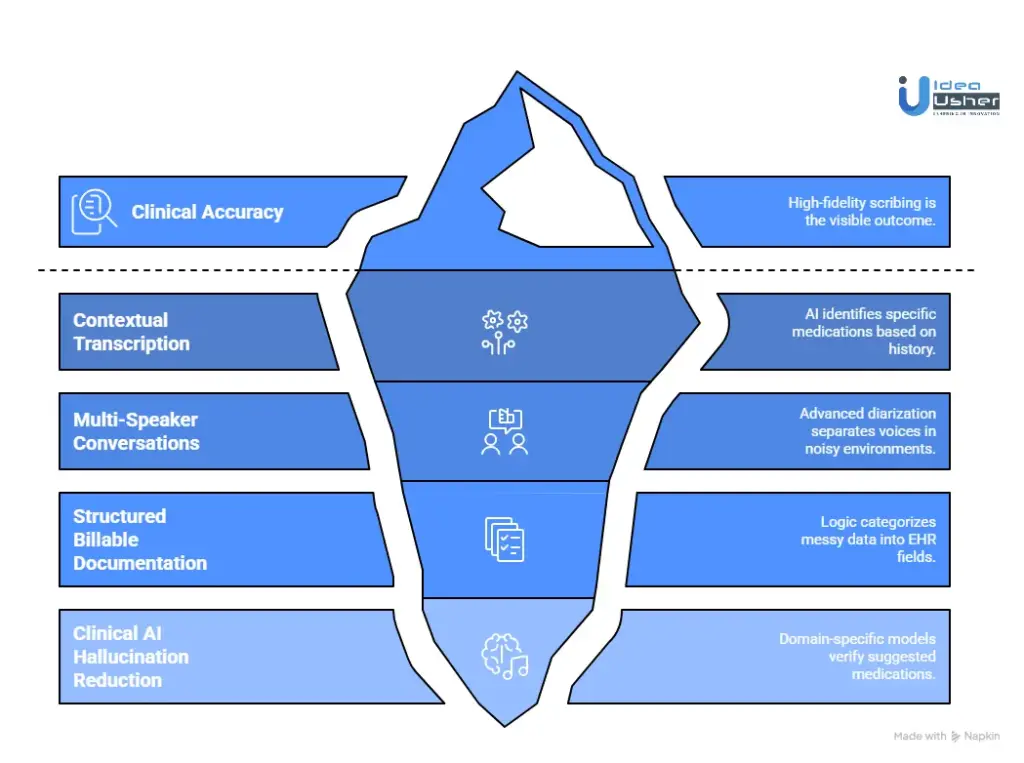
1. Contextual Transcription
A verbatim transcript is actually a burden for a doctor. If a patient says, “I’ve been taking that red pill every morning,” a basic AI transcribes the words, but a professional-grade platform identifies “that red pill” as Lisinopril 10mg based on the patient’s history.
- The Difference: Raw transcription is a mirror. Context-aware AI is a filter.
- Our Approach: We integrate AI Pre-charting to pull longitudinal data into the current session. Similar to the benchmarks set by DeepScribe, this ensures the AI understands “it’s better” refers specifically to the patient’s chronic hypertension.
2. Multi-Speaker Conversations
Clinical environments are loud, and speakers often overlap. Our builds utilize advanced diarization to separate the physician’s voice from the patient’s, even when a third party like a spouse or translator, is in the room.
Technical Benchmark: Achieving top-level accuracy requires a “Hard Input” strategy. The system must filter out crosstalk and background noise while maintaining a continuous “thread” of the clinical narrative.
3. Structured Billable Documentation
A patient visit doesn’t follow a SOAP note format; it meanders from symptoms to social talk and back. To match top-tier output, we develop specialized logic to categorize this “messy” data into discrete EHR fields.
- Deduplication: Removing redundant patient mentions of the same symptom.
- Clinical Mapping: Moving a casual mention of family history into the correct “Family History” section.
- Diagnosis Intelligence: Surfacing potential ICD-10 codes based on the conversation to ensure the note is billable immediately.
4. Clinical AI Hallucination Reduction
The biggest risk in AI clinical platforms is “hallucination,” which is when the AI invents a detail or confuses a dosage. We mitigate this through a “Check and Balance” architecture.
- Logic Over Lyrics: We do not rely solely on a single Large Language Model. We layer domain-specific medical models on top of the transcript to verify every suggested medication was actually mentioned.
- Customization Studio: We give clinicians a way to “teach” the AI. Just as DeepScribe uses iterative feedback to refine its models, our system learns preferences from every edit to create an ever-tightening loop of accuracy.
Building Context-Aware AI That Goes Beyond Scribing
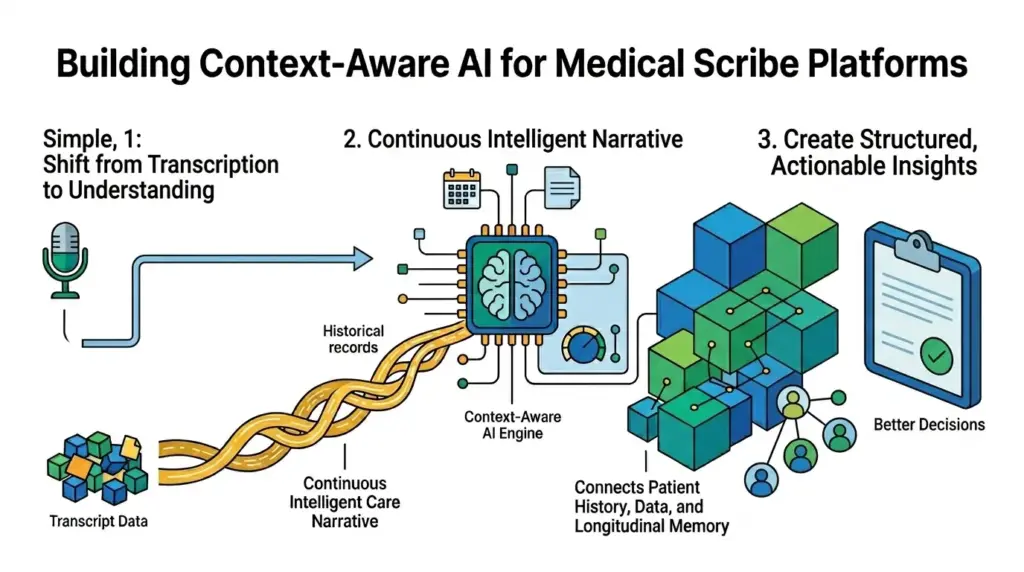
To develop AI clinical platforms that provide real value, you must move beyond transcription toward true clinical reasoning. A simple scribe only records; a context-aware assistant understands. Our focus is on building an intelligent layer that sits between the conversation and the patient record, turning passive recordings into multi-dimensional medical tools.
1. History Mapping
A smart platform knows the patient before the doctor says hello. By pre-loading a contextual brief, the AI listens for updates to existing conditions rather than treating every mention as new information.
- The Workflow: As a patient mentions leg pain, the AI cross-references the last orthopedic note.
- The Result: Instead of a generic note, the AI writes: “Patient reports persistent pain in the left calf, previously noted as a Grade 1 strain on March 12.”
- Market Example: Suki AI uses this type of ambient intelligence to surface relevant patient data, allowing doctors to verbally retrieve history during the visit.
2. Data Connectivity
Raw dialogue is often ambiguous. We build dynamic data connectors that allow the AI to query the EHR in real-time to clarify spoken statements.
Technical Synergy: If a doctor mentions “starting the standard dose,” the AI doesn’t guess. It pulls the latest lab results from the EHR and suggests the exact milligram dosage based on current guidelines. This bridge between audio and data eliminates common sources of medical error.
3. Longitudinal Memory
Patient care is a marathon. We implement a three-tier memory architecture to ensure the AI maintains a “golden thread” of care across years of visits.
- Core Memory: Captures the immediate “right now” of the current encounter.
- Contextual Memory: Tracks trends, such as gradual weight loss or sliding blood pressure.
- Persistent Memory: Stores “never-forget” facts like life-threatening allergies.
- Market Example: Platforms like Nabla Copilot leverage these memory layers to ensure that every summary is tailored to the specific longitudinal needs of the patient’s specialty.
4. Actionable Insights
The final step is converting messy conversational data into a structured plan that a care team can act upon immediately.
| Raw Patient Input | AI Interpretation | Actionable Insight |
| “I’m always thirsty and tired.” | Potential Hyperglycemia | Alert: Suggest A1C test and metabolic panel. |
| “I missed my pills for three days.” | Medication Non-Adherence | Task: Flag for pharmacist consult or education. |
| “My chest feels tight when I walk.” | Exertional Angina | Priority: Order stress test and update EKG. |
By layering this intelligence on top of the ambient audio, we ensure your platform doesn’t just save time; it surfaces the signals hidden within the noise to improve care.
Building AI That Works Across Specialties for AI Clinical Platforms
To build a competitive AI clinical platform, you must move beyond “one-size-fits-all” models. A primary care note is a narrative, but a specialty note is data-driven. Our engineering treats each medical branch as a distinct language, ensuring the AI thinks like a specialist rather than a generalist.
Oncology vs. Primary Care
Oncology documentation is longitudinal and complex, tracking multi-drug regimens and staging over months. Primary care is transactional, covering everything from infections to wellness checks.
- Primary Care Focus: High-speed capture of Chief Complaints and rapid ROS checklists.
- Oncology Focus: Tracking RECIST criteria, chemotherapy cycles, and toxicity monitoring.
- Market Example: Ambience Healthcare excels here by providing a “Pre-Visit” suite that synthesizes complex chart history specifically for specialists before they enter the room.
- Our Solution: We deploy Workflow Templates that automatically toggle the AI logic based on appointment type, ensuring an oncologist sees a treatment-heavy plan while a PCP gets a concise SOAP summary.
Cardiology Model Adaptation
Cardiology is a field of numbers. To match the precision of leaders like DeepScribe, the AI must prioritize ejection fractions, lipid values, and EKG interpretations over general dialogue.
The Cardio Logic: When a cardiologist says “the EF is thirty percent,” the AI should not just transcribe the words. Our specialized models recognize this as a critical marker, automatically flagging it for the Objective section and checking it against previous imaging for any significant changes.
Terminology and Nuance
General AI often trips over similar-sounding medical terms. In high-stakes environments, confusing atrial fibrillation with atrial flutter is a critical error.
- Phonetic Mapping: We build custom phonetic dictionaries for each specialty to distinguish between sound-alike medications.
- Contextual Guardrails: If the AI hears a term statistically rare for a specific specialty, it triggers a secondary verification against the patient problem list.
- Market Example: Augmedix addresses this by using specialty-specific fine-tuned LLMs that make multiple passes over a transcript to ensure nuanced terminology is captured accurately.
Scaling and Accuracy
As you add more specialties, there is a risk of model drift. We solve this through a modular architecture that maintains high precision.
| Scaling Strategy | Technical Implementation | Benefit |
| Modular Fine-Tuning | We use “Adapter” layers that plug into the core LLM for specific fields. | Keeps the core model lean while adding deep specialty expertise. |
| Context Switching | The AI identifies the specialty from EHR metadata before the recording starts. | Prevents the AI from applying pediatric logic to a geriatric patient. |
| Human-in-the-Loop | We implement a QA layer for high-complexity surgical or oncology notes. | Ensures 99% accuracy for the most complex medical summaries. |
Why Choose IdeaUsher for AI Clinical Platforms?
At IdeaUsher, we transform complex healthcare challenges into seamless digital experiences. With over 500,000 hours of coding experience, our team of ex-MAANG/FAANG developers brings a world-class engineering mindset to every project. We don’t just build apps; we engineer high-performance ecosystems that empower clinicians and improve patient outcomes.
Proven Healthcare AI
Our experience in developing AI clinical platforms is defined by precision and deep domain expertise. We have successfully deployed systems ranging from ambient scribing to diagnostic support. By leveraging refined machine learning models, we reduce your time-to-market while ensuring clinical-grade accuracy.
End-to-End Development
We handle the entire product lifecycle, taking your vision from a whiteboard concept to a fully deployed enterprise solution. Our process covers clinical UI/UX design, robust backend engineering, and sophisticated AI model training. We provide the technical heavy lifting required to build, launch, and scale your platform.
Scalable Compliance
Security is at the heart of our development. We utilize a “security-first” architecture that ensures full HIPAA and SOC 2 Type II compliance from day one. Our systems are built on cloud-native, auto-scaling infrastructures that handle thousands of concurrent clinical encounters without latency or data risk.
Conclusion
Building an AI clinical platform like DeepScribe requires a sophisticated blend of ambient intelligence, medical-grade NLP, and deep EHR integration. Success lies in moving beyond simple transcription to provide a context-aware assistant that truly understands the nuances of specialty-specific care. By partnering with IdeaUsher, you turn this complex vision into a secure, scalable, and HIPAA-compliant reality that empowers clinicians to focus back on their patients.
FAQs
A1: AI accelerates clinical development by automating patient recruitment, optimizing trial site selection, and identifying patterns in massive datasets. In AI clinical platforms, these models can predict patient outcomes and monitor safety in real time, reducing the time required to bring new therapies to market.
A2: Developing a professional AI medical scribe typically ranges from $50,000 for an MVP to over $500,000 for an enterprise platform. The total investment depends on the depth of EHR integrations, the complexity of the AI models, and the cost of maintaining HIPAA-compliant infrastructure.
A3: These apps use ambient sensing to capture the natural conversation between a doctor and patient. The audio is processed through specialized medical NLP models that filter out small talk, identify clinical intent, and automatically populate the relevant sections of an electronic health record.
A4: Core features include multi-speaker voice recognition, automated SOAP note generation, and bidirectional EHR synchronization. High-end platforms also offer specialty-specific templates, ICD-10 coding suggestions, and mobile-first interfaces to ensure clinicians can review and sign notes from any device.