

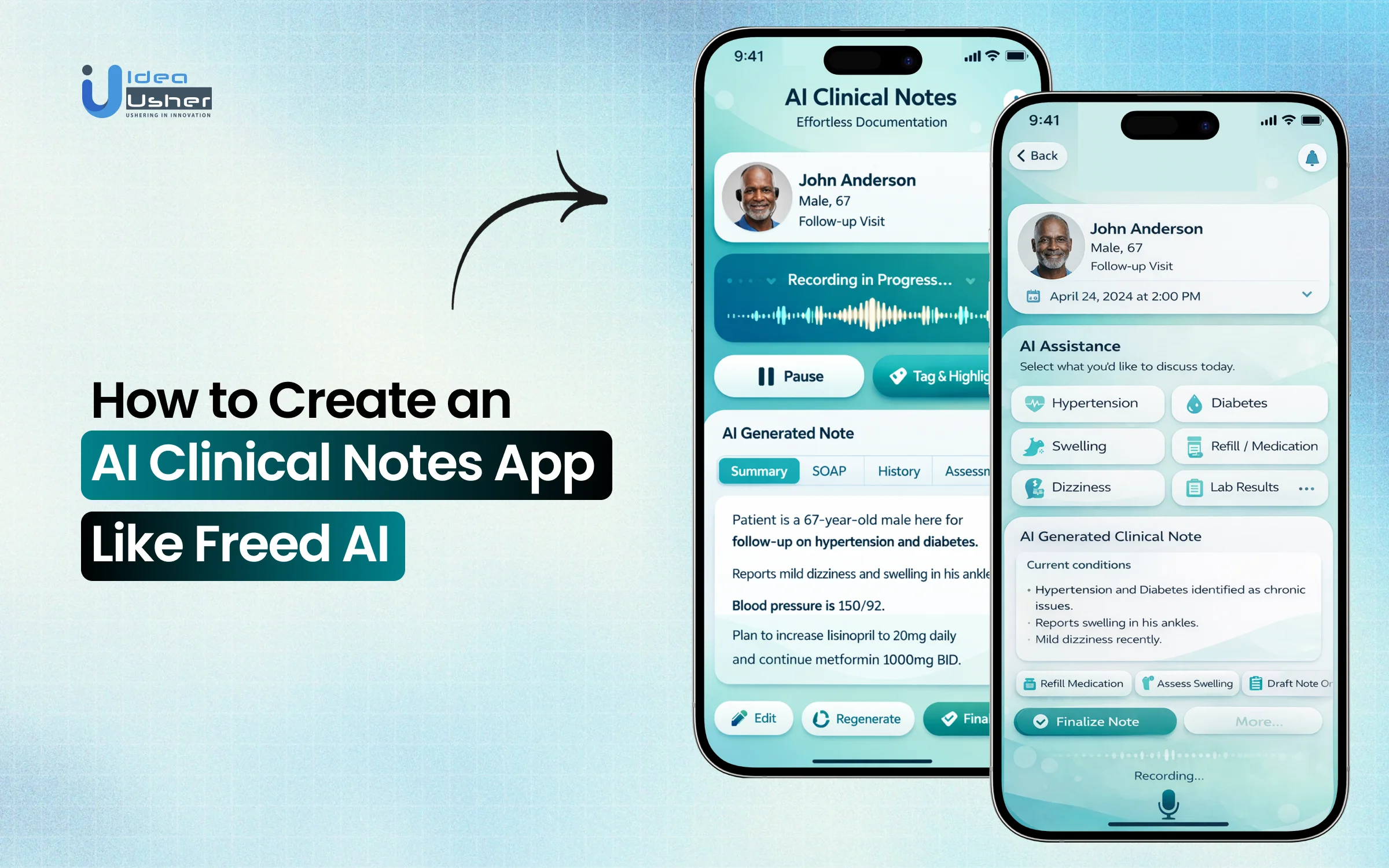
In healthcare, time rarely moves evenly, and some days may feel under control while others quickly build a backlog of unfinished notes after hours. The problem is not inefficiency but a widening gap between clinical care and documentation load. As requirements grow, clinicians must handle more structured data with limited support. Many clinics are now turning to AI clinical notes apps to manage this shift.
These systems can automatically capture patient conversations and convert them into structured records. Platforms like Freed AI can instantly generate usable notes and reduce manual entry. This approach should help clinicians focus more consistently on patient care while still meeting technical documentation standards.
Over the years, we’ve developed several AI clinical documentation solutions powered by clinical NLP and healthcare interoperability frameworks. As we have this expertise, we’re sharing this blog to discuss the steps to develop an AI clinical notes app like Freed AI.
Market Demand for AI Clinical Notes Apps
According to Precedence Research, the global AI note-taking market was valued at USD 623.50 million in 2025 and is projected to reach USD 3476.74 million by 2035, growing at a CAGR of 18.75%. For investors, this shift represents a move from manual labor to autonomous infrastructure.

Source: Precedence Research
Administrative overload is pushing healthcare systems toward collapse. Physicians currently spend double the time on paperwork compared to patient care. This inefficiency creates a massive opening for ambient intelligence tools like Freed AI, which automates the extraction of clinical data from natural conversation.
Modern platforms now exceed 90% accuracy in mapping unstructured dialogue into structured SOAP notes. For entrepreneurs, this sector offers high barriers to entry and massive lifetime value from institutional clients who view these tools as essential infrastructure.
Global Staffing Shortage
A projected shortfall of 10 million healthcare workers by 2030 has made human-dependent documentation models obsolete. Traditional scribes are too expensive and prone to high turnover.
AI-native platforms serve as a force multiplier. This replaces the labor-heavy scribe model with high-margin AI infrastructure. Solutions like Abridge have already gained massive traction in large health systems by linking recorded audio directly to the generated note, providing a level of auditability that human scribes cannot match.
AI in Clinical Workflows
Clinicians are demanding agentic AI that integrates directly into their daily routines. They need tools that do more than transcribe; they need real-time clinical support.
- Workflow Integration: Tools must live within the EHR to eliminate the “toggle tax.” Nabla Copilot, for instance, has successfully captured the market by offering a high-speed, browser-based interface that works alongside any digital record.
- Burnout Reduction: AI documentation has reduced physician burnout by 31% by eliminating “pajama time,” which refers to the late-night charting that drives physicians out of the profession.
- Patient Focus: Removing screens from the exam room improves patient satisfaction and reimbursement metrics, turning the visit back into a human-to-human interaction.
AI Investment Trends
Capital is flowing aggressively into healthcare AI, which captured 55% of all digital health funding in 2025. Investors are prioritizing domain-specific tools with HIPAA-compliant “moats.”
These platforms are exceptionally “sticky.” Once integrated into a billing cycle, switching costs are prohibitive. This ensures predictable, recurring revenue with software margins often exceeding 80%. As the market matures, the focus is shifting toward platforms that offer deep enterprise-grade security and seamless multi-specialty support.

Market Gap in AI Clinical Documentation
A functional void remains between recording audio and understanding medicine. Many health systems are trapped in a phase where rigid software has replaced paper, but at the cost of clinical efficiency. The market gap exists where technology fails to capture the non-linear, often chaotic nature of real patient encounters.
The opportunity for investors lies in the fact that current solutions often replace a “writing” problem with a “reviewing” problem. Clinicians still spend too much time editing drafts that lack medical context. The next leap requires cognitive AI that understands clinical intent rather than just transcribing syntax.
Limits of Traditional Dictation Tools
Legacy systems are increasingly viewed as relics. These tools rely on a one-way model where the physician must still perform the mental labor of structuring data.
- Linear Constraints: These tools require awkward verbal commands like “New Paragraph,” which breaks the clinician’s focus.
- Zero Synthesis: They transcribe words but cannot synthesize information or distinguish between a patient’s “maybe” and a doctor’s “confirmed diagnosis.”
- High Correction Rates: Lacking medical common sense, legacy tools often produce literal transcriptions of verbal stumbles, requiring manual cleanup.
Where Existing Apps Still Fall Short
Institutional frustration persists because first-generation AI scribes often lack transparency. When the logic behind a clinical summary is opaque, it creates liability concerns for providers.
Medical directors don’t need a 10-minute transcript of a patient’s vacation; they need the 30 seconds of relevant clinical updates distilled into the record.
Current apps also struggle with multi-party conversations involving caregivers or translators. Additionally, many fail to handle diverse dialects and accents, limiting their utility in high-volume, urban clinical settings.
Opportunities for New Entrants
Market leaders will soon shift from “Scribes” to “Clinical Intelligence Engines.” For those building or investing in new platforms, the competitive edge lies in three areas:
- Specialty Logic: Generalist apps are common. Platforms built with deep logic for specific fields like oncology or orthopedics can command premium pricing.
- Hyper-Personalization: Systems that learn a doctor’s unique style and shorthand create a “personal moat,” making the software indispensable.
- Autonomous Billing: Linking clinical notes directly to 99% accurate billing codes (ICD-10/CPT) is the ultimate value driver for healthcare entrepreneurs.
By solving these specific friction points, new entrants can displace incumbents currently burdened by the technical debt of earlier AI models.
What Is Freed AI and How Does It Work?
Freed AI is an ambient medical scribe engineered to strip away the administrative weight of clinical charting. It acts as a background intelligence layer that listens to patient encounters in real-time. The primary appeal of this platform is zero-friction adoption; it requires no complex hardware, allowing for rapid scaling across medical practices.
The platform targets the high-pain sector of primary care. Automating the most tedious part of a clinician’s day, it transforms a manual clerical task into a streamlined, automated workflow.
Capturing Patient Conversations
The technology uses ambient sensing to record dialogue without requiring the doctor to change how they speak. Through the Capture Conversation feature, the AI identifies and separates the voices of the clinician and the patient.
| Capability | Benefit |
| Passive Listening | Eliminates the need for verbal wake words or commands. |
| Noise Filtering | Isolates clinical speech from background clinic sounds. |
| Multi-Language | Transcribes diverse languages directly into English clinical notes. |
From Voice to Structured Notes
Post-encounter, the platform processes raw audio through a medically-tuned Large Language Model. Within seconds, it filters out small talk and extracts relevant symptoms and findings.
The system then generates a structured SOAP note. Through the Copy to EHR feature, clinicians can move these notes into their records with a single click. This transition from unstructured conversation to professional documentation is the core value driver, reducing charting time by up to 70%.
Learning and Adapting to Clinicians
Personalization is the platform’s competitive moat. Using the Learn Format feature, the AI evolves to mirror the specific documentation habits of each provider.
- Style Mirroring: The AI Assistant learns a doctor’s unique shorthand and preferred terminology through their manual edits.
- Specialty Templates: Supported by Specialty-specific Templates, the platform ensures the note structure fits over 60 different clinical contexts.
- Smart Prep: Features like Smart Visit Prep provide summaries of previous visits, ensuring the AI has the context needed to personalize current notes.
“The software doesn’t just write a note; it learns to write your note, creating a personalized experience that makes the tool nearly impossible for a clinician to give up once trained.”
Core Features of AI Clinical Notes Apps Like Freed AI
The architecture of modern AI clinical notes apps like Freed AI is built on the premise of complete administrative liberation. These platforms do not just record audio; they function as intelligent clinical partners that handle the most burdensome aspects of the patient encounter.

By centralizing documentation, coding, and patient communication, they allow medical professionals to refocus on the human element of care.
1. Real-Time Transcription
The foundation of these tools is high-accuracy ambient sensing that captures natural dialogue without the need for manual dictation. Modern systems utilize advanced speaker diarization to distinguish between multiple voices while filtering out environmental noise.
Heidi Health, for instance, has gained significant traction by offering ambient listening that functions in over 100 languages. This ensures every clinical detail is captured in real-time to provide a verbatim baseline for structured documentation.
2. Automated SOAP Notes
Moving beyond simple transcription, these platforms use medically-tuned language models to synthesize unstructured conversations into professional clinical formats. The AI identifies key medical data points and organizes them into the SOAP structure.
Abridge excels in this area by not only drafting the note but also mapping the generated text directly back to the original audio. This allows clinicians to verify the synthesis of unstructured dialogue into a refined, EHR-ready narrative.
3. ICD-10 and CPT Code Suggestions
To streamline the revenue cycle, top-tier clinical apps analyze the documented encounter to suggest appropriate billing and diagnostic codes. By mapping the clinical narrative to specific ICD-10 and CPT requirements, the software reduces the cognitive load of coding while minimizing the risk of claim denials.
Suki has become a leader in this functional niche. It utilizes its voice-enabled assistant to suggest accurate codes based on the documented encounter, effectively bridging the gap between clinical care and financial reimbursement.
4. Smart Patient Summaries and Instructions
Effective care extends beyond the exam room, and AI tools facilitate this by auto-generating plain-language summaries and follow-up instructions. These documents translate complex medical jargon into actionable guidance that patients can easily understand, improving treatment adherence.
Ambience Healthcare is frequently cited for its “Chart Awareness” capabilities. It helps generate these patient-facing materials by synthesizing the current visit with the patient’s longitudinal history to ensure instructions remain contextually relevant.
5. EHR Integration and Data Sync
The utility of an AI scribe is maximized when it communicates directly with existing Electronic Health Record systems. Through secure API connections or browser extensions, the platform can sync generated notes and codes directly into the appropriate patient chart.
DeepScribe has set a high bar for this feature by offering bi-directional integration with major systems like Epic and Cerner. This eliminates the “toggle tax” by routing clinical data into discrete fields rather than just dumping a narrative block into a progress note.
6. Voice Personalization for Clinicians
Recognizing that every provider has a unique style, advanced platforms incorporate machine learning to adapt to individual preferences. The system observes manual edits and formatting choices over time, eventually mirroring the clinician’s specific terminology and narrative flow.
Nabla has successfully utilized this adaptive approach. It allows the AI to learn a doctor’s specific “clinical voice” so that each subsequent draft requires less review, creating a highly customized tool that evolves with the practitioner’s career.
Advanced Features That Drive AI Clinical Notes App Adoption
Advanced AI clinical notes apps are transforming modern medicine by shifting the focus from screens back to patients. These platforms function as intelligent clinical partners, handling the most burdensome administrative aspects of every encounter. By centralizing documentation, coding, and patient communication, they allow medical professionals to reclaim their time and refocus on the human element of care.
1. Learning Doctor Preferences
One of the most powerful drivers of retention is the ability of the AI to mirror a clinician’s unique professional voice. Modern platforms use machine learning to analyze manual edits, gradually adopting preferred terminology and shorthand.
Nabla, for example, uses a “memory” feature that learns a doctor’s specific narrative style over time, significantly lowering the “edit-to-publish” ratio.
2. Multilingual and Accent Handling
In diverse clinical settings, processing multiple languages and varied accents is a critical differentiator. Top-tier apps can record encounters in languages such as Spanish or Mandarin and automatically generate a structured English note.
Heidi Health excels here, supporting over 100 languages to ensure that language barriers do not compromise the integrity or speed of the documentation.
3. Noise Filtering in Busy Clinics
Clinical environments are rarely silent, often filled with medical equipment and hallway chatter. Advanced apps employ neural noise suppression to isolate the conversation between the doctor and patient.
DeepScribe utilizes sophisticated audio processing to ensure high accuracy even in high-traffic emergency rooms, preventing background distractions from polluting the narrative.
4. Real-Time Consultation Alerts
The shift toward agentic AI allows platforms to provide active support during the visit. Some systems now flag potential drug interactions or remind clinicians to ask about specific symptoms based on patient history.
Suki integrates these “smart nudges” directly into the workflow, acting as a safety net to ensure critical details are not overlooked during fast-paced consultations.
5. Referral and Documentation AI
Beyond the standard SOAP note, comprehensive platforms are expanding into secondary tasks. AI can now instantly draft referral letters and insurance authorization justifications based on the visit audio.
Abridge stands out by generating these ancillary documents alongside the clinical note, addressing the entire administrative lifecycle of a patient encounter in one go.
How to Create an AI Clinical Notes App Like Freed AI?
Creating an AI clinical notes app like Freed AI starts with understanding how clinicians document patient visits and then designing a system that captures speech and converts it into structured medical notes. It should carefully use speech recognition and medical NLP models while securely handling patient data so the solution works reliably in real clinical environments.
We have developed a range of AI-powered clinical notes apps like Freed AI, and here’s how we get it done.

1. Validate Clinical Demand
Success begins by identifying specific administrative bottlenecks within the clinic. We engage with medical directors to understand EHR frustrations and documentation habits. This discovery phase ensures we solve “burning” problems like physician burnout rather than building a technical novelty without market fit.
2. Define Patient Workflows
Our architects design for the “zero-click” reality of high-volume exam rooms. We map the journey from the first “hello” to the final note signature to ensure the AI captures conversations passively. By defining these touchpoints early, the app integrates into the clinician’s natural rhythm instead of forcing them to adapt.
3. Select Speech & NLP Models
Choosing the right technical stack is critical for clinical-grade accuracy. We utilize specialized speech-to-text models like Whisper v3 to handle complex terminology and accents. For the reasoning layer, we leverage medical-specific LLMs like GPT-4o or Med-PaLM to synthesize unstructured audio into professional SOAP notes.
4. Build Secure Data Pipelines
In healthcare, security is a foundational requirement. We construct robust, HIPAA-compliant architectures that utilize end-to-end encryption for all data. Our pipelines include granular audit logs and automated de-identification to meet the rigorous compliance standards and SOC2 requirements necessary for institutional trust.
5. Design Hands-Free UX
The interface is optimized for a minimalist experience that reduces cognitive load during a busy shift. Our UX team focuses on high-visibility status indicators and seamless “Copy to EHR” functionality. This approach ensures the technology feels like a helpful assistant that supports, rather than distracts from, the patient-provider connection.
6. Launch With Doctor Feedback
We believe in rapid, iterative deployment with a core group of “alpha” clinicians. By launching a lean MVP, we gather real-world data on how the AI handles variables like background noise or multi-party chatter. This feedback loop allows us to fine-tune the “clinical voice” of the app to ensure indisputable product-market fit.
Cost to Build an AI Clinical Notes App Like Freed AI
The financial roadmap for developing AI clinical notes apps is divided between initial engineering and long-term operational overhead. In the current landscape, building a HIPAA-compliant platform requires a significant upfront investment to ensure the medical accuracy and data security that providers demand.

MVP Development Cost Breakdown
A Minimum Viable Product focuses on the core “Capture-to-Note” loop. This phase establishes the essential user interface, basic transcription, and secure cloud storage.
| Development Phase | Estimated Cost (USD) |
| UX/UI & Prototyping | $10,000 – $20,000 |
| Core Backend & HIPAA Security | $30,000 – $55,000 |
| EHR Integration (Initial) | $15,000 – $30,000 |
| Compliance Audits | $10,000 – $20,000 |
| Total MVP Estimate | $65,000 – $125,000 |
Cost of AI Model Training
Most modern developers do not train “Frontier” models from scratch. Instead, they focus on fine-tuning existing medical LLMs to handle specific clinical terminologies and diverse accents.
The cost to adapt a model like Whisper or Llama typically ranges from $20,000 to $80,000. This budget covers data acquisition, GPU compute time, and human-in-the-loop (HITL) annotation, where actual doctors verify the AI’s output to ensure clinical safety.
Third-Party API and Cloud Costs
Operating an ambient scribe creates recurring expenses that scale with your user base. Since clinical data requires extreme care, HIPAA-compliant cloud hosting often carries a 25% premium over standard rates.
- LLM API Fees: Using models like GPT-4o or Med-PaLM costs roughly $0.50 to $1.50 per hour of processed audio.
- Transcription APIs: Dedicated medical Speech-to-Text services often add $500 to $1,500 monthly for a medium-sized practice.
- Secure Infrastructure: HIPAA-compliant hosting, storage, and encrypted audit logs generally cost $1,000 to $3,000 per month.
Ongoing Maintenance and Scaling
Launching the app is only the beginning. To keep the platform relevant and secure, you must budget for continuous technical evolution and security patches.
A common industry rule is to set aside 15% to 20% of the initial development cost for annual maintenance. For a $100,000 app, this means an annual ‘keep-the-lights-on’ budget of $15,000 to $20,000.
This ongoing investment covers model monitoring to prevent “drift” and ensures the AI remains accurate as medical guidelines change. As you scale to larger health systems, custom EHR integration fees can also become a recurring line item, often exceeding $10,000 per new institutional connection.
Build AI That Auto-Generates SOAP Notes Instantly
The hallmark of a high-performance AI clinical notes app is the ability to transform a chaotic conversation into a precise medical record in seconds. By leveraging state-of-the-art NLP, we eliminate manual data extraction.
This allows the software to understand the difference between a patient’s self-reported symptoms and a clinician’s professional assessment.
Mapping to SOAP Format
Our NLP engine doesn’t just transcribe; it categorizes dialogue into the standard Subjective, Objective, Assessment, and Plan structure. Using advanced speaker diarization, the system identifies who is speaking and cross-references their statements against clinical ontologies.
- Subjective: Extracts chief complaints and history of present illness.
- Objective: Captures physical exam findings and vital signs mentioned.
- Assessment: Distills the clinician’s diagnostic reasoning and differentials.
- Plan: Outlines medications, follow-up schedules, and patient education.
Training for Accurate Summaries
To ensure medical-grade accuracy, we utilize specialized training protocols that go beyond general language models. We fine-tune our AI on massive datasets of de-identified clinical encounters. This ensures the system recognizes complex terminology, specific dosages, and regional medical shorthand.
The difference between a transcription and a summary is clinical intent. A transcript is raw data; a summary is actionable intelligence that reflects the doctor’s decision-making process.
This rigorous training reduces hallucinations and ensures that the AI focuses only on clinically significant portions of the visit. It effectively ignores non-medical small talk to keep the note professional and concise.
Minimizing Manual Edits
The goal of our development is to reach a sign-off-ready state where the clinician spends less than 30 seconds reviewing the note. We achieve this through context-awareness, where the AI remembers the patient’s longitudinal history from previous visits.
| Feature | Impact on Workflow |
| History Pull-Forward | Reduces the need for the doctor to re-verbalize chronic conditions |
| Specialty Templates | Adapts the note structure for Oncology, Orthopedics, or Mental Health |
| Adaptive Learning | Remembers a doctor’s specific phrasing and formatting preferences |
By incorporating these intelligent layers, the AI produces a note that sounds like the doctor who wrote it. This results in a massive reduction in edit fatigue, moving the provider closer to the ideal of zero-click documentation.
Designing AI That Suggests ICD Codes Accurately
Ensuring a note is billable is just as critical as writing it. By integrating automated coding into AI clinical notes apps, we bridge the gap between clinical dialogue and financial health. Our systems use hierarchical logic to map natural speech to ICD-10 and CPT standards, ensuring every diagnosis is backed by documented evidence.

Diagnosis Extraction
Our AI uses Named Entity Recognition to understand clinical intent. For example, when a patient describes chest pain radiating to the arm, the engine identifies potential Angina Pectoris rather than just general pain. Sully.ai utilizes specialized “AI Coder Agents” to navigate these terminologies with minimal human intervention.
- Semantic Mapping: Links patient language to formal medical terms.
- Laterality Detection: Identifies “left” vs. “right” automatically.
- Negation Handling: Recognizes phrases like “no signs of fever” to prevent incorrect codes.
Reducing Coding Errors
Manual coding is prone to fatigue, leading to claim denials. Our AI acts as a real-time auditor, scanning for inconsistencies before the note is finalized.
Platforms like DeepScribe offer specialty-specific prompts that flag missing documentation. If a clinician mentions a procedure but forgets the matching diagnosis, the system flags the gap instantly.
AI-driven coding reduces the risk of “upcoding” or “under-coding” by applying objective logic to every encounter. This protects the practice from audit risks while maximizing legitimate reimbursement.
Billing Standards Alignment
We build pipelines that stay current with evolving CMS and AMA guidelines. By using the latest medical ontologies, the app ensures suggestions are always compliant.
Heidi Health streamlines this by organizing suggested codes into relevance tiers, allowing clinicians to confirm the most applicable ICD-10 IDs from a sidebar.
| Strategy | Benefit to Practice |
| HCC Capture | Identifies chronic conditions for better reporting |
| MDM Analysis | Calculates Decision-Making levels to justify billing tiers |
| Evidence Linking | Provides a digital “trail” justifying specific codes |
By automating these administrative layers, we allow clinicians to focus on the patient while the backend billing is handled with precision. This shifts the tool from a simple transcriber to a comprehensive revenue cycle solution.
Train AI on Medical Conversations Safely in Clinical Notes Apps
Building a reliable AI clinical notes app requires balancing medical precision with absolute data privacy. Our development pipeline is engineered to prevent information leakage while maximizing the AI’s ability to grasp complex medical nuances.
1. Sourcing Clinical Training Data
High-quality data is the lifeblood of clinical AI. We focus on ethical acquisition to ensure models are both accurate and compliant.
- Synthetic Datasets: Realistic, AI-generated scenarios that mimic medical dialogue without using real patient info.
- De-identified Repositories: Using approved medical datasets stripped of all personal identifiers.
- Consented Programs: Partnering with clinics for recorded sessions where both parties provide explicit, written consent.
2. Handling PHI During Training
To remain HIPAA-compliant, Protected Health Information (PHI) must never enter a model’s long-term memory. We implement a “Privacy Sandbox” to ensure data sanctity.
- Automated Scrubbing: A dedicated Redaction AI removes names, dates, and locations before any transcript reaches the training engine.
- Encryption at Rest: All training inputs are stored in SOC2-compliant, encrypted environments.
- Zero-Retention: We use “Stateless” training nodes that process data in volatile memory, leaving no trace once the update is complete.
3. Fine-Tuning for Medical Accuracy
Off-the-shelf AI often struggles with “Medicalese.” To fix this, we perform Supervised Fine-Tuning using expert-labeled data.
General AI sees the word “cold” and thinks of the weather; clinical AI sees “cold” and checks the transcript for rhinorrhea or congestion.
We employ Reinforcement Learning from Human Feedback (RLHF), where physicians rank AI-generated notes. This teaches the model to prioritize significant info, like dosage changes, while ignoring small talk. This iterative loop ensures the AI’s “clinical voice” is professional and medically sound.
Creating AI That Works in Noisy Clinics in Clinical Notes Apps
Developing AI clinical notes apps for real-world use requires accounting for the chaos of a live medical setting. Unlike a quiet office, a clinic is filled with humming equipment, hallway chatter, and overlapping voices.
A robust system must filter this acoustic pollution. This ensures that only the relevant patient-doctor dialogue reaches the final note.
Noise Reduction for Clinics
Audio engineering in a clinical context focuses on isolating the human voice. Advanced systems employ digital signal processing to strip out the persistent hum of HVAC units or the high-frequency beeps of monitors.
- Spectral Subtraction: Identifies and removes background noise frequencies in real time.
- Far Field Processing: Optimizes microphone sensitivity as the clinician moves.
- Acoustic Echo Cancellation: Prevents the AI from hearing its own output.
Accents and Multi-Speaker Input
Clinical encounters are rarely one-on-one. They often include family members, translators, or multiple specialists. DeepScribe utilizes sophisticated speaker diarization to distinguish between the primary physician and other participants.
This ensures a spouse’s comment is correctly attributed. Furthermore, universal speech models are fine-tuned on diverse datasets to maintain high accuracy across regional and international accents.
Accuracy in Busy Settings
In high-traffic environments, accuracy is maintained by combining audio clarity with contextual intelligence. When noise levels spike, the AI leans on “Medical Mode” logic (as seen in platforms like Deepgram) to predict medical terms based on the specialty.
Speaker Labeling correctly identifies participants in a crowded room. Terminology Bias prioritizes clinical terms over similar-sounding common words. Denoising Filters silence the small talk and hallway noise from the recording.
By layering these technologies, the app remains reliable even during a frantic shift. This ensures the final clinical note is a clean, structured summary of the encounter.
Why Choose IdeaUsher for AI Clinical Notes Apps?
Partnering with IdeaUsher means gaining access to a specialized engineering team that understands the high stakes of medical software. With over 500,000 hours of coding experience, our team of ex-MAANG/FAANG developers builds sophisticated AI systems designed to handle the complexities of real-world healthcare environments.
Expertise in Healthcare Workflows
The team specializes in merging advanced machine learning with the daily realities of clinical practice. By focusing on how doctors actually move and speak, the AI is built to capture essential medical data without forcing providers to change their natural patient interaction styles.
Proven HIPAA-Ready Solutions
Security is never an afterthought; it is the foundation of every line of code. Developers implement rigorous SOC2 and HIPAA-compliant architectures, including end-to-end encryption and automated PII scrubbing, ensuring that patient privacy is protected at every stage of the data pipeline.
Custom-Built, No Templates
Every medical specialty has its own language, and a generic template rarely suffices. IdeaUsher builds bespoke AI clinical notes apps tailored to specific workflows, whether that requires custom EHR integrations or unique SOAP note formatting that aligns with a practice’s exact documentation needs.
Conclusion
Building an AI clinical notes app like Freed AI requires a focus on ambient listening and medical transcription. The process involves creating a secure assistant that captures dialogue and structures it into SOAP notes. By prioritizing accuracy and HIPAA compliance, developers eliminate manual charting. This allows providers to focus on care while the AI handles the administrative load.
FAQs
A1: Yes, clinicians can use AI to draft notes, provided the platform is HIPAA-compliant and a BAA is in place. While AI automates the structure of SOAP notes and summaries, the provider remains legally responsible for the final content. Every AI-generated draft must be reviewed and edited to ensure medical accuracy and clinical integrity.
A2: Building an app requires integrating a secure ambient listening layer with a specialized Medical Speech-to-Text engine. Developers must implement LLMs fine-tuned for clinical terminology and “speaker diarization” to distinguish between doctor and patient. The architecture must include end-to-end encryption and automated PII scrubbing to meet strict healthcare security standards.
A3: The 30% rule is a guiding principle for hybrid AI-human systems, suggesting that while AI can automate approximately 70% of a workflow, 30% requires human oversight. In clinical settings, this 30% represents the essential “human-in-the-loop” phase where a physician applies ethical reasoning, corrects hallucinations, and validates clinical decisions that a machine cannot legally or safely make.
A4: Development costs in 2026 typically range from $40,000 to $150,000 for a robust MVP, while enterprise-grade platforms can exceed $300,000. Key cost drivers include the complexity of EHR integrations, the depth of AI model fine-tuning, and the rigorous security audits required for HIPAA compliance. Ongoing costs for model monitoring and data storage also contribute to the total investment.