 (+971) 8007 4267
 (+91) 946 340 7140
 (+1) 628 432 4305

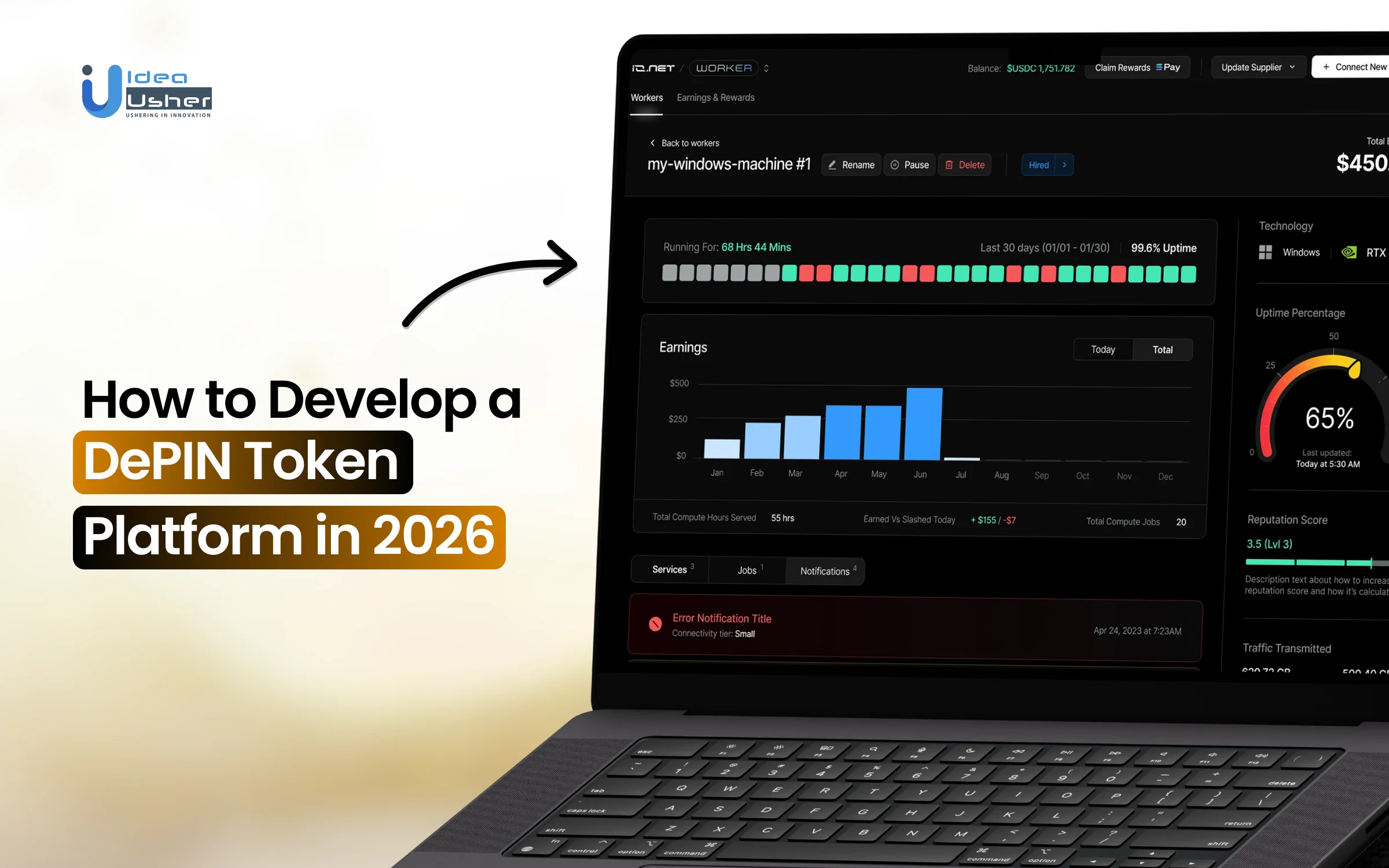
Decentralized physical infrastructure networks bring together hardware, connectivity, and on-chain coordination, which makes their design fundamentally different from purely digital platforms. Incentives must align with real-world deployment, data needs to reflect physical activity, and network participants have to be rewarded reliably for contributing resources. These realities define how teams approach building a DePIN token platform, where blockchain logic is closely tied to physical infrastructure and operational execution.
At the system level, a DePIN token platform must coordinate device onboarding, data verification, reward distribution, and network governance without introducing friction for contributors. Token economics, off-chain data pipelines, oracle mechanisms, and smart contracts all need to operate together while accounting for latency, reliability, and misuse. Decisions around architecture and incentive design directly affect whether the network can scale beyond early pilots into a sustainable ecosystem.
In this blog, we explain how to develop a DePIN token platform in 2026 by breaking down core components, technical architecture, and the practical considerations involved in launching and scaling decentralized infrastructure networks.

What “DePIN” Means?
DePIN (Decentralized Physical Infrastructure Network) is a system that uses blockchain technology to build and operate physical resources such as wireless coverage, energy grids, storage, transport, sensors, or computing devices through decentralized networks rather than centralized companies. Contributors supply hardware or services and are rewarded with crypto tokens.
What Is a DePIN Token Platform?
A DePIN token platform is a blockchain-based system that issues, manages, and uses tokens to run a Decentralized Physical Infrastructure Network (DePIN). In a DePIN, blockchain technology is used to coordinate and reward individuals for contributing resources (like bandwidth, storage, or compute power) with crypto tokens, creating peer-to-peer, decentralized alternatives to traditional centralized services. These tokens have several key roles:
- Incentivizing Participation: Tokens reward individuals or organizations that contribute physical infrastructure or resources to the network. For example, those providing network coverage or storage space receive tokens for their contributions.
- Governance and Decision-Making: Token holders can vote on major network decisions, including protocol upgrades, rules, or incentive changes. This supports community-driven governance instead of centralized control.
- Payments and Access: In a DePIN ecosystem, tokens serve as payment for platform services, such as bandwidth, storage, computing power, or other infrastructure offerings.
- Staking and Network Security: Some DePIN tokens can be staked, meaning they are locked to support network security or operations. Participants earn additional rewards for helping maintain or validate the network.
How DePIN Tokens Differ from Other Crypto Assets?
DePIN tokens connect blockchain incentives with real-world infrastructure, rewarding physical network contributions rather than purely digital activity across decentralized ecosystems. Below is a concise comparison highlighting functional, economic, and governance distinctions.
| Aspect | DePIN Token | Traditional Crypto Tokens |
| Primary Purpose | Used to incentivize real-world physical infrastructure contributions (e.g., running nodes, providing hardware or bandwidth). | Often used for digital utilities, financial services, store of value, governance, or transactional purposes in purely digital ecosystems. |
| Connection to Physical World | Directly linked to physical infrastructure and real-world services, rewards are based on contributions of physical resources. | Mostly digital only, not inherently tied to tangible, real-world infrastructure contributions. |
| Incentive Mechanism | Rewards users for actual physical contributions, such as hosting devices or providing network coverage. | Rewards can be based on speculation, staking, trading, governance participation, or digital usage. |
| Network Governance | Often uses tokens for community-driven governance over physical infrastructure decisions. | Governance tokens are common, but they govern protocol logic or digital ecosystem changes, not coordination of physical assets. |
| Usage Model | Users earn tokens by contributing to a real network, e.g., hosting hotspots, providing storage, or energy. | Many tokens are used for financial functions (DeFi), utility access, or speculative purposes without physical service delivery. |
| Value Drivers | Real-world usage and demand for physical services can directly influence token value. | Token value is usually tied to adoption, speculation, market liquidity, and digital ecosystem demand. |
| Examples of Contribution | Running decentralized physical networks like community wireless, storage, or sensors. | Examples include staking in Proof-of-Stake, liquidity mining, or paying for decentralized finance services. |
How a DePIN Token Platform Works?
A DePIN token platform is a blockchain-based coordination layer that replaces top-down corporate management with token-incentivized networks. It uses cryptographic verification and economic incentives to deliver real-world services through independent operators, with trust guaranteed by transparent code, not central entities.

1. Onboarding & Hardware Registration
A participant, known as a Node Operator, deploys and connects a physical device (e.g., a 5G radio, GPU cluster, or storage server) to the network. The device is cryptographically identified and registered on-chain. The operator often must stake the platform’s native tokens as collateral, ensuring their commitment to proper operation and forfeiting them for malicious behavior.
2. Service Delivery & Data Generation
The registered hardware performs its designated real-world task. A Helium hotspot provides wireless coverage; a Filecoin storage miner hosts client data; an io.net GPU processes an AI training job. During this stage, the device generates raw operational data like signal metrics, file storage proofs, or compute task logs.
3. Proof Generation & Off-Chain Verification
This is the crucial technical bridge between the physical and digital worlds. The platform employs a Proof-of-Physical-Work mechanism.
- Proof-of-Coverage (PoC): For wireless networks, devices perform periodic cryptographic challenges to prove their location and radio coverage.
- Proof-of-Replication/Storage: For storage networks, miners generate proofs that they are storing unique copies of data correctly.
- Proof-of-Compute: For compute networks, workers submit verifiable proofs that a computational task was completed accurately.
For scalability, these complex proofs are verified by a dedicated sub-network of nodes or oracles off-chain, not on the main blockchain.
4. On-Chain Settlement & Reward Distribution
The verified proof is submitted to a smart contract on the main blockchain. This contract receives the proof, validates it against network rules, and automatically triggers minting and distribution of native token rewards to the operator’s wallet. This process is trustless, transparent, and unstoppable.
5. Token Utility & Economic Closure
The distributed tokens are not passive rewards; they are the lifeblood of the ecosystem’s economy. They serve three core utility functions:
- For Contributors/Node Operators: This is where they decide what to do with their earned tokens: Reinvest (back to Step 1), Govern (vote on protocol changes), or Take Profit (sell on the market).
- For the Network Protocol: This is where the tokenomics design is tested. A well-designed system sees a healthy balance of tokens being spent on services, staked for security, and used for governance.
- For End Users: This is the value consumption point. They acquire tokens (from an exchange or as rewards) specifically to spend them on the useful service the network provides (storage, compute, etc.).
Why DePIN Token Platforms Are Gaining Massive Adoption in 2026?
Decentralized physical infrastructure networks (DePIN) are set to grow from $30-50 billion today to $3.5 trillion by 2028, according to the World Economic Forum. This projection signifies a growth trajectory of over 100x in just a few years, highlighting a fundamental shift in how physical infrastructure is built, managed, and owned. This explosive growth is being validated by real, on-chain economic activity and rapidly scaling networks.

According to the report, the $10 billion DePIN sector generated an estimated $72 million in on-chain revenue, showing that it has moved beyond conceptual value and now produces tangible, verifiable cash flow that supports sustainable growth.
This massive market expansion is being directly fueled by the concrete achievements and scale of pioneering platforms. The following statistics, collected from leading networks, provide a snapshot of the foundational infrastructure already in place:
Network Scale & Adoption:
- Nearly 13 million active hardware devices are currently operating globally across DePIN networks, forming a new, decentralized physical grid.
- Helium Mobile now connects nearly 2.5 million people daily through its decentralized wireless network.
- The Grass Network, powering decentralized AI data collection, is powered by a community of over 3 million daily active users.
Infrastructure Coverage & Output:
- Hivemapper has crowdsourced the mapping of over 700 million kilometers of roads, covering approximately 33% of the world’s roadways.
- The decentralized storage network Filecoin provides a massive 20 Exbibytes (EiB) of committed storage capacity, a decentralized alternative to traditional cloud storage.
- Render Network processes approximately 1.5 million frames monthly, supplying critical decentralized GPU compute for AI and 3D rendering.
Community & Tokenholder Engagement:
Major networks have fostered significant communities, with Render ($RNDR) and Filecoin ($FIL) boasting 204.70K and 153.85K total token holders, respectively, indicating broad-based ownership and governance participation.
Core Features of a DePIN Token Platform
DePIN token platforms enable decentralized coordination of real-world infrastructure through blockchain-based incentives, governance, and transparent participation models. The following core features highlight their functional, economic, and user-centric foundations.

1. Decentralized Physical Infrastructure Integration
This core feature connects tangible hardware such as sensors, GPUs, or wireless hotspots to a blockchain ledger. It creates a verifiable, trustless bridge between the physical and digital worlds, enabling the foundation for crowdsourced infrastructure like global wireless networks or distributed data storage.
2. Tokenized Incentive and Reward Model
Tokens provide cryptoeconomic incentives for individuals to deploy and maintain physical hardware. This model, often called “Proof-of-Physical-Work,” directly aligns contributor effort with network growth and health, ensuring resources are supplied where they are most needed and valued.
3. Decentralized Governance and Community Control
Token holders use their stake to vote on protocol upgrades, treasury allocation, and resource pricing. This shifts control from a central corporation to the user-operator community, ensuring the network evolves to serve the collective interest of its builders and users.
4. Blockchain Transparency and Security
Every device’s contribution, reward payment, and service transaction is recorded on an immutable public ledger. This tamper-proof audit trail eliminates fraud, enables trust between anonymous parties, and provides verifiable data for network health and tokenomics analysis.
5. Smart Contract-Driven Automation
Self-executing smart contracts autonomously verify work, calculate rewards, and distribute tokens based on predefined, transparent rules. This removes administrative overhead and central points of failure, ensuring reliable, permissionless, and predictable operations 24/7.
6. Economic Access and Ecosystem Utility
The token is the native currency for purchasing network services like GPU compute, file storage, or geospatial data. This creates a closed-loop economy where demand for services directly fuels the token’s utility and value, driving the entire ecosystem.
7. Community-Driven Network Expansion
Token rewards catalyze organic, scalable growth. As early contributors earn rewards, new participants are incentivized to join and expand network coverage or capacity, creating a virtuous cycle of investment, deployment, and increasing utility that traditional models cannot easily replicate.
8. User Empowerment & Participatory Ownership
Tokens grant governance rights and profit-sharing potential, turning users into owners. This transforms passive consumers into active stakeholder-builders, fostering deep alignment and commitment to the network’s long-term success.
9. Off-Chain Verification & Oracles Integration
Secure oracles act as bridges, feeding verified real-world data onto the blockchain. This critical link enables trustless, accurate reward distribution for physical contributions, maintaining system integrity without a central authority.
How to Develop a DePIN Token Platform in 2026?
DePIN token platform development in 2026 requires aligning blockchain with infrastructure, scalable tokenomics, and compliant governance. Our developers focus on scalable systems, secure smart contracts, regulatory compliance, and integrating real-world components.

1. Consultation & Infrastructure Mapping
We begin by defining the DePIN use case, mapping physical infrastructure requirements, participant roles, device types, and service flows to design a decentralized network architecture that aligns real-world resource contribution with blockchain-based incentive mechanisms.
2. Blockchain and Network Selection
We select a Layer 1, Layer 2, and application-specific blockchains based on transaction throughput, finality speed, and oracle support. Our choice balances scalability for micro-rewards with the robust security and developer ecosystem needed for complex, automated infrastructure operations.
3. DePIN Tokenomics and Incentive Modeling
We design DePIN token economics that balance reward emissions, staking requirements, slashing conditions, and long-term value retention, ensuring contributors are fairly incentivized while preventing inflation, reward abuse, or short-term extraction from the ecosystem.
4. Smart Contract & Token Development
Our developers architect the core tokenomics: minting, distribution, and burn mechanics. We code immutable smart contracts for reward distribution, service payments, and governance, establishing the trustless economic engine that will autonomously power the entire network.
5. Hardware Integration & Node Onboarding
We build the crucial software layer like SDKs and protocols, that allows physical hardware (IoT devices, sensors, gateways, or coverage nodes) to communicate with our blockchain. Our focus is on creating a seamless, secure onboarding process for node operators to deploy and connect their devices to the network.
6. Data Verification & Proof Mechanisms
We implement the critical Proof-of-Physical-Work logic. Using oracles and cryptographic proofs, our system verifies that a physical device performed real work (e.g., provided storage) before triggering on-chain rewards, ensuring integrity and preventing fraudulent claims.
7. Governance and DAO Framework
Our developers establish on-chain governance frameworks that allow token holders to propose, vote, and enforce network decisions, creating a decentralized decision-making structure that governs protocol upgrades, incentive adjustments, and ecosystem fund allocation.
8. Frontend and Participant Interfaces
We build intuitive dashboards for contributors, operators, and users to track rewards, monitor infrastructure performance, manage nodes, and interact with governance, ensuring transparency and usability across the entire DePIN token platform.
9. Security Audits & Compliance Readiness
Our development process includes comprehensive smart contract audits, infrastructure threat modeling, and attack simulations to protect against Sybil attacks, data manipulation, economic exploits, and network-level vulnerabilities before mainnet deployment.
10. Mainnet Launch & Network Scaling
We execute a phased mainnet launch, often starting with a controlled genesis group of nodes. Our strategy then focuses on incentivized growth campaigns and partnerships to bootstrap supply and demand, driving the network toward sustainable, organic scaling.
Cost to Build a DePIN Token Platform
The cost to build a DePIN token platform varies based on infrastructure complexity, blockchain selection, token economics, and compliance requirements. The following overview outlines key cost factors and development considerations.
| Cost Component | Description | Estimated Cost Range |
| Consultation & Architecture Design | Infrastructure mapping, network roles, incentive logic, blockchain alignment, and technical architecture tailored to the DePIN use case | $5,000 – $8,000 |
| Tokenomics & Incentive Modeling | DePIN token utility design, reward emission schedules, staking and slashing rules, inflation control, and sustainability modeling | $8,000 – $12,000 |
| Smart Contract Development | Token contracts, reward distribution, device registration, governance logic, and automation contracts built for DePIN scalability | $16,000 – $28,000 |
| Blockchain & Protocol Integration | Layer 1 or Layer 2 integration, transaction optimization, oracle connections, and interoperability setup | $10,000 – $18000 |
| Hardware / IoT Integration | Device identity setup, secure data submission pipelines, node onboarding logic, and hardware–blockchain communication | $13,000 – $20,000 |
| Data Verification & Proof Systems | Oracle frameworks, proof-of-contribution logic, fraud prevention mechanisms, and validation models for real-world data | $7,000 – $15,000 |
| Governance & DAO Development | On-chain voting, proposal systems, treasury controls, and governance dashboards for community-led infrastructure | $6,000 – $10,000 |
| Frontend Dashboards & UX | Contributor dashboards, reward tracking, node monitoring, governance interfaces, and admin panels | $9,000 – $18,000 |
| Security Audits & Testing | Smart contract audits, economic attack simulations, penetration testing, and risk mitigation | $8,000 – $15,000 |
| Mainnet Launch & Deployment | Network configuration, token deployment, phased rollout strategy, and launch support | $4,000 – $8,000 |
| Ongoing Maintenance & Scaling (Optional) | Protocol upgrades, performance optimization, infrastructure monitoring, and ecosystem growth support | $3,000 – $7,000 / month |
Total Estimated Cost: $65,000 – $130,000+
Note: The DePIN token platform development costs vary by infrastructure, blockchain, tokenomics, security, and scalability, with strong engineering needed for long-term sustainability.
Consult with IdeaUsher to evaluate your DePIN use case, define the right architecture, and develop a scalable DePIN token platform tailored to your infrastructure and business goals.
Cost Factors During DePIN Token Platform Development
DePIN token platform development costs depend on infrastructure scope, blockchain selection, security requirements, and ongoing operational complexity. The following factors outline key cost considerations.
1. Hardware Trust and Identity Enforcement
Implementing cryptographic device identities, hardware attestation, and anti-spoofing mechanisms increases development cost, especially when physical nodes must prove authenticity before earning DePIN token rewards.
Estimated Cost: $6,000 – $10,000 — Requires cryptographic device identity, secure key storage, anti-spoofing logic, and hardware onboarding verification before nodes can earn DePIN token rewards.
2. Proof-of-Physical-Work Design
Designing verifiable proofs for real-world activity such as coverage, uptime, or data accuracy requires custom validation logic, simulations, and oracle coordination, adding cost beyond standard smart contract development.
Estimated Cost: $7,000 – $14,000 — Custom proof models, simulations, and oracle coordination are needed to verify real-world infrastructure activity, which cannot rely on standard on-chain validation alone.
3. Reward Emission Precision at Scale
High-frequency micro-rewards for thousands of devices demand optimized smart contracts, batching strategies, and gas-efficient accounting, significantly affecting engineering effort and blockchain infrastructure costs.
Estimated Cost: $5,000 – $12,000 — High-frequency micro-rewards require gas-optimized accounting, batching logic, and scalable smart contracts to prevent cost explosions during network growth.
4. Fraud Resistance Against Physical Attacks
Protecting networks from GPS spoofing, relay attacks, and fake data injection requires layered security models combining cryptography, behavior analysis, and off-chain computation, raising both development and audit costs.
Estimated Cost: $6,000 – $15,000 — Mitigating GPS spoofing, relay attacks, and fake data submissions requires layered security models, behavioral analysis, and extensive testing.
5. Oracle Reliability and Latency Optimization
DePIN platforms depend on low-latency, tamper-resistant oracle systems for real-world data verification, often requiring custom oracle pipelines instead of off-the-shelf solutions.
Estimated Cost: $5,000 – $11,000 — Real-time infrastructure data needs custom Oracle pipelines, redundancy mechanisms, and latency optimization beyond generic Oracle integrations.
6. Hardware Lifecycle and Node Churn Management
Handling device failures, upgrades, downtime penalties, and node replacement logic introduces additional contract states and backend complexity that directly impact long-term development and maintenance costs.
Estimated Cost: $4,000 – $8,000 — Device downtime penalties, replacements, upgrade paths, and churn handling introduce additional smart contract states and backend coordination.
Challenges and How Our Developers Will Solve Them?
Building a DePIN token platform presents technical, operational, and regulatory challenges across infrastructure, incentives, and scalability. Our developers address these challenges through proven architectures, secure smart contracts, and user-focused engineering strategies.

1. Hardware Reliability and Network Trust
Challenge: DePIN platforms rely on physical devices that can malfunction, go offline, or submit unreliable data, directly impacting reward fairness and network credibility.
How Our Developers Solve It: We implement device identity verification, uptime-based reward weighting, redundancy logic, and automated penalties, ensuring only reliable infrastructure contributors consistently earn DePIN token rewards.
2. Data Fraud and Sybil Attacks
Challenge: Malicious actors can exploit fake devices, spoofed data, or multiple identities to manipulate reward systems and drain token emissions.
How Our Developers Solve It: Our developers deploy cryptographic device authentication, proof-of-physical-work models, behavior analysis, and oracle-backed validation to prevent Sybil attacks and block fraudulent reward claims.
3. Token Inflation and Incentive Misalignment
Challenge: Poorly designed tokenomics can cause excessive emissions, short-term farming, and long-term value erosion, discouraging genuine infrastructure contributors.
How Our Developers Solve It: We design emission controls, staking requirements, slashing conditions, and performance-based rewards that align long-term infrastructure value with sustainable DePIN token economics.
4. Scaling Across Regions and Geographies
Challenge: Expanding DePIN networks globally introduces regulatory variation, infrastructure inequality, latency challenges, and uneven participation incentives.
How Our Developers Solve It: We implement region-aware tokenomics, modular compliance logic, scalable blockchain architectures, and localized incentive models to support efficient, compliant DePIN network expansion.
How DePIN Platforms Generate Real Revenue and Sustain Growth?
For a DePIN platform, long-term sustainability is the ultimate measure of success. Platforms that cannot transition from token emissions to demand-driven revenue will collapse. The core challenge is designing an economy where user fees eclipse token rewards as the primary incentive for operators.
A. The Pillars of Sustainable DePIN Revenue
A sustainable DePIN platform must build its economic model on three interconnected pillars, moving beyond simple token distribution.
| Revenue Pillar | How It Works | Key Metric For Success | Real-World Example |
| 1. Protocol- Captured Service Fees | The network takes a 5–10% fee on user-to-operator transactions, directing it to a community treasury or burning it. | Protocol Revenue vs. Token Emissions: The goal is for fee revenue to surpass the market value of daily token rewards. | Helium Mobile: A portion of every $20 monthly subscriber fee is allocated to the protocol treasury and token buybacks. |
| 2. Enterprise & B2B Data/Service Contracts | The platform sells bundled network services or aggregated data directly to enterprise clients. | Annual Recurring Revenue (ARR) from Enterprise Clients. | Hivemapper: Sells its freshed, high-definition map data to mapping, logistics, and autonomous vehicle companies like Lyft. |
| 3. Strategic Staking & Slashing Fees | Operators stake tokens to offer services, with the protocol charging staking fees or retaining slashed tokens for poor performance. | Fee Revenue from Network Security Actions. | Filecoin: Uses staking with burned slashed tokens, reducing supply and boosting value accrual. |
B. The Transition From Inflationary Bootstrapping to Fee-Driven Sustainability
Every DePIN platform begins with an inflationary phase. To bootstrap the network, it mints and distributes large amounts of new tokens to reward early hardware operators, as there are no users yet to pay them. This phase is necessary but perilous.
The sustainable model flips this script. The long-term goal is a self-sustaining system where user demand funds the network, not new token creation. Making the Transition: Key Strategies for 2026

- Embed Fee Capture in Smart Contracts: Design service payment logic with an adjustable protocol fee routed to a treasury, which governance can activate and tune after critical mass is reached.
- Incentivize Early Demand: Use token grants, subsidized pricing, and developer partnerships to bootstrap real usage. A network with 10,000 devices and 100 paying users is more sustainable than one with 100,000 devices and 10 users.
- Operate a Transparent, Programmable Treasury: Direct all protocol revenue into a community-governed treasury, with token holders deciding allocations for development, buybacks, or staking rewards.
- Build for Enterprise-Grade Reliability: Support high-value B2B contracts with SLAs, reliable APIs, and verifiable data quality, often through a front-end layer that simplifies blockchain complexity for enterprises.
C. Common Pitfalls That Threaten Sustainability
Sustainable token models require careful design to avoid structural risks. The following pitfalls outline common mistakes that can weaken long-term network stability and participant incentives.
- The “Infinite Inflation” Trap: Failing to design a definitive schedule for reducing token emissions, leading to perpetual dilution and collapse of operator rewards’ purchasing power.
- Ignoring External Market Value: Assuming the token’s value will be sustained solely by network use, without acknowledging that its market price is subject to broader crypto volatility. Sustainability requires managing this volatility risk for operators.
- Over-Reliance on Speculation: Building a model where the only incentive for early operators is reselling the token at a higher price, rather than earning sustainable fees from genuine service provision.
Top DePIN Token Platforms in the Market
Real-world DePIN platforms demonstrate how blockchain tokens incentivize community-driven physical infrastructure across wireless, storage, compute, and data networks. The following examples showcase practical implementations and unique value propositions.
1. Helium Network (HNT)

A community-driven decentralized wireless network where individuals deploy hotspots to provide IoT and mobile coverage, earning HNT tokens based on network contribution and proof-of-coverage. Helium exemplifies a scalable peer-to-peer connectivity infrastructure.
2. Filecoin (FIL)

A decentralized storage network built on blockchain, where users rent out unused disk space. Storage providers earn FIL tokens for contributing verifiable storage capacity using Proof-of-Replication and Proof-of-Spacetime. Filecoin bridges data storage and DePIN economics.
3. Render Network (RNDR)

A decentralized GPU compute and rendering platform that connects idle graphics processors with creators and developers needing high-performance rendering and AI computing, using RNDR tokens for compute-as-a-service transactions.
4. Hivemapper (HONEY)

A community-built mapping network that rewards contributors for capturing and submitting street-level imagery and geospatial data via dashcams or sensors. HONEY tokens incentivize participation in decentralized mapping infrastructure.
5. Akash Network (AKT)

A decentralized cloud computing marketplace where users lease out unused compute resources to developers and businesses, challenging centralized cloud providers with a cost-efficient, token-driven compute economy.
Conclusion
Developing a DePIN token platform requires more than blockchain expertise; it demands a clear understanding of real-world infrastructure, incentive design, and long-term network sustainability. A well-planned DePIN Token Platform development process brings together secure architecture, balanced tokenomics, and reliable verification of physical contributions. When these elements work in harmony, the platform can support meaningful participation, transparent governance, and scalable growth. Careful planning and execution help ensure the network remains resilient as technology, regulations, and user expectations continue to evolve toward 2026 and beyond.
Partner With IdeaUsher for DePIN Token Platform Development!
Our team brings together blockchain expertise and real-world infrastructure understanding to deliver robust DePIN token platforms designed for long-term network sustainability. We help founders translate physical infrastructure concepts into reliable, token-driven ecosystems ready for market adoption.
Why Work With Us?
- End-to-End DePIN Expertise: From architecture and tokenomics to verification mechanisms and governance models.
- Infrastructure-Aligned Design: We ensure real-world contributions are accurately reflected and rewarded on-chain.
- Security-First Development: Smart contracts, data flows, and integrations are built with strong security standards.
- Future-Ready Platforms: Our solutions are designed to scale with evolving regulations, users, and infrastructure demands.
Review our past blockchain projects to understand how we help innovative platforms move from concept to launch with confidence.


FAQs
A.1. Enterprises commonly face challenges related to infrastructure verification, regulatory uncertainty, token value volatility, and network scalability. Addressing these early through robust architecture and clear incentives improves long-term platform sustainability.
A.2. Tokenomics define incentives, rewards, and long-term sustainability. Balanced emission schedules, utility-driven demand, and fair reward distribution help maintain operator participation while reducing excessive speculation and long-term value dilution.
A.3. DePIN platforms use hardware validation, off-chain data sources, oracles, and smart contracts to verify physical activity. This ensures rewards are distributed transparently based on measurable, verifiable infrastructure participation.
A.4. Platforms manage volatility by combining token rewards with usage-based fees, dynamic incentives, or stable pricing mechanisms. This helps operators earn predictable value from real services rather than relying only on token price appreciation.


