 (+971) 8007 4267
 (+91) 946 340 7140
 (+1) 628 432 4305

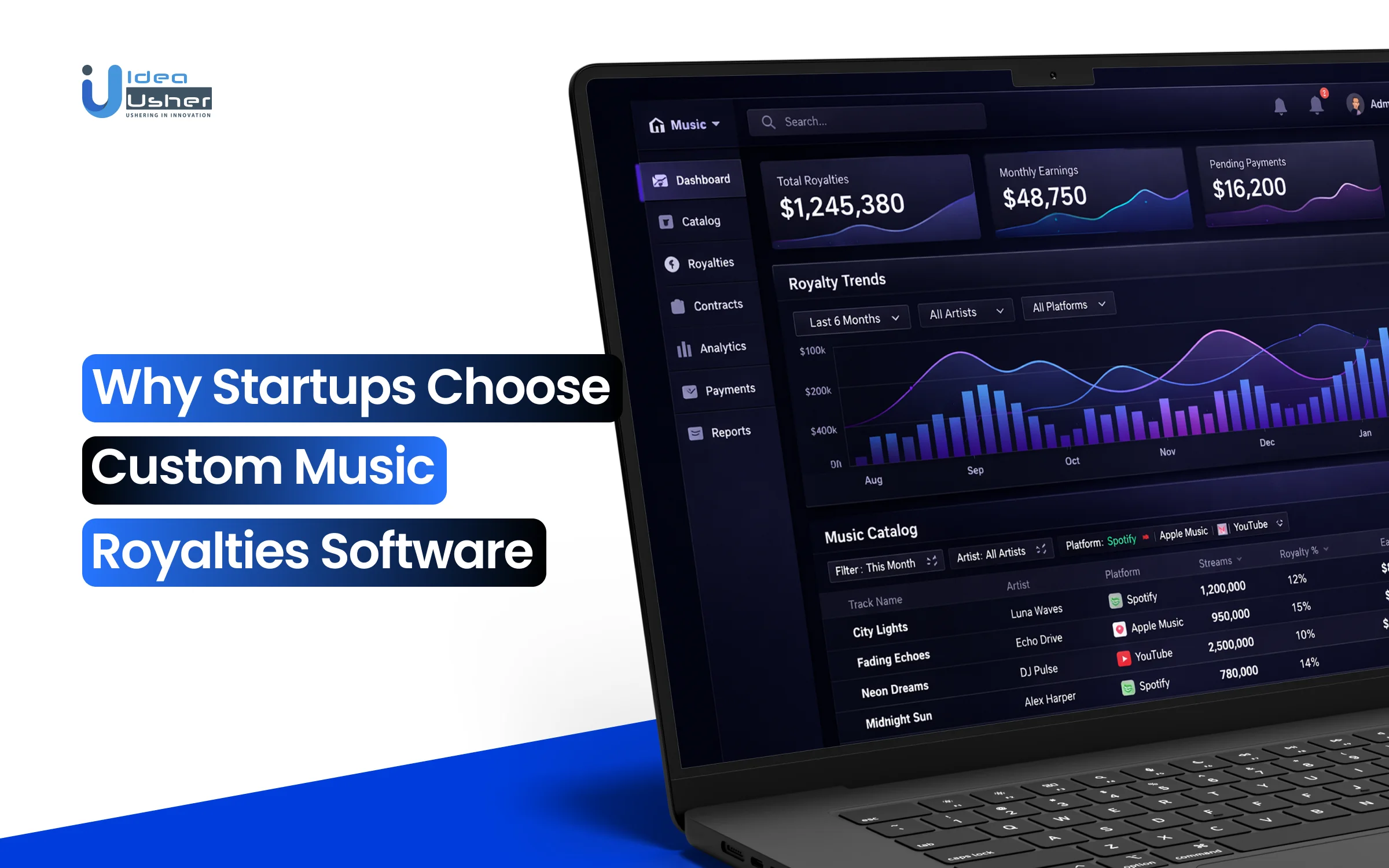
The music business no longer depends on a single revenue path, and income now flows from streams, shorts, licenses, and other emerging formats at the same time. Most legacy royalty software was never designed for this level of fragmentation, which is why startups experience friction as they grow. As teams begin tracking micro-royalties across platforms and territories, rigid systems can quietly slow decision-making and obscure financial visibility.
Custom music royalties software enables founders to define ownership splits, automate event-level calculations, and manage multi-currency payouts without manual intervention. With auditable ledgers and real-time reporting, royalties become core business infrastructure rather than a back-office accounting process.
Over the years, we’ve developed numerous custom music-royalty software systems, powered by rights graph modeling and event-driven ledger architectures. With this experience, we’re sharing this blog to explain why startups choose custom music-royalty software and how to build one with confidence. Let’s start.
Key Market Takeaways for Music Royalties Platform
According to Allied Market Research, the global online music streaming market is growing rapidly, from $17.7 billion in 2024 to $52.6 billion by 2034. As streaming volumes expand across platforms and geographies, royalty flows are becoming more frequent, fragmented, and difficult to reconcile.

Source: AlliedMarketResearch
This complexity has made efficient royalty management less of an operational task and more of a structural necessity, pushing music royalties platforms into a critical role for artists, songwriters, and publishers who depend on accurate, timely payouts.
Platforms such as Royalty Exchange and Songtrust illustrate how the sector is maturing. Royalty Exchange has created a marketplace model that allows creators to convert future royalty income into immediate, debt-free capital, while offering investors access to income-producing assets with historically strong returns.
Songtrust, on the other hand, focuses on publishing administration, enabling songwriters to collect global royalties without giving up ownership, often unlocking revenue streams that were previously untracked or unpaid.
Momentum in this space is also being driven by strategic partnerships that bring royalty visibility closer to creators. A recent example is Audiomack working with Mogul to provide integrated royalty tracking for hundreds of thousands of artists.

What Is Custom Music Royalties Software?
Custom music royalties software is a purpose-built financial system that accurately tracks, calculates, and distributes music royalties at scale. Unlike generic tools, it ingests usage data from streaming platforms, social media, gaming, and emerging digital channels, then applies contract-specific rules to attribute revenue and calculate payouts correctly.
The system is tailored to a business’s unique deal structures, territories, and revenue models, ensuring every rights holder is paid transparently and on time.
How It Differs from Off-the-Shelf Platforms?
Choosing between custom and off-the-shelf royalty software is not just a technical decision. It is a strategic direction that shapes how your business scales, controls data, and builds trust.
| Aspect | Off-the-Shelf Royalty Platforms | Custom Music Royalties Software |
| Logic and Flexibility | Fixed templates that force your business to fit predefined rules | Custom logic designed around complex splits, advances, and deal structures |
| Data Ownership | Vendor lock-in where critical financial data lives on external servers | Full data sovereignty with complete ownership of data, logic, and IP |
| Architecture and Scale | Subscription limits where costs rise with usage and growth | Engineered to scale and handle viral growth without per-transaction penalties |
| Integration | Generic pre-built connectors with slow support for new platforms | API-native design that connects easily to new platforms and internal systems |
| Transparency | Black-box calculations that are difficult to audit | Granular audit trails where every calculation is traceable and verifiable |
Types of Custom Music Royalties Software
Custom music royalties software can take different forms depending on how your revenue is generated and shared. It may support artist payouts, large-scale distribution reporting, licensing workflows, or catalog-level accounting, and it should adapt smoothly as volume grows.

1. Artist Royalty Management Platforms
These platforms help labels and independent artists manage royalties with clarity and trust by providing accurate statements, transparent reporting, and automated payouts aligned with complex contracts. Solutions similar to Stem are often referenced in this category for their artist-facing reporting approach, though custom systems allow far deeper contract logic.
2. Music Distribution & Aggregation
This software supports high-volume ingestion of royalty data from multiple streaming platforms and storefronts, normalising inconsistent reports into a single financial view. Aggregation models used by platforms like TuneCore highlight the scale challenge, which custom-built systems address with greater control and flexibility.
3. Sync & Micro-Licensing Engines
These systems manage royalties from film, television, advertising, and gaming licenses by tracking usage and applying license-specific payout rules. Marketplaces such as Songtradr illustrate this model, while custom engines handle far more granular licensing and backend royalty logic.
4. AI Music Attribution Systems
Built for AI-generated and user-generated music ecosystems, this software focuses on attribution, fingerprinting, and rights compliance. Emerging platforms like Soundful demonstrate this direction, while custom solutions embed deeper compliance and detection logic tailored to platform risk.
5. Enterprise Royalty Engines
These engines are designed for large catalog holders and investment firms managing complex ownership structures and historical data. Enterprises often look to platforms such as Royalty Exchange for reference, while custom royalty engines deliver investor-grade reporting and full ownership transparency.
How to Develop a Custom Music Royalties Software?
To develop custom music-royalty software, the process should begin by converting real contracts into precise system logic to ensure revenue flows remain accurate. A secure royalty ledger and ingestion layer must then be designed to process high-volume usage data while preserving audit integrity.
We have built numerous custom music royalties software solutions over the years, and this is the structured process we follow.

1. Contract & Royalty Logic
We start by translating artist agreements into system-ready logic. Revenue splits, advances, and territory-specific rules are carefully mapped so the platform behaves exactly as defined by contracts. This foundation reduces ambiguity and prevents downstream conflicts.
2. Royalty Ledger Design
We design the core ledger that records every royalty event. Based on audit and compliance requirements, we implement event-sourced or immutable-ledger models. Clear audit trails and reconciliation flows ensure financial data remains verifiable over time.
3. Data Ingestion Pipelines
We build pipelines to ingest high-volume usage data from DSPs, social platforms, and games or metaverse environments. Validation and normalization happen at the edge so only clean and consistent data enters the royalty system.
4. Split & Dependency Logic
We implement the calculation engine using dependency-based logic. DAG-driven flows handle complex splits, recoupment rules, thresholds, and escalation conditions in the correct order. This ensures payouts remain accurate as deal structures evolve.
5. Payouts & Compliance
We integrate multi-currency payout systems with automated triggers. Tax withholding rules and regional compliance logic are embedded in the payment flow to ensure distributions remain accurate and compliant with regulations.
6. Dashboards & Reporting
We develop dashboards that provide clarity for both artists and administrators. Artists see transparent earning breakdowns while admins manage reporting, corrections, and disputes through controlled workflows.
How Custom Music Royalty Software Impacts Artist Trust & Retention?
Custom music royalty software can quietly change how artists feel about the platform they work with. When earnings are detailed and updates arrive in near-real time, trust may build naturally and consistently. Over time, that clarity can reduce disputes and help artists stay aligned for the long run.

The Trust Crisis: Why Artists Are Walking Away
The Black Box Statement Problem
Many artists still receive unclear PDF statements.
- Unclear deductions labeled as fees or costs
- Long gaps between streams and payments with no explanation
- Complex calculations without line item visibility
- No insight into future earnings
A common example is SoundExchange. While essential for digital performance royalties, statements often show aggregated totals. An artist may see a single payout figure from a platform without knowing which tracks earned it or where demand is growing. This creates doubt and weakens trust.
How Custom Software Turns Suspicion into Partnership?
1. Radical Transparency
Custom platforms expose the full financial story behind every payout. Instead of a legacy statement that shows only a single streaming-royalty total, the platform can present clear sources of earnings and calculations. This clarity may help artists understand their income with greater confidence and trust the numbers they see.
Custom platform view
- Platform-specific streams with rates
- Clear split logic
- Recoupments shown line by line
- Tax deductions explained
- Net payable amount visible
Platforms like Amuse demonstrate this shift by showing real-time earnings per track and per platform. When traction builds in a new territory, artists see it immediately, not months later. Transparency becomes trust.
2. Real Time Visibility
Quarterly payout cycles create stress and uncertainty. Traditional societies such as ASCAP and PRS often pay months after activity occurs. That delay strains relationships.
Custom platforms replace uncertainty with clarity by showing:
- Daily streaming and usage updates
- Pending payouts with expected dates
- Forecasted earnings based on live trends
Dashboards like those from BeatStars show how real-time insight turns anxiety into engagement. Artists stay involved because they always know where they stand.
The Retention Multiplier
Predictive Analytics Builds Partnership
When artists see forward-looking insights such as projected revenue tied to social growth, the relationship shifts. You are no longer a distributor. You become a planning partner.
DistroKid’s tools show this value in thedaily stats. Custom platforms go further by adding predictive modeling and strategic guidance, strengthening long-term retention.
Automated Splits That Actually Work
Delayed split payments create tension between collaborators. While Songtrust excels at global collection, split payouts still depend on slower legacy systems.
Custom royalty software solves this by embedding splits directly into the calculation engine.
- Producers are paid instantly
- Featured artists receive their share without delay
- No disputes caused by missing or late payments
Recent TuneCore features move in this direction. Custom platforms complete the loop by making splits automatic, immediate, and transparent.
Is Custom Royalty Software Right for Enterprise Catalog Owners?
The short answer is yes. Custom music royalty software is not just suitable. It is the only viable option for enterprise catalog owners. Off-the-shelf tools may support independent artists or small publishers, but enterprise catalogs operate at a scale and complexity that generic platforms are not designed to handle.

Why Generic Solutions Fail at Scale?
Enterprise catalogs manage millions of assets across decades of contracts, acquisitions, and regional rules.
A group like Universal Music Group manages millions of recordings across hundreds of sub-labels, with contracts dating back decades. Platforms such as Kobalt are highly effective for publishing administration across large songwriter bases. Still, they are not designed for master recording catalogs with century-long rights histories and complex ownership changes.
No off-the-shelf platform can reliably support
- Billions of monthly transactions across master and publishing rights
- Thousands of unique royalty rate structures across acquired catalogs
- Copyright terms spanning decades with territory-specific expirations
- Tax compliance across more than 200 territories
The Legacy Catalog Conundrum
Enterprise catalogs introduce complexity that breaks standardized systems.
A company such as Warner Music Group manages:
- Pre-1972 recordings with unique royalty treatment
- Escalating songwriter agreements tied to performance metrics
- Joint ventures with custom profit-sharing models
- Catalog acquisitions with earn-outs and legacy obligations
Platforms such as Songtrust are well-suited to standardized publishing collections. They are not designed to handle multi-tier recoupment schedules, cross-collateralization, or enterprise profit participation logic.
Why Custom Software Is Non-Negotiable for Enterprises?
1. Unmatched Scale Handling
Enterprise operations process five thousand to ten thousand times more data than indie workflows.
A company like Sony Music must support:
- More than ten billion monthly streams
- Over one hundred DSP integrations
- Real-time currency conversion across more than one hundred fifty currencies
- Historical data migration from multiple legacy systems
Generic tools like DistroKid are built for simplicity. They are optimized for thousands of transactions, not billions, which leads to system slowdowns and processing failures when used at enterprise scale.
How custom software solves this: It uses horizontally scalable architectures, stream-processing pipelines, and optimized data models to handle billions of transactions without performance loss.
2. Complex Deal Structure Management
Enterprise contracts often carry deal logic that standard platforms cannot express correctly. Revenue may flow through three sixty deals profit participation and investor waterfalls that change as thresholds are met. A custom system can quietly model these rules and apply them accurately so settlements remain precise and dependable..
How custom software solves this: It embeds configurable contract engines that dynamically calculate royalties based on deal terms, recoupment status, and revenue sources, without manual intervention.
3. Global Compliance Automation
Enterprise catalog owners must comply with:
- EU DAC7 reporting
- Country-specific withholding tax rules with frequent updates
- US Form 1042 S filings for thousands of international payees
- AML regulations across multiple jurisdictions
How custom software solves this: It integrates automated tax engines, jurisdiction-aware compliance logic, and audit-ready reporting that updates as regulations change, reducing risk and operational burden.
Conclusion
Custom royalty software is no longer optional because royalties now operate as core infrastructure. They should reliably handle scale accuracy and compliance rather than serve as a back-office accounting task. For founders and enterprise leaders, the takeaway is clear because investing early in robust royalty systems can quietly protect revenue and enable confident growth.
Looking to Develop a Custom Music Royalties Software?
IdeaUsher can design a custom music royalties system that should accurately model your rights logic and payout rules while scaling with usage growth. We will carefully architect data pipelines and ledger systems to enable near-real-time royalty calculations with strong auditability.
Why build with us?
- 500,000 plus hours of coding expertise led by ex-MAANG and FAANG developers
- Architected for your unique splits, from tiered royalties to recoupable advances
- Seamless API integrations with streaming platforms, metaverse environments, social audio, and crypto payments
- Investor-ready transparency that turns your royalty data into a valuation asset
- Full ownership of your code and data with no vendor lock-in or per-transaction fees
Check out our latest projects.


FAQs
A1: Custom music royalties software may feel expensive upfront because it requires careful architecture, data modeling, and compliance logic. Yet the real comparison is not upfront cost but long-term return. A well-designed system can steadily reduce disputes, improve payout accuracy, and unlock revenue that would otherwise remain unclaimed.
A2: Development timelines depend heavily on complexity and scope. A focused platform for core ingestion, calculation, and payouts may take four to six months. More advanced systems with multi-territory rules, real-time reporting, and audit readiness can take nine to twelve months.
A3: Yes, and this is where custom systems become critical. AI-generated music introduces new challenges around ownership attribution, training data, and rights splits. Custom software can apply metadata tagging, provenance tracking, and configurable compliance logic to handle these scenarios
A4: Custom software can be suitable for early-stage startups when royalties are central to the business model. If revenue accuracy, trust or differentiation depends on how royalties are handled, buying generic tools may slow growth. Even a lean custom system can act as core infrastructure that scales with the company.


