 (+971) 8007 4267
 (+91) 946 340 7140
 (+1) 628 432 4305

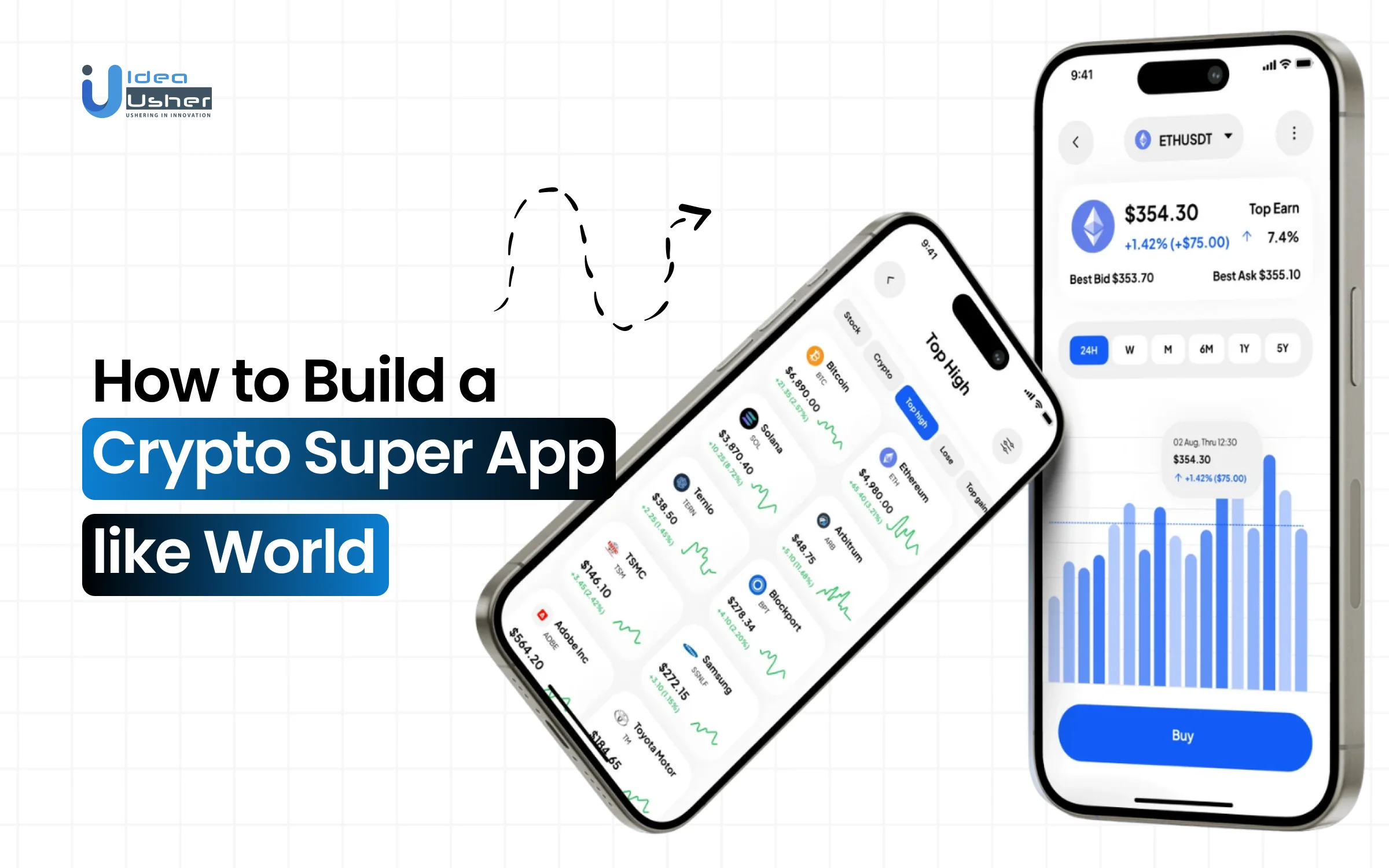
Crypto adoption often stalls not because of lack of interest, but because everyday use still feels fragmented. Wallets, payments, identity, on-chain apps, and compliance checks usually live in separate products, forcing users to switch contexts constantly. This fragmentation is pushing interest toward crypto super app development, where multiple financial and identity functions can be accessed through a single, coherent experience.
Reducing friction at this level means unifying functions that are usually handled in isolation. Wallet management, identity verification, payments, and access to on-chain services all need to operate within a single account framework. Platforms such as World show how these elements can be combined, but success depends on how well security, permissions, scalability, and regulatory alignment are handled behind the scenes.
In this blog, we explain how to build a crypto super app like World by breaking down core components, architectural decisions, and practical considerations involved in creating a unified, scalable crypto platform for real-world adoption.
What is a Crypto Super App, World?
A crypto super app is a single, unified digital platform that consolidates multiple cryptocurrency and blockchain-related services into one application, so users can manage, trade, interact with, and use digital assets like crypto trading, wallet management, payments, DeFi tools, NFT access, messaging and more, without needing multiple separate apps.
World by Worldcoin is a crypto super app combining privacy-preserving proof of personhood, digital identity, crypto payments, and app access, enabling verified humans to manage assets and use on-chain services. Built for an AI-driven internet, it provides a reliable proof-of-human system while unifying identity, finance, and applications into one global, user-centric ecosystem.
The Three Pillars of the World App
The “World” app is built on three specific technological layers that define its status as a super app:
1. World ID (The Identity Layer): Uses “Proof of Personhood” via iris scanning to distinguish humans from AI. This serves as a global, private login system for the entire app ecosystem.
2. World App (The Financial Layer): A self-custodial wallet built on the World Chain (an Ethereum Layer 2). It allows users to hold, swap, and send digital assets (like $WLD, BTC, ETH, and USDC) globally with zero gas fees for verified humans.
3. World Chat (The Social Layer): An encrypted messaging service that integrates financial tools directly into the chat window, allowing users to send money as easily as a text message to other verified humans.
A. How the World App & Ecosystem Work?
World builds a human-verified digital identity and payments ecosystem, unifying crypto, apps, and proof-of-personhood at global scale.
- Digital Identity & Proof-of-Personhood: The core offering is World ID, a privacy-preserving digital identity proving users are human without revealing personal data. This foundational identity layer enables apps, services, and platforms to ensure real human participation online.
- Native Crypto & Wallet Services: The World App functions as a digital wallet, enabling users to store, send, receive, and manage the native WLD token and other digital assets. It supports financial activities like staking and generating passive rewards for users.
- Mini-Apps & Ecosystem Services: The World App hosts a Mini App ecosystem (like an internal app store). Third-party developers build apps leveraging World ID, wallets, payments, and services, transforming the platform into a broader ecosystem beyond just a wallet.
- Network & Platform Growth: The world’s business model emphasizes growing a global user base backed by identity verification. A large, human-verified network creates network effects, making the platform more valuable to developers, partners, and users.
B. How the World Generates or Plans to Generate Money?
Monetization comes from identity services, transactions, partnerships, and app ecosystem fees across the World platform.
- Fees from Identity & Verification Services: World charges fees to apps and services using World ID verification. Businesses benefiting from proof-of-personhood pay for this capability, creating a revenue stream.
- Transaction & Blockchain Fees: As the ecosystem grows and more transactions occur on Worldchain, the platform earns transaction processing fees (similar to blockchain gas or sequencer fees).
- Mini App Revenue & Marketplace: The World App operates like an app marketplace, collecting commissions or shared revenue from in-app purchases, Mini App usage fees, or services within the ecosystem, similar to other super apps and digital marketplaces.
- Partnerships & Integrations: World builds partnerships with platforms and services (banking rails, payments, dating apps using human verification). These partnerships involve revenue sharing, licensing, or access fees as the ecosystem gains adoption.
- Future Financial Services: With expanded payment capabilities (virtual accounts, crypto payments, and integration with debit cards and banking services), World earns income from payment-related fees and financial service charges.
Crypto Super App vs Wallet vs dApp: Key Differences
Crypto super apps, wallets, and dApps serve different roles in the Web3 ecosystem. Understanding their key differences helps businesses and users choose the right platform for adoption, scalability, and real-world usability.
| Aspect | Crypto Super App | Crypto Wallet | dApp Ecosystem |
| Core Value Proposition | All-in-one gateway combining identity, payments, and applications | Secure key management and transaction signing | Specialized DeFi, gaming, or trading service |
| Identity Model | Proof of Personhood (verified human) | Pseudonymous wallet address | No native identity; inherits wallet identity |
| User Experience | Seedless, gasless, push notifications, unified dashboard | Seed phrases, manual gas, transaction-focused UI | Fragmented; requires wallet connection each time |
| User Lock-In & Portability | High lock-in via verified identity and social graph | Low; portable across all dApps | Very low; one click to competitor |
| Target Audience | Mainstream, non-technical, global population | Crypto-native users, DeFi participants | Niche power users in specific verticals |
| Key Competitive Moat | Human verification + curated mini-app ecosystem | Network effects from chain support + extensions | Deep liquidity or unique protocol mechanics |
Why Are Crypto Super Apps Replacing Standalone Web3 Products?
Crypto super apps are emerging as the preferred Web3 model by unifying identity, payments, and applications. They reduce fragmentation, improve user experience, and enable scalable adoption compared to standalone crypto wallets and dApps.
1. Mainstream User Acquisition
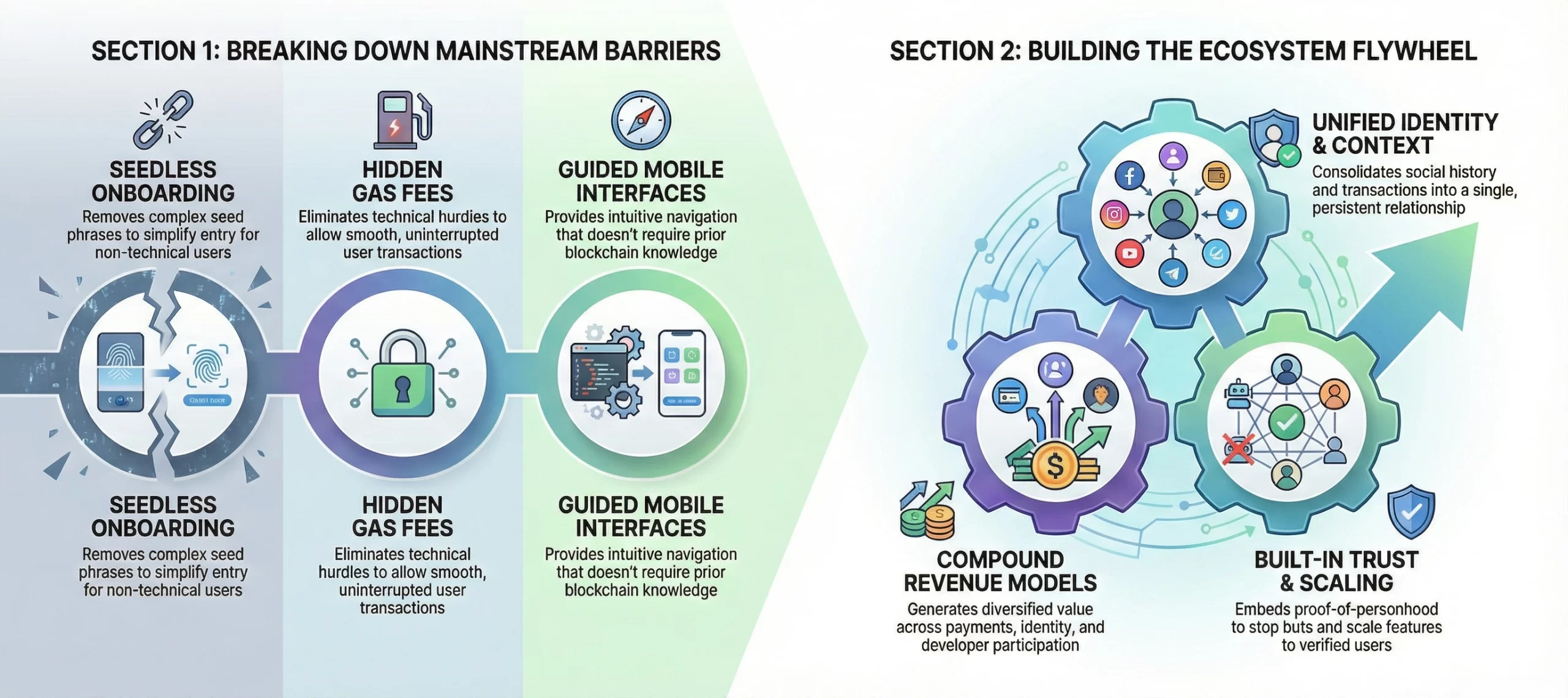
Mainstream adoption has been constrained by seed phrases, gas fees, and fragmented dApps. Crypto super apps remove these barriers through seedless onboarding, hidden fees, and guided mobile interfaces, enabling non-technical and unbanked users to access crypto without blockchain knowledge.
2. Ownership of the User Relationship
User engagement in Web3 has traditionally been fragmented across wallets and transactional dApps. Crypto super apps consolidate verified identity, transaction history, social context, and engagement channels into one ecosystem, transforming crypto access from a single-use tool into a persistent user relationship.
3. Cross-Selling & Ecosystem Flywheel
The verified users interact with an integrated suite of services within a crypto super app rather than isolated products. Lending, payments, gaming, and governance coexist in one interface, with each interaction improving recommendations, incentives, and long-term retention.
4. Superior Unit Economics
Economic models in standalone dApps rely on narrow, single-function fees. Crypto super apps generate diversified value across payments, premium identity services, ecosystem access, transaction volume, and developer participation, creating compounding, portfolio-level revenue instead of isolated margins.
5. Trust & Safety Advantage
Trust challenges in Web3 are typically addressed through reactive and costly fraud controls. Crypto super apps embed proof of personhood at onboarding, preventing bots, sybil attacks, and scams before entry, making trust a foundational system property.
6. Network Effects Density
Distribution remains a major constraint for standalone dApps competing for attention. Crypto super apps launch new features into an existing base of verified users, where persistent identities produce denser network effects and enable faster, more reliable scaling.
Why Crypto Super Apps are Gaining Popularity?
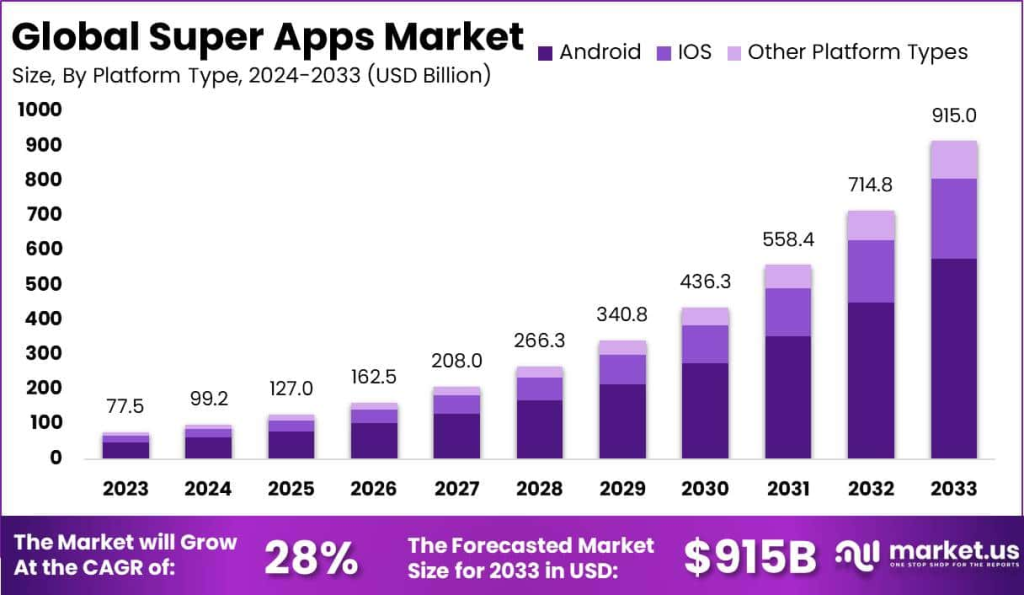
The Global Super Apps Market is projected to reach USD 915 billion by 2033, up from USD 77.5 billion in 2023, with a 28% CAGR from 2024 to 2033. This rapid growth presents a significant opportunity for crypto-native platforms to develop into comprehensive super apps integrating payments, identity, DeFi, and social features into a unified ecosystem like World.
This momentum is not driven by speculation alone. Crypto super apps are gaining traction because they solve real, structural problems across global finance, identity, payments, and digital access. The following factors explain why adoption is accelerating across both emerging and developed markets:
Remittances & Cross-Border Payments: In 2024, over $400 billion in crypto value was transferred to low- and middle-income countries, largely for remittances. Platforms like Bitso ($3.3B US–Mexico), BitPesa/AZA Finance (1–3% fees vs 20%), and Venezuela (nearly 10% of a $5B market) highlight crypto’s cost advantage.
Financial Inclusion for the Unbanked: Crypto super apps are expanding access for the 1.7 billion unbanked adults globally, especially in regions with weak banking infrastructure but high mobile usage. World App’s 40 million users and nearly 20 million verified World IDs demonstrate large-scale adoption of wallet-first financial access.
Identity Verification & Anti-Fraud Infrastructure: As AI-driven fraud accelerates, verifiable human identity has become essential. World’s Orb system has scanned nearly 20 million people, targeting 1 billion verifications, and is already being integrated into platforms like Tinder to prevent bots, sybil attacks, and deepfake abuse.
These dynamics position crypto super apps as foundational digital infrastructure rather than consumer experiments. By unifying payments, identity, and financial access at scale, platforms like World are redefining how institutions, developers, and enterprises engage with global users in on-chain ecosystems.
Industry Adoption of Crypto Super Apps
Crypto super apps are gaining traction across industries by enabling human verification, integrated payments, and seamless digital services. Their adoption reflects growing demand for secure, scalable, and user-centric blockchain solutions in real-world markets.
1. Financial Services & Banking
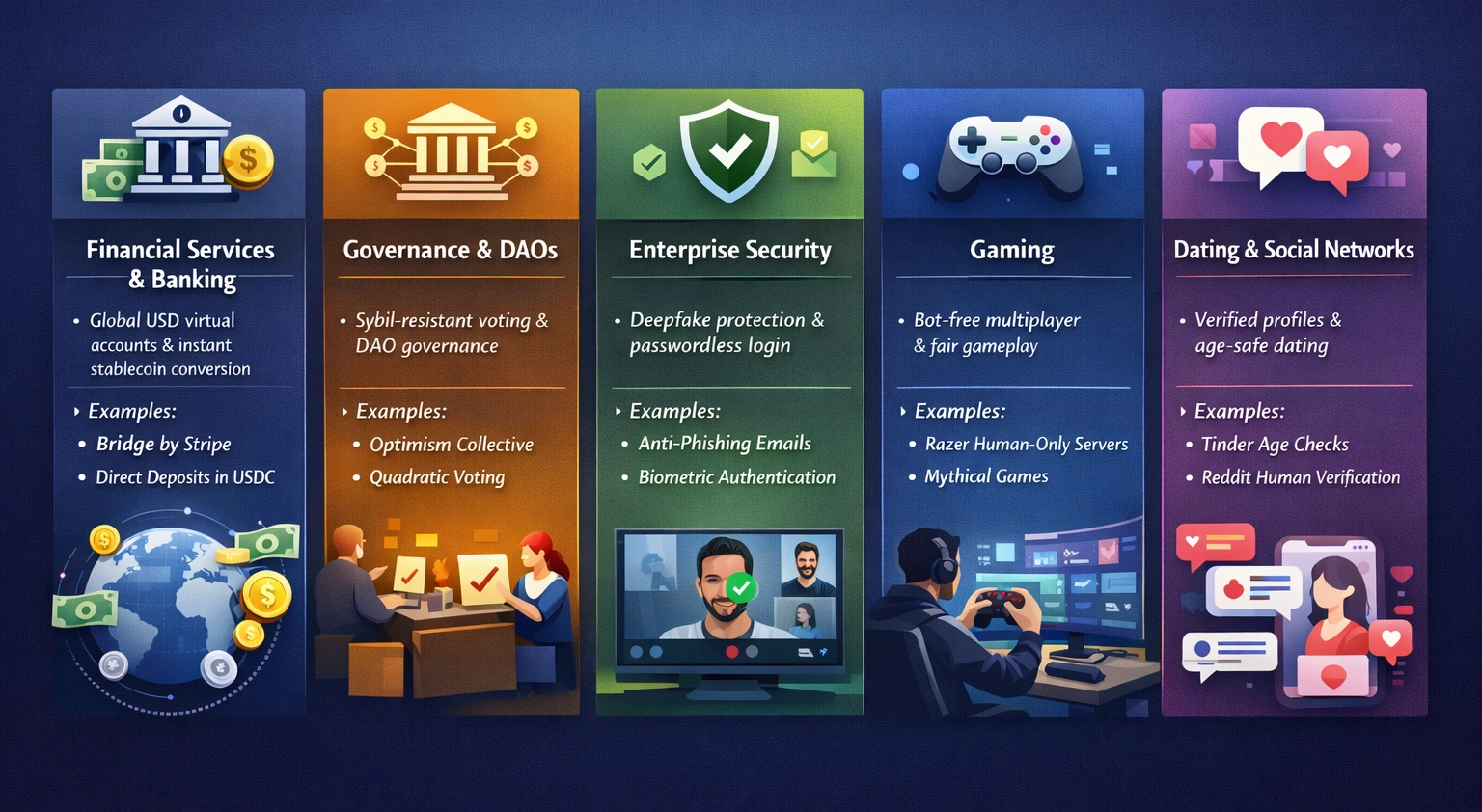
Crypto super apps extend banking access globally by combining digital identity, virtual accounts, and stablecoins. Users can receive salaries, convert fiat instantly, and transact 24/7, without relying on traditional banking rails or costly intermediaries.
Examples:
- World partnered with Bridge (owned by Stripe) to offer U.S. dollar virtual accounts across 18 countries, including the U.S., Japan, Singapore, and South Korea.
- Users receive personal account numbers for direct deposit, enabling paychecks to flow straight into the app.
- Incoming USD is automatically converted to USDC on World Chain, reducing fees and delays while providing a continuous, global financial on-ramp.
2. Governance & DAOs
Crypto super apps strengthen decentralized governance by enabling Sybil-resistant decision-making, ensuring votes reflect real human participation rather than token concentration or fake identities. This restores fairness, legitimacy, and democratic integrity to on-chain governance systems.
Examples:
- World enables DAOs to prevent Sybil attacks by requiring verified World IDs, enforcing true one-person, one-vote governance regardless of financial stake.
- The app supports advanced models like quadratic voting, allowing participants to express preference intensity while limiting outsized influence from large token holders.
- The Optimism Collective uses World ID for Sybil-resistant retroactive public goods funding, ensuring rewards are distributed based on genuine human consensus.
3. Cybersecurity & Enterprise
Crypto super apps enhance enterprise security by enabling human-verified authentication, mitigating AI-driven threats, and replacing fragile password-based systems with privacy-preserving identity assurances that scale across organizations without storing sensitive personal data.
Examples:
- Deepfake Mitigation: Tools like Deep Face use World ID authentication in real-time communication, ensuring participants in video calls or chats are verified humans, not synthetic AI clones.
- Passwordless Authentication: World ID v4.0 (launched in early 2026) leverages account abstraction and multi-key authenticators, allowing enterprises to replace passwords with biometric-backed access that is significantly harder to steal or replicate.
- Anti-Phishing & BEC Protection: Services such as Outtake Verify for Email integrate World ID to cryptographically sign corporate emails, ensuring messages originate from a verified human authorized to the account and sharply reducing business email compromise attacks.
4. Gaming
Crypto super apps enable human-only gaming environments by verifying real players, eliminating bots, cheating, and Sybil attacks. This ensures fair competition, protects in-game economies, and improves player trust in multiplayer and competitive gaming ecosystems.
Examples:
- Razer integrates World ID to enable human-only servers and modes, significantly reducing bot interference.
- Mythical Games adopts World ID to ensure fair play and verified participation among real users.
5. Dating & Social Networking
The crypto super apps provide privacy-preserving identity and age verification in social platforms, reducing fake profiles, catfishing, and AI-generated bots while maintaining user anonymity and safety.
Examples:
- Match Group uses World ID for age and identity verification in markets like Japan to improve safety and reduce fake accounts.
- Reddit has explored partnerships to verify human users and counter large-scale AI-driven bot activity.
Key Features of a Crypto Super App like World
Crypto super apps combine identity, payments, and on-chain services into one platform. Key features focus on usability, security, and scalability, enabling real-world adoption beyond the limitations of traditional crypto wallets.

1. Proof of Personhood
Biometric or social verification creates a unique human identifier, ensuring one person per account. This Sybil-resistant foundation enables fair participation, universal basic income eligibility, and the creation of anti-bot, human-only digital communities.
2. Privacy-Preserving Identity Verification
Zero-knowledge proofs verify humanity without exposing biometric data, while on-device processing prevents centralized storage. Through selective disclosure, users share only the minimum credentials required, ensuring no central biometric database exists.
3. Integrated Crypto Wallet & Payments
A multi-chain wallet enables secure asset custody and instant peer-to-peer payments. Built-in fiat on/off ramps connect traditional finance, while stablecoin compatibility supports everyday spending across the ecosystem.
4. Built-In Web3 Mini Apps
A curated DApp ecosystem is embedded directly within the super app, enabling one-click Web3 access using existing identity and wallet balances. A sandboxed environment ensures safe interaction with embedded mini-apps.
5. All-in-One Super App Experience
Seedless onboarding via email or passkeys abstracts blockchain complexity. A unified dashboard displays identity, assets, transactions, and apps, while push notifications operate through a robust blockchain abstraction layer.
6. Human-Verified Network
Bot-free social graphs ensure participation is limited to verified humans, eliminating Sybil attacks. This identity-based trust layer supports AI content verification and restores authenticated human interaction online.
7. Cross-App Identity & Login
A portable identity enables seamless login across platforms through third-party login integration. Cross-platform verification ensures reputation portability without lock-in, supporting vendor-independent Web3 authentication standards.
8. Global, Permissionless Access
The system offers censorship-resistant verification designed for worldwide inclusion through decentralized governance. It prioritizes emerging market access, low-bandwidth optimization, and compatibility with basic smartphones.
9. Account Recovery & Management
Social recovery guardians replace fragile seed phrases, while multi-party computation secures keys without central custody. This non-custodial safety model prevents permanent loss of assets or identity.
10. Gas Abstraction & Invisible Fees
Meta-transactions and paymaster contracts remove the need to manage gas, enabling multi-token gas payments. The result is a feeless UX that feels Web2-simple while remaining fully on-chain.
Crypto Super App Development Process like the World
The crypto super app development requires careful planning, security-first architecture, and global scalability considerations. Our developers follow a structured, end-to-end development process to deliver identity-driven, secure, and user-centric crypto super apps like World.
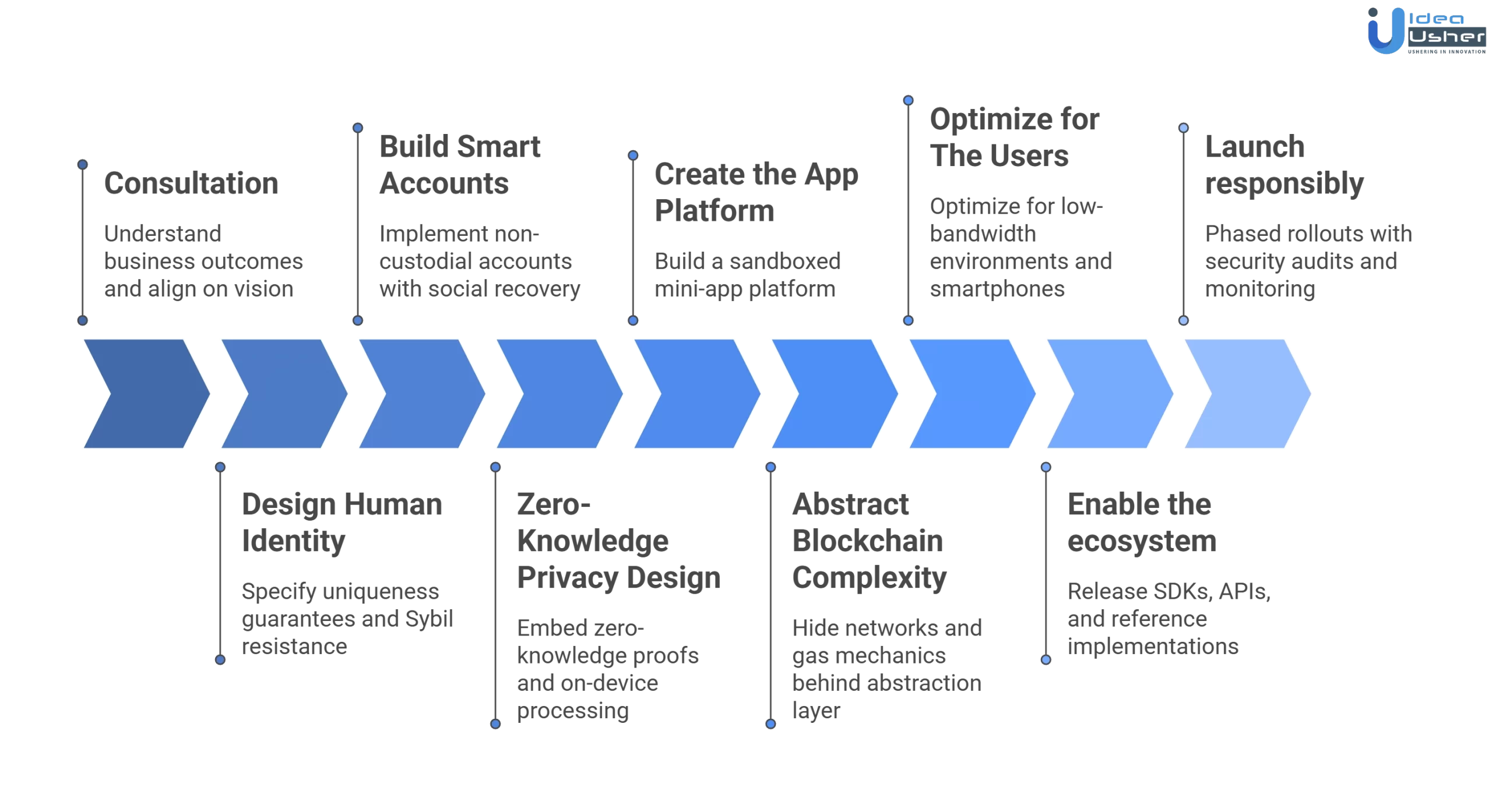
1. Consultation
We consult closely with clients to understand business outcomes, then align on a super-app vision covering proof of personhood, payments, and apps. We assess abuse vectors, target geographies, and adoption barriers early, locking non-negotiable principles before architecture and feature decisions.
2. Design Human Identity
We design proof-of-personhood first, specifying uniqueness guarantees, Sybil resistance, re-verification, and revocation logic. Privacy constraints, adversarial models, and verification flows are finalized before wallet, payments, or app layers exist.
3. Build Smart Accounts
We implement non-custodial smart accounts with seedless onboarding, social recovery guardians, and gas abstraction. Human-centric key management eliminates irreversible loss while preserving self-custody, censorship resistance, and multi-chain interoperability.
4. Zero-Knowledge Privacy Design
We embed zero-knowledge proofs, on-device processing, and selective disclosure into the protocol. No raw biometrics, identifiers, or correlation data are stored centrally, ensuring privacy guarantees survive scale, audits, and regulatory pressure.
5. Create the App Platform
We build a sandboxed mini-app platform where identity, wallet, and payments are inherited by default. Fine-grained permissions, isolation, and composability protect users while allowing developers to ship fast without fragmentation.
6. Abstract Blockchain Complexity
We hide networks, gas mechanics, and cryptographic workflows behind a unified abstraction layer. Meta-transactions, relayers, and paymasters ensure Web2-smooth interactions while preserving full on-chain settlement and transparency.
7. Optimize for The Users
We optimize for low-bandwidth environments, entry-level smartphones, and unreliable connectivity. Lightweight clients, resilient syncing, and performance-first design ensure global, emerging-market readiness from day one.
8. Enable the ecosystem
We release SDKs, APIs, and reference implementations early. Identity-aware permissions, wallet primitives, and clear documentation accelerate third-party mini-apps and create compounding network effects beyond our internal roadmap.
9. Launch responsibly
We launch through phased rollouts with security audits, red-team testing, and live abuse monitoring. Compliance remains adaptive, not fragmenting, while governance and control progressively decentralize as trust and adoption grow.
Cost to Build a Crypto Super App like World
The crypto super app development cost depends on identity depth, security, and ecosystem scope. Understanding key cost drivers helps businesses plan realistic budgets for scalable, World-like crypto platforms.
| Development Phase | What We Deliver | Estimated Cost |
| Consultation | Business goals alignment, MVP feature definition, proof-of-personhood overview, abuse vectors, target geographies, adoption risk assessment | $5,000 – $10,000 |
| Human Identity | Basic proof-of-personhood flow, uniqueness enforcement, privacy constraints, limited verification logic | $25,000 – $45,000 |
| Wallet & Payments | Non-custodial wallet, single-chain support, basic P2P transfers, stablecoin support | $30,000 – $55,000 |
| Key Management & Recovery | Seedless onboarding, basic social recovery or smart-account setup | $15,000 – $30,000 |
| Privacy & Security | Minimal ZK or cryptographic privacy layer, on-device processing where feasible | $20,000 – $35,000 |
| Mini-App Access | One or two internal mini-apps, simple embedded app container | $15,000 – $25,000 |
| UX & Mobile App | Core UX flows, onboarding, dashboard, iOS/Android MVP builds | $25,000 – $45,000 |
| Infrastructure & Scalability | Basic backend, cloud infra, monitoring, limited load optimization | $10,000 – $20,000 |
| Testing & Launch | QA testing, basic security review, beta rollout, feedback loop | $10,000 – $20,000 |
Total Estimated Cost: $70,000 – $132,000+
Note: Actual crypto super app development cost depends on features, blockchain, compliance, integrations, and security scope, while validating core capabilities and reducing launch risk.
Consult with IdeaUsher to strategically plan, develop, and launch your crypto super app with confidence.
Cost-Affecting Factors of Crypto Super App Development
Crypto super app development costs depend on identity architecture, security, scalability, and compliance. Understanding these factors helps businesses estimate budgets accurately and plan efficiently.
1. Depth of Proof-of-Personhood Implementation
Biometric, social, or hybrid verification choices affect cost through hardware needs, fraud prevention, and operational complexity, while stronger Sybil resistance increases cryptography, auditing, and abuse monitoring.
Estimated Cost: $25,000–$45,000, verification systems need custom fraud logic, workflows, and monitoring that scale with users and cannot rely on generic identity APIs.
2. Privacy & Cryptography Architecture
Implementing zero-knowledge proofs, on-device processing, and selective disclosure raises costs due to specialized cryptography, performance optimization, and extensive testing across diverse mobile environments.
Estimated Cost: $20,000–$35,000, Cryptographic privacy demands expert engineers, peer review, and device-level optimization beyond standard backend security implementations.
3. Wallet & Account Model Complexity
Smart accounts increase costs through contract development, audits, and lifecycle management, while social recovery or MPC key systems add UX, security, and operational complexity.
Estimated Cost: $15,000–$30,000, account recovery and self-custody safety require additional contracts, audits, and long-term maintenance beyond simple wallet setups.
4. Blockchain Abstraction & Gas Management
Gas abstraction adds cost by introducing meta-transactions, relayers, and paymasters that hide network complexity while requiring reliable backend execution and monitoring.
Estimated Cost: $15,000–$25,000, transaction sponsorship needs persistent infrastructure, abuse controls, and failure handling not present in direct user-paid gas models.
5. Multi-Chain Support Scope
Supporting multiple blockchains multiplies development, testing, and monitoring costs as each network introduces unique tooling, failure modes, and maintenance requirements.
Estimated Cost: $10,000–$20,000 per chain; each additional chain adds independent RPC dependencies, QA cycles, and operational risk management overhead.
6. Mini-App Platform & Sandbox Security
Building a mini-app platform increases cost through sandboxing, permission controls, and secure app isolation to safely run third-party code.
Estimated Cost: $15,000–$25,000, secure execution environments require isolation layers and audits to prevent third-party apps from compromising core systems.
Challenges and How Our Developers Will Solve Them
The crypto super app development involves complex technical and adoption challenges. Our developers address these challenges with proven architectures, security-first design, and scalable solutions to ensure reliable, user-ready platforms.
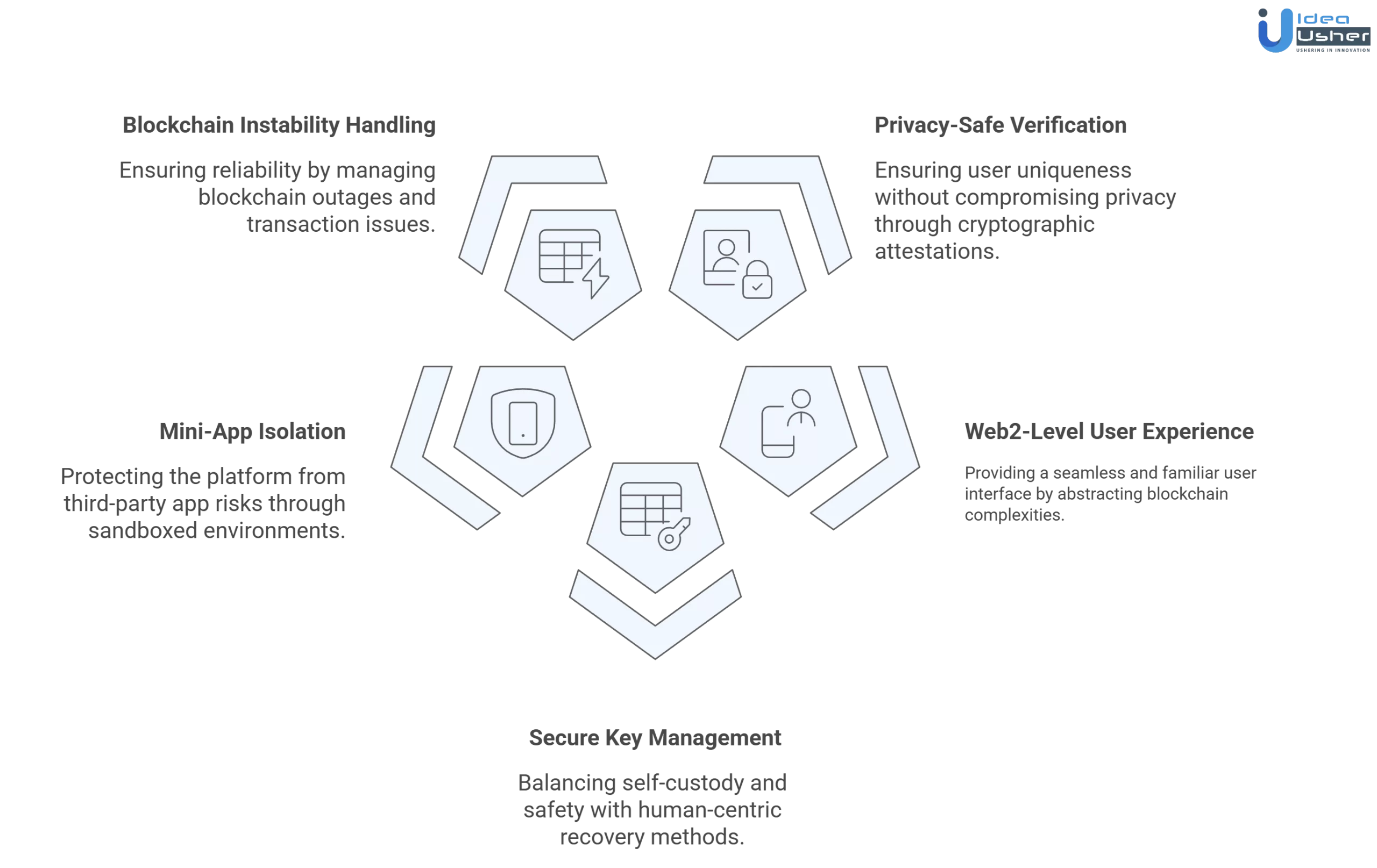
1. Privacy-Safe Human Verification
Challenge: Proving users are unique humans while avoiding centralized biometric storage is extremely difficult. Poor implementations lead to privacy backlash, regulatory risk, or ineffective bot prevention.
How we solve it: Our developers design privacy-first proof-of-personhood flows using cryptographic attestations, on-device processing, and re-verification logic, ensuring Sybil resistance without exposing or storing sensitive personal data.
2. Web2-Level User Experience
Challenge: Users abandon apps that expose gas fees, seed phrases, network errors, or slow confirmations. Blockchain complexity directly harms adoption.
How we solve it: We implement smart accounts, gas abstraction, meta-transactions, and retry-safe relayers so users interact through familiar flows while all blockchain execution remains invisible and reliable underneath.
3. Secure Key Management
Challenge: Losing private keys permanently locks users out, while centralized custody undermines trust and regulatory positioning.
How we solve it: Our developers implement human-centric recovery using smart accounts, social recovery guardians, and MPC-based key management, balancing self-custody, safety, and usability without introducing single points of failure.
4. Mini-App Isolation
Challenge: Embedding third-party apps risks data leaks, wallet exploits, or cross-app attacks that can compromise the entire platform.
How we solve it: We build sandboxed mini-app environments with strict permissioning, isolated execution contexts, and identity-aware access controls, ensuring third-party apps inherit capabilities without endangering users or core systems.
5. Blockchain and Network Instability Handling
Challenge: Public blockchains experience RPC outages, chain reorgs, stuck transactions, and inconsistent confirmations, which can break user flows and cause loss of trust if not handled properly.
How we solve it: Our developers implement transaction state tracking, retry-safe relayers, multi-RPC fallbacks, and reconciliation logic, ensuring user actions remain consistent even when underlying networks behave unpredictably.
Why Identity-First Architecture Is Critical for Crypto Super App?
Identity-first architecture enables crypto super apps to prioritize real users, trust, and security. It reduces fraud, improves usability, and creates a scalable foundation for payments, governance, and real-world adoption.
1. Human-Centric Architecture Shift
Traditional Web3 platforms begin with wallet addresses, while super apps prioritize users. Identity-first architecture reverses this: users complete biometric verification before receiving wallets. Addresses support identity rather than define it. World App ensures participant uniqueness through iris verification.
2. Solving Network Bootstrap Paradox
Identity-first architecture solves the bootstrapping paradox where dApps need users and users need dApps. Verified individuals are pre-qualified for airdrops, credit, and governance. Platforms like Optimism and Gitcoin distribute rewards exclusively to World ID holders, guaranteeing genuine human participation.
3. Built-In Protocol-Level Trust
Identity-first architecture enables immediate trust at initial interaction, unlike standalone dApps that establish trust gradually. Reputation is granted based on verification rather than accumulated over time. Verified users can borrow, trade, or vote without waiting periods or collateral.
4. Identity-Based Spam Prevention
Without identity verification, inboxes are vulnerable to sybil attacks. Identity serves as the only scalable spam filter. World ID-verified Discord servers report a 99% reduction in bot raids, leading to higher user engagement through guaranteed authenticity.
5. Portable Identity Across Applications
Identity-first architecture enables portable reputation, allowing a single human credential to work across platforms. World ID holders can move between DeFi, social, and gaming apps with verified status, eliminating repeated KYC and fragmented trust scores across walled gardens.
Conclusion
Building a platform like World requires more than integrating wallets, payments, and identity into one interface. It demands a clear product vision, strong compliance planning, scalable architecture, and a user experience that simplifies complex blockchain interactions. Success lies in creating real utility while maintaining security and trust at every layer. If you are exploring crypto super app development, focus on interoperability, ecosystem partnerships, and long-term value creation. A well-structured strategy will position your platform to grow sustainably in a rapidly evolving digital economy.
Build Your Crypto Super App with Expert Development Support!
We specialize in blockchain architecture, digital identity integration, and secure fintech ecosystems to help you launch a high performance crypto super app like World. Our experienced blockchain engineers design unified platforms that combine wallets, payments, DeFi services, and compliance-ready infrastructure.
Why Partner With Us?
- End-to-End Crypto Super App Development: From product strategy to deployment, we build scalable, user-centric super apps tailored to your market vision.
- Secure Identity & Wallet Integration: We implement robust KYC, digital identity verification, and multi-layer wallet security to protect user assets.
- Interoperable Blockchain Architecture: Our team develops cross-chain compatible platforms that ensure speed, efficiency, and long-term adaptability.
- Regulatory-Ready Frameworks: We design compliant systems aligned with evolving global crypto regulations.
Explore our portfolio to see how we build secure and scalable blockchain ecosystems. Connect with us to discuss your crypto super app development roadmap.


FAQs
A.1. A crypto super app should combine wallet functionality, digital identity, payments, token transfers, and access to DeFi services within one interface. You also need strong security, KYC compliance, scalability, and seamless onboarding to ensure long-term user retention and ecosystem growth.
A.2. The cost depends on features, blockchain integration, compliance requirements, and development location. A basic version may require a moderate investment, while a fully scalable crypto super app with identity, payments, and DeFi modules demands significantly higher technical and security resources.
A.3. Regulatory compliance requires integrating KYC and AML processes, data protection standards, and jurisdiction-specific licensing. You must consult legal experts early, implement audit trails, and design adaptable compliance layers to support expansion across multiple regions without restructuring the core architecture.
A.4. The ideal blockchain depends on scalability, transaction fees, ecosystem maturity, and security. Ethereum offers strong developer support, while Layer 2 solutions and alternative chains provide lower fees and faster transactions. Your choice should align with performance goals and user adoption strategy.