 (+971) 8007 4267
 (+91) 946 340 7140
 (+1) 628 432 4305


Creator platforms work best when they align effort, ownership, and monetization into a single system. Creators generate value through content, communities, and engagement, yet the tools supporting them often fragment revenue, data, and audience relationships across platforms. This disconnect is pushing interest toward building a creator economy platform on Base that gives creators more control over how value is created and shared, especially when designed to build on Base with lower friction and better scalability.
As creators grow, monetization needs move beyond ads or one-time payments. Memberships, fan access, digital assets, and on-chain incentives introduce new ways to reward participation and loyalty. These models can be implemented with lower transaction costs and faster interactions, but success depends on how well the platform combines creator tools, payment logic, and community mechanics into a cohesive experience.
In this blog, we explain how to build a creator economy platform on Base by breaking down the core product components, system architecture, and design considerations involved in supporting sustainable creator-led businesses on-chain.
What Is a Creator Economy Platform?
A creator economy platform is a digital product that helps creators monetize content, community, and expertise directly, reducing reliance on intermediaries. These platforms enable creators to turn audience engagement into revenue via subscriptions, memberships, digital assets, and fan support.
When powered by blockchain, creator economy platforms embed ownership, payments, and access rules directly into smart contracts, reducing platform dependency and increasing transparency for both creators and users.
Why Businesses Should Build a Creator Economy Platform on Base?
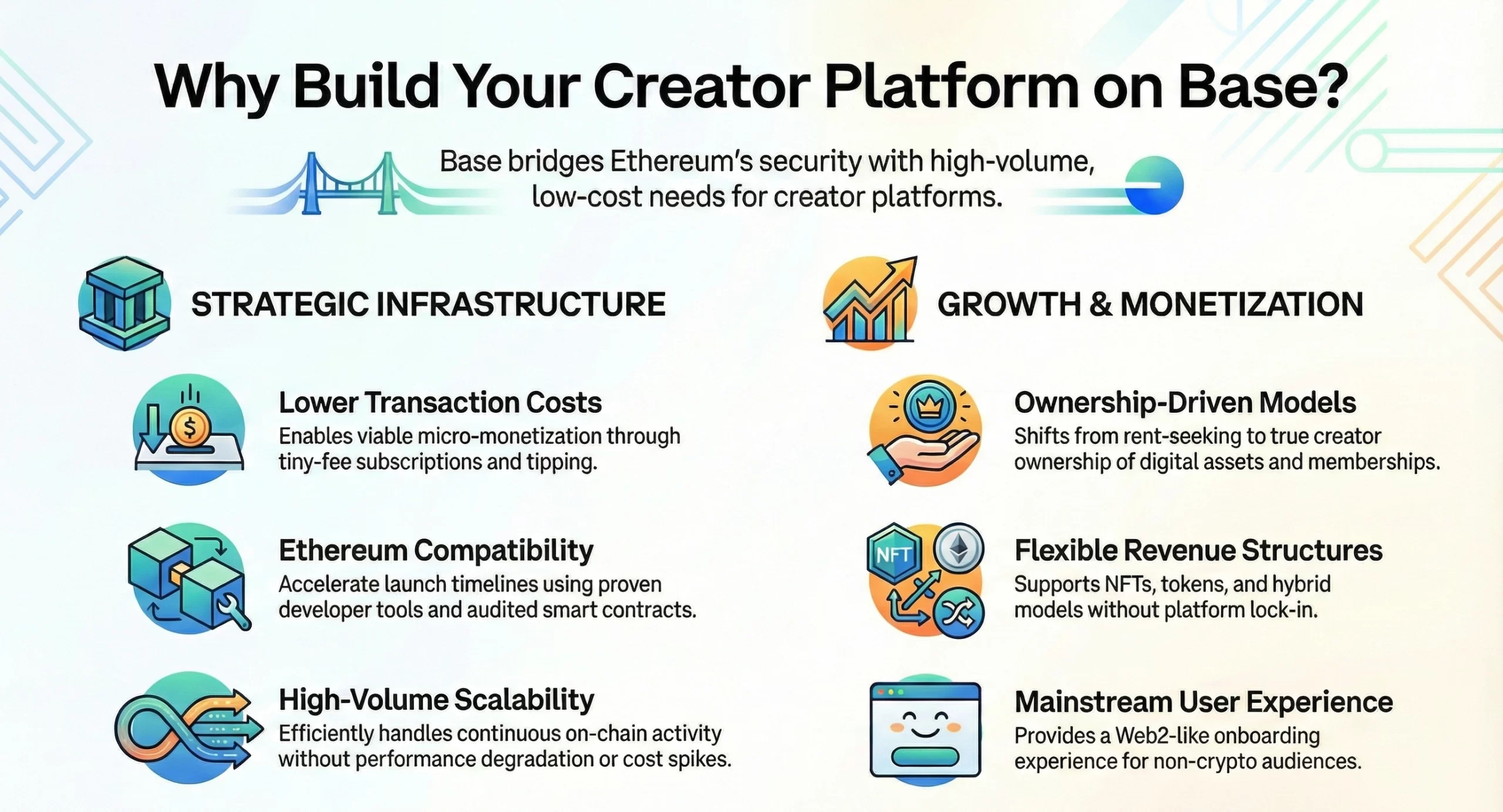
Businesses exploring the creator economy are increasingly choosing Base as the foundation for their platforms. The reason is not hype. It is about economic efficiency, ownership control, and long-term scalability that traditional platforms struggle to offer. Below are the core reasons why Base makes strategic sense for businesses building creator economy platforms.
1. Lower Transaction Costs
Creator platforms depend on subscriptions, tips, and small-value purchases. Base’s low transaction fees make these frequent interactions viable, allowing businesses to support micro-monetization without eroding creator earnings or user experience.
2. Ownership-Driven Business Models
Platforms built on Base allow businesses to offer creators true ownership of memberships, content access, and digital assets. This shifts the platform from a rent-seeking model to a partnership-driven ecosystem, increasing creator retention and loyalty.
3. Scalable Infrastructure for High Engagement
Creator economy platforms generate continuous on-chain activity. Base is designed to handle high transaction volumes efficiently, enabling businesses to scale creators, users, and interactions without performance degradation or unpredictable costs.
4. Flexible Monetization
Base supports subscriptions, NFTs, token-gated access, tipping, and hybrid monetization models. Businesses are not forced into a single revenue structure and can evolve their platform as creator behavior and market demand change.
5. Faster Development With Ethereum Compatibility
Businesses can leverage proven Ethereum tooling because Base is fully EVM-compatible, audited smart contract patterns, and existing developer expertise. This reduces development risk and accelerates platform launch timelines.
6. Better UI/UX for Non-Crypto Audiences
Creator platforms must appeal to mainstream users. Base supports modern onboarding patterns, wallet abstraction, and gas-efficient interactions, allowing businesses to deliver a Web2-like experience while retaining Web3-native benefits.
Types of Creator Economy You Can Build on Base
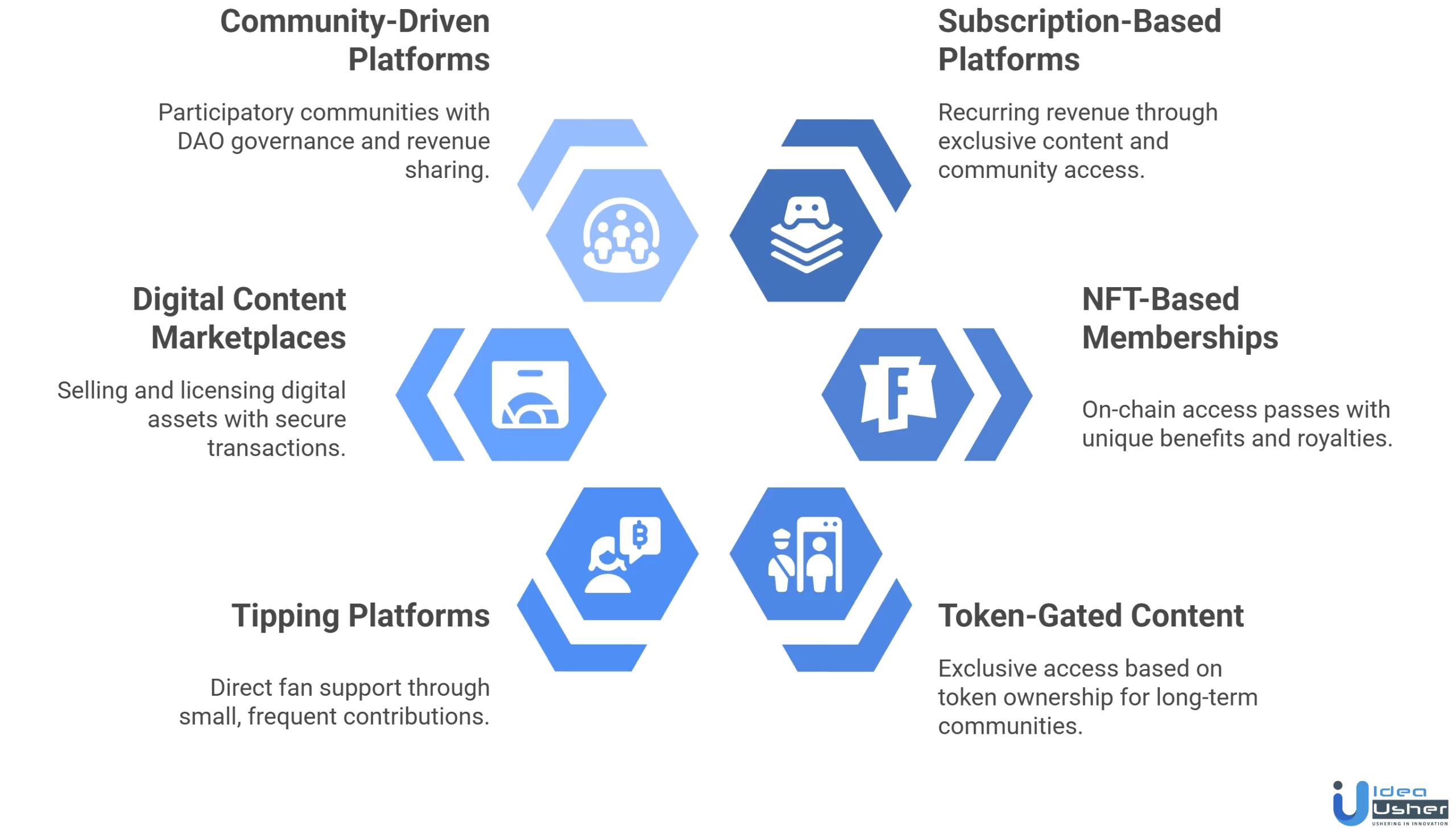
Creator economy platforms are not one-size-fits-all products. Different creators monetize in different ways, and the flexibility of Base makes it possible to design multiple creator-first business models on a single scalable foundation. Below are the most practical and in-demand creator economy use cases founders are actively building on Base today.
1. Subscription-Based Creator Platforms
Subscription models allow creators to generate recurring revenue by offering exclusive content, early access, or premium community participation. On Base, subscriptions can be implemented using smart contracts that:
- Handle recurring or renewable payments
- Automatically grant or revoke access based on subscription status
- Reduce reliance on centralized billing systems
Low transaction fees make Base especially suitable for monthly or tiered subscriptions, even at lower price points.
Example: Creator publishing platforms such as Paragraph use Base to support wallet-based subscriptions and gated reader access.
2. NFT-Based Creator Memberships
NFT memberships act as on-chain access passes that grant holders specific privileges within a creator’s ecosystem. Common NFT membership use cases include:
- Lifetime access to exclusive content
- Tiered memberships with different benefits
- Event access or gated communities
Because NFTs are transferable, creators can design secondary-market-friendly memberships while still earning royalties through smart contract logic.
Example: NFT membership and drop-based communities are actively built using Zora on Base.
3. Token-Gated Content and Communities
Token-gated platforms restrict access to content, tools, or communities based on token ownership. On Base, token gating enables:
- Exclusive posts or media for token holders
- Private communities linked to wallet ownership
- Dynamic access rules that evolve over time
This model works well for creators building long-term communities rather than one-off content monetization.
Example: Social and community tools built around Farcaster leverage Base for token-gated interactions and creator-led communities.
4. Tipping and Fan Support Platforms
Direct fan support is a core part of the creator economy. Tipping platforms allow audiences to support creators through small, frequent contributions. Base’s low fees make tipping practical by:
- Keeping transaction costs low for micro-payments
- Enabling real-time creator rewards
- Supporting multiple tokens or payment flows
This is particularly valuable for live creators, educators, and community-driven platforms.
Example: Creator tipping and engagement features on Farcaster are powered by Base’s low-cost transactions.
5. Digital Content Marketplaces
Digital content marketplaces enable creators to sell, license, and monetize digital assets through secure platforms. They support efficient transactions, audience reach, and sustainable creator revenue models.
- Courses and educational materials
- Premium articles or research
- Music, art, or digital collectibles
Smart contracts on Base can manage purchases, access rights, and revenue distribution automatically, reducing operational complexity for both creators and platform operators.
Example: Music and digital collectible marketplaces such as Sound.xyz operate on Base to support direct creator sales.
6. Community-Driven Creator Platforms
Some creators focus on building participatory communities rather than traditional content businesses. These platforms may include:
- DAO-style governance for members
- Community rewards and incentives
- Revenue-sharing models
Base supports these use cases by allowing transparent voting, automated payouts, and scalable on-chain interactions.
Example: Community-owned publishing and collaboration platforms like Mirror leverage Base for governance and shared ownership models.
Base NFT Trading Volume Hits $122M, Boosting Creator Platforms
The global creator economy market size was estimated at USD 205.25 billion in 2024 and is projected to reach USD 1,345.54 billion by 2033, growing at a CAGR of 23.3% from 2025 to 2033. This growth reflects rising demand for creator-led platforms, digital ownership, and direct monetization models.

Base NFTs reached $122 million in trading volume with 6.7 million sales in 2025, including a 336% month-over-month increase in June, signaling strong creator and user activity. This engagement indicates Base offers a scalable environment where creator economy platforms can enter with meaningful opportunities for adoption and growth.
What Base NFT Growth Indicates for Creator Platforms
The growth in NFT activity on Base highlights meaningful creator and user participation, offering practical insights for teams planning to build and launch creator-focused platforms.
- High creator engagement: Strong trading volume reflects active creators consistently publishing and monetizing digital content
- User willingness to transact: Millions of completed sales indicate buyer confidence in on-chain creator assets
- Low-friction monetization: Lower transaction costs support frequent purchases and microtransactions
- Proven market demand: Sustained activity shows creator-led experiences resonate with users
Base Creates Strong Conditions for Creator Economy Apps
Base combines infrastructure efficiency with ecosystem momentum, helping creator platforms grow beyond early adoption.
- Scalable transaction capacity: Handles increasing user and creator activity without performance bottlenecks
- Predictable operating costs: Enables creators and platforms to plan sustainable revenue models
- Growing user base: Expanding on-chain participation improves visibility for new platforms
- Ecosystem alignment: Existing tools and integrations simplify creator onboarding and platform development
Base’s NFT performance and creator engagement point to a network with real usage and growing momentum. For builders, this signals an environment where creator economy platforms can launch with confidence and scale steadily when supported by thoughtful design and execution.

How does a Creator Economy Platform on Base Works?
A creator economy platform on Base leverages Ethereum Layer 2 infrastructure to enable scalable monetization, ownership, and engagement. It showcases decentralized tools supporting creators, communities, and on-chain growth, ecosystems globally.
1. Creator Onboarding and Identity Setup
Creators begin by creating a profile that is linked to a wallet address. This wallet acts as the creator’s on-chain identity and payout destination. On Base, onboarding can be designed to:
- Support wallet creation with minimal friction
- Abstract technical blockchain steps from creators
- Allow optional Web2-style signups with wallet linking
This ensures creators can start publishing and monetizing without deep blockchain knowledge.
2. Content Publishing and Access Definition
Once onboarded, creators upload or reference their content, which is typically stored off-chain for performance and cost efficiency. The platform then defines access rules through smart contracts. Access logic may include:
- Active subscriptions
- Ownership of NFTs or tokens
- One-time purchase validation
Smart contracts on Base enforce these rules automatically whenever a user attempts to access gated content.
3. User Interaction and Payments
When users engage with a creator’s content or community, payments are processed directly on Base. This can include:
- Subscription payments
- Tipping or fan contributions
- NFT purchases or renewals
Because Base offers low transaction fees, these interactions remain cost-effective even for small-value transactions. Once a payment is confirmed on-chain, access is granted instantly based on the contract logic.
4. Automated Revenue Distribution
One of the biggest advantages of building on Base is automated, transparent payouts. Smart contracts can be configured to:
- Send earnings directly to creators’ wallets
- Split revenue between multiple parties
- Enforce platform fees programmatically
This removes the need for manual payout processes and reduces disputes around earnings.
5. Access Verification and Engagement
Each time a user returns to access content or participate in a community, the platform checks on-chain conditions remembered by the smart contracts. These checks ensure:
- Subscriptions are still active
- Tokens or NFTs are still owned
- Access rules are consistently enforced
This continuous verification allows creators to maintain controlled, monetized access without manual oversight.
6. Analytics, Monitoring, and Scaling
While core logic runs on-chain, off-chain services track events and provide insights for creators and platform operators. These systems help:
- Monitor creator earnings and engagement
- Track subscription and payment trends
- Optimize platform performance and UX
As the platform grows, Base’s scalability ensures that increasing transaction volume does not degrade user experience.
Core Features of Creator Economy Platform on Base
A creator economy platform on Base combines scalability, low fees, and on-chain verification to support sustainable monetization and audience engagement. These core features define a modern, resilient foundation.

1. Wallet-Based Authentication and Identity
Wallet-based login replaces traditional usernames and passwords, allowing creators and fans to authenticate using on-chain identities. This approach enables ownership-based access, reduces onboarding friction, and aligns user identity directly with assets, memberships, and permissions.
Example: Platforms like Farcaster use wallet-based identities to let creators own their profiles and social graphs while enabling seamless login across applications built on Base.
2. Audience Accounts and Access Management
User accounts enable audiences to manage subscriptions, purchases, and content access in one place. By linking access rights to wallets or abstracted accounts, platforms ensure secure, permission-based access while maintaining a smooth, Web2-like user experience.
Example: Paragraph enables readers to manage paid access and memberships through wallet-linked accounts while keeping the reading experience familiar and intuitive.
3. Token-Gated Content
Token-gated access ensures that only users holding specific tokens or NFTs can view content or join communities. This creates scarcity-driven value, supports exclusive experiences, and allows creators to monetize access without relying on centralized gatekeepers.
Example: Zora allows creators to gate drops, content, and community participation using NFTs deployed on Base.
4. NFT Memberships and Subscription Models
NFT memberships represent recurring access to content, perks, or communities. Unlike traditional subscriptions, these memberships are transferable, programmable, and verifiable on-chain, giving creators flexible monetization while offering fans true ownership of access rights.
Example: Creator-led communities on Mirror use NFT-based memberships to unlock exclusive writing, governance rights, and community benefits on Base.
5. On-chain Creator Monetization
On-chain payments enable creators to earn directly through tips, subscriptions, or one-time purchases. Base’s low and predictable fees make micro-transactions and recurring monetization practical, supporting sustainable creator income without high transaction overhead.
Example: Sound.xyz enables musicians to monetize audio releases and fan interactions with direct on-chain payments on Base.
6. Automated Revenue Distribution
Smart contracts can automatically distribute revenue among creators, collaborators, or communities based on predefined rules. This removes manual payouts, ensures transparency, and builds trust by enforcing fair revenue sharing directly at the protocol level.
Example: Creator collectives using Zora can programmatically split earnings from NFT sales among multiple contributors on Base.
7. Payments, Payouts, and Earnings Visibility
Clear payment flows and transparent payouts are critical for creator trust. Creator dashboards display real-time earnings, completed transactions, and payout history, helping creators track income while ensuring instant or automated fund distribution.
Example: Platforms built on Farcaster integrate tipping and monetization tools that allow creators to see earnings and transaction history directly tied to their wallet.
8. Creator Analytics and Performance Insights
Creator dashboards provide visibility into earnings, engagement metrics, and audience behavior. By combining indexed on-chain data with off-chain analytics, creators gain actionable insights to refine content strategy and optimize monetization performance.
Example: Paragraph offers creators insight into subscriber behavior, paid content performance, and wallet-based engagement data.
9. Fan Engagement and Loyalty Mechanisms
Reward systems such as loyalty tokens, participation incentives, or achievement-based perks encourage recurring fan interaction. Base enables these high-frequency engagement loops without excessive fees, helping platforms build active, long-term creator communities.
Example: NFT-based engagement campaigns on Zora reward fans for participation, minting, and community interaction on Base.
10. Platform Governance and Control Tools
Governance features allow platforms to manage creator onboarding, content policies, and rule updates. These controls support moderation and long-term scalability while still enabling creators to operate independently within a transparent, on-chain framework.
Example: Publishing collectives using Mirror implement token-based governance to manage editorial decisions and community participation.
How to Build a Creator Economy Platform on Base?
Building a creator economy platform on Base requires scalable blockchain infrastructure, smart contracts, and user-focused design. Our developers follow proven Web3 practices to deliver secure, scalable creator platforms, showcasing reliability.

1. Consultation and Strategy
We start by understanding the creator segment, revenue goals, and platform vision. Our team defines the core monetization model like subscriptions, NFT memberships, tipping, or hybrids and aligns features with real creator and audience behavior.
2. Platform Architecture and Planning
Our developers design the platform architecture with both MVP speed and future scale in mind. We select smart contract patterns, frontend frameworks, backend services, and storage layers that allow the platform to evolve without costly rewrites.
3. Smart Contract Development on Base
We develop smart contracts that handle creator monetization, access control, and revenue distribution. Our focus is on gas-efficient logic, secure permission handling, and contract designs that support frequent transactions on Base.
4. Frontend Development
Our frontend team builds interfaces that abstract blockchain complexity. We design creator dashboards, content access flows, and onboarding experiences that feel familiar to Web2 users while remaining fully compatible with on-chain logic.
5. Backend Services and Off-Chain Logic
We implement backend systems to manage content metadata, analytics, notifications, and integrations. These services work alongside smart contracts, ensuring on-chain events are reflected accurately across the platform without unnecessary blockchain overhead.
6. Wallet Integration and Payment Setup
Our developers integrate wallets and payment flows optimized for Base. We focus on minimizing transaction friction, supporting subscriptions and one-time payments, and ensuring creators receive payouts smoothly and transparently.
7. Testing and Quality Assurance
Before launch, we rigorously test smart contracts, frontend workflows, and backend integrations. Our team performs security checks, validates edge cases, and ensures the platform is stable, secure, and ready for real user activity.
8. MVP Launch and Early Creator Onboarding
We launch the MVP with a focused feature set and onboard an initial group of creators. Early usage data helps us validate monetization flows, refine UX, and identify improvements before expanding functionality.
9. Iteration, Optimization, and Scaling
Post-launch, we continuously iterate based on real user behavior. Our developers optimize performance, introduce new features, and prepare the platform to handle more creators, higher transaction volumes, and additional monetization models.
Technical Architecture of a Creator Economy Platform on Base
This section explains the technical architecture of a creator economy platform built on Base, covering smart contracts, backend systems, and scalability considerations. It highlights how these components work together to ensure secure, efficient platform performance.
| Component | Architectural Role in the Platform | How Base Strengthens This Component |
| Creator & Fan Frontend | Creator dashboards, content publishing tools, fan discovery, and gated content access | Fast transaction confirmations on Base enable near real-time access checks and smooth user interactions with minimal blockchain latency |
| Wallet Integration | User identity, authentication, ownership verification, and payments | Base-compatible wallets enable decentralized login and payments, strengthening user ownership |
| Smart Contract Layer | Defines monetization logic, access rules, subscriptions, and revenue splits | Base supports frequent smart contract interactions at low, predictable cost, enabling viable subscriptions and engagement |
| Token & NFT Infrastructure | Creator tokens, NFT memberships, access passes, and digital ownership | Base enables scalable token issuance and NFT interactions, supporting token-gated content and transferable creator memberships |
| Indexing & Data Layer | Tracks ownership, subscriptions, access rights, and platform activity | On-chain data from Base can be indexed efficiently, enabling fast permission checks and a responsive user experience at scale |
| Backend & Off-Chain Services | Content delivery, notifications, moderation, analytics processing | Keeps compute-heavy and non-critical logic off-chain while relying on Base for trust, verification, and execution guarantees |
| Payments & Revenue Distribution | Automated payouts to creators, collaborators, and platform wallets | Smart contracts on Base enforce transparent, programmable revenue flows with minimal transaction overhead |
Cost to Build a Creator Economy Platform on Base
The cost to build a creator economy platform on Base depends on features, integrations, and scalability requirements. It provides a clear overview of budget considerations and development scope, showcasing flexibility.
| Development Area | Scope | Estimated Cost |
| Product Strategy & Technical Discovery | Requirement analysis, creator model design, feature scoping, technical roadmap | $5,000 – $10,000 |
| UI/UX Design (Creator-First) | Creator dashboards, user flows, onboarding UX, responsive design | $8,000 – $15,000 |
| Smart Contract Development | Subscriptions, payments, NFT memberships, token gating, revenue splits | $12,000 – $25,000 |
| Frontend Development | Creator profiles, content access, monetization flows, dashboards | $15,000 – $30,000 |
| Backend Development | Content management, analytics, notifications, integrations | $12,000 – $25,000 |
| Wallet & Payment Integration | Wallet setup, payment flows, Base transaction handling | $4,000 – $8,000 |
| Testing & QA | Functional testing, UX testing, edge case validation | $4,000 – $8,000 |
| Security Review (Pre-Audit) | Smart contract review, permission checks, risk mitigation | $5,000 – $12,000 |
| Deployment & Launch Support | Base network deployment, environment setup, and go-live support | $3,000 – $6,000 |
Total Estimated Cost by Platform Stage
| Platform Stage | Realistic Cost Range |
| Founder-Ready MVP | $55,000 – $80,000 |
| Production-Ready Platform | $80,000 – $140,000 |
| Enterprise / Multi-Creator Platform | $150,000+ |
Note: The total estimated cost depends on platform complexity, feature set, blockchain integrations, security requirements, development timeline, and ongoing maintenance needs.
Consult with IdeaUsher for Creator Economy Platform Development on Base to ensure scalable architecture, secure implementation, and long-term growth.
Cost-Affecting Factors in Creator Economy Platform Development
Cost-affecting factors in creator economy platform development include features, integrations, security, and scalability. It outlines key elements influencing overall investment and planning considerations.
1. Creator Monetization Model Complexity
The number and interaction of monetization methods directly affect development effort. Supporting subscriptions, NFTs, tipping, and bundles together requires more contract logic, testing, and UX alignment than a single revenue model.
2. Creator and Audience Onboarding Experience
Reducing friction for non-crypto creators increases cost. Wallet abstraction, seamless sign-up flows, and guided onboarding require additional UX design, backend logic, and deeper integration testing across user journeys.
3. Access Control and Permission Logic
Complex access rules increase development time. Tiered memberships, time-based access, bundled content rights, and dynamic permissions require careful smart contract design and frontend enforcement to prevent revenue leakage.
4. Smart Contract Security Requirements
Higher-value creator earnings increase security needs. Revenue-handling contracts require extensive testing, edge-case handling, and security reviews, which significantly impacts development time and overall project cost.
5. Content Type and Delivery Method
Different content formats add complexity. Supporting video, live streams, gated downloads, or community feeds requires varied storage, delivery, and access-verification mechanisms beyond basic text content.
6. Real-Time Payments and Payout Frequency
Frequent payouts increase system complexity. Instant or near-real-time creator payouts require optimized transaction handling, monitoring, and reconciliation logic compared to delayed or batched payout systems.
Challenges and How Our Developers Solve Them?
Building a creator economy platform on Base comes with practical challenges that directly impact adoption, revenue, and scalability. Below are the most common real-world challenges we see and how our developers address them during development.

1. Smart Contract Design for Monetization
Challenge: Poorly designed contract state structures make subscriptions, renewals, and access checks expensive, hard to upgrade, and error-prone during real user activity.
Solution: We design minimal, purpose-driven contract states with clear ownership mappings, reducing gas usage and ensuring monetization logic remains stable as creators and transactions scale.
2. On-Chain and Off-Chain System Sync
Challenge: Keeping content visibility perfectly aligned with on-chain access rules becomes difficult when content is stored off-chain and accessed at scale.
Solution: Our developers build strict on-chain validation layers combined with backend verification, ensuring content delivery always reflects real-time subscription, token, or NFT ownership.
3. Subscription Lifecycle Edge Cases
Challenge: Subscription edge cases like early renewals, failed payments, expired access, and overlapping tiers often break user experience if not handled carefully.
Solution: We explicitly model subscription lifecycle states during development, covering renewals, grace periods, and expirations to keep access logic predictable and creator revenue protected.
4. Gas Optimization Trade-Offs
Challenge: Adding advanced monetization features often increases gas costs, making creator interactions expensive and harming adoption.
Solution: We balance feature richness with gas efficiency by splitting logic across contracts and moving non-critical operations off-chain while keeping revenue and access enforcement on-chain.
5. Multi-Creator Data Isolation and Security
Challenge: As platforms scale, isolating creator data and permissions becomes harder, increasing the risk of data leaks or incorrect access enforcement.
Solution: Our developers implement strict creator-level data separation and permission checks across smart contracts, backend services, and frontend logic to maintain platform integrity.
Top Creator Economy Platforms Built on Base
Creator economy platforms built on Base demonstrate how blockchain supports scalable monetization and community engagement. These real-world examples highlight practical use cases for creators leveraging Base infrastructure.
1. BasePaint

BasePaint is a collaborative on-chain art platform where creators collectively build and mint digital artwork. Base enables low-cost transactions and fast confirmations, allowing frequent participation, real-time creativity, and seamless minting without high gas fee constraints.
2. CrowdMuse

Crowdmuse is a creator and fashion-focused platform that enables community-led curation and ownership. Built with Base compatibility, it supports scalable participation, transparent coordination, and on-chain incentives, allowing creators and communities to collaboratively shape culture with verifiable ownership and engagement.
3. Bright Moments

Bright Moments connects artists and collectors through curated digital art drops and immersive experiences. Base provides the infrastructure for efficient NFT minting, secure ownership records, and accessible participation, enabling global audiences to engage with creator-led digital art events.
4. Coinvise

Coinvise allows creators to launch tokens, memberships, and gated communities. Base plays a key role by reducing transaction costs and simplifying token interactions, making creator monetization more accessible while ensuring transparent, programmable revenue and access control.
5. District

District is a community and governance platform that supports creator-led groups and DAO-style coordination. Base enables secure on-chain voting, membership management, and asset handling, allowing creators to manage communities efficiently with scalable and cost-effective blockchain operations.
Conclusion
Building a creator economy platform on Base requires thoughtful planning across technology, user experience, and long-term sustainability. This guide walks through core components, development steps, and cost considerations to help clarify the process. Base offers scalable infrastructure and lower transaction costs, making it suitable for creator-focused applications. Success depends on aligning platform features with creator needs while maintaining security and performance. With the right strategy and execution, a creator economy platform on Base can support meaningful engagement and sustainable monetization for creators and communities across diverse digital ecosystems.
Partner with IdeaUsher for Developing Creator Economy Platform on Base
At IdeaUsher, we help businesses and creators design and build creator economy platforms that leverage Base for scalable monetization, community engagement, and digital ownership. Our team understands the technical and product nuances required to support creators at scale.
Why Partner with Us?
- Creator-Focused Architecture: We design platforms that support content monetization, NFTs, memberships, and fan engagement.
- Base-Native Development: Our developers build optimized solutions that take advantage of Base’s low fees and scalable infrastructure.
- End-to-End Execution: From product strategy to launch-ready deployment, we manage the complete development lifecycle.
- Secure and Scalable Builds: We prioritize smart contract security and long-term platform growth.
Explore our portfolio to see how we’ve helped Web3 platforms bring creator-driven products to market with confidence.


FAQs
A.1. Base reduces costs through lower gas fees and efficient transaction processing compared to mainnet Ethereum. This allows creators and users to interact more frequently, making microtransactions, content monetization, and community engagement economically sustainable.
A.2. Smart contracts automate creator payouts, ownership rules, and monetization logic. They ensure transparent revenue distribution, reduce manual intervention, and build trust between creators and users while keeping platform operations consistent and verifiable.
A.3. Key challenges include smart contract security, creator retention, onboarding non crypto users, and managing platform scalability. Addressing compliance, user trust, and long term sustainability early helps reduce risks during market launch.
A.4. Non crypto onboarding can be simplified through embedded wallets, social logins, gas abstraction, and intuitive interfaces. Reducing technical friction helps creators focus on content while users interact without deep blockchain knowledge.


