 (+971) 8007 4267
 (+91) 946 340 7140
 (+1) 628 432 4305

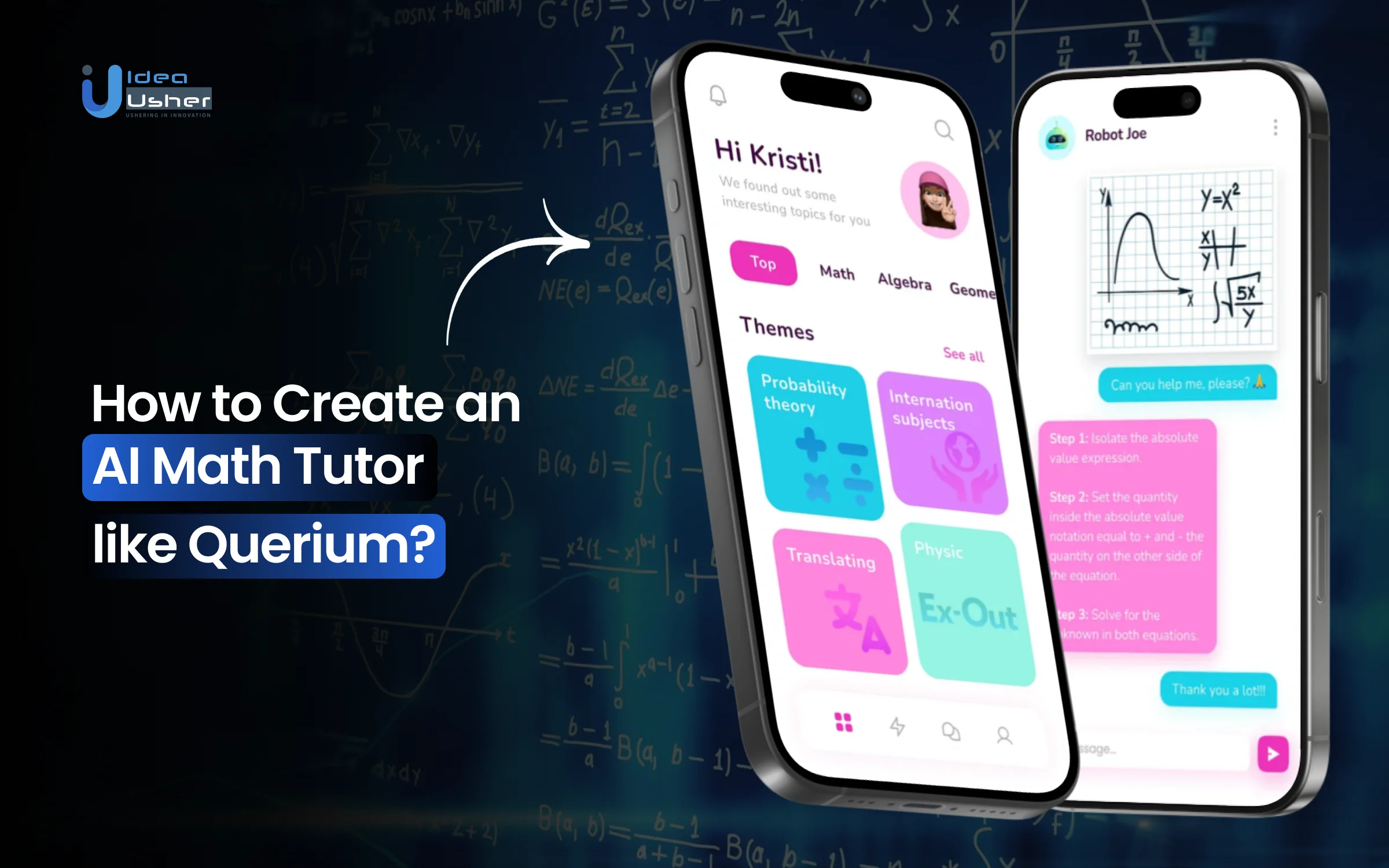
Math anxiety has become a subtle barrier for many learners, as they often understand the concepts but freeze when working through a problem independently. Parents and teachers notice this gap grow as traditional instruction rarely keeps up with the need for personalized guidance. That is why more students have started turning to AI math tutors that can adjust to their pace.
In recent years, these systems have moved far beyond basic drills and now provide structured support with step-level guidance that feels like a calm mentor. Some of these platforms can detect specific mistakes and offer instant hints that nudge the student toward the correct method. They may also track mastery patterns and evaluate each step using symbolic reasoning, ensuring feedback remains consistent and accurate.
We’ve developed numerous AI math learning solutions over the years, powered by computational reasoning frameworks and adaptive learning architectures. Since IdeaUsher has this expertise, we’re sharing this blog to walk you through the steps to develop an AI math tutor similar to Querium. Let’s get started.
Key Market Takeaways for AI Math Tutors
According to Grandview Research, the market for AI-powered tutoring is expanding quickly, rising from about USD 1.63 billion in 2024 to nearly USD 7.99 billion by 2030. That rapid growth reflects a global push toward more personalized learning, especially in subjects where students often need extra guidance. As families and schools seek tools that adapt to individual learning needs, math tutoring has become one of the clearest opportunities.

Source: Grandview Research
AI math tutors have gained momentum because they offer clear, step-by-step support that students can access anytime. They address a growing need for homework help and stronger STEM foundations, providing learners with immediate feedback rather than leaving them stuck on confusing steps.
Their integration into familiar platforms, including major learning sites, has helped them reach classrooms and homes more seamlessly.
Several programs are shaping what effective digital math support can look like. Khan Academy’s tutoring tool provides conversational help across skill levels, while Third Space Learning’s Skye uses voice-based interaction to create a more natural tutoring experience.
Partnerships such as Khan Academy’s work with Microsoft and Drexel University’s collaboration with Ursinus College and the 21st Century Partnership for STEM are pushing the field forward by refining how students receive feedback and build confidence in math.

What is the Querium Platform?
Querium is an education technology platform built around StepWise, an AI engine that analyzes how students work through math problems step by step. Instead of grading only final answers, StepWise evaluates each part of a student’s reasoning. This helps the system identify misconceptions and tailor instruction to the learner’s needs.
The company offers StepWise as a technology layer for schools, publishers, and LMS providers. It also provides a free math tutor for public school students, teachers, and parents. Querium’s approach is reinforced by several patents that protect its methods for adaptive assessment, dynamic problem generation, and AI tutoring modeled after a master teacher.
Here are its key features,
1. Step-by-Step AI Tutoring
Students receive guidance at every stage of a math problem. When they make an error, the tutor responds immediately with explanations that reflect how an expert teacher would think. This prevents students from practicing incorrect methods and supports deeper understanding.
2. Dynamic Problem Generation
A single template can generate thousands of unique problem variations. Students can practice the same concept repeatedly without seeing the exact same question, reducing memorization and keeping practice engaging.
3. Personalized and Adaptive Learning Paths
StepWise monitors student performance in real time. It adapts the sequence and difficulty of problems to match their needs, allowing them to move ahead when ready and spend more time on skills that require reinforcement.
4. Targeted Diagnostic Assessment
The platform uses expert-system logic to determine the minimum number of questions needed to identify a student’s strengths and weaknesses. This shortens the diagnostic process and avoids long, unnecessary assessments.
5. Instructor Analytics
Teachers receive detailed insights into how students solve problems. The reports highlight skill gaps, error patterns, and progress over time, helping instructors plan interventions more effectively.
6. Easy LMS and Content Integration
StepWise is built with HTML5, CSS3, and JavaScript and can plug directly into publisher platforms or digital textbooks. It integrates with systems such as Canvas, Blackboard, and Moodle via LTI, requiring no additional plugins.
7. Free Access for Public School Users
Querium offers its StepWise AI Math Tutor free to public school students, teachers, and parents. Reported outcomes show an average improvement of about 16 percent on standardized tests and higher pass rates for regular users.
How Does the Querium Platform Work?
The Querium platform uses its StepWise engine to guide students through math problems in clear and adaptive steps. It analyzes each action and adjusts the path, enabling learners to move forward with increasing accuracy and confidence. Its real strength lies in how precisely it models expert instruction while still responding instantly to student actions.

1. StepWise: The Technology Behind the Teaching
Querium’s StepWise engine is what gives the platform its teaching power.
Guided, Step-by-Step Support
Instead of simply scoring answers as correct or incorrect, StepWise breaks each problem into individual steps. As students work, the tutor offers help the moment they hesitate or take a wrong turn. This prevents students from repeating the same mistake and builds real understanding of the underlying skills.
Instruction That Adapts to Each Student
Every learner has a different starting point. StepWise quickly identifies what a student already knows and where the gaps are. From this diagnostic step, the system creates a customized plan that evolves as the student progresses. Students advance when they have mastered a concept and receive extra support when they need reinforcement.
Unlimited Practice Variations
Each problem definition can generate thousands of unique versions. Students get as much targeted practice as they need without falling into repetitive patterns. This variety helps deepen mastery and keeps practice sessions engaging.
2. Why It Works: Proven Improvement
Querium’s approach produces measurable gains. The platform reports that students using StepWise demonstrate 16% higher performance on standardized tests and see improved pass rates in their math courses. These results come from a continuous learning cycle:
- Diagnosis: Understanding where the student stands
- Personalized Teaching: Delivering tailored step-level instruction
- Practice and Scaffolding: Offering immediate, meaningful feedback
- Adjustment: Modifying the learning path based on progress
- Insight: Giving educators clear, detailed data on student skills and problem-solving behavior.
Easy Integration for Schools and Publishers
Querium is designed to integrate seamlessly with existing digital learning environments. The StepWise component is built entirely with HTML5, CSS3, and JavaScript, so no plug-ins or special installations are needed.
LMS Compatibility
The platform integrates seamlessly with major learning management systems, including Canvas, Blackboard, and Moodle, via standard LTI.
Enhancement for Digital Content
Publishers can embed StepWise into their HTML5 apps or ePub3 materials to instantly add interactive, intelligent tutoring to their existing resources.
What is the Business Model of the Querium Platform?
Querium operates as a hybrid EdTech and AI solutions company, combining SaaS products with enterprise consulting services. Its core engine is StepWise, an AI tutor that guides students through math problem-solving. The company packages this technology in several ways to serve schools, publishers, universities, and individual learners.
1. Licensing StepWise to Publishers and Institutions
The heart of Querium’s revenue comes from B2B licensing agreements.
Publishers and educational institutions integrate StepWise directly into their digital courses or learning platforms using HTML5/JavaScript components or LTI integrations for LMSs such as Canvas, Moodle, Blackboard, and Agilix.
Because the product becomes an embedded part of a partner’s digital content, deals typically follow:
- Per-student or per-seat pricing
- Course- or institution-level subscription contracts
- Multi-year, negotiated enterprise agreements
This model positions StepWise as an infrastructure layer for math instruction rather than a standalone app, which strengthens long-term recurring revenue.
B. Direct-to-Student Test Prep
In addition to enterprise licensing, Querium sells a branded self-study product for college placement exams. For about $30 per learner, students receive a personalized study plan with StepWise-powered practice.
This creates a high-volume, low-price B2C revenue stream, separate from publisher deals. It also increases visibility with community colleges and universities that rely heavily on placement testing.
C. Free K–12 Access as a Growth and Evidence Strategy
Querium offers free StepWise access to public-school educators, students, and families.
Although this tier does not directly generate income, it serves two strategic purposes:
- Evidence generation – boosting documented learning gains helps support district-level sales and grant applications.
- Adoption funnel – widespread classroom usage makes it easier for institutions and publishers to justify formal licensing.
The free tier functions as both a mission-aligned service and a practical go-to-market strategy.
D. Smarter.sh Platform and AI Consulting for Enterprises
Beyond education, Querium markets Smarter.sh, a platform for building generative AI applications, and provides AI consulting to universities and corporate clients across healthcare, financial services, and IT.
These engagements usually involve:
- Project-based consulting fees
- Platform subscriptions or usage-based billing
- Longer-term AI enablement partnerships
This business line diversifies revenue and positions Querium as an applied-AI partner rather than just an EdTech company.
Funding and Company Structure
Querium has raised a modest amount of outside capital compared with high-growth EdTech startups:
- A Series B of roughly $3.2 million, largely from existing investors, including Ingram Content Group and Wild Basin Investments
- Total historical fundraising is estimated at around $5.8–$6 million.
This funding profile aligns with Querium’s strategy of capital efficiency and a focus on sustainable revenue rather than aggressive hypergrowth.
Financial Scale and Market Footprint
Querium does not publish official revenue numbers, but third-party data sources consistently place the company in the low single-digit millions in annual revenue. Public estimates include:
- Around $1–1.2 million in annual revenue
- A team of roughly 10–20 employees
- Revenue per employee in a typical small-SaaS range
StepWise usage in the tens of thousands of students, especially in algebra and college-readiness contexts.
How to Develop an AI Math Tutor Like Querium?
An AI math tutor like Querium starts with a symbolic algebra engine that can parse each step and judge equivalence with high precision. The system can then match student errors to known patterns and guide the learner with technical hints that update as mastery shifts.
We have built many AI math tutors similar to Querium for our clients over the years and this is the approach we rely on every time.

1. Algebra Engine
We begin by building a symbolic math engine that converts student inputs into Abstract Syntax Trees and checks algebraic equivalence at each step. Rule-based error detection helps the system understand common mistake patterns, so feedback reflects actual student reasoning.
2. Expert Feedback System
We develop a library of misconception patterns, skill tags, and corrective hints and then build a logic layer that maps incorrect steps to specific buggy rules. This produces targeted feedback that guides learners through each step, making it feel instructional rather than generic.
3. Question Template System
We create structured templates for algebra problems, equations, and word problems with constraints that guarantee solvability. A generation engine produces many accurate variants, and automated checks ensure each version meets mathematical standards before use.
4. Adaptive Learning Layer
We integrate Bayesian Knowledge Tracing to track skill mastery across micro-concepts and select the next best question based on learner needs. Real-time dashboards update continuously, giving teachers a clear view of progress and learning gaps.
5. Lightweight Front End
We design a fast interface using HTML5, CSS3, and JavaScript that runs smoothly on low-end mobile devices. The platform avoids heavy runtime processing and includes multilingual support to reach a wide range of learners.
6. LMS Integration
We enable secure LTI-based single sign-on, allowing tutors to log in directly into major LMS platforms. Grade performance data and mastery metrics sync automatically, and APIs allow deeper integrations for institutions and publishers.
How Much Revenue Can an AI Math Tutor Generate?
The revenue potential of an AI math tutor platform is not a single number but a spectrum defined by its market positioning, monetization strategy, and operational scale. By analyzing publicly available data from key players and industry benchmarks, we can build a realistic financial model that spans a promising niche startup to a dominant market leader.
The Revenue Model Framework
An AI math tutor primarily generates revenue through four core models, each with distinct user profiles and unit economics:
- Direct Consumer Subscriptions: Monthly or annual fees paid by students, parents, or individual learners.
- Enterprise & Institutional Sales (B2B/B2B2C): Site-wide licenses sold to schools, school districts, tutoring centers, or EdTech publishers.
- Freemium & Tiered Premium: A free base tier to drive user acquisition, with advanced features (e.g., detailed analytics, priority support, advanced curriculum) behind a paywall.
- Transaction-Based & Pay-Per-Use: Revenue from features like one-on-one tutor matching commissions, pay-per-session fees, or micropayments for specialized test prep packages.
Below is a staged model, with realistic assumptions based on public benchmarks and typical ed-tech performance.
Tier 1: Early-Stage Startup (Years 1–3)
Market reference: niche players like Astra AI or MathGPT-style tools entering their first real growth cycle.
Main focus: B2C subscriptions.
Key Assumptions
- 10,000 monthly active users (MAUs)
- 5% paid conversion (strong for a well-executed freemium model)
- $15 monthly ARPPU ($180 per year)
Revenue
- Paying users: 10,000 × 5% = 500
- ARR: 500 × $180 = $90,000 per year
Interpretation
At this stage, revenue isn’t the engine of growth—proof of traction is. With ~$90k ARR, the team can support a lean operation while refining product quality and retention. Venture funding, not customer revenue, typically fuels expansion to the next phase.
Tier 2: Growth Platform (Years 3–5)
Market reference: Photomath or Symbolab once they hit mainstream adoption.
Main focus: B2C remains strong, B2B pilots begin.
Key Assumptions
- 500,000 MAUs
- 4% paid conversion (bigger audiences tend to convert at slightly lower rates)
- $12 monthly ARPPU ($144 per year)
- 50 school pilots at $5,000 per year each
Revenue
- B2C: 500,000 × 4% = 20,000 paying users → 20,000 × $144 = $2,880,000
- B2B: 50 × $5,000 = $250,000
Total ARR ≈ $3.13 million
Interpretation
Crossing the $3M ARR mark signals a real business with scalable economics. B2B contracts, though still a minority of revenue, introduce stability and long-term retention. Companies in this phase either become profitable or reinvest aggressively to accelerate user acquisition.
Tier 3: Mature Category Leader (Year 5+)
Market reference: Khan Academy’s AI offerings, enterprise-integrated tools like Querium.
Main focus: Deep institutional partnerships + massive consumer footprint.
Key Assumptions
- 5 million MAUs
- 3% paid conversion
- $10 monthly ARPPU ($120 per year)
- 500 school districts at $25,000/year
- 10 EdTech publishers licensing integration at $100,000/year
Revenue
- B2C: 5,000,000 × 3% = 150,000 subscribers → 150,000 × $120 = $18,000,000
- District contracts: 500 × $25,000 = $12,500,000
- Publisher licensing: 10 × $100,000 = $1,000,000
Total ARR ≈ $31.5 million
Interpretation
At this level, the company becomes part of the educational infrastructure. Revenue is diversified, predictable, and resilient. Institutional contracts deliver strong margins and low churn, while the consumer side drives brand dominance and long-term growth. The business is typically profitable and a strong candidate for IPO or acquisition.
What Actually Drives Revenue at All Tiers?
1. User Scale + Conversion
Platforms like Photomath have hundreds of millions of downloads. Even a tiny fraction of paying users can yield multi-million-dollar revenue.
2. Pricing Power
Symbolab charges ~$7/month; niche tools can charge more for specialized features. School contracts of $5k–$25k per institution mirror the pricing of established platforms like Kami, Nearpod, and district SaaS tools.
3. Institutional Value
A single district contract often covers thousands of students. One district at $25k delivers the equivalent revenue of ~170 consumer subscribers. This is why enterprise sales radically change a company’s economics.
4. Lifetime Value and Churn
The real financial magic lies in retention: If a student stays subscribed for 24 months instead of 12, the platform’s LTV doubles.
Higher LTV → More room for marketing spend → Larger user base → Higher ARR.
Platforms that consistently improve learning outcomes—Querium reports improvements of around 16%, and tend to achieve significantly higher retention.
How AI Math Learning Tools Help Students Learn 31% More?
Some might question how an AI-supported tool could lift math learning so sharply, yet the mechanism is straightforward. A replication RCT of ASSISTments showed a 31 percent improvement in 8th-grade math scores one year after use, driven by immediate feedback that prevented small errors from becoming larger problems.
With timely prompts and steady guidance, students can strengthen core reasoning skills and gradually build the clarity needed to advance to more complex work.

A. Students Get Just-In-Time Support
AI tutors do not simply mark answers as right or wrong. They can offer hints, step-by-step help, or targeted nudges that point students in the right direction without solving the problem for them.
This keeps students doing the intellectual heavy lifting while still feeling supported.
- If they understand a topic, the system moves them ahead.
- If they struggle, the system slows down and provides more practice on that exact skill.
Students are not left confused, and they are not pushed forward before they are ready. The result is a cleaner, more secure understanding of core skills.
B. Teachers Get Better Information
Before AI tools, teachers had to grade every assignment to figure out who needed help. Now that diagnostic work is automated.
Teachers log in and see:
- Which problems tripped up most of the class
- Which students need immediate attention
- Which standards require reteaching
Instead of spending hours grading stacks of papers, teachers walk into class already knowing where their time will have the greatest impact.
AI does not replace teachers. It amplifies them.
C. The System Learns and Strengthens
With every assignment, every hint, and every correction, the system helps students chip away at confusion and move steadily toward mastery. It is like having a patient guide who never tires of explaining or reviewing work.
Over weeks and months, this consistency compounds.
How Does an AI Math Tutor Handle Creative Correct Answers?
An advanced AI math tutor does not enforce a single method; instead, it checks whether each step logically follows from the previous one. It symbolically validates transformations, so creative paths should still be accepted if they are mathematically sound. When a learner works differently, the system can quietly adapt hints and feedback to keep learning efficient and meaningful.
1. The Foundation
A primitive tutor relies on a linear decision tree. Step A, then Step B, then Step C. Any deviation breaks the flow.
An advanced tutor uses a Domain Model Knowledge Graph. This is a structured map of mathematical concepts such as Distributive Property, Combine Like Terms, and Isolate the Variable, connected by logical dependencies.
When a student submits a step, the system does not ask whether this is the expected step. It asks whether the step is mathematically valid and logically consistent with the current problem state.
Example
Problem: 2(x + 3) = 16
Expected path: 2x + 6 = 16
Creative path: x + 3 = 8
AI validation process
- Identifies the operation as division by 2
- Confirms the operation is applied correctly to both sides
- Verifies the algebraic validity
Result: The step is approved. The student’s path is different, not wrong.
2. Symbolic Logic Over Pattern Matching
This is where the tutor moves beyond surface-level recognition. The system does not compare text strings like x + 3 = 8 versus 2x + 6 = 16.
It uses a symbolic math engine, similar to SymPy, to perform mathematical reasoning.
How it works
- Parsing converts expressions into symbolic structures
- Verification checks whether x + 3 = 8 is logically derivable from 2(x + 3) = 16 through a valid transformation
Since dividing both sides by 2 is valid, the engine confirms the result is correct.
Result: The internal problem state updates to x + 3 = 8. All future hints and checks now follow this new valid state.
3. Real-Time Adaptive Pedagogy
This layer turns correctness into learning.
Adaptive hinting: If the student later gets stuck, hints align with their chosen approach. A student who divided first receives subtraction-focused hints rather than distribution-based ones.
Student model enrichment
The system records that the learner used a Divide to Simplify strategy. This signals strategic thinking rather than rote execution. That insight can shape future problem selection and feedback.
Positive reinforcement
The tutor can respond with feedback like: “Great move simplifying the equation first. That made the next steps easier.”
This builds confidence and encourages creativity.
When Creative Becomes Accidentally Correct
The hardest scenario is not wrong answers. It is inefficient reasoning that still lands on the correct result.
Example
x + 2 = 5
x + 2 – 3 = 5 – 3
x – 1 = 2
x = 3
The final answer is correct. The process is unnecessarily complex.
AI response
The symbolic engine validates each step, so the student is not blocked; however, the pedagogical layer flags inefficiency.
End-of-problem feedback: “You reached the correct answer. A more efficient approach is subtracting 2 from both sides directly.”
x + 2 – 2 = 5 – 2 gives x = 3.
This approach corrects the method without penalizing success.
The AI’s Decision Between Hints and Worked Examples
An AI math tutor watches how you struggle, not just whether you are wrong. If hints no longer help and errors indicate a conceptual block, a worked example may help you learn faster.
The tutor continuously runs a Risk–Benefit Analysis for Learning. It weighs the value of continued struggle against the risk of confusion or dropout.
Three core data streams drive this decision.
1. Moment-of-Struggle Diagnostics
The system analyzes the quality of the struggle, not just the presence of errors.
Error Type
- Careless mistakes like sign flips or arithmetic slips suggest progress.
- Conceptual dead ends, such as misapplying a theorem or attempting invalid transformations, are a strong trigger for escalation.
Hint Efficacy: If the last two progressively clearer hints fail to produce progress, the system infers that the student is stuck in an incorrect mental model.
Step Regression: Undoing correct steps or looping between incorrect states signals deep confusion and rising cognitive overload.
2. The Longitudinal Student Model
The decision is personalized using historical learning data.
Mastery Level
- A student with strong prerequisite mastery may benefit from one more nudge.
- A student who repeatedly fails a foundational skill may need a concrete, worked example immediately.
Frustration Profile
The system tracks time-per-step, rapid random inputs, repeated hint requests, and long pauses. These signals combine into a frustration score. Crossing a personalized threshold triggers escalation.
Learning Style Inference: If the student has historically succeeded after seeing a full example, the system adapts to that pattern.
3. Problem Context Awareness
The tutor also considers where the student is in the learning journey.
Problem Difficulty and Novelty: A first encounter with a new structure, like the sum of cubes or logarithmic equations, justifies faster escalation than routine practice.
Placement in the Lesson
- Formative practice encourages struggle.
- Summative assessments may disable hints entirely.
- Pedagogical intent defines the escalation rules.
Decision Algorithm in Action: A Case Study
Problem: log₂(x − 3) + log₂(x − 1) = 3
- Hint 1: “Recall a logarithmic property that lets you combine terms.”
- Student writes: log₂(x² − 4x + 3) = 3
This step is correct. The system recognizes valid log multiplication. Learning is happening.
- Hint 2 after a 90-second pause: “The equation is now log₂(A) = B. How can you rewrite it in exponential form?”
- Student writes: x² − 4x + 3 = 3
This is incorrect. The system flags a critical conceptual error.
log₂(A) = 3 means A = 2³, not A = 3.
The Decision Point
The AI evaluates:
- Error Type: Conceptual misunderstanding of log to exponential conversion
- Hint History: A direct hint on this concept already failed
- Student Model: Low mastery in logarithmic transformations
- Frustration Metrics: Long pause followed by a fundamental error
Verdict: Escalate to a worked example.
How the Worked Example Is Delivered
This is not an answer dump. It is a strategic instructional pivot.
Annotated Step-by-Step Guidance
“Starting from your correct step: log₂(x² − 4x + 3) = 3”
“We convert to exponential form using the rule: log_b(A) = C means A = b^C”
“So here: x² − 4x + 3 = 2³ = 8”
“Now solve the quadratic:
x² − 4x + 3 − 8 = 0
x² − 4x − 5 = 0”
Focus on the Breakthrough Concept: The tutor isolates and explains the exact rule that caused the breakdown.
The Follow-Up That Makes Learning Stick
The system immediately generates an isomorphism problem.
- New Problem: log₅(x + 1) + log₅(x − 2) = 2
- Prompt:“Now try this similar one. I will help if you get stuck at the same step.”
- Goal: Transfer insight from observation into independent problem solving.
Why This Escalation Logic Is a Competitive Edge
This mechanism transforms an AI tutor from a grading tool into an adaptive instructional partner.
- It tells educators:“This system diagnoses, intervenes, and teaches with intent.”
- It tells students:“You will not be abandoned, but you will be challenged.”
Common Challenges for an AI Math Tutor like Querium
After building AI math tutors like Ouerium for numerous clients, we have identified a set of challenges that appear in almost every project. The good news is that each of them has a proven, reliable solution when the right technical strategy is applied.
Challenge 1: Validating Algebraic Steps
Accurately interpreting a student’s step-by-step algebraic work is one of the hardest parts of building an intelligent math tutor. Students can express the same idea in many different ways, and small mistakes often have multiple possible causes.
Solution: Combine symbolic algebra libraries with a custom rule engine that evaluates each transformation. This approach enables the system to recognize equivalent expressions, detect subtle errors, and provide meaningful feedback rather than generic correctness checks.
Challenge 2: Unlimited Question Variants
Teachers want endless practice problems, but automatically generated questions can easily become unsolvable or mismatched in difficulty if not carefully constructed.
Solution: Use constraint-driven template systems that pre-validate each problem before it is released to the learner. This ensures that every generated question is mathematically sound, aligned with learning goals, and offers a consistent challenge level.
Challenge 3: Ensuring Real-Time Feedback
Instant feedback is essential for learning, yet computationally heavy AI models can slow down the experience, especially when thousands of students are working simultaneously.
Solution: Offload intensive processing to cloud microservices and keep the front end lightweight. This architecture supports fast response times, horizontal scaling, and a smooth experience even during peak usage.
Challenge 4: Tracking Micro-Skill Mastery
Math mastery isn’t binary. Every topic contains many small skills that evolve. Tracking these micro-skills inaccurately leads to poor recommendations and frustration for students.
Solution: Implement Bayesian Knowledge Tracing or Deep Knowledge Tracing with continuous recalibration. These models update mastery estimates in real time, allowing the tutor to adapt instruction with precision.
Tools & APIs to Create an AI Math Tutor like Querium
Building a capable AI math tutor involves far more than evaluating answers. A successful system must understand how students reach their conclusions, spot misconceptions as they appear, and adapt instruction to each learner’s needs.
Platforms like Querium show how powerful this can be when done well. To create something comparable, you need a coordinated set of technologies working together behind the scenes.

1. Math and Step Validation
SymPy
This Python library serves as the mathematical engine powering your system. SymPy understands algebraic and symbolic structure, which allows you to:
- Parse and simplify complex expressions
- Validate a student’s work step by step
- Generate equivalent versions of expressions
- Determine whether a student’s answer is mathematically identical to the expected solution
MathJax or KaTeX
These tools handle math rendering, ensuring formulas look clean and professional on every device. KaTeX is faster for static content, while MathJax provides broader LaTeX support for dynamic expressions.
Custom AST Parser
An Abstract Syntax Tree parser is one of the most important pieces of the tutor. By breaking expressions into a structured tree, you can:
- Examine each step of a student’s reasoning
- Detect common mistakes such as misapplied exponents or incorrect distribution
- Deliver feedback tied to the exact step where the logic went wrong
- Monitor the student’s full solution pathway rather than a single outcome
2. Expert System and Rule Engine
Drools
Drools encodes instructional rules so the tutor can spot specific mistakes, such as adding instead of multiplying or confusing sine and cosine, and respond with immediate, targeted guidance.
Prolog-Based Engines
Prolog supports deeper logic analysis by recognizing solution patterns, identifying the likely misconception behind repeated errors, and suggesting alternative problem-solving paths.
Custom Rule Sets for Algebraic Errors
A curated library of algebraic error rules helps the system detect issues such as missing signs, order-of-operations errors, fraction simplification errors, and balancing-equation errors.
3. Adaptive Learning Models
Bayesian Knowledge Tracing
BKT uses probability models to track a student’s skill mastery in real time, helping the system distinguish between true understanding and guessing while determining when a learner needs support or is ready for more challenge.
Deep Knowledge Tracing Using PyTorch
DKT uses neural networks to capture deeper patterns in student behavior, enabling the tutor to connect related skills, predict future performance from past work, and manage more complex learning domains more effectively.
4. Dynamic Content Generation
Python-Based Template Systems
Python-driven template systems generate many variations of the same problem pattern by adjusting values, ensuring each version has a valid solution, and keeping the difficulty aligned with the intended level.
Constraint Solvers
Constraint solvers confirm that every generated problem is mathematically sound, solvable by the expected method, and appropriate for the targeted grade or skill level.
Authoring Dashboards for Educators
Authoring dashboards gives teachers control by letting them create custom assignments, outline solution steps and common errors, set difficulty levels, and align problems with curriculum standards.
5. Front-End Development
HTML5, CSS3, JavaScript
These core web technologies ensure smooth cross-browser performance, clear and accessible math rendering, and responsive animations that make step-by-step explanations feel natural.
React, Vue, or Svelte
Modern frameworks enable a dynamic learning interface built from reusable components, support real-time updates as students work, and handle complex multi-step interactions through strong state management.
Mobile-Responsive UI
A mobile-ready tutor offers tap-friendly equation editors, layouts that adapt well to smaller screens, and offline capability so students can keep learning even without a stable connection.
6. Integration and Deployment
LTI 1.3 and LTI Advantage
LTI standards enable your platform to integrate smoothly with learning management systems, providing secure single sign-on, automatic gradebook syncing, and roster updates pulled directly from school systems.
REST APIs
REST APIs allow the tutor to communicate with external systems, supporting data exchange with student information systems, analytics integrations, and the import or export of learning content and reports.
OAuth2 and Single Sign-On
OAuth2 and SSO provide secure access for all user types, ensure proper role-based permissions, and help the platform meet essential student privacy and data protection requirements.
Conclusion
Building an AI math tutor that can truly match systems like Querium takes far more than dropping an LLM into a product. It calls for symbolic algebra engines that process student inputs precisely, reasoning pipelines that clearly reveal each step, adaptive models that track mastery in real time, and generation systems that scale new problems without sacrificing quality. When these elements come together, platform owners and EdTech teams gain tools that could strengthen learning outcomes and create strong subscription value.
Looking to Develop an AI Math Tutor like Querium?
Our team at IdeaUsher can help you build an AI math tutor like Querium with a modular architecture that supports adaptive pathways and efficient model deployment. We would integrate NLP-driven reasoning and robust analytics to enable the system to evaluate students’ steps and deliver targeted guidance efficiently.
You will also gain a scalable cloud infrastructure that reliably supports updates and delivers strong performance under real workloads.
Why Choose Us?
- 500,000+ hours of coding expertise—led by ex-MAANG/FAANG developers who’ve built scalable AI platforms.
- Deep EdTech & AI/ML focus—from step-by-step problem-solving engines to real-time gap analysis.
- End-to-end development—UI/UX, backend, AI integration, cloud deployment, and ongoing support.
- Proven results—check out our portfolio to see how we’ve delivered for ambitious EdTech innovators.


FAQs
A1: You start by defining the math scope and learning goals clearly because the system must know what to teach and how deep to go. You then train models on structured math problems and solution paths so the tutor can explain steps logically. It should gradually adapt based on student interactions while aligning with curriculum requirements and assessment logic.
A2: The cost typically depends on model complexity and content depth and can vary widely. A basic tutor may cost less if it focuses on a limited set of topics and rule-based logic. A more advanced system with adaptive reasoning and real-time feedback will likely require greater investment due to data training and infrastructure requirements.
A3: Most AI math tutors monetize through subscriptions or tiered access models. Some platforms may also license the technology to schools or publishers. Over time, it can also generate revenue through personalized practice modules or premium analytics for educators.
A4: Development time depends on the tutor’s level of sophistication and the amount of content it must cover. A focused MVP can be built in a few months with a clear scope. A fully adaptive tutor that reasons step by step will usually take longer due to training and testing cycles.


