 (+971) 8007 4267
 (+91) 946 340 7140
 (+1) 628 432 4305

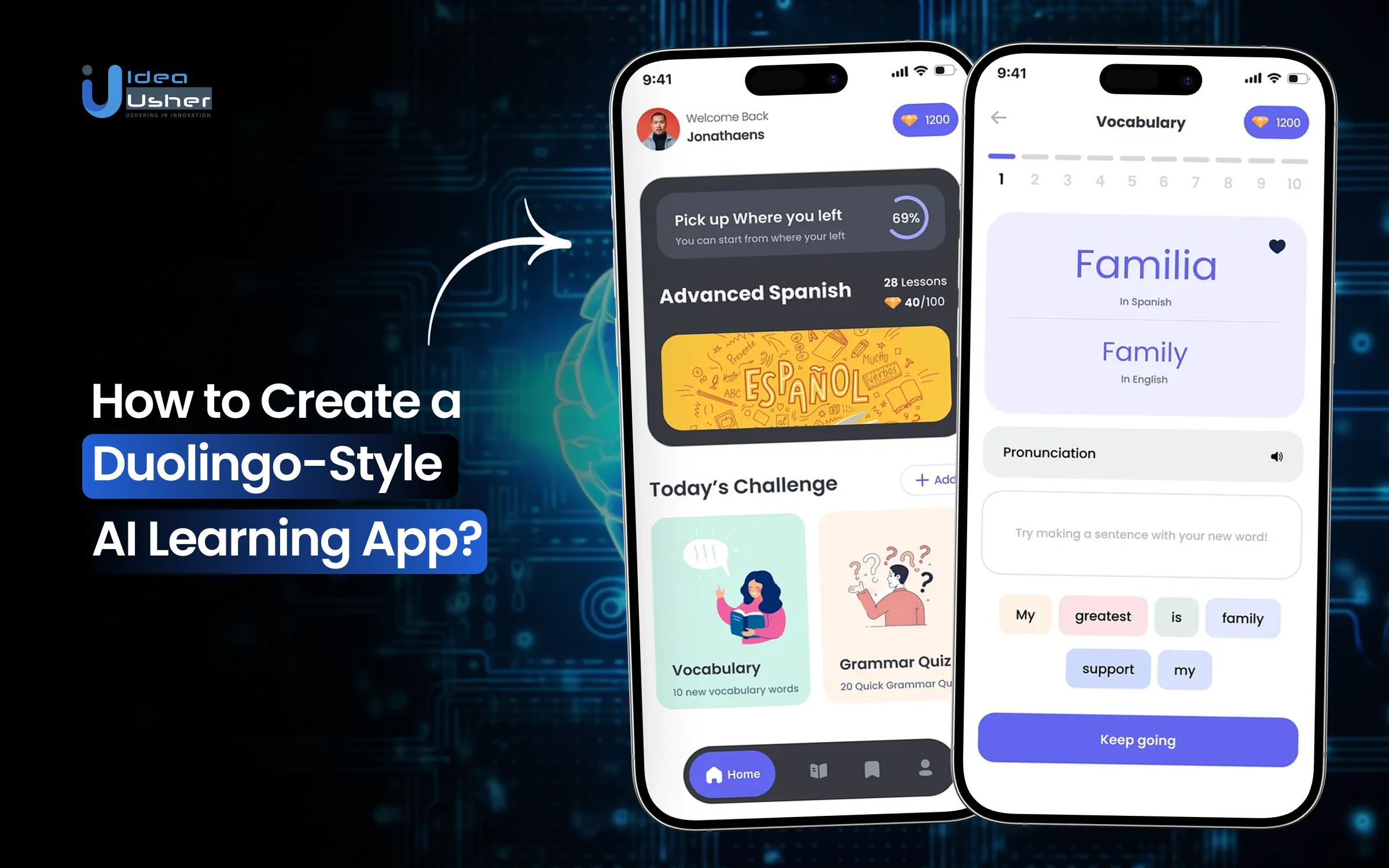
Learning a new skill often begins with excitement, but that momentum fades when lessons feel rigid, and progress slows. Many learners step away not because they lack potential, but because the experience no longer feels meaningful. Modern AI learning apps counter this by offering short, bite-sized sessions that users can complete quickly, and by tracking progress in a way that rewards consistency.
These systems analyze patterns, adapt to individual pacing, and deliver tailored challenges that can keep users engaged longer. They also use gentle prompts to bring learners back at the right moment, supporting steady improvement.
Over the years, we’ve developed numerous learning solutions powered by cognitive AI systems and adaptive learning architectures. Since IdeaUsher has this expertise, we’re writing this blog to walk you through the steps involved in developing a Duolingo-style AI learning app. Let’s get started.
Key Market Takeaways for AI Learning Apps
According to MarketsandMarkets, the market for intelligent learning apps is expanding steadily as more students and educators turn to mobile tools for personalized study support. Industry projections show growth from roughly USD 2.21 billion in 2024 to about USD 5.82 billion by 2030, signaling rising confidence in digital companions that deliver tailored practice, instant feedback, and multimodal learning experiences. This shift reflects changing expectations, with learners wanting support available anytime and institutions seeking scalable ways to guide students more effectively.

Source: MarketsandMarkets
AI-driven learning apps are now widely used for language practice, math assistance, and general homework help, reaching millions of learners daily. Duolingo illustrates this trend with its adaptive approach that adjusts difficulty in real time, schedules targeted review sessions, and enhances pronunciation through interactive feedback. These features create a personalized, game-like environment that keeps learners motivated and engaged over long periods.
Tools like Photomath showcase how visual learning is becoming central to student support. By allowing users to scan a math problem and receive a clear, step-by-step breakdown, the app functions as an approachable tutor that explains reasoning rather than simply presenting solutions.

What is the Duolingo App?
Duolingo is a free (with optional paid upgrades) smartphone and web-based learning platform that helps people learn new languages. It offers courses in more than 40 languages, from widely studied options such as English, Spanish, French, and German to less common or even fictional languages. Lessons are short and bite-sized, designed to fit easily into your daily routine.
The app uses a freemium model: basic access with ads is free for everyone, while paid plans offer perks such as an ad-free experience and additional features.
Here are some of its standout features,
Gamified Learning
Gamified elements like XP, points, streaks, badges, and leaderboards keep learners motivated by making progress visible and rewarding. Daily streaks encourage consistent practice, badges celebrate milestones, and leaderboards add a friendly competitive element.
Bite-sized, Interactive Lessons
Lessons are short and easy to complete, making them suitable for busy schedules. Activities include reading, writing, listening, and speaking tasks, and the colorful, user-friendly interface helps keep learning engaging.
Adaptive & Personalized Learning Path
Duolingo personalizes learning by allowing users to start at their level through placement tests and by adapting lessons based on performance. It uses spaced repetition and algorithms to determine when to review or introduce new material.
Flexibility and Accessibility
The app fits easily into daily routines since lessons can be done in small moments throughout the day. It is available in many languages, making it accessible to learners worldwide.
Additional Offerings Beyond Languages
Although Duolingo is primarily for language learning, it continues to expand by experimenting with new subjects and modules, offering learners additional types of educational content.
How Does the Duolingo App Work?
Duolingo tracks how quickly you might forget each concept and then schedules your reviews to keep your memory strong. It wraps this system in game mechanics that nudge you to return daily and engage with short, structured tasks. The app also relies on adaptive models that adjust difficulty in real time so each session feels efficient and technically purposeful.

1. The Core Learning Engine
Most learning apps use basic spaced repetition. Duolingo goes further with an algorithm called Half-Life Regression, a statistical model that predicts how quickly you forget each item.
How it works:
- Every word or concept is assigned a “memory strength,” represented as a half-life.
- Your half-life increases or decreases depending on your interactions. A fast, confident, and correct answer significantly raises it. A slow or hint-assisted answer raises it slightly. An incorrect answer drops it sharply.
- The app schedules reviews when your memory is predicted to fade.
The underlying logic
The model estimates your probability of remembering an item using an exponential decay curve. Instead of you deciding what to review, the system quietly adjusts the curriculum so you revisit material right before you would forget it.
What you feel as a user: It seems as if the app understands your memory patterns. In reality, it is recalculating behind the scenes and altering the sequence of lessons around you.
2. The Gamification Layer
Duolingo’s cheerful interface is intentionally designed to tap into motivational triggers that keep people returning.
The Streak: A Habit Loop Driven by Loss Aversion
People dislike losing progress more than they enjoy gaining it. Duolingo uses this instinct effectively.
- Your streak is always visible, increasing the sense of ownership.
- A streak freeze lets you protect that progress using in-app currency.
- If you usually study at a certain time and do not open the app, Duolingo may send a reminder before your streak breaks.
The longer the streak grows, the more emotionally painful it becomes to lose it.
Leagues and Leaderboards
Instead of ranking you against the entire world, Duolingo places you in weekly groups of about 30 users with similar activity levels.
- You can rise to a higher league or risk falling to a lower one.
- Groups remain fair and manageable, which keeps competition motivating.
Matching you with users of similar engagement requires backend systems that track activity levels and adjust placements continuously.
Gems, Lingots, and the In-App Economy
The virtual currency system is not just decorative.
- You earn rewards for consistent practice.
- You spend them on streak tools, extra lessons and cosmetic upgrades.
- Having accumulated currency subtly encourages continued use.
This creates a sense of investment that grows more meaningful the longer you use the app.
3. How Duolingo Builds Skills
Each lesson feels simple, yet Duolingo trains several language skills at once.
| Skill | How Duolingo Builds It | What Supports It |
| Reading | Word matching and sentence translation | Pattern libraries and language rules |
| Writing | Typing answers and forming sentences | Input evaluation logic |
| Listening | Transcribing spoken prompts | Text to Speech systems |
| Speaking | Repeating phrases into the microphone | Speech recognition models |
The Lesson Structure
Each skill, such as “Food 1,” is divided into crown levels. As you level up:
- The activities become more challenging.
- Sentences become longer and more complex.
- Listening and speaking tasks appear more often.
By mixing multiple modes, Duolingo avoids monotony and supports more natural language development.
4. The AI Expansion
In the early years, all content was written manually. Today, Duolingo uses a hybrid system in which AI produces many of the practice sentences.
- Vocabulary lists feed into grammar templates.
- Constraints ensure every sentence is level-appropriate.
- Your mistakes influence what appears next.
This explains the occasional quirky sentence, such as “My horse drinks coffee.” Odd sentences are intentionally memorable and help reinforce patterns.
Duolingo Max: AI as a Guided Tutor
For users with access to the premium tier, AI becomes an interactive companion during lessons.
- Explain My Answer gives simple, direct explanations for mistakes.
- Roleplay enables natural conversations with characters that respond to your input and assess your clarity.
These AI systems are restricted by Duolingo’s curriculum to avoid off-topic responses and to match explanations to the user’s level.
What is the Business Model of the Duolingo App?
Duolingo operates on a freemium model, allowing anyone to learn for free while generating revenue from users who choose to upgrade or purchase additional services. This approach has helped the company attract a massive global audience.
1. Subscriptions (Primary Revenue Driver)
Paid subscriptions accounted for roughly 76-81% of Duolingo’s revenue in 2024. The company offers several tiers:
- Super Duolingo, which removes ads, unlocks offline lessons, and provides unlimited hearts
- Duolingo Max, a higher tier that includes AI-powered tools and deeper explanations
Together, subscription products generated more than $400 million in 2023 and contributed to Duolingo’s jump in reported results to $805.5 million in the subsequent period. This segment continues to grow rapidly as more free users convert into paying subscribers.
2. Advertising (About 7%)
Free users see targeted in-app ads, and this advertising layer consistently generates a smaller but steady share of overall revenue. Since Duolingo has one of the largest daily active user bases in the education category, even a small slice of the ad market contributes meaningful revenue.
3. In-App Purchases (Around 5%)
Users can buy gems and special items to unlock bonus features or tools that support progress. These purchases are optional but create a micro-economy that appeals to highly engaged learners.
4. Duolingo English Test (About 6%)
The Duolingo English Test has become a notable revenue stream of its own. More than 3,000 universities and institutions accept it, allowing students worldwide to take an affordable, online English proficiency exam. Each test incurs a fee, generating recurring income for Duolingo beyond its core app.
Financial Performance
Duolingo’s financial growth has been strong and consistent. In 2024, the company recorded $748 million in revenue, up 41 percent from $531 million the previous year. Paid subscribers reached 9.5 million, representing a 43 percent year-over-year increase.
By Q2 2025, the company reported $252 million in revenue, a 41 percent increase from the prior year, and $45 million in net income. Duolingo raised its full-year 2025 forecast to $1.01-$1.02 billion, reflecting confidence in continued growth.
Geographically, international markets outpaced the U.S. in 2024 with $436 million in revenue compared to $311.5 million from U.S. users. Q4 2024 alone generated $209.6 million, demonstrating strong momentum heading into 2025.
Funding History
Before going public, Duolingo secured $183.3 million across nine funding rounds. These investments helped the company scale its mobile app, expand into testing and build the infrastructure that supports its global user base.
Notable funding milestones include:
- Series A (2011): $3.3 million from Union Square Ventures and Ashton Kutcher
- Series B (2012): $15 million led by New Enterprise Associates
- Series C (2014): $20 million from Kleiner Perkins
- Series D (2015): $45 million from CapitalG, valuing Duolingo at $470 million
- 2020 Extension Round: $35 million from Durable Capital and General Atlantic, pushing valuation to $2.4 billion
In 2021, Duolingo completed its IPO on Nasdaq under the ticker DUOL, raising approximately $521 million and marking its transition to a public company.
How to Develop a Duolingo-Style AI Learning App?
When we create a Duolingo-style AI learning app for our clients, we always begin by building the intelligence first and the interface after. This approach ensures the platform learns, adapts, and behaves like a real tutor. Our team has delivered several AI-driven learning platforms for clients, and this is the pattern we follow to achieve quality and speed.

1. Adaptive Learning Core
We start by shaping the intelligence that drives personalization. Memory decay models forecast when concepts may fade; the skill graph maps how topics connect; and learning path logic determines the next best activity. This core becomes the foundation for every feature.
2. Personalized Model Training
Next, we refine the system using real learner behavior. Error frequency analysis highlights gaps, speed-based tuning adjusts difficulty instantly, and mastery scoring evaluates true understanding. This makes the app feel responsive from the very first session.
3. Generative AI Layer
We then build a curriculum-aligned generative engine. Level-restricted prompts keep content appropriate, controlled generation maintains accuracy, and safe tutoring workflows guide the learner without risk. This is where the platform becomes a smart and trusted companion.
4. Gamification Systems
Engagement features come next. XP tracking rewards progress, league logic creates healthy competition, and streak recovery supports long-term motivation. These systems give the app the playful rhythm users love in Duolingo-style products.
5. Speech & Pronunciation AI
For language learners, we add real-time voice intelligence. Accent models improve recognition, instant audio inference keeps practice smooth, and AI-driven feedback shows learners how to improve. This turns speaking practice into an interactive coaching moment.
6. Monetization & Dashboards
Finally, we built the growth and analytics layer. Subscription paywalls enable revenue, corporate tracking supports enterprise rollouts, and performance dashboards give teams clear insight into learning outcomes. This ensures the product scales reliably.
How Much Revenue Can an AI-Powered Learning Platform Generate?
AI-powered learning platforms earn dramatically different amounts depending on their model and market:
$1M–$10M: Niche Specialist Platforms
Platforms offering high-value, narrow content (compliance training, technical certifications, workforce upskilling) often fall here. They attract small but committed audiences willing to pay premium prices for expert-level training.
$10M–$100M: Mid-Market EdTech Players
This group includes many K–12 supplemental learning tools, test-prep brands, and language-learning platforms that successfully scale user acquisition.
Revenue typically grows through subscription bundles, institutional partnerships, and strong user retention.
$100M–$1B+: Global Multi-Stream Platforms
Market leaders often operate as ecosystems instead of single products, combining:
- Subscription models
- Institutional licensing
- Certification fees
- Advertising
- Ancillary services
A strong example is Duolingo, which generated $531 million in 2023 revenue, up 44% year over year, demonstrating how diversified monetization accelerates scale.
The EdTech companies that break into the upper tiers rarely rely on a single income source.
1. The Freemium Subscription Model
This dominant model offers core learning for free while charging for premium features. Revenue depends heavily on conversion rates and average revenue per user (ARPU).
Key Metrics That Drive Revenue:
- Conversion Rate: Typically ranges from 2-5% for most language apps, though top performers can reach 8-10%
- Monthly ARPU: $6-15 for individual plans, with significant increases for family plans
- Annual Retention: Critical for LTV—successful platforms maintain 40-60% yearly retention for paying users
Example: Duolingo’s Financial Evolution
Duolingo’s journey demonstrates scalable freemium economics:
- 2019: $70 million revenue with 3 million paying subscribers
- 2021: $250 million revenue with 2.9 million daily active paying users
- 2023: $531 million revenue with 5.8 million paid subscribers
- Current Pricing: $13.99/month or $83.99/year for individuals; $119.99/year for family plans (6 users)
The platform’s 70% gross margin demonstrates the scalability of digital learning products once initial development costs are amortized.
2. Institutional Licensing Model
Selling to schools, universities, and corporations represents a higher-ticket, more predictable revenue stream with longer sales cycles but substantial contract values.
Revenue Examples:
- Coursera for Business: Enterprise plans start at $400 per user annually, with large corporate deals reaching seven figures. Coursera’s total revenue reached $636 million in 2023, with its enterprise segment showing particular strength.
- Carnegie Learning: Sells to school districts with typical contracts ranging from $20,000 to $500,000+ annually, depending on district size and implementation scope.
- ALEKS: Institutional licenses for higher education institutions typically range from $10,000 to $75,000 per year, with K-12 pricing based on student counts.
Contract Structure: Most institutional contracts include per-student/per-employee pricing, implementation fees, training costs, and annual renewal fees. The key advantage is predictable recurring revenue with 80-90% renewal rates in established markets.
3. Certification and Assessment Fees
Platforms that offer verified credentials or standardized testing can command premium pricing for certification.
Notable Examples:
- Duolingo English Test: Charges $59 per test, compared to $200+ for traditional English proficiency tests. With approximately 1 million tests taken annually, this represents roughly $59 million in dedicated revenue.
- Coursera Certificates: Specialization certificates range from $39-79 per month with programs typically lasting 3-6 months, while professional certificates cost $49 per month with 4-7 month durations.
- LinkedIn Learning: Individual certificates are included in their $39.99 monthly subscription, but their real value is in the platform integration that enhances professional profiles.
Why 95.6% Students Use AI for Learning?
In a 2025 survey, 95.6% of students reported using AI in academic work because it helps them understand technical concepts more quickly. They might choose AI when they need quick clarification or structured guidance that would otherwise slow them down. This shows how modern learning demands tools that can support heavy workloads with steady accuracy.

1. Students Are Overwhelmed
Today’s students navigate a workload that would have been unthinkable twenty years ago. Many juggle:
- 5 to 7 courses at once, each with separate deadlines
- constant streams of readings, videos, and digital notifications
- part-time jobs or internships in addition to classes
It is no surprise that students often describe their academic life using words like drowning or barely keeping up.
Modern education quietly assumes that every student has the same number of hours and the same processing speed. Reality paints a different picture.
Where AI Fits In
Students use AI as a form of academic triage rather than a shortcut. They turn to it for:
- Quick explanations instead of searching through dozens of pages
- Breakdowns of what assignments actually require
- Study plans when deadlines collide all at once
AI turns chaos into order, which is why students repeatedly return to it.
2. Traditional Learning Is Not Personal
Every student learns differently, yet most classrooms move at one pace that leaves fast learners bored, average learners maintaining the rhythm, and struggling learners falling behind. Students also come in with very different levels of background knowledge, so a concept that feels like review to one person may feel entirely new to someone else
Why AI Feels Like a Personal Tutor
Students appreciate AI for its real-time adaptability. They can request:
- Explanations in plain language
- Examples, analogies, or step-by-step guidance
- Clarification without embarrassment
- Repeat as many times as needed
Students do not want easier coursework. They want instruction that aligns with the way their mind processes information.
3. AI Shows Up When Traditional Support Cannot
Most academic support operates on limited schedules, while many students work long hours, commute long distances, care for family members, or study late at night when everything else is closed, making traditional help difficult to access when they need it.
Why Availability Matters
- When a student is stuck on a calculus problem at 2 AM, AI is the only tutor available.
- When a student cannot afford high-priced tutoring sessions, AI becomes an affordable alternative.
- When a first-generation student has no academic support at home, AI fills that space.
Students are not choosing AI over their instructors. They are choosing AI over having no help at all.
4. Students Want Efficiency
Gen Z grew up with tools that streamline nearly every task they face. Autocorrect, search engines, templates, and instant reference tools have shaped how they approach learning. To them, using AI is not cheating. It is efficiency in the same way calculators replaced longhand arithmetic.
What AI Actually Helps With
Most students are not outsourcing their thinking. They are outsourcing mechanical tasks such as:
- Citation formatting
- Grammar improvement
- Summarizing dense readings
- Creating initial outlines
- Checking the logic of their arguments
This allows students to devote mental energy to analysis, creativity, and problem-solving, which are the skills that truly matter.
Common Challenges for a Duolingo-style AI Learning App
Creating an engaging, AI-powered learning app is more than designing lessons and adding gamification. After helping numerous clients build Duolingo-style education products, we have identified the most common challenges teams face and the proven ways to overcome them.
1. Training AI Without Clean Behavioral Data
High-quality behavioral data is the backbone of adaptive learning systems. Unfortunately, most early-stage products lack the volume or consistency of data needed to train accurate machine learning models. User interactions are often incomplete, mislabeled, or influenced by inconsistent lesson structures.
How to solve it:
- Start with synthetic datasets generated from controlled learning paths.
- Build event tracking from day one to collect consistent, structured behavioral logs.
- Use reinforcement learning loops that adapt as more real data comes in.
- Keep your training pipeline flexible so the AI improves continuously.
2. Preventing LLM Hallucinations in Education
Education requires precision. Large language models are powerful, but they occasionally generate incorrect facts, misleading explanations, or inaccurate examples. In a learning environment, even minor hallucinations can erode credibility and harm user progress.
How to solve it:
- Use retrieval-augmented generation to ground AI responses in vetted content.
- Build strict guardrails and evaluation layers to validate accuracy.
- Keep the AI aligned using domain-specific fine-tuning and curated answer sets.
- Provide transparent “Why is this the correct answer?” explanations backed by sources.
3. Managing Real-Time User Scaling
A Duolingo-style app often experiences large spikes in activity, especially in the mornings, evenings, and during global learning challenges. If the platform cannot handle sudden usage peaks, users encounter lag, dropped sessions, or slow AI responses.
How to solve it:
- Use auto-scaling infrastructure to handle traffic spikes in real time.
- Deploy edge inference for low-latency AI responses, especially for speech tasks.
- Build a caching layer for frequently accessed lessons and assessments.
- Monitor with proactive performance alerts to resolve issues before users feel them.
4. Balancing Free Learning With Paid Monetization
Sustainable growth requires balancing the value of free experiences with incentives to subscribe. Many educational apps struggle to find this equilibrium. Giving away too much content reduces subscription conversion, while restricting content too aggressively frustrates users and discourages long-term engagement.
How to solve it:
Offer core learning for free, while monetizing premium features such as:
- Personalized coaching
- Advanced progress analytics
- Unlimited practice or review
- Offline learning
Introduce soft paywalls that motivate upgrade decisions without forcing them.
Continuously A/B test conversion funnels and subscription pricing.
Tools & APIs for a Duolingo-style AI Learning App
Building a Duolingo-style learning app is more than assembling features. It requires a tightly integrated ecosystem where AI models, mobile frameworks, backend services, and data pipelines work together seamlessly. The frontend is only the surface. Real value comes from the intelligence, gamification, and scalable infrastructure underneath.

1. Core AI and Machine Learning Stack
Your AI models are your competitive moat. They determine how personalized, adaptive, and engaging your learning journey becomes.
TensorFlow / PyTorch
Purpose: Foundation for building, training, and deploying custom machine learning models.
Where They Power the App:
- Implementing spaced-repetition systems like Half-Life Regression (HLR)
- Training pronunciation assessment engines
- Building handwriting or character-recognition models
- Powering recommendation systems for lesson sequencing and difficulty adjustment
Expert Take: PyTorch is ideal for experimentation because of its flexibility. TensorFlow’s TFX ecosystem excels at taking models to production. Many AI-focused teams use both. PyTorch for rapid prototyping and TensorFlow for deployment at scale.
2. OpenAI GPT API and Open-Source LLM Alternatives
Purpose: Natural language intelligence for generating explanations, exercises, corrections, and dialogues.
High-Impact Use Cases:
- Contextual “Explain My Answer” feedback
- AI-driven conversation practice similar to Duolingo’s Roleplay
- Dynamic generation of quizzes or examples
- Grammar correction paired with natural-language explanations
Key Consideration: Depending only on third-party LLM APIs can introduce latency, unpredictable costs, and limited fine-tuning. A hybrid strategy that combines LLM APIs with fine-tuned open-source models, such as Llama or Mistral, offers greater control and long-term efficiency.
3. Specialized Speech Recognition Systems
A language-learning app needs more than transcription. It needs scoring and corrective guidance.
Critical Components:
- Baseline STT Engine: Google Speech-to-Text, Azure Speech Services, or Mozilla DeepSpeech
- Pronunciation Scoring Models: Custom models trained with Librosa, Kaldi, and domain-specific datasets
- Accent Adaptation: Fine-tuned acoustic models trained on non-native speaker audio
Generic STT systems identify words. A learning app must evaluate clarity, accuracy, and articulation and offer targeted feedback. This requires custom acoustic modeling rather than off-the-shelf transcription.
4. Mobile and Frontend Development
React Native
React Native is ideal for teams with web experience thanks to its strong TypeScript support and familiar React-based structure. It enables quick onboarding and facilitates easy code sharing with existing web apps, accelerating cross-platform development.
Flutter
Flutter delivers excellent performance and smooth rendering, making it well-suited for animation-heavy or gamified learning interfaces. Its consistent UI across devices makes it a strong choice for apps that rely on polished streak animations, progress effects, and visually rich interactions.
Strategic Recommendation: Begin with Flutter for fast, polished user experiences. Introduce native Swift or Kotlin modules only when you need low-latency audio processing or platform-specific advanced animations.
5. Backend and Cloud Infrastructure
Node.js (Express or Fastify)
Node.js is well-suited for real-time features and interactive elements thanks to its event-driven architecture. Its large ecosystem, extensive package library, and fast development cycles make it a strong choice for building responsive backend services that need to handle frequent user interactions.
Python (FastAPI or Django)
Python is a natural fit for AI-focused platforms because it integrates seamlessly with machine learning models and data workflows. Frameworks such as FastAPI and Django provide strong support for analytics, model serving, and complex backend logic, making Python well-suited to powering AI-driven features at scale.
6. Cloud Providers
- AWS: Massive global footprint and mature ML ecosystem.
- GCP: Best integrated data and ML workflow with tools like Vertex AI and BigQuery.
- Azure: Strong option for enterprise and .NET-focused teams.
Recommendation: AI-heavy applications often thrive on GCP’s data tooling. Large-scale consumer apps benefit from AWS’s global infrastructure.
7. Critical Infrastructure Components
- Firebase: Ideal for quick MVP authentication and real-time data but costly at scale
- Redis: Essential for leaderboards, streak logic, caching, and rate limiting
- PostgreSQL or MySQL: Primary relational database for user progress and structured content
- MongoDB or DynamoDB: Flexible storage for user-generated content or feature experimentation
8. Analytics Tools
Analytics tools play a critical role in optimizing a learning platform. Mixpanel and Amplitude provide deep insights into user retention and behavior, while Firebase Analytics offers lightweight metrics suitable for early-stage apps. For advanced needs, custom pipelines built on BigQuery or Snowflake support ML training and complex analysis.
9. A/B Testing Frameworks
Optimizely or LaunchDarkly
These A/B testing platforms offer robust feature flagging, multivariate experimentation, and controlled rollouts, enabling safe testing of new ideas and measuring their impact. They allow teams to experiment with user experience, gamification mechanics, and learning flows without disrupting the entire user base.
Custom Framework
A custom A/B testing system can be built using Redis for experiment assignment and StatsD with Grafana for tracking performance. This approach provides full control over data, logic, and integration with your learning models, making it ideal for teams that require highly tailored experimentation capabilities.
Conclusion
Building a Duolingo-style learning app involves far more than creating a playful interface; you must integrate machine learning models, behavioral analytics, speech processing systems, and real-time gamification into a single, reliable platform. When these components work together, the app can guide learners intelligently, adapt their progress smoothly, and deliver support that feels immediate and personal. The engineering may seem demanding, yet it ultimately becomes a strong competitive advantage, since it enables capabilities that many learning products cannot match.
Looking to Create a Duolingo-style AI Learning App?
Idea Usher can help you create a Duolingo-style AI learning app by engineering a robust, scalable architecture. Our team can integrate adaptive models that intelligently respond to user behavior and enable real-time personalization. You will get a product built with clean code practices and tooling that can evolve smoothly as your platform grows.
Why partner with Idea Usher?
- Custom AI-driven learning paths tailored to your audience
- Engaging gamification inspired by the best in edtech
- Scalable architecture built for millions of users
- Sleek, intuitive UI/UX that turns learners into loyal fans
- End-to-end development from idea to launch and beyond
Check out our latest projects to see the kind of work we deliver and what your future app can become.


FAQs
A1: A project like this typically takes 6 to 12 months because your team must design the core learning engine, build intelligent feedback loops, and test the system with real users to ensure stability. The timeline may shift slightly if you add advanced speech or adaptive modeling features, but a structured roadmap will keep development moving steadily.
A2: It can be safe when you place the model inside a controlled environment that follows your curriculum and enforces clear rules for content generation. You should also conduct ongoing evaluations to ensure outputs remain accurate and age-appropriate, helping you maintain predictable performance.
A3: Yes, it can fit corporate training very well because employees often need short sessions, immediate guidance, and measurable progress tracking. When you add domain-specific modules, you create a system that can support onboarding, skill development, and compliance training with consistent reliability.
A4: Most platforms lean on a freemium model where you offer essential features for free, then add subscription layers that provide enhanced learning tools and priority support. You may also sell enterprise access or integrate premium AI-driven functions that deliver deeper insights for learners and managers.


