 (+971) 8007 4267
 (+91) 946 340 7140
 (+1) 628 432 4305

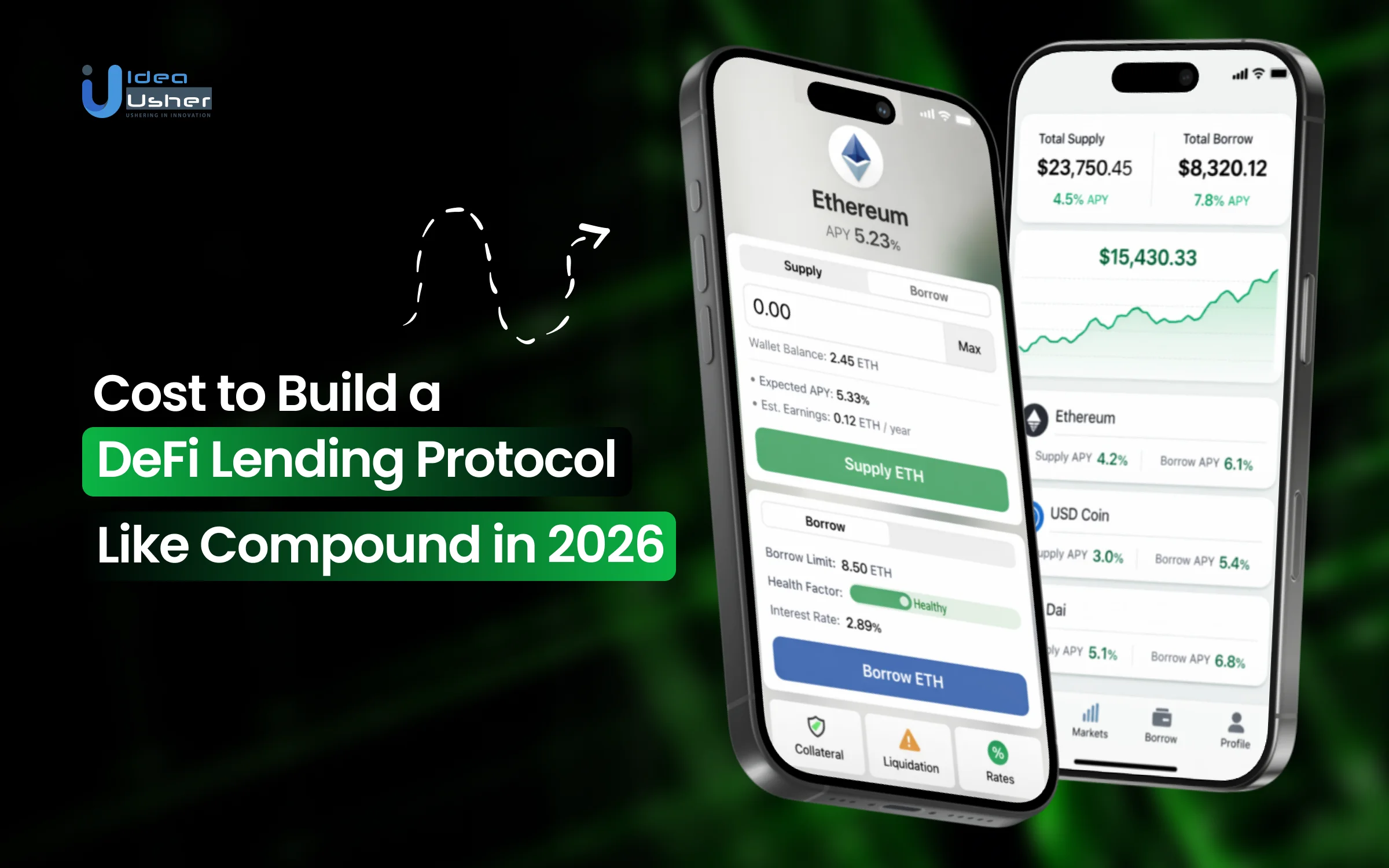
For years, developing financial products meant navigating layers of permissions and institutions that determined who could participate. Founders observed users facing slow approvals, frozen liquidity, and rules that changed without notice. This is why DeFi lending protocols grew in popularity as access became more predictable and capital could move without manual approval.
Rather than relying on trust, these systems encoded lending logic directly into smart contracts. Borrowing and interest rates operated continuously, without intermediaries slowing them down. Businesses adopted this model because liquidity remained available and settlement became faster.
Over the past decade, we’ve developed several DeFi lending solutions that use decentralized oracle networks and liquidation automation infrastructure. As IdeaUsher has this expertise, we’re sharing this blog to discuss the cost of developing a DeFi lending protocol like Compound.
Key Market Takeaways for DeFi Lending Protocols
According to Technavio, the DeFi lending market has entered a clear scale phase. Total value locked in lending protocols stood at nearly $69 billion in early 2026, accounting for over 35% of total DeFi activity. Lending volumes have expanded by around 55% to $41 billion, while global users crossed 7.8 million, growing 26% year over year.
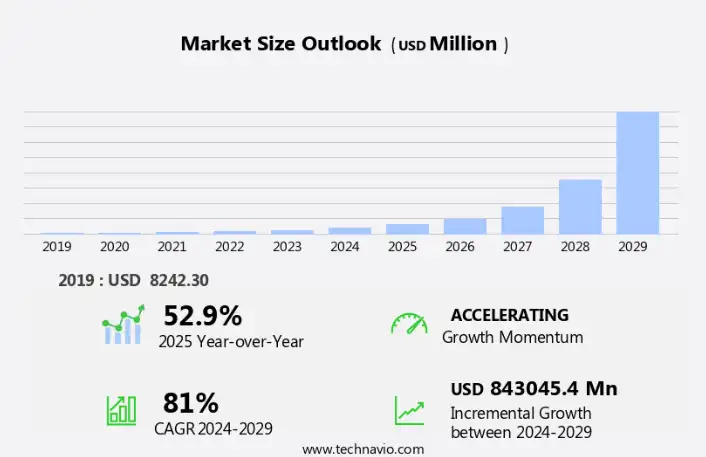
Source: Technavio
What is driving this momentum is not just yield chasing but structural maturity. Permissionless access, capital-efficient tools such as flash loans, and native cross-chain support are attracting both retail and institutional investors.
Institutional capital now accounts for about 11.5% of lending TVL, while Layer-2 ecosystems such as Arbitrum and Optimism have driven lending activity up by roughly 85%.
On the protocol side, Aave has reasserted dominance with $33.58 billion in TVL, capturing over 51% market share for the first time since 2020, led by Ethereum at $29.93 billion and rapid growth on Arbitrum.
Compound Finance remains strategically focused on USDC-based markets through V3, backed by security collaborations such as Chainrisk and liquidity integrations with DeBank and Zapper, targeting an additional $750 million inTVL.

What Is the Compound DeFi Lending Protocol?
Compound is a leading decentralized finance lending protocol built on Ethereum that allows users to lend and borrow cryptocurrencies without intermediaries. It relies on smart contracts to create shared liquidity pools, where interest rates adjust algorithmically based on real-time supply and demand.
This design removes centralized control while enabling transparent, permissionless access to on-chain credit markets.
Standout Features of the Compound Protocol
What stands out about the Compound DeFi lending protocol is its ability to quietly balance risk and yield without human intervention. Assets can earn interest automatically while borrowing stays controlled through strict over-collateralization rules and real time rate adjustments.
1. Supply Assets to Pools
Users can deposit assets like ETH or stablecoins into Compound’s liquidity pools to earn variable interest. In return, they receive cTokens that automatically appreciate over time, representing both the original deposit and the accumulated yield.
2. Borrow Against Collateral
Supplied assets can be used as over-collateralized security to borrow other tokens. Borrowing power depends on the collateral value and protocol-defined risk parameters designed to keep the system solvent.
3. Dynamic Interest Rates
Interest rates adjust in real time for each asset based on supply and demand. When liquidity is abundant, rates tend to stay low, while high borrowing activity pushes rates upward to attract more supply.
4. Earn cToken Rewards
cTokens accrue interest continuously without manual claiming. They can be redeemed at any time for the underlying asset plus interest, or transferred to other DeFi protocols as yield-bearing tokens.
5. Monitor Health Factor
The health factor reflects the degree to which a position is collateralized. By monitoring this ratio on the dashboard, users can add collateral or repay loans before the position becomes eligible for liquidation.
6. Liquidate Undercollateralized Positions
When a borrower’s collateral falls below safe limits, liquidators can step in to repay part of the debt. In return, they receive the borrower’s collateral at a discounted rate, thereby incentivizing the maintenance of protocol stability.
7. Govern with COMP
Users earn and hold COMP to participate in protocol governance. COMP holders vote on proposals that shape the system, including asset listings, risk parameters, and future upgrades.
How Does the Compound DeFi Lending Protocol Work?
Compound Finance works by pooling user deposits into smart contracts where capital can be borrowed instantly against over-collateralized positions. Interest rates may automatically adjust every block based on real-time supply and demand, keeping pricing efficient.
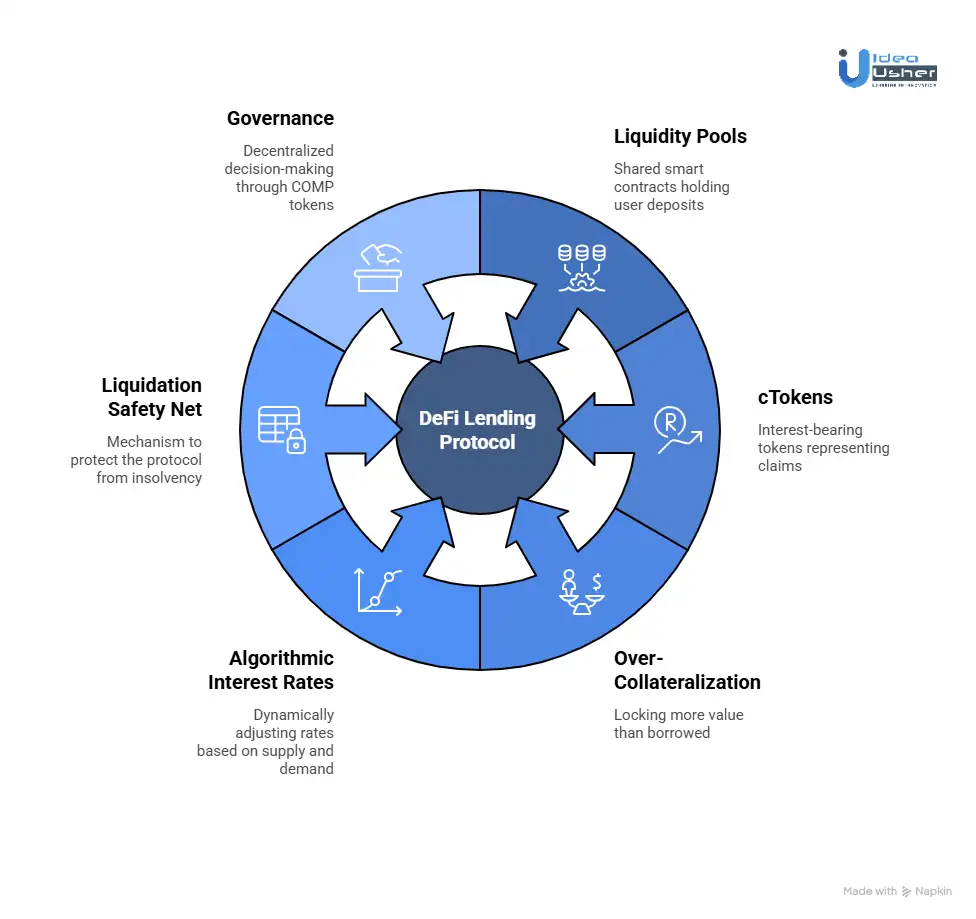
1. The Core Idea
Unlike peer-to-peer platforms, where lenders must match with specific borrowers, Compound uses a pool-based model. Think of it as a decentralized liquidity reservoir.
- Lenders (Suppliers) deposit assets like ETH, USDC, or DAI into a shared smart contract known as a liquidity pool.
- Borrowers can draw from this pool as long as they deposit collateral of higher value.
The smart contract serves as the counterparty for all participants, providing instant liquidity and enabling users to withdraw or repay at any time.
2. The Magic Receipt: cTokens
When an asset is deposited into Compound, the user receives cTokens such as cETH or cUSDC.
- These are interest-bearing tokens that represent a proportional claim on the pool.
- cTokens increase in value relative to the underlying asset over time.
- For example, 1 cUSDC may later be redeemed for 1.02 USDC.
Instead of distributing interest through periodic payments, Compound embeds interest growth directly into the token value.
3. Borrowing: Over-Collateralization Is Key
On Compound Finance, all borrowing is overcollateralized, meaning users must lock more value than they borrow to manage risk. Collateral factors are assigned to each asset and may dynamically limit the liquidity available for access based on volatility and market conditions.
A real-time Health Factor is calculated as:
(Total Collateral Value × Collateral Factor) / Total Borrowed Value
If this ratio falls below 1, the position becomes eligible for liquidation to protect the protocol.
4. Algorithmic Interest Rates
Interest rates on Compound are not set by humans. They adjust automatically every block based on asset utilization.
Utilization Rate (U) = Total Borrows / Total Supply
When utilization is high, borrowing rates increase to attract more liquidity and reduce borrowing demand. When utilization is low, borrowing rates decrease to encourage borrowing.
The supply rate is derived from the borrow rate, with a portion allocated to protocol reserves for security.
5. The Liquidation Safety Net
If a borrower’s Health Factor drops below 1 due to price fluctuations, liquidations can occur.
- Any participant can repay part of the outstanding debt.
- In return, the liquidator receives collateral at a discount, typically between 5 and 8 percent.
This open liquidation mechanism keeps the system solvent without relying on centralized enforcement.
6. Governance
Compound Finance is governed through its native COMP token, allowing stakeholders to propose and vote on protocol-level changes. Governance may adjust assets, risk parameters, and interest models so the system can evolve transparently with market conditions.
Compound v2 vs. Compound III
The compound has evolved significantly since its early versions.
- Compound v2 introduced multi-asset borrowing and established the core lending model.
- Compound III (Comet) refines this design for improved risk management and capital efficiency.
Key upgrades in Compound III include:
- A single borrowable base asset, such as USDC, while allowing multiple collateral assets.
- Higher capital efficiency due to isolated risk per market.
- Explicit borrow limits that improve predictability and liquidity safety.
Together, these changes make Compound III a more robust foundation for institutional and long-term DeFi lending.
How Does the Compound DeFi Lending Protocol Generate Revenue?
Compound generates protocol-level revenue primarily from interest rate spreads and reserves, not from traditional trading fees. Its on-chain metrics show mid single-digit millions in annualized revenue on a multibillion-dollar TVL base.
Interest Rate Spread
Borrowers pay a variable interest rate. Most of this interest flows to suppliers, while a smaller portion is routed to the protocol via an asset-specific reserve factor.
Reserve Factor as an Implicit Fee
If a market has a 20 percent reserve factor, then 20 percent of the total interest paid by borrowers is diverted into that asset’s reserve. Economically, this functions like protocol revenue while also strengthening system safety and supporting treasury needs.
cToken Model
Lenders receive cTokens at a 1:1 ratio with supplied assets. Over time, the exchange rate of cTokens to the underlying asset increases as interest accrues. This embeds the protocol’s spread directly into exchange rate growth rather than charging users explicit fees.
Algorithmic Rate Curves
Supply and borrow rates adjust continuously based on utilization. At high utilization, borrow APY can rise into double digits, sometimes up to around 15 percent for certain assets. Higher borrowing rates increase total interest flowing through markets and raise the protocol’s reserve intake.
Historical Usage and Macro Performance
Cumulative lending volume
Ecosystem analytics estimate that Compound has facilitated over USD 150 billion in lifetime lending volume, underscoring its position as one of the earliest and most widely used DeFi money markets.
Cumulative protocol revenue
Lifetime protocol-level revenue from reserves is estimated at hundreds of millions of dollars. One source cites roughly 270 million USD in accumulated reserves over the protocol’s history, while current live dashboards show about 64 million USD within their defined reporting window.
Token market metrics
COMP’s circulating market cap is approximately 250 plus million USD, with a fully diluted valuation of 260 million USD. The token trades at roughly 2-3% of its all-time high of about USD 910.
Funding Rounds and Off-Chain Capital
Compound Labs, the company behind the protocol, has raised multiple rounds to fund development, liquidity, and expansion.
| Round type | Date | Amount raised USD | Notes |
| Seed | May 2018 | 8,200,000 | Led by Andreessen Horowitz, Bain Capital Ventures, and Polychain. Used to build the initial protocol and attract early users |
| Series A | Nov 2019 | 25,000,000 | Led by Andreessen Horowitz at roughly 90,000,000 valuation. Focused on integrations with exchanges, custodians, and wallets |
| Debt financing | Nov 2022 | 37,634,255 | Used to provide liquidity and support operational expenses |
| Series unknown | Jan 2020 | Not disclosed | Amount and valuation undisclosed. Aimed at scaling development |
| Series unknown | Mar 2025 | 95,000 | Small follow-on round to support ongoing platform enhancements |
Total capital raised: Across equity and debt, Compound has raised approximately 71.93 million USD, excluding undisclosed amounts.
Use of funds
Capital has primarily been deployed to protocol R&D, security audits, ecosystem integrations, and liquidity or operational support. These off-chain resources complement on-chain revenue and treasury flows rather than replacing them.
Cost to Build a DeFi Lending Protocol Like Compound
Building a DeFi lending protocol requires precision across economics, security, and engineering, but it does not have to lead to uncontrolled spending. We follow a cost-effective, phased approach that prioritizes risk modeling, modular development, and security-first decisions, so our clients receive a resilient lending protocol with minimal unnecessary overhead.
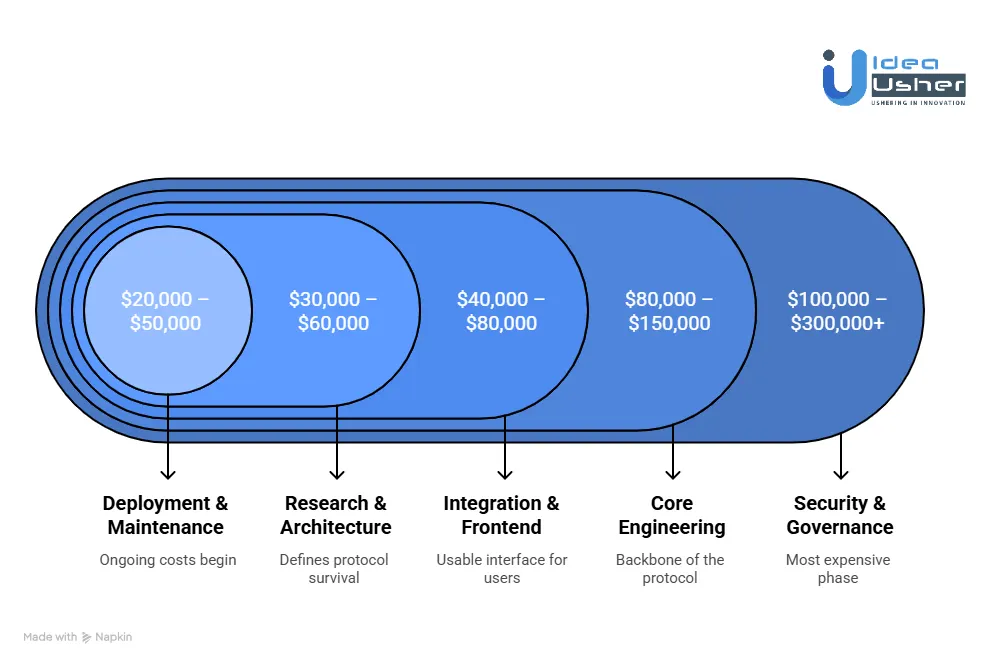
Phase 1: Research & Architecture
This phase defines whether the protocol survives real market stress. You are paying for financial engineering, risk modeling, and economic simulations before a single contract is written.
| Component | Scope | Cost Range | Timeline |
| Market & Risk Modeling | LTV ratios, collateral factors, interest rate curves | $15,000 – $30,000 | |
| Economic Simulations | Monte Carlo simulations, crash scenarios, stress testing | $15,000 – $30,000 | |
| Phase 1 Total | $30,000 – $60,000 | 4–6 weeks |
Phase 2: Core Engineering
This is the backbone of the protocol. Most failures happen here if corners are cut.
| Component | Scope | Cost Range | Timeline |
| Smart Contract Development | Lending pools, cToken logic, interest rate models, vaults | $45,000 – $80,000 | |
| Liquidation Engine | Internal keeper bots, solvency testing | $15,000 – $30,000 | |
| Backend & Indexing | Subgraphs, TVL tracking, user balance indexing | $10,000 – $20,000+ | |
| Phase 2 Total | $80,000 – $150,000 | 3–5 months |
Phase 3: Integration & Frontend
A DeFi lending protocol is unusable without accurate data and a reliable interface.
| Component | Scope | Cost Range | Timeline |
| Oracle Integration | Chainlink feeds, fallback logic, subscriptions | $5,000 – $20,000 | |
| Web3 Frontend | Dashboard, APY views, health factors, history | $25,000 – $40,000 | |
| Wallet Integration | MetaMask, Ledger, WalletConnect | $10,000 – $20,000 | |
| Phase 3 Total | $40,000 – $80,000 | ~2 months |
Phase 4: Security & Governance
This phase determines credibility. Skipping or underfunding it is the fastest way to lose TVL.
| Component | Scope | Cost Range | Timeline |
| Smart Contract Audits | Two-tier audits (OpenZeppelin, Trail of Bits, Spearbit) | $70,000 – $200,000+ | |
| Governance (DAO) | Voting contracts, timelocks, proposal system | $15,000 – $30,000 | |
| Bug Bounty Program | Immunefi setup and reward pool | $15,000 – $70,000+ | |
| Phase 4 Total | $100,000 – $300,000+ | ~2 months (overlaps dev) |
Phase 5: Deployment & Maintenance
This is where ongoing costs begin. DeFi protocols are never “done.”
| Component | Scope | Cost Range |
| Mainnet Deployment | Gas costs for contract deployment (Ethereum) | $5,000 – $15,000 |
| Operational Infrastructure | RPC providers, nodes, hosting, and monitoring | $15,000 – $35,000 |
| Initial Phase 5 Cost | $20,000 – $50,000 | |
| Ongoing Maintenance | Monitoring, infra, upgrades | ~$5,000/month |
This breakdown represents a realistic estimate, not a fixed price, as final costs vary based on asset complexity, network choice, and security depth. For a protocol of this scope, the total estimated cost typically ranges from $270,000 to $640,000+ USD. For a more accurate, project-specific quote, feel free to connect with us for a free consultation.
Factors Affecting the Cost of a DeFi Lending Protocol Like Compound
Phase-wise estimates are useful for planning, but they rarely tell the full story. In practice, the final cost of building a DeFi lending protocol is shaped by a handful of technical and economic choices that quietly expand scope.
These variables often explain why two platforms that look similar on the surface end up with very different budgets.
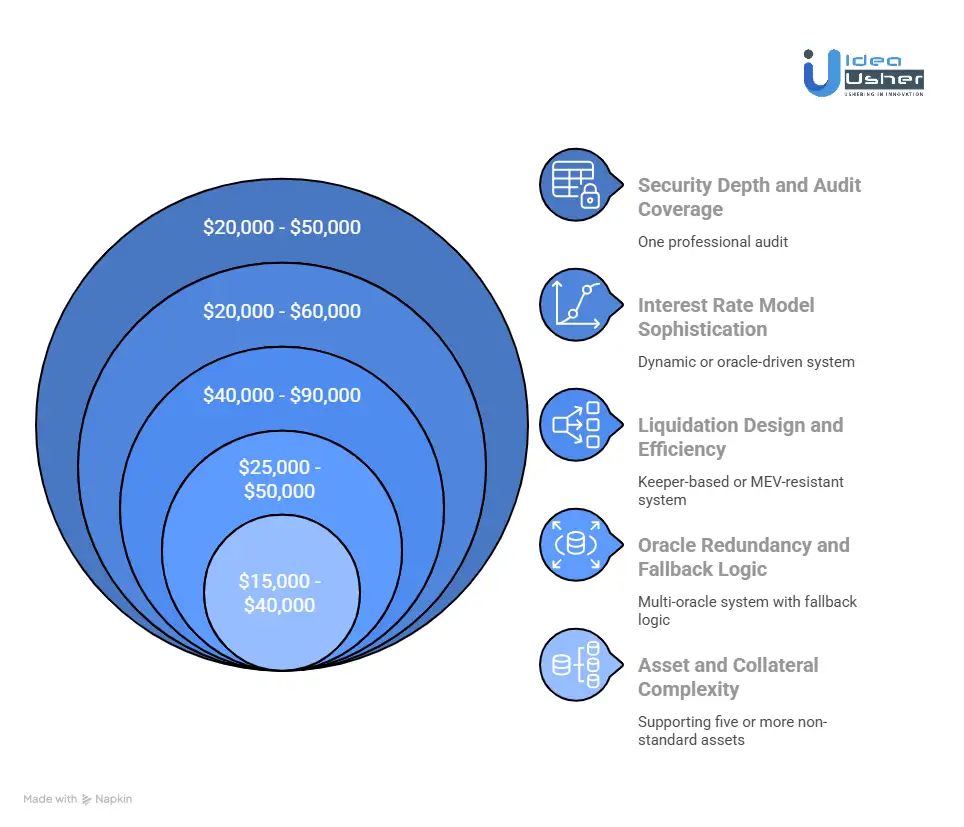
1. Asset and Collateral Complexity
Launching with ETH and a few major stablecoins is relatively straightforward. The moment a protocol supports volatile, thinly traded, or long-tail assets, complexity increases sharply. Each new asset requires custom risk parameters, oracle calibration, liquidation thresholds, and expanded test coverage. Audits also become more involved as asset behavior diverges under market stress.
Cost impact: Supporting five or more non-standard assets can increase smart contract complexity by roughly 30 to 50 percent, adding $15,000 to $40,000 in additional development and audit effort.
2. Interest Rate Model Sophistication
Most early protocols rely on fixed or utilization-based interest curves because they are predictable and easier to validate. More advanced models that react to volatility, liquidity depth, or external market signals demand deeper financial engineering.
These systems require simulations across extreme market conditions and significantly more testing to avoid unintended feedback loops.
Cost impact: Upgrading from a standard kinked interest model to a dynamic or oracle-driven system can add $20,000 to $60,000 in specialized development and testing.
3. Liquidation Design and Efficiency
Basic on-chain liquidations are cheaper to implement but often fail during periods of congestion or rapid price movements. More resilient designs rely on keeper networks, auction-based liquidations, or backstop liquidity mechanisms.
These systems reduce insolvency risk but introduce additional infrastructure and coordination costs.
Cost impact: A simple liquidation module typically costs $10,000 to $25,000. A keeper-based or MEV-resistant liquidation system can push this to $40,000 to $90,000.
4. Oracle Redundancy and Fallback Logic
Using a single price oracle keeps costs down but leaves the protocol exposed to outages or price manipulation. Production-grade lending platforms often implement multiple oracles with fallback logic, circuit breakers, and anomaly detection to maintain pricing integrity during abnormal conditions.
Cost impact: A basic Chainlink integration may cost $5,000 to $15,000. A multi-oracle system with custom fallback logic can add $25,000 to $50,000 in development and integration costs.
5. Security Depth and Audit Coverage
Smaller protocols may launch with a single audit, but lending platforms aiming for long-term credibility typically require multiple independent audits, extended remediation cycles, and, in some cases, formal verification.
Bug bounty programs and ongoing security reviews further increase the overall budget but materially reduce existential risk.
Cost impact: One professional audit typically ranges from $20,000 to $50,000. A comprehensive security approach with multiple audits and verification can exceed $100,000 to $250,000.
How Much Liquidity Is Required for a DeFi Lending Protocol to Succeed?
Liquidity must meet a minimum threshold before a lending protocol can function properly. Approximately five to ten million in TVL may be sufficient for survival, while fifty million could realistically enable stable borrowing and rate efficiency.
At scale, a protocol typically requires hundreds of millions to reliably support utilization and still attract serious capital over time.
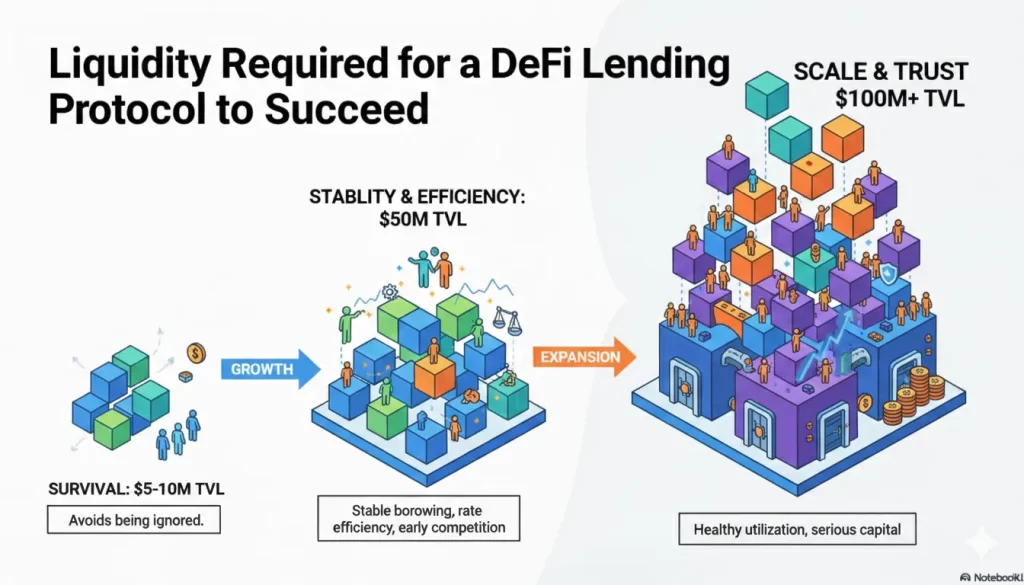
1. The Survival Threshold: $5–10 Million TVL
This is the absolute bare minimum to avoid being labeled a ghost chain. Below this threshold, a protocol faces a fatal chicken-and-egg problem.
Early Euler Finance is a good example. Despite launching with advanced risk isolation and permissionless listing features, it struggled to gain traction until it crossed roughly $10 million in TVL. Only after reaching this level did it begin attracting users who required meaningful borrowing capacity.
The reality: Launching with less than $5 million TVL often signals impending failure. This range represents the baseline required to be taken seriously by early adopters and integrators.
2. The Competitive Threshold: $50–100 Million TVL
This is where a protocol moves from surviving to competing.
Aave’s pivotal moment occurred when it surpassed approximately $50 million in TVL during its transition from ETHLend to Aave V1. At this level, the protocol could offer more stable interest rates, attract its first institutional flows, and compete directly with Compound for users and liquidity.
Why it works: At $50 million or more in TVL, protocols can support professional borrowing strategies, achieve rate stability, and activate the network effect flywheel that drives organic growth.
3. The Market Leader Threshold: $500 Million-$1 Billion+TVL
This is the domain of established infrastructure.
Protocols like Compound and MakerDAO operate in this range. When Compound maintains TVL above $500 million, it signals to the broader ecosystem that it is a reliable money market primitive. This reliability allows hundreds of DeFi applications to integrate it as a core liquidity layer.
The takeaway: Reaching $500 million TVL is a long-term goal that enables institutional participation and makes the protocol systemically important.
Asset by Asset Breakdown: Quality Over Quantity
Having $100 million TVL concentrated in a single obscure token is far less valuable than having $50 million distributed across core assets.
Strategy: Launch with two to three blue-chip pools at $10 million or more depth each before expanding. Aave’s early success was built on deep ETH and stablecoin pools rather than a wide set of shallow markets.
The Hidden Costs of Acquiring Liquidity
This is where most teams underestimate the challenge. Building the protocol is only one part of the journey. Bootstrapping liquidity is often the harder problem.
Liquidity mining incentives:
Compound’s 2020 COMP distribution is a defining example. By allocating COMP tokens to lenders and borrowers, the protocol attracted over $900 million in TVL within months. The lesson is clear. Expect to allocate roughly 3 to 5 percent of total token supply to bootstrap meaningful liquidity.
The real budget:
For a protocol targeting $50 million TVL, teams should plan for $500,000 to $1.5 million in liquidity incentives alone. In many cases, this matches or exceeds core development costs.
The Ultimate Metric: Sustainable Utility Over Vanity TVL
Chasing TVL through unsustainable yield farming often results in short-lived spikes followed by rapid outflows. The real north star is sustainable borrow demand.
- Focus on the borrower side: High lending APYs can always be manufactured with incentives. Organic borrowing, where users are willing to pay interest is the strongest validation of product market fit.
- Monitor utilization: A healthy lending protocol typically maintains borrow utilization between 40 and 70 percent in its major pools. This range signals real demand without excessive liquidity stress.
Conclusion
Building a DeFi lending protocol like Compound in 2026 should be seen as a long-term infrastructure decision rather than a fast product launch. The protocol may succeed only when engineering depth, security discipline, and regulatory readiness work together from day one. Teams should carefully consider upgrade paths, risk controls, and capital efficiency, as these systems tend to compound over time. Partnering with an experienced development firm like IdeaUsher can help ensure the protocol is designed for scalability, resilience, and eventual institutional adoption.
Looking to Develop a DeFi Lending Protocol Like Compound?
IdeaUsher can help design a DeFi lending protocol like Compound by structuring interest rate models, smart contracts, and liquidation logic that actually work under real market stress.
Our team may carefully architect risk-parameter oracle integrations and security audits so the protocol remains stable as liquidity scales.
Why Partner With Us?
- Beyond Basic Forks: We build capital-efficient, multi-chain protocols with AI-driven risk management
- Security-First Approach: From formal verification to continuous monitoring, we protect your protocol and your users
- Real-World Ready: We integrate compliance layers and RWA modules to attract institutional liquidity
- Full-Cycle Development: From whitepaper to mainnet launch and beyond, we’re your technical co-founders
Explore our latest DeFi projects to see how we’ve helped founders turn concepts into live protocols with millions in TVL.


FAQs
A1: Developing a DeFi lending protocol usually starts with defining the lending model and risk logic before writing any smart contracts. Teams should carefully design interest rate curves, collateral rules, and liquidation flows, as these directly affect capital safety. Smart contracts may then be built, audited, and tested under adversarial scenarios. A gradual mainnet launch with caps and monitoring often helps reduce early risk.
A2: The cost of developing a DeFi lending protocol can vary widely based on complexity and security depth. A basic protocol may require a lower budget, while institutional-grade systems usually need heavier investment in audits and monitoring. Costs should also account for ongoing maintenance and governance upgrades. Teams should plan funding realistically rather than treating it as a one-time build.
A3: A DeFi lending protocol typically includes permissionless lending pools, collateralized borrowing, and automated liquidations. Interest rate models adjust dynamically based on utilization to balance supply and demand. Oracles play a critical role in accurately pricing assets. Governance mechanisms may allow the protocol to evolve over time.
A4: The tech stack for a DeFi lending protocol usually centers on smart contracts written in Solidity or similar languages. Blockchain networks like Ethereum or rollups provide execution and settlement. Oracle’s indexers and monitoring tools support pricing and transparency. Frontend interfaces may be built with modern web frameworks to ensure usability.