

A surprising amount of wealth today still sits quietly, locked away in assets that are valuable but painfully slow to move. Real estate transactions can take months. Private equity remains constrained by long holding periods. Collectibles often trade only within closed networks. For businesses and investors, this friction creates a silent cost.
That is why the popularity of security token platforms has started increasing. They allow assets to move faster without breaking regulatory boundaries. By converting ownership into compliant digital tokens, these platforms make participation smaller, clearer, and more efficient.
Over the years, we’ve developed several asset tokenization solutions that leverage technologies such as digital identity trust frameworks and asset lifecycle management systems. Given our expertise, we are sharing this blog to discuss the cost of developing an asset tokenization marketplace.
Key Market Takeaways for Asset Tokenization Marketplaces
Source: Mordor Intelligence
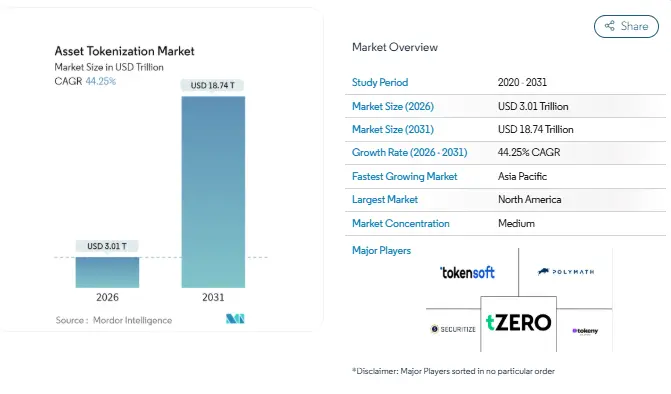
Security token platforms are central to this expansion because they make traditionally illiquid assets more accessible and operationally efficient.
By enabling compliant digital representations of equities, debt, and real estate, these platforms support fractional ownership, faster settlement, and global participation while enforcing regulatory rules through standards such as ERC-1400.
Among established players, tZERO and Polymath illustrate how the market is maturing. tZERO operates a regulated marketplace through its SEC-registered ATS and FINRA broker-dealer, enabling secondary trading of digital securities.
What Is an Asset Tokenization Marketplace?
An asset tokenization marketplace is a digital platform where real-world assets like equities, debt, real estate, or funds are converted into blockchain-based tokens and issued or traded under defined rules. It brings together issuance, compliance checks, ownership tracking, and secondary trading in a single system, enabling assets to move with greater transparency, efficiency, and regulatory control.
Types of Assets Commonly Tokenized
Asset tokenization marketplaces usually support equities, debt instruments, real estate, funds, and commodities. These assets can be structured as on-chain representations with ownership, transfer rules, and settlement logic built in. If designed correctly, the platform may improve liquidity and operational efficiency while staying compliant.
1. Equities
Public or private company shares are tokenized to enable fractional ownership and faster settlement. Transfer rules and investor eligibility can be enforced directly to meet regulatory requirements. This makes equity issuance more accessible while preserving shareholder rights and governance.
A well-known example is tZERO, which operates a regulated marketplace for tokenized equities with compliant secondary trading.
2. Debt Instruments
Bonds and fixed income products are tokenized to automate interest payments and maturity events. This improves transparency while keeping issuance and transfers compliant. Issuers can also reduce settlement delays and operational overhead.
Securitize supports the issuance and management of tokenized bonds and debt products with built-in compliance and investor verification.
3. Real Estate
Residential and commercial properties are split into digital units that represent ownership rights. Tokenization improves liquidity while preserving legal ownership records. Investors can participate with smaller ticket sizes and clearer cash flow tracking.
RealT allows investors to buy fractional ownership in real estate properties through legally structured tokens.
4. Investment Funds
Private equity and venture funds use tokens to manage subscriptions, redemptions, and investor access. This simplifies fund administration while maintaining strict compliance. Fund managers gain better visibility into ownership and lifecycle events.
ADDX enables tokenized access to private equity and venture funds for accredited investors under regulatory oversight.
5. Commodities
Assets like gold or energy credits are tokenized to improve traceability and tradability. Custody and verification remain tightly controlled through the platform. This helps align physical asset backing with digital ownership records.
Paxos provides tokenized commodities, such as gold, backed by physical reserves and issued under a regulated framework.
6. Alternative Assets
Art, collectibles, and similar assets are tokenized to unlock liquidity without losing provenance. Ownership rights and resale conditions can be clearly defined on-chain. This allows secondary trading while respecting creator and issuer constraints.
Maecenas focuses on tokenizing high-value art and collectibles, enabling fractional ownership while preserving provenance.
How Do Asset Tokenization Marketplaces Work?
Asset tokenization marketplaces typically begin by legally structuring a real-world asset and linking it to compliant smart contracts that govern ownership. Investors can onboard via verified identity checks and then buy or trade tokens, with every transfer validated on the chain.
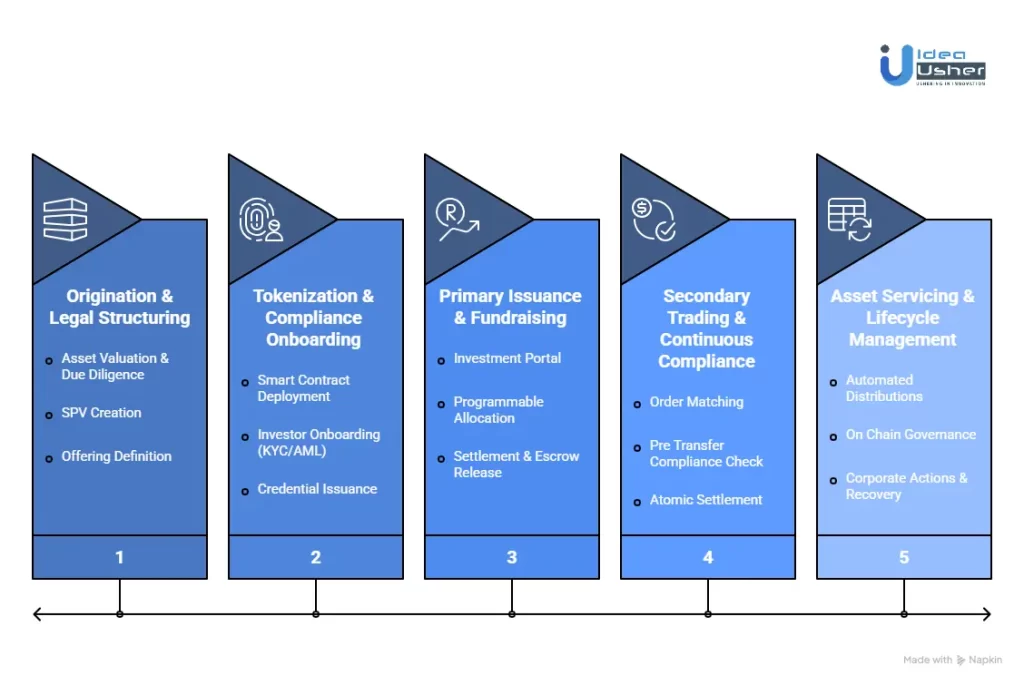
1. Origination & Legal Structuring
Before a single line of code is written, the real-world asset must be legally prepared for its digital twin.
Asset Valuation & Due Diligence: The asset, such as a commercial property, is appraised, and its legal title is verified. All existing liens or encumbrances are cleared.
SPV Creation:
The asset is transferred into a Special Purpose Vehicle, which may be an LLC or a trust. This SPV becomes the legal owner. Tokens represent fractional ownership of the SPV rather than the asset directly. This step isolates liability and establishes a clean legal framework.
Offering Definition:
The issuer defines the token structure, including total supply, price per token, dividend policies, voting rights, and transfer restrictions, such as a one-year lock-up for certain investors.
2. Tokenization & Compliance Onboarding
This is where the digital representation is created and linked to verified identities.
Smart Contract Deployment:
Developers build and deploy asset-specific smart contracts. For regulated securities, standards such as ERC 3643 and ERC 1400 are commonly used. These contracts include built-in rules such as restricting ownership to accredited investors.
Investor Onboarding (KYC/AML):
Investors register on the marketplace and complete identity verification and sanctions screening through integrated compliance providers. Accredited investor verification may also be required.
Credential Issuance: Once approved, the investor receives a verifiable credential or compliance NFT in their wallet. This credential proves eligibility without exposing sensitive personal data.
3. Primary Issuance & Fundraising
This phase covers the initial token sale to investors.
Investment Portal:
Investors access a dashboard containing asset details, legal documentation, and investment terms. Funds are committed through integrated payment rails such as bank transfers or stablecoins.
Programmable Allocation:
The smart contract validates the investor’s credentials before accepting funds. If valid, the contract mints the correct number of tokens and transfers them to the investor’s wallet. Funds remain in escrow until the fundraising target is reached.
Settlement & Escrow Release:
After the offering closes, funds are released to the issuer SPV, and investors hold tokenized ownership in their wallets. The cap table is now permanently recorded on chain.
4. Secondary Trading & Continuous Compliance
Liquidity is enabled through compliant peer-to-peer trading.
Order Matching: The platform offers an order book or an automated market maker where buyers and sellers submit trade intents.
Pre Transfer Compliance Check:
Before execution, the smart contract validates compliance conditions. It verifies whether the buyer credential is still valid. It checks jurisdiction eligibility for both parties. It confirms lock up expiration and enforces ownership concentration limits.
Atomic Settlement:
If all conditions are satisfied, the trade settles via Delivery versus Payment. The asset token and payment token are exchanged in a single atomic transaction, removing counterparty risk.
5. Asset Servicing & Lifecycle Management
The marketplace remains active throughout the asset lifecycle.
Automated Distributions:
Income, such as rent or dividends, flows into a smart contract vault using standards like ERC 4626. Funds are distributed proportionally to all token holders.
On Chain Governance:
Token holders participate in governance decisions using token-weighted voting. All votes are transparent and immutable.
Corporate Actions & Recovery:
Regulated administrative actions are supported. In the event of lost private keys, a predefined multi-signature process allows tokens to be burned and reissued to a new wallet, ensuring alignment between legal ownership and the on-chain record.
Cost to Build an Asset Tokenization Marketplace With Compliance
Building a compliant asset tokenization marketplace requires precision, not excess. We take a cost-effective approach by focusing investment where it truly matters: compliance, security, and permissioned infrastructure, while avoiding unnecessary engineering overhead for our clients.
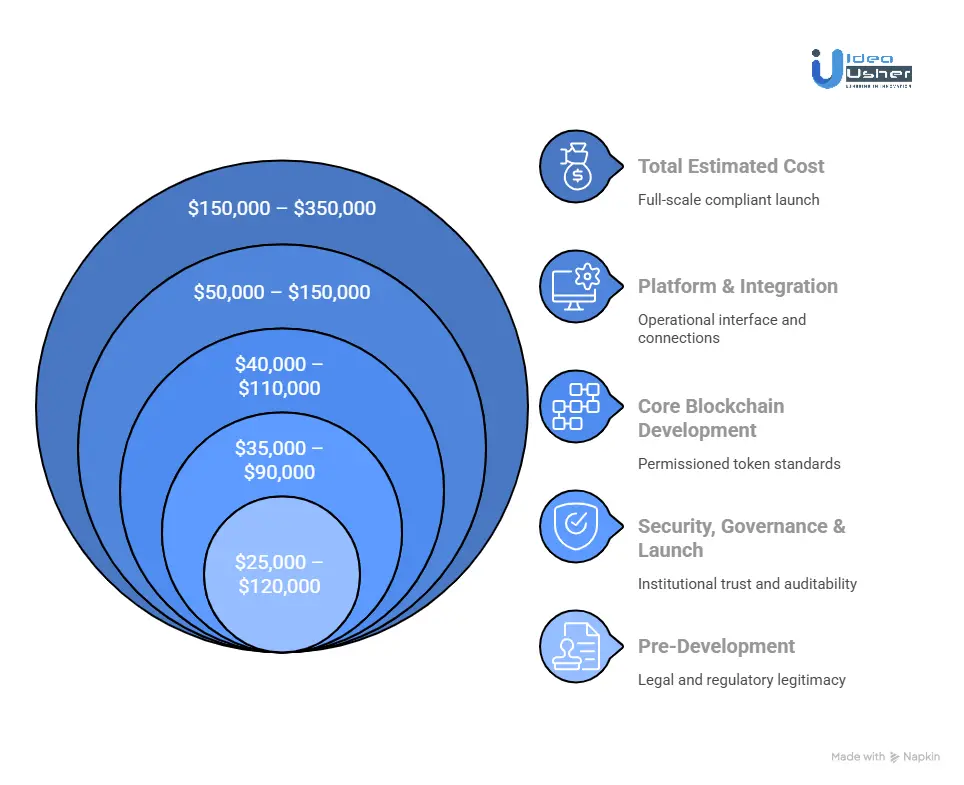
Phase 1: Pre-Development (Legal & Planning)
Cost Bracket: $25,000 – $120,000
This phase establishes legal and regulatory legitimacy. Cost-cutting here often leads to compliance failures later.
| Sub-Step | Cost Range (USD) | Breakdown |
| SPV / Trust Formation | $15,000 – $50,000 | Creation of legal entities, tax structuring, deed transfers, and ownership mapping |
| Legal Opinions & Filings | $10,000 – $60,000 | SEC Reg D / Reg S or MiCA documentation, jurisdictional analysis, legal comfort letters |
| Technical Architecture Design | $5,000 – $10,000 | Mapping on-chain tokens to off-chain assets, compliance flow design |
Phase 2: Core Blockchain Development
Cost Bracket: $40,000 – $110,000
Focused on permissioned token standards, identity enforcement, and compliant settlement logic.
| Sub-Step | Cost Range (USD) | Breakdown |
| Compliance Token Contracts | $15,000 – $40,000 | Custom ERC-3643 / ERC-1400 logic with transfer restrictions and role enforcement |
| Identity Layer (DID) | $10,000 – $30,000 | On-chain identity registries, wallet whitelisting, and investor eligibility checks |
| Payment Rails & DvP | $15,000 – $40,000 | Atomic delivery-versus-payment logic, stablecoin settlement integration |
Phase 3: Platform & Integration
Cost Bracket: $50,000 – $150,000
This phase delivers the operational interface and connects to the external compliance infrastructure.
| Sub-Step | Cost Range (USD) | Breakdown |
| Investor & Admin UX | $30,000 – $80,000 | Dashboards for issuance, cap table management, dividends, and governance |
| KYC / AML Integration | $5,000 – $20,000 | API integration, onboarding flows, initial verification credits |
| Custody Integration | $15,000 – $50,000 | Institutional custody setup, key management, transaction policy enforcement |
Phase 4: Security, Governance & Launch
Cost Bracket: $35,000 – $90,000
Required to meet institutional trust, auditability, and launch readiness standards.
| Sub-Step | Cost Range (USD) | Breakdown |
| Smart Contract Audit | $25,000 – $60,000 | Third-party review of token, identity, and settlement contracts |
| Penetration Testing | $5,000 – $20,000 | Security testing across frontend, backend, and APIs |
| Deployment & Gas | $5,000 – $10,000 | Contract deployment costs are higher on the Ethereum mainnet and lower on L2s |
This breakdown represents a practical estimate rather than a fixed price, since regulatory scope and technical depth vary by jurisdiction and asset class.
For a full-scale compliant launch, the total estimated cost typically ranges from $150,000 to $350,000 USD. For a more accurate quote aligned with your use case, feel free to connect with us for a free consultation.
Factors Affecting the Cost of an Asset Tokenization Marketplace
The cost of an asset tokenization marketplace usually depends on how many jurisdictions you want to support and how deeply compliance is embedded into the protocol. Asset complexity and custody design can quickly raise engineering and audit effort.
1. Jurisdiction & Regulatory Scope
Your target market dictates your legal architecture. A single jurisdiction, such as the UAE under VARA, has a defined framework, whereas operating simultaneously under the SEC in the US and MiCA in the EU is exponentially more complex.
Cost Driver: This is not just about legal opinions. It is about programmable compliance logic. Each jurisdiction requires its own rulebook, embedded in smart contracts and user flows.
Cost Fluctuation:
Moving from a single jurisdiction, such as one EU country under MiCA, to a dual US and EU launch can increase legal, structuring, and development costs from approximately $50,000 to $100,000 to $200,000 to $400,000 plus. This includes parallel Special Purpose Vehicle setups and jurisdiction-aware transfer restrictions.
2. Asset Class Complexity
Not all assets are created equal. Tokenizing a simple ownership share is fundamentally different from tokenizing a revenue-generating asset with complex rights.
Cost Driver: Smart contract sophistication. A static real estate ownership token is one thing. A token representing private equity with waterfall distributions, voting rights, and drag-along clauses requires intricate, audited logic for lifecycle management.
Cost Fluctuation:
Development and audit costs can jump from approximately $25,000 to $50,000 for a basic fractional ownership model to $75,000 to $150,000 or more for dynamic assets such as funds or intellectual property royalties.
This is driven by the need for advanced standards such as ERC 1400, 3643, and 4626 for yield distribution.
3. Identity & Compliance Depth
A checkbox for a passport scan is the entry point. A platform for institutional players requires a robust, privacy-preserving identity layer.
Cost Driver: Integration with regulated identity providers and decentralized identity wallets. Building a system that verifies accredited investor status, performs ongoing sanctions screening, and uses zero-knowledge proofs for privacy is a major technical undertaking.
Cost Fluctuation:
Integrating basic third-party KYC might cost $10,000 to $20,000. A full-stack in-house or deeply integrated on-chain identity registry with reusable credentials and programmatic eligibility checks can range from $40,000 to $100,000 or more.
4. Custody & Settlement Model
The platform may use a regulated custodian, a multi-signature wallet, or a hybrid custody model. It also needs a clear path to convert fiat into stablecoins for on-chain settlement in a secure and compliant manner.
Cost Driver: Licensing fees, integration complexity, and security overhead. Institutional grade custody partners come with significant fees. Building a secure atomic delivery-versus-payment settlement layer between banking rails and the blockchain is a core and costly capability.
Cost Fluctuation:
A self-custodied multi-signature setup may cost $15,000 to $30,000 to develop. Integrating a licensed, insured custodian and building compliant fiat on- and off-ramps can add $50,000 to $150,000 in development, licensing, and ongoing operational costs.
5. Security & Audit Rigor
In a tokenization marketplace, security is not a feature. It is the product. The level of scrutiny scales with the value and sensitivity of the assets being tokenized.
Cost Driver: Number and depth of audits. A single smart contract audit for an MVP is standard. An enterprise platform requires full-stack penetration testing, infrastructure audits, formal verification of critical financial logic, and, in many cases, multiple audit rounds.
Cost Fluctuation:
A basic smart contract audit from a reputable firm typically ranges from $5,000 to $15,000. A comprehensive security program for an institutional platform, including protocol, web app, and infrastructure audits, plus a bug bounty program, can easily reach $50,000 to $200,000 plus.
Do Businesses Need Licenses for an Asset Tokenization Marketplace?
Yes, businesses do need regulatory licenses to launch an asset tokenization marketplace. Once you tokenize real-world assets, you are effectively operating a regulated financial service, and you must legally follow securities custody and trading rules. The exact licenses may vary by region, but you must first ensure compliance; otherwise, the platform cannot operate.
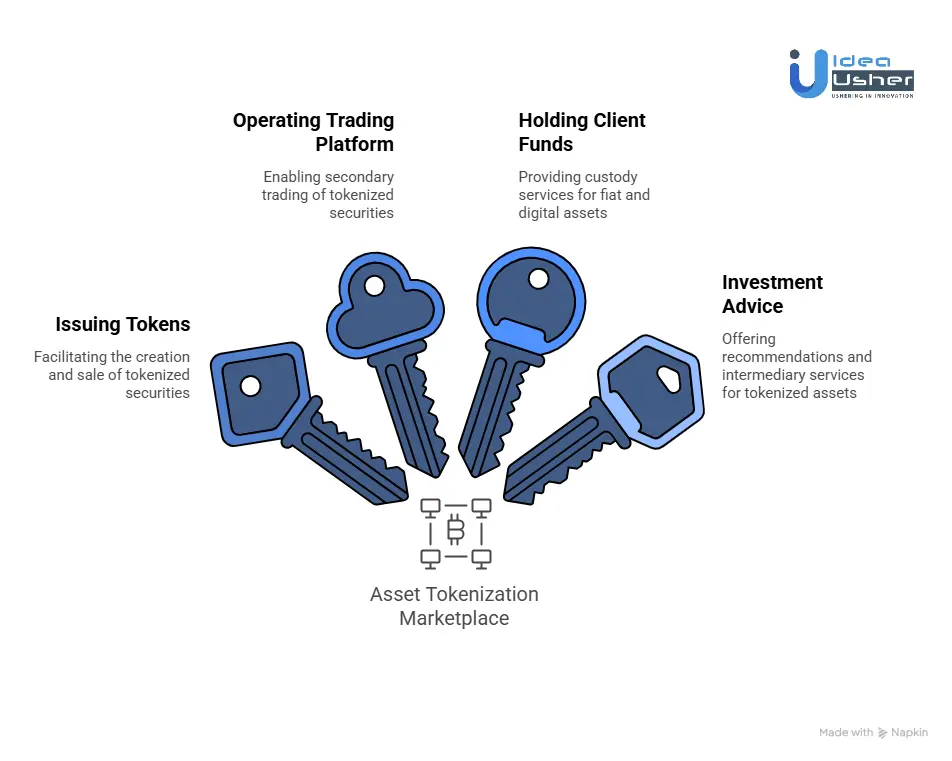
1. Issuing Tokens
When your platform facilitates or participates in creating and selling tokenized securities, you are acting as an issuer or a promoter.
Key Requirement: You are subject to securities registration or exemption laws.
Typical Licenses or Registrations:
- In the USA, you must file an exemption like Regulation D 506c for accredited investors or Regulation A+ for a public offering with the SEC. This is not a license per se, but a mandatory registration that brings ongoing disclosure duties.
- In the EU under MiCA, you will likely need authorization as a Crypto Asset Service Provider for issuing asset-referenced or electronic money tokens, and must publish a detailed whitepaper approved by a national authority such as BaFin in Germany or AMF in France.
- In the UAE, under VARA, you must obtain a Virtual Asset Service Provider license for the specific activity of Advisory Services and or Exchange Services.
The issuer carries the primary legal responsibility for the offering. Legal counsel is non-negotiable at this stage.
2. Operating the Trading Platform
If your platform enables secondary trading of tokenized securities between users, you are operating a Multilateral Trading Facility or an Alternative Trading System.
Key Requirement: This is one of the most heavily regulated activities.
Typical Licenses:
- In the USA, Registration as an Alternative Trading System with the SEC and FINRA, or as a full national securities exchange, is a far more onerous process.
- In the EU, under MiCA and MiFID II, authorization is required for a Crypto Asset Service Provider to operate a trading platform. You must also demonstrate robust market surveillance, pre and post-trade transparency, and conflict-of-interest management systems.
- In the UK: Authorization from the Financial Conduct Authority as a Multilateral Trading Facility.
- In Singapore: A Recognized Market Operator license from the Monetary Authority of Singapore.
For example, tZERO, one of the first regulated security token trading platforms, spent years and significant capital to obtain its broker-dealer and ATS licenses from FINRA.
This regulatory foundation enables them to offer legitimate secondary liquidity for tokenized assets, distinguishing them from unregulated crypto exchanges.
3. Holding Client Funds or Assets
If your marketplace takes possession of investors’ fiat money or digital asset securities, even momentarily during settlement, you are providing custody services.
Key Requirement: High bar capital adequacy, insurance such as FDIC pass-through insurance for fiat or crime insurance for crypto, and regular security audits.
Typical Licenses:
- In the USA: A state money transmitter license for fiat custody, and potentially a trust charter for digital asset custody. Many states now have specific Virtual Currency Business Activity licenses.
- In the EU, MiCA requires authorization for Crypto Asset Service Providers to provide custody services and imposes strict standards for segregating client assets.
Pro Tip: Most modern platforms integrate with licensed third-party custodians, such as Anchorage, BitGo, or Fireblocks, to avoid the high costs and complexity of becoming a custodian themselves.
4. Investment Advice or Brokerage Services
If your platform recommends specific tokenized assets or acts as an intermediary for transactions for a fee, you are a broker-dealer or investment advisor.
Typical Licenses:
- In the USA: Registration as a Broker Dealer with the SEC and FINRA, and or as an Investment Adviser at the state or federal level.
- Globally, equivalent licenses, such as Investment Dealer licenses, are nearly universal.
How Secondary Market Trades Stay Compliant With Securities Laws?
Secondary market trades remain compliant because the rules are enforced directly by the token logic rather than by humans. Every buyer must already be verified, and the smart contract may automatically block transfers that violate jurisdiction or holding-period rules. This way, trades can settle smoothly while still complying with securities laws by design.
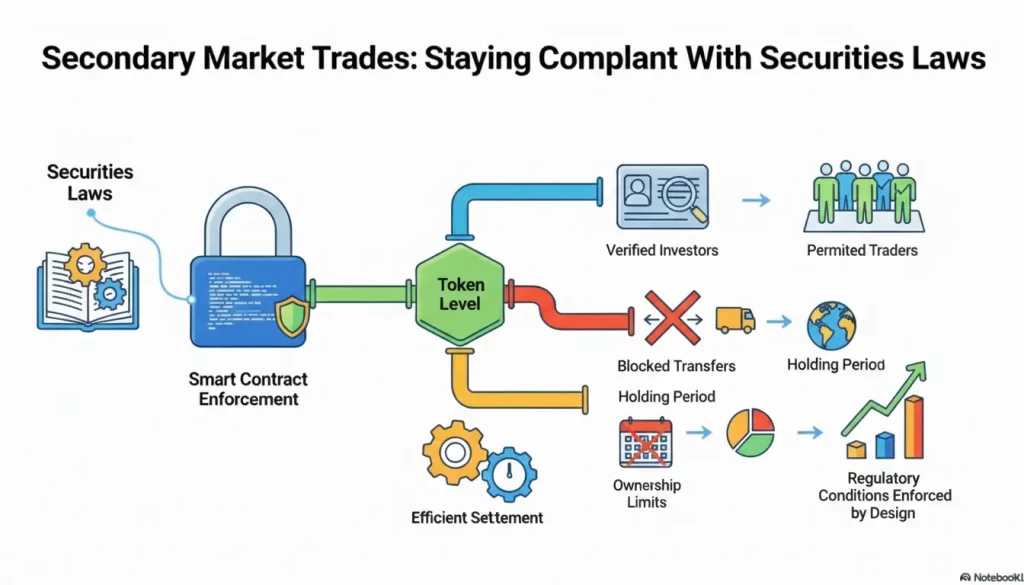
1. Identity and On-Chain Verification
The foundational requirement. Tokens are not freely transferable to any blockchain address.
How it Works:
Every potential trader must have a verified Decentralized Identity DID or a compliance NFT in their wallet, issued after full KYC, AML, and accreditation checks. When a trade is initiated, the smart contract queries the on-chain identity registry.
The Compliance Lock:
The transfer function will execute only if the recipient wallet holds a valid, unexpired credential. If an investor’s KYC expires, their tokens become non-transferable until re-verification is completed.
Standards such as ERC-3643 and ERC-1400 embed these checks directly in the token logic.
2. Jurisdictional and Investor-Type Gating
Securities laws vary by geography and investor classification such as accredited versus retail. These boundaries must be enforced in real time.
How it Works: A trader-verified identity credential includes metadata tags such as US-accredited jurisdiction or EU retail jurisdiction. The smart contract rule engine applies the correct regulation.
- A token issued under SEC Reg D can be programmed to transfer only to wallets tagged as US-accredited.
- Under EU MiCA, a token can be restricted from transferring to wallets tagged in non compliant third countries.
Dynamic Rule Engine:
Advanced platforms rely on an off chain compliance oracle that holds the full regulatory rulebook. The smart contract submits a canTransfer sender receiver tokenID query and proceeds only if the response is true.
3. Holding Period Enforcement
Regulations like SEC Rule 144 and private placement terms impose mandatory holding periods such as six to twelve months before resale.
How it Works: At primary issuance, the smart contract records a mintTimestamp for each token ID. The transfer function checks whether the current block timestamp exceeds the lock up period defined at issuance.
Programmable Escrow:
Tokens subject to lock-ups can be held in vesting contracts that release them only after time based conditions are met. This technically prevents premature secondary trading.
4. Controlled Secondary Trading Environments
The marketplace itself must operate as a licensed venue rather than an unregulated exchange.
How it Works: The platform runs as a regulated Alternative Trading System in the US or a Multilateral Trading Facility in the EU.
- All trading occurs within the licensed platform environment.
- The venue provides pre-trade transparency and post-trade regulatory reporting.
- Audit trails and market surveillance systems are maintained to detect manipulation.
Integration with Primary Issuance: The licensed trading venue integrates directly with the identity and compliance layer. This creates a closed and auditable loop from investor onboarding to final settlement.
5. Cap Table and Ownership Limits
Some securities restrict the number of holders or impose ownership concentration limits.
How it Works:
The smart contract maintains an on-chain cap table. Before minting in a primary issuance or approving a secondary transfer, it verifies compliance with the conditions.
- Will the transfer exceed the maximum number of allowed holders?
- Will the transaction cause a single investor to cross ownership thresholds, such as ten percent of a regulated fund?
Automated Reversion: If a trade breaches any of these constraints, the transaction is automatically reverted. This ensures the legal structure of the underlying SPV remains intact at all times.
Top 5 Asset Tokenization Marketplaces in the USA
We conducted focused research to assess how asset tokenization marketplaces are evolving across the US. What became clear early on was that a small group of platforms consistently combine regulatory alignment with well-engineered on-chain controls and legally structured real-world assets.
1. Securitize
Securitize is one of the most established asset tokenization platforms in the U.S., enabling compliant issuance and lifecycle management of tokenized securities. It supports equities, funds, and alternative assets with embedded identity checks and programmable transfer controls, making it widely used by institutional issuers.
Compliance: SEC-aligned issuance workflows with integrated KYC, AML, investor accreditation, and jurisdiction-based transfer restrictions.
2. tZERO
tZERO operates a regulated secondary marketplace for tokenized securities, providing liquidity for digital assets through broker-dealer and ATS infrastructure. It focuses on compliant trading environments for tokenized equities and private securities within U.S. markets.
Compliance: Operates under SEC and FINRA oversight using a registered broker-dealer and Alternative Trading System framework.
3. RealT
RealT specializes in tokenizing U.S. residential real estate by enabling fractional ownership through blockchain-based tokens. Investors gain exposure to rental income and property appreciation via legally structured asset-backed tokens.
Compliance: Uses LLC-based ownership structures with Reg D exemptions and investor eligibility controls for U.S. real estate securities.
4. Ondo Finance
Ondo Finance focuses on tokenized exposure to traditional financial products, including U.S. Treasuries and low-risk yield instruments. It enables on-chain access to institutional-grade assets while preserving traditional financial safeguards.
Compliance: Assets are structured through regulated entities with KYC-gated access and compliance aligned to U.S. securities and fund regulations.
5. Centrifuge
Centrifuge enables tokenization of real-world cash-flow assets, such as invoices and private credit, and connects off-chain assets to on-chain liquidity. It is widely used for structured credit and asset-backed financing.
Compliance: Uses issuer-level KYC, asset verification, and permissioned pools to meet jurisdictional and investor compliance requirements.
Conclusion
Asset tokenization marketplaces with built-in compliance are transforming how private assets are issued, managed, and traded at scale. If you look at it practically, the real opportunity is not the token itself but the platform architecture that can reliably satisfy regulators, investors, and institutions over time. With the right design and an experienced implementation partner, compliant tokenization can gradually become a secure revenue engine rather than a source of operational or regulatory risk.
Looking to Develop an Asset Tokenization Marketplace?
IdeaUsher helps you design an asset tokenization marketplace where compliance logic is built directly into the platform. Our team can carefully engineer smart contracts, identity layers, and settlement flows so assets move securely and predictably.
With over 500,000 hours of coding experience and a team of ex-MAANG and FAANG developers, we build marketplaces where compliance is coded into every transaction.
Why Choose Us?
- Programmable Compliance – Smart contracts that auto-enforce KYC, jurisdiction rules, and investor eligibility
- Institutional-Grade Architecture – Atomic settlement, cross-chain interoperability, and secure identity layers
- End-to-End Development – From legal structuring (SPV setup) to investor dashboards and secondary trading
- Future-Ready & Upgradeable – Designed to adapt as regulations and markets evolve
Check out our latest projects to see how we’ve helped clients unlock liquidity, reduce operational costs, and enter new markets with confidence.


FAQs
A1: You usually start by defining the asset types, compliance scope, and custody model. The platform should then be designed with smart contracts, identity verification, and transfer controls to ensure issuance and trading run predictably. A phased approach often helps reduce risk and validate the model early.
A2: The cost depends on the features, level of compliance, and scale. A basic marketplace may require a moderate budget, while a production-ready platform with audit integrations and governance will cost more. Careful planning of the scope can help control spending.
A3: Core features include asset onboarding, token issuance, investor verification, and controlled transfers. You may also need dashboards, reporting, secondary trading support, and admin controls. These features work together to keep assets liquid and compliant.
A4: Most platforms earn revenue through issuance fees, transaction fees, and ongoing platform usage. Some also charge for compliance services, custody, or premium analytics. This model can scale steadily as asset volume grows