


Key Takeaways
- Managing Kubernetes across AWS, Azure, and GCP introduces challenges around networking, security, observability, and cluster management at scale.
- Businesses can address these issues through GitOps automation, platform engineering, service mesh architecture, and unified security policies.
- Fragmented multi-cloud operations often lead to higher cloud spending, compliance risks, operational bottlenecks, and reduced reliability.
- A successful multi-cloud Kubernetes strategy depends on standardization, automation, cloud-neutral infrastructure, and centralized governance.
- How Idea Usher helps businesses solve multi-cloud Kubernetes challenges with pre-vetted developers, automated management, and cloud-native expertise.
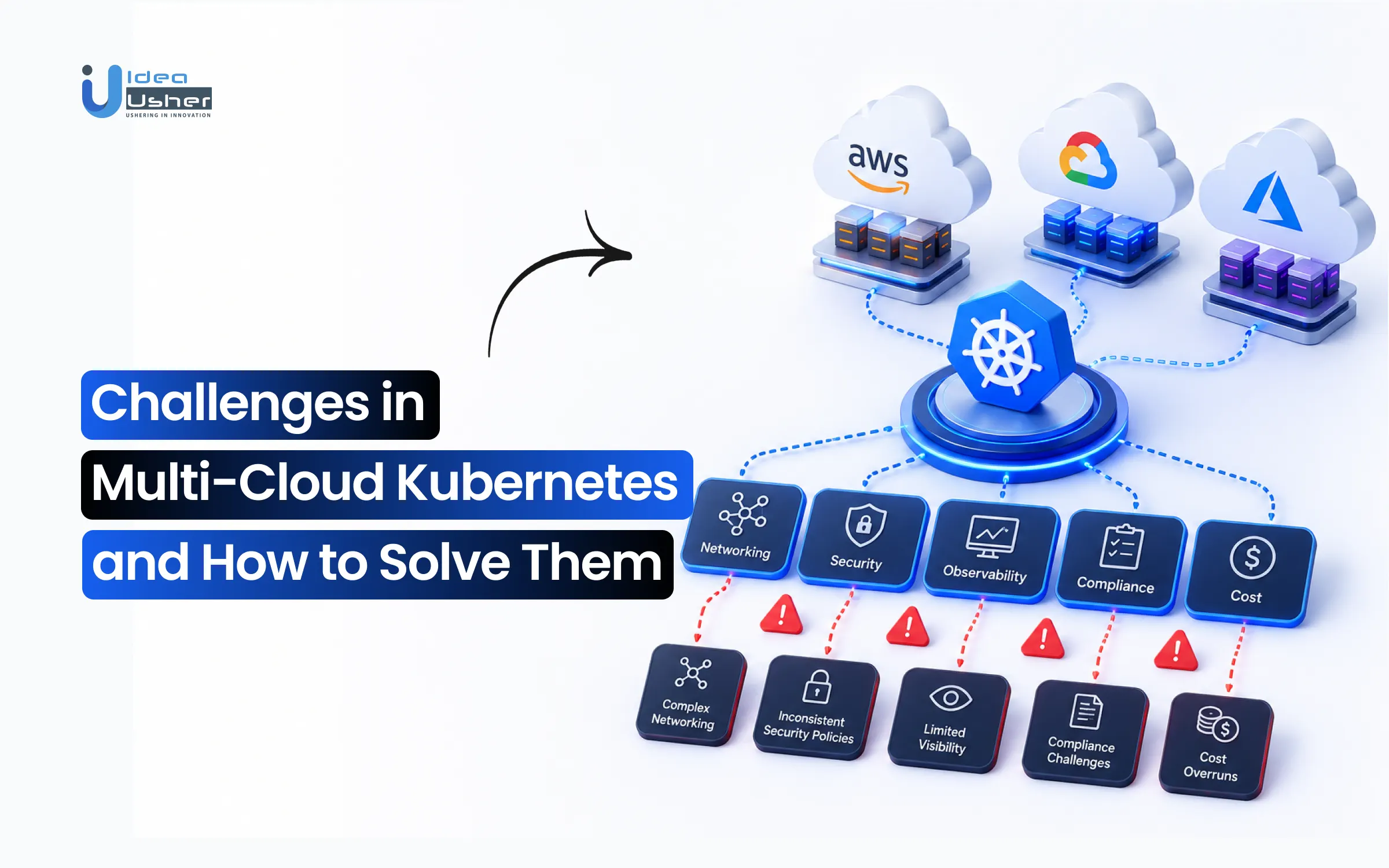
Why are companies scaling multi-cloud Kubernetes faster than they can manage it? Running workloads across Amazon Web Services, Microsoft Azure, and Google Cloud promises flexibility and resilience, but it also creates operational fragmentation that most teams are not prepared for. Different networking models, inconsistent security policies, fragmented observability, and duplicated workflows are turning Kubernetes management into a growing operational burden. What worked in a single-cloud setup no longer scales across distributed environments.
The shift now is not about adopting Kubernetes. It is about standardizing operations across clouds without slowing development velocity. Companies that solve this early with automation, centralized governance, and platform engineering will build faster, reduce infrastructure complexity, and maintain control as cloud environments continue expanding.
We’ve helped enterprises simplify multi-cloud Kubernetes management by improving standardization, automating operations, and reducing infrastructure complexity across cloud environments. In this blog, we break down the biggest multi-cloud Kubernetes challenges and how to solve them effectively at scale.
Why Multi-Cloud Kubernetes Is No Longer Optional?
According to Virtue Market Research, in 2025, the Kubernetes Security Market was valued at approximately USD 1.95 billion and is projected to reach around USD 6.77 billion by 2030, growing at a CAGR of 28.2% over the forecast period from 2026 to 2030. This growth confirms that infrastructure resilience is now a top priority for serious investors. For entrepreneurs, moving to multi-cloud is a defensive strategy against vendor dependency and a proactive step toward global scale.

Source: Virtue Market Research
The shift is driven by the risk of single-provider fragility. When a platform depends on one ecosystem, it remains vulnerable to outages and price hikes. By distributing workloads across multiple environments, a business de-risks its digital assets. This ensures that performance stays consistent regardless of a single vendor’s stability. This architecture is the foundation for high-valuation platforms built for reliability.
Vendor-Neutral Infrastructure
Modern enterprise value is tied to portability. Investors avoid platforms locked into proprietary services because they represent high migration costs. Vendor-neutral infrastructure treats the cloud as a commodity. This allows a business to move workloads to whichever provider offers the best performance or lowest cost at any given time.
- Asset Liquidity: A platform that runs on any cloud is a more liquid asset. It is easier to sell or pivot because the technology is not tied to a third party.
- Negotiating Power: Being vendor-neutral provides leverage in contract negotiations. The ability to migrate is the best protection against price increases from major vendors.
- Standardized Tooling: Using open standards ensures engineering talent focuses on building features rather than learning the quirks of a single closed ecosystem.
Expanding Beyond One Cloud
Expansion across multiple clouds is driven by data sovereignty and risk mitigation. For platforms operating at scale, processing data within specific geographic boundaries is often a legal necessity. Multi-cloud strategies allow entrepreneurs to enter restricted markets by using local providers while keeping core operations on global networks.
Multi-cloud also provides redundancy that a single provider cannot match. High-net-worth investors prioritize systems that are built to last. By architecting across multiple clouds, a platform can survive a catastrophic failure of a major region. This reliability is a major selling point for B2B platforms where downtime leads to significant financial liability.
Hidden Operational Complexity
The strategic advantages of multi-cloud come with operational demands. Managing multiple environments increases the surface area for security threats and errors. Teams often underestimate the engineering headcount needed to maintain parity across different cloud interfaces, networking protocols, and identity systems.
- Unified Security: Security must be centralized. A multi-cloud platform requires a posture that applies the same standards to every cluster, regardless of the host.
- The Cost of Egress: Moving data is a significant overhead. Strategic investors look for designs that minimize data transfer fees to protect profit margins.
- Specialized Talent: The return on investment depends on the quality of the DevOps team. Hiring architects who understand cross-cloud networking is essential to keep infrastructure from becoming a bottleneck.
The Multi-Cloud Backbone
Kubernetes has become the universal abstraction layer. It provides a consistent interface for managing containers regardless of the underlying hardware. For an entrepreneur, Kubernetes acts as a buffer that translates complex infrastructure into a manageable platform. It allows developers to deploy code with the same commands across different global regions.
This standardization is key to scaling a digital business. Kubernetes removes the friction of infrastructure management so the business can focus on its unique value. By investing in a Kubernetes-native platform, you are investing in a future-proof engine. It allows you to navigate the cloud market without needing to rebuild your entire software stack.

Challenges in Multi-Cloud Kubernetes and How Idea Usher Solves Them
Deploying Kubernetes across a multi-cloud footprint is a strategic necessity for modern enterprises seeking redundancy and global reach. However, the architectural complexity of managing disparate clusters often results in operational friction that can erode the very agility these platforms are meant to provide. For the investor and the entrepreneur, the goal is not just running Kubernetes, but building a resilient, cost-efficient ecosystem that scales without linear increases in headcount.

Idea Usher bridges the gap between raw infrastructure and enterprise-grade orchestration. We approach multi-cloud not as a series of isolated clusters, but as a unified fabric. By standardizing the underlying operational logic, we transform fragmented cloud environments into a cohesive platform that drives business value rather than technical debt.
1. Networking Challenges
Networking is the bedrock of any distributed system. While Kubernetes provides a universal API, the actual implementation is dictated by the specific provider network architecture. This creates operational inconsistencies that become harder to manage at enterprise scale.
Provider Networking Differences
Each hyperscaler uses a proprietary Container Network Interface to bridge pods to their native VPCs. AWS, Azure, and GCP handle IP addresses and security groups using different logic. This variation means a policy designed for one cloud may fail in another, leading to inconsistent security and unpredictable traffic. Teams often spend significant engineering effort troubleshooting provider-specific networking behavior.
Cross-Cluster Communication
Standard Kubernetes service discovery is localized to one cluster. When a GCP frontend needs to talk to an AWS middleware, standard methods break down. Bridging these gaps often requires complex VPN peering or expensive interconnects, creating overhead that grows with every new cluster. Bridging these gaps often requires:
- Complex VPC peering and manual routing tables.
- Expensive dedicated interconnects like Direct Connect or ExpressRoute.
- Overhead that grows exponentially with every new cluster added.
As environments expand, maintaining stable service discovery across these boundaries becomes a significant barrier to scaling.
Latency And Traffic Routing
Global traffic management often relies on DNS-based load balancing. This lacks the granular control needed for real-time failover. For a serious platform, high latency is a user retention issue that directly impacts the bottom line. Poor routing strategies can also negatively impact application reliability during traffic spikes.
Limits Of Traditional Networking
Traditional models were built for static Virtual Machines. Kubernetes is ephemeral. Pods are created and destroyed in seconds. Static firewalls cannot keep pace with this churn, leading to configuration drift where the network security state no longer reflects reality. Legacy networking architectures struggle to adapt to highly dynamic containerized workloads.
Service Mesh Benefits
A Service Mesh acts as a dedicated infrastructure layer for service-to-service communication. By deploying a mesh across all clouds, we abstract the complexity. This ensures every pod can discover and talk to any other pod securely, with encryption baked in at the infrastructure level. It also improves traffic observability and policy enforcement across distributed services.
Idea Usher’s Networking Approach
We move beyond provider-specific tools by implementing a unified networking overlay. Our approach involves standardizing the network layer across all providers, using programmable load balancers for a single entry point, and automating peer management through code. This creates a predictable communication layer that remains consistent even as infrastructure expands across regions and providers.
Our Networking Core Pillars:
- Standardization: Implementing a consistent CNI regardless of the cloud provider.
- Centralization: Using a single control plane for ingress and egress rules.
- Automation: Eliminating manual network configuration through Infrastructure-as-Code.
2. Fragmented Multi-Cluster Security
Fragmented security is a massive risk to brand reputation. In a multi-cloud environment, a standard security policy is a myth unless specifically engineered. Even small policy inconsistencies can introduce serious compliance and governance risks. These gaps often become more difficult to detect as infrastructure scales across providers.
IAM Inconsistencies
Managing AWS IAM, Azure Active Directory, and GCP Identity simultaneously is prone to error. A developer might have restricted access in one cloud but remain over-privileged in another. This lack of identity parity is a primary vector for internal breaches during rapid scaling. Without centralized governance, identity sprawl quickly becomes difficult to control.
Centralized Secrets And RBAC
- Secrets Management: We move away from provider-specific stores to a unified vault that injects secrets into any cluster. This minimizes credential duplication and strengthens operational security.
- Unified RBAC: We synchronize access control across all environments so permissions are tied to identity, not the cloud provider. Consistent RBAC policies reduce the risk of privilege escalation across clusters.
- Zero-Trust Enforcement: We treat the network as hostile, requiring every request between services to be authenticated in real-time. This significantly limits lateral movement during a potential security breach.
Compliance Challenges
Compliance requires a single audit trail. If logs and events are scattered across three different consoles, proving compliance becomes a multi-week manual effort. This fragmentation increases the risk of audit lag, where a vulnerability exists in one cloud while others remain patched. Centralized visibility is essential for maintaining continuous compliance readiness.
Common Security Gaps
Enterprises often overlook the security of traffic moving between pods within the same cluster. They also frequently fail to implement consistent container image scanning, allowing a vulnerable image to be blocked in one cloud but accidentally deployed in another. These gaps become more dangerous as deployment frequency increases.
Shift-Left Security
Shift-left security moves the focus from the runtime environment to the development pipeline. By scanning manifests and images at the moment of code commit, we ensure security is a fundamental part of the build rather than a check at the end. Early detection dramatically reduces remediation costs and deployment delays.
Idea Usher’s Security Strategy
We build a security command center for your infrastructure. Our strategy includes using policy-as-code to enforce the same rules across every cluster automatically, federating cloud identities, and deploying real-time threat detection. Our framework ensures security posture remains uniform even during rapid cloud expansion and continuous deployments. This creates a scalable security foundation that evolves alongside business growth.
3. Observability Gaps
Multi-cloud observability becomes fragmented as infrastructure expands across providers. When issues occur, teams often struggle to identify whether the problem originates from the application, network, or cloud environment. Without unified visibility, troubleshooting distributed systems becomes significantly more time-consuming. This often increases incident resolution time during critical outages.
Monitoring Challenges
Cloud-native monitoring tools are built for their own ecosystems and lack cross-cloud visibility. This creates blind spots between providers, making it difficult to trace user requests across distributed platforms. These observability gaps often delay incident detection and increase downtime. Engineering teams also face challenges correlating metrics across multiple environments.
Operational Impact Of Poor Monitoring
| Challenge | Operational Impact |
| Blind spots between clouds | Slower troubleshooting |
| Isolated monitoring tools | Fragmented visibility |
| Delayed incident detection | Increased downtime |
| Inconsistent telemetry | Poor operational insights |
Even small monitoring gaps can create significant reliability issues in large-scale Kubernetes environments.
Log Aggregation Issues
Aggregating logs across clouds is expensive and operationally complex. Moving large volumes of data between providers can increase egress costs dramatically. The absence of centralized logging also slows down root-cause analysis during outages. Inconsistent logging formats further complicate troubleshooting workflows.
Fragmented Pipelines
Engineering teams often manage multiple monitoring tools and data formats across providers. This fragmentation reduces operational efficiency and makes automated insights difficult to achieve. Over time, these inefficiencies create additional operational overhead. It also increases the learning curve for internal DevOps teams.
Signs Of Pipeline Fragmentation
- Separate dashboards for different providers
- Multiple alerting systems with inconsistent rules
- Difficulty correlating logs, traces, and metrics
- Increased onboarding complexity for engineering teams
As environments scale, fragmented observability pipelines become increasingly difficult to maintain.
Alert Fatigue
Monitoring everything across multiple environments generates excessive alerts that teams eventually ignore. Focusing on critical metrics such as latency, traffic, errors, and saturation helps prioritize incidents that truly impact business operations. Prioritized monitoring improves platform stability and response efficiency. This allows engineers to respond faster to high-impact issues.
Unified Observability
A cloud-agnostic observability layer standardizes logs, traces, and metrics across all environments. Using standards like OpenTelemetry creates consistency and simplifies long-term monitoring workflows. Standardization also improves visibility across distributed applications. Unified telemetry enables more accurate operational insights across cloud environments.
Visibility By Idea Usher
We implement a global observability framework that standardizes monitoring data across every cloud environment. Our approach reduces egress costs, improves event correlation, and enables faster root-cause analysis. This improves operational awareness while reducing unnecessary monitoring complexity. It also helps organizations proactively identify risks before service disruptions occur.
4. Cost Optimization
Multi-cloud Kubernetes environments can quickly become financially inefficient without proper governance. Limited cost visibility across providers often leads to uncontrolled infrastructure spending. Without financial accountability, cloud expenses can outpace operational growth. This creates long-term sustainability challenges for scaling businesses.
Cost Fragmentation
AWS, Azure, and GCP all follow different billing structures and pricing models. This makes it difficult to calculate the true cost of workloads running across multiple providers. Lack of visibility also affects budgeting and forecasting accuracy. Financial reporting becomes more complicated as infrastructure scales further.
Common Financial Challenges Across Multi-Cloud
- Separate billing dashboards create reporting silos
- Teams struggle to map infrastructure spend to business outcomes
- Cross-cloud data transfer fees are often overlooked
- Forecasting becomes inaccurate as workloads scale dynamically
Without centralized cost intelligence, organizations often fail to identify where infrastructure waste is occurring.
Idle Resources
Developers frequently overprovision resources to avoid performance risks. In large environments, idle CPU, memory, and unused services silently increase infrastructure costs. Without governance, this waste continues unnoticed. Excessive idle resources can significantly reduce infrastructure efficiency over time.
Hidden Sources Of Waste
| Resource Type | Common Issue | Business Impact |
| Compute Instances | Underutilized workloads | Increased monthly cloud bills |
| Storage Volumes | Unattached resources | Wasted infrastructure spending |
| Development Environments | Left running after hours | Continuous idle consumption |
| Networking Resources | Unoptimized traffic routing | Higher egress fees |
Even small inefficiencies become expensive when multiplied across dozens of clusters.
Autoscaling Limitations
Traditional autoscalers focus only on performance and ignore infrastructure pricing. Workloads may continue running on expensive instances even when lower-cost alternatives are available. Intelligent scaling is essential for balancing performance and operational cost. Cost-aware automation is critical for improving cloud resource utilization.
Why Traditional Autoscaling Falls Short
- It reacts to usage, not infrastructure pricing
- It lacks awareness of spot and reserved instance availability
- It does not optimize workloads based on business priority
- Scaling decisions are often disconnected from financial governance
This creates situations where infrastructure scales efficiently from a technical perspective but inefficiently from a financial one.
Governance Risks
Hidden expenses such as cross-cloud data transfer and unattached resources often consume a large portion of cloud budgets. Poor governance practices allow these inefficiencies to persist for long periods. Financial waste becomes harder to identify as environments scale. Ineffective governance also limits visibility into department-level cloud spending.
FinOps Strategies
FinOps introduces accountability into cloud operations through resource tagging, right-sizing, and usage optimization. It helps organizations align infrastructure investments with actual business demand. Mature FinOps practices improve long-term cost efficiency. These strategies also support more predictable cloud budgeting and forecasting.
Cost Optimization By Idea Usher
We automate cost optimization using spot instances, idle environment shutdowns, and traffic re-architecture to reduce egress fees. Our governance framework continuously aligns infrastructure usage with business requirements. This enables sustainable scaling without losing financial control. Businesses also gain greater visibility into cloud spending patterns across providers.
5. Lifecycle Bottlenecks
Managing Kubernetes clusters across multiple clouds creates significant operational complexity. As environments scale, manual processes become inefficient and difficult to maintain. Without automation, cluster operations slow down overall platform growth. Operational bottlenecks can also impact deployment speed and service reliability.
Version Drift
Kubernetes releases updates frequently, and unsupported versions quickly become security and compatibility risks. Running inconsistent versions across clusters creates fragile deployment environments. Delayed upgrades also expose infrastructure to known vulnerabilities. Version inconsistency often results in deployment instability across environments.
Risks Caused By Version Drift
| Issue | Business Impact |
| Deprecated APIs | Failed deployments |
| Unsupported versions | Security exposure |
| Tool incompatibility | Reduced developer productivity |
| Inconsistent environments | Operational instability |
Even minor version mismatches can create major deployment and reliability issues across a distributed infrastructure.
Fleet Management Complexity
Managing large cluster fleets manually consumes engineering time and increases operational risk. Patching, maintenance, and monitoring become increasingly difficult as infrastructure expands. Operational inefficiencies compound as more clusters are added. Large-scale environments require centralized automation to remain manageable.
Manual Scaling Issues
Manual processes create configuration drift, where clusters gradually become inconsistent with each other. This makes recovery and replication difficult during outages. Standardized automation is essential for maintaining reliability at scale. Consistency across environments is critical for faster disaster recovery.
Signs Of Configuration Drift
- Different policies across clusters
- Inconsistent networking configurations
- Uneven security controls
- Deployment behavior varies by environment
These inconsistencies significantly increase operational risk during scaling or recovery events.
Compatibility Risks
Older Kubernetes versions limit access to modern ecosystem tools and security updates. Version incompatibilities can break deployment workflows and slow innovation efforts. Consistent upgrades are critical for long-term platform stability. Unsupported versions also increase operational and compliance risks.
Automation Benefits
GitOps-based automation allows infrastructure to be managed through version-controlled code. Updates, rollbacks, and deployments can then be executed consistently across all clusters. Automation reduces human error while accelerating operational workflows. It also improves infrastructure consistency across distributed environments.
Benefits Of GitOps Automation
- Faster infrastructure provisioning
- Consistent deployment workflows
- Automated rollback capabilities
- Improved auditability and compliance
- Reduced operational dependency on manual processes
Automation transforms Kubernetes lifecycle management into a repeatable and scalable operational model.
Lifecycle Automation By Idea Usher
We implement zero-touch lifecycle management with automated upgrades, self-healing infrastructure, and infrastructure-as-code consistency. Our approach reduces operational overhead while improving deployment reliability. This enables organizations to scale infrastructure efficiently without increasing management complexity. Automated lifecycle management also improves long-term operational resilience.
6. Platform Lock-In
Although Kubernetes was designed for portability, cloud providers often introduce proprietary services that create dependency. Over time, these dependencies reduce infrastructure flexibility and increase migration complexity. Businesses that ignore portability risks often lose long-term strategic leverage. Vendor lock-in can also increase operational costs over time.
Provider Differences
Cloud providers manage networking, storage, identity, and load balancing differently. Applications built around provider-specific services become difficult to migrate later. This dependency significantly increases future re-engineering costs. Infrastructure portability becomes more challenging as cloud-specific integrations expand.
Infrastructure Differences Across Providers
| Infrastructure Area | Portability Challenge |
| Networking | Different VPC and routing models |
| Storage | Proprietary storage APIs |
| Identity Management | Cloud-specific IAM systems |
| Load Balancing | Provider-native ingress behavior |
These differences often force engineering teams to maintain separate operational workflows for each environment.
Portability Challenges
Many organizations rely on provider-specific add-ons for monitoring, ingress, and databases. As a result, workloads become tightly coupled with the underlying cloud environment. Portability problems often appear only during migration attempts. This limits the ability to optimize workloads across providers.
Deployment Pipeline Issues
Maintaining separate deployment pipelines for different providers increases operational complexity and maintenance effort. Deployment inconsistencies between clouds also increase the likelihood of failed releases. Multiple workflows reduce engineering efficiency over time. Standardized pipelines are essential for maintaining deployment reliability.
Common Pipeline Problems
- Separate CI/CD workflows for each cloud
- Different deployment configurations by provider
- Inconsistent release validation processes
- Increased operational overhead for DevOps teams
Without standardized deployment automation, operational scalability becomes difficult to maintain.
Agnostic Strategy Failures
Many cloud-agnostic strategies fail because they rely only on basic provider features. This often limits platform performance and flexibility. Effective abstraction requires a dedicated platform layer that standardizes infrastructure behavior. Without proper abstraction, operational consistency becomes difficult to achieve.
Why Basic Cloud-Agnostic Approaches Fail
- Overreliance on lowest-common-denominator features
- Lack of centralized orchestration
- Inconsistent infrastructure policies
- Limited workload portability across providers
- Reduced platform optimization opportunities
True portability requires balancing flexibility with operational performance.
Portable Architectures
Portable architectures require storage abstraction, standardized ingress, and centralized control planes. This prevents applications from directly depending on provider-specific infrastructure services. A strong portability strategy improves long-term operational resilience. It also gives businesses greater flexibility when optimizing cloud investments.
Cloud-Neutral Scaling By Idea Usher
We design cloud-neutral Kubernetes platforms with unified control planes, standardized environments, and migration-ready architectures. Our approach gives businesses the flexibility to move workloads wherever operational or financial value is highest. This creates a resilient infrastructure foundation that supports long-term scalability and vendor independence. Organizations also gain greater leverage during cloud vendor negotiations.
How We Enable Cloud-Neutral Operations
- Unified Control Plane: We centralize infrastructure orchestration across multiple cloud providers.
- Standardized Kubernetes Environments: Clusters follow consistent operational, security, and deployment standards across all platforms.
- Migration-Ready Infrastructure: Applications are designed to remain portable without deep provider dependency.
- Cross-Cloud Governance: Operational policies remain consistent regardless of where workloads are deployed.
The Business Risks of Ignoring Multi-Cloud Kubernetes Complexity
Multi-cloud Kubernetes is often viewed through a technical lens, but its true impact is felt on the balance sheet. Ignoring the complexity of a fragmented cloud footprint creates a drain on capital and human resources. When clusters in AWS, Azure, and GCP are managed as isolated silos, the resulting friction acts as a tax on every new feature.

Strategic decision-makers must recognize that infrastructure complexity is a business risk. A platform without cohesion becomes a bottleneck for innovation, preventing the organization from responding to market shifts. Idea Usher transforms this complexity into a competitive advantage by instituting high-level standardization.
1. Slower Engineering Velocity
In a competitive market, speed is the primary currency. When Kubernetes environments are inconsistent, the path from code to production is littered with manual interventions and provider-specific debugging. This friction directly impacts business agility. It also increases release delays and reduces the ability to respond quickly to market demands.
The Velocity Trap:
- Context Switching: Engineers spend hours adjusting manifests to fit unique ingress or storage rules of different clouds.
- Pipeline Fragility: CI/CD pipelines become bloated with conditional logic to handle environmental quirks.
- Testing Latency: Inconsistent environments lead to deployment failures, forcing expensive rollbacks.
By standardizing the deployment interface, organizations reclaim thousands of engineering hours. High-velocity teams rely on a platform that remains predictable regardless of the underlying infrastructure.
2. Increased Cloud Spending
Operational fragmentation is the primary driver of cloud bill shock. Without centralized governance, the cost transparency required to manage a global footprint vanishes. Organizations often pay for high-tier services in one cloud while identical resources sit idle in another.
| Operational Factor | Fragmentation Impact | Unified Advantage |
| Resource Allocation | 30% waste due to over-provisioning. | Automated right-sizing across all clouds. |
| Data Movement | Unmanaged egress fees inflate bills. | Traffic-aware routing to minimize costs. |
| Staffing | Requires specialists for every provider. | Single team manages a unified platform. |
Fragmented management makes a true FinOps strategy impossible. Without a single pane of glass to view expenditures, leadership cannot accurately calculate unit costs, leading to eroded margins and poor capital allocation.
3. Compliance And Security Exposure
For an enterprise, the most significant risk is a security breach or compliance failure. Multi-cloud environments exponentially increase the attack surface. If security policies are not enforced globally, a single misconfiguration in one cluster can expose the entire enterprise data estate.
The Compliance Gap:
Compliance frameworks like SOC2 or GDPR require consistent enforcement of data protection. In a fragmented environment, proving this consistency during an audit is a logistical nightmare. Fragmented logging means there is no unified audit trail, making it difficult to detect lateral movement by an attacker across cloud boundaries.
Decreased Developer Productivity
Developer Experience is a critical metric for retaining top-tier talent. When developers must understand the nuances of EKS, AKS, and GKE just to deploy a service, their productivity plummets. This added operational complexity increases cognitive load and slows down development cycles. Over time, inconsistent deployment workflows can also contribute to engineering fatigue and reduced software quality.
Strategic Perspective: A developer should never have to think about where their code is running. Their interaction should be with a standardized API. Inconsistent platforms increase cognitive load, leading to burnout and decreased software quality.
Idea Usher builds abstraction layers that provide a self-service internal developer platform. This removes cloud noise and allows teams to commit code with the confidence that the platform handles the underlying complexity.
4. Higher Reliability Risks
Reliability in a multi-cloud world cannot be achieved cluster-by-cluster. Without Unified Reliability Engineering, the risk of cascading failures increases. An issue in one cloud identity service can bring down a frontend in another if cross-cloud dependencies are not visible.
The Reliability Deficit:
- Observability Silos: Critical alerts are missed because they are buried in tools that do not communicate.
- Manual Failover: Without automation, shifting traffic between clouds takes too long, resulting in downtime.
- Untested Recovery: Disaster recovery plans often fail because they lack cross-cloud validation.
Impact On Customer Experience
Customers care about uptime and performance, not cloud architecture. When complexity leads to slow loads or service interruptions, trust erodes. In the digital economy, a poor technical experience is a poor brand experience. Unified management ensures infrastructure remains invisible, providing the high-availability experience customers expect.
The Cost Of Poor Standardization
Organizations failing to standardize face a competitive cost that grows over time. While competitors launch features weekly, fragmented organizations stay in maintenance mode, spending 80% of their budget just keeping the lights on. Standardization is about agility. By partnering with Idea Usher to build a cloud-neutral platform, enterprises gain the freedom to move workloads to the provider offering the best price-to-performance ratio, providing a strategic edge that fragmented organizations cannot match.
What an Effective Multi-Cloud Kubernetes Strategy Actually Looks Like?
An effective multi-cloud strategy is not just about having clusters in multiple locations; it is about creating a unified operational reality. For organizations with significant capital at stake, the goal is to decouple business logic from underlying infrastructure. This ensures that AWS, Azure, or GCP are treated as interchangeable utilities rather than proprietary anchors.

At Idea Usher, we believe the hallmark of a mature strategy is invisibility. When infrastructure is managed correctly, engineering teams do not feel the friction of the cloud provider. We deploy pre-vetted developers who specialize in building these seamless fabrics, allowing you to bypass the steep learning curve and high cost of internal experimentation.
1. Platform Engineering Standardization
Platform Engineering is the gold standard for multi-cloud management. We focus on building internal products that handle cloud complexity, allowing your team to focus exclusively on shipping features. This creates a more consistent developer experience across every environment. It also reduces operational overhead by standardizing infrastructure workflows and deployment processes.
Reusable Deployment Patterns
Standardization starts with Golden Paths. Instead of every team reinventing how they deploy a service, our developers provide pre-approved, reusable templates. These patterns ensure that security, networking, and scaling are identical across every cloud, eliminating the snowflake cluster problem.
Developer Self-Service Platforms
An Internal Developer Platform allows developers to provision what they need through a simple interface.
- Speed: Infrastructure is ready in minutes, not days.
- Governance: Limits are built-in, preventing accidental over-provisioning.
- Independence: Developers do not need to wait for a ticket-based Ops team.
Reducing Operational Dependencies
By embedding the knowledge of cloud-specific quirks into the platform itself, we reduce the need for specialized providers on every sub-team. When you hire from our talent pool, you bring in specialists who have already codified this knowledge, ensuring infrastructure logic remains a company asset rather than tribal knowledge.
2. Centralized Kubernetes Control Plane
A centralized control plane acts as the brain of your multi-cloud estate. Without it, you are managing a collection of disconnected islands; with it, you are managing a single, global fleet. This centralized visibility improves operational coordination across distributed environments. It also enables teams to enforce consistent policies, governance, and automation at scale.
Unified Policy Management
Centralization allows us to set a policy once, such as no pod can run as root, and have it enforced across 50 clusters instantly. This ensures that your security posture remains identical across AWS, Azure, and on-premise environments. It also reduces the risk of configuration drift between distributed clusters. Consistent enforcement simplifies compliance management and strengthens overall infrastructure governance.
The Role Of GitOps
GitOps uses Git repositories as the Single Source of Truth for infrastructure.
- Visibility: Every change to the infrastructure is recorded in a pull request.
- Auditability: You know exactly who changed what and when.
- Consistency: Automated agents ensure the live environment matches the code in Git.
Eliminating Configuration Drift
Configuration drift occurs when manual changes make a cluster state different from its documentation. Our teams eliminate this by having an automated controller constantly compare the live cluster to the Git repo, automatically correcting the cluster back to the desired state.
Reliability Via Declarative Models
In a declarative model, you define the desired result (e.g., 5 replicas), and the system figures out how to make it happen. This is inherently more reliable than imperative scripts, which often fail if the environment is not exactly as expected. It also improves consistency by ensuring infrastructure states remain continuously aligned with defined configurations.
3. Intelligent Kubernetes Automation
Automation is the only way to manage multi-cloud scale without an infinite increase in headcount. We implement intelligent automation that uses data to make real-time decisions about infrastructure health. This reduces the operational burden on engineering teams while improving system responsiveness. Automated workflows also help maintain consistency across rapidly changing cloud environments.
Automated Provisioning And Scaling
Modern automation goes beyond simple rules. It looks at historical usage patterns to proactively spin up capacity before a traffic spike hits. We also automate the selection of the most cost-effective cloud region for a new batch job based on current spot-instance pricing. This enables organizations to improve performance while continuously optimizing infrastructure costs in real time.
Self-Healing For Resilience
Resilience is a core priority for our engineers. When a node fails or a service crashes, the platform detects the failure and recreates the resource automatically, often before the end-user notices a lag. This minimizes downtime and helps maintain a consistent user experience during infrastructure disruptions. Automated recovery mechanisms also reduce the need for manual intervention during critical incidents.
AI In Kubernetes Operations
Machine Learning models now analyze millions of log lines to identify pre-failure signals. We integrate AI tools that can detect a memory leak pattern that a human might miss, triggering a proactive restart of the affected service.
Predictive Scaling And Resolution
- Predictive Scaling: Shifting from reactive scaling to forecasting based on traffic patterns.
- Automated Remediation: If a known error occurs, our systems can run a pre-approved runbook script to fix it without human intervention.
4. Multi-Cloud Security As Code
Security must be an automated, non-negotiable part of the infrastructure delivery pipeline. In a multi-cloud environment, manual security checks are equivalent to no security at all. Automated enforcement ensures policies remain consistent across every cluster and deployment workflow. It also helps organizations detect vulnerabilities earlier before they reach production environments.
Policy Enforcement Automation
Using tools like Open Policy Agent, we treat security rules as code. This allows our developers to test security policies in the CI/CD pipeline. If a deployment manifest violates a rule, the build fails before it ever reaches a cluster. This proactive validation reduces security risks while improving deployment consistency across environments.
Centralized Identity And Access
Managing separate identities for each cloud is a major risk. We implement Identity Federation, allowing a user to sign in once through an enterprise provider and gain specific, time-limited access to clusters across AWS and GCP based on their role. This centralized access model improves security governance while simplifying identity management across distributed environments.
Security From Day One
Retrofitting security into a running multi-cloud environment is incredibly expensive and disruptive. By implementing a Zero Trust architecture from the start, we create a platform that is inherently resistant to lateral attacks. This approach strengthens security posture early while reducing long-term operational and compliance risks..
Automating Distributed Compliance
For industries like fintech or healthcare, compliance is a continuous requirement. We automate this by running continuous audits that scan the infrastructure every hour, ensuring that a single configuration change does not accidentally move the platform out of a compliant state.
5. Unified Observability Architecture
Observability is about more than just up or down. It is about understanding the why behind system behavior across cloud boundaries. Deep visibility into metrics, logs, and traces helps teams identify performance bottlenecks faster. It also improves decision-making by providing real-time insights into distributed application behavior.
OpenTelemetry And Tracing
OpenTelemetry provides a vendor-neutral standard for telemetry data. By standardizing on this, we ensure that if you move a workload from Azure to AWS, your monitoring does not break. Distributed tracing allows us to follow a single user request as it hops across clouds. This creates consistent observability across environments while simplifying troubleshooting in distributed systems.
Real-Time Visibility
Real-time visibility is essential for managing modern multi-cloud Kubernetes environments at scale. Organizations need instant insights into infrastructure health, application performance, and cross-cloud activity to respond quickly to issues before they impact users. With centralized monitoring and live telemetry, teams can detect anomalies faster, reduce downtime, and maintain consistent operational performance across distributed systems.
| Data Type | Primary Goal | Business Value |
| Metrics | Performance tracking | Resource cost optimization |
| Logs | Forensic analysis | Rapid root-cause discovery |
| Traces | Latency mapping | Improved customer experience |
Correlating Telemetry Data
The power of modern observability lies in correlation. If a metric shows a spike in errors, our setup allows you to click on that spike and instantly see the specific log lines and the distributed trace for that exact moment. This significantly reduces troubleshooting time by connecting metrics, logs, and traces into a unified operational view.
Full-Stack Kubernetes Visibility
Full-stack visibility means seeing from the hardware level up to the application code. We provide teams that understand how to build these deep-visibility stacks so you are never left guessing during an outage. This comprehensive visibility improves incident response and enables faster root-cause identification across distributed systems.
Reducing MTTR With Intelligence
Mean Time To Repair is the ultimate metric for operations. By using intelligent observability that automatically surfaces the root cause, we help organizations maintain high uptime, protecting both revenue and brand reputation. When you partner with Idea Usher, you gain access to the experts who make this level of reliability possible.
Key Questions to Ask Before Scaling Multi-Cloud Kubernetes
Before committing capital to multi-cloud expansion, leadership must evaluate its structural readiness. Scaling without a verified foundation leads to technical debt that can take years to unwind. At Idea Usher, we help businesses transition from experimental clusters to enterprise-grade fleets by addressing these fundamental hurdles early.

By hiring our pre-vetted developers, you gain access to professionals who have navigated these specific scaling challenges for global enterprises. We ensure your strategy is built on reality rather than theory, allowing you to scale with confidence.
Is Your Architecture Cloud-Agnostic?
A cluster working in a single AWS region is not inherently ready for a multi-cloud footprint. True scalability requires an architecture that abstracts proprietary provider hooks. If your setup relies on provider-specific load balancers or storage without an abstraction layer, you are building a silo, not a platform.
Architectural Checkpoints:
- Networking: Are you using a CNI that maintains a flat network across providers?
- Data Portability: How easily can stateful workloads move if a provider changes pricing?
- Environment Parity: Does staging in Azure truly mirror production in GCP?
Our developers specialize in creating these abstraction layers. We ensure your architecture remains neutral and capable of horizontal expansion without a complete re-engineering effort.
Can You Maintain Security Consistency?
Security is the most common casualty of rapid scaling. When moving from one cluster to twenty, the risk of policy drift increases exponentially. If your team must manually verify RBAC and IAM settings for each cloud, you have a significant vulnerability. These inconsistencies can quickly create hidden access risks across distributed environments.
The Security Parity Test: Can you prove, with a single report, that every pod across your entire multi-cloud estate runs with the same encryption and access standards?
If the answer is no, your risk exposure is high. We implement Security-as-Code, where policies are defined once and enforced globally. By integrating our specialists, we ensure Zero Trust principles are baked into your clusters from day one.
Do You Have Centralized Visibility?
In multi-cloud, observability gaps are major business risks. Without a centralized view, you cannot effectively manage margins or uptime. Fragmented data leads to slow incident response and unoptimized spending. It also makes it difficult to identify performance bottlenecks across distributed environments. Unified visibility is essential for maintaining both operational efficiency and service reliability.
Operational Visibility Matrix:
| Visibility Area | Single-Cloud State | Multi-Cloud Requirement |
| Cost Attribution | Basic cloud billing | Granular, container-level unit costs |
| Health Monitoring | Provider-specific dashboards | Agnostic single pane of glass |
| Incident Response | Localized logging | Global distributed tracing |
We build unified observability fabrics that aggregate metrics and costs across all providers. This allows leadership to make data-driven decisions about workload placement based on real-time performance and financial data.
Are Your Operations Highly Automated?
Manual management is the enemy of growth. If scaling infrastructure requires a linear increase in SRE headcount, your model is not sustainable. Sustainable scaling is only possible through high-level automation. Automated operations improve consistency while reducing dependency on repetitive manual tasks.
The Automation Checklist:
- GitOps: Is Git the absolute source of truth for all infrastructure changes?
- Self-Healing: Can your system replace an unhealthy node without human intervention?
- Lifecycle: Can you provision a compliant cluster in under 15 minutes?
Our developers prioritize the Everything-as-Code philosophy. When you partner with us, we replace manual runbooks with automated GitOps pipelines, reducing human error and letting your internal teams focus on product innovation.
Is Your Infrastructure AI-Ready?
Modern platforms must support AI/ML workloads, which require specialized Kubernetes orchestration. Managing GPU scheduling and high-performance data pipelines adds a new layer of complexity to the multi-cloud equation. Efficient resource orchestration becomes essential for maintaining both performance and cost optimization at scale.
AI-Ready Infrastructure Pillars:
- GPU Orchestration: Efficiently scheduling expensive compute resources across clusters.
- Data Pipelines: Ensuring low-latency data access for training and inference in any region.
- Dynamic Scaling: Handling massive compute demands without overpaying for idle capacity.
Idea Usher provides the technical depth required to build these advanced environments. We ensure your Kubernetes foundation is optimized for the next generation of AI-driven applications. Hiring from our specialized pool gives you the edge needed to deploy these technologies faster than the competition.
Why Choose Kubernetes Engineering Partners Like Idea Usher?
The transition to multi-cloud Kubernetes is a leap many organizations underestimate. For serious decision-makers, the goal is reaching production-grade maturity without the years of expensive trial and error that typically accompany the learning curve. At Idea Usher, we bridge this gap. By deploying our pre-vetted developers who specialize in global orchestration, we allow our partners to bypass common pitfalls. When you hire from our talent pool, you integrate specialized knowledge refined across complex enterprise environments.
1. The Kubernetes Adoption Expertise Gap
There is a significant difference between using Kubernetes and running it at scale across multiple providers. While adoption is high, the pool of talent capable of architecting resilient platforms remains shallow. We fill this gap by providing experts who serve as a seamless extension of your core team.
Internal Challenges With Scaling
Internal teams are often focused on product delivery rather than platform stability. This often leads to the creation of snowflake clusters that are manually tuned and impossible to replicate. We solve this by standardizing your environment through code, ensuring continuity regardless of personnel changes.
Shortage Of Multi-Cloud Architects
A true multi-cloud architect must understand the deep networking and security nuances of EKS, AKS, and GKE simultaneously. Finding these specialists is a primary hurdle for most enterprises. We offer immediate access to developers who live and breathe these environments, providing the right talent without recruitment lag.
The Cost Of Trial And Error
In cloud infrastructure, a wrong decision is expensive. Misconfiguring a networking layer or selecting the wrong storage class can lead to several business setbacks:
- Cost Spikes: Inefficient resource management that doubles cloud bills.
- Security Breaches: Fragmented policies that leave backdoors open.
- Performance Lag: Latency issues that drive away users.
2. Choosing A Kubernetes Partner
An effective partner does not just fix problems. We build a scalable foundation that enables your business to grow without technical debt. Our approach focuses on long-term operational stability rather than short-term infrastructure fixes. This allows organizations to scale faster while maintaining consistency, reliability, and governance across environments.
Expertise Across Major Providers
A partner must be cloud-neutral. If a firm only understands one provider, they will push a solution that benefits their knowledge base rather than your business. We ensure our developers are proficient across the entire hyperscaler spectrum, allowing for true workload portability.
Automation And Platform Capabilities
We avoid manual configuration in favor of specialized systems that our developers implement for you. This improves operational consistency while reducing the risk of human error across environments. Automated infrastructure workflows also make scaling and maintaining Kubernetes platforms significantly more efficient.
- Infrastructure as Code: Every resource defined in Terraform or Pulumi for total replicability.
- GitOps Patterns: Using Git as the source of truth for all cluster states to ensure transparency.
- Developer Self-Service: Building platforms that allow your team to ship code faster without waiting on infrastructure requests.
Security-First Implementation
Security cannot be an afterthought. Our team has a proven track record of implementing Zero Trust architectures and automated compliance scanning. We embed security directly into the CI/CD pipeline, ensuring every deployment is scanned for vulnerabilities before it reaches a production node.
AI-Ready Infrastructure Experience
As enterprises integrate AI workloads, the underlying infrastructure must handle GPU orchestration and high-performance data pipelines. We provide the technical depth required to build these specialized environments, ensuring your platform is ready for the next wave of innovation.
CTO Questions For Consulting Partners
Before committing to a partnership, vet candidates with experience-driven questions that our developers are prepared to answer. Evaluating real-world implementation experience helps organizations identify partners with proven operational maturity. It also ensures the engineering team can handle large-scale multi-cloud challenges beyond theoretical expertise.
- Failover: Can you demonstrate a multi-cloud failover scenario you have successfully implemented?
- Identity: How do you handle secrets management and RBAC across different cloud providers?
- Costs: What is your approach to reducing data egress costs in a distributed cluster setup?
- Onboarding: Do you have a pre-defined Golden Path for onboarding new microservices?
Infrastructure Delivery Red Flags
A poor partnership can be more damaging than no partnership at all. Be vigilant for these indicators of a low-maturity engineering firm. Weak engineering practices often create long-term operational debt that becomes expensive to reverse later. Choosing the right partner is critical for maintaining scalability, security, and infrastructure reliability.
- Manual Fixes: If a partner logs into the CLI to tweak settings rather than updating the code, they are building a legacy system. Our developers prioritize declarative code for every change.
- No Observability Focus: If their strategy excludes a unified plan for logging and metrics, they are building a black box. We prioritize full-stack visibility.
- Vendor Lock-In: Beware of partners who suggest proprietary features without a clear abstraction layer. We advocate for cloud-neutrality.
- No Shift-Left: If they suggest securing the cluster later, they fundamentally misunderstand risk management. We integrate security at the earliest possible stage.
By partnering with Idea Usher and hiring from our specialized pool, you acquire a strategic.
Conclusion
Mastering multi-cloud Kubernetes requires moving beyond provider silos toward a unified, automated architecture. By standardizing networking, security, and observability, businesses transform complex infrastructure into a seamless, portable asset. Idea Usher accelerates this transition by deploying pre-vetted developers who build resilient, cloud-neutral platforms. Partnering with us ensures your organization avoids expensive technical debt, allowing you to scale with an AI-ready foundation designed for long-term growth.
FAQs
A1: Consistency is achieved by adopting a Security-as-Code model that replaces provider-specific settings with a universal policy layer. By using tools like Open Policy Agent, we define governance rules once and enforce them across AWS, Azure, and GCP clusters. Our developers implement identity federation to keep Kubernetes access controls uniform, preventing the security gaps that occur when managing disparate IAM systems manually.
A2: The most effective solution is implementing a Service Mesh to create a unified communication fabric across all clusters. This abstraction layer handles service discovery and encryption regardless of the underlying cloud network. We specialize in building these flat Kubernetes network architectures, ensuring microservices communicate with low latency and high reliability even when spanning multiple geographical regions.
A3: Controlling costs requires centralized FinOps governance and automated resource optimization. By utilizing container-level cost attribution, we provide clear visibility into which Kubernetes workloads drive expenses. Our teams implement intelligent automation, such as spot instance orchestration and scheduled scaling, to reduce idle resource waste and keep your footprint financially sustainable.
A4: GitOps serves as the single source of truth, ensuring your infrastructure always matches the state defined in Git. This eliminates configuration drift, a common cause of outages in Kubernetes setups where manual changes often go untracked. Our developers leverage GitOps to automate deployments and cluster lifecycles, providing an auditable, reversible, and stable operational framework.