 (+971) 8007 4267
 (+91) 946 340 7140
 (+1) 628 432 4305

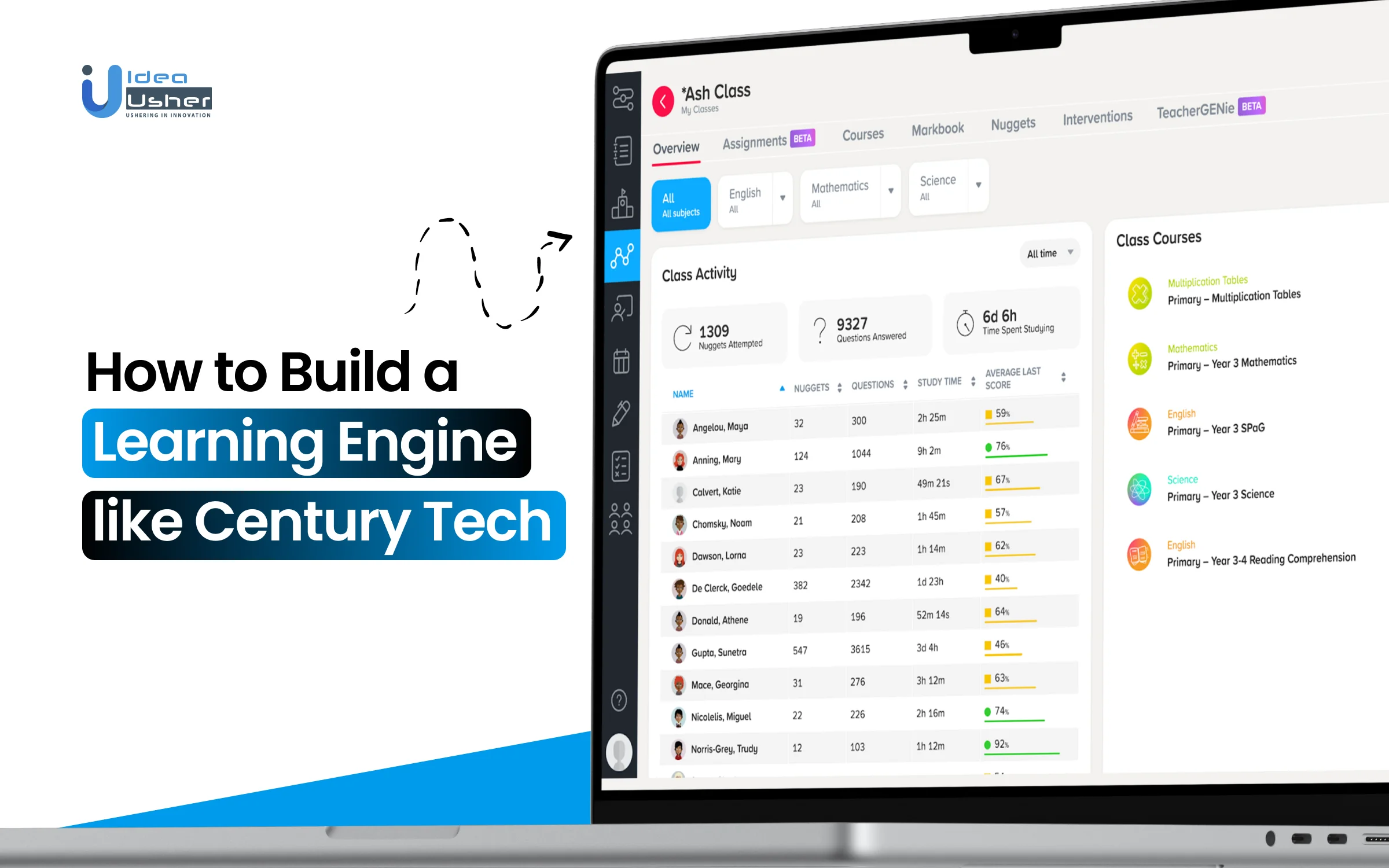
Most classrooms still rely on one-size-fits-all teaching, leaving many learners without the support they need. Teachers managing large groups and varied skill levels often struggle to personalize instruction. Century Tech-like learning engines adapt in real time, analyze individual performance, and provide tailored learning pathways, improving student engagement, comprehension, and overall educational outcomes.
AI-driven learning platforms combine cognitive science, data analytics, and adaptive algorithms to deliver personalized education. They identify knowledge gaps, adjust difficulty, recommend resources, and refine learning journeys based on student interactions. This creates a dynamic environment where every learner receives guidance that is purposeful, meaningful, and tailored to their needs.
This guide explores how to build a learning engine like Century Tech, covering core features, AI technologies, and development considerations. It provides a clear roadmap for creating a scalable, next-generation adaptive learning system that enhances personalized education.

What is a Learning Engine, Century Tech?
Century Tech’s Learning Engine is an AI-powered adaptive education system that personalizes learning pathways using AI, learning science, and cognitive neuroscience. It analyzes strengths, misconceptions, and performance to deliver tailored content, targeted practice, and real-time insights, with curriculum-aligned resources, self-marking questions, and actionable analytics that enhance outcomes for learners and educators.
This AI learning engine scales across classrooms and education systems, providing predictive insights to help teachers track progress and plan interventions. Automating tasks like grading and feedback boosts teaching capacity while enhancing learning outcomes, with proven global impact on student attainment and engagement.
- Knowledge Tracing-based Recommendation Engine: Century’s AI monitors student interactions with an advanced Knowledge Tracing model, matching learning “nuggets” to each learner’s level for personalized recommendations.
- Micro-lesson “Nugget” Intelligence: The platform breaks content into micro-lessons, tracking learner interactions to dynamically refine adaptive pathways and suggest Focus or Stretch concepts.
- Smart Assignments Powered by Proprietary AI: Century’s Smart Assignments feature leverages its AI engine to create personalized homework and practice tasks aligned with each student’s strengths and gaps.
- Real-time Adaptation Loops: The system ingests performance data continuously, recalibrating learning paths in near real time to optimize content sequencing and challenge levels.
A. Business Model: How it Operates
Century Tech operates a scalable B2B edtech model that delivers AI-powered personalised learning solutions directly to schools, institutions, and tutoring providers worldwide.
- Institution-focused platform: Provides AI-driven adaptive learning technology to primary schools, secondary schools, colleges, and tutoring businesses.
- Curriculum-aligned content: Offers structured learning “nuggets” built by educators and aligned with national and international curricula.
- AI analytics for educators: Supplies real time insights, progress tracking, and performance dashboards for teachers and leadership teams.
- Long term institutional contracts: Prioritizes multi-year partnerships with schools for predictable, recurring growth.
- Global deployment strategy: Active across 70+ countries, supporting diverse education systems with scalable AI infrastructure.
- Product ecosystem: Includes personalised pathways, Smart Assignments, automated marking, diagnostics, and wellbeing insights.
B. Pricing Model & Funding Highlights:
Century Tech generates recurring institutional revenue through annual subscription plans, scalable licensing models, and strategic funding that supports product expansion and AI innovation.
1. Funding Highlights
- Raised $6.5M+ in early rounds, including investment from MIT Solve’s philanthropy-driven fund, Solve Innovation Future.
- Secured growth debt investment in 2024 from the Hambro Perks Growth Debt Fund to support AI expansion and global scaling.
- Received £22M+ in total lifetime support through equity rounds, Innovate UK grants, strategic investors, and angel contributions.
2. Pricing Structure
- Primary schools: Plans typically start around £910 per year, with price adjustments based on school size and required features.
- Secondary & independent schools: Prices start at £1,300 per year per school due to larger student populations and broader curriculum coverage.
- Tutoring businesses: Custom pricing for commercial tutoring platforms using Century Tech’s AI-powered personalised learning engine.
- Multi-school groups: Discounted institutional bundles for trusts, districts, and networks purchasing at scale.
Core AI Models Powering Modern Adaptive Learning Engines
Adaptive learning engines use core AI models to personalize education, track progress, and predict outcomes. These models analyze performance data, identify gaps, and deliver tailored content to improve student engagement and achievement.
| AI Model Type | Purpose in Learning Engines | How It Enhances Adaptive Learning |
| Knowledge Tracing Models | Track mastery levels and detect learning gaps. | Enable real time mastery updates that adjust pathways instantly for each learner. |
| Personalisation & Recommendation Models | Suggest the next optimal lesson or task. | Create dynamic personalised pathways that evolve with performance. |
| NLP-Based Content Understanding Models | Interpret text, questions, and learner responses. | Enable real-time mastery updates that adjust pathways instantly for each learner. |
| Adaptive Assessment Models | Evaluate answers and identify misconceptions. | Deliver instant diagnostic insights that refine learning routes. |
| Behaviour Analytics Models | Analyse pacing, hesitation, and engagement patterns. | Provide context-aligned feedback and accurate content generation. |
| Knowledge Graph Models | Map relationships across concepts and curriculum. | Ensure curriculum aligned sequencing and deeper conceptual clarity. |
| Predictive Performance Models | Forecast risk, grades, and learning outcomes. | Help educators apply early intervention strategies to improve retention. |
How The Learning Engine Works in Institutes?
A Century Tech-like Learning Engine works by analyzing student performance, identifying knowledge gaps, and delivering personalized learning pathways. Its adaptive AI, real-time feedback, and curriculum-aligned content ensure each learner progresses efficiently and effectively.

1. Learners Interact With Micro Lessons and Tasks
Students begin by accessing structured micro lessons, quizzes, videos, or assignments. Each interaction generates behavioural signals such as completion time, accuracy, misconceptions, and pacing. These signals become the core data that the learning engine continuously evaluates.
2. AI Analyses Performance Using Personalisation Models
The engine processes learner behaviour through adaptive decision layers that assess strengths, weaknesses, and understanding depth. It detects whether a student is progressing, struggling, or needs reinforcement, building a real-time learning profile based on performance patterns.
3. Knowledge Mapping Aligns Content With Academic Standards
Every concept is mapped within a structured curriculum framework. Using curriculum-aware mapping logic, the engine identifies prerequisite skills, related concepts, and knowledge gaps, ensuring students move through lessons in a pedagogically correct sequence.
4. The Engine Recommends Personalised Learning Pathways
Based on analytics, the system generates personalised content pathways, adjusting difficulty, lesson order, and skill focus. Struggling learners receive targeted micro lessons, while advanced learners are introduced to stretch tasks that deepen understanding.
5. AI Generates Real-Time Feedback
The engine evaluates learner responses instantly using context-aligned analysis, identifying specific misconceptions and highlighting areas that need attention. Educators receive dashboards showing progress trends, risk indicators, and recommended interventions for every student.
6. The Engine Continuously Refines the Learning Journey
Every new interaction feeds into a continuous improvement cycle. The system updates mastery levels, adjusts recommendations, and reshapes the learner’s pathway using behaviour-aware refinement loops, ensuring the learning experience evolves with each student’s growth.
How 78.5% Institutional Adoption Proves AI Learning Engines Are Essential?
The global AI Education Tools market is rapidly growing as institutions adopt AI-powered learning engines over static digital tools. Valued at USD 7.5 billion in 2024, it is projected to reach USD 223.2 billion by 2034, growing at a 40.4% CAGR, driven by AI personalization, institutional digitization, and demand for measurable learning outcomes.

According to recent analysis, 78.5% of academic institutions now use adaptive learning tools. This shift shows AI learning engines have moved from experimental pilots to essential systems that deliver personalized content, reduce dropouts, and boost student success.
A. 10× Grade Improvement Shows AI Engine Transforms Learning
CENTURY Tech reports up to 10× the national average grade improvement, validated by Nesta and UK academic studies, highlighting the significant impact adaptive learning engines can have on student performance.
- Colorado Technical University raised pass rates from 76% to 94% and cut withdrawal rates from 36% to 17%, showing adaptive learning boosts retention and institutional stability.
- University College London reported a 30% improvement in student understanding across 11,000 pupils, demonstrating the effectiveness of personalized learning pathways.
- A global review found 59% of adaptive learning studies showed better academic performance, and 36% reported higher engagement, highlighting AI systems’ advantage over traditional methods.
- Adaptive platforms enhance long-term mastery, with studies showing 40% improved performance as instruction adjusts in real time to learner behavior.
B. AI Engines Cut Failures, Dropouts, and Teacher Workload
AI engines improve grades while reducing course failures, dropouts, and teacher burnout, driving growing demand for learning systems that support both student and educator success.
- Georgia State University reduced the DFW rate in college algebra from 43% to 21% across 7,500 students, proving adaptive learning performs reliably at scale in high-risk courses.
- Universities such as UCF and CTU now deploy adaptive systems across 250+ courses, showing cross-disciplinary applicability in nursing, mathematics, sciences, and humanities.
- Teachers save up to 6 hours per week through automated marking, realtime feedback, and streamlined monitoring. Over a year, that equals 222 hours saved per educator, a major retention-boosting benefit for institutions facing staffing shortages.
- 43% of teachers already use adaptive learning platforms, and 51% use AI-powered educational tools, confirming that educator acceptance has reached the mainstream, reducing adoption friction for new platforms.
Key Features of Century Tech-like Learning Engine
A Century Tech-like Learning Engine uses adaptive algorithms and real-time analytics to personalize learning for every student. These core features work together to deliver targeted content and continuously improve learning efficiency.

1. AI-Powered Personalised Learning Pathways
This engine adapts instruction to each learner by analysing performance patterns and behaviour signals. It builds personalised pathways using context-driven models that adjust content difficulty, learning pace, and concept sequencing to strengthen mastery and long-term knowledge retention.
2. Adaptive Micro Lesson Delivery
The engine structures content into digestible micro units that reflect learner needs. These micro-lessons rely on interaction-aware sequencing, allowing the system to present a focused lesson or an extended challenge based on how a learner engages with previous concepts.
3. Real-Time Educator Insights
Teachers receive actionable dashboards that highlight misconceptions, progress levels, and learning gaps. The engine uses data-informed insight models to support targeted interventions and guide instructional decisions, helping educators personalise classroom support with precision and clarity.
4. Automated Marking & Feedback
The system evaluates responses instantly and produces context-aligned feedback that helps learners understand mistakes. This reduces manual grading time and ensures every student receives timely guidance that reinforces comprehension and supports deeper concept understanding.
5. Diagnostic & Mastery Tracking
The engine identifies baseline understanding and continuously tracks knowledge growth. It uses mastery detection logic to pinpoint weak areas and recommend corrective content, helping learners close gaps early and maintain steady academic progress across subjects.
6. Smart Assignment Generation
This feature creates homework sequences dynamically using performance signals and conceptual difficulty levels. The engine uses recommendation-driven assignment logic to build personalised tasks that reflect each learner’s strengths, gaps, and evolving skill trajectory.
7. Curriculum Aligned Learning Content
The platform includes structured content aligned with educational standards. Using curriculum mapping intelligence, the engine ensures that every micro lesson, quiz, and feedback instance remains consistent with required learning outcomes across different academic stages.
8. Student Wellbeing Monitoring
The engine incorporates wellbeing metrics by analysing engagement patterns, study behaviour, and pace variations. Its behaviour interpretation layer helps educators identify potential stress points or disconnected learning moments, supporting healthier and more sustainable learning habits.
9. AI Multi-Modal Concept Engine
This feature converts any learning material into multiple formats tailored to different learning styles. Using multi-modal synthesis intelligence, the engine can turn text into diagrams, audio explanations, visual storyboards, or interactive sequences, helping every learner understand complex ideas through their preferred cognitive mode.
10. AI-Driven Cognitive Skill Mapping Engine
This feature builds a detailed learner profile by measuring comprehension depth, recall behaviour, pacing tendencies, and critical thinking strengths. Using cognitive pattern mapping, the engine generates learning routes that match how the learner processes information, offering deeper personalisation than standard performance-based systems.
How to Build a Learning Engine like Century Tech?
Building a Century Tech-like Learning Engine combines adaptive AI, structured content, and real-time analytics to create personalized learning pathways. Our developers follow a detailed process to ensure the system delivers targeted instruction and enhances learner outcomes.

1. Consultation
Our developers consult with clients to define learning goals, user expectations, and institutional needs to understand the concepts. We outline requirements using structured discovery sessions, ensuring the foundation supports personalised pathways, intelligent feedback, and scalable learning analytics across diverse academic environments.
2. Product & Learning Model Planning
We identify the instructional approach, define adaptive rules, and map the behaviour of the learning engine. Our team designs pedagogy-aligned interaction flows that shape how the system interprets data, manages knowledge states, and guides students through personalised micro lessons.
3. UI and UX Blueprinting
Our designers craft interfaces that simplify complex learning interactions. We create intuitive layouts supported by cognition-friendly design principles, enabling students and educators to navigate insights, assignments, and personalised pathways with ease, clarity, and minimal friction during ongoing study sessions.
4. AI Personalisation Framework Design
We architect how the engine interprets learner data, tracks progress, and predicts mastery. Our developers structure adaptive decision layers that help the system recommend content, detect misconceptions, and align learning journeys to individual knowledge patterns.
5. Knowledge Mapping & Curriculum Structuring
We build the system that organises concepts, outcomes, and subjects into interconnected structures. Using curriculum-aware mapping logic, our team ensures the learning engine understands relationships between topics and presents micro-lessons that match real academic standards.
6. Micro Lesson & Content Logic Development
Our developers define how micro lessons are generated, sequenced, and refined over time. We integrate interaction-driven lesson models that adjust content depth or clarification needs based on each learner’s engagement patterns and demonstrated comprehension signals.
7. Educator Dashboard Development
We design dashboards that transform raw performance data into clear insights. Through data interpretation workflows, teachers receive actionable information about progress, gaps, and well-being patterns, enabling them to make informed and timely instructional decisions.
8. Automated Assessment & Feedback Engine
We develop the logic that evaluates responses and produces feedback instantly. Using context-aligned evaluation rules, the system highlights misconceptions, reinforces correct reasoning, and feeds data back into the learner’s personalised pathway for continuous improvement.
9. QA & Behaviour Testing
Our QA team tests every adaptive rule, interaction flow, and insight mechanism. We use scenario-based testing cycles to validate that the engine behaves predictably, delivers accurate recommendations, and maintains a consistent student experience across all academic subjects.
10. Deployment and Launch
Once validated, we deploy the engine with a focus on scalability and institutional readiness. Our developers ensure smooth onboarding processes, stable performance, and secure access so educators and students can begin using the platform with confidence from the first day.
Cost to Build Century Tech-like Learning Engine
The cost to build a Century Tech-like Learning Engine depends on AI complexity, adaptive features, content structure, and scalability. Knowing these factors helps plan an effective budget and create a high-performing learning system.
| Development Phase | Description | Estimated Cost |
| Consultation | Defines goals, learning workflows, and project scope using structured discovery insights. | $3,000 – $6,000 |
| Product Discovery & Learning Model Planning | Outlines adaptive rules, user journeys, and pedagogy aligned behaviours through strategic planning frameworks. | $6,000 – $12,000 |
| UI & UX Blueprinting | Outlines adaptive rules, user journeys, and pedagogy-aligned behaviours through strategic planning frameworks. | $5,000 – $10,000 |
| AI Personalisation Framework Design | Designs intuitive, cognition-friendly interfaces that support seamless student and educator experiences. | $14,000 – $26,000 |
| Knowledge & Curriculum Structuring | Builds concept relationships and academic alignment using curriculum aware logic. | $13,000 – $25,000 |
| Micro Lesson & Content Logic Development | Builds concept relationships and academic alignment using curriculum-aware logic. | $12,000 – $22,000 |
| AI Insights & Educator Dashboard | Creates visual dashboards and analytics layers supported by data interpretation workflows. | $15,000 – $28,000 |
| Automated Assessment & Feedback Engine | Validates adaptive rules and platform consistency using scenario-based testing cycles. | $12,000 – $16,000 |
| QA & Behaviour Testing | Develops micro lesson sequencing and content behaviour through interaction-driven lesson models. | $6,000 – $12,000 |
| Deployment & Launch | Prepares production setup, onboarding readiness, and ensures stable platform rollout. | $4,000 – $8,000 |
Total Estimated Cost: $68,000 – $130,000
Note: Actual costs vary based on AI sophistication, data structure, subject coverage, and integration needs. Additional customization or advanced analytics can increase the final budget.
Consult with IdeaUsher to receive a tailored estimate and a detailed roadmap for developing a high-performance learning engine aligned with your educational vision.
Cost-Affecting Factors to Consider in Development
Several factors influence the cost of developing a Century Tech-like Learning Engine, including AI complexity, content structure, scalability, and feature customization.
1. Complexity of Adaptive AI Personalisation
The cost increases when building adaptive decision layers that analyse performance, predict mastery, and personalise pathways. More sophisticated personalisation logic requires deeper behavioural modeling and additional refinement cycles.
2. Curriculum Mapping & Subject Coverage
Aligning learning content with multiple curricula adds cost because the engine must handle curriculum-aware logic and diverse academic structures, ensuring micro-lessons match standards across subjects and grade levels.
3. Content Structuring & Micro Lesson Design
Creating structured micro-lessons demands custom interaction-responsive content models that adapt based on learner behaviour. Increased complexity in lesson logic and branching scenarios raises overall development investment.
4. Assessment & Feedback Engine Requirements
Instant evaluation and context-aligned feedback require sophisticated evaluation logic and validation rules. Expanding assessment formats or introducing deeper diagnostic capabilities adds to cost.
5. Institutional Integration & Multi-User Support
Costs grow when supporting schools, tutors, and administrators with access control, reporting layers, and multi-user workflows. This requires scalable architecture planning and secure data handling at institutional levels.
Suggested Tech Stack For Learning Engine Development
Choosing the right tech stack is crucial for building a Century Tech-like Learning Engine that is scalable, adaptive, and capable of delivering personalized learning experiences.
| Category | Purpose / Why It’s Used | Suggested Technologies |
| Frontend Development | Builds interactive dashboards, smooth learner interfaces, and responsive educator portals. | React, Next.js, TypeScript |
| Backend Development | Handles core logic, adaptive rule processing, and communication between all learning engine components. | Node.js, Python, Django, Express |
| AI & Machine Learning | Supports adaptive personalisation, mastery prediction, and behavioural modelling for dynamic learning pathways. | TensorFlow, PyTorch, Scikit-Learn |
| NLP & Text Analysis | Processes notes, lessons, and assessments with context aware NLP for insights, recommendations, and feedback. | spaCy, HuggingFace Transformers |
| Data Storage & Databases | Stores learner progress, lesson structures, curriculum maps, and analytics securely and efficiently. | PostgreSQL, MongoDB, Firebase |
| Cloud Infrastructure | Ensures scalable hosting, high availability, and efficient compute usage for AI-driven workloads. | AWS, Google Cloud, Azure |
| Real Time Analytics & Processing | Processes notes, lessons, and assessments with context-aware NLP for insights, recommendations, and feedback. | Kafka, Redis |
| Content Delivery & Media Handling | Powers real-time insight updates, adaptive triggers, and performance-driven recommendations. | CloudFront, CDN, AWS S3 |
Challenges & How Our Developers Resolve These?
Building a Century Tech-like Learning Engine involves technical, content, and scalability challenges. Our developers tackle these with structured processes, robust architectures, and continuous optimization for a smooth and effective development process.

1. Building Accurate Adaptive Personalisation
Challenge: Adaptive engines can misread learner behaviours, causing inaccurate pathway adjustments that disrupt learning flow and reduce personalisation quality across different subjects.
Solution: We build behaviour-aware adaptation layers that analyse long-term patterns, recalibrate difficulty, and refine pathway logic. This ensures learners receive consistent and meaningful personalisation that reflects their actual progress and knowledge state.
2. Mapping Complex Curricula to Structured Models
Challenge: Academic curricula contain varied learning standards, prerequisites, and concept dependencies, making it difficult to build a unified and scalable learning map.
Solution: We apply curriculum-aware modeling that structures outcomes, concept links, and prerequisite paths. This helps the engine deliver micro lessons that remain academically aligned across grades, subjects, and institutional requirements.
3. Generating Accurate Educator Insights
Challenge: Transforming raw student data into clear, reliable insights is challenging, especially when multiple skills, subjects, and behaviours overlap.
Solution: We design data interpretation workflows that translate performance signals into actionable insights. Educators receive transparent dashboards that highlight gaps, strengths, and learning patterns they can respond to instantly.
4. Delivering Instant & Context-Aware Feedback
Challenge: It is difficult for AI to understand why a learner made a mistake and provide feedback that feels specific rather than generic.
Solution: We build context-aligned evaluation rules that analyse answer patterns and identify misconception types. This produces feedback that explains reasoning clearly and reinforces understanding without overwhelming the learner.
Conclusion
Building a Century Tech-like Learning Engine involves thoughtfully combining adaptive algorithms, robust data analytics, and evidence-based learning design. When these elements work together, they create a personalized, scalable system that supports both learners and educators. As you plan your own solution, focus on creating clear learning pathways, ensuring continuous data feedback, and aligning content with real user needs. A well-structured approach will help you create a learning engine that is not only intelligent but genuinely impactful for long-term educational growth.
Build Your Own Adaptive Learning Engine With IdeaUsher!
At IdeaUsher, we design intelligent learning platforms that integrate AI, cognitive science, and real-time analytics. Our team helps you build scalable, personalized learning engines similar to Century Tech, tailored to your audience and goals.
Why Partner With Us?
- Adaptive AI Expertise: We build Knowledge Tracing models, recommendation engines, and dynamic content pathways to personalize learning.
- Custom EdTech Development: We provide end-to-end solutions including UI/UX, AI architecture, platform development, and integrations.
- Proven Track Record: We have experience delivering secure, scalable educational systems used across classrooms and institutions.
- Data-Driven Insights: Our platforms include dashboards, analytics, and real-time performance monitoring for teachers and admins.
Explore our portfolio to see how we have helped organizations build high-impact AI solutions to launch in the market.
Contact us today for a free consultation and start creating a smarter learning experience.


FAQs
Building a Century Tech-like Learning Engine requires combining adaptive learning models, detailed learner analytics, curriculum mapping, and continuous performance feedback. These elements help create a personalized system that adjusts content difficulty, recommends next steps, and improves learning outcomes over time.
Knowledge Tracing helps track a learner’s mastery level by analyzing responses and identifying patterns in performance. This allows the system to predict gaps, adjust learning pathways, and recommend targeted content that supports stronger retention and more effective progression.
Core technologies include machine learning models, natural language processing, content classification tools, and data analytics frameworks. Together, they enable real-time adaptation, automated insights, and personalized recommendations that match each learner’s evolving needs and skill development.
Cost goes around $68,000 – $130,000 and varies based on features, AI complexity, and platform scale. A basic prototype may require a moderate budget, while a full adaptive engine with analytics, dashboards, and curriculum alignment requires a higher investment to ensure quality, stability, and long-term performance.


