 (+971) 8007 4267
 (+91) 946 340 7140
 (+1) 628 432 4305

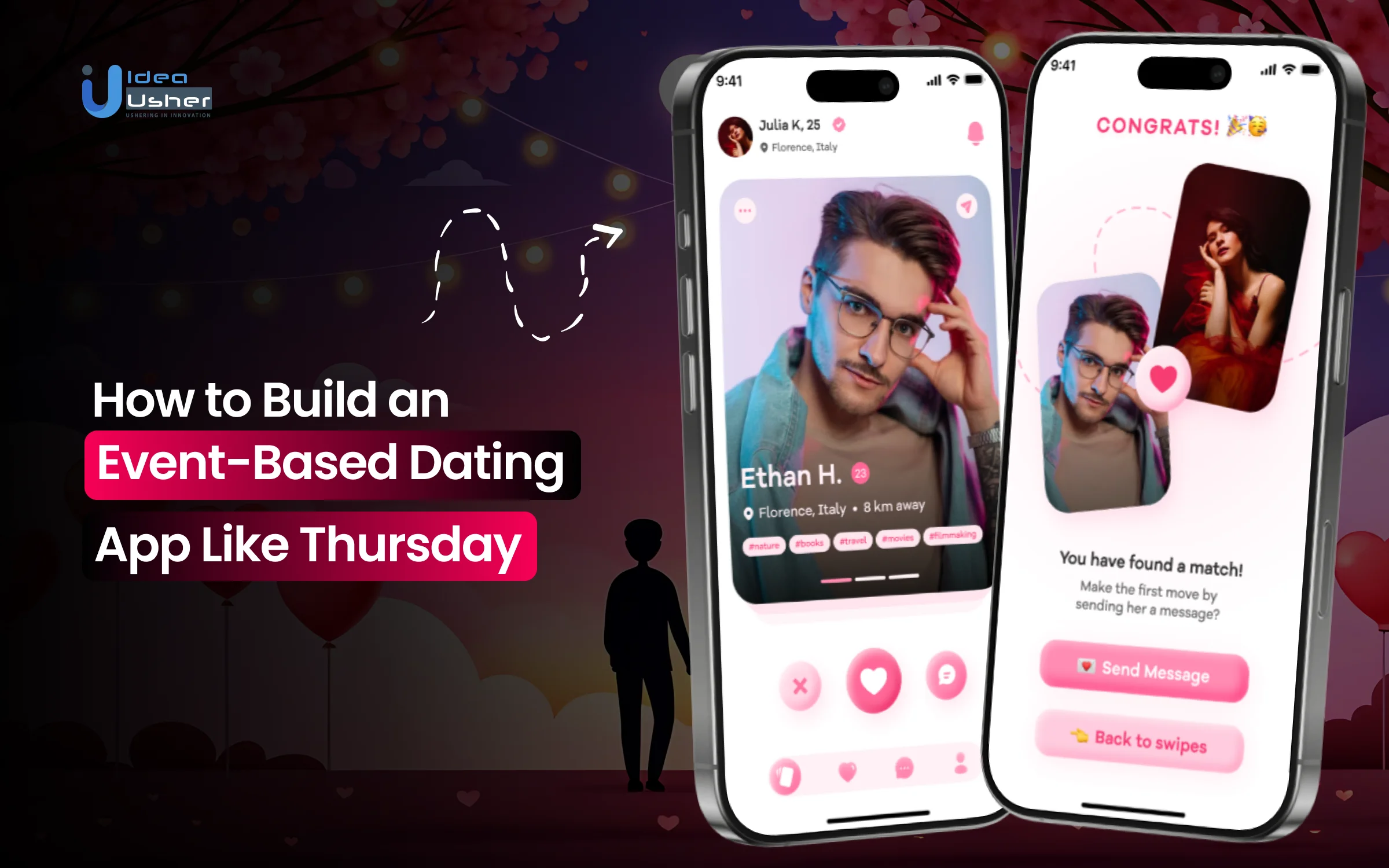
Dating apps are shifting toward experiences that encourage real-world interaction rather than endless swiping. The growing preference for curated events and limited-time matches is driving significant interest in Thursday like event-based dating app development. This shift ensures that user discovery and engagement are centered around meaningful shared activities and scheduled interactions rather than the fatigue of continuous browsing.
The seamless coordination between digital and physical experiences is essential for bringing this app concept to life, requiring event creation, user matching, and location handling to work in perfect harmony. This platform’s effectiveness depends on integrating ticketing, access control, and real-time notifications to support timely engagement while prioritizing safety and user trust for a smooth event experience.
In this blog, we explain how to build an event-based dating app like Thursday by examining core features, architectural considerations, and practical steps involved in launching and scaling an experience-driven dating platform.
Why Event-Based Dating Apps Are Replacing Swiping?
The global online dating app market is experiencing steady expansion, creating strong opportunities for innovative models like event-based dating. The market was valued at over $8.6 billion in 2023 and is projected to reach approximately $14.4 billion by 2030, growing at a CAGR of around 7.6%.

Additionally, with 350+ million users worldwide and increasing demand for more meaningful, real-world interactions, the industry is shifting toward experiential formats such as Thursday like event based dating app, to reduce the gap between a digital match and a physical meet, transitioning from being social networks for singles to logistical engines for real-world romance.
A. The Shift from Endless Swipes to Real Meetings
The primary criticism of traditional dating platforms is their tendency to keep users trapped in a cycle of digital preamble. Many users find themselves in “pen-pal” dynamics, weeks of superficial messaging that rarely result in an actual date. A Thursday like event based dating app disrupts this by making the physical meeting the focal point rather than an afterthought.
| Feature | Traditional Dating Apps | Event-Based Dating Apps |
| Primary Goal | Sustained App Engagement | Immediate Offline Meeting |
| Interaction Style | Passive Browsing | Goal-Oriented Matching |
| Success Metric | Number of Matches | Number of Check-ins |
| Time to Meet | Days or Weeks | Same Day (24-Hour Window) |
B. Why Time-Limited Dating Creates Higher Intent
Scarcity is a powerful psychological driver. When a platform is accessible 24/7, there is no urgency to respond or commit. By restricting the app functionality to a single day, you create a burst-engagement window that triggers immediate action.
- Elimination of Procrastination: The ephemeral nature of chats that disappear at midnight acts as a catalyst. Users know they have a finite amount of time to exchange contact information or solidify plans.
- Synchronized Activity: When the entire user base is active simultaneously, the likelihood of a real-time response nears 100 percent. This synchronization eliminates the lag time that plagues traditional apps.
- Quality Filtering: The model naturally filters out casual users who are just browsing out of boredom, attracting individuals who are serious about meeting someone new.
C. Market Demand for Offline-First Dating Experiences
Post-pandemic social trends indicate a massive resurgence in the experience economy. Younger demographics are reporting higher levels of digital burnout, leading to a craving for organic, offline interaction. However, the organic meet-cute in the wild is increasingly rare.
- The Third Space: These apps act as a hybrid social club, providing a safe, curated space where the barrier to entry is controlled.
- Curation over Volume: Users no longer want an infinite list of profiles. They want access to exclusive venues, fitness studios, or cultural spaces where they know other singles will be present.
- Reduced Pressure: Meeting in a group setting at a curated event lowers the stakes compared to a high-pressure one-on-one blind date, making the experience more enjoyable and repeatable.
D. Where Traditional Dating Apps Fail Users Today
To build a superior product, one must understand the structural failures of the incumbents. Traditional apps have become victims of their own success, leading to several pain points that an event-based model can solve:
- The Ghosting Culture: Because matches are permanent and plentiful, they often become disposable. Event-based apps make every match feel more valuable due to the strict time-bound window.
- Monetization of Loneliness: Many legacy apps are incentivized to keep users on the platform as long as possible to serve ads or upsell premium features. A date-first app succeeds when the user puts the phone down and goes out.
- Identity Verification Gaps: Traditional apps face fake profiles and low authenticity, while event-based models add implicit verification, as real-world meetups make it harder to maintain a false persona.

What Makes Thursday’s Dating Model So Effective?
The effectiveness of this model comes from solving digital-to-real dating friction, using a 24-hour window to reduce always-on anxiety and drive real-world interactions.
This hyper-focused approach creates a weekly cultural moment rather than a daily digital chore. For anyone building a Thursday like event based dating app, the goal is to create an ecosystem where the digital interface exists solely to facilitate immediate, offline movement.

A. The Psychology Behind One-Day-Only Access
Restricting access to one day a week leverages several psychological triggers that traditional apps ignore. When a service is always available, its perceived value decreases because there is no penalty for inaction.
- Mental Availability: Users know exactly when to tune in, which creates a shared social ritual. This reduces the cognitive burden of constantly checking for notifications throughout the week.
- Decision Paralysis Reduction: On standard platforms, the infinite choice often leads to users choosing nothing at all. A one-day window forces a “now or never” mindset that simplifies the decision-making process.
- Anticipation Building: The six days of downtime serve as a “cooldown” period, building genuine excitement and anticipation for the next live window, which significantly boosts engagement rates when the app finally opens.
B. How Expiring Matches Drive Real-World Action
A Thursday like event based dating app utilizes “ephemeral connectivity” to ensure users don’t get stuck in a loop of endless small talk. By setting a hard deadline of midnight, the platform introduces a functional consequence to hesitation.
- The Midnight Deadline: Because matches and chat logs disappear at 12:00 AM, users are incentivized to exchange phone numbers or agree on a meeting spot within hours of connecting.
- High Velocity Interaction: The expiration mechanic increases the velocity of the conversation. There is no room for the three-day reply gap that usually kills the momentum of a potential date.
- Action-Oriented UX: The interface is designed to move users toward a “Yes/No” outcome quickly, mirroring the pace of real-life social interactions where opportunities are often fleeting.
C. Event-Led Dating vs Chat-Based Engagement
Traditional apps prioritize “chat-first” engagement, where the conversation is the product. The Thursday like event based dating app treats the conversation as a mere logistical tool for a specific gathering.
| Feature | Chat-Based Engagement | Event-Led Engagement |
| User Intent | Virtual Validation | Physical Attendance |
| Communication | Open-ended and vague | Goal-directed and logistical |
| App Utility | Entertainment/Boredom | Event Discovery/Access |
| Platform Role | Social Network | Concierge/Event Organizer |
D. Scarcity, Urgency, and User Retention Mechanics
While it may seem counterintuitive to keep an app closed for 85% of the week, this scarcity is exactly what drives long-term retention. By not overstaying its welcome on a user’s home screen, the app avoids the “burnout” phase that leads to mass uninstalls.
- The Fear Of Missing Out (FOMO): If a user misses the Thursday window, they have to wait an entire week to try again. This creates a powerful incentive to participate every single time the app goes live.
- Sustainable Engagement: With a 24-hour cap, users don’t feel “drained,” making the Thursday like event based dating app a sustainable weekly habit rather than a short burst followed by quick drop-off.
- Community Cohesion: By bringing users to the same events at the same time, the app builds a shared “at the event” experience, fostering stronger community and brand loyalty than digital-only connections.
Key Features Required in an App Like Thursday
A Thursday like event based dating app demands a shift from traditional social discovery architecture, built to handle burst-mode traffic and prioritize fast transitions from matching to real-world meetings. These features focus on real-time performance, seamless event integration, and frictionless user experiences.

1. Time-Locked App Access and Weekly Activation
A programmatic activation engine controls global or regional access based on local time zones. This creates a synchronized social ritual where every user in a city begins their journey simultaneously.
The platform maintains a six-day “wait state” featuring countdowns and event teasers for brand presence. At midnight, the matchmaking algorithm must process massive latent demand to ensure a seamless transition.
2. Ephemeral Matches and Auto-Deleting Chats
Strictly ephemeral messaging serves as a core psychological driver. Hard-coded expiration at the 24-hour mark forces users to choose: take the relationship offline immediately or lose the connection forever.
The backend executes automated data purges at midnight. Clear visual cues, such as countdown timers, maintain transparency and motivate users to exchange contact details before the communication window closes.
3. Event Discovery and Real-World Meetup Booking
The platform acts as a curated guide for experiences and people. A robust CMS manages exclusive venue partnerships, offering users safe, official gathering spots to meet their matches in person.
Seamless booking functionality allows for instant check-ins and RSVPs. To successfully launch a Thursday like event based dating app, integration with map APIs must provide real-time navigation and capacity updates.
4. Smart Match Limits to Avoid Swipe Fatigue
Strict match limits counter the “infinite scroll” that devalues individual profiles. Capping interactions during the 24-hour window forces users to be more intentional and selective with their limited attention.
The system delivers higher-quality recommendations by narrowing the active pool. This quality over quantity approach prioritizes convertible connections over aimless swiping, maximizing the potential for successful real-world meetings.
5. Geo-Based Matching with Venue Integration
Hyper-local proximity drives the engine of event-based dating. The algorithm utilizes venue-aware matching to identify users interested in the same locations, facilitating immediate face-to-face introductions within a tight radius.
Hardware integrations like beacons or QR codes bridge the digital-physical gap. Within any Thursday like event based dating app, digital icebreakers can notify users of mutual presence while respecting privacy.
6. Real-Time Notifications for Time-Sensitive Actions
A high-priority pulse notification strategy is essential for a 24-hour ecosystem. Alerts drive immediate re-engagement by highlighting new matches, remaining chat time, and trending “hot-spot” venue updates.
Dynamic triggers reflect the urgency of the closing window. Messaging adapts based on user activity and proximity, ensuring the app remains the central coordination tool for the entire activation.
7. Safety Features for In-Person Dating Events
Integrated safety tools protect users during real-world transitions. A Thursday like event based dating app includes post-venue check-ins to verify well-being and emergency contact sharing for those feeling uncomfortable.
Vetted partner establishments provide a controlled, secure environment with professional staff. Mandatory AI-driven photo verification and selfie-checks further ensure that profiles match the real individuals attending the events.
Advanced Features That Differentiate Your App
A competitive edge in a Thursday like event based dating app comes from advanced architecture, real-time processing, and seamless physical-to-digital coordination that supports large-scale, time-bound interactions.
These features enable smarter matchmaking, efficient event logistics, and a premium, high-retention user experience.

1. AI-Based Match Prioritization for 24-Hour Cycles
A sophisticated AI engine processes massive weekly demand during the limited live window. This system prioritizes high-intent profiles and proximity, ensuring users receive quality-over-quantity recommendations that convert into real-world meetings before the midnight data purge occurs.
2. Curated Event Hosting and Partner Integrations
The platform functions as a curated experience guide through robust B2B venue partnerships. Strategic integrations with local hotspots provide users with official gathering spots, transforming digital connections into safe, physical interactions within a vibrant social atmosphere.
3. In-App Ticketing for Exclusive Dating Events
Frictionless digital ticketing manages event capacity while generating a direct revenue stream. This system allows the app to dynamically balance gender ratios in real-time, ensuring a high-quality attendee experience and increasing the overall likelihood of successful matches.
4. Social Proof Layers Like Verified Attendance
Verified Attendee badges and reliability scores build essential trust within the community. By rewarding users who follow through on commitments, the platform discourages ghosting and flaking, effectively boosting the profiles of the most active, high-value members.
5. Post-Date Feedback Loops for Better Matching
The “Friday Morning” feedback loop captures qualitative data on compatibility and venue quality. These insights drive algorithmic refinement and safety standards of Thursday like event based dating app, ensuring the ecosystem evolves based on real-world etiquette and the actual success of physical dates.
Thursday like Event Based Dating App Development Process
The Thursday like event based dating app requires a peak-load-focused, non-linear development strategy built for extreme weekly surges and real-time synchronization. These steps ensure scalable infrastructure, seamless event coordination, and reliable performance.

1. Define Your Dating Model and User Intent
Success begins with a clear philosophy centered on intentionality. A platform focused on immediate meetings must eliminate the “always-on” dopamine loops of standard apps. The core logic hinges on solving the ghosting crisis by prioritizing real-world availability over digital-only presence.
2. Choose Between Event Marketplace or Own Events
Operational scalability depends on selecting either a partner-driven venue model or a proprietary event series. A marketplace approach leverages existing nightlife infrastructure via API integrations, while owned events offer total brand control and higher exclusivity for the active user community.
3. Design UX for Urgency and Fast Decision Making
The interface must utilize high-contrast visual cues and countdown timers to signal expiring opportunities. Minimalist profile layouts and rapid-action buttons reduce cognitive load, ensuring that users move from matching to logistical coordination within minutes rather than hours or days.
4. Build MVP With Core Time-Based Features
Initial development should focus exclusively on the “Activation Engine” and the “Midnight Wipe” mechanic. This minimum viable product validates the 24-hour scarcity theory while testing the server’s ability to handle massive concurrent traffic spikes during the weekly launch.
5. Test Engagement Within Limited Time Windows
Beta testing requires a “Single-City” focus to observe local density and interaction velocity. Data gathered during these live windows helps refine the matching algorithm, ensuring that users are connected based on their immediate proximity to partner venues and event hubs.
6. Scale With Multi-City Event Infrastructure
Expansion involves deploying a “Geo-Zoned” backend that manages time-locked access across different time zones. A robust B2B portal for venue partners is essential here, allowing the platform to manage a global network of curated experiences while maintaining a local feel.
Thursday like Event Based Dating App Development Cost
The Thursday like event based dating app development centers on robust infrastructure built for synchronized traffic spikes and high-performance real-time processing during its 24-hour active window. The following cost sheet outlines the investment required to move from a lean market entry to a full-scale, enterprise-ready social ecosystem.
| Development Phase | MVP Level | Enterprise Level | Key Deliverables |
| Discovery & Planning | $5,000 – $8,000 | $12,000 – $18,000 | Technical roadmap, SRS documentation, and market-fit analysis. |
| UI/UX Design | $7,000 – $12,000 | $15,000 – $25,000 | Wireframes, high-fidelity prototypes, and custom animations. |
| Frontend Development | $15,000 – $25,000 | $40,000 – $65,000 | Cross-platform (Flutter/React Native) or Native (Swift/Kotlin) apps. |
| Backend & Database | $12,000 – $20,000 | $35,000 – $55,000 | Time-locked activation engine, real-time chat, and geolocation. |
| Event & API Integration | $5,000 – $10,000 | $15,000 – $30,000 | Partner venue dashboards, ticketing systems, and Map APIs. |
| QA & Security Testing | $6,000 – $10,000 | $15,000 – $25,000 | Load testing for traffic spikes and compliance checks. |
| Total Estimated Cost | $50,000 – $85,000 | $132,000 – $218,000 | A fully functional, launch-ready platform. |
Cost-Affecting Factors During Development
The total cost of Thursday like event based dating app is influenced by several high-impact variables that go beyond simple feature lists. Managing these factors effectively is the difference between a high-performing platform and one that struggles with technical debt.
- Concurrency & Load Balancing Architecture: Backend must handle peak-load bursts of 10,000–50,000 concurrent users in a 24-hour window, increasing costs by 25%–40% compared to staggered-traffic apps.
- In-App Payment & Ticketing Complexity: Secure, low-latency payments for tickets and “24-hour boosts,” including multi-currency and split payouts for venues, add $8,000–$15,000.
- Real-Time Data Infrastructure: WebSockets enable instant messaging and live location updates, preventing lag during critical interactions, adding $5,000–$12,000 to the build.
- Advanced Content Moderation: AI-driven photo verification and real-time chat monitoring ensure safety during live events, typically accounting for ~10% of the total functional budget.
- Third-Party API Scaling Fees: External services like Google Maps (geofencing) and Twilio (SMS verification) can scale to $300–$2,500/month as usage grows.
- Platform Maintenance & Iteration: Ongoing updates and optimization require 15%–20% of the initial build cost annually to maintain performance and ensure features like “Midnight Wipe” work seamlessly across OS updates.
Designing UX for High-Intent Dating Behavior
A Thursday like event based dating app requires a high-intent UX focused on speed, clarity, and quick transitions from matching to real-world meetings. Every interaction drives users from screen to venue within the 24-hour cycle. These design principles focus on fast decisions, reduced friction, and seamless user-to-venue conversion.
1. Reducing Friction Between Match and Meetup
The gap between a digital “like” and an actual date is where most connections fail. To bridge this, the UX should proactively suggest the next steps once a match occurs.
- Integrated Venue Suggestions: Instead of a blank chat screen, the app can present a “Meet Here” button that pulls in curated partner venues based on the mid-point location of both users.
- One-Tap RSVPs: Allow users to confirm their attendance at an official event directly from the chat interface, automatically sharing the “Check-in” status with their match.
- Logistical Shortcuts: Direct integration with ride-sharing APIs or map directions within the chat ensures that the transition to the physical world requires as few clicks as possible.
2. Designing for Quick Decisions, Not Browsing
Endless profile details often lead to “analysis paralysis.” To maintain high intent, the profile design should be minimalist, highlighting only the most relevant “compatibility triggers” for a first meeting.
| Design Element | Traditional Dating UX | Event-Based UX |
| Profile Depth | Long bios and 6+ photos | Snapshot bios and 3 verified photos |
| Primary Action | “Save for later” or Swipe | “Meet tonight” or Pass |
| Discovery Mode | Global / Radius-based | Event-based / Hyper-local |
| Content Focus | Hobbies and Interests | Current Location and Tonight’s Plans |
3. Creating Urgency Through UI and Timers
Visual cues are the most effective way to communicate that time is a finite resource on the platform. The UI must constantly remind the user that their window of opportunity is closing.
- The Global Countdown: A persistent, non-intrusive timer at the top of the app showing exactly how many hours remain until the “Midnight Wipe.”
- Chat Expiry Progress Bars: Within each conversation, a color-coded bar (turning from green to red) indicates how much time is left to exchange details before the match is deleted.
- Active Status Indicators: Real-time “Active Now” pulses on profiles show who is currently online and ready to coordinate plans, discouraging the habit of late replies.
4. Balancing Simplicity With Event Discovery
While the matchmaking side must be fast, the event discovery side must be enticing. The challenge is providing enough information about a venue without overwhelming the user’s primary goal of finding a partner.
- Card-Based Event Previews: Use high-quality imagery of venues (e.g., a “Social Run” or a “Rooftop Mixer”) that users can flip through as easily as profiles.
- “Who’s Going” Heatmaps: A privacy-conscious visual representation showing which venues currently have the highest density of app users, helping people choose the “hottest” spot for the night.
- Status-Driven Navigation: A simple toggle between “People” and “Events” ensures the user can switch contexts without losing their place in the funnel, keeping the experience streamlined and goal-oriented.
Technology Stack for Event-Based Dating Apps
The foundation of a Thursday like event based dating app depends on a scalable, high-performance tech stack built to handle extreme concurrency and prevent latency during synchronized user activity spikes. Robust architecture ensures stability under the “thundering herd” effect.
The following table outlines the specialized, high-impact components required to manage time-locked access, ephemeral data, and real-world event logistics.
| Component | Industry-Standard Technology | Strategic Impact & Key Deliverables |
| Frontend for Real-Time Interfaces | Flutter / React Native | Delivers 60fps fluid animations for real-time countdowns and responsive “swipe-to-meet” interfaces across iOS and Android. |
| Backend for Time-Based Logic and Scalability | Node.js (NestJS) / Go (Golang) | Manages asynchronous “burst” traffic spikes and executes the “Midnight Wipe” logic with millisecond precision across global time zones. |
| Event Management and Booking Integrations | WebSockets / Redis Pub-Sub | Enables instantaneous message delivery and “Active Now” status pulses, ensuring users never experience lag during the 24-hour window. |
| Cloud Infrastructure for Peak-Time Traffic | AWS (Lambda & Auto-Scaling) | Utilizes serverless functions to scale resources 10x during the active Thursday window and scales down to near-zero costs during the off-week. |
| APIs for Maps, Payments, and Notifications | Google Maps / Stripe / FCM | Powers hyper-local venue discovery, secure event ticketing, and high-priority “Closing Soon” reminders to drive re-engagement. |
Monetization Strategies That Actually Work
The Revenue strategy for a Thursday like event based dating app centers on high-intent interactions, focusing on features that directly improve users’ chances of meeting offline within the 24-hour cycle. These models monetize “access” and “convenience,” positioning the app as a premium social club with paid, curated, safe, and exclusive real-world dating experiences.
1. Paid Event Access and Premium Experiences
Revenue is generated through “Member-Only” tickets for curated mixers and social gatherings. These exclusive experiences provide a high-value environment, filtering for serious participants while creating a consistent weekly income stream from event sales.
2. Subscription for Early Access and More Matches
Recurring revenue tiers offer users the ability to see matches before the 24-hour window officially opens. Subscriptions also unlock higher swipe limits, providing power users with increased visibility and more opportunities for meaningful connections.
3. Venue Partnerships and Sponsored Events
Local businesses pay for “Featured Venue” status to drive foot traffic from the app’s user base. These B2B partnerships involve listing fees and promotional takeovers, turning the platform into a powerful local marketing engine.
4. Boost Features for Higher Visibility
Micro-transactions allow users to “Level Up” their profile in the stack during the active window. This high-margin feature ensures that time-pressed individuals can maximize their exposure to potential matches during the limited 24-hour cycle.
5. Commission Models on Ticketed Meetups
Transactional revenue is secured by taking a percentage of every ticket sold through the integrated booking engine. This scalable model incentivizes the platform to host larger, more frequent events while automating the settlement process.
Challenges in Building Event-Based Dating Apps
The Thursday like event based dating app development face challenges in peak-load scalability, real-time coordination, user safety, and seamless offline transitions within limited time windows. Our developers solve these with robust architecture, real-time systems, and secure, high-performance user experience design.

1. Balancing Supply of Users and Events
Challenge: Maintaining a critical mass of active users in specific neighborhoods while simultaneously securing enough diverse partner venues to prevent overcrowding.
Solution: Our developers implement “Smart-Zoning” algorithms that unlock app features only when a specific geographic radius reaches a verified user threshold, ensuring every match has a viable meeting spot.
2. Managing Peak Usage on Specific Days
Challenge: Handling massive, synchronized traffic spikes during the 24-hour window which can cause server latency, message delays, or total crashes.
Solution: We utilize AWS Lambda for “Serverless” execution and auto-scaling database clusters that instantly expand capacity during the Thursday surge and retract during downtime to optimize operational costs.
3. Ensuring Safety in Offline Interactions
Challenge: Protecting users from potential harassment or “catfishing” when the platform actively encourages rapid transitions from digital chat to physical meetings.
Solution: Our team integrates AI-driven identity verification and “Live-Event Check-ins” with SOS triggers, allowing users to report discomfort or share their real-time location with trusted contacts via the app.
4. Driving Consistent User Retention Weekly
Challenge: Preventing “app fatigue” where users stop logging in after a few unsuccessful weeks or once the 24-hour novelty fades.
Solution: We build “Gamified Anticipation” modules featuring weekly countdowns, exclusive event teasers, and “Friday Feedback” loops that reward consistent attendance with higher profile visibility in the next active cycle.
Case Insight: Building a Date-First Platform
Examining a real-world application of high-intent design provides the most valuable roadmap for development. A prime example from our portfolio is Upendo, a platform we built and launched to solve the very issues of “swipe fatigue” and “digital disconnection” that an event-based dating app seeks to address.
Upendo shows how authentic profiles and real-world activity can balance user privacy, platform safety, and revenue growth through structured product design. These insights share our experience in turning business gaps into a market-ready dating app.

A. How We Designed for Immediate Meetups
The primary goal was to move beyond the superficial “hot or not” dynamic. To facilitate immediate meetups, we prioritized profile depth and verification, ensuring that when users connect, there is a foundation of trust that encourages taking the conversation offline quickly.
- Dual Variant Architecture: We developed both a User App and a Vendor App, allowing for seamless integration between dating profiles and the venues where they meet.
- Contextual Discovery: By integrating categories like fashion and social outings, the platform suggests the “why” and “where” of a date simultaneously with the “who.”
- Intent-Based UI: The interface was structured to reduce the clutter of traditional apps, focusing the user’s attention on verified, high-quality matches ready for engagement.
B. Lessons From Real User Behavior Patterns
Our development of Upendo revealed that users are significantly more active when they feel the environment is secure and the profiles are legitimate. We learned that “passive swiping” is often a defense mechanism against low-quality matches.
- The Trust Catalyst: Implementing robust moderation and verification features increased user messaging rates, as people were more willing to invest time in conversations with verified individuals.
- The Quality Filter: We observed that users preferred fewer, more personalized matches over an infinite, uncurated stack, confirming the market demand for “scarcity-driven” dating models.
- Platform Safety as a Feature: Real-time reporting and community standards were not just backend requirements but front-facing value propositions that drove user retention.
C. What Worked in Driving Event Attendance
A key success factor in the Upendo project was the “Vendor App” variant, which allowed brand partners to highlight social opportunities directly within the dating ecosystem. This created a natural pipeline from digital matching to physical attendance.
- Category-Based Incentives: By offering discounts in categories like nightlife and gadgets, we gave users a tangible reason to choose a specific partner venue for their first meetup.
- Centralized Reporting: Managing community standards through a unified system ensured that “Bad Actors” were removed quickly, maintaining a high-quality environment at physical gatherings.
- Meaningful Matchmaking: Moving away from basic swiping toward “meaningful matches” ensured that users attending events were highly compatible, leading to better post-event feedback and repeat usage.
D. Key Metrics That Defined Product Success
Measuring the success of a “date-first” platform requires looking beyond simple app downloads. For Upendo, we focused on indicators that reflected actual human connection and platform health.
- Verification Rate: The percentage of the user base that completed the authenticity checks served as a primary metric for community trust levels.
- Match-to-Meeting Conversion: Tracking how effectively digital connections translated into RSVPs at partner venues or utilization of vendor discounts.
- Subscription Retention: The stability of revenue through the centralized subscription management system, indicating users found long-term value in the curated experience.
- Safety Incident Frequency: A low rate of reports and high efficacy in moderation served as a critical KPI for the platform’s long-term viability and brand reputation.
Growth Strategies for Event-Based Dating Apps
Scaling a Thursday like event based dating app requires a hyper-local execution strategy. Success depends on achieving critical mass within specific neighborhoods, transforming digital interactions into a vibrant, weekly social movement.
1. Launching City-by-City for Better Liquidity
A phased rollout ensures high user density, preventing the “empty room” effect. By dominating one city before expanding, the platform builds a concentrated network of active singles and reliable venue partners in one region.
2. Partnering With Local Venues and Communities
Strategic alliances with popular bars, gyms, and social clubs provide instant credibility. These partnerships turn existing physical hotspots into “Official App Zones,” funneling established local communities directly into the digital ecosystem every single week.
3. Influencer-Led Event Promotion Tactics
Collaborating with local lifestyle creators generates authentic buzz around weekly events. Influencers act as “Event Hosts,” documenting their real-world experiences to showcase the app’s safety, fun, and success in facilitating genuine, high-intent human connections.
4. Creating FOMO Through Limited Access
The 24-hour restriction naturally builds social urgency. By utilizing “Waitlists” and “Invite-Only” access during the launch phase, the platform positions itself as an exclusive club, making the weekly activation a highly anticipated, unmissable event.
Privacy & User Safety of Thursday like Event Based Dating App
Operating a Thursday like event based dating app requires a rigorous approach to user protection. Building trust through high-standard security protocols is essential for maintaining a safe, high-intent social community.
A. Data Privacy for Location-Based Dating Apps
Maintaining strict confidentiality over real-time movements is critical. The platform must implement enterprise-grade encryption and granular permission settings to ensure user location data is never compromised or stored unnecessarily.
- End-to-End Encryption: All location coordinates and private messages are secured using AES-256 protocols, ensuring that data is unreadable to unauthorized parties even if intercepted.
- Dynamic Distance Obfuscation: The UI displays approximate distances rather than precise GPS coordinates, preventing “predatory tracking” while still facilitating local matches within the active window.
- Automated Data Purging: To minimize the risk of a breach, all sensitive transit data and precise location history are programmatically deleted from the server every 24 hours after the app closes.
B. Identity Verification and Fraud Prevention
Ensuring every profile represents a real person reduces the risk of catfishing. A multi-layered verification process builds a foundation of accountability, which is vital when encouraging rapid offline meetings.
- Liveness-Detection Selfies: Users must complete a real-time, pose-matching selfie check that an AI-driven system compares against profile photos to verify physical identity and prevent photo-spoofing.
- Government ID Integration: For higher-tier security, the app can integrate with third-party verification services to scan and validate official identification documents, awarding a “Verified” badge to trusted users.
- Device Fingerprinting: This prevents bad actors from creating multiple fraudulent accounts by identifying and blocking unique device hardware signatures associated with previously banned or suspicious profiles.
C. Moderation Systems for Events and Users
Real-time monitoring is necessary to maintain the integrity of the 24-hour cycle. Automated and human moderation must work in tandem to identify and remove bad actors before they reach events.
- NLP-Driven Chat Filtering: Natural Language Processing (NLP) algorithms scan active chats in real-time to flag harassment, solicitation, or offensive language, allowing for instant intervention or account suspension.
- Community Reporting Tools: A one-tap “Report & Block” feature is embedded in every chat and profile, prioritizing user-generated flags for immediate review by a 24/7 human moderation team.
- Venue-Link Moderation: Partner venues are equipped with a “Business Dashboard” to report inappropriate behavior observed during offline events, ensuring that the community remains safe both digitally and physically.
D. Legal Considerations for Offline Meetups
Facilitating physical gatherings introduces unique liability challenges. The platform must operate with transparent terms of service and robust insurance coverage to protect both the business and its active users.
- Clear Terms of Service (ToS): Legal frameworks must explicitly state that while the app facilitates introductions, users are responsible for their personal safety and conduct during in-person interactions.
- GDPR & CCPA Compliance: The data architecture must follow global privacy standards, including the “Right to be Forgotten,” ensuring users can easily delete their entire data footprint upon account closure.
- Third-Party Liability Clauses: Contracts with partner venues should outline shared responsibility for event safety, ensuring that all physical meetups occur in vetted, safe, and legally compliant environments.
How IdeaUsher Builds High-Conversion Dating Apps?
At IdeaUsher, we transcend basic app development by engineering high-performance ecosystems designed for rapid user movement. Our specialized team builds data-first architectures that prioritize real-time synchronization, scarcity-driven engagement, and seamless physical-to-digital transitions.
A. Our Approach to Time-Based App Architecture
Our ex-FAANG/MAANG developers engineer burst-ready backends specifically designed to handle massive, synchronized traffic spikes. We utilize time-locked activation engines and automated data-purging logic to maintain the integrity of 24-hour dating cycles.
B. Experience in Real-Time Engagement Platforms
With 500,000+ hours of development experience, our team builds complex, geo-aware social platforms that require millisecond-perfect synchronization. We leverage advanced WebSocket frameworks to ensure that matches, chats, and event updates occur instantly without latency.
C. How We Design for Conversion, Not Just Features
We focus on the psychological triggers that move a user from a screen to a venue. Our UX strategy eliminates “analysis paralysis” by highlighting high-intent signals and immediate call-to-actions.
D. End-to-End Development From MVP to Scale
From initial market-fit analysis to deploying global, multi-city infrastructure, we provide a comprehensive development roadmap. Our process ensures your platform remains lean during validation and robust during massive user acquisition.
Conclusion
Building a Thursday like event based dating app requires a strategic blend of high-performance engineering and intentional UX design. By replacing the endless swipe cycle with time-locked access and ephemeral matches, you create a high-intent ecosystem that prioritizes real-world chemistry. While the technical demands of peak-load concurrency and real-time data are significant, the result is a sustainable, premium community. Ultimately, success lies in bridging the digital-physical gap, transforming a mobile app into a powerful logistical engine for authentic human connections.


FAQs
A.1. Development costs typically range from $50,000 for a basic MVP to over $200,000 for enterprise-level solutions. Total investment depends on concurrency requirements, real-time data infrastructure, and complex third-party API integrations.
A.2. Restricting access creates psychological scarcity and urgency, forcing users to act quickly. This synchronized activity window eliminates ghosting and decision paralysis, resulting in higher-quality matches and more frequent real-world meetings.
A.3. A combination of Node.js or Go for the backend and AWS Lambda for auto-scaling is ideal. These technologies efficiently manage massive weekly traffic surges during the 24-hour live window.
A.4. Primary revenue streams include in-app ticketing commissions, premium subscriptions for early access, and sponsored venue partnerships. You can also offer profile boosts to users seeking higher visibility during active periods.


