

Key Takeaways
- Enterprises are replacing outdated procurement operations with AI-powered platforms that automate approvals, compliance, and spend tracking.
- Traditional procurement systems struggle because of manual approval chains, disconnected ERP environments, and fragmented workflows.
- Modern procurement software requires dynamic approval engines, ERP integrations, AI-driven automation, and enterprise-grade security.
- Scalable procurement platforms depend on specialized engineering, accurate financial processing, seamless integrations, and intuitive experiences.
- How Idea Usher helps businesses build procurement workflow software like ServiceNow using pre-vetted developers.
The fatal flaw of most custom procurement platforms is that they decouple the workflow from the asset infrastructure. True enterprise automation cannot exist in a vacuum. A high-scale procurement tool must function as a single pane of glass that bridges the gap between disparate IT asset repositories, active HR directories, and complex accounting frameworks without introducing data latency.
When engineering a platform to rival ServiceNow, your primary technical challenge isn’t the front-end user experience; it is designing a highly structured, relational data engine capable of tracking multidimensional asset dependencies in real time. If your development team treats these entities as simple, flat database fields, your application will quickly become bogged down by manual reconciliation loops and system-wide synchronization failures.
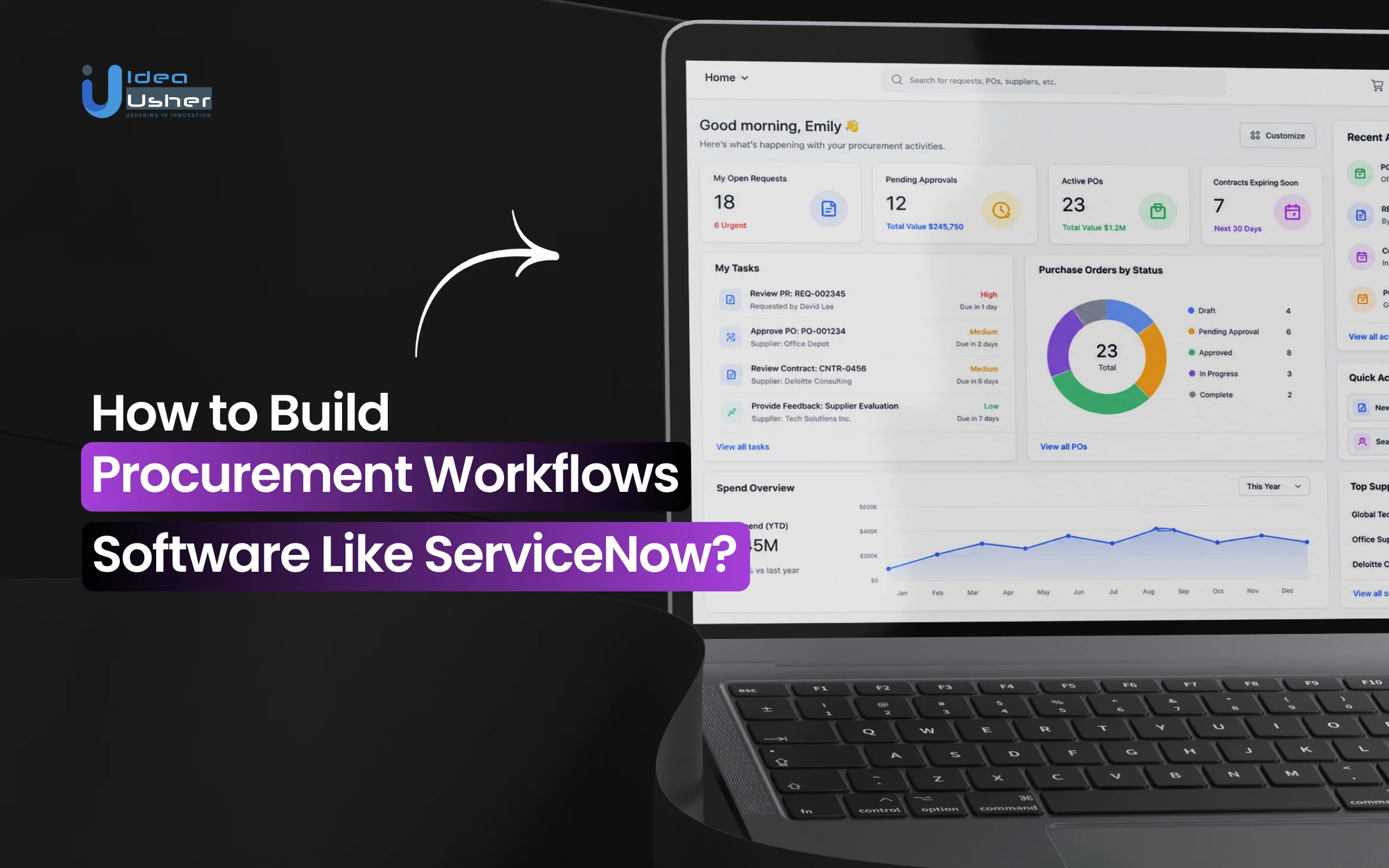
Over the past decade, we’ve built many enterprise procurement and workflow automation solutions powered by approval workflows and vendor management systems. In this blog, we’ll break down how to build procurement workflow software like ServiceNow, covering its core features, automation capabilities, and architecture.
Why Traditional Procurement Operations Fail at Enterprise Scale?
According to Mordor Intelligence, the financial stakes driving enterprise procurement transformation have never been higher. With the Procurement Analytics market size in 2026 estimated at USD 7.11 billion and projected to reach USD 20.72 billion by 2031 at a 23.85% CAGR, capital is rapidly shifting to modernized spend architecture. For entrepreneurs and investors, this aggressive growth curve proves that enterprises are actively abandoning legacy frameworks to protect their cash flow and margins.
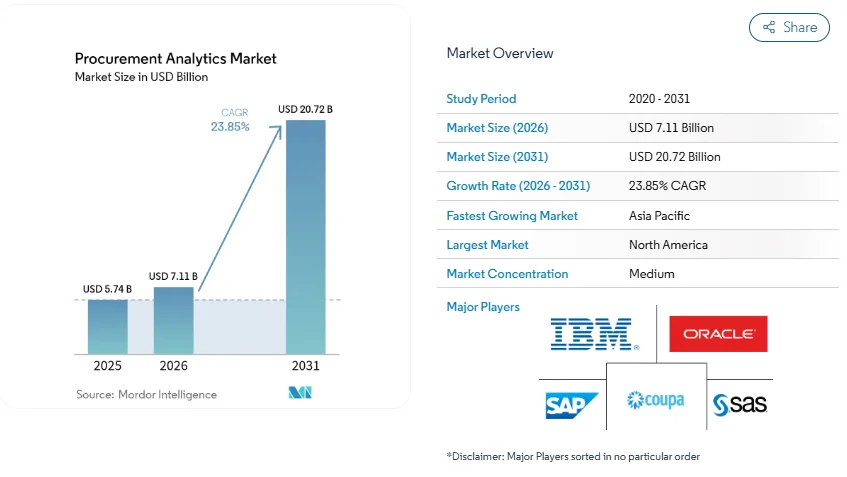
Source: Mordor Intelligence
At scale, traditional linear procurement operations fail because they cannot handle the volatile, high-velocity demands of modern global business. When an enterprise attempts to scale manual or fragmented systems, operational friction multiplies exponentially. This structural breakdown exposes the organization to severe revenue leakage, missed savings, and immediate competitive disadvantage.
Manual Approval Bottlenecks and Risks
In an enterprise environment, every day a purchase requisition sits idle represents capital tied up and operational velocity lost. Manual approval chains rely heavily on human intervention, requiring documents to move through sequential hierarchies via email, spreadsheets, or outdated intranet portals. This introduces severe operational bottlenecks.
- Velocity Degradation: If a critical raw material or SaaS contract requires signatures from department heads, finance leaders, and legal counsels sequentially, a single bottleneck halts the entire pipeline.
- Maverick Spend: When internal stakeholders face weeks of delays to secure a necessary tool or vendor, they bypass standard channels entirely. This results in unauthorized corporate spending outside of negotiated contracts, destroying the enterprise leverage for volume discounts.
- Audit Exposure: Manual interventions leave a fragmented paper trail. When compliance teams or external auditors attempt to trace the lineage of a major purchase, they often find missing rationale for vendor selection, undocumented price deviations, and a lack of clear accountability. This creates substantial regulatory and financial risk.
While platforms like Coupa have successfully automated basic approval routing to mitigate these delays, many enterprises still struggle to configure these workflows without heavy technical overhead.
System Fragmentation and Complexity
Large enterprises rarely operate on a single infrastructure, typically inheriting a patchwork of legacy ERPs, standalone inventory software, and disparate accounting systems through expansions. When these environments cannot communicate in real time, operational blindness follows. Even legacy giants like SAP Ariba, despite massive supplier networks, require extensive and costly customization to bridge the data gaps between these disconnected regional systems.
This fragmentation forces procurement teams to act as human middleware, manually copying data between invoices, ERPs, and banking portals. The resulting lag in spend visibility leaves leadership looking at weeks-old financial data, making proactive cash flow management impossible. Consequently, duplicate payments, inventory discrepancies, and mismatched purchase orders become structural inevitabilities that directly erode enterprise profitability.
Legacy Constraints on AI Workflows
The current shift toward predictive forecasting and intelligent automation requires a modern data architecture that legacy procurement software cannot provide. Older systems act merely as static digital filing cabinets, recording past transactions but offering zero utility for anticipating future trends. These rigid platforms lack the data ingestion capabilities, semantic processing, and API-driven flexibility required to leverage artificial intelligence.
Without these capabilities, legacy systems cannot ingest unstructured global market data to predict supply chain disruptions or dynamically analyze vendor contracts for sub-optimal renewal terms. This forces enterprises into a reactive posture while competitors utilizing AI-driven architectures optimize their cost of goods sold in real time. For an investor, backing a platform that solves this specific structural bottleneck represents a highly lucrative market capture opportunity.
What is ServiceNow Software and How Does It Work?
ServiceNow is an enterprise cloud platform that unifies fragmented corporate systems into automated digital workflows, acting as an orchestration layer over legacy infrastructure to streamline cross-departmental operations. It enables enterprises to centralize operational data, automate approvals, and improve real-time visibility across business functions.
Procurement Lifecycle Architecture
Enterprise procurement demands an architecture that can track a dollar from initial demand to final payment. The core architecture of modern platforms coordinates this process by linking sourcing, contracting, and purchasing into a continuous digital loop. This connected infrastructure improves financial transparency while reducing delays caused by disconnected procurement systems.
- Demand Intake and Sourcing: The architecture captures internal requisitions through a single, intuitive portal. It automatically maps requests against pre-approved vendor catalogs to ensure contract compliance from day one.
- Contract Repository Integration: Legal and commercial terms are stored as structured data rather than static PDF files. This allows the system to monitor volume tiers, track active commitments, and flag upcoming expiration dates automatically.
- Supplier Performance Tracking: The platform continually scores suppliers on delivery times, price accuracy, and compliance, giving procurement leaders clear data for future negotiations.
This unified approach ensures that instead of managing a series of disconnected transactional events, the enterprise runs an integrated lifecycle. This visibility reduces maverick spend and safeguards corporate margins.
AI Workflow Automation
The introduction of artificial intelligence shifts procurement from a reactive administrative task to a proactive financial strategy. Modern systems do not just route documents; they analyze the data within them to make intelligent, autonomous operational decisions. This allows enterprises to improve purchasing accuracy, reduce operational risk, and accelerate decision-making across procurement workflows.
- Intelligent Document Ingestion: Natural language processing engines read unstructured supplier invoices, extract key line items, and instantly cross-reference them with the original purchase order and delivery receipt.
- Predictive Anomaly Detection: Machine learning algorithms flag risk vectors, such as price anomalies, duplicate billing patterns, or unapproved vendor cross-border transactions, before any capital leaves the bank.
- Autonomous Routing Models: Instead of sending every request through an identical chain of human reviewers, AI-driven workflows analyze historical transaction risk. Routine, low-risk catalog orders are approved instantly, allowing human specialists to focus exclusively on high-value exceptions.
Integrations and Automation
A procurement platform is only as strong as its connection to the rest of the enterprise tech stack. True automation relies on deeply embedded APIs that synchronize financial and operational data in real time across the entire organization. This seamless connectivity enables faster decision-making, reduces manual reconciliation, and improves enterprise-wide operational accuracy.
- Bi-Directional ERP Synchronization: When a purchase order is updated, the platform pushes that data directly into core ERP systems like SAP or Oracle, keeping general ledgers perfectly accurate without human data entry.
- Secured Banking and Payment Gateways: Automated workflows connect straight to corporate banking infrastructure to initiate clearing house or virtual card payments the moment a three-way match is validated.
- Identity and Access Management (IAM): Integrations with enterprise security frameworks like Okta ensure that employee approval permissions dynamically update whenever organizational roles or spending limits change.
Most enterprises don’t have a procurement budget problem. They have an Adapter Tax problem, spending thousands of dollars trying to force a rigid, off-the-shelf SaaS tool to understand their legacy ERP.
Key Features for a Procurement Workflow Software
Building a competitive SaaS platform for enterprise procurement requires moving past basic digital intake forms. To capture market share from entrenched players, your software must function as an intelligent operational layer that coordinates complex transactions, enforces corporate compliance, and surfaces real-time financial insights.
The platform requires a modular architecture capable of handling high transaction volumes while maintaining a fluid, consumer-grade user experience for enterprise stakeholders.
1. Multi-Level Approval Engine
Enterprise spending rarely follows a linear path. A robust workflow engine must dynamically adjust approval routing based on data context rather than relying on rigid, pre-coded logic, allowing organizations to adapt instantly to shifting corporate budgets and fluctuating vendor conditions.
Dynamic Routing Rule Example: If a purchase requisition exceeds $50,000, originates from the marketing department, and involves a new vendor, the engine must automatically inject a legal review and a finance sign-off step before routing the request to the department head.
- Conditional Logic Fields: Users must be able to design complex branching paths using drag-and-drop conditions based on cost centers, geographic locations, project codes, or custom risk thresholds.
- Parallel Approval Processing: The engine should allow multiple departments, such as legal and IT security, to review a vendor contract simultaneously to eliminate sequential bottlenecks.
- SLA Escalation Triggers: When an approval request sits idle in a manager queue for more than 48 hours, the system must trigger an automated escalation path to keep operational pipelines moving.
2. Supplier Management Module
An enterprise is only as reliable as its supply chain. The vendor module must serve as a secure ecosystem for onboarding, risk management, and continuous performance evaluation, ensuring that every partner integrates smoothly into corporate workflows. By capturing real-time partner metrics at scale, this infrastructure eliminates supplier variance before it impacts company margins.
| Core Capability | Strategic Enterprise Benefit |
| Self-Service Onboarding | Shifts data-entry work to vendors, who upload their own tax documents, banking details, and insurance certifications. |
| Automated Compliance Engine | Automatically checks global watchlists and flags expiring certifications to protect the enterprise from legal risks. |
| Dynamic Scorecards | Tracks delivery lead times, price variance, and product defects to give buyers clear, data-driven leverage during contract renewals. |
3. Spend Analytics Dashboard
Enterprise decision-makers do not need more raw data; they need actionable financial visibility. The dashboard infrastructure must process thousands of line-item transactions into clear visual trends that highlight cost-saving opportunities. By building a native analytics engine, your platform can move enterprises away from retrospective spreadsheet tracking.
The analytics system must aggregate real-time transaction volume, contract utilization rates, and departmental budgets. This allows corporate treasurers to identify leakages instantly, catch duplicate billing setups, and negotiate better volume-based discounts with frequently used vendors.
4. ERP Integration Infrastructure
A standalone procurement tool creates operational friction. To provide real-time value, your platform must offer a robust API framework that connects seamlessly with major enterprise systems, eliminating the need for manual data reconciliation. This structural connectivity guarantees that transactional updates reflect across all financial ledgers instantaneously.
- Bi-Directional Data Pipelines: Financial data must flow smoothly between your platform and core ERP architectures like NetSuite, SAP, or Microsoft Dynamics without manual data entry.
- Automated Three-Way Matching: The software should automatically compare the purchase order, the receiving log, and the supplier invoice. If the data matches within set tolerances, the system creates a payment record in the financial ledger without human intervention.
- Bank-Grade Clearing Execution: Direct API integrations with global corporate banking networks allow the platform to initiate automated clearing house or virtual credit card payments the moment an invoice is approved.
5. Security and Compliance Layer
When a platform processes millions of dollars in corporate spend, security is a fundamental business requirement rather than a secondary feature, serving as the foundation of enterprise trust. This requires implementing rigorous encryption standards and multi-tenant isolation protocols to safeguard sensitive financial data.
- Role-Based Access Control: Administrators must be able to define granular read, write, and approval permissions down to individual line items or regional cost centers.
- Immutable Audit Logging: Every system interaction, including requisition edits, approval stamps, and vendor account updates, must be recorded in an unalterable log file for internal compliance and external regulatory reviews.
- Enterprise Identity Integration: Native support for Single Sign-On protocols, such as SAML 2.0 and OIDC, ensures that user access privileges align instantly with central IT directory updates.
The Hidden Cost of Off-the-Shelf Procurement Tech
When you buy a generic procurement platform, you adapt your supply chain to its code. The moment you need a custom multi-tier approval matrix or a localized tax engine for cross-border logistics, you hit a wall. You end up managing the exceptions manually in Excel, creating Ghost Spend that escapes your system.
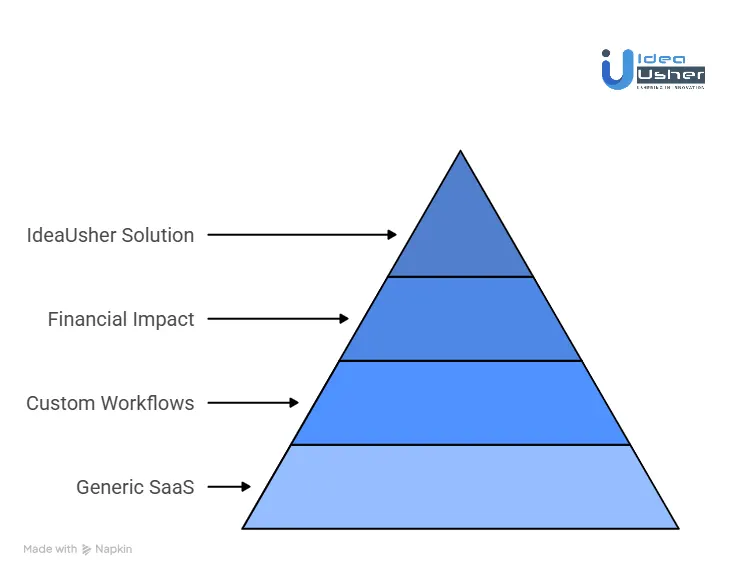
Rigid SaaS vs. Custom Workflows
Modern procurement operations demand flexibility, deep system integration, and workflow customization that many off-the-shelf SaaS platforms struggle to provide. Comparing rigid procurement software with custom-built workflow architectures highlights how tailored systems deliver stronger scalability, automation control, and long-term operational efficiency for enterprises.
| Operational Requirement | Generic SaaS Software | IdeaUsher Custom Architecture |
| Multi-Tier Approvals | Limited to standard linear routing paths. | Unlimited dynamic paths based on real-time budgets. |
| ERP Connectivity | Rigid, expensive third-party middleware adapters. | Native, bi-directional API pipelines built to your schema. |
| Compliance & Tax Logic | Hardcoded regions with manual overrides required. | Automated localized engines for cross-border logistics. |
Financial Impact Analysis
The financial leakage from off-the-shelf software structures can be broken down into specific operational drains. These hidden inefficiencies often increase administrative overhead, reduce financial visibility, and create long-term operational bottlenecks. Over time, fragmented workflows and manual interventions can significantly impact procurement accuracy and enterprise profitability.
- The Integration Sunk Cost ($25,000 to $60,000): This represents the typical engineering spend required just to build custom translation layers so a generic tool can speak to SAP or Oracle.
- Manual Exception Leakage ($15,000 to $40,000): The ongoing financial cost of human labor required to patch data gaps manually in spreadsheets when workflows reject non-standard procurement requests.
- Compliance Audit Penalties: The variable risk premium associated with undocumented Ghost Spend transactions escaping the primary corporate accounting engine.
The IdeaUsher Solution
We don’t believe in forcing custom business logic into a generic template. We build procurement workflow software from the ground up, tailored to your exact operational mechanics. This allows enterprises to automate workflows more efficiently while maintaining full control over approvals, compliance, and financial operations.
Engineering Philosophy: True financial control requires software that bends to your business rules, not the other way around. Every workflow module we develop is mapped directly to your physical supply chain.
You don’t need to waste months interviewing talent to find engineers who understand both enterprise architecture and procurement logic. IdeaUsher’s pre-vetted developers scale your team instantly. Our professionals are vetted not just for clean code, but for building high-compliance, secure financial infrastructure that eliminates data fragmentation before it impacts corporate margins.
How to Build Procurement Workflow Software Like ServiceNow?
Developing a procurement workflow software requires shifting focus from simple form-fill applications to complex distributed systems engineering. To attract serious corporate buyers, your application must handle concurrent database writes, maintain precise data history, and process unstructured financial documents instantly.
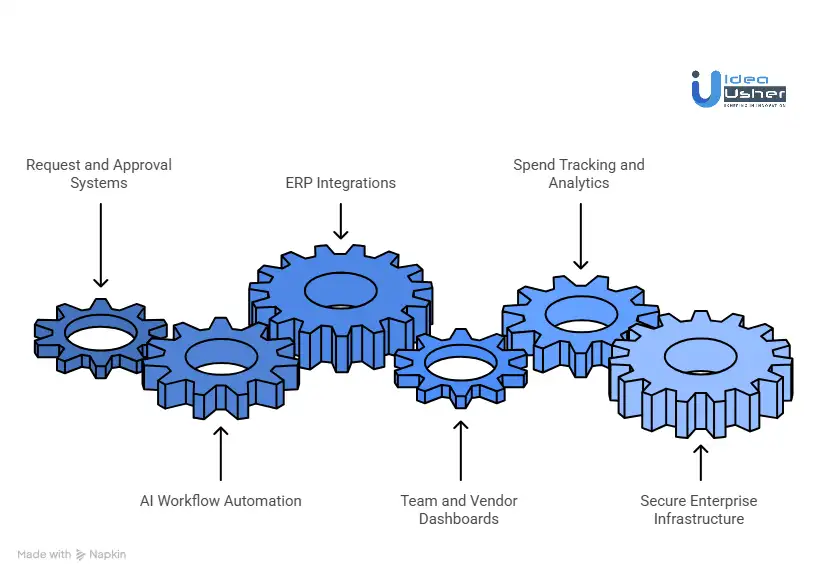
At IdeaUsher, we engineer these resilient, secure procurement architectures using our pre-vetted development teams, ensuring your product is built from day one to manage high-volume B2B commerce.
1. Request and Approval Systems
The entry point of the platform is the intake and orchestration engine, a system that must translate unstructured employee purchasing requests into structured transactional data while evaluating corporate spend limits in real time. This allows procurement teams to standardize purchasing workflows from the very beginning of the approval cycle.
- Relational Database Design: We utilize robust relational database schemas to enforce strict ACID compliance across purchase orders, line items, and department budgets. This architecture guarantees that total calculated spend amounts match the underlying transactional data exactly.
- Contextual Evaluation Engine: Our developers build backend policy evaluators that parse transaction attributes, such as asset class, total cost, and geographical source, against corporate compliance rules to determine the optimal routing sequence automatically.
- Asynchronous Notification Framework: We implement event-driven message queues using technologies like RabbitMQ or Apache Kafka. This setup ensures that approval tasks update instantly across corporate messaging tools like Slack or Microsoft Teams without introducing web server lag.
2. AI Workflow Automation
Integrating artificial intelligence directly into the core workflow turns a basic tracking tool into a highly optimized, proactive financial platform. This automation layer focuses on eliminating manual document review and identifying structural spending risks early. It also improves operational efficiency by accelerating approvals and reducing repetitive administrative workloads.
- Document Extraction Pipelines: We deploy optical character recognition engines and specialized large language models via secure APIs to ingest vendor invoices and delivery receipts. The system extracts critical fields, including tax identifiers, banking routing codes, and itemized costs, transforming unstructured text into clean JSON payloads.
- Deterministic Validation Engines: Our teams program automated cross-checking algorithms to match invoice data directly against original purchase orders and warehouse receipt logs. When deviations exceed set company tolerances, the system automatically stops payment and flags the transaction for human review.
- Anomalous Transaction Scoring: We train machine learning models to analyze transaction records, comparison pricing, and vendor profiles. This framework highlights potential financial anomalies, including unnegotiated rate increases, duplicate billing setups, or sudden changes in supplier payment routing, before funds leave corporate accounts.
3. ERP Integrations
A standalone procurement platform creates data silos. To deliver true enterprise value, we design your software to function as a real-time data bridge to legacy systems of record. This ensures procurement, finance, and operational data remain continuously synchronized across the enterprise ecosystem.
| Integration Target | Core Data Exchange Protocol | Primary Engineering Objective |
| SAP S/4HANA | SOAP / OData REST APIs | Synchronizes complex corporate general ledger accounts and updates operational cost centers instantly. |
| Oracle Fusion Cloud | Enterprise REST Endpoints | Reconciles active fixed-asset records and updates global supplier master files across regional branches. |
| NetSuite ERP | SuiteTalk Web Services / REST | Automates three-way accounting matching and creates vendor bills inside the core ledger without human input. |
4. Team and Vendor Dashboards
Enterprise platforms serve diverse user groups, each requiring tailored user interfaces and strict data access permissions. For internal procurement specialists, we design dashboards that prioritize operational visibility, highlighting stalled approval queues, high-risk contract deadlines, and immediate supply chain issues. This layout uses compact, data-dense grids to maximize daily productivity.
Conversely, we build vendor portals with a clean, straightforward interface focused on transaction tracking. Suppliers use this secure space to manage their compliance profiles, upload tax documents, review active purchase orders, and track invoice payment dates independently. This self-service approach minimizes administrative tasks for your clients.
5. Spend Tracking and Analytics
To provide corporate leadership with clear financial control, the platform must process raw transactional data into actionable financial metrics instantly. Real-time analytics help decision-makers identify spending inefficiencies, monitor budget utilization, and respond quickly to procurement anomalies.
Operational Insight Engine: A modern procurement database cannot rely on slow, historical batch processing. Corporate treasurers need to see their active cash commitments change the moment an approval is completed.
By leveraging distributed database replication and optimized caching layers like Redis, our engineers enable the platform to deliver live financial visualization. We build analytics engines that automatically track budget vs. actual spend across distinct global departments, highlight category-specific price creeping, and identify contract leakage where users buy outside of pre-negotiated corporate vendor agreements.
6. Secure Enterprise Infrastructure
The underlying infrastructure must match the security and reliability standards of modern cloud financial systems, ensuring high availability and total data protection. This helps enterprises maintain uninterrupted procurement operations while safeguarding sensitive financial and supplier data against unauthorized access or system failures.
- Containerized Deployment Architecture: We deploy the platform services inside isolated Docker containers managed by a Kubernetes orchestration framework. This strategy enables automated horizontal scaling to handle heavy transaction loads during peak end-of-quarter financial processing.
- End-to-End Cryptographic Protection: Our security engineers enforce strict TLS 1.3 encryption protocols for all data in transit across the web, combined with AES-256 storage encryption for databases, document storage, and system log files.
- Granular Identity Management: We implement robust OAuth 2.0 and OpenID Connect protocols to integrate directly with corporate single sign-on systems. This architecture ensures that user approval authorities and data access privileges update instantly whenever an employee’s role changes within the company directory.
Cost and Timeline for a Procurement Workflow Software
Investing in a procurement workflow software requires a strategic understanding of capital allocation and time-to-market dynamics. Developing a platform capable of competing with legacy orchestration giants is a high-cap deployment. It demands substantial engineering resources upfront to ensure long-term profitability and system scalability.
At IdeaUsher, we eliminate the guesswork of budgeting and scheduling. We provide pre-vetted development teams that specialize in building high-performance financial systems. This ensures your capital translates directly into a high-ROI asset, minimizing engineering waste and accelerating launch timelines.
1. Key Cost Drivers
The capital expenditure required to build enterprise procurement software fluctuates heavily based on structural and architectural decisions. Understanding these variables allows investors to allocate resources strategically without compromising market viability. Factors such as workflow complexity, integration depth, and security infrastructure significantly influence overall development costs and scalability planning.
- Integration Complexity and Ecosystem Depth: Procurement software cannot exist in an isolated silo. To provide value to enterprise clients, it must seamlessly interface with legacy ERP systems like SAP or Oracle. Building reliable, bidirectional, and real-time APIs that sync inventory, ledger accounts, and purchase orders across disparate systems drastically alters development hours.
- Compliance, Auditing, and Security Architecture: Enterprise clients handle sensitive financial data and vendor contracts. Your platform must inherently support strict compliance frameworks such as SOC 2 Type II, GDPR, and ISO 27001. Incorporating features like immutable audit logs, RBAC, and end-to-end data encryption adds layers of specialized security engineering to the budget.
- The Sophistication of the Workflow Engine: A basic, linear approval chain is relatively simple to code. However, a ServiceNow competitor requires a dynamic, conditional workflow engine. Users must be able to visually map out intricate procurement logic, such as routing a purchase order to a regional VP only if the expenditure exceeds a specific threshold. Developing this level of customizable business logic requires advanced backend architecture.
2. MVP Estimates
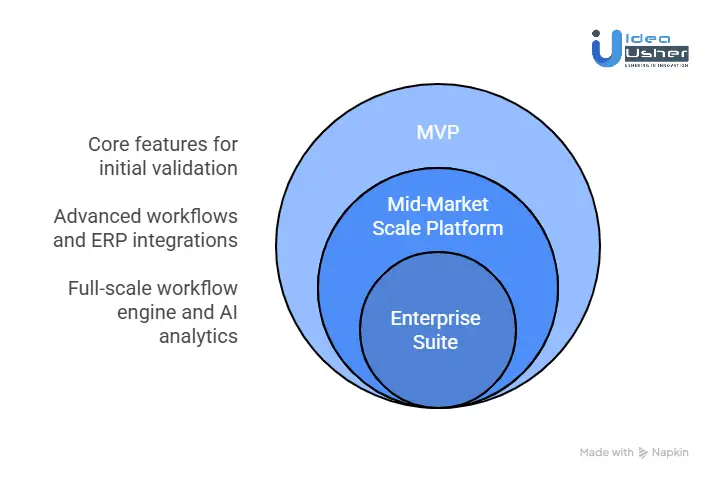
To mitigate market risk, seasoned investors favor a phased deployment, starting with an MVP that addresses core pain points before scaling into a full enterprise suite. The table below outlines the budgetary and temporal realities of building a procurement workflow platform, categorized by product maturity.
| Development Phase | Core Deliverables & Functionality | Average Timeline | Estimated Cost Range (USD) |
| Minimum Viable Product (MVP) | Basic vendor onboarding, automated purchase requisition, single-tier approval workflows, and standard PDF generation for invoices. | 4 to 6 Months | $90,000 – $150,000 |
| Mid-Market Scale Platform | Advanced conditional workflows, native ERP integrations, multi-role dashboards, contract management, and automated SLA tracking. | 7 to 11 Months | $160,000 – $320,000 |
| Enterprise Suite (ServiceNow Rival) | Full-scale workflow engine, predictive AI spend analytics, global compliance frameworks, multi-currency support, and custom API SDKs. | 12+ Months | $350,000 – $700,000+ |
In the MVP stage, the focus is purely on validating the core value proposition: accelerating the time it takes for a procurement request to clear an internal approval pipeline. As the capital injection increases into the mid-market and enterprise levels, the investment shifts from building features to optimizing scale, security, and deep system interoperability.
3. Required Team Structure
To build a reliable software solution, you need a highly coordinated engineering team. At IdeaUsher, we supply specialized, pre-vetted cross-functional professionals directly to your project to handle every layer of the architecture. This ensures faster development cycles, stronger system reliability, and smoother enterprise-scale deployment.
| Engineering Role | Core System Responsibility | Strategic Development Value |
| Workflow Automation Engineers | Code the core dynamic routing engines and build the conditional branching logic. | Guarantees rapid, bottleneck-free processing of complex corporate spend paths. |
| ERP Integration Specialists | Develop custom middleware connectors and configure secure bi-directional API pipelines. | Ensures perfect data synchronization with legacy legacy systems of record. |
| Enterprise Cloud Architects | Design containerized multi-tenant hosting environments and manage Kubernetes networks. | Guarantees high availability, rapid system scaling, and automated infrastructure recovery. |
| AI/ML Procurement Engineers | Program the document ingestion pipelines and build financial anomaly detection models. | Transforms the software into a proactive financial tool that blocks margin leakage. |
The Secret Reason Procurement Projects Go Over Budget
When you hire unvetted freelancers or traditional contract devs to build procurement software, you aren’t paying for code during the first month. You are paying for their education while your internal leads teach them how basic purchasing cycles work. Procurement software isn’t a simple social app; it requires deep domain knowledge of purchase requisitions, requests for quotes, three-way matching, and amortization schedules. If you have to spend forty hours explaining supply chain basics to a contractor, your internal team’s productivity plummets.
Cost of Onboarding Non-Specialized Talent
Hiring developers without procurement or enterprise workflow experience often creates hidden operational costs long before actual product development begins. Extended onboarding, workflow training, and constant technical supervision can slow delivery timelines, reduce internal productivity, and significantly increase overall project expenses.
| Traditional Contractor Model | IdeaUsher Domain-Ready Engineers |
| Unvetted contractor onboarding | Pre-vetted procurement-focused engineers |
| 40+ hours spent on training and alignment | Day-one operational and technical alignment |
| Slower development velocity due to ramp-up time | Faster execution with domain-ready expertise |
| Inconsistent code quality and workflow understanding | Clean, scalable, enterprise-grade code standards |
| Higher risk of delays and budget overruns | Predictable timelines and on-time delivery |
Strategic Resource Comparison
Choosing the right engineering talent directly impacts the speed, scalability, and long-term success of enterprise procurement software. Comparing traditional contractors with domain-ready procurement engineers highlights how specialized expertise can reduce onboarding delays, improve code quality, and accelerate enterprise deployment timelines.
- Traditional Contract Developers: Require extensive hand-holding, struggle with complex financial database logic, and inadvertently create architectural bottlenecks due to a lack of supply chain domain awareness.
- IdeaUsher Pre-Vetted Engineers: Arrive with a solid foundation in enterprise software requirements, handle high-compliance workflows independently, and integrate smoothly into your existing development sprints.
The IdeaUsher Difference
We eliminate the Day-Zero training tax. IdeaUsher’s developers are pre-vetted for both technical execution and business-logic adaptability, ensuring immediate alignment with your project goals. This allows your teams to accelerate development without losing valuable time on operational onboarding and workflow training.
Our Engineering Standard: We match you with software engineers who already speak the language of enterprise finance and supply chains, meaning they commit production-ready code in days, not weeks.
Your internal tech leads shouldn’t double as supply-chain teachers for temporary contractors. Hire pre-vetted, domain-ready engineers from IdeaUsher and protect your product roadmap from expensive onboarding drag.
Why Standard Devs Fail at Procurement Calculations?
If your developer is using floating-point math instead of arbitrary-precision decimals to calculate bulk supply chain purchase orders, your new custom software is quietly leaking enterprise cash every single day. In a standard application, a rounding error of a fraction of a cent does not matter.
In enterprise procurement, when you are multiplying half a million units across multi-tier regional tax codes, currency conversions, and bulk discount brackets, those microscopic errors compound into thousands of dollars of unreconciled variance on your balance sheet.
Mathematical Realities in Financial Code
Financial software operates under a completely different level of precision than standard consumer applications. In procurement systems, even microscopic calculation inconsistencies can accumulate across large transaction volumes, making accurate mathematical handling essential for maintaining audit compliance, financial integrity, and operational trust.
| Calculation Method | System Behavior | Enterprise Impact |
| Floating-Point Math | Binary fractions cause rounding anomalies like 0.1 plus 0.2 equaling 0.30000000000000004. | Creates ghost variances that fail external corporate balance sheet audits. |
| Arbitrary-Precision Math | Exact decimal handling using specialized libraries or precise database storage. | Guarantees perfect line-item reconciliation across millions of transaction units. |
Architectural Requirements
You cannot build procurement software with generalist web developers. To protect your bottom line, the core calculation engine requires a highly specialized structural blueprint. Enterprise procurement systems demand precise financial logic, scalable transaction processing, and audit-ready data handling at every stage of the workflow.
- High-Precision Storage: Configuring database fields to handle exact numeric scales rather than relying on approximate float data types.
- Immutable Financial Ledgers: Designing write-once data stores where transaction histories cannot be altered or deleted after an approval clears.
- Strict Audit Trails: Engineering automated logging frameworks that record every single tax modification and bulk discount adjustment in real time.
We do not just vet for standard coding parameters. IdeaUsher’s pre-vetted developers are screened specifically for enterprise financial logic and mathematical accuracy. When you hire from us, you get engineers who know how to build bulletproof calculation engines that eliminate compound rounding errors completely.
Our specialized developer teams ensure your system is structurally sound, passing strict corporate audits and protecting your margins from day one.
The Shadow Procurement Tax: Why UX is a Security Feature?
If your custom procurement software takes more than four clicks to submit a purchase request, your employees won’t use it. Instead, they will put the company card on a personal account to buy what they need, instantly creating a wave of unmanaged shadow spend. Many enterprise applications are built with ugly, confusing dashboards because the developers only care about backend database fields, not human behavior.
But in procurement, bad UX is a security threat. If the interface is a headache, users will bypass it entirely, breaking your internal compliance and blowing past budget caps.
How Friction Drives Compliance Failures
Even well-designed procurement policies can fail when employees encounter slow, confusing, or overly complicated workflows. As friction increases inside the platform, users are more likely to bypass official processes, creating compliance gaps, unmanaged spending, and reduced financial visibility across the organization.
| Procurement Experience | User Behavior | Business Outcome |
| Complex 10-Click Form | User frustration and workflow avoidance | Corporate policy bypass and shadow spend |
| Clean 3-Click Intake | Effortless adoption and faster approvals | Automated audit trails and stronger budget control |
UX Principles for Enterprise Platforms
A high-adoption procurement tool requires front-end engineers who treat B2B workflows with the same behavioral design principles as a consumer fintech app. It needs to feel effortless, so compliance becomes the path of least resistance. A streamlined user experience increases platform adoption while reducing the likelihood of employees bypassing approved procurement workflows.
- Frictionless Intake Fields: Minimizing open-ended typing by using smart autocomplete fields linked directly to your supplier master data.
- Contextual Action Layouts: Grouping approval buttons and expense summaries so managers can verify and sign off on requests without scrolling through dense pages of text.
- Proactive Status Visibility: Displaying clear, visual progress bars so employees can track their requests instantly without sending follow-up emails to the finance team.
At IdeaUsher, we vet our developers for system empathy, which is the ability to turn complex business restrictions into clean, intuitive digital workflows. You can hire dedicated front-end pods from us who know exactly how to design for enterprise adoption. Security and compliance only work if they are actually used.
Our engineers build front-end interfaces that guide users naturally through your policy guardrails without slowing down their daily operations.
Contact Idea Usher for a Procurement Workflow Software
Transforming your corporate spend management into a unified, high-margin asset requires the right technical partnership. At Idea Usher, we remove the friction from enterprise software engineering. With over 500,000 hours of coding experience, our team of ex-MAANG/FAANG developers is ready to architect a custom, highly scalable platform designed to meet your precise transactional demands.
Discuss Your Requirements
very enterprise operates under unique fiscal policies, regulatory frameworks, and operational structures. Because a generic template cannot support complex corporate spend, our consultation process focuses entirely on the realities of your business. This allows us to design procurement workflows that align precisely with your operational and compliance requirements.
- Process Discovery: We analyze your existing administrative hurdles, from slow multi-department sign-offs to manual invoice cross-checking.
- Architecture Mapping: Our engineers review your current IT stack to determine the best approach for real-time data flow and multi-tenant isolation.
- Risk Mitigation: We identify potential bottleneck areas in your current workflow and plan robust automation strategies to protect your bottom line.
Get a Custom Roadmap
We do not believe in speculative timelines or vague milestones. When you work with us, you receive a highly detailed technical blueprint that maps out your entire development loop from the initial schema design to the final compliance audits. This structured planning approach helps ensure predictable execution, clearer resource allocation, and smoother enterprise deployment
Our Deployment Strategy: We focus on clear execution. Your customized roadmap details the specific database models, infrastructure plans, and API integration phases required to build your platform on time and within your target budget.
This structured plan gives your leadership team full visibility into resource allocation, core module timelines, and platform launch targets. It ensures that every line of code written directly serves your core business goals.
Partner with Elite Engineers
Building software capable of handling millions of dollars in concurrent transactions requires high-level systems engineering. Our developer ecosystem is purpose-built to deliver this tier of performance for your organization. By pairing our 500,000 hours of deep coding experience with the specialized knowledge of engineers from top-tier tech environments, we build applications that scale effortlessly.
We enforce clean-code methodologies, deploy modern containerized cloud frameworks, and embed bank-grade encryption protocols directly into your software. Partnering with Idea Usher means gaining a reliable, elite technical extension of your team dedicated to turning your procurement infrastructure into a major competitive advantage.
Conclusion
Building a procurement platform like ServiceNow requires a strategic blend of dynamic workflow orchestration, secure ERP integration, and automated document processing. By establishing a robust relational database schema and a highly scalable cloud infrastructure from the start, you eliminate operational data silos and margin leakage. Ultimately, transforming fragmented purchasing loops into an optimized, unified digital system drives long-term compliance and predictable enterprise efficiency.
FAQs
Q1: What are the costs to build custom procurement software?
A1: Developing an enterprise procurement platform requires a variable engineering investment depending entirely on the overall system scope. Basic intake and approval orchestration systems represent an initial entry-level cost allocation, while adding intelligent AI document pipelines requires a larger dedicated engineering investment. Additionally, building secure custom data connectors for legacy ERP suites like SAP or Oracle adds a significant premium per integration module based on the complexity of the data mapping.
Q2: How long does it take to deploy a procurement MVP?
A2: A functional minimum viable product focused on core request intake and basic approval workflows usually takes several months to properly plan and build. This timeframe includes an initial dedicated phase for database schema design and architecture mapping, followed by an extensive development cycle of core backend and dashboard coding. Extending the application with deep enterprise ERP integrations and multi-tenant security testing will require an additional block of specialized engineering months.
Q3: Why is bi-directional ERP integration critical?
A3: A procurement platform cannot operate effectively as a standalone data silo because spending decisions must constantly validate against core corporate ledgers. Bi-directional API syncing ensures that whenever an invoice settles or a purchase order is approved, general ledger cost centers and supplier master records update instantly across systems like NetSuite, SAP, or Oracle. This automated communication eliminates manual data entry mistakes and protects financial data integrity across the entire company.
Q4: How does AI automation lower purchasing friction?
A4: Integrating artificial intelligence into the core database architecture removes manual document validation bottlenecks by reading and processing receipts automatically. Optical character recognition pipelines extract unstructured data from incoming invoices into clean payloads, while validation engines cross-reference those figures against original purchase orders. Machine learning models then analyze these logs to flag pricing anomalies, duplicated bills, or unauthorized spend before corporate funds leave the company.