 (+971) 8007 4267
 (+91) 946 340 7140
 (+1) 628 432 4305

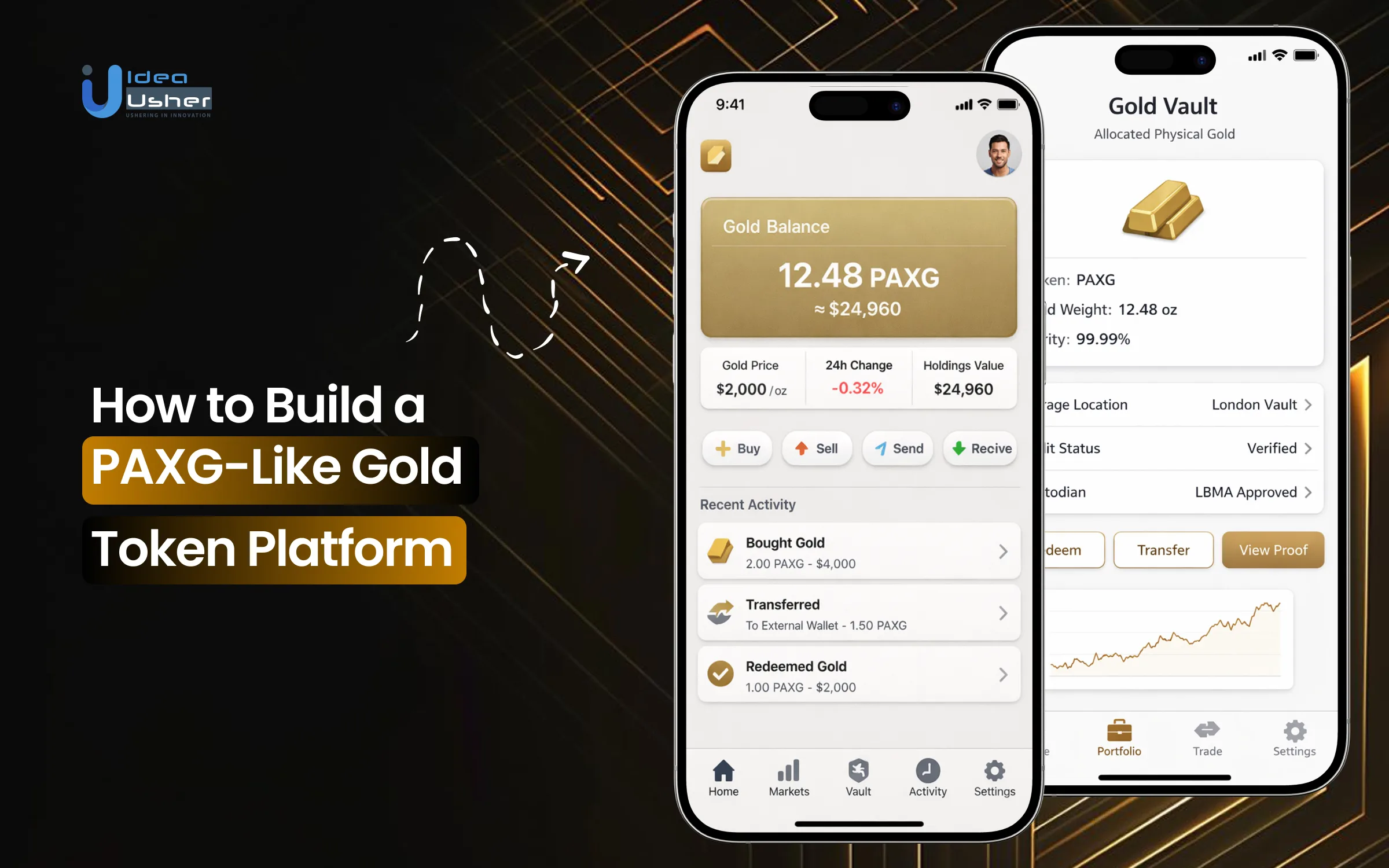
Gold has always held value, but using it efficiently often felt slow. Selling physical gold could take days, and verification often depended on intermediaries. These inefficiencies quietly created demand for gold token platforms. As finance moved toward real-time settlement, this friction became harder to ignore.
Tokenization introduced a practical shift by keeping gold physically vaulted while enabling fractional ownership and on-chain transfers. Ownership could be verified against audited reserves, and settlement could happen almost instantly. That balance explains why institutional tokenized gold models gained traction.
We’ve developed numerous gold tokenization solutions over the years, powered by blockchain smart contract systems and proof-of-reserve oracle infrastructure. Thanks to this expertise, we’re sharing this blog to discuss the steps to develop a PAXG-Like gold token platform. Let’s start!
Key Market Takeaways for Gold Token Platform
According to Future Market Insights, the market infrastructure supporting gold token platforms is expanding steadily. Token display and transparency systems are projected to grow from about USD 420 million in 2026 to nearly USD 1.17 billion by 2036, driven by rising demand for digital interfaces that can clearly represent real-world assets on the chain.

Source: Future Market Insights
Tokenized gold has moved into a more mature phase. Market capitalization has grown from under USD 500 million to over USD 3 billion, with daily trading volumes exceeding USD 200 million. These platforms enable fractional ownership, continuous liquidity, and verifiable reserves, making gold more usable as a hedge during periods of equity and currency volatility.
Leadership in this segment is concentrated. PAX Gold, issued by Paxos, maintains a strict 1:1 backing with LBMA-approved gold stored in London vaults and is actively traded on exchanges such as Binance and Coinbase. Tether Gold remains the largest by market capitalization at around USD 2.2 billion, offering deep fractionalization and Swiss-vaulted custody.
Together, these platforms account for over 90 percent of the gold-backed crypto market, with momentum reinforced by derivatives initiatives such as Paxos partnering with Deribit to launch PAXG futures and options, which crossed USD 250 million in notional volume in their first week.

What is the PAXG Platform?
The PAXG Platform is a regulated digital asset infrastructure operated by Paxos Trust Company. It connects physical gold ownership with blockchain-based settlement by tokenizing real gold bars held in professional vaults.
At its core, the platform combines a legal trust framework, insured vaulting infrastructure, and the Paxos web dashboard, which allows verified users to mint, redeem, and manage gold-backed tokens with full transparency.
Unlike ETFs or physical coins, the PAXG platform focuses on direct ownership and on-chain control, offering tools designed for digital asset users.
1. Gold Bar Lookup Tool
One of the most distinctive user-facing features is the gold bar lookup system. Because PAXG uses an allocated gold model, users can enter their Ethereum wallet address to view the exact gold bar exposure backing their tokens. This includes the bar serial number, purity, and weight, and the vault location where the gold is stored.
2. Physical Redemption
The platform supports gold-on-demand redemption, allowing tokens to be burned in exchange for real gold. Users can redeem full balances for 400 oz London Good Delivery bars, or convert smaller amounts through Paxos-approved retail partners into coins or smaller bars, maintaining a direct link between digital and physical gold.
3. Instant Minting and Burning
Through the Paxos Dashboard, verified users can mint and burn tokens with minimal friction. Users may mint PAXG by depositing USD or unallocated gold, and burn PAXG to convert holdings back into USD or Loco London gold, all within a controlled and compliant interface.
4. Fractional Ownership
The platform enables fractional gold ownership starting at 0.01 troy ounce, making institutional-grade gold accessible to retail investors. This structure enables gradual accumulation strategies, such as dollar-cost averaging, similar to how users approach digital assets and equities.
5. 24/7 Global Portability
Because PAXG is an ERC-20 token on Ethereum, it can move globally at any time without physical transport. Users may also use PAXG as collateral on DeFi and trading platforms, extending gold’s utility beyond storage to active financial use.
6. Zero Storage Fees
Unlike a bank safety deposit box or a gold ETF (which often charges an annual management fee of 0.25%–0.40%), the Paxos platform charges no ongoing storage fees. Users pay only a small fee (0.02%) when moving tokens on the blockchain, or a creation/redemption fee when using the Paxos portal.
How Does the PAXG Platform Work?
PAX Gold represents a carefully engineered integration of the timeless value of physical gold with the efficiency of blockchain infrastructure. At its core, one PAXG token equals one fine troy ounce of investment-grade gold. This is not a symbolic link. It is a direct legal entitlement to physical gold held in custody by Paxos Trust Company, a regulated financial institution.
The system is designed to create a transparent, auditable, and real-time bridge between physical gold bars and digital ownership on blockchain rails.

Physical Gold in Regulated Vaults
The credibility of PAXG begins with how its gold is stored and governed.
- Direct ownership: Holding PAXG means owning a specific portion of allocated gold bars, not a pooled claim or fund share. Each token corresponds to physical metal held in custody.
- Institutional grade vaulting: All gold is stored in London Bullion Market Association-accredited vaults in London. LBMA standards define global benchmarks for gold purity, handling, and security.
- Monthly independent audits: Gold reserves are audited monthly by third parties. This ensures the total gold in vaults always matches the total PAXG supply, reinforcing proof of reserves and trust.
PAXG as an Ethereum Token
On the blockchain side, PAXG is issued as an ERC 20 token on Ethereum.
- Fractional ownership: Gold ownership becomes highly accessible. Tokens can represent fractions as small as 0.01 troy ounces, removing traditional minimum investment barriers.
- Instant settlement: Transfers settle in minutes rather than days. This eliminates the T+2 settlement delay common in gold ETFs and traditional bullion markets.
- Self-custody and DeFi compatibility: PAXG can be held in self-custody wallets and integrated into DeFi protocols for lending or yield strategies, while still remaining fully gold-backed.
Minting and Redemption
PAXG is designed to move seamlessly between physical and digital form.
Minting: When gold is deposited into approved vaults, an equivalent amount of PAXG is minted on chain. Buying PAXG on supported exchanges gives exposure to this fully backed supply.
Redemption rights
PAXG holders retain direct redemption rights, which is a major structural advantage.
- Physical redemption: PAXG can be redeemed for LBMA Good Delivery gold bars, typically suited for institutional-scale holders.
- Cash redemption: Any holder can redeem PAXG for USD at the prevailing gold market price, without taking delivery of physical gold.
Regulation and Cost Structure
PAXG’s trust model is anchored in regulation, not marketing.
- Regulatory oversight: Paxos operates under the supervision of the Office of the Comptroller of the Currency, imposing strict compliance, capital, and consumer protection requirements.
- No settlement or credit risk: Because transactions settle on the chain, counterparty default risk is effectively removed.
- Cost efficiency: PAXG has no storage fees for holders. Vaulting and insurance costs are absorbed by Paxos, making it structurally more efficient than many ETFs and physical gold products.
What is the Business Model of the PAXG Platform?
Paxos operates PAX Gold (PAXG) as a regulated blockchain infrastructure service, rather than a speculative crypto product. The core idea is simple but powerful. Paxos combines asset tokenization, regulated custody, and on-chain settlement into a single platform for commodities like gold.
The model is designed for low-friction access for both retail and institutional users across major exchanges and wallets, with compliance overseen by the New York State Department of Financial Services.
Minting and Redemption Fees
Paxos charges fees when users mint or redeem PAXG directly through its platform. These fees cover gold sourcing, vault storage, insurance, and operational processing, ensuring the token remains fully backed at all times.
On-Chain Transaction Fees
Every PAXG transfer automatically incurs a 0.02 percent smart contract fee. This creates continuous network-level revenue, even when Paxos is not directly involved in minting or redemption. At scale, annual volumes of around 700 million dollars can translate into millions in recurring fees.
Ancillary and Platform Services
Additional revenue comes from custody services, brokerage infrastructure for partners, and institutional integrations.
PAXG also contributes to Paxos’ diversified income, alongside stablecoin products such as USDP, which has maintained roughly 1 billion dollars in supply, and the historical BUSD program, which peaked at roughly 16 billion dollars, generating substantial interest-based income.
Financial Performance and Cost Structure
Following the 2023 market reset, Paxos restructured operations with approximately 20 percent staff reduction, improving efficiency and operating leverage. Revenue is driven primarily by interest on reserves, transaction fees, and brokerage services, while capital expenditures remain low given the platform’s software-first approach.
There is no heavy physical infrastructure ownership, as vaulting is handled through specialized custodial partners. Paxos has publicly stated it maintains a very strong financial position, operating near break-even without immediate fundraising pressure.
Funding and Capital Strength
Paxos has raised over $ 500 million in total funding, including a $ 300 million Series D in April 2021 at a $ 2.4 billionvaluation.
The round was led by Oak HC FT, with participation from PayPal Ventures, Mithril Capital, and others. Additional strategic investors in expanded rounds include Bank of America, Coinbase Ventures, Founders Fund, and FTX.
This capital base has supported platform scaling, regulatory expansion, liquidity programs, and global licensing initiatives, including efforts toward a national trust bank and a Singapore MPI license. As a result, PAXG growth is cushioned against crypto market volatility, supported by strong balance sheet fundamentals.
How to Build a PAXG-Like Gold Token Platform?
A PAXG-like gold token platform is built by first anchoring legal ownership to audited physical gold held with regulated vault custodians. Smart contracts should then mint and burn tokens only when verified reserve data confirms coverage, and transfers could be restricted by compliance logic.
Over the years, we have delivered several PAXG-style gold tokenization platforms tailored to institutional requirements.

1. Legal Foundation
We start by structuring trusts, SPVs, or regulated custodial entities that legally hold the physical gold. The setup is designed to be bankruptcy-remote so the underlying gold remains protected regardless of the operating company’s financial position. This ensures token holders retain clear legal ownership rights from the outset.
2. Vault Integration
We integrate LBMA-compliant vault infrastructure by connecting directly with vault APIs and inventory systems. Gold bar serial numbers, weights, and purity details are captured at the system level, enabling continuous alignment between physical holdings and on-chain supply.
3. Gold Allocation Engine
We build the physical-to-digital allocation layer that links tokens to specific gold bars. Fractional ownership logic allows precise portions of each bar to be represented on-chain. Real-time reconciliation ensures vault records and blockchain data remain synchronized at all times.
4. Smart Contracts
Our team develops secure smart contracts with embedded compliance controls. We help clients choose between ERC-20 or ERC-1155 architectures based on control and reporting needs. Core functions such as mint, burn, freeze, and rescue are built in to support governance, security, and regulatory intervention.
5. Proof of Reserves
To prevent over-issuance, we implement proof-of-reserve mechanisms via oracle integrations with vault systems. Audit data is synchronized with the minting logic, so new tokens are issued only after verified gold reserves are confirmed.
6. Interfaces & Redemption
We complete the platform with user and enterprise interfaces that provide transparency and operational control. Gold lookup dashboards allow holders to verify bar-level details, while structured redemption workflows support both retail and institutional redemption with full auditability.
Is Physical Redemption Mandatory for Credibility in Gold Token Platforms?
A gold token platform makes a simple but powerful pledge. One token equals a defined quantity of physical gold. Redemption is the only actionable proof of that pledge.

Proof of Reserves Stress Test
Audits reflect reserves as of a point in time. A redemption request is a real-time test initiated by the user. It verifies liquidity, operational readiness, and the actual availability of gold. Any platform that fails or delays redemption immediately loses credibility.
Closing the Trust Loop
Blockchain explains the digital side. Vault reports explain custody. Redemption connects both worlds, allowing a complete cycle from fiat to token to physical gold. This closed loop is what converts a digital IOU into a legitimate ownership claim.
Psychological Assurance
Most holders may never take delivery, but knowing redemption is possible removes doubt. It reassures investors that the gold is real, allocated, and accessible rather than a paper promise.
The Redemption Spectrum
Redemption does not follow a single format. Credible platforms usually offer tiers to serve different investor profiles, with physical delivery as the highest standard.
| Redemption Tier | Typical User | Credibility Impact | Example |
| Physical bar redemption | Institutions and high net worth investors | Highest. Proves allocated, deliverable bullion exists | PAX Gold supports LBMA 400 oz bar redemption |
| Cash or fiat redemption | Retail and institutional investors | High. Implies real backing through market liquidation | Tokens can be sold for USD or EUR at spot price |
| No redemption policy | Not applicable | Low or none. Raises immediate doubts about backing | Fails the core asset backed test |
While cash redemption supports liquidity, physical bullion redemption is the ultimate signal of credibility. It proves the platform deals in allocated LBMA Good Delivery gold rather than pooled or unallocated claims.
Building Credibility Beyond the Redemption Button
Although redemption is mandatory, it must operate inside a broader trust framework. Redemption alone is not sufficient.
- Regulated custody: Gold must be held by a licensed and regulated custodian, separate from the platform operator. This structure ensures legal protection and bankruptcy remoteness.
- Frequent and transparent audits: Reserves should be verified by independent top-tier auditors, with reports published regularly and made accessible to users.
- On-chain transparency: Users should be able to monitor token supply and view attestations linking circulating tokens to audited vault holdings.
A platform that offers physical redemption but fails on custody, audits, or transparency will still struggle to earn lasting trust. True credibility emerges only when redemption, regulation, and verification work together as one system.
How do Gold Token Platforms Prevent Double-Spending of Physical Gold?
Gold token platforms prevent double-spending by using allocated gold custody, where each token is linked to a specific serialized bar held by a regulated custodian. Tokens can only be minted after vault confirmation and must be burned immediately when redemption occurs, so supply always stays aligned.
Allocated vs Unallocated Gold
The first and most critical safeguard lies in how the physical gold is legally held.
| Gold Holding Model | How It Works | Double Spend Risk |
| Unallocated pooled gold | Users hold a general claim on a pooled reserve without ownership of specific bars | Higher risk. The same ounce could back multiple claims if records fail. This is effectively an IOU system |
| Allocated gold model | Each token maps to a specific serialized gold bar or a defined fraction of it | Extremely low risk. A unique bar can only be linked to one set of on chain tokens |
Allocated custody is the bedrock of double-spend prevention. Each bar carries a unique serial number, which acts as the physical world equivalent of a blockchain transaction ID.
The Three-Layered Defense System
Credible platforms never rely on a single control. They deploy three mutually reinforcing layers of protection.
1. Legal and Custodial Firewall
This is the most important non-technical safeguard.
- Bankruptcy-remote custody: The gold is held by a regulated, independent custodian, not bythe platform operator. Even if the operating company fails, token holder gold remains legally protected.
- Segregated allocated accounts: Gold is recorded in segregated accounts on the custodian’s ledger, fully separated from any other assets the custodian manages.
2. Operational Ledger Synchronization
This layer ensures physical gold and digital tokens move in perfect lockstep.
- Minting gatekeeper: Tokens are minted only after the custodian confirms that a specific bar has been deposited and allocated. No gold means no tokens.
- Redemption burn mechanism: When gold is redeemed for cash or physical delivery, the corresponding tokens are permanently burned on chain. Token supply always mirrors vault holdings.
- Continuous reconciliation: Backend systems constantly reconcile the custodian ledger with blockchain balances to prevent drift or mismatch.
3. Transparency and Audit Spotlight
Trust must be independently verifiable.
- Third-party attestations: Regular audits by established accounting firms confirm that vaulted allocated gold equals or exceeds tokens in circulation.
- On-chain verification: Token supply, mint events, and burn events are fully visible on public blockchains and can be independently verified by anyone.
- Granular gold lookup tools: Some platforms allow users to view the exact serial numbers of the bars backing the tokens in their wallet, providing individual-level proof of ownership.
The Ultimate Safeguard: The Redemption Test
All safeguards are designed to withstand the most extreme scenario. Simultaneous mass redemption.
If a platform had double-spent its gold reserves, this event would immediately expose the flaw as multiple users attempt to claim the same ounce.
Platforms built on allocated custody, audited reserves, synchronized ledgers, and enforced redemption can meet this demand because each token corresponds to a specific, immutable physical asset.
This is why redemption is not a feature. It is the final operational proof that the physical gold double-spend problem has been fully solved.
How Can Gold Token Platforms Profit Without Storage Fees?
For gold token platforms, the no-storage-fee promise strongly attracts users by removing a traditional cost barrier and making digital gold feel more efficient than vault-based ownership.
The business remains sustainable because these platforms have evolved beyond custody to financial infrastructure, generating revenue from minting, redemption, liquidity flows, and enterprise usage rather than from charging users to simply hold gold.

1. Minting and Redemption Fees
This is the most direct and predictable revenue stream. It works like a processing spread on the bridge between physical gold and digital tokens.
PAX Gold provides a clear example. The issuer charges approximately 0.05 percent to 0.10 percent when physical gold is deposited to mint tokens, and a similar fee when tokens are redeemed back into gold or cash.
At scale, this becomes significant. For a 2 billion dollar tokenized gold supply, a 0.10 percent minting fee on 1 billion dollars of new inflows generates 2 million dollars in revenue.
These fees are not arbitrary. They directly fund gold assay, insured logistics, vault audits, and blockchain settlement costs, while still leaving a margin on the infrastructure service itself.
2. Treasury Management & Financial Engineering
This model leverages professional balance sheet management rather than user fees.
Tether Gold illustrates this approach well. The issuer applies conservative treasury strategies to both cash and gold flows inside the ecosystem.
Cash management yield
Funds received from token sales before final gold settlement can be placed in low-risk, interest-bearing instruments such as U.S. Treasury bills.
In Q1 2023, Tether reported 1.5 billion dollars in net profit, driven largely by treasury yields on government securities. This demonstrates how powerful this model can be at scale.
Institutional gold market participation
In wholesale bullion markets, short-term secured lending of physical gold is standard practice. Even modest annualized rates can create meaningful revenue without compromising full allocation or client backing.
3. B2B Licensing and Ecosystem Fees
As gold tokens mature, the infrastructure itself becomes the product.
For example, LODE follows a strong enterprise-focused strategy. Through products such as AGX Coin and AUX Coin, LODE enables white-label issuance of gold and silver tokens for communities, companies, and financial institutions.
Revenue is generated through platform setup fees, licensing agreements, and ongoing service charges. This shifts the business model from retail-trading dependence to recurring B2B revenue, with growthtied to partner onboarding rather than market speculation.
Conclusion
Building a PAXG-like gold token platform is not about releasing another crypto asset but about shaping a regulated financial system on blockchain rails. The work should focus on aligning legal custody and implementing precise smart contract controls to enable trust to form naturally over time. IdeaUsher helps enterprises design and integrate PAXG-like platforms with institutional-grade security and compliance, enabling the model to scale steadily and generate durable liquidity.
Looking to Develop PAXG-Like Gold Token Platform?
IdeaUsher helps by architecting a PAXG-like gold token platform that tightly connects regulated vault custody with on-chain execution. Our team will carefully design allocation logic, proof-of-reserve systems, and compliance layers to ensure the token supply always reflects physical gold.
With over 500,000 hours of coding experience, our team of ex-MAANG/FAANG developers specializes in the deep tech that makes platforms like PAXG stand out:
- Bankruptcy-Remote Architecture: We design the legal-tech framework so your users’ gold is truly theirs, safeguarded from operational risk.
- The “Allocation Engine”: We build the proprietary backend that dynamically maps fractional tokens to specific, serialized gold bars in LBMA-accredited vaults.
- DeFi-Ready & Frictionless: We engineer for zero-fee interoperability, making your gold token a productive asset on Aave, Uniswap, and beyond.
- Real-Time Proof of Reserve: Go beyond PDF audits. We implement live transparency dashboards and Oracle-fed verification.
Check out our latest projects to see the caliber of fintech and Web3 platforms we deliver.


FAQs
A1: A PAXG-like platform is built on allocated gold ownership, where each token is legally tied to specific vaulted bars. This structure can quietly strengthen enforceability and transparency by updating reserve data in near-real time. The difference usually shows up when trust matters and systems must scale without ambiguity.
A2: Regulatory approval is essential when a platform targets institutional or cross-border markets. Compliance frameworks should align with custody licensing requirements, token-issuance rules, and reporting standards. This foundation can steadily reduce friction and support long-term adoption.
A3: PAXG-like tokens can be used in DeFi when smart contracts support clean interoperability and reliable oracle feeds. These tokens should integrate smoothly into lending and collateral systems. Proper design can safely extend gold utility beyond storage.
A4: Platforms usually earn revenue through minting and redemption flows, along with enterprise integrations. DeFi participation can also generate protocol-level activity-based income. This model can gradually scale without placing pressure on end holders.


