 (+971) 8007 4267
 (+91) 946 340 7140
 (+1) 628 432 4305

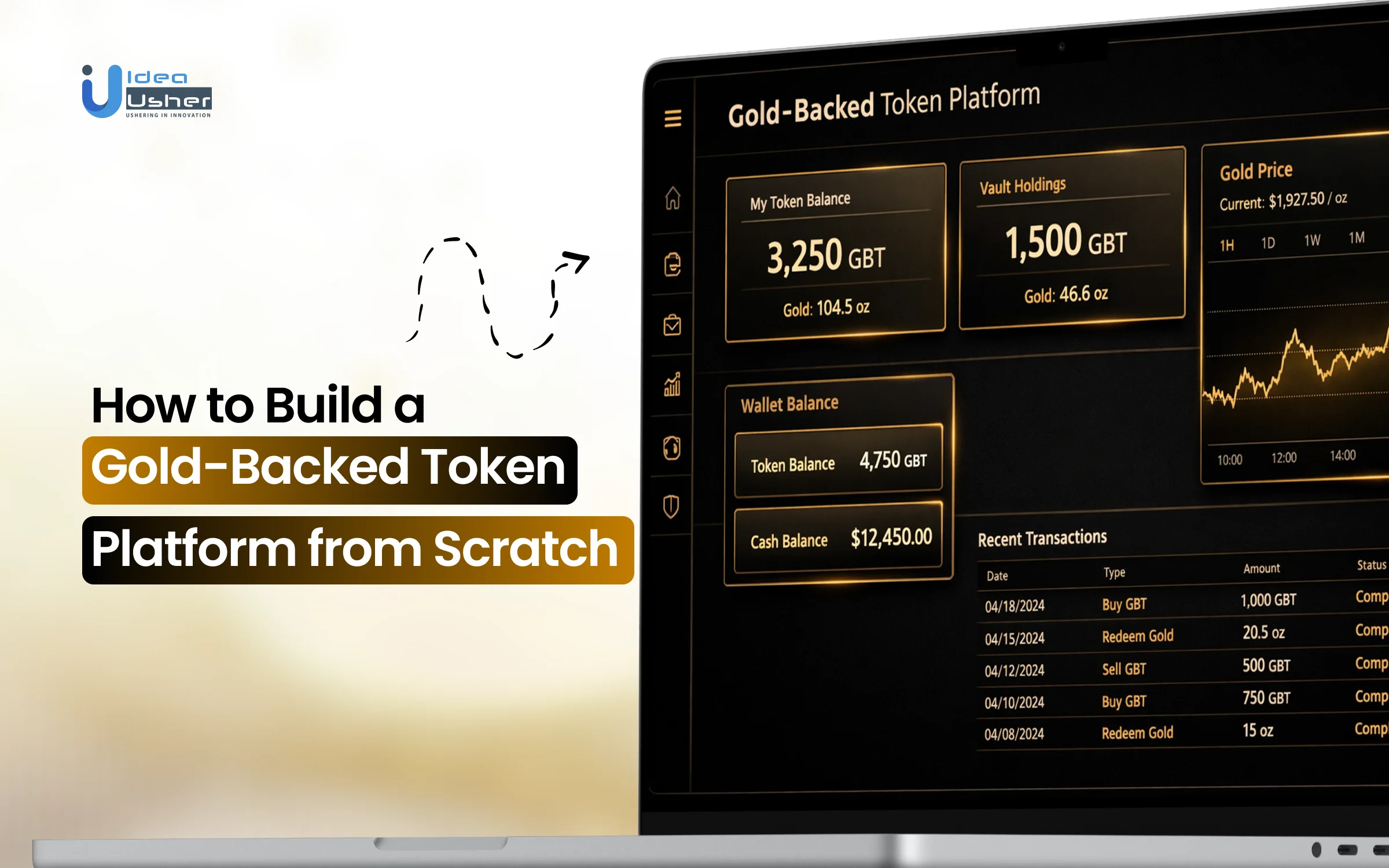
Holding value has never been the hard part for gold investors. Exiting cleanly often became difficult when liquidity depended on physical handling or manual approvals. Many discovered that stability quietly introduced friction when flexibility was needed. Investors retained ownership but lost exit flexibility, which led to wider acceptance of gold-backed token platforms.
Tokenization could enable fractional exits, near-instant transfers, and rules-driven liquidity while remaining anchored to physical reserves. The technology did not invent demand, but it effectively removed constraints that had existed for decades.
Over the years, we’ve developed numerous gold-backed token platforms that leverage technologies such as on-chain proof-of-reserve oracle frameworks and specialized smart contract architectures. Drawing on this experience, this blog outlines practical steps for building a gold-backed token platform from the ground up. Let’s start.
Key Market Takeaways for Gold-Backed Token Platforms
According to Fortune Business Insights, the tokenization market is moving steadily from niche adoption to measurable scale. Valued at USD 3.32 billion in 2024, it is expected to reach USD 3.95 billion in 2025 and grow to USD 12.83 billion by 2032, reflecting an 18.3 percent CAGR. Within this broader momentum, gold-backed token platforms are gaining disproportionate attention because they combine a familiar hedge asset with blockchain efficiency.

Source: Fortune Business Insights
Gold-backed tokens are seeing rapid uptake, with the tokenized gold market reaching over USD 4 billion in value by late 2025, up from below USD 500 million at the start of the year.
This sharp rise reflects growing demand for digitally accessible gold that maintains price stability while offering on-chain portability. Investors are increasingly viewing these platforms as a practical alternative to physical bullion.
Strategic partnerships are accelerating this trend. In December 2025, Global Settlement Holdings partnered with Ubuntu Tribe to tokenize more than USD 5 billion in gold via the MiCA-compliant GIFT token.
Similarly, BlocPal International collaborated with VNX Commodities to launch BPG1, a gold-backed token representing one ounce of physical gold distributed via regulated exchanges and OTC channels.

What Is a Gold-Backed Token Platform?
A gold-backed token platform is a system that represents physical gold as blockchain tokens backed by real reserves. Each token reflects verified gold held in secure vaults, allowing ownership to be transferred or redeemed without moving the asset. This approach combines custody, proof-of-reserves, and smart contracts to make gold more liquid and transparent.
Types of Gold-Backed Token Platforms
Gold-backed token platforms usually fall into custodial, proof-driven, institutional, or DeFi-enabled models. Some may rely on regulated vault partners, while others could use on-chain reserve verification to reduce trust gaps. The right structure often depends on compliance needs, liquidity goals, and the expected level of token circulation.
1. Custodial Gold Token Platforms
These platforms issue tokens backed by physical gold stored in regulated vaults and managed by trusted custodians. A well-known example is Paxos Gold, where each token represents one fine troy ounce of gold held in LBMA-approved vaults.
2. Non-Custodial or Proof-of-Reserve Platforms
These platforms rely on on-chain verification and transparent reserve proofs rather than pure custodial trust. Digix is a notable example, using proof-of-asset frameworks to link token supply directly to audited gold reserves.
3. Institutional and Enterprise Platforms
Designed for regulated entities, these platforms prioritize compliance, reporting, and large-scale issuance. Perth Mint Gold Token serves institutional investors by issuing tokens backed by gold held by a government-owned mint.
4. Hybrid DeFi-Integrated Platforms
These platforms allow gold-backed tokens to be used within DeFi ecosystems while remaining physically backed. Tether Gold is commonly integrated across exchanges and DeFi protocols, enabling gold to function as programmable collateral.
5. Retail-Focused Investment Platforms
Built for individual investors, these platforms focus on accessibility, fractional ownership, and simple redemption flows. Comtech Gold is an example that targets retail users by combining regulated gold custody with easy digital access.
How Do Gold-Backed Token Platforms Work?
Gold-backed token platforms store physical gold in regulated vaults and mirror it on the blockchain via smart contracts. Each token represents a precise weight of gold and can move instantly once reserves are verified.

1. Legal and Custodial Trust
Before any blockchain logic exists, trust is established in the physical and legal world.
The Vault
Reputable platforms partner with LBMA-certified vaults located in politically stable regions such as Switzerland, Singapore, or London. These facilities are fully insured, continuously monitored, and subject to strict auditing standards. This gold is not pooled casually. Each bar is identifiable and professionally stored.
The Legal Wrapper
Gold is typically held inside a bankruptcy-remote Special Purpose Vehicle. This structure ensures the gold remains legally isolated from the operating company. Even if the platform fails, token holders retain full claim over the underlying gold.
The Audit Evolution
Independent auditors verify holdings on a recurring basis. However, the industry is shifting away from static PDF audit reports toward live cryptographic verification, which in turn leads to tokenization.
2. Tokenization on the Blockchain
This is where physical gold gains a digital counterpart. For every verified gram or ounce stored in the vault, a matching on-chain token is created.
The Token Standard
Most platforms use ERC-20 on Ethereum or SPL tokens on Solana. The industry, however, is moving toward ERC-3643, which enables regulatory rules and identity checks to be enforced directly at the token level.
Minting and Burning Logic
- Minting happens only after the custodian confirms the gold deposit. Smart contracts then issue tokens at a fixed ratio, such as one gram equals one token.
- Burning occurs during redemption. Tokens are destroyed on-chain, and the vault releases the equivalent amount of physical gold.
This ensures no token can exist without gold and no gold can be claimed twice.
3. Oracles and Proof of Reserve
This layer is the technical heart of the system. Blockchains cannot natively see vaults. To bridge this gap, platforms rely on decentralized oracle networks such as Chainlink.
Real-Time Attestation: Oracles pull cryptographically signed inventory data directly from vault systems and submit it on-chain. This data cannot be altered without detection.
Proof of Reserve Smart Contracts
A dedicated contract continuously compares:
- Total tokens in circulation
- Total gold held in custody
The results are displayed publicly in real time. Any imbalance becomes immediately visible, enforcing a powerful principle: do not trust, verify.
4. Trading, Earning, and Redeeming
Once tokens are live, gold becomes programmable capital.
24 by 7 Trading: Users can transfer or trade gold tokens globally without waiting for market hours or intermediaries.
DeFi Utility
This is where tokenized gold goes beyond traditional ownership.
- Tokens can be used as collateral in lending protocols such as Aave or Maker, unlocking liquidity without selling gold.
- Some platforms distribute protocol fees back to holders, creating yield-generating gold exposure.
Physical Redemption
Through a compliant user interface, holders can redeem tokens for physical delivery. Platforms manage insurance, logistics, and compliance. Many support fractional redemption, making gold ownership practical rather than symbolic.
How to Build a Gold-Backed Token Platform?
We build gold-backed token platforms by first anchoring them to regulated custody and verifiable reserves. Smart contracts are then engineered to securely mint, burn, and restrict transfers while compliance rules can operate on the chain.
We have built many gold-backed token platforms over the years, and this is the approach we follow.

1. Regulated custody
We start by partnering with LBMA-approved vault providers and defining clear custody and insurance structures. Our team establishes audit processes that continuously validate physical reserves. This ensures every token issued is backed by verified and protected gold.
2. Proof of reserves
We design a proof-of-reserve layer that connects vault inventory data to the blockchain. Decentralized oracles independently validate reserve balances before any minting occurs. Supply controls are enforced to ensure tokens do not exceed actual gold holdings.
3. Compliant contracts
We develop smart contracts using regulated token standards that support identity verification and transfer rules. Minting and burning logic is built with strict compliance checks. This allows the platform to operate within regulatory boundaries across jurisdictions.
4. Redemption flows
We automate token-burn-to-physical-gold-redemption workflows. Integration with logistics and insurance partners enables secure global delivery or vault withdrawal. Fractional redemption is supported to serve different user segments.
5. Omnichain utility
We extend the platform across multiple chains using secure cross-chain messaging. Tokens can be used for approved DeFi use cases such as collateralization. Security and reserve integrity are maintained across all environments.
6. Platform control
We deliver dashboards that show real-time reserve status and token supply. Admin tools enable compliance reporting and access management. This gives clients full operational oversight as the platform scales.
How Is Physical Gold Legally Linked to the Digital Token?
Physical gold is legally linked to a digital token through a dedicated trust or SPV that owns the gold on behalf of token holders.n The smart contract may act as the official ownership ledger, and it usually reflects each holder’s enforceable share in the vaulted asset.
This structure can reliably ensure that every token issued corresponds to real gold held under regulated custody.

1. The Gold Is Not Owned
This is the single most critical legal safeguard. The company operating the platform does not own the gold. Instead, the gold is purchased and held by a legally independent SPV or Trust created solely for this purpose.
Why this matters: This separation creates bankruptcy remoteness. If the platform company faces insolvency, lawsuits, or operational failure, its creditors have no legal claim over the gold. The gold remains protected for token holders only.
2. Token Represents a Beneficial Interest
When a user purchases a gold-backed token, they are not buying gold from the company. Legally, they are acquiring a beneficial ownership interest or a co-ownership share in the SPV’s gold pool.
Simple analogy: The SPV exists to hold gold and nothing else. Each token functions as a digital share certificate representing proportional ownership of that gold pool.
3. The Legal Ownership Ledger
The blockchain is not merely a technical layer. It serves as the authoritative register of ownership. The smart contract’s balance records represent the legally recognized allocation of gold ownership within the SPV. The ledger is immutable, auditable, and transparent. In effect, the smart contract becomes the single source of truth for ownership distribution.
The Legal Lifecycle of a Gold Token
To understand how this works in practice, consider a user purchasing a token.
Gold Acquisition and Custody
The SPV purchases physical gold and deposits it with an LBMA-approved custodian, such as Brinks or Loomis in a regulated jurisdiction. Custody agreements define storage, insurance, audits, and segregation.
Legal Documentation and Opinions
The SPV’s ownership of the gold is formally recorded. A legal opinion letter issued by a reputable law firm confirms that:
- The SPV is bankruptcy remote
- Token holders have a direct and enforceable claim on the gold
- The structure complies with applicable securities, commodities, and financial regulations.
This documentation is foundational. Without it, tokenization lacks legal force.
Token Minting as the Legal Link
When a user purchases tokens, the SPV uses their funds to acquire additional gold.
Tokens are minted only after the custodian confirms receipt of the gold. The smart contract’s minting function is authorized exclusively by the SPV.
Crucially, the smart contract address is explicitly referenced in the SPV’s governing documents, legally binding the on-chain token to off-chain ownership.
Redemption and Enforcement
When tokens are redeemed, the user is exercising their legal right as a beneficial owner of the SPV’s assets.
The SPV is obligated under its constitutive documents to instruct the custodian to release the corresponding amount of gold. Burning the tokens on the chain serves as the digital proof of claim execution.
Why This is Stronger Than a Simple “Promise to Pay”
Many confuse gold-backed tokens with a simple liability or IOU from the issuing company. The SPV structure is fundamentally different and far more secure:
| Feature | Company IOU (Unsecured Claim) | SPV Backed Token (Proprietary Claim) |
| Asset Ownership | Gold sits on the issuing company’s balance sheet. | A legally separate SPV owns gold. |
| Your Legal Position | You are an unsecured creditor and must queue with others if the company fails. | You are a beneficial owner of the SPV’s assets, and the gold is held specifically for you. |
| Bankruptcy Risk | High because company assets may be seized to satisfy creditors. | Minimal because the SPV’s assets are ring-fenced and legally protected. |
This structural difference turns the token from a company obligation into a direct ownership claim backed by segregated physical gold.
The Role of Regulation & Modern Legal Frameworks
Well-designed platforms do not avoid regulation. They are the architects for it.
- MiCA in the EU defines asset-referenced tokens with strict reserve, custody, and disclosure rules
- DABA in Bermuda provides a clear licensing regime for digital asset issuers and custodians
- US state money transmitter laws govern fiat on ramps and redemption flows
Compliance is not a constraint. It is a defensive moat that protects users and strengthens trust.
Is It Possible to Tokenize Different Grades or Forms of Gold?
When people think of gold tokenization, they often envision uniform 400-ounce London Good Delivery bars stored in high-security vaults. But gold exists far beyond bullion. It lives in family heirlooms, rare collectible coins, industrial components, and even electronic waste.
The answer is a definitive yes. Blockchain technology now enables the tokenization of virtually any form or grade of gold, reshaping how ownership, liquidity, and value move across the entire gold ecosystem.

1. Standardized, Fungible Gold
Forms: LBMA standard bars, such as 1kg or 100oz bars, along with accredited mint coins like American Eagles and Canadian Maples.
How it works: Identical gold units are pooled inside a vault. Each token represents an equal undivided share of the pool; for example, one token equals one gram of 99.99 percent fine gold. Tokens are fully fungible, meaning each unit is interchangeable with any other unit.
Use case: This is the model used by major gold-backed tokens, including PAX Gold and Tether Gold. It is ideal for investment exposure, active trading, and DeFi integrations.
2. Differentiated Pools.
Grades and forms: 24 karat jewelry scrap, dental gold, industrial byproducts, 22 karat coins, or gold sourced from ESG-certified mines.
How it works: Gold is segregated by purity, form, or origin into distinct reserve pools, each governed by its own smart contract and token. A single user might hold multiple tokens, each tied to a different pool.
- Token A is backed by 99.99 percent investment-grade bars.
- Token B is backed by 99.0 percent recycled industrial gold.
- Token C is backed by ethically sourced green gold.
Use case: This structure enables price differentiation. Ethically sourced gold, or lower-refining-cost gold, can trade at a premium or discount, creating specialized and transparent markets.
3. Non-Fungible Tokenization
Forms: A specific serialized gold bar, a rare numismatic coin, a high-value jewelry piece, or gold-based art.
How it works: Each physical item is linked to a non-fungible or semi-fungible token that represents that exact object. The token metadata typically includes high-resolution images, serial numbers, assay certificates, provenance history, purity, and weight.
Use case: This model enables fractional ownership of high-value collectibles, secured lending against unique gold assets, and real-time provenance tracking. For example, multiple investors can co-own a single rare coin collection through fractional NFTs..
Real World Applications and Market Opportunities
| Gold Form | Token Model | Unique Value Proposition |
| Jewelry Scrap and E Waste | Differentiated Fungible Pool | Unlocks value from idle gold and supports a sustainable circular economy |
| Rare Collectible Coins | Fractionalized NFT | Democratizes access to numismatics and enables shared ownership of high-value assets |
| Ethical Green Gold | Premium Fungible Token | Appeals to ESG-focused funds and investors and trades at a verifiable premium |
| Industrial Gold Wire and Plating | Discounted Fungible Pool | Provides cost-efficient raw material exposure for manufacturers and investors |
| Specific Serialized Gold Bars | Unique NFT | Enables institutional-grade auditing where ownership of a specific bar can be proven in real time |
Successful Business Models for Gold-Backed Token Platforms
Gold-backed token platforms succeed when revenue scales naturally with usage, trust, and asset growth. The strongest models align platform earnings with real economic activity rather than speculation. Below are three proven business models that have already demonstrated sustainability in real markets.
1. The Transaction Fee Model
This is the most widely adopted model in gold tokenization. Platforms earn revenue by charging a small percentage fee on every transaction involving gold-backed tokens. These fees typically range from 0.1 percent to 0.5 percent and apply to token purchases, sales, and transfers.
Financial Mechanics and Statistics
Paxos Gold maintains roughly 500 million dollars in assets under tokenization through its PAXG token. Gold-backed tokens typically experience 2-3 times annual turnover, meaning they change hands multiple times per year.
- Assuming a conservative 0.25 percent transaction fee, estimated annual revenue would be:
- 500M AUM × 2.5 annual turnover × 0.25 percent fee = 3.125 million dollars per year
This excludes additional income from custody or enterprise services.
2. The Premium Subscription Model
This model offers basic tokenization services at low or zero cost while monetizing advanced capabilities through paid subscriptions. These services may include institutional-grade custody, enhanced security controls, advanced trading tools, enterprise APIs, priority redemptions, or premium support.
The result is predictable recurring revenue and stronger long-term customer relationships.
Financial Mechanics and Statistics
Kinesis Money uses a hybrid model with premium membership tiers. Its Velocity Tier subscriptions range from $ 15 to $ 50 per month, offering higher yields and enhanced benefits.
With approximately 100,000 active users, assuming 10 percent adoption at an average 30-dollar monthly fee, estimated subscription revenue equals:
100,000 users × 10 percent × 30 dollars × 12 months = 3.6 million dollars annually
3. The Yield Generation Model
This model transforms tokenized gold from a static store of value into an income-generating financial asset. Platforms facilitate lending and borrowing against gold collateral or integrate with decentralized finance protocols. Revenue is generated from interest rate spreads or a percentage of the yield produced.
Some platforms also explore controlled rehypothecation or institutional lending, with strict transparency and reserve limits.
Financial Mechanics and Statistics
Aurus enables gold-backed tokens to be used as collateral in lending markets offering 4 to 12 percent annual interest. The platform typically captures 20 to 30 percent of the yield.
With 75 million dollars in tokenized gold, assuming 25 percent utilization at an 8 percent average interest rate, and a 25 percent platform share, estimated annual revenue equals:
75M × 25 percent × 8 percent × 25 percent = 375,000 dollars per year
Meld Gold has outlined institutional lending models projecting annual revenue of $ 1.2 to $ 2 million per $ 100 million in tokenized gold, assuming higher utilization and institutional lending premiums.
Top 5 Gold-Backed Token Platforms in the USA
We did some digging and quietly explored how gold is moving onto the blockchain in practical ways. A few gold-backed token platforms stood out for their thoughtfully engineered custody models and on-chain controls.
1. Kinesis Gold (KAU)

Kinesis Gold combines physical gold backing with a monetary system that enables spending, transfers, and the earning of yield on gold-denominated assets. The platform focuses on making gold usable as a transactional asset rather than just a store of value..
2. VeraOne (VRO)

VeraOne issues gold-backed tokens that represent direct ownership of insured physical gold stored in high-security vaults. The platform emphasizes legal clarity, asset segregation, and long-term wealth preservation rather than short-term trading.
3. Comtech Gold (CGO)

Comtech Gold is a Sharia-compliant gold token backed by physical bullion and governed by established Islamic finance principles. It caters to investors seeking faith-aligned digital exposure to gold with transparent custody and redemption processes.
4. Matrixdock Gold (XAUM)

Matrixdock Gold is an institution-oriented gold token backed by vaulted physical reserves and supported by third-party verification. It is structured for professional investors seeking transparent reserve reporting and enterprise-grade custody standards.
5. Paxos Gold (PAXG)

PAX Gold is issued by a New York–regulated trust company and gives token holders legal ownership of specific LBMA-accredited gold bars. Its strong regulatory standing in the US makes it a preferred option for institutions and compliance-focused investors.
Conclusion
Gold-backed token platforms are among the most practical and enterprise-ready applications of blockchain today. They combine the assurance of physical gold with the efficiency of digital systems, supporting compliant growth and real revenue models. With the right architecture, custody setup, and regulatory design, a business can confidently move into the next phase of asset tokenization. IdeaUsher can steadily support this journey from early technical decisions through to secure large-scale deployment.
Looking to Develop a Gold-Backed Token Platform?
IdeaUsher can help design a gold-backed token platform grounded in secure architecture and real-asset verification. The system may integrate on-chain custody workflows, proof-of-reserves, and compliant token logic from the outset. This approach can steadily support scalability, operational trust, and long-term platform reliability
Why Partner with Us
- 500,000 plus hours of mastery: A seasoned team of former MAANG and FAANG engineers applies deep technical rigor across smart contracts and scalable blockchain systems.
- Beyond basic tokenization: Real-time asset attestation is implemented through decentralized oracles to maintain clear one-to-one backing on the chain.
- Compliance by design: KYC and AML logic is embedded into token standards such as ERC 3643 to support secure and compliant operations.
- Full cycle delivery: Architecture design, custodian integration, multi-chain deployment, and redemption flows are delivered as a unified system.
Together, this approach helps build platforms that operate on trust and scale with confidence.


FAQs
A1: Gold-backed token platforms represent direct ownership of specific physical gold rather than synthetic price exposure. The asset exists on-chain with verifiable reserves and may be redeemed for vaulted bullion. This structure can offer more transparency and operational flexibility than ETF models.
A2: Gold-backed tokens can be designed to align with regulatory expectations when appropriate standards and controls are in place. With compliant token standards, regulated custody, and KYC frameworks, they can operate within defined legal boundaries. The design must deliberately support jurisdiction-specific rules.
A3: These platforms can generate revenue across several technical and operational layers. Transaction processing, custody services, and enterprise integrations may contribute predictable income streams. Some platforms can also participate in DeFi markets in a controlled manner.
A4: Physical redemption is not always mandatory from a technical standpoint. However, offering redemption can materially strengthen trust and perceived asset legitimacy. Many platforms may include it as an option to support long-term credibility.


