


Key Takeaways
- A digital car financing platform connects dealerships, buyers, lenders, banks, and credit unions through one connected financing ecosystem.
- Core features include digital applications, lender matching, credit decisioning, F&I management, financing comparison, e-signatures, and funding tracking.
- Development covers dealer workflows, financing journeys, decisioning engines, lender APIs, CRM/DMS integrations, security controls, and pilot optimization.
- A multi-lender architecture enables smart application routing, real-time lender responses, offer comparison, deal structuring, and centralized financing management.
- U.S. compliance can involve GLBA, FCRA, ECOA, identity verification, and electronic-signature requirements, depending on the platform’s role and financing model.
- Development costs range from $65,000 for MVPs to $700,000+ for enterprise platforms, depending on lender integrations, DMS connectivity and platform scope.
A vehicle purchase can reach the final stage and still stall at financing when lender portals, paperwork, and F&I workflows remain disconnected. This friction delays approvals, complicates offer comparison, and creates buyer drop-offs at the point of purchase. A digital car financing platform for dealerships can connect lenders, buyers, and dealers through one streamlined financing workflow, improving speed and conversion.
Modern auto-finance platforms combine multi-lender connectivity, prequalification, automated credit decisioning, payment calculators, document collection, e-KYC, e-signatures, fraud detection and real-time application tracking while integrating with dealership CRM, desking and F&I systems. The goal is not another standalone finance tool, but a connected infrastructure layer that can streamline the path from vehicle selection to funding.
In this blog, we will talk about how to build a digital car financing platform for dealerships, its core features, compliance requirements, development cost factors and how IdeaUsher can help you build a scalable automotive fintech platform that streamlines financing workflows, improves dealer efficiency, and delivers seamless digital experiences for car buyers.
Why Dealerships Are Moving Toward Digital Auto Finance
The global automotive finance market is expanding from $325.6 billion toward $505.6 billion by 2031 at a 7.6% CAGR, as vehicle retail shifts toward digital-first and omnichannel retailing, the finance department has evolved from a back-office administration unit into the primary engine of dealer profitability.
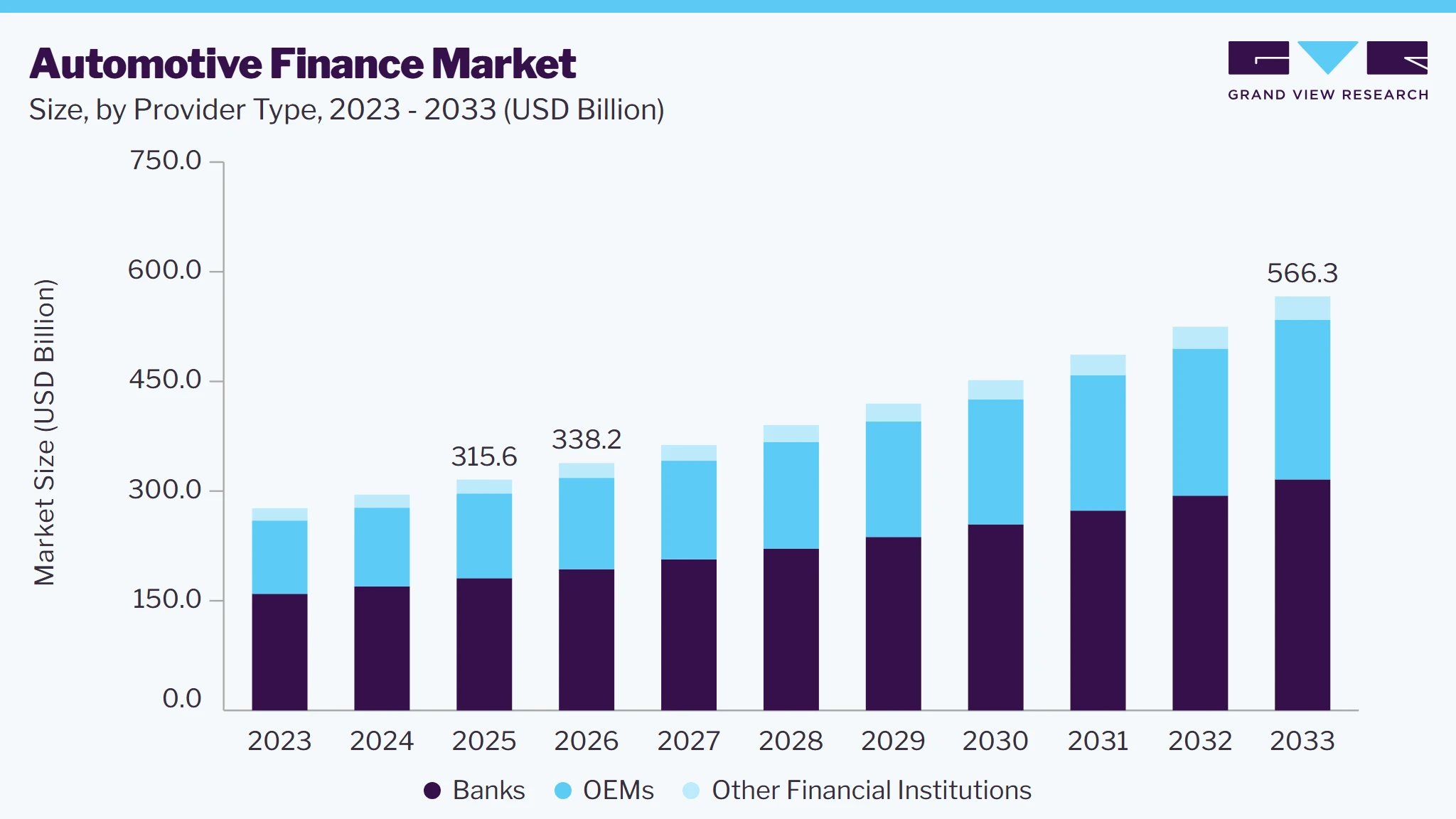
Historically, dealership financing relied on slow paper workflows and fragmented systems. Today, digital auto finance platforms help eliminate funding bottlenecks and support multi-lender financing. Cox Automotive’s 2026 study found 48% of buyers want to apply for credit online, versus 33% who currently do, revealing a clear digital adoption gap.
A. Where Traditional Dealership Financing Breaks Down
Legacy dealership financing relies on disconnected software and manual handoffs, resulting in transaction friction that damages close rates and extends “contracts-in-transit” (CIT) cycles:
- Fragmented Lender Portals & Manual Data Re-Entry: Finance managers manually re-enter credit data across Dealertrack, RouteOne, captive lenders, and credit unions, driving up errors. 97% of dealers report buyers repeat online steps in-store, with 70% re-doing them for accuracy.
- Slow Credit Decisions & Manual Submissions: Batch processing, manual stipulations, and disconnected lender systems cause lengthy approval delays. Digitizing credit workflows saves buyers an average of 30 minutes at the dealership.
- Disconnected F&I Processes & Menu Fatigue: Customers may spend 50–90 minutes waiting for F&I, where static paper menus can create friction. 40% wanted to select F&I products online, but only 16% actually did, exposing a significant digital F&I gap.
- Limited Application Visibility & Funding Delays: Untracked income, residence, and insurance stipulations delay approval and funding, extending contracts-in-transit to 3–7 business days. With 86% of 2025 auto finance contracts eligible for digital submission, automated funding offers significant value.
B. How Digital Finance Connects the Dealership Workflow
A connected digital finance workflow gives dealerships greater control over customer data, lender interactions, F&I processes, contracting, and funding, while reducing repetitive tasks that slow transactions and affect the buyer experience.
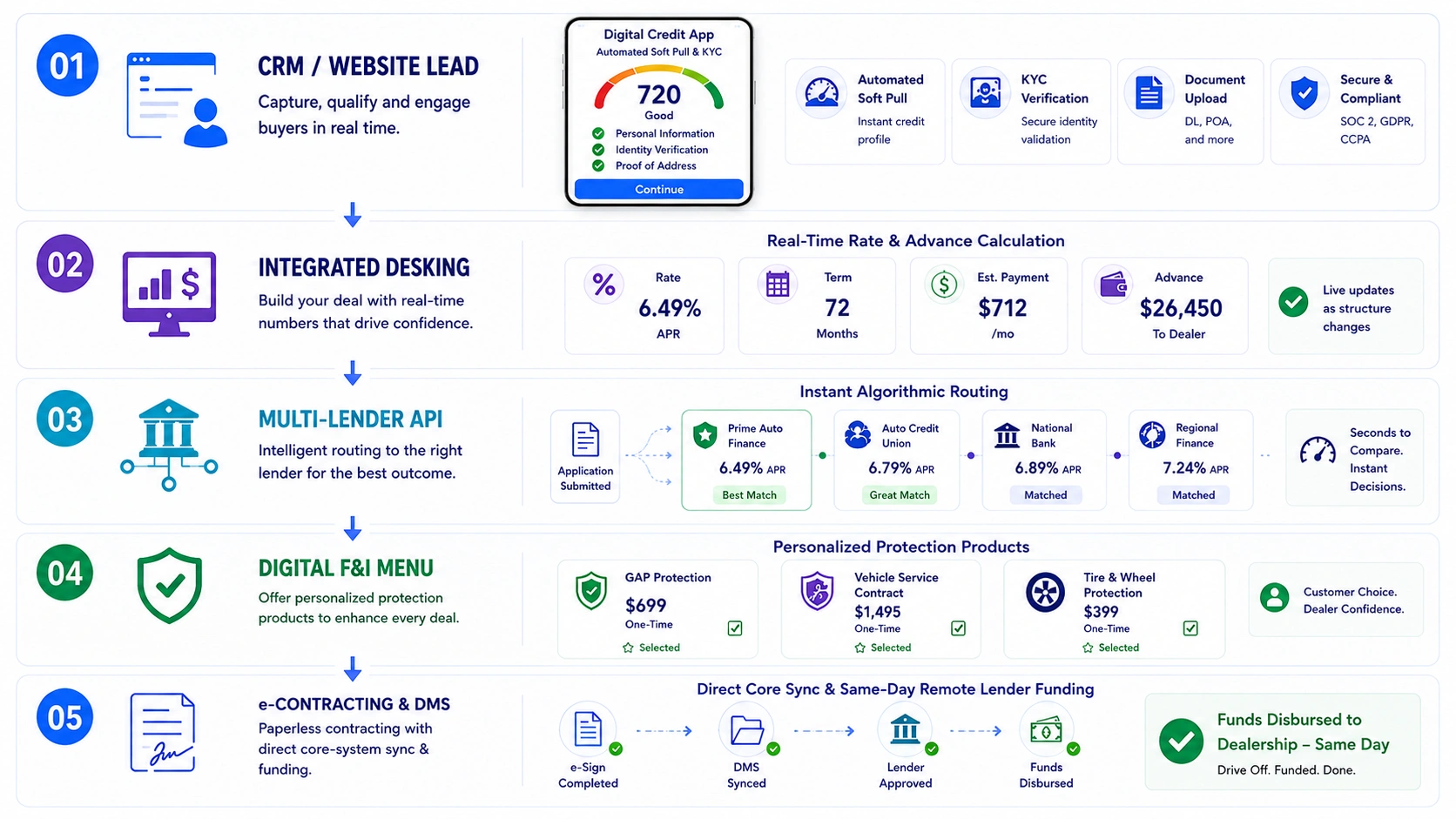
A unified, dealer-controlled digital finance platform creates an unbroken data thread across the showroom floor, website, and back-end accounting systems:
| Process Step | Legacy Dealership Workflow | Digital Auto Finance Platform |
| Credit Application | Paper form or standalone web lead form. | Single digital credit app with automated identity and KYC verification. |
| Lender Matching | Manually submitted one-by-one to select lenders. | Automated decisioning engine routing to optimal prime, near-prime, and subprime tiers. |
| F&I Structuring | Manual paper menu presentation. | Interactive, personalized digital menu based on vehicle warranty history and buyer profile. |
| Contracting & Funding | Physical wet signatures and mailed packages. | e-Signatures, automated stipulation capture, and same-day direct deposit funding. |
| System Sync | Manual CSV/re-typing into DMS. | Bi-directional bi-sync with CRM, Desking tools, and Dealership Management Systems (DMS). |
The shift to digital finance is already producing measurable results, with buyers and dealers reporting stronger demand for online financing, greater efficiency, and better experiences across connected retail workflows.
- Single-Source Ingestion: Consumer credit details flow from digital retailing directly into CRM, desking tools, and DMS without redundant entry. Research found 83% of dealers report customers repeat online steps in-store, highlighting the value of connected data.
- Algorithmic Lender Routing: The platform compares LTV, DTI, vehicle age, and credit tiers against lender policies to identify suitable financing structures. 87% of buyers explored financing before visiting a dealership, reinforcing the need for early digital lender matching.
- Integrated e-Contracting: Digital signatures and document capture reduce re-contracting errors and streamline funding workflows. Buyers who signed paperwork online saved 38 minutes at the dealership, demonstrating the operational value of digital contracting.
C. Why Enterprises Are Investing in Digital Car Finance Platforms
Automotive dealer groups, original equipment manufacturers (OEMs), and fintech enterprises are investing heavily in modern finance technology to drive measurable operational and financial returns:
- Accelerated Funding Velocity & Cash Flow: Digital origination can reduce approval times from 7 days to 2.5 days or less, with same-day funding compressing CIT cycles and freeing floorplan credit.
- Higher Back-End F&I Gross Profit: Digital menus and AI-assisted product recommendations can raise F&I margins to 18%–25% on financed vehicles, increasing VSC, GAP, and maintenance-package penetration.
- Operational Cost Reduction: Cloud-based digital F&I platforms can reduce dealership administrative overhead by 15%–22% by eliminating courier costs, paper archiving, and manual compliance audits.
- Superior Omnichannel Customer Experience: With 71% of North American dealerships adopting digital F&I, transparent payment-building across online and in-store channels can improve retention, repeat purchases, and CSI scores.
The Enterprise Takeaway: Digital auto finance platforms transform the slowest part of the car-buying process into a strategic profit center. By integrating multi-lender decisioning, digital F&I menus, and automated e-contracting with core DMS systems, dealerships can reduce overhead, accelerate cash flow, and deliver a frictionless retail finance experience.

What Is a Digital Car Financing Platform for Dealerships?
A dealership car financing platform (also referred to as an automotive lending software or Auto F&I platform) is a digital technology solution that connects auto dealers, car buyers, and automotive lenders to streamline vehicle loan origination, credit underwriting, and financing approvals.
Operating as an intermediary engine within a dealership’s Finance & Insurance (F&I) department, the platform automates credit score pulls, matches buyers with optimal lending partners (captive lenders, banks, credit unions), generates compliant loan contracts, and facilitates e-signing, all at the point of sale.
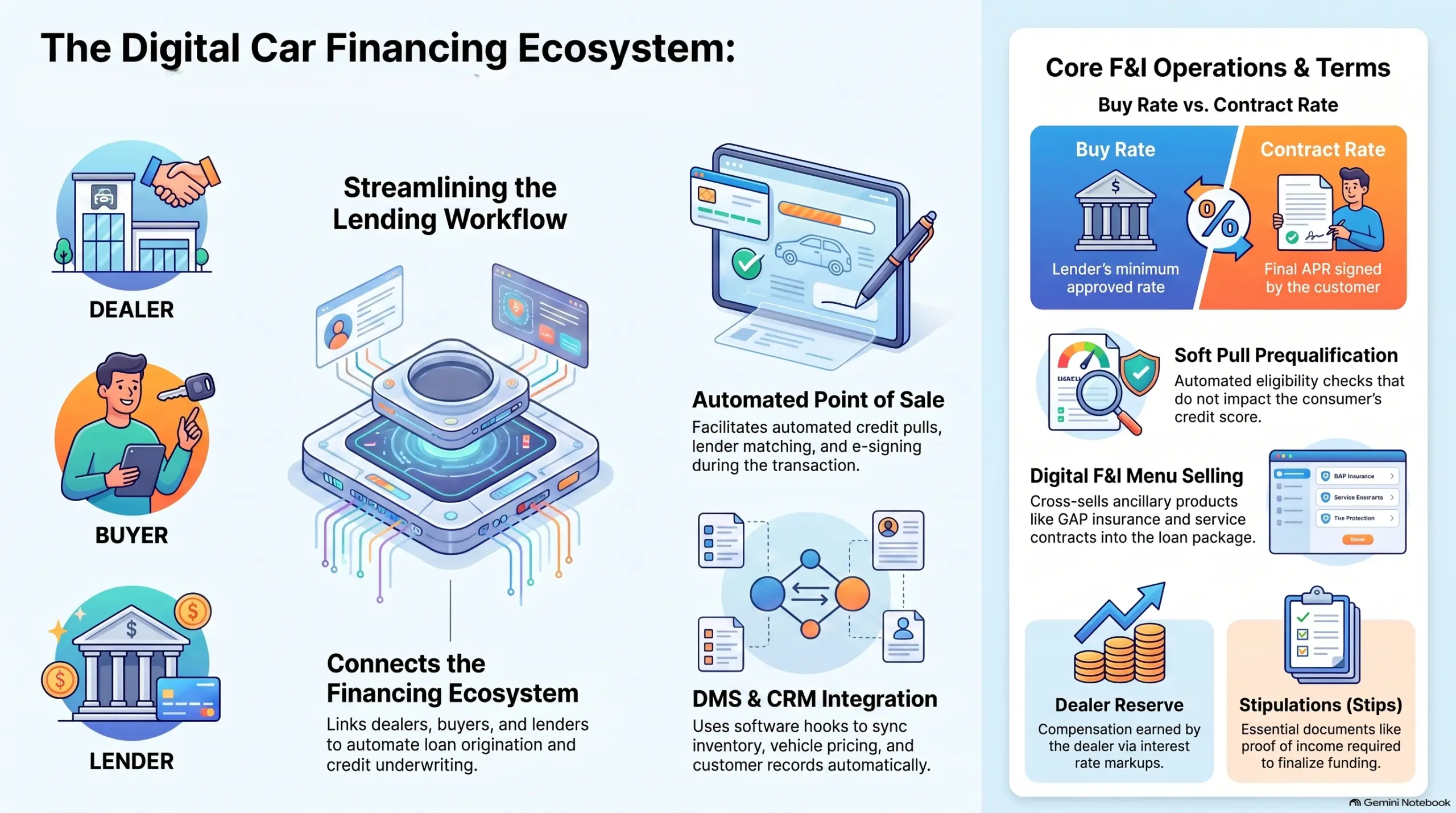
These core terms help explain how dealership finance platforms connect lending workflows, dealer operations, credit processes, and F&I activities into one digital financing ecosystem.
- Dealer Reserve (Interest Rate Markup): The compensation a dealership earns by acting as an intermediary, offering a loan rate slightly higher than the lender’s wholesale buy rate.
- Buy Rate vs. Contract Rate: The Buy Rate is the minimum interest rate a lender approves for a borrower; the Contract Rate is the final APR presented to and signed by the customer.
- DMS & CRM Integration: Direct software hooks connecting the platform with a dealership’s Dealer Management System (DMS) and Customer Relationship Management (CRM) tools to sync inventory, vehicle pricing, and customer records.
- Soft Pull Prequalification: An initial automated credit check executed online or via mobile that checks credit eligibility without hurting the consumer’s credit score.
- F&I Menu Selling: Digital menu software within the platform used to cross-sell ancillary protection products (e.g., GAP insurance, extended vehicle service contracts, tire/wheel protection) directly into the loan package.
- Stipulations (Stips): Documents required by lenders to finalize loan funding (such as proof of income, proof of residency, or driver’s license copies).
How the Digital Auto Finance Marketplace Works
A digital auto finance marketplace connects customers, dealerships, lenders, and financing systems through one streamlined workflow, simplifying credit applications, lender matching, deal structuring, digital contracting, approval tracking, and funding from start to finish.
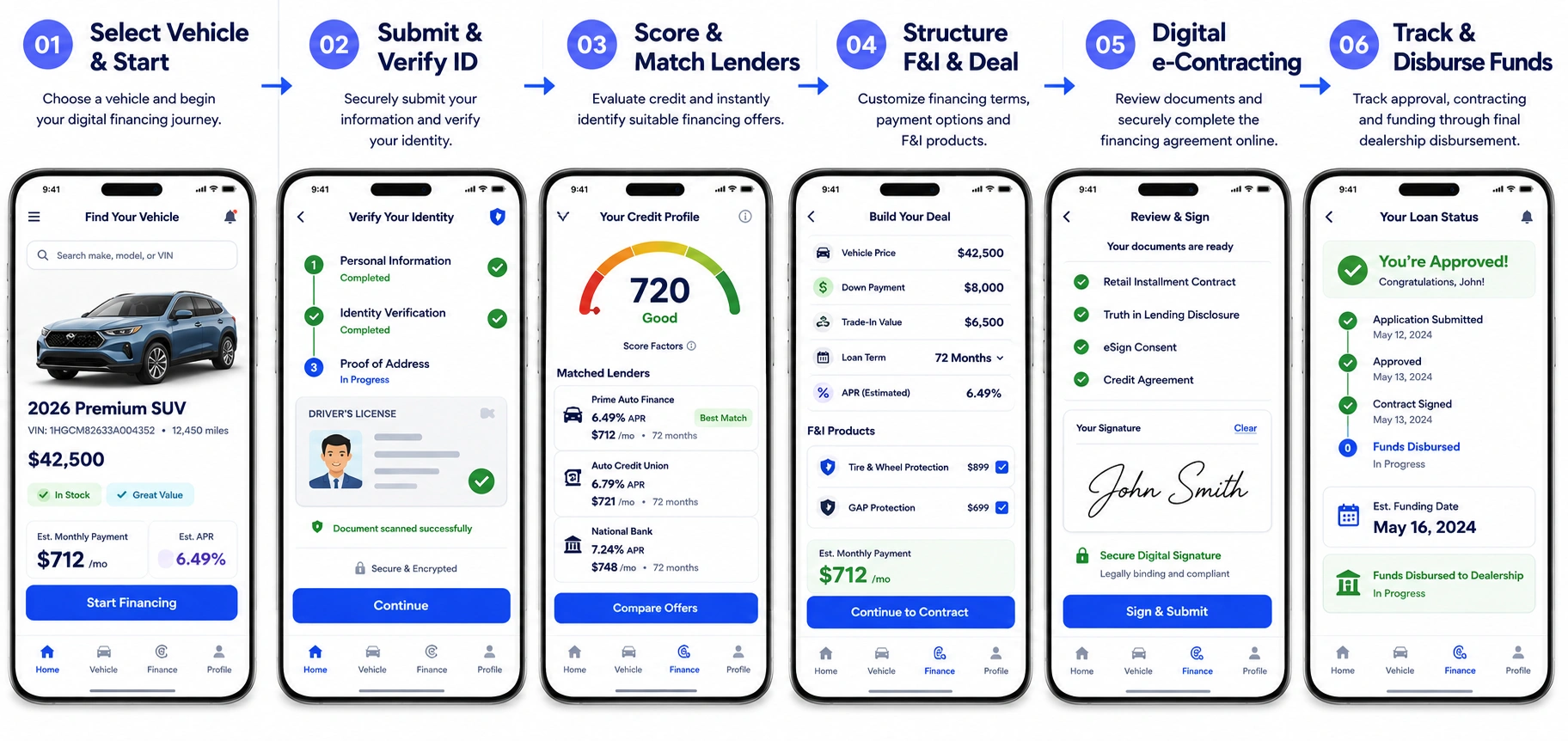
1. Select Vehicle & Start Financing
The customer selects a new or pre-owned vehicle from live dealership inventory or a showroom portal. The platform captures vehicle details, VIN valuation, loan amount, trade-in equity, and down payment preferences to initialize the financing profile.
2. Submit & Verify the Credit Application
Customers complete a streamlined application through mobile, desktop, or showroom kiosks. The platform performs KYC/CIP, fraud screening, consent logging, and secure document collection for income, driver’s licenses, and insurance.
3. Evaluate Credit & Match Lenders
The decision engine runs soft or hard bureau inquiries and evaluates borrower risk against configurable underwriting rules. Applications are automatically routed to prime, near-prime, and subprime lenders, maximizing approval potential without manual re-entry.
4. Compare Offers & Structure the Deal
F&I teams use a centralized dashboard to compare lender offers, buy rates, LTV limits, and terms. Managers can adjust dealer reserve, add GAP, warranties, and service contracts, and present transparent financing options.
5. Complete Digital Contracting
After offer selection, the platform generates compliant loan agreements and dealership documents. Integrated e-signature workflows aligned with ESIGN and UETA enable secure remote or in-store contract execution.
6. Track Approval, Funding & Disbursement
Following signing, the platform validates deal packages and sends funding documents directly to the lender’s LMS. Real-time status tracking covers lender review, contract validation, and final ACH disbursement to the dealer.
What are the Core Features of Digital Car Finance Platform
A digital car financing platform for dealerships must connect the entire financing workflow, from digital applications and lender matching to deal structuring, contracting and funding, while fitting into existing dealer systems and reducing manual F&I work. The following features showcase what makes a dealership finance platform competitive in today’s digital automotive market.
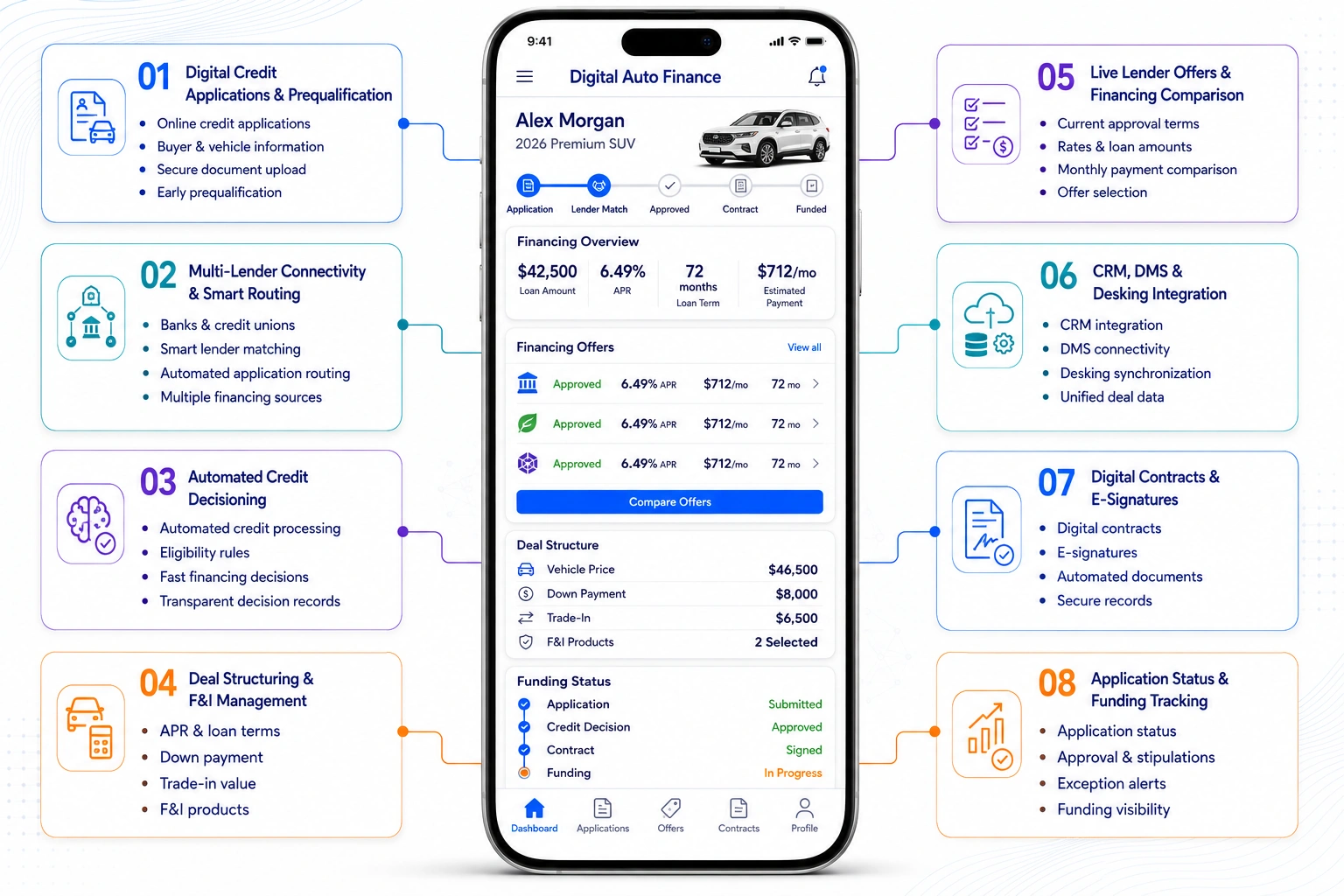
1. Digital Credit Applications and Prequalification
Digital credit applications let buyers submit financial details, vehicle information and required documents online before or during dealership interactions. Prequalification can provide an early view of eligibility, reduce paperwork and give dealers cleaner application data for faster financing workflows.
2. Multi-Lender Connectivity and Smart Lender Routing
Multi-lender connectivity lets dealerships access banks, credit unions and other financing partners through one platform. Smart lender routing can evaluate borrower, vehicle and deal data against lender criteria, directing applications toward suitable financing sources instead of requiring separate lender portals.
3. Automated Credit Decisioning and Loan Eligibility
Automated credit decisioning processes credit data, borrower information, vehicle details and lender eligibility rules to accelerate financing decisions. The platform should support configurable decision workflows, real-time or near-real-time responses and transparent decision records without removing required lender controls.
4. Deal Structuring and F&I Management
Deal structuring gives finance managers a centralized workspace to configure loan terms, APR, down payment, trade-in value, payment options and F&I products. The platform should let dealers adjust deal structures while maintaining lender requirements, pricing rules and compliance controls.
5. Live Lender Offers and Financing Comparison
Live lender offers allow dealers to present available financing options using current approval terms, rates, loan amounts and repayment conditions. A comparison interface helps buyers evaluate eligible offers while giving finance managers greater control over offer presentation and deal selection.
6. CRM, DMS and Desking System Integration
CRM, DMS and desking integrations connect financing with existing dealership operations instead of creating another isolated workflow. Synchronizing customer, vehicle, deal and F&I data reduces duplicate entry, improves application accuracy and lets finance teams manage deals from familiar systems.
7. Digital Contracts and E-Signatures
Digital contracting moves approved financing from offer selection to completed documentation without relying on physical paperwork. E-signatures, electronic contracts, automated document workflows and secure record storage can shorten deal completion while creating an auditable financing trail for dealers and lenders.
8. Application Status and Funding Tracking
Application tracking provides dealers and customers with visibility across submission, lender review, approval, stipulations, contracting and funding. Status updates, exception alerts and lender responses help finance teams identify stalled applications quickly and coordinate outstanding requirements until disbursement.
How to Build a Digital Car Financing Platform
The digital car financing platform development for dealerships requires more than developing a loan application. Our developers must connect dealership workflows, lender networks, credit decisioning, compliance controls and digital contracting into one scalable financing ecosystem.
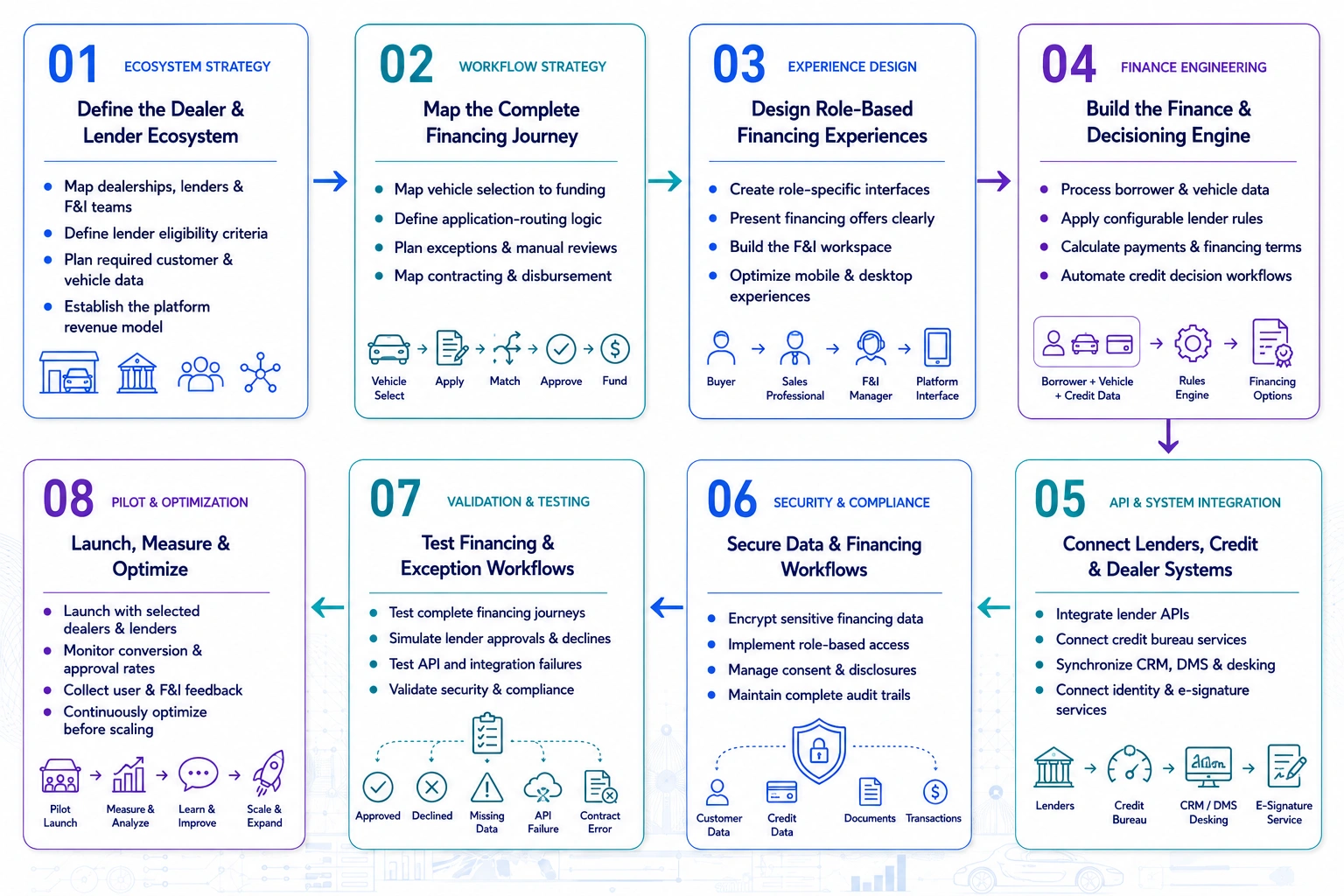
1. Define Your Dealer and Lender Ecosystem
We first identify target dealerships, F&I teams, lenders and financing partners, then define their roles, data requirements, lender rules, revenue model and application-routing logic before development begins.
- Stakeholder Mapping: Identifies dealerships, lenders, finance teams, buyers, and technology partners involved throughout the financing ecosystem.
- Lender Criteria Definition: Establishes lender requirements, eligibility parameters, financing products, documentation needs, and application submission conditions.
- Data Requirement Planning: Defines customer, vehicle, credit, financial, dealership, and lender data required for accurate financing decisions.
- Revenue Model Planning: Determines platform revenue streams, transaction fees, lender commissions, subscription models, and dealership pricing structures.
2. Map the End-to-End Financing Workflow
Our team maps every financing stage, from vehicle selection and credit application through lender matching, approval, deal structuring, e-contracting and funding, including exceptions, manual reviews and failed application scenarios.
- Customer Journey Mapping: Documents every customer interaction from vehicle selection and credit application through approval, contracting, and funding.
- Application Routing Logic: Defines how applications move between dealerships, lenders, credit services, verification systems, and financing workflows.
- Exception Workflow Planning: Establishes processes for declined applications, missing information, manual reviews, lender stipulations, and processing delays.
- Funding Process Mapping: Outlines post-approval activities including contract completion, document verification, funding requests, and disbursement confirmation.
3. Design Dealer, F&I and Customer Experiences
We design role-specific interfaces for buyers, sales teams and F&I managers, ensuring each user can submit applications, review financing offers, manage deals and complete required actions with minimal friction.
- Role-Based Experience Design: Creates tailored interfaces based on responsibilities, permissions, workflows, and information needs across platform users.
- Financing Offer Presentation: Displays eligible financing options, payment estimates, loan terms, rates, and applicable conditions clearly for customers.
- F&I Workspace Design: Provides finance managers with centralized tools for deal structuring, lender communication, documentation, and financing management.
- Mobile Experience Optimization: Ensures customers and dealership teams can complete essential financing activities efficiently across smartphones, tablets, and desktops.
4. Build the Finance and Decisioning Engine
Our developers build the core finance engine to process borrower, vehicle and credit data, apply lender eligibility rules, support automated decisioning and generate financing options while maintaining configurable controls.
- Credit Data Processing: Collects, validates, and organizes borrower credit information required for financing assessment and lender decision workflows.
- Eligibility Rules Engine: Applies configurable lender criteria to determine suitable financing sources based on borrower and vehicle information.
- Payment Calculation Engine: Calculates estimated payments using loan amount, interest rate, term, down payment, fees, and applicable financing conditions.
- Decision Workflow Automation: Automates repetitive financing decisions while maintaining configurable review points for lenders and dealership finance teams.
5. Integrate Lenders, Credit and Dealer APIs
We integrate lender APIs, credit bureaus, CRM, DMS, identity verification, e-signature and other services, creating secure data flows that synchronize applications, decisions, documents and deal information across systems.
- Lender API Integration: Connects financing applications with lender systems for submissions, decisions, stipulations, contracts, status updates, and funding information.
- Credit Bureau Connectivity: Enables secure retrieval and exchange of credit information required for eligibility assessment and financing decisions.
- Dealer System Integration: Connects CRM, DMS, desking, inventory, and customer management systems to reduce duplicate data entry.
- Identity and Signature Integration: Connects identity verification and e-signature services to support secure customer authentication and digital contract completion.
6. Implement Security and Compliance Controls
Our developers implement encryption, role-based access, consent management, audit trails, secure document handling and identity controls while aligning platform workflows with applicable lending, privacy and electronic-signature requirements.
- Data Encryption Controls: Protects sensitive customer, financial, credit, and transaction information during storage and transmission across platform systems.
- Role-Based Access Management: Restricts sensitive financing information according to user responsibilities, permissions, dealership roles, and administrative requirements.
- Consent and Disclosure Management: Records customer permissions, required disclosures, acknowledgments, and consent activities throughout financing workflows.
- Audit Trail Implementation: Maintains detailed records of application changes, decisions, documents, user actions, approvals, and compliance-related activities.
7. Test Financing and Exception Workflows
We test complete financing journeys and edge cases, including lender declines, missing documents, failed API responses, credit exceptions, approval changes, contracting errors and funding delays to ensure reliable operations.
- End-to-End Workflow Testing: Validates complete financing journeys across applications, lender decisions, deal structuring, contracting, and funding stages.
- Lender Response Testing: Tests approvals, declines, counteroffers, stipulations, unavailable lenders, and unexpected lender responses under realistic conditions.
- Integration Failure Testing: Evaluates API timeouts, invalid responses, connectivity failures, synchronization issues, and incomplete data transmission.
- Security and Compliance Testing: Verifies access controls, encryption, authentication, consent handling, audit records, and secure document processing throughout workflows.
8. Launch a Pilot and Optimize the Platform
We launch with a controlled dealer and lender pilot, monitor application conversion, approval rates, processing times and integration failures, then use operational feedback to optimize workflows before wider deployment.
- Pilot Dealer Selection: Selects representative dealerships and financing partners to validate platform workflows across different operational environments.
- Performance Monitoring: Tracks application conversion, approval rates, processing times, lender responses, funding speed, and platform reliability.
- User Feedback Collection: Gathers feedback from customers, sales teams, F&I managers, lenders, and administrators to identify workflow improvements.
- Continuous Platform Optimization: Uses performance data and user feedback to refine features, integrations, automation, usability, and financing workflows before scaling.
Cost to Build a Digital Car Financing Platform for Dealerships
The cost to build a digital car financing platform typically depends on its financing workflows, lender integrations, decisioning capabilities, compliance requirements and dealership systems. A focused MVP can cost significantly less than an enterprise-grade multi-lender platform.
The following breakdown estimates development costs across major phases, helping businesses understand where budget is typically allocated throughout the product development lifecycle.
| Development Phase | Estimated Cost (MVP → Enterprise) | What the Phase Covers |
| Discovery & Business Analysis | $5,000 – $50,000 | Defines dealer workflows, lender ecosystem, requirements, business model and technical specifications for the platform. |
| UX/UI Design | $10,000 – $80,000 | Designs customer, dealer and F&I interfaces, financing journeys, dashboards and responsive platform experiences. |
| Backend & Finance Engine | $15,000 – $150,000 | Develops application processing, lender routing, decisioning logic, deal structuring and financing workflow infrastructure. |
| Frontend Development | $10,000 – $100,000 | Builds customer applications, dealer dashboards, F&I workspaces and financing offer interfaces across supported devices. |
| API & System Integrations | $15,000 – $120,000 | Connects lenders, credit bureaus, CRM, DMS, KYC, e-signature and payment-related third-party services. |
| Security & Compliance | $5,000 – $60,000 | Implements encryption, access controls, audit trails, consent management and secure financial data handling mechanisms. |
| Testing & Quality Assurance | $10,000 – $70,000 | Tests financing workflows, lender responses, integrations, security, performance, edge cases and exception scenarios. |
| Deployment & Launch | $10,000 – $70,000 | Configures production infrastructure, monitoring, deployment pipelines, analytics and initial platform launch support. |
| Total Estimated Cost | $65,000 – $700,000 | Overall estimated investment for developing a digital car financing platform for dealerships. |
Note: These figures are indicative development ranges rather than fixed quotations. Actual costs can vary substantially based on lender API complexity, geographic compliance requirements, number of integrations, platform scale, and custom decisioning capabilities.
Development Cost According to Platform Level
Platform level provides another practical way to estimate investment based on the capabilities and operational complexity required for your dealership finance product.
| Platform Level | Estimated Cost | What It Includes |
| MVP (Dealer-Focused Digital Finance Platform) | $65,000 – $140,000 | Digital credit application, soft pull, 1–3 lender integrations, basic decisioning, dealer dashboard, document upload, e-signatures, basic compliance logging |
| Growth / Multi-Lender Platform (Most Common in Market) | $150,000 – $300,000 | Multi-lender routing engine, real-time decisioning, DMS/CRM integrations, F&I workflows, AI-assisted approvals, fraud checks, advanced reporting, funding workflow |
| Enterprise Fintech Ecosystem Platform | $300,000 – $700,000+ | Full lender marketplace, AI underwriting, dynamic pricing, deep DMS integrations, complete compliance stack (SOC2/PCI/GLBA), fraud intelligence, multi-region support |
2026 Market Reality & Why MVP Costs Are Higher
These estimates reflect current 2026 fintech and auto-finance development conditions, where security, compliance, integrations, and financing automation significantly influence platform complexity and investment requirements.
- The cost ranges in this guide reflect current 2026 fintech and auto-finance market conditions, not legacy estimates.
- Digital car financing platforms have become significantly more complex due to AI, compliance, and real-time lender ecosystems.
A. Why MVP Costs Are Higher Today
Modern automotive finance MVPs require foundational financial infrastructure from the beginning, making them considerably more complex than conventional MVPs focused primarily on basic customer-facing functionality.
- Secure KYC / identity verification workflows
- Soft credit pull integrations with bureaus
- Encrypted document storage & handling
- Basic fraud detection & compliance logging
- At least 1–3 lender API integrations
- Secure cloud infrastructure with audit trails
These capabilities are increasingly considered baseline requirements, rather than optional enhancements, which is why MVP development starts at a higher cost range.
B. Key Market Shift Impacting Pricing
The automotive finance technology market is evolving toward more connected, automated, and compliance-focused infrastructure, increasing the engineering effort required even during the initial development phase.
- AI-assisted decisioning is now common even in early-stage platforms.
- Compliance requirements such as SOC 2, GLBA, PCI, and AML/KYC have become critical considerations from day one.
- Lender integrations are more complex and require real-time data exchange systems.
- Cloud infrastructure and security standards have significantly increased baseline engineering effort.
The definition of an automotive finance MVP has expanded, requiring secure financial infrastructure and compliance foundations alongside core financing functionality from the earliest development stage.
- MVP is no longer a light version. It is a compliance-ready financial system foundation.
- This shift is the primary reason 2026 MVP costs are substantially higher than older market estimates.
Factors That Influence Development Budget
Development costs increase when the platform requires more integrations, complex financing logic, enterprise security or specialized dealership workflows. The following factors have the greatest impact on your final budget:
- Lender Network Onboarding: Banks, credit unions, captive lenders, and finance companies require separate APIs, certifications, testing, and configurations, typically adding $15,000–$50,000 per lender.
- Credit Bureau & Soft-Pull Integration: Credit checks, prequalification, identity verification, and reporting require secure third-party integrations, typically costing $20,000–$60,000 per bureau.
- DMS Connectivity: CDK, Reynolds and Reynolds, and Dealertrack integrations require custom mappings, authentication, synchronization, certification, and maintenance, costing $25,000–$80,000 per DMS.
- Real-Time Lender Decisioning: Instant approvals, counteroffers, stipulations, rate changes, and lender responses require real-time APIs and robust error handling, adding $40,000–$120,000.
- Digital Contracting & Funding: eContracts, e-signatures, document validation, lender submission, funding status, and contract storage typically cost $25,000–$90,000, depending on integrations.
- F&I Product Integration: Warranties, GAP coverage, service contracts, insurance, and other F&I products require catalogs, pricing rules, disclosures, and provider integrations, adding $15,000–$50,000 per category.
- Fraud Prevention & Identity Verification: Identity checks, document verification, device intelligence, suspicious-activity detection, and fraud monitoring typically require $30,000–$100,000 for setup and security hardening.
Compliance Requirements to Include in Digital Car Financing Platform
Security and compliance must be built into the platform from the architecture stage because dealership finance systems process credit, identity, financial and contractual data. U.S. requirements also vary based on platform role, lender relationships and business model.
Important: The exact obligations depend on whether the platform operates as a technology provider, dealer, lender, marketplace or service provider. U.S. legal and compliance requirements should therefore be validated with qualified counsel before launch.
| Compliance Requirement | Compliance / Security Standard | What the Platform Should Implement |
| GLBA & Safeguards Rule | GLBA, FTC Safeguards Rule | Risk assessments, access controls, encryption, security monitoring, and safeguards for nonpublic personal information. |
| FCRA Compliance | Fair Credit Reporting Act (FCRA) | Permissible-purpose checks, credit-data controls, disclosures, and compliant adverse-action workflows. |
| ECOA & Fair Lending | Equal Credit Opportunity Act (ECOA) | Consistent credit decisioning, explainable records, required notices, and nondiscriminatory lending controls. |
| Identity Verification & Authentication | NIST 800-63 | Identity verification, secure authentication, authorization, and access controls for sensitive financing data. |
| E-Signature & Electronic Records | ESIGN Act, UETA | Signer identity, consent capture, document integrity, and electronic transaction records. |
| API & Integration Security | OWASP API Security Top 10 | Authentication, access controls, encryption, monitoring, and secure third-party integrations. |
| Incident Response & Monitoring | NIST 800-61 | Security monitoring, anomaly detection, incident response, investigation, and notification procedures. |
Important: These are the core requirements for planning a U.S. dealership finance platform but exact obligations depend on whether it operates as a dealer, lender, marketplace, or technology provider. The FTC requires covered auto dealers to maintain a comprehensive information security program under the Safeguards Rule.
Challenges in Building a Digital Car Financing Platform for Dealerships
Building a digital car financing platform for dealerships involves navigating complex integrations, regulatory requirements, and real-time financial workflows. These challenges impact system reliability, data accuracy, and user experience, requiring robust architecture and specialized engineering solutions to ensure seamless operations consistently.
1. Legacy Automotive Finance System Integration
Challenge: Fragmented lender, credit bureau, and dealership systems rely on outdated SOAP services, SFTP exchanges, and inconsistent APIs, causing integration failures and unstable data exchange during peak dealership operations.
Solution: Our developers build protocol-agnostic adapters, schema normalization layers, and transformation pipelines with queued processing, idempotency, and circuit breakers to maintain stable communication even when legacy or third-party systems degrade.
2. Variable Lender Credit Decision Logic Management
Challenge: Lender credit rules frequently change based on risk policies, promotions, and regional compliance, often requiring partial manual underwriting and making fully automated decisioning difficult to maintain consistently.
Solution: We implement a versioned rules orchestration engine with conditional logic, hybrid manual-automated workflows, and audit tracking, enabling developers to update lender-specific decision paths without disrupting existing financing operations.
3. Duplicate Financing Application Prevention
Challenge: Customers often submit financing applications through multiple dealership channels, causing duplicate lender submissions, underwriting confusion, and potential rejection of valid credit requests.
Solution: We build deduplication systems using identity and VIN-based fingerprinting, combined with idempotent APIs and centralized deal registries to ensure each financing application is uniquely tracked across all submission channels.
Leading Digital Car Financing Platforms for Dealerships
Modern dealership financing increasingly depends on connected digital tools that simplify credit, lender, and transaction workflows. The following platforms showcase leading solutions helping dealerships deliver faster, more convenient, and digitally integrated vehicle financing experiences.
1. AutoFi
AutoFi is a finance-centered digital retail platform helping dealerships connect shoppers with lender routing, soft-credit payment estimates, instant finance decisions, accurate deal structuring, loan or lease options, and online-to-showroom purchasing workflows that accelerate conversion and improve financing transparency.
2. Dealertrack
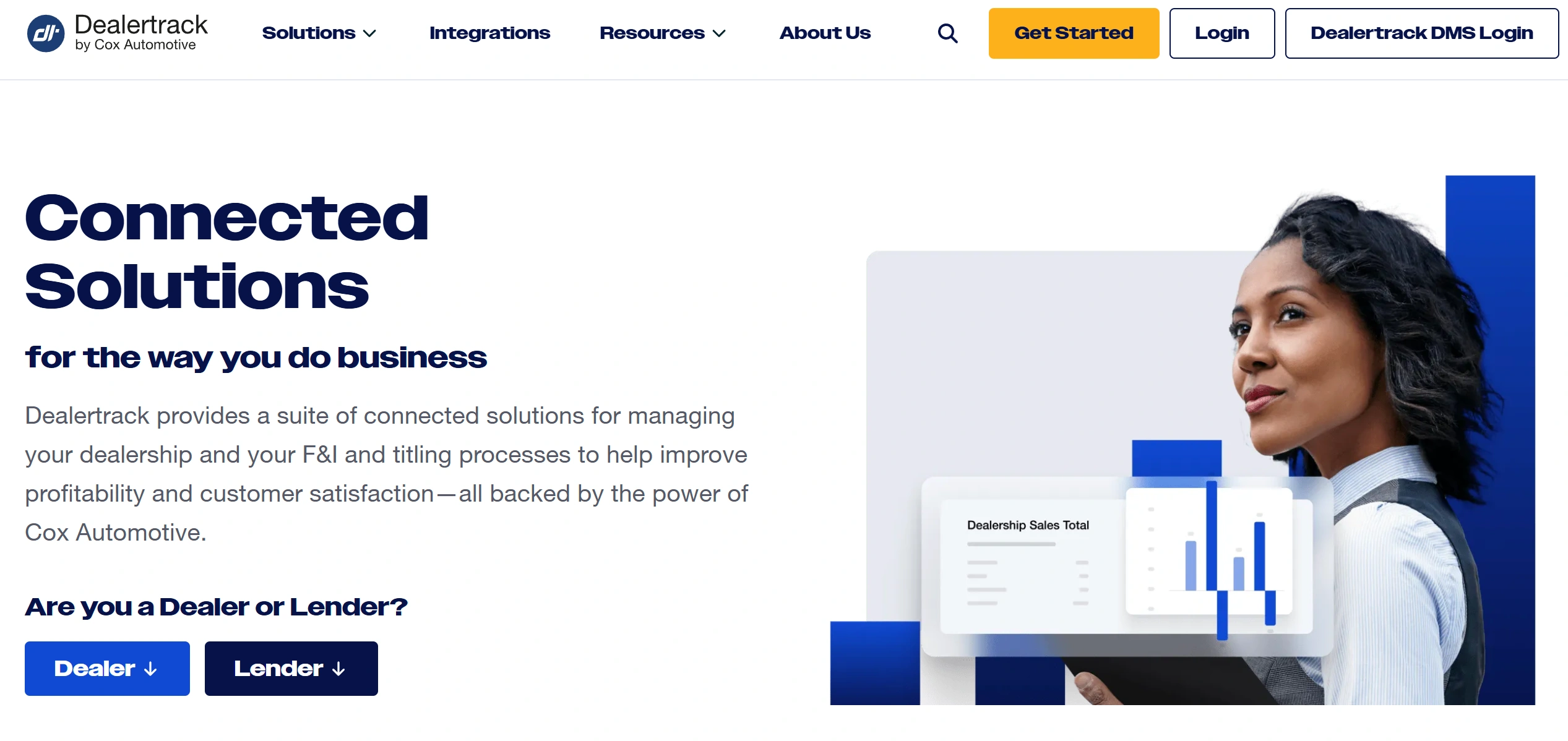
Dealertrack provides dealership financing infrastructure through digital credit applications, lender connectivity, instant decisions, LTV/PTI calculations, digital contracting, and e-signing. Its network connects dealers with 1,600+ lenders for streamlined credit submission, financing approvals, deal structuring and faster funding workflows.
3. RouteOne
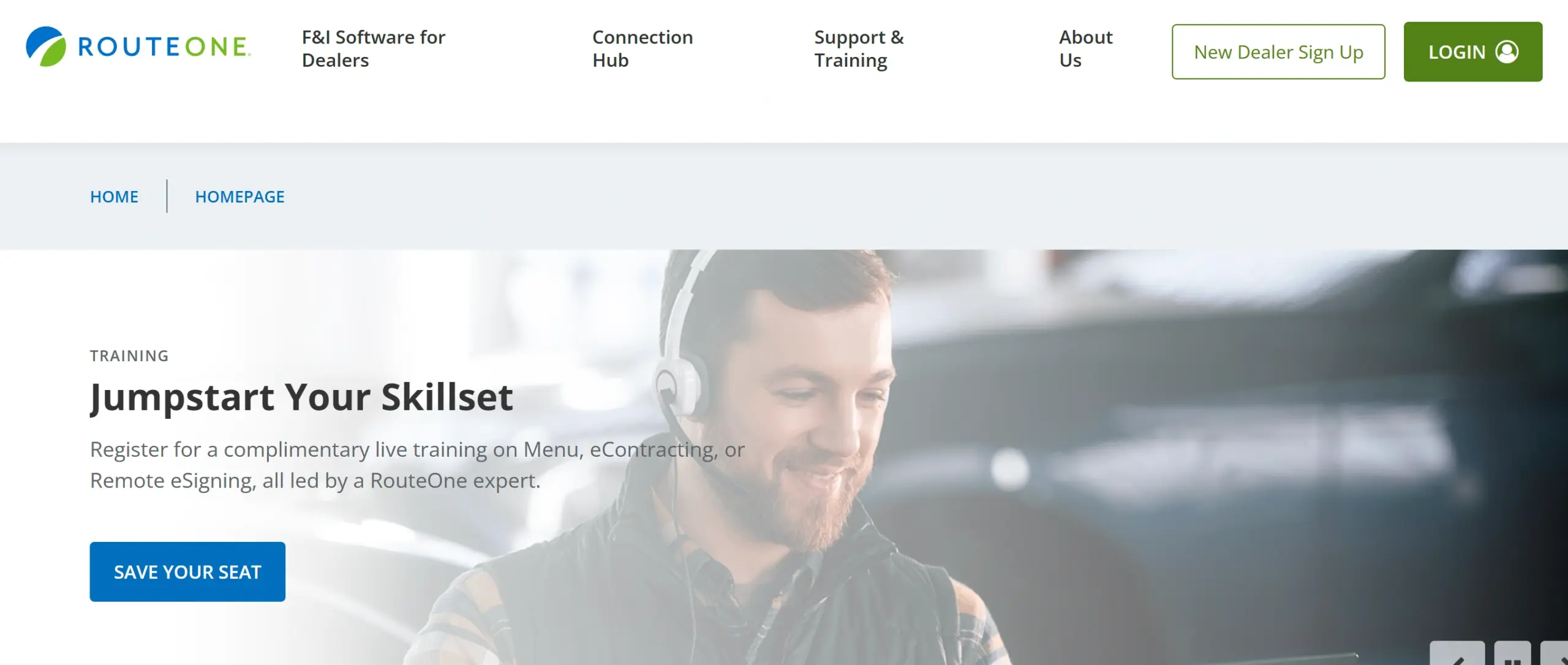
RouteOne is a dealer-focused digital finance and F&I platform connecting dealerships with 1,700+ finance sources. Its capabilities include online credit applications, automated compliance, lender decisioning, digital retailing, eContracting, remote eSigning, and faster funding while reducing duplicate data entry across dealership workflows.
4. Upstart Auto Retail

Upstart Auto Retail Digital Finance combines AI-powered financing, credit decisioning, offer presentation, deal structuring, automated verification, eContracting, e-signing, and next-day funding. Dealerships can present Upstart and preferred-lender offers through one connected workflow, expanding approvals while reducing financing friction and contracts-in-transit.
5. CDK Roadster
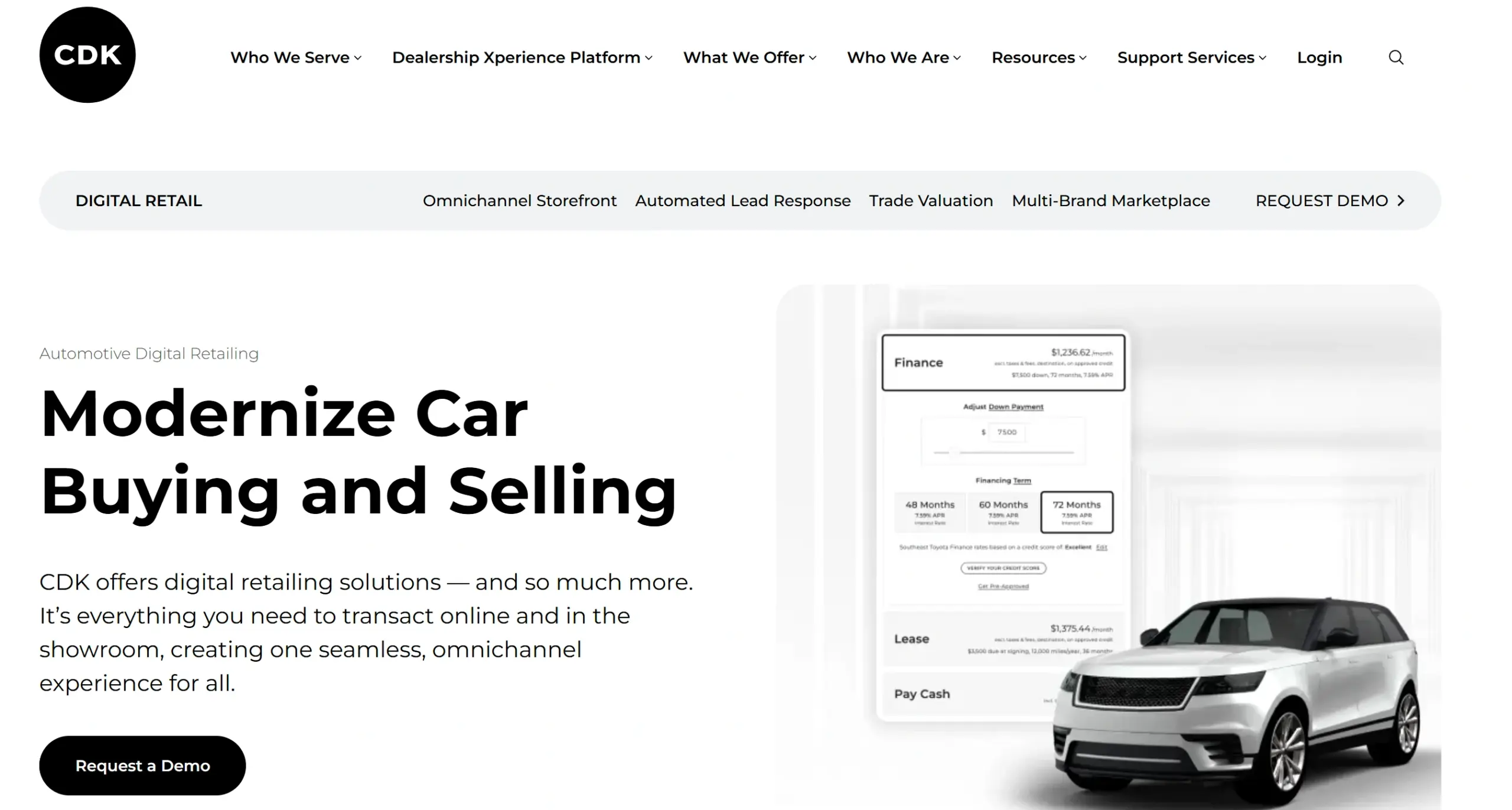
CDK Roadster provides dealership digital retailing with online financing, credit applications, pre-approval, transparent deal sheets, cash/lease/finance options, and omnichannel purchasing. Its integrations connect customer data across dealership systems, while e-Contracting supports electronic lender contracts and streamlined digital financing workflows.
Build Your Digital Car Financing Platform With Idea Usher
IdeaUsher is a product engineering partner expert in the fintech and other sectors with 11+ years of experience across 50+ countries. Backed by 250+ experts, 1,000+ completed projects, and a 4.9/5 Clutch rating, we build custom automotive financing platforms from scratch.
Instead of template-based solutions, we build scalable, cloud-native lending platforms with sub-second credit decisioning, automated dealer management system (DMS) integrations, multi-lender syndication, and instant digital contracting to help you lead the auto finance market.
Why Enterprises Partner With Us
Auto dealer groups, automotive lenders, and fintech innovators partner with us because we transform complex point-of-sale financing into friction-free, automated, and high-converting showroom and online car-buying workflows.
- Multi-Lender Syndication & Dynamic F&I Engines: We engineer automated loan-routing engines that broadcast applications across prime, near-prime, and subprime lenders to secure competitive rates and terms within seconds.
- Bi-Directional DMS & Inventory Interoperability: Our developers build high-throughput API bridges syncing vehicle inventory, pricing, and buyer records with CDK Global, Reynolds and Reynolds, and Dealertrack.
- Automated Bureau Pulls & AI Risk Decisioning: We integrate Experian, TransUnion, and Equifax APIs with custom ML models for instant prequalification and automated credit decisioning.
- Instant Digital Contracting & Remote E-Signing: We build paperless digital desk tools with automated deal jackets, remote e-signatures, and document validation to reduce funding turnaround from days to minutes.
- Isolated Cloud Security & Regulatory Compliance: We host backend logic in AES-256 encrypted cloud environments aligned with GLBA, FCRA, and FTC Safeguards requirements to protect financial data and PII.
- Zero Vendor Lock-In Asset Delivery: We deliver clean, fully documented, and auditable source code, granting your organization 100% platform ownership from day one.
Ready to revolutionize automotive lending with an enterprise-grade digital car financing platform? Partner with Idea Usher’s principal automotive fintech and software architects to map out your custom product build today.
Conclusion
The opportunity for dealership-focused digital finance goes beyond putting loan applications online. A connected platform can unify lenders, buyers, credit decisioning, F&I teams, dealership systems and digital contracting in one workflow. The right technology partner can help translate this model into a scalable, secure product with the integrations and compliance controls required for real-world adoption. If you have a dealership finance concept in mind, IdeaUsher can help define the product scope, technology roadmap, MVP and development strategy needed to take it forward.
FAQs
A.1. A dealership platform needs digital applications, lender connectivity, credit decisioning, deal structuring, CRM/DMS integration, e-signatures, application tracking, secure data handling and funding workflows to support financing end-to-end.
A.2. AI can support lender matching, document extraction, fraud detection, risk analysis and finance-team assistance. Credit decisions still require appropriate lender policies, regulatory controls, validation and explainability where applicable.
A.3. Development costs vary by features, integrations, security, complexity, and geography. MVP platforms range $65K–$140K, growth multi-lender $150K–$300K, and enterprise fintech ecosystems with advanced integrations and decisioning $300K–$700K+ depending on scope and regulatory needs overall market.
A.4. U.S. platforms may need to address GLBA, FCRA, ECOA, privacy, electronic-signature and security requirements. Applicable obligations depend on the platform’s role, financing model, lender relationships and operating jurisdictions.