 (+971) 8007 4267
 (+91) 946 340 7140
 (+1) 628 432 4305

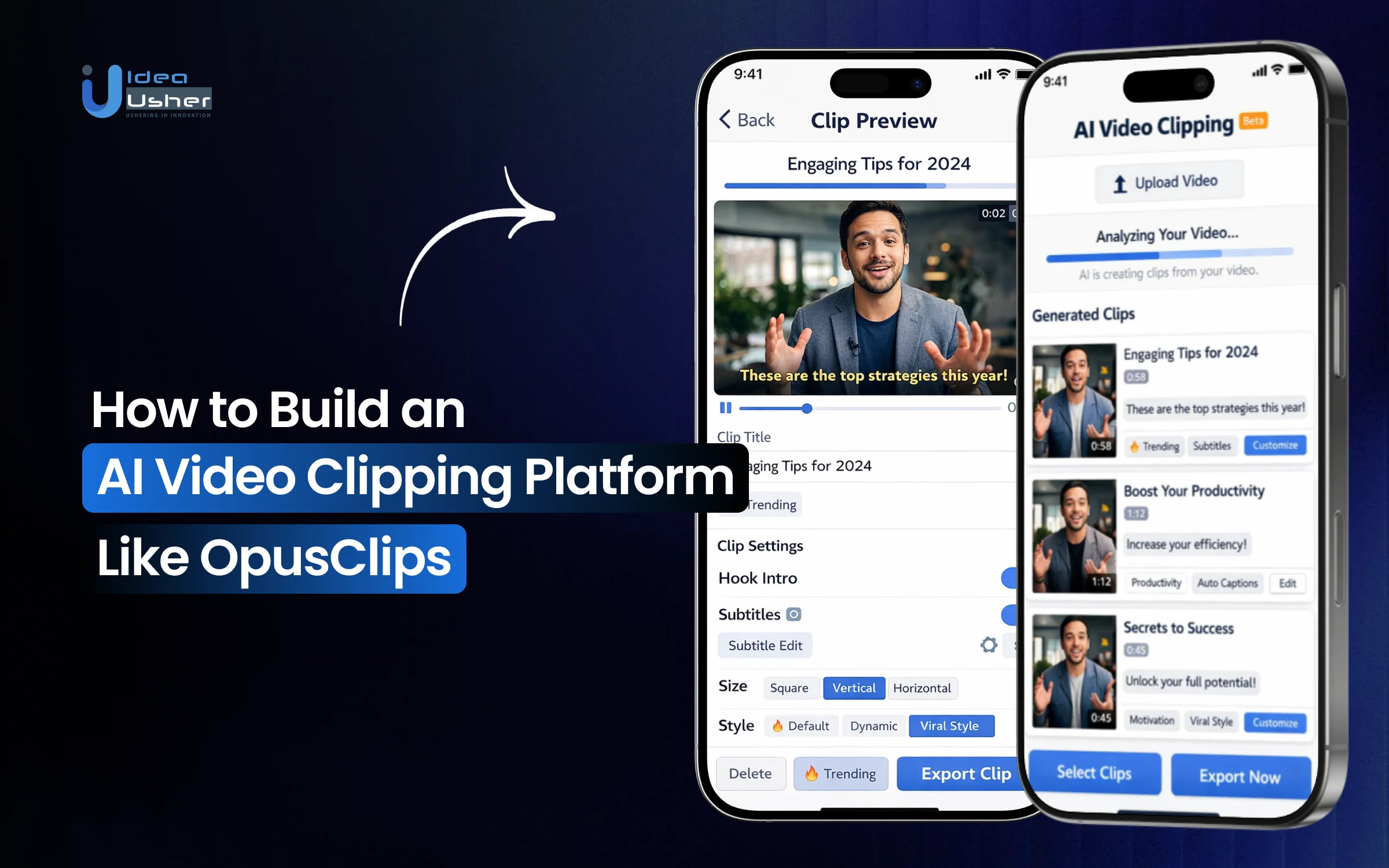
Creators often spend hours recording podcasts, interviews, or educational videos. The real challenge begins when that content must be repurposed for multiple social platforms. Manually reviewing long recordings and cutting short clips can quickly slow down the entire content workflow.
The popularity of AI video clipping platforms has started increasing because creators must now publish content frequently while managing limited editing time. These systems can intelligently analyze long videos and detect segments with the highest engagement value. They may also automatically reframe videos for vertical or square formats used by social media.
We’ve developed numerous AI video-clipping solutions powered by engagement-prediction models and multimodal content understanding. Since IdeaUsher has this expertise, we’re sharing this blog to discuss the steps to develop an AI video-clipping platform like OpusClip.
Market Demand for AI Video Repurposing Platforms
According to Grand View Research, the global AI video generator market size was estimated at USD 788.5 million in 2025 and is projected to reach USD 3,441.6 million by 2033, growing at a CAGR of 20.3% from 2026 to 2033. This surge reflects a fundamental shift in media consumption, with vertical short-form video becoming the primary driver of digital engagement across global platforms.

Source: Grand View Research
Traditional video production is resource-heavy and slow. In contrast, AI repurposing platforms use computer vision and NLP to autonomously transform long-form webinars and interviews into high-impact clips. For modern organizations, these tools have transitioned from experimental novelties to essential infrastructure for maintaining a competitive digital presence. Two leading examples of such platforms include:
- OpusClip: A specialist tool known for its ClipAnything technology, which identifies viral moments in long-form videos and automatically handles reframing and captioning.
- Munch: An analytics-driven platform that cross-references video content with current social media trends to extract the most engagement-optimized segments.
Growth of the Creator Economy
The creator economy has evolved into a multi-billion-dollar industry where success depends on omnipresence across multiple platforms. Creators must fragment their core assets, such as hour-long podcasts, into dozens of micro assets tailored for TikTok, Reels, and Shorts to trigger specific algorithmic recommendations.
AI tools solve the primary bottleneck of post-production for these creators. By automating the identification of viral moments and handling the technical labor of reframing, AI allows independent creators to match the output volume of major media houses without a linear increase in overhead.
Rising Need for Content Repurposing Automation
Marketing teams now prioritize content atomization, the strategy of breaking a single pillar asset into a week’s worth of social fodder. This shift is driven by the need for better ROI on high-cost production. A brand film must live across multiple channels to justify its initial budget.
Automation handles the mechanical grunt work, such as removing filler words, generating captions, and tracking active speakers. This efficiency allows creative directors to focus on high-level storytelling rather than manual clipping, ensuring brands can keep pace with the rapidly shortening half-life of digital content.
How Brands Monetize Short-Form Video Content
Monetization has moved beyond simple ad revenue sharing toward sophisticated lead generation. Brands use AI-extracted insights to create breadcrumb trails that move viewers from a 30-second clip toward high-ticket conversions or product purchases.
- Social Commerce: Integrating shopping features into short-form feeds lets repurposed clips serve as high-intent organic advertisements.
- Brand Authority: B2B firms use bite-sized executive insights on LinkedIn to build thought leadership and drive traffic to gated webinars.
- Algorithmic Arbitrage: By consistently posting AI-optimized clips, brands secure organic reach that significantly lowers their blended customer acquisition cost.

What Makes OpusClip Different From Basic Clipping Tools?
OpusClip represents a generational leap in automation, streamlining the editing process. While legacy tools require manual trimming, this platform uses context-aware extraction to prioritize narrative flow and visual dynamics. It moves beyond simple time-based cuts to identify the most impactful segments of a video.
For teams scaling their output, the distinction is critical. Basic tools require a human to define every start and end point. OpusClip utilizes advanced visual and auditory analysis to understand the core message of a video, ensuring resulting clips are strategically superior for modern digital distribution.
AI That Detects the Most Engaging Video Moments
The platform’s core differentiator is high-level content analysis. Using proprietary algorithms, the AI scans long-form footage to identify key highlights, punchlines, or emotional peaks. It looks for shifts in tone and specific keywords that indicate a transition from filler to high-value information.
By detecting these moments, the AI eliminates the need for manual scrubbing through hours of raw files. It differentiates between casual remarks and profound insights, acting as an automated story editor that understands exactly what captures a viewer’s attention from the first second.
Automated Shorts for Reels, TikTok, and YouTube
Format fragmentation is a major challenge for modern marketing. Content designed for YouTube does not naturally fit the vertical constraints of TikTok or Reels. OpusClip automates the reframing process using active speaker detection to keep the subject centered in a 9:16 aspect ratio.
This automation includes generating dynamic, high-visibility captions optimized for silent mobile viewing. By producing platform-ready assets in a single click, the tool removes the friction between long-form production and multi-channel social media distribution.
Virality Score That Predicts Clip Performance
The Virality Score is a strategic feature that removes the guesswork from content distribution. The AI analyzes extracted clips against a massive database of high-performing social media content, evaluating factors like hook strength, pacing, and subject relevance.
This scoring system provides a quantitative prediction of engagement potential. It allows creators to prioritize their most promising assets, ensuring teams rely on data-driven insights rather than intuition to curate a feed that is mathematically more likely to capture public interest.
Core Features of an AI Video Clipping Platform
Modern AI video clipping platforms solve the bottleneck of manual editing by integrating machine learning into the ingestion phase. These systems transform raw footage into a searchable database of high-value moments, allowing teams to shift from labor-intensive cutting to strategic curation.
A robust platform understands the relationship between visual cues and audience retention. By automating the technical overhead of post-production, these features enable brands to maintain a high-frequency posting schedule without compromising quality or relevance.
1. Scene Detection
Advanced scene detection identifies shifts in context, speaker, and visual composition. Unlike basic motion detection, AI-driven extraction parses the transcript to identify peaks in information density. This ensures the system captures the most impactful segments of any presentation or interview.
2. Auto-Generation
The primary value is turning an hour of footage into dozens of platform-ready assets in minutes. The system automatically handles segmentation, ensuring each clip has a logical flow. This reduction in turnaround time allows creators to capitalize on trending topics while they are still relevant.
3. Virality Scoring
Predictive analytics identify which clips are algorithm bait before they are published. By comparing a clip’s hook and keywords against historical data, the AI assigns an engagement potential score. This helps teams prioritize distribution budgets toward high-potential assets.
4. Auto Captions
Since many social media users watch videos without sound, high-quality captions are non-negotiable. AI platforms generate frame-accurate, textually correct, and visually engaging subtitles. These dynamic captions highlight keywords in real-time to maintain viewer focus.
5. Smart Reframing
Converting 16:9 video to 9:16 requires more than a simple center crop. Smart reframing uses face tracking and motion analysis to keep the active speaker the focal point. This automated cinematography preserves a professional look within the constraints of a mobile screen.
6. Platform Export
The final stage is seamless distribution through direct integrations with major social networks. By handling specific requirements for file size, bitrate, and metadata, these tools ensure that every export is technically optimized for its target feed.
Advanced AI Features That Increase Platform Value
The value of an AI video clipping platform lies in its ability to replicate human intuition at scale. Advanced systems interpret psychological triggers using deep learning models, offering a level of creative intelligence that makes video production both more effective and less expensive.
This evolution allows organizations to operationalize their content strategy. Instead of guessing which clips might work, decision-makers rely on sophisticated features that identify the highest-value segments within any given file.
1. Emotion and Engagement Models
Modern platforms use multi-modal AI to detect emotional shifts in a speaker. By analyzing facial expressions and vocal tonality, the system identifies moments of high intensity or humor. These segments are statistically more likely to trigger social shares because they resonate on a visceral level.
2. Topic Segmentation
Topic segmentation uses Natural Language Processing (NLP) to break long videos into thematic chapters. The AI understands transitions from technical explanations to case studies. This ensures every generated clip remains a self-contained, coherent piece of information that provides immediate value.
3. AI Hook Detection
The first three seconds of a vertical video determine its success. AI hook detection identifies the most provocative or intriguing opening statements in a transcript. The system automatically positions these at the start of a clip to “stop the scroll” and maximize retention across competitive feeds.
4. Creator Analytics
Beyond editing, advanced platforms provide deep performance insights by aggregating data from integrated social accounts. This creates a feedback loop that identifies which topics or speakers generate the highest ROI, allowing creators to refine their strategy based on actual audience behavior.
How AI Identifies Viral Moments in Long Videos?
Identifying a viral moment is no longer a matter of human intuition; it is a matter of pattern calculation. AI platforms ingest raw footage and dissect it into thousands of data points to find the intersection of high information density and emotional resonance. By analyzing the structural integrity of a narrative, the AI determines which segments can stand alone as compelling micro content.

This process involves a multi-layered analysis where audio, text, and visual data are synchronized. The result is a selection process that is faster and often more objective than a human editor, focusing on what the data suggests will perform rather than personal preference.
1. Dialogue Analysis
Natural Language Processing serves as the platform’s brain. It does not just transcribe words; it understands the weight of the conversation.
- Semantic Mapping: The AI identifies the core thesis of a discussion, ensuring clips do not cut off mid-thought.
- Keyword Heatmaps: By tracking the frequency of high-value industry terms and trending topics, the AI flags sections likely to be searchable.
- Sentiment Analysis: It detects shifts in the speaker’s tone, identifying where a point is made with particular conviction or humor.
This ensures that the meat of the content is preserved while the fluff is discarded, creating a concise and punchy narrative.
2. Visual Detection
While NLP handles the what, computer vision manages the who and where. Sophisticated visual models scan every frame to ensure the technical quality of the output matches the editorial quality.
Technical Insight:
Computer vision algorithms use facial landmark detection to track speaker movement in real time. This allows the AI to crop a wide 16:9 shot into a 9:16 vertical frame without losing the subject’s expressions or gestures.
The system also recognizes scene transitions. If a speaker switches to a screen share or a product demo, the AI detects the visual shift and adjusts the framing or clip boundaries accordingly. This prevents jarring cuts and ensures a professional, polished aesthetic.
3. Virality Prediction
How does the AI know if a clip will succeed? It compares the new content against a historical database of millions of successful short form videos.
| Factor | AI Evaluation Method | Impact on Score |
| Hook Strength | Analyzes the first 2 seconds for high impact keywords. | High |
| Pacing | Measures words per minute and visual cut frequency. | Medium |
| Relevance | Cross references topics with current social trends. | High |
| Retention | Predicts drop-off points based on narrative structure. | High |
These models assign a numerical value to each clip. A high score suggests that the clip contains the specific triggers, such as a bold claim or a clear how-to step, that typically result in higher shares and longer watch times. This allows creators to focus their energy only on the content that is mathematically positioned for growth.
How to Build an AI Video Clipping Platform Like OpusClip?
Building an AI video-clipping platform like OpusClip requires systems capable of analyzing long videos and detecting high-engagement moments. The platform should combine computer vision and speech analysis to generate short, social-ready clips.
Our team has delivered several AI video clipping solutions similar to OpusClip for clients, and this is how we typically build them.

1. Define Use Cases
We start by identifying your team’s specific bottlenecks. Whether you are a media house or a B2B firm, we tailor the AI logic to your output needs. This ensures all automated clips align with your brand’s unique tone and audience intent.
2. Build the Pipeline
Our team constructs cloud-native infrastructure for heavy computational lifting. We optimize for low-latency ingestion, transcription, and frame analysis. This allows your team to move from a raw recording to social-ready assets in minutes.
3. Develop Models
We refine the platform’s brain by training proprietary models on industry-specific data. By teaching the AI to distinguish between filler and high-impact insights, we engineer virality into the selection process from the start.
4. Integrate Tools
We bridge the gap between analysis and delivery with professional-grade editing features. Our builds include automated 9:16 reframing and dynamic captioning. These one-click solutions ensure all files meet the technical requirements of every major social platform.
5. Optimize With Data
Post-launch, we use an iterative cycle to sharpen detection algorithms based on real-world performance. As social algorithms shift, we fine-tune your predictive models to keep your content strategy data-driven and ahead of competitors.
Cost to Build an AI Video Clipping Platform
Estimating the investment for an AI video clipping platform requires a deep understanding of the intersection between specialized talent and high-performance hardware. The budget is not just for code; it covers the computational power needed to “see” and “hear” video data at scale. For decision-makers, the goal is to balance the high upfront cost of model training against the long-term efficiency of an automated pipeline.
Costs vary significantly based on whether you are building a proprietary model or leveraging existing APIs. However, to achieve a competitive edge with unique features like custom virality scoring, a dedicated investment in custom development is necessary.
AI Model Development Costs
Developing the platform’s brain is the most resource-intensive phase. This includes data collection, cleaning, and the iterative process of training and validation.
- Data Ingestion: Sourcing and labeling thousands of hours of video to train the AI on “viral” cues can cost between $30,000 and $70,000.
- Model Training: Utilizing GPU-heavy cloud instances (like NVIDIA A100s) for deep learning models typically ranges from $20,000 to $50,000, depending on complexity.
- NLP and Computer Vision Integration: Customizing these models to handle specific accents, industry jargon, or complex scene changes adds another $40,000+ to the budget.
Video Processing Infrastructure Costs
Infrastructure is an ongoing operational expense, but the initial setup is critical for system stability. You are essentially building a factory that processes large video files in real time.
Technical Note:
Unlike standard web apps, video platforms require massive egress bandwidth and high-speed storage. Expect monthly cloud architecture costs to scale rapidly with user growth, often starting at $5,000 to $10,000 for a robust MVP environment.
Estimated Development Cost Breakdown
A professional-grade platform requires a multifaceted budget. Below is a high-level estimation for a custom-built solution.
| Development Phase | Estimated Cost Range (USD) | Key Deliverables |
| Discovery & Architecture | $15,000 – $25,000 | Technical roadmap and system design. |
| AI Model Engineering | $70,000 – $150,000 | Custom detection and scoring algorithms. |
| Backend & Video Pipeline | $50,000 – $90,000 | Ingestion, processing, and storage systems. |
| UI/UX & Frontend | $30,000 – $60,000 | Video editor and creator dashboard. |
| Total Estimated MVP Cost | $165,000 – $325,000 | Fully functional, scalable platform. |
Team Required for Development
Building this technology requires a specialized “strike team.” You aren’t just hiring developers; you are hiring architects of digital intelligence.
- AI/Machine Learning Engineer: Focuses on model training and computer vision.
- Video Infrastructure Specialist: Manages codecs, rendering, and cloud pipelines.
- Backend Developer: Handles API integrations and database management.
- Frontend/UX Designer: Creates the intuitive “one-click” editing interface.
- Project Manager/Product Owner: Ensures the technical build meets the business use cases.
Key Product Decisions Before Building an OpusClip-Like Tool
Before a single line of code is written, the most consequential work happens at the product strategy level. The decisions made before building determine everything from infrastructure costs to your monetization ceiling. Get these wrong, and you will build an impressive tool that solves the wrong problem.

Creator Tools vs Enterprise Platforms
This is the first fork in the road, and the path you choose reshapes every downstream decision.
The creator tool path means building for YouTubers, podcasters, and social media managers who need speed and simplicity. The interface must be frictionless, onboarding must be near-instant, and outputs must be strong enough for a solo creator to feel professional. Business models follow freemium or subscription structures driven by self-serve growth.
The enterprise path means building for media companies, agencies, and broadcast organizations that prioritize accuracy, API access, and workflow integration. One enterprise contract can outvalue thousands of creator subscriptions, but sales cycles are longer, and tolerance for AI errors is far lower.
The smartest middle path is to build creator-first, design the architecture to scale into an enterprise, keep the interface clean, and add API infrastructure and usage-based billing from day one.
Defining Your AI Clipping Accuracy Goals
Accuracy in AI video clipping is not a single metric. It is a cluster of distinct capabilities, and defining which matter most shapes your entire model development roadmap.
The four dimensions to evaluate:
- Semantic accuracy — Does the AI capture complete ideas rather than cutting mid-thought?
- Engagement prediction — Can it score clips by likely social performance?
- Boundary precision — Are cut points set at natural speech breaks?
- Platform fit — Does it adapt clips contextually, not just technically, for each platform?
For creator tools, engagement prediction, and boundary precision deliver the highest leverage. For an enterprise, semantic accuracy and completeness matter more than virality scoring. Define your accuracy targets early because they determine your infrastructure investment and model selection before you write a line of training code.
Selecting Target Platforms for Clip Distribution
Platform selection shapes your AI training requirements, formatting logic, and user expectations from day one. It is far more than an export feature.
| Platform | Aspect Ratio | Ideal Duration | Content Norms |
| TikTok | 9:16 | 15–60 sec | Fast hooks, high energy |
| YouTube Shorts | 9:16 | Under 60 sec | Educational, retention-focused |
| Instagram Reels | 9:16 | 15–90 sec | Visual-first, aesthetic |
| 1:1 or 4:5 | 30–90 sec | Insight-driven, professional | |
| X (Twitter) | 16:9 or 1:1 | Under 2 min | Commentary, debate |
For TikTok and Reels, your model needs to identify hook moments within the first few seconds. For LinkedIn, it should weigh structured insight over emotional peaks.
Launch with deep support for two or three platforms rather than shallow support for eight. Deep support means optimized captions, platform-native styling, and correct output-quality settings, significantly reducing post-export editing work.
Who Should Build an AI Video Clipping Platform Today?
Not every team that can build an AI video clipping platform should. The opportunity rewards builders who already have proximity to the problem, whether through an existing user base, a content pipeline, or a distribution channel that makes adoption natural.
1. SaaS Startups in the Creator Economy
The creator economy has matured past the point where generic productivity tools win. Creators today evaluate tools on output quality, workflow fit, and time saved. AI video clipping is a strong entry point for SaaS startups willing to go deep on a specific creator segment rather than wide across all of them.
The startups best positioned to win are not building another all-in-one creator suite. They identify a specific bottleneck and build an experience so well-fitted to that workflow that switching feels painful.
What gives a SaaS startup an edge:
- An existing content-adjacent user base to convert into early adopters
- A focused wedge: one content format, one platform, one use case done exceptionally well
- Distribution partnerships with creator platforms or agencies
- A feedback loop that allows rapid model improvement from real usage data
The startups that struggle treat AI clipping as a feature addition rather than a core product. When clipping is an afterthought, the AI is undertrained, the UX is bolted on, and the output quality reflects both.
2. Podcast Networks Scaling Shorts
Podcast networks are in a uniquely advantageous position. They already own large libraries of long-form content, understand their audience deeply, and feel the pressure to maintain a short-form presence without hiring full production teams.
Consider the math:
A network producing 10 podcasts per week at 60 minutes each generates 600 minutes of raw content every seven days. Manually clipping five highlights per episode requires a dedicated full-time editor. An AI system handling 80% of that work does not just save money; it unlocks a content strategy that was previously impossible at that volume.
Podcast networks also benefit from building proprietary clipping infrastructure because their content has recognizable hosts, recurring formats, and audience-specific language.
These characteristics make fine-tuning an AI model significantly more tractable. A well-trained clipping model specific to your content style becomes a competitive moat that off-the-shelf tools cannot replicate.
3. Marketing Platforms Adding Video AI
For marketing platforms, AI video clipping is a natural evolution of what they already sell. If your platform helps brands manage social content or measure performance, adding video repurposing AI is not a pivot. It is an expansion of the core value proposition.
| Without Video AI | With Video AI |
| Users leave the platform to clip content | End-to-end workflow stays in platform |
| Long-form assets are underutilized | Assets generate more content touchpoints |
| Editing requires separate tools | AI handles repurposing at scale |
| Output limited by production capacity | Content scales without added headcount |
Marketing platforms hold a significant advantage in integration over standalone tools. They already have brand asset libraries, audience data, and performance analytics.
An embedded clipping feature can match clip styles to brand guidelines, schedule clips to align with campaign timing, and surface content aligned with top-performing themes.
UX Design for Creator-Friendly AI Video Clipping Platforms
Good UX in a clipping platform is not about having the most features. It is about removing every possible point of friction between a creator uploading raw footage and walking away with publish-ready clips. The platforms that win on UX are the ones that make the AI feel like a collaborator, not a black box.

1. Upload and Clip Generation Workflow
The upload experience sets the tone for everything that follows. A well-designed workflow covers three things: broad format support, transparent processing status, and fast time-to-first-clip.
The generation flow should follow a predictable pattern:
- Upload completes with visual confirmation
- Transcription runs with a visible progress state
- AI analyzes transcript and video signals
- Clips are surfaced ranked by quality or engagement score
- Creator reviews results without waiting for full processing to finish
Streaming results as they become available, rather than making users wait for a complete batch, dramatically improves perceived performance and keeps creators engaged.
2. AI Suggestions
AI suggestions are only valuable when creators trust them, and trust is built through transparency and control. Effective design shows a score or signal alongside each clip, whether an engagement rating, topic label, or confidence indicator, so creators make informed decisions rather than guesses.
The manual controls that matter most:
- Trim handles for adjusting in and out points on the timeline
- Ability to reorder, merge, or discard individual clips
- Transcript-based editing where cutting text cuts the corresponding video
- Deep undo history that encourages experimentation
The goal is a workflow where AI handles 80% of decisions and the creator refines the remaining 20% without friction.
3. One-Click Publishing
One-click publishing closes the loop. Without it, creators export files, switch apps, re-upload, and reformat, undermining everything the platform saved them.
A well-built integration pre-populates captions from transcript context, applies the correct aspect ratio per platform, and remembers account preferences so repeat publishing requires minimal input.
| Good | Great |
| Correct file format per platform | Auto-resized with preview before publish |
| Connected social accounts | Saved publishing profiles per platform |
| Manual caption entry | AI-generated captions from the transcript |
| Publish now option | Scheduled publishing with calendar view |
When a creator can go from raw upload to published clip in under five minutes without leaving the platform, that experience becomes the reason they return every week.
Future Trends in AI Video Clipping Platforms
The current generation of AI clipping tools is largely reactive. You give it footage, it finds the best moments. What is coming next shifts that dynamic, moving from tools that process content after the fact to systems that anticipate, generate, and distribute in real time.
1. AI That Predicts Viral Clips
Current engagement scoring tells you which clips performed well after posting. The next frontier is predictive, identifying which moments are likely to perform before a single view is recorded.
Models trained on millions of clips with known performance outcomes learn to identify structural signals that correlate reliably with strong engagement across platforms.
The signals these models learn to read:
- Emotional intensity peaks in voice and facial expression
- Sentence structures that create open loops or unresolved tension
- Topic shifts that signal a high-value insight are incoming
- Pacing changes that indicate a story is reaching its payoff
A reliable virality predictor changes the entire content strategy conversation. Instead of posting and hoping, teams prioritize clips with the highest predicted performance and build a feedback loop that continuously improves output quality.
A model that improves clip selection accuracy by 30% over random selection delivers measurable business value, and that bar is already within reach.
2. Real-Time Clipping for Live Streams
Live streaming is one of the largest untapped opportunities in AI video repurposing. Millions of hours stream daily across Twitch, YouTube, and LinkedIn Live, and the vast majority disappear into VOD archives without any repurposing.
A live product launch that generates a powerful audience reaction is significantly more valuable as a clip shared during the event than one posted three hours later. Timing is part of the content.
What a real-time clipping pipeline requires:
- Streaming transcription with sub-second latency
- Continuous segment scoring that updates as new content arrives
- Lightweight rendering optimized for speed over perfection
- Auto-publish triggers based on score thresholds or manual approval
Early versions of this capability already exist in gaming and sports contexts, where highlight detection leans on structured events. The harder problem is unstructured content like interviews and panels, where the AI must understand conversational context. That problem is getting closer to being solved as language models become faster and more context-aware.
3. Automated Multi-Platform Publishing
Automated publishing is where the full stack of AI video repurposing closes into a complete workflow. The vision is a system that takes a single long-form input, generates platform-specific clips, applies correct formatting, and publishes on an optimized schedule without manual intervention.
| Layer | Function |
| Clip generation | AI identifies and cuts the strongest segments |
| Format adaptation | Aspect ratio, resolution, and captions per platform |
| Caption and copy | AI writes platform-native descriptions and hashtags |
| Schedule optimization | Posts timed to peak engagement windows |
| Performance feedback | Results feed back into clip scoring for future content |
Full automation is not the right mode for every context. Brand-sensitive content and executive communications will always benefit from a human review step.
Well-designed systems will make that step optional and fast, configurable based on content type and risk tolerance. Teams that build this end-to-end capability earliest will scale content volume with infrastructure rather than headcount.
Why Businesses Choose IdeaUsher for AI Video Platforms?
IdeaUsher builds high-performance AI video solutions by merging deep machine learning with user-centric design. With over 500,000 hours of coding experience, our team of ex-MAANG/FAANG developers brings the engineering rigor of global tech giants to your project. We transform complex video data into a strategic asset for your brand.
AI Video Expertise
We leverage advanced Computer Vision and NLP to build engines that truly “understand” content. Our developers create systems that identify emotional peaks, speaker transitions, and thematic highlights. This ensures every clip is contextually coherent and mathematically optimized for audience retention.
End-to-End Development
From initial architecture to final deployment, we manage the entire lifecycle. We handle the heavy lifting of cloud-native processing, dynamic captioning, and smart-reframing for vertical formats. Our turnkey solutions allow your team to focus on strategy while our technology manages the production.
Scalable Creator Systems
Scalability is at the core of our engineering. We design architectures that handle thousands of simultaneous uploads without latency. By utilizing infrastructure optimization and model quantization, we keep your operational costs low even as your platform scales globally.
Conclusion
Building a custom AI video platform definitely requires a deep technical commitment to high-performance neural networks. You should ideally prioritize low-latency processing pipelines that effectively manage these heavy computational loads. Our specialized engineering team can surely architect a solution that transforms your raw footage into high-value engagement assets. We will always ensure your final system remains mathematically optimized for the latest social media algorithms.
Looking to Develop an AI Video Clipping Platform Like OpusClip?
IdeaUsher can help you develop an AI video clipping platform like OpusClip with intelligent video analysis systems. Our team can build pipelines that combine computer vision and speech analysis to automatically generate short clips.
With over 500,000 hours of coding experience, our team of ex-MAANG/FAANG developers understands the deep architectural rigor required to handle massive video data and real-time AI inference. We bridge the gap between “experimental tech” and “market-ready dominance.”
Why Partner with IdeaUsher?
- Proprietary Virality Logic: We build custom scoring models that analyze dialogue, sentiment, and pacing to predict which clips will trend.
- Precision Auto-Reframing: Our computer vision models track subjects in real-time, ensuring a perfect 9:16 vertical crop every time.
- Enterprise-Grade Pipelines: We design cloud-native, low-latency infrastructures that process thousands of hours of video simultaneously.
- Dynamic Aesthetic Control: From “Hormozi-style” captions to AI-generated B-roll, we automate the creative polish that stops the scroll.
Check out our latest projects to see the kind of work we can do for you.


FAQs
A1: Monetization certainly becomes possible through platform revenue programs or by offering specialized editing services to high-growth creators. Many businesses will gladly pay for a professional who can consistently identify and extract their most viral moments. Leveraging automated tools should ideally maximize daily output and increase overall profit margins.
A2: The process starts by importing raw footage into a high-performance timeline where start and end points are precisely defined. A modern AI engine will automatically handle the heavy lifting by detecting the most impactful dialogue segments. Final export settings must always match the technical requirements of the target social platform.
A3: A viral clip usually relies on a high-retention hook that immediately captures the viewer’s attention within the first few seconds. It is essential to prioritize a narrative structure that delivers a satisfying emotional or intellectual payoff very quickly. The underlying algorithm will always favor content that generates strong engagement signals, such as shares and repeat views.
A4: This essential data management strategy requires editors to maintain three separate copies of all video assets across different storage media. Two copies should ideally remain on distinct local devices while the final version stays in a secure off-site cloud location. Following this workflow will effectively protect creative projects against any sudden hardware failures or data corruption.


