 (+971) 8007 4267
 (+91) 946 340 7140
 (+1) 628 432 4305

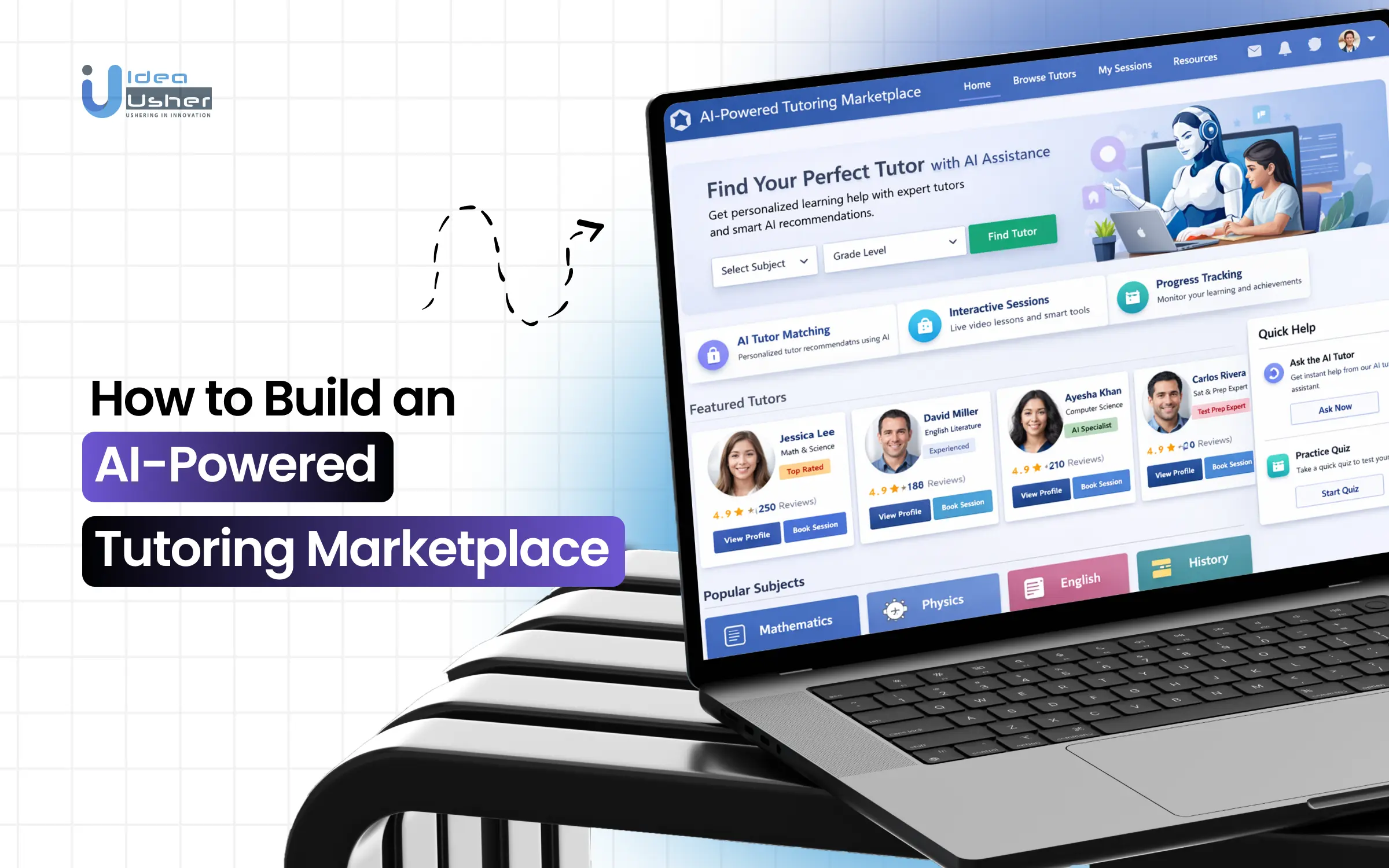
For years, finding a good tutor depended mostly on word of mouth or nearby coaching centers. Students often had limited choices, and the teaching style did not always match how they learned. Even after selecting a tutor, families would still spend time adjusting schedules and expectations. Many students have started using AI-powered tutoring marketplaces because they can quickly match students with tutors based on learning patterns and subject requirements.
The system can analyze past performance and study behavior to recommend suitable instructors. Students may therefore connect with tutors who can realistically support their academic progress. Automated scheduling feedback and progress tracking also keep the learning process structured and efficient.
Over the years, we have developed several AI-powered tutoring marketplaces powered by machine-learning-based recommendation engines and adaptive learning analytics. With this experience, we are sharing this blog post to discuss the steps for building an AI-powered tutoring marketplace.
Why AI Tutoring Marketplaces Are Growing Fast in EdTech?
According to Global Market Statistics, the global Online Tutoring Market size is estimated at USD 12,981.72 million in 2026 and is projected to reach USD 55,508.16 million by 2035, growing at a CAGR of 15.8% from 2026 to 2035. This surge is driven by a fundamental shift from static digital directories to intelligent, outcome-oriented ecosystems.

Source: Global Market Statistics
Decision-makers are pivoting to AI models to resolve the historical trade-off between educational quality and operational cost. By automating diagnostics and routine instruction, marketplaces now deliver premium, personalized mentorship at a scale previously deemed impossible.
Demand for Personalized AI Learning Platforms
Modern learners now expect hyper-personalization. They seek platforms that adapt to their specific cognitive load and emotional state in real-time. AI meets this demand by building Dynamic Learning Paths that evolve based on student performance.
If a student struggles with a concept like linear algebra, the AI analyzes past interactions to identify the root cause, such as a foundational gap in fractions. It then immediately adjusts the curriculum to create a high-impact, friction-free environment for mastery.
Limits of Traditional Tutor Marketplaces
Traditional models are hitting a scalability wall because they rely entirely on manual human hours. This creates systemic inefficiencies:
- The Expertise Gap: High-tier tutors are often too expensive or geographically restricted for many students.
- High Churn: Without AI to bridge the gap between weekly sessions, students lose momentum and drop off.
- Operational Fatigue: Tutors spend up to 40% of their time on administrative tasks, driving up costs for end users.
How AI Is Changing Online Tutoring Platforms
The leading platforms function as Hybrid Ecosystems. AI acts as an exoskeleton for the teacher, using Agentic Workflows to proactively nudge students to review using Spaced Repetition algorithms. For example, platforms like Khan Academy use their AI guide, Khanmigo, to provide Socratic coaching that helps students find answers themselves rather than just handing them out.
Technologically, these platforms utilize Multimodal LLMs to provide instant, step-by-step feedback on handwritten work.
Marketplaces like Preply have integrated AI to enhance tutor matching and support language learners with 24/7 practice, while tools like Wise help human tutors automate their reporting and content generation.
By using AI for sentiment analysis, these systems can detect frustration and automatically escalate the session to a human mentor for emotional support.

What Is an AI-Powered Tutoring Marketplace?
An AI-powered tutoring marketplace is a digital ecosystem using artificial intelligence to optimize the connection between educators and students. Unlike basic directories, these platforms integrate an intelligent middle layer to manage the entire learning lifecycle.
By treating education as a data-driven science, they monitor everything from initial searches to session engagement. This ensures learning is optimized for efficiency, leading to higher success rates and lower operational overhead for stakeholders.
How It Differs From Standard Tutor Platforms
The primary differentiator is the shift from passive discovery to active orchestration. In a standard platform, the burden of finding the right fit, assessing quality, and maintaining progress sits entirely on the student. An AI-powered marketplace removes this friction through several key technological shifts
From Filters to Matching:
Standard platforms use basic filters such as price, subject, or rating. AI-powered systems use predictive matching to analyze hundreds of compatibility markers, such as teaching speed, accent, and cognitive alignment.
Continuous vs. Episodic Learning:
Traditional tutoring is episodic; learning stops when the session ends. AI marketplaces use adaptive middleware to keep students engaged 24/7 through personalized practice and instant doubt resolution between live appointments.
Static vs. Dynamic Feedback:
Instead of waiting for a monthly progress report, AI systems provide real-time dashboards that highlight specific skills that are decaying before the student even realizes they have forgotten the material.
Core Components of an AI Tutoring Marketplace
To function at an elite level, these marketplaces rely on a three-tier architecture
- The Learner Model: A dynamic digital twin of the student. It tracks performance, behavioral patterns, and preferences to predict where the student will struggle next.
- The Domain Model: This organizes subject matter into granular knowledge nodes. For instance, rather than seeing Mathematics as one block, the AI sees a web of interconnected skills, allowing it to pinpoint that a struggle with calculus actually stems from a weakness in quadratic factoring.
- The Adaptation Model: Often referred to as the brain, this component determines what content or intervention is needed in real time. It might recommend a specific human tutor for a complex theory but assign an AI-driven drill for routine memorization.
Key Features of a Successful AI Tutoring Marketplace
A successful AI-powered tutoring marketplace does not just host content; it actively manages the learning journey. By integrating intelligence into the core infrastructure, these platforms remove the administrative and cognitive friction that typically leads to student burnout and tutor turnover.
The most effective platforms prioritize features that enhance human interaction rather than replace it. By automating routine aspects (such as scheduling, grading, and basic drills) the system allows the human element to focus on mentorship and complex problem solving.
1. Predictive Tutor Matching
The matching engine is the heart of the marketplace. Unlike basic keyword filters, an AI-driven engine uses predictive analytics to pair students with tutors based on behavioral compatibility. It analyzes learning pace and communication styles, significantly increasing satisfaction and long-term retention.
Example: Preply’s “Zeus” algorithm analyzes thousands of data points, including a student’s stated goals and a tutor’s past conversion rates, to suggest the highest-probability match within seconds.
2. Smart Scheduling
Scheduling is often the biggest operational bottleneck. AI resolves this by predicting optimal session times based on student alertness and tutor workload. Advanced systems can even auto-fill calendar gaps by offering proactive invites to students nearing a learning plateau.
Example: Lingooda uses automated scheduling to manage “Sprints,” ensuring that high-demand time slots are optimized across time zones to maximize tutor utilization.
3. Dynamic Lesson Recommendations
Static curricula are being replaced by dynamic recommendation engines. After every session, AI analyzes performance to suggest the next logical step. If a student masters a concept quickly, the system bypasses redundant material; if they struggle, it recommends targeted remedial micro-lessons.
Example: Duolingo For Schools integrates with classroom tutors to recommend specific “Weak-point” exercises based on the vocabulary words the AI identifies as most challenging for that specific student.
4. Real-Time Progress Tracking
Traditional progress reports are often delayed and subjective. AI-powered tracking provides objective data through a digital twin of the learner’s progress. These dashboards highlight skill decay and trigger review sessions exactly when they are needed most.
Example: Khan Academy’s “Khanmigo” creates real-time teacher dashboards that flag which students are “stuck” on a specific math proof, enabling immediate human intervention.
5. Automated Evaluation
By utilizing Multimodal LLMs, platforms can evaluate handwritten work, code, or essays instantly. This provides students with immediate feedback while they are engaged. The AI highlights errors and provides Socratic hints while flagging recurring misconceptions for the human tutor.
Example: Chegg uses AI to provide instant feedback on students’ writing and coding assignments, highlighting structural errors before students submit the work to their mentors.
6. 24/7 AI Learning Assistants
Between live sessions, AI assistants serve as a constant support layer. These agents are trained on specific curricula to ensure pedagogical consistency. They act as coaches who guide students through hurdles, maintaining the momentum often lost in traditional tutoring models.
Example: Cambly features AI-powered “Tutor Bots” that allow students to practice conversational English in a low-pressure environment between their scheduled sessions with native speakers.
7. Secure AI Payments
To maintain trust, top-tier marketplaces integrate AI-driven financial layers. These systems handle complex global transactions, including multi-currency support and automated tutor payouts. Many platforms now use hybrid subscription models that blend 24/7 AI support with live session credits.
Example: Italki manages a complex global “Wallet” system that uses automated fraud detection to secure transactions across hundreds of different local payment methods and currencies.
AI Features That Make Tutoring Marketplaces Stand Out
To stand out in a saturated EdTech market, a platform must offer a clear competitive advantage. Modern marketplaces use AI to create high-performance environments that anticipate the needs of both learners and educators.
By utilizing deep learning and real-time data, these platforms transform from passive tools into active participants. This ensures every minute spent on the site is optimized for maximum cognitive gain and efficiency.

1. Predictive Matching Algorithms
Superior matching goes beyond subject expertise. Advanced algorithms analyze historical engagement data, personality traits, and linguistic patterns to ensure high rapport. By identifying which tutor archetypes work best with specific student profiles, the platform fosters the chemistry necessary for effective long-term mentorship.
2. AI Doubt Resolution
The gap between live sessions is where most learning stalls. NLP allows platforms to provide instant, high-quality doubt resolution. These systems understand the context of a student’s question and provide incremental hints rather than direct answers. This encourages critical thinking while ensuring the student never stays stuck.
3. Automated Lesson Planning
AI drastically reduces educators’ preparation time by generating bespoke lesson plans based on a student’s latest performance data. The system aggregates recent errors and current goals to create a structured roadmap. This allows the tutor to arrive fully briefed and ready to tackle the most pressing challenges immediately.
4. Dynamic Learning Paths
Every learner follows a unique trajectory. AI monitors these paths in real time, adjusting the difficulty and sequence of topics based on the individual’s mastery level. This dynamic scaffolding ensures that the content is never too easy to cause boredom, nor too difficult to cause anxiety, keeping the student in the optimal learning zone.
5. Intelligent Speech Recognition
In language marketplaces, specialized AI provides objective feedback on pronunciation, intonation, and fluency. Students practice in a low-pressure environment with the AI, which then provides a phonetic heatmap to the human tutor. This allows live sessions to focus on high-level conversation rather than repetitive correction.
6. Advanced Performance Analytics
Data-driven insights provide a level of transparency that traditional tutoring lacks. Analytics engines track metrics such as learning velocity and concept retention rates. These insights are shared via intuitive dashboards, turning abstract progress into a concrete, measurable journey that motivates continued investment.
How to Build an AI Tutoring Marketplace?
When we build an AI tutoring marketplace for our clients, we don’t just develop a platform; we engineer a high-performance educational ecosystem. Our approach centers on creating a “Triadic Relationship” where the student, the human tutor, and the AI agent work in a seamless feedback loop.
By removing the technical friction that hinders learning, we allow your business to scale through automated intelligence rather than manual overhead. Here is the precise process we follow to bring your vision to a market-ready reality.

1. Defining Your Niche
We begin by identifying a high-value vertical to avoid the “generalist” trap. Whether we are building for medical board prep, K-12 STEM, or corporate leadership, we help you define a niche that allows for specialized AI training. This ensures the AI models we deploy understand domain-specific terminology from day one.
2. Validating User Demand
Our team works with you to identify friction gaps (such as high tutor churn or student disengagement). By testing core assumptions with your target audience, we ensure that every AI feature we build, from automated session summaries to predictive matching, directly serves a proven market need.
3. Architecting the System
We design a robust, scalable backend capable of handling real-time data streaming and complex logic. Our infrastructure includes a centralized Learner Record Store (LRS) that captures every interaction. This allows the AI to maintain a persistent memory of a student’s progress, ensuring educational intelligence remains intact even if a student switches tutors.
4. Developing Custom Apps
We build intuitive, flow-state interfaces for both sides of the market. The student app provides a distraction-free environment with real-time Socratic hints. For the tutor, we build a comprehensive command center that offers at-a-glance insights into student knowledge gaps, allowing them to maximize the impact of every live minute.
5. Integrating AI Engines
This is where we differentiate your platform. We go beyond simple API calls by implementing Retrieval-Augmented Generation (RAG) to keep the AI grounded in your specific curriculum. We also fine-tune matching algorithms and integrate speech recognition engines tailored to the technical jargon of your chosen niche.
6. Automating Payouts
Financial integrity is the bedrock of marketplace trust. We implement secure, automated escrow systems where payments are secured upfront and released only after session verification. We also integrate AI-driven fraud detection to monitor for platform leakage, protecting your revenue by keeping transactions within your ecosystem.
7. Continuous Optimization
Post-launch, we focus on optimization through feedback loops. We use AI to analyze session transcripts and identify where learners might be dropping off. By monitoring the matching success rate, we refine the algorithms to ensure that tutor-student pairings result in the highest possible long-term engagement.
Cost to Build an AI-Powered Tutoring Marketplace
Building an AI-driven tutoring marketplace is a significant investment that shifts from traditional software capital to ongoing operational intelligence. When we estimate these projects for our clients, we categorize costs into two categories: the initial “build” to reach market-readiness and the “run” costs required to maintain AI model accuracy and platform stability.
Our approach focuses on a “Modular MVP” to validate your niche while ensuring the underlying architecture can support a seven-figure user base without a total rebuild.
MVP Development Cost Breakdown
An MVP for an AI tutoring marketplace focuses on the “Triadic” core: seamless video, a basic matching algorithm, and essential payment flows. In the current market, a professional-grade MVP typically ranges from $50,000 to $150,000, depending on platform complexity (Web vs. Mobile).
| Phase | Estimated Cost | Duration |
| Discovery & UI/UX Design | $10,000 – $20,000 | 3–5 Weeks |
| Core App Development | $30,000 – $70,000 | 8–12 Weeks |
| Initial QA & Testing | $10,000 – $25,000 | 3–4 Weeks |
| Deployment & Launch Support | $5,000 – $15,000 | 2 Weeks |
AI Integration Development Cost
This is the specialized layer where we integrate the intelligence that differentiates your platform. The cost here is driven by whether we are using third-party APIs (like OpenAI or Gemini) or building custom-trained models for your specific niche.
- Basic AI Integration ($20,000 – $50,000): Focuses on “Wrapper” technology using RAG (Retrieval-Augmented Generation) to ground existing LLMs in your curriculum for 24/7 student support.
- Advanced Model Development ($70,000 – $150,000+): Includes custom-built recommendation engines for tutor matching, speech-to-text models for language fluency, and automated multimodal grading systems.
- Data Engineering & Labeling ($10,000 – $40,000): Clean, high-quality data is essential. This covers the cost of cleaning and structuring your initial “knowledge base” so the AI doesn’t hallucinate.
Infrastructure and Maintenance Cost
AI marketplaces have unique “hidden” costs related to GPU compute and model drift. We suggest budgeting 15% to 25% of your initial build cost annually for ongoing maintenance.
- Cloud Infrastructure ($1,000 – $5,000+/mo): Covers hosting on AWS or GCP, including specialized GPU instances for AI inference and high-speed video streaming.
- Model Retraining & Fine-tuning: As you collect more student interaction data, the AI must be retrained to remain accurate. This typically requires a part-time data scientist or a managed MLOps service.
- API Usage Fees: If your platform relies on third-party models, costs scale with your user base. We implement “caching” and “Small Language Models” (SLMs) to keep these monthly bills predictable.
Estimated Total Development Budget
For a production-ready, competitive AI tutoring marketplace, we recommend the following budget tiers:
- The Lean Startup ($80,000 – $120,000): A robust web-based MVP with API-driven AI support and essential matching. Best for testing a specific niche.
- The Scaling Contender ($150,000 – $350,000): A cross-platform (Web + iOS/Android) marketplace with custom-trained recommendation engines and advanced video features.
- The Enterprise Leader ($500,000+): A full-scale ecosystem with proprietary speech/vision models, deep LMS integrations, and advanced security compliance (GDPR/HIPAA).
AI Models Used in Tutoring Marketplace Platforms
Integrating specific AI models enables a marketplace to move beyond simple search and video tools, becoming a truly intelligent intermediary. When we build these platforms, we select and fine-tune models based on their specific role in the learning lifecycle, ensuring accuracy, speed, and pedagogical soundness.

1. NLP Models for Student Questions
The primary goal of NLP in tutoring is to bridge the gap between live sessions. We deploy a tiered model approach to balance cost and performance.
- Llama 3.2 & Mistral Small 3: These act as the reasoning engines for complex, subjective questions. They are highly effective for generating detailed explanations and creative analogies that help students grasp difficult concepts.
- Small Language Models (SLMs) like Phi-4 or Qwen-3: For routine queries (such as “What is the formula for area?” or simple grammar checks) we use SLMs. These offer significantly lower latency and reduced compute costs while maintaining high accuracy for structured knowledge.
- Retrieval-Augmented Generation (RAG): We ground these models in your platform’s proprietary curriculum or textbooks. This prevents “hallucinations” and ensures the AI provides hints consistent with the specific teaching methods of your marketplace.
2. Recommendation Engines for Tutor Matching
Matching is a multidimensional data problem. We move beyond simple subject tags to create a Compatibility Score using advanced recommendation architectures.
Neural Collaborative Filtering (NCF):
This model analyzes historical interactions to predict which tutor-student pairings will result in the highest engagement. It learns subtle patterns, such as a student’s preference for a specific tone or teaching pace.
XGBoost & LightGBM:
We use these gradient boosting frameworks to process tabular data (such as tutor availability, student time zones, and historical rebooking rates) to optimize marketplace liquidity and ensure the most reliable tutors are prioritized.
Knowledge Graphs:
We build a graph of related concepts (e.g., knowing that Trigonometry is a prerequisite for Calculus). The matching engine uses this to suggest tutors who have a proven track record in the specific foundational areas a student is missing.
3. AI Assessment and Grading Models
Automated grading provides the instant feedback that modern learners expect. We utilize multimodal models to “see” and “read” student work just as a human would.
Multimodal LLMs (GPT-4o / Gemini 3 Flash):
These models can analyze uploaded images of handwritten math problems or chemistry diagrams. They identify the specific step where a student made an error and provide a Socratic hint rather than just the final answer.
BERT-based Encoders:
For essay grading and short answer evaluation, BERT models excel at understanding context and semantic meaning. We use them to compare student responses against rubrics, ensuring consistent and unbiased scoring across the entire platform.
Answer Grouping:
We implement AI that clusters similar student answers together. This allows tutors to grade a “type” of error once and apply that feedback to dozens of students simultaneously, drastically reducing their administrative workload.
4. Speech AI for Language Learning
For language marketplaces, the AI must act as a high-fidelity ear, capable of detecting the finest nuances of speech.
Whisper v3 & Wav2Vec:
These state-of-the-art speech-to-text models provide the backbone for transcription and fluency analysis. They are particularly resilient to background noise and varied accents, making them ideal for global marketplaces.
Phonetic Heatmapping:
We integrate specialized models that compare a student’s waveform against a native speaker’s. The AI generates a heatmap that shows exactly which phonemes were mispronounced, enabling targeted correction.
Emotional & Tone Analysis:
Advanced Speech AI now detects a student’s confidence level and hesitation patterns. This data is fed back to the human tutor, letting them know if a student is technically correct but still lacks the confidence to use the language in real-world scenarios.
How AI Improves Tutor Matching and Learning Outcomes?
When we design the matching and analytics layer of your marketplace, we move beyond simple directories. Traditional platforms rely on manual filtering, which leads to decision fatigue and poor pairings. Our AI-driven approach transforms this into a high-precision science, ensuring every student is paired with a mentor who maximizes their cognitive potential.
By analyzing thousands of data points in real time, the platform identifies the patterns that lead to educational success. This results in higher retention, faster mastery, and a significant competitive advantage for your brand.

1. AI-Driven Skill Matching
Standard filters only capture surface-level data, such as “Math” or “Physics.” Our AI-driven matching maps specific micro competencies of a tutor against the precise knowledge gaps of a student.
If a student struggles with quadratic equations but excels at linear algebra, the AI identifies this nuance. It prioritizes tutors with a high-resolution score for that specific subtopic. This granular alignment ensures efficient sessions and faster student progress.
2. Behavioral Learning Data Analysis
The best outcomes happen when there is a strong pedagogical fit. We use behavioral analysis to capture how a student learns best by monitoring engagement metrics and preferred communication styles.
The AI matches students with tutors whose teaching style (whether structured or conversational) complements their profile. By fostering this natural rapport through data, we reduce tutor churn and increase satisfaction for both parties.
3. Predictive Performance Models
We implement predictive models that act as an early warning system for student success. By analyzing historical learning trajectories, the AI predicts when a student is likely to hit a plateau or lose motivation.
These models allow the platform to be proactive. If the AI detects a high probability that a student will miss a milestone, it suggests a targeted review or alerts the tutor to adjust their strategy. This shift to proactive support keeps students on track and improves long-term ROI.
Monetization Models for AI Tutoring Marketplaces
Selecting the right revenue strategy is critical to balancing marketplace liquidity with profitability. When we build these platforms, we implement flexible financial architectures that let you mix and match models to suit your specific niche.
By leveraging AI to track engagement and value delivery, we help you transition from simple transaction fees to sophisticated, value-based pricing. This ensures sustainability while providing clear ROI for students and fair compensation for tutors.
1. Commission-Based Marketplace
This is the standard entry point for new marketplaces. The platform takes a percentage of every transaction between a student and a tutor. Our AI enhances this by identifying high-value tutors with high retention, allowing for dynamic commission tiers that reward performance.
Example: Preply uses a tiered commission model that starts at 33% for new tutors and scales down to 18% as they complete more teaching hours. In early 2026, the company reached a $1.2 billion valuation, driven by this high-volume transaction model.
2. Subscription-Based Platforms
Subscriptions provide the predictable recurring revenue investors value. We often implement a hybrid model where a monthly fee provides unlimited access to AI features (like 24/7 doubt resolution) plus a set number of human tutoring credits.
Example: Chegg reported over $100 million in subscription revenue in early 2025. Their model typically charges around $15–$20/month, giving students access to AI-powered study tools and a massive database of expert Q&A.
3. Pay-Per-Session Model
Ideal for just-in-time learning, this model allows students to purchase individual sessions on demand. We integrate AI-driven flash pricing to fill unexpected tutor cancellations with proactive, discounted invites to active students.
Example: Wyzant allows tutors to set their own hourly rates (often ranging from $30 to $100+) and charges a flat 25% commission on these individual bookings. This model caters to students seeking specialized, short-term help rather than a long-term commitment.
4. Premium AI Features
As AI becomes central to the value proposition, many platforms offer AI-only tiers. This separates human labor costs from technology costs, creating a low-friction upsell for users who want personalized support without the high price of a human tutor.
Example: Duolingo Max is a premium tier that uses GPT-4 to offer features like “Explain My Answer” and “Roleplay.” By 2025, Duolingo surpassed $1 billion in annual revenue, largely by converting free users into these AI-enhanced paid tiers.
Growth Strategies Used by Successful Tutor Marketplaces
Successful marketplaces do not grow by accident; they solve the classic “chicken and egg” problem through strategic liquidity management and aggressive user acquisition. By analyzing the trajectories of global leaders, clear patterns emerge in how they scale from a few dozen to millions of users.
These platforms prioritize high-trust environments and viral loops, ensuring that every new participant adds exponential value to the network.
1. Marketplace Liquidity Strategy
Liquidity is the lifeblood of a tutoring platform. It is defined by how quickly a student can find a high-quality tutor and how consistently a tutor can fill their calendar.
Preply achieves liquidity through geographical labor arbitrage. By connecting students in high-cost-of-living regions (like the US) with native speakers in lower-cost regions, they provide affordable learning for students while offering tutors competitive global wages.
VIPKid maintained liquidity by using a centralized curriculum. By providing the lesson materials themselves, they removed the “prep burden” from tutors. This allowed them to onboard over 20,000 teachers rapidly, as tutors could simply show up and teach without extensive planning, ensuring a constant supply of available slots for students.
2. Early User Acquisition Channels
The most effective platforms focus on channels where their target audience is already seeking information or community.
Italki initially grew as a social network for language exchange. By allowing users to correct each other’s written “notebook” entries for free, they built a massive community of motivated learners. They then successfully converted these community members into paying students for their professional 1-on-1 tutoring services.
GoStudent leveraged hyper-local SEO and trust signals. By focusing on specific European curricula and amassing over 20,000 5-star Trustpilot reviews, they built a brand that felt safer than a global, anonymous directory.
This local authority allowed them to scale rapidly across different countries by replicating the same trust-based marketing playbook.
3. Referral Systems for Tutors and Students
Virality is the most cost-effective way to grow. Successful marketplaces turn their existing user base into an unpaid sales force through incentivized referrals.
Cambly uses a dual-incentive referral system. When a student refers a friend, the friend receives a 10-minute trial, and the referrer receives 60 free minutes upon the friend’s subscription. This creates a “win-win” loop that significantly lowers the cost of customer acquisition.
Duolingo Max and other platforms utilize Ambassador Programs. They identify their most active users and offer them commissions or exclusive features in exchange for promoting the platform to their own social circles.
This turns high-retention users into long-term brand advocates, driving high-quality leads that are more likely to convert than those from standard paid ads.
Why Businesses Partner With IdeaUsher for AI EdTech?
Choosing the right development partner is the difference between launching a generic directory and a high-performance educational ecosystem. At IdeaUsher, we combine deep pedagogical understanding with cutting-edge engineering to build platforms that do not just host tutors but actively improve learning outcomes.
We act as a strategic extension of your team, ensuring that every line of code serves your specific business goals and prepares your marketplace for global scale.
Marketplace Platform Experience
Building a two-sided marketplace requires a delicate balance of supply and demand. With over 500,000 hours of coding experience, our team of ex-MAANG/FAANG developers understands the nuances of marketplace liquidity, fraud prevention, and user retention.
We have successfully delivered complex EdTech ecosystems that handle thousands of simultaneous live sessions without a drop in performance.
AI Development Expertise
We specialize in moving beyond basic API wrappers to build truly agentic educational tools. Our team designs custom RAG (Retrieval-Augmented Generation) pipelines and fine-tunes Small Language Models (SLMs) to provide students with Socratic, curriculum-aligned support. By embedding intelligence at the core, we help you create a platform that feels like a personal mentor for every user.
Faster MVP Development Approach
Speed to market is a competitive necessity. We utilize a modular development framework that allows us to launch a feature-rich MVP in weeks (not months).
By focusing on high-impact features (such as predictive tutor matching and automated scheduling) we enable you to start collecting real-world user data and generating revenue while the full platform continues to evolve.
Scalable Cloud Infrastructure
As your user base grows, your infrastructure must remain invisible. We architect AI-native backends on AWS and Google Cloud that scale automatically to handle traffic spikes. Our systems are built for 99.9% uptime, utilizing Kubernetes for self-healing and specialized GPU instances for low-latency AI inference, ensuring a seamless experience for a global audience.
Conclusion
Building an AI-powered tutoring marketplace requires a strategic blend of high-performance engineering and a deep focus on the user experience. By integrating advanced AI models for matching, assessment, and personalized support, you move beyond a simple directory and create a scalable, intelligent ecosystem. At IdeaUsher, we leverage our extensive coding experience and expertise in AI-native infrastructure to help you turn this vision into a market-leading reality.
Looking to Develop an AI-Powered Tutoring Marketplace?
IdeaUsher can help you build an AI-powered tutoring marketplace that intelligently matches students with the right tutors. Our team can efficiently integrate adaptive learning algorithms and real-time analytics to optimize scheduling and progress tracking.
With over 500,000 hours of coding experience, our team of ex-MAANG/FAANG developers brings the elite technical standards required to turn your vision into a global market leader.
- Intelligent Matching: We move beyond basic filters to build neural recommendation engines that pair students and tutors based on cognitive compatibility and micro-skill gaps.
- Agentic Socratic AI: Our custom RAG pipelines ensure your AI acts as a 24/7 mentor, providing curriculum-aligned hints instead of just giving away answers.
- Frictionless Scaling: We deploy AI-native infrastructure that grows with your user base, ensuring 99.9% uptime for live sessions and automated global payouts.
- Predictive Analytics: Our platforms use behavioral data to identify “learning plateaus” before they happen, increasing student retention and long-term platform ROI.
Check out our latest projects to see the kind of work we can do for you.


FAQs
A1: You should definitely start by identifying a high-value niche where specialized knowledge is in high demand. Your team must architect a robust two-sided marketplace that seamlessly connects qualified mentors with eager students. It is technically essential to integrate automated scheduling and secure payment gateways to ensure smooth operational flow.
A2: You can build a high-performance platform by utilizing a modern tech stack like Next.js for a responsive frontend experience. It is highly recommended to implement a centralized Learner Record Store to track student progress across different sessions. You must also integrate low-latency video APIs, such as WebRTC, to enable real-time, interactive learning.
A3: An online tutoring marketplace can be remarkably profitable when you leverage AI to reduce manual administrative overhead. You should implement a commission-based model or recurring subscriptions to ensure a steady, predictable revenue stream. The platform will efficiently maximize margins by using automated tools to resolve doubts and generate session summaries.
A4: You could effectively grow your presence by using data-driven SEO strategies that target specific educational keywords. It is incredibly helpful to share success stories and technical whitepapers that demonstrate your platform’s unique learning outcomes. You should also establish strong referral loops that incentivize existing users to advocate for your specialized services.


