 (+971) 8007 4267
 (+91) 946 340 7140
 (+1) 628 432 4305

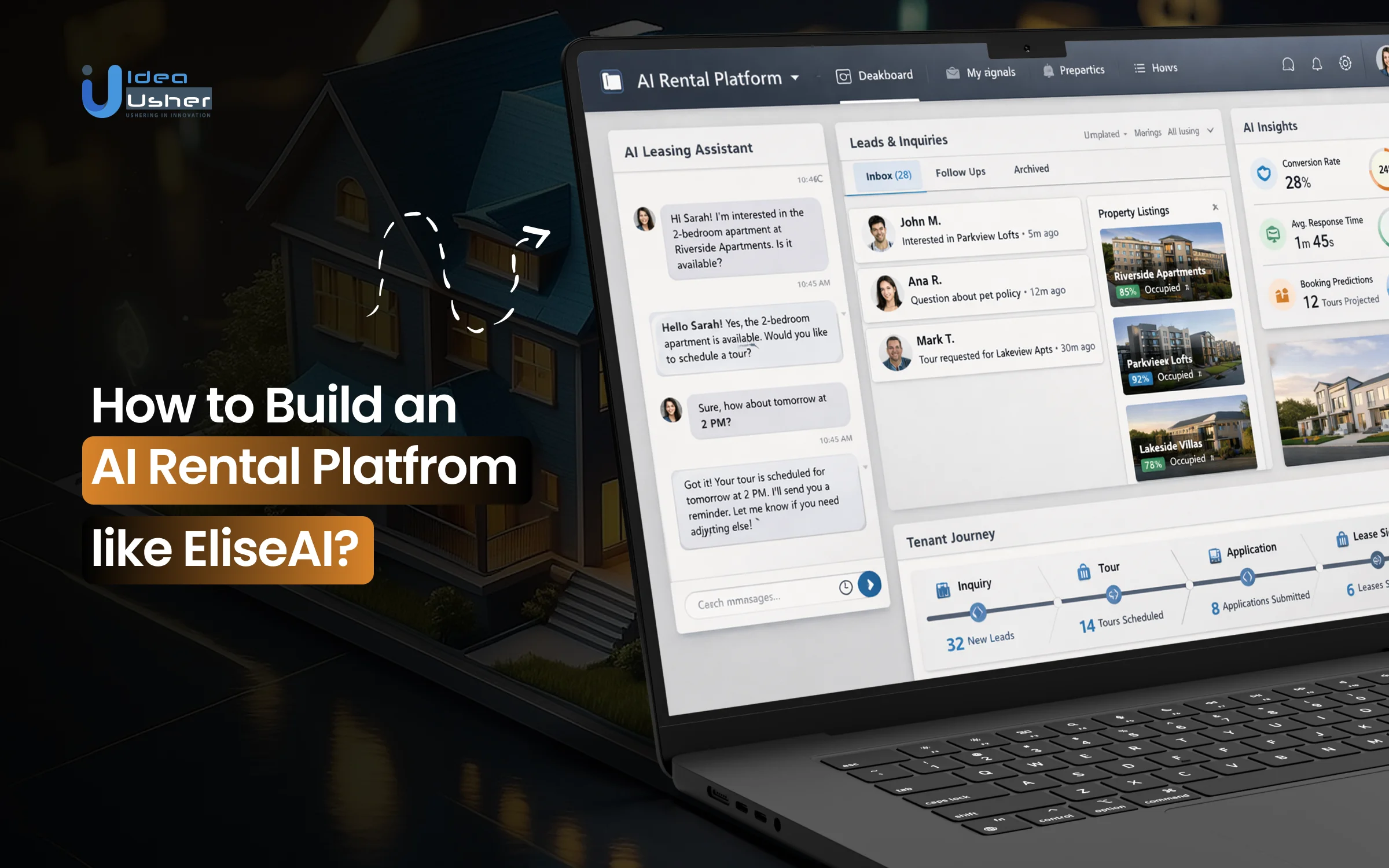
In property rental operations, delays are expensive and often hard to see. Every unanswered message can extend vacancy time and slow revenue recovery. Manual steps quietly reduce conversion even when teams work hard. This pressure pushed operators toward AI rental platforms like Elise AI that engage prospects across channels and respond instantly.
These systems began handling first touch conversations, scheduling tours, and updating internal records automatically. Human teams could then focus on complex or high-value interactions. As efficiency became tied to profitability, AI adoption steadily increased across rental operations.
We have developed numerous AI rental solutions over the years, powered by agentic AI frameworks and context management engines. As IdeaUsher has this expertise, we’re sharing this blog to outline practical steps for building an AI rental platform like EliseAI. Let’s start.
Key Market Takeaways for AI Rental Platforms
According to MarketsandMarkets, the AI-as-a-Service market supporting AI rental platforms is projected to grow from USD 20.26 billion in 2025 to USD 91.20 billion by 2030, at a 35.1 percent CAGR. This expansion is driven by organizations adopting AI without investing in costly infrastructure, a shift that is clearly reshaping how real estate operations are run.

Source: MarketsAndMarkets
As adoption increases, AI-driven rental and property management platforms are becoming core operational tools. Property owners and managers use AI to automate lead responses, tenant communication, and leasing workflows, reducing manual workload while meeting growing expectations for fast, always-on service.
This trend is reflected in platforms like EliseAI and AppFolio. EliseAI deploys AI agents to handle leasing and resident operations, including tour scheduling, maintenance coordination, renewals, and billing, and has attracted strong investor interest as it expands into adjacent sectors.
AppFolio has embedded AI across its property management suite to automate communication and operational tasks, while partnerships, such as its collaboration with Second Nature, extend AI value by integrating essential resident services directly into daily property workflows.

What is the EliseAI Platform?
EliseAI is built to take pressure off teams that manage high-volume conversations in housing and healthcare. In property management, whether it is multifamily, student housing, or single-family rentals, the platform steps in as a conversational layer that works around the clock. It handles leasing questions, maintenance requests, renewals, and payment follow-ups across voice, text, email, and web chat.
The same core system also supports healthcare providers by managing patient scheduling and routine inquiries. At the center is a unified CRM that keeps prospect, resident, and patient context in one place and integrates with existing management systems, so staff spend less time on manual tasks and more time on work that requires human judgment.
Here are some of its standout features,
1. 24/7 Voice Calls
Inbound calls are answered immediately, and outbound calls are placed automatically when needed. The system can explain amenities, schedule tours, and resolve common questions without putting callers on hold. This keeps callers engaged and prevents missed opportunities outside office hours.
2. SMS and Text Messaging
Text is used for fast, practical communication. The platform sends maintenance updates, renewal and payment reminders, and responds quickly to short questions while users are on the move. It fits naturally into how residents and patients already prefer to communicate.
3. Email Management
Incoming emails are read and answered with context-aware responses. Follow-ups for leasing or resident needs are handled consistently, with no inbox backlog. This reduces response delays that often frustrate prospects and residents.
4. Website Web Chat
Visitors on a website get real-time answers instead of forms and delays. Questions are handled instantly, and qualified leads are captured while interest is still high. This helps convert casual visits into meaningful conversations.
5. Tour Scheduling
Self-guided, virtual, or in-person tours are booked automatically. The system can suggest units based on budget and preferences and share floor plans or media without staff involvement. It also keeps calendars accurate across multiple properties.
6. Maintenance Handling
Requests are received, converted into work orders, and tracked through completion. Status updates and satisfaction follow-ups are sent by text to keep residents informed. This creates a clearer service experience without repeated check-in calls.
7. Renewal and Delinquency Support
Renewal outreach starts well in advance, and payment reminders are sent automatically. Fees and balances are clearly explained, helping reduce missed payments and the need for manual follow-up. The tone remains consistent and professional across all interactions.
How Does the EliseAI Platform Work?
EliseAI quietly monitors messages, calls, and chats and can understand intent almost instantly. It may connect context from leasing data schedules and workflows, enabling automatic, accurate replies. Over time, it can learn patterns, adapt responses, and reliably hand off to humans when logic or compliance requires it.

1. Multi-Channel Communication Hub
The platform’s primary function is to serve as a single unified brain for all customer interactions. Unlike tools that handle only one channel, EliseAI manages conversations across the four key channels where people naturally reach out.
| Channel | How It Works |
| Text SMS | Delivers instant responses for fast, effortless communication, reducing response delays. |
| Reads understands and replies to inbox messages while reliably handling follow-ups without manual effort. | |
| Chat | Engages website visitors in real time, captures leads, and answers questions as they naturally arise. |
| Voice | Handles real phone calls continuously with zero hold time and can manage inbound queries and outbound calls in a human-like way. |
This omnichannel approach ensures that whether a prospect texts at midnight, calls on a weekend, or emails during business hours, they receive an instant, consistent, and helpful response.
2. Intelligent Automation
The platform automates end-to-end workflows rather than sending simple automated replies. It understands intent and completes tasks end-to-end. In property management, this allows the system to handle the following.
- Answer detailed questions about pricing, availability, and amenities.
- Schedule and confirm property tours automatically.
- Qualify leads by asking relevant follow-up questions.
- Process maintenance requests by collecting details and creating work orders.
- Send payment reminders and manage lease renewal conversations.
In healthcare environments, the same logic streamlines patient communication by handling appointment scheduling, pre-visit instructions, billing inquiries, and post-visit follow-ups while integrating with existing systems.
3. Delivering Tangible Business Outcomes
The clearest explanation of how the platform works is visible in the outcomes it delivers. By absorbing high-volume, repetitive communication, the system directly drives measurable results.
- Improved Operational Efficiency: Routine tasks are automated, freeing staff to focus on complex, high-value interactions. Documented payroll savings have exceeded fourteen million dollars across clients.
- Enhanced Customer Experience: Twenty-four-seven availability and instant personalized responses in the user’s preferred language, with support for fifty-one written and seven voice languages, significantly improves satisfaction.
- Increased Conversions: Immediate engagement with prospects leads to lease conversion rates by ensuring no inquiry goes unanswered.
- Scalability: Organizations can manage more than 1.5 million interactions per year and automate up to 90% of prospect workflows without increasing staff headcount.
4. Integration and Scale
The platform is designed to fit into existing operations rather than disrupt them. It integrates directly with leading property management software and electronic health record systems.
This allows the AI to access real-time data, such as unit availability or appointment slots, and write actions back into the system, like logging a tour or creating a service ticket. This level of deep integration is what transforms the platform from a communication tool into an autonomous operational layer.
What is the Business Model of the EliseAI Platform?
EliseAI operates a SaaS platform that delivers agentic AI to automate customer interactions across housing and healthcare. In housing, the platform supports leasing and resident services, while in healthcare, it focuses on patient scheduling and intake.
The business model is primarily subscription-driven, built around vertical-specific AI products, with a free entry-level CRM used to encourage adoption and upsell into paid tiers.
Subscriptions
The core revenue stream comes from subscription plans tied to the LeasingAI, ResidentAI, and HealthAI platforms. Pricing is typically based on property unit counts or defined usage tiers, with annual recurring revenue growing strongly after the Series C round.
Usage-Based Fees
Additional revenue is generated through charges for high-volume conversations and premium capabilities. These usage-driven fees have contributed to a 15 percent revenue uplift, in line with 2024 SaaS benchmarks.
Bundled Modules
EliseAI also drives expansion revenue through bundled add-ons, including AI-guided tours launched in January 2025 and delinquency management tools. These modules have helped clients reduce operational costs by around 30 percent while improving retention.
Financial Performance
As of 2024, the platform processes more than 1 million conversations each month. This scale has delivered measurable efficiency gains of roughly 15 percent through automation, alongside tangible client benefits such as reduced payroll costs and higher occupancy rates.
Strong ARR growth has enabled EliseAI to scale across large addressable markets, including the $15 billion real estate digital advertising ecosystem and the $12 billion healthcare operations market. In 2024, a mix of direct sales and strategic partnerships drove a 15-30% increase in customer acquisition.
Funding Rounds
- Total Funding: $134 million raised across five rounds, combining equity and debt.
- Series D (August 2024): $75 million raised at a valuation exceeding $1 billion.
- Prior Rounds: Approximately $110 million raised across earlier rounds, supporting expansion from housing into healthcare use cases.
How to Build an AI Rental Platform Like EliseAI?
Building an AI rental platform like EliseAI typically starts by unifying rental data and training the AI to model how real renter conversations flow. The system should remain aware of context across channels and connect directly to property systems to enable real-time action.
We have successfully developed AI-driven rental platforms such as EliseAI, and this is the approach we follow.

1. Unified Rental Data
We start by designing a single AI-first data model that covers prospects, residents, and historical interactions. CRM and PMS silos are removed, ensuring the AI always operates on a complete dataset. Clear lifecycle states help the system understand where each renter stands and what action should come next.
2. Context & State Engine
We build a centralized engine that preserves conversational state across all channels. The AI tracks workflow progress and previous interactions in real time. This prevents repeated questions and keeps conversations focused and efficient.
3. Multi-Agent Orchestration
We deploy task-specific AI agents to handle leasing, support, renewals, and follow-ups. A supervisor agent coordinates these agents and resolves overlaps. Compliance routing ensures sensitive scenarios follow predefined rules.
4. PMS Write-Back
We integrate the AI deeply with property management systems so it can update records directly. Secure APIs enable actions like scheduling tours or updating application status. Idempotent logic and error recovery mechanisms maintain data consistency.
5. Voice AI Layer
We add voice AI to support phone-based leasing and resident support. The system is trained for natural spoken conversations with multi-turn reasoning. Low-latency responses ensure calls feel smooth and human.
6. Compliance & Analytics
We embed Fair Housing guardrails and monitoring across all interactions. Conversation audits help teams review AI behavior. Performance and conversion metrics provide visibility into business impact.
How AI Rental Platforms Identify High-Intent Leads?
AI rental platforms identify high-intent leads by quietly observing how people behave, not just what they submit in a form. They may track response speed, question depth, and repeated engagement with unit details to estimate readiness. Over time, the system can confidently surface leads that are more likely to move forward and deserve immediate attention.

The Predictive Engine
The predictive power of an AI leasing platform does not come from a crystal ball, but from a continuous cycle of data collection, pattern recognition, and behavioral analysis. It transforms every digital interaction into a data point that feeds a probability model.
The Data It Analyzes
To predict likelihood, the AI synthesizes information from multiple streams.
Explicit Prospect Data
The information a lead voluntarily provides.
- Desired Move-In Date: A lead needing an apartment next week is often hotter than one looking six months out.
- Self Reported Budget and Credit Score Range: Provided during initial qualification chats.
- Unit Type and Must-Have Amenities: Specificity often indicates serious intent.
Implicit Behavioral Data
How the prospect interacts is often more telling than what they say.
- Engagement Velocity: How quickly do they respond to the AI texts or emails? Rapid, detailed replies are a strong positive signal.
- Interaction Depth: Do they ask superficial questions or deep, specific ones about lease terms, policies, and utilities?
- Content Consumption: Do they click links to view specific floor plans, virtual tours, or the full application? Do they revisit the property page multiple times?
- Channel Preference: A lead who initiates contact by phone may be treated as having higher intent than a single web chat query, depending on the property’s historical conversion patterns.
How does the Prediction Work?
Platforms like EliseAI and others use this data to assign a dynamic Lead Score or conversion probability percentage to each prospect. This score is not static. It changes in real time based on the prospect’s actions.
For example
A prospect named Sarah submits a web form on Tuesday. She gets a base score of 25 out of 100.
- +15 points. She instantly replies to the AI text with three specific questions about Unit 304B.
- +20 points. She watches the 3D virtual tour of that unit the same day.
- +10 points. She asks the AI about the application fee and lease terms on Wednesday.
- -10 points. When the AI suggests a tour, she says she cannot view it for three weeks.
Sarah’s score is now 60 out of 100, flagging her as a high-intent lead for the leasing agent, even though she has not yet scheduled a tour. The system can now automatically prioritize her for personalized follow-up.
From Prediction to Action
The true power lies in how the platform uses these predictions.
Intelligent Lead Routing and Alerts
High-scoring leads are instantly flagged in the CRM dashboard and can trigger immediate notifications to a leasing agent’s phone. For example, Hot Lead Alert. Sarah is highly engaged with Unit 304B. Recommend a personal call within 1 hour.
Automated, Tiered Follow-Up Campaigns
The AI can personalize its own nurturing.
- High-Intent Leads Score 75+: The AI may shorten its automated follow-up cycle and use more direct language. Sarah, Unit 304B is receiving interest. Are you available for a quick 10-minute call today to discuss your application?
- Mid Intent Leads Score 40 to 74: Continues with standard, helpful nurturing, like scheduling tours and sending amenity details.
- Low Intent or Cold Leads Score Below 40: Maintains basic engagement with less frequency, keeping the property top of mind without wasting agent time.
Predictive Insights for Agents
Beyond scores, the AI can surface actionable insights. For example, this lead has asked four questions about pet policies but has not scheduled a tour. Consider sending a video of the dog park and clarifying the pet fee structure.
The Quantifiable Impact
Implementing predictive AI leads to measurable business outcomes.
- Increased Conversion Rates: Agents focus on high-quality leads, reducing time wasted on tire-kickers. Companies report 20-35% improvements in lead-to-lease conversion.
- Reduced Cost Per Lease: Marketing and labor dollars are spent more efficiently.
- Shorter Vacancy Cycles: Units are filled faster by identifying ready-to-apply prospects early in their journey.
- Improved Agent Productivity and Morale: Leasing teams spend less time on frustrating cold calls and more time closing qualified deals.
How AI Rental Platforms Handle Multilingual Communication?
AI rental platforms handle multilingual communication by automatically detecting the renter’s language and responding in that language across chat, text, email, and calls. They can correctly understand rental-specific terms and may preserve their legal meaning through pre-approved translations. This approach quietly improves clarity, speed, and trust for both prospects and residents.

1. Omnichannel Language Support
A robust platform detects and responds in the user’s preferred language across all communication channels.
Website Chat and Text SMS
A prospect visits your website from a device set to Vietnamese. The chat widget automatically greets them in Vietnamese. Xin chào. Tôi có thể giúp gì cho bạn về các căn hộ của chúng tôi. The entire conversation continues in their native language.
The AI reads and comprehends inbound emails in dozens of languages, formulating a contextually accurate reply in the same language.
Voice Calls VoiceAI
This is the pinnacle of multilingual tech. When a call comes in, the AI can:
- Detect the spoken language in real time.
- Conduct a fluid, natural conversation using human-quality synthetic voices in that language.
- Provide consistent information, whether the call is about pricing in German or maintenance in Portuguese.
For example, a platform like EliseAI offers support for written responses in 51 languages and voice support in 7, allowing a single property to effortlessly serve a vast international audience without hiring a multilingual staff.
2. Context-Aware Translation
Rental conversations are filled with jargon and specific terms. Basic translators often fail to translate terms such as security deposit, rider, HOA, earnest money, or appliance warranty. AI platforms are trained on industry-specific lexical databases.
Standard Translation
The English phrase lease renewal might be directly translated to a term meaning lease rebirth in another language, causing confusion.
Context-Aware Translation
The platform understands the operational context. It knows that in the flow of a conversation about dates and pricing, lease renewal must be translated to the legally and culturally appropriate term for extending a rental contract, ensuring complete clarity.
3. Compliance and Consistency Across Languages
This is the critical layer. It is not enough to just translate words. The legal and regulatory meaning must be preserved exactly.
Automated Disclosures
Fair Housing disclaimers, lease terms, and fee structures are not translated in real time. Instead, the platform stores pre-approved, legally vetted translations of these critical disclosures. Whether in Spanish, Korean, or Arabic, the resident receives the exact same legally compliant information.
Eliminating Hallucination
A sophisticated AI is constrained to use only these approved translations for high-stakes topics, preventing it from inventing a non-compliant or inaccurate term in another language.
The Operational Impact
The benefits of integrated multilingual AI are transformative.
- Expanded Market Reach: Instantly market to and serve non-English speaking demographics, filling vacancies faster in diverse communities.
- Dramatically Improved Resident Experience: Residents feel respected and understood when they can report a leak or ask a question in their most comfortable language, leading to higher satisfaction and retention.
- Operational Efficiency: No more scrambling to find a staff member who speaks a particular language or paying for third-party translation services for routine communications. The AI handles it instantly, 24/7.
- Risk Reduction: Ensures critical legal and safety information is communicated accurately to all residents, regardless of language proficiency, reducing liability.
Quantifying the Financial Impact of AI Rental Platforms
The question of how much revenue AI rental platforms can generate must be answered on two levels. The first is the direct revenue of platform companies themselves, such as vendors like EliseAI. For operators considering adoption, the second metric is far more critical, as the return on investment is what justifies the business model.
The Vendor Business Model
AI rental platform companies are typically Software-as-a-Service businesses. They generate revenue through monthly or annual subscription fees, structured to align with the value and scale they deliver to clients.
- Per Unit or Per Property Fee: A monthly charge for each apartment unit or property on the platform.
- Per Conversation or Usage-Based Fee: Charging based on the volume of AI-handled interactions, such as calls, texts, and chats.
- Tiered Subscription Plans: Offering different feature sets, such as basic chat versus full voice AI and predictive analytics, at escalating price points.
- Percentage of Revenue Increase: Some platforms may charge a fee based on a percentage of the rental income uplift they generate.
Justifying the Cost
While exact vendor revenue figures are often private, their funding and valuation signal market confidence. Clients pay for this service because the operational return is compelling.
The Client Revenue Impact
For property managers and owners, the AI platform is not an expense line item but a profit center. Revenue is generated through conversion uplift, revenue optimization, operational savings, and portfolio growth.
1. Increased Lead to Lease Conversion
The most direct revenue impact comes from converting more prospects into paying residents. AI platforms accomplish this by responding instantly and systematically following up.
Industry benchmarks show that the likelihood of contacting a lead declines by a factor of 10 after the first five minutes. Platforms like EliseAI report helping clients increase lead-to-lease conversion rates by 20-35%.
For a 200-unit property with a 70 percent occupancy rate, this can translate to 10 to 15 additional leased units annually. At an average annual rent of $20,000 per unit, this translates to $200,000 to $300,000 in incremental annual rental revenue.
2. Revenue Optimization via Dynamic Pricing
A specialized subset of AI platforms, like RealPage YieldStar, focuses on maximizing rental income through predictive analytics. They analyze datasets including local market rates, demand forecasts, competitor pricing, and local events.
RealPage reports that properties using YieldStar achieve 2-7% higher rental revenue than traditional pricing methods. For a 300-unit portfolio with $6.48M in annual revenue, a conservative 3 percent uplift would add $194,400 in annual revenue.
3. Operational Cost Savings
AI directly reduces labor costs associated with high-volume, repetitive tasks. These savings directly improve Net Operating Income.
EliseAI cites a client case study with Equity Residential, noting $14 million in payroll savings. For a midsize portfolio, saving just 10 hours per week of leasing agent time at $25 per hour amounts to $13,000 in annual labor savings.
4. Enabling Scalable Portfolio Growth
This is the strategic long-term revenue driver. AI automation allows a leasing team to manage more units or properties without a linear increase in headcount. The platform removes the human bandwidth bottleneck to growth.
The Compound Financial Effect
Consider a 500-unit portfolio with an average rent of $1,500 per month, or $9 million in annual revenue.
| Revenue Driver | Conservative Impact | Annual Financial Impact |
| Conversion Uplift | 5 additional leased units | +$90,000 |
| Revenue Optimization | 2 percent average rent increase | +$180,000 |
| Operational Savings | 15 hours per week saved in leasing labor | -$19,500 |
Estimated AI Platform Cost: ~$15,000 – $30,000/year.
Net Annual Financial Gain: ~$259,500 – $274,500.
This demonstrates a 10:1 to 18:1 return on investment, underscoring the SaaS business model for vendors and delivering substantial value to clients.
Conclusion
AI rental platforms like EliseAI point to where property management is heading. They move teams away from scattered tools and toward systems that can think, decide, and execute in real time. If you are building in this space, the goal should not just be automation but a digital asset that can steadily generate revenue. With the right architecture and a capable execution partner, you could realistically launch a platform that scales across portfolios, markets, and regulatory environments while operating efficiently and reliably.
Looking to Build an AI Rental Platform like EliseAI?
IdeaUsher can help you build an AI rental platform like EliseAI that manages renter conversations, workflows, and follow-ups with technical precision. We design intelligent automation that should connect inquiry availability and pricing decisions in real time.
With 500,000+ hours of development expertise and a team of ex-MAANG/FAANG developers, we build platforms that:
- Think & Execute – From lead to lease to renewal, full-cycle automation
Integrate Deeply – Direct “write-back” into Yardi, AppFolio, Entrata
Sound Human – Voice AI that converts calls into booked tours
Never Forget – Cross-channel memory for every resident
Scale Fearlessly – Cloud-native, secure, and compliant


FAQs
A1: Developing an AI rental platform usually starts with defining the rental workflows and the decisions the system should make automatically. You would then design a scalable architecture that supports data ingestion model training and real-time execution. With proper integrations and testing, the platform can gradually evolve into a reliable system that performs consistently in live environments.
A2: An AI rental platform continuously collects data from user interactions, property systems, and external sources. This data feeds machine learning models that can respond to renter queries, qualify leads, and trigger actions across leasing and management tools. Over time, it may improve accuracy and efficiency through feedback loops and retraining.
A3: Core features typically include AI-powered chat and voice assistants, lead-qualification automation, scheduling, and CRM integration. Advanced platforms may also support intent detection, pricing guidance, and performance analytics. The focus should always remain on reliability, compliance, and measurable operational impact.
A4: The cost of developing an AI rental platform can vary based on scope, integrations, and the depth of intelligence. A basic system may require a moderate investment, while an enterprise-grade platform may demand a higher budget due to security, scalability, and compliance requirements.