 (+971) 8007 4267
 (+91) 946 340 7140
 (+1) 628 432 4305

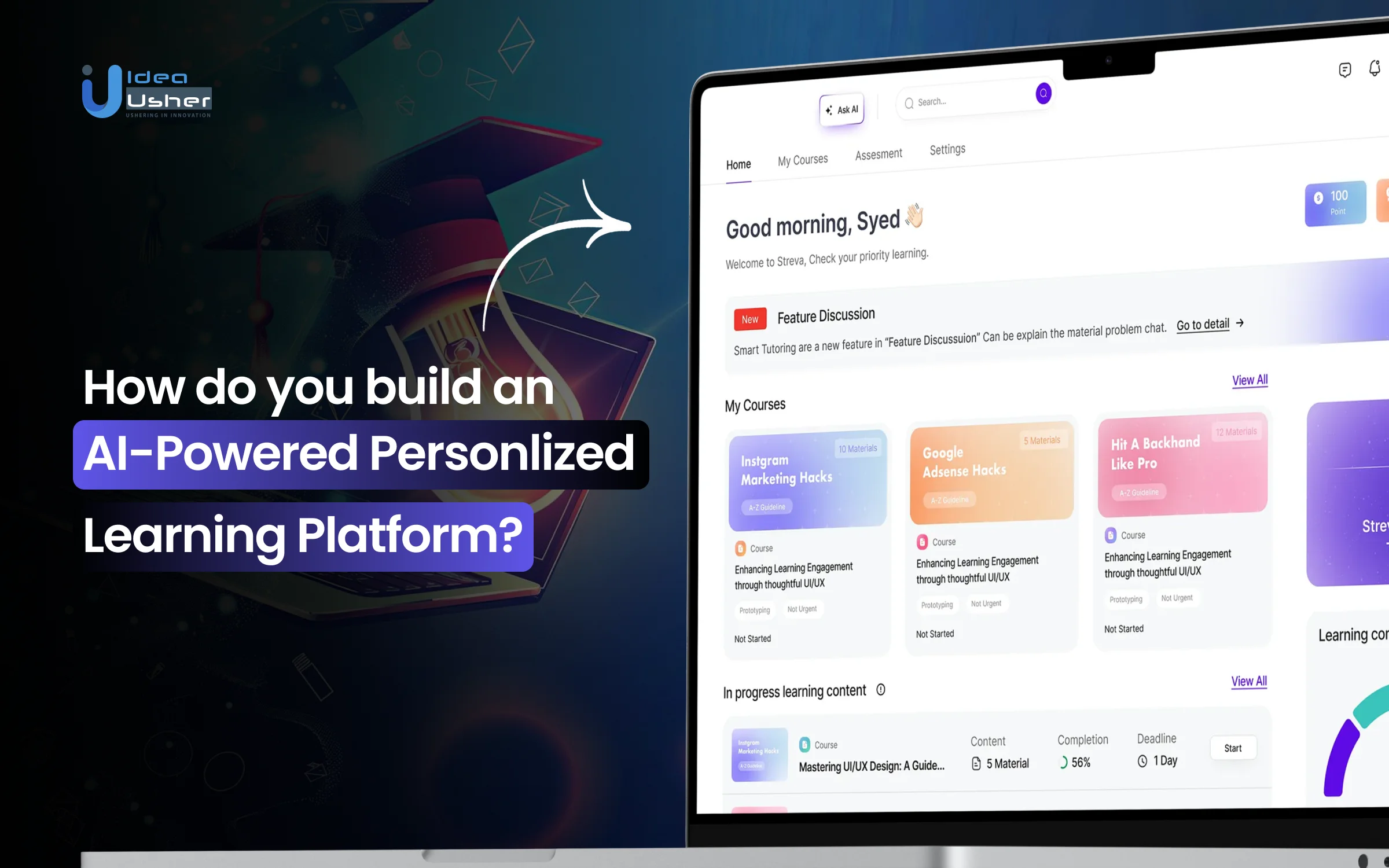
Learning has shifted fast, and most traditional platforms still feel rigid and outdated. Today, every learner moves differently, and that gap becomes obvious the moment someone tries to learn at their own pace. An AI-powered personalized learning platform solves that by reading patterns and adapting content in real time.
It adjusts difficulty based on performance, and it can even change learning formats when engagement drops. The platform learns from the learner, so the experience becomes smarter every session. It can also recommend a simulation instead of a video or a short assessment instead of a long module.
Over the years, we’ve built numerous AI-powered learning ecosystems using technologies like adaptive learning AI and cognitive behavior modeling. With this experience, we’re writing this blog to break down the steps required to develop an AI-powered personalized learning platform. Let’s get started.
Key Market Takeaways for AI Personalized Learning Platforms
According to Grandview Research, the market for AI-driven personalized learning is expanding quickly as education systems shift from generalized instruction to tailored learning experiences. Estimates place the global AI in education market at nearly USD 6 billion in 2024, with projections showing it could surpass USD 32 billion by 2030. This acceleration reflects growing demand for technology that adapts to each learner’s pace, supports differentiated instruction, and provides teachers with real-time insights rather than static assessment snapshots.

Source: Grandview Research
Educators are increasingly drawn to these tools because they help identify where students are struggling and recommend the next steps without requiring hours of manual analysis. Beyond improving outcomes, they also reduce administrative pressure by streamlining tasks like progress tracking and planning.
As platforms evolve to include multimodal lessons, real-time feedback, and more natural conversational features, personalized learning is becoming a core expectation rather than an extra feature.
Momentum in the space can be seen in examples like CENTURY Tech, which builds tailored learning pathways using insights from cognitive science and student behavior.
Another standout is Khan Academy’s Khanmigo, offering guided practice and classroom support through an interactive digital tutor. A notable development is Khan Academy’s partnership with Microsoft, which gives educators in the U.S. free access to advanced digital tutoring and signals a new phase of scaled, widely accessible personalized learning.

What Is an AI Personalized Learning Platform?
An AI-powered personalized learning platform is an educational system or software that uses artificial intelligence to tailor the learning experience to each student based on their skills, strengths, weaknesses, interests, and learning pace. By analyzing learner data and behavior, the platform continuously adapts and delivers customized content to support more effective and engaging learning outcomes.
Key Features of AI Personalized Learning Platforms
AI personalized learning platforms use adaptive algorithms that respond to how learners learn and how fast they progress through concepts. They analyze data such as accuracy, speed, and engagement so the system can adjust the difficulty and recommend content that feels relevant.
1. Personalized Learning Paths
AI-powered learning platforms create individualized pathways that adapt in real time to a learner’s pace, skill level, and goals. Instead of following a fixed syllabus, students are guided through recommended lessons, resources, and activities that best match what they need next, helping them progress more efficiently and stay motivated.
Example: DreamBox Learning adjusts math difficulty per student performance.
2. Adaptive Assessments
Assessments dynamically adjust difficulty and question types based on how the user responds, ensuring each test accurately reflects current skill and knowledge levels. Instead of static grading, the platform uses adaptive logic to challenge learners appropriately and guide them toward mastery.
Example: Duolingo uses adaptive testing to adjust language lesson levels.
3. Intelligent Tutoring / AI Coach
Learners can interact with an AI tutor that explains concepts, answers questions, and provides hints using natural language. This tool acts like a personal coach, available anytime, offering tailored examples, detailed walkthroughs, and scalable support tailored to the learner’s needs.
Example: Khanmigo from Khan Academy functions as an AI teaching assistant.
4. Real-Time Feedback and Error Correction
Users receive immediate, individualized feedback on quizzes, writing, coding, or spoken responses. The platform not only highlights mistakes but also explains the rationale for corrections, helping learners understand errors and improve more quickly rather than simply being scored.
Example: Grammarly provides instant writing feedback with detailed reasoning.
5. Gamified Learning Experience
Gamification elements such as points, badges, streaks, and leaderboards make learning interactive and rewarding. These features encourage consistency, provide clear milestones, and help maintain engagement by transforming learning into an enjoyable challenge
Example: Kahoot! Motivators like leaderboard scores increase engagement.
6. Learning Modality Switching
Users can switch between different content formats, such as videos, text, flashcards, or hands-on practice to match how they prefer to learn. This flexibility ensures every learner can engage with material in a way that best suits their style, mood, or comprehension needs.
Example: Quizlet supports flashcards, quizzes, writing mode, and test mode.
7. AI Role-Playing Simulations
Learners can practice real-world scenarios with interactive AI avatars, such as job interviews, negotiation exercises, or language conversations. This feature provides practical learning experiences in a safe environment where mistakes become opportunities for learning.
Example: Immerse uses VR-driven AI role-play for language learning.
How Does an AI-Powered Personalized Learning Platform Work?
An AI-powered personalized learning platform works by building a constantly evolving model of the learner and mapping it against structured knowledge. It analyzes performance and behavior in real time and then selects the most suitable next task, format, or difficulty level. Over time, the system becomes smarter and more precise, and it may adjust teaching strategies so the learning path feels natural and efficient.

Layer 1: Understanding the Learner
Before the platform adapts anything, it first needs to understand who it is teaching. This begins with creating a digital learning profile. This profile is not static. It is a dynamic portrait that evolves as the learner interacts with the system.
The model is built in two ways:
- Information provided intentionally: age, learning goals, background knowledge, skill level, and sometimes a placement assessment.
- Patterns observed naturally: pacing, error patterns, hesitation points, preferred learning format, time of day performance peaks, and use of hints or retries.
Every attempt, pause, success, correction, and engagement behavior refines the model’s accuracy. The learner profile is continuously updated, making it more personal over time.
Layer 2: Understanding the Knowledge
Once the learner is understood, the platform needs an organized understanding of the subject material. The Domain Model provides that structure and can be imagined as an interconnected map of ideas.
In this map:
- Nodes represent skills or concepts.
- Connections represent the relationship between them.
Some skills are foundational and must be learned early. Others are extensions. The model understands these dependencies and ensures that content is introduced in a meaningful and logically sound order.
Layer 3: Making Smart Decisions
This is the system’s decision center. The Adaptation Engine compares the learner’s current profile with the content’s structure and decides what should happen next.
It considers:
- What the learner currently understands
- What they are developmentally prepared to learn next
- The level of challenge that will support learning without discouraging progress
- The learner’s long-term goals and current engagement patterns
Using predictive algorithms and principles of learning science, it selects the most effective next step for that specific learner at that moment.
Layer 4: Delivering the Personalized Experience
This is where the intelligence becomes visible to the learner. Personalization may appear in many forms, including:
- A learning path that changes in real time
- Content formats chosen to match learning preferences
- Immediate feedback that explains not only whether something is incorrect, but why and how to adjust
- Assessments that adjust question difficulty based on previous responses
Instead of progressing through a fixed curriculum, the learner experiences material at a rhythm and level that aligns with their needs.
Layer 5: The Continuous Learning Loop
The final step is the feedback loop. Every interaction is analyzed and sent back into the learner model. The platform does not simply respond once. It continually refines its understanding of the learner and, in some cases, the structure of the content itself.
If many learners consistently struggle with the same concept pathway, the platform may adjust the order of instruction, provide additional scaffolding, or introduce new explanation formats.
The process becomes cyclical:
Teach → Observe → Update → Adapt → Teach again.
Over time, the system becomes better at supporting both the individual learner and future learners who follow similar patterns.
How to Build an AI-Powered Personalized Learning Platform?
To build an AI-powered personalized learning platform, you first map skills and learning paths so the system can track progress and respond intelligently. Then you design real-time data flows and adaptive models that predict mastery and adjust difficulty automatically. We have engineered adaptive learning solutions across industries, and this is the approach that makes it work.

1. Intelligence Framework
We begin by architecting the platform’s intelligence core, including defining a scalable skill graph aligned with learning goals and implementing adaptive logic to personalize every pathway. Our knowledge dependency engine ensures that learning flows naturally based on cognitive readiness.
2. Behavioral Data Systems
We design and deploy behavioral telemetry that captures real learning signals and transforms raw interactions into meaningful insights through normalization pipelines. With low-latency streaming infrastructure, the system responds instantly and adapts in real time.
3. Adaptive AI Models
Our models predict mastery, detect cognitive load, dynamically adjust difficulty, and forecast dropout risk before disengagement. This approach ensures the platform becomes proactive and continuously optimizes the learner journey.
4. Ethical & Explainable AI
We embed transparency, compliance, and ethical safeguards, including explainability layers and bias monitoring. Consent-based governance ensures users remain informed and in control of their data.
5. Instructor Insights
We create dashboards that provide skill heatmaps, risk alerts, and cohort analytics to surface actionable insights. This helps instructors intervene earlier and support learners more effectively.
6. Enterprise & Monetization
We integrate seamlessly with existing ecosystems and offer white-label deployment, licensing management, and enterprise billing options. This ensures scalability and operational flexibility as the organization grows.
Most Successful Business Models for AI Personalized Learning Platforms
AI-driven learning is becoming a mainstream investment category. With the global AI education market projected to reach $25.7 billion by 2027 at a 43.3% CAGR, the opportunity is massive. However, technology alone does not create profitable companies. The platforms gaining market share are the ones that pair advanced personalization with the right commercial model.
1. Enterprise SaaS Model
This model is dominant in corporate training, workforce development, and higher education. Buyers are not paying for static content. They are paying for measurable improvements such as skill mastery, reduced onboarding time, internal mobility, and verified competencies.
How These Platforms Charge
Most platforms structure their pricing around annual recurring contracts based on seat count, feature access, or usage. Common ranges include:
| Tier | Typical Price | Features |
| Basic | $3,000–$10,000/year | Limited AI personalization, core LMS capabilities |
| Professional | $15,000–$50,000/year | Full personalization, analytics, integrations |
| Enterprise | $75,000–$500,000+/year | Custom AI models, API ecosystem, premium support |
Average cost per active user: $15–$50 per month
Proof the Model Works
- Docebo reported $134.9M ARR in 2023, with enterprise buyers making up the majority of revenue.
- Cornerstone OnDemand generates more than $600M annually, and personalization is positioned as a premium differentiator.
Growth often follows a land-and-expand path. A pilot serving 500 users at $25,000 per year can scale to a full organizational rollout worth multiple six- or seven-figure sums once measurable results are demonstrated.
2. B2C or B2B2C Freemium Model
This model is most common among consumer learning platforms and supplemental K-12 systems. Free access builds a large user base and the platform monetizes through premium tiers that unlock deeper personalization, analytics, or adaptive learning paths.
Conversion Economics of Top Performers
Successful platforms often achieve:
- 3–8% free to paid conversion
- $8–$30 monthly subscription range
- $200–$600 lifetime value
- Customer acquisition cost recovery in 4–8 months
Duolingo demonstrates the ceiling of the model with 4.2 million paying subscribers generating more than $370 million in subscription revenue annually. Duolingo Max at $12.99 per month proves that users will pay a premium for adaptive tutoring and personalized pathways.
This model relies on habit formation, strong user retention, and network effects to accelerate growth.
3. Outcome-Based or Performance Revenue Model
This emerging model ties revenue directly to outcomes such as certification completion, skill proficiency gains, degree progress, or job placement and retention. The approach creates a strong incentive alignment between what customers pay for and the results they achieve, but it also requires reliable data tracking, transparent metrics, and trust in the platform’s ability to verify progress and impact.
How Revenue Is Structured
A typical pricing structure includes:
- A low base subscription of $1,000–$10,000 per month
- A success-triggered fee worth 10–30% of the verified value created
- Bonus tiers for exceeding agreed outcomes
Companies Using This Approach
- Guild Education partners with major employers such as Walmart and Chipotle and earns 15–25% of the education value created.
- Pluralsight uses a hybrid approach. Plans range from $299–$699 per year and adaptive learning paths correlate with 53% higher certification pass rates, which directly supports ROI-driven pricing.
This model works best when outcomes are measurable, and customers value guaranteed performance.
Why AI Learning Platforms Deliver 2–2.5x Better Learning Results?
Research shows that learners using AI-powered platforms achieve outcomes up to 2 to 2.5 times better than those learning through traditional instruction. This level of improvement isn’t luck or marketing language. It reflects how neuroscience, cognitive psychology, and adaptive technology work together to support the way the human brain learns best.

1. They Prevent Overload and Boredom
Traditional learning moves at a fixed pace. If the instruction feels too fast, learners become overwhelmed and shut down. If it feels too slow, they lose interest and disconnect. Both situations weaken learning and retention.
The AI Solution:
- AI-driven platforms monitor signals such as hesitation, accuracy trends, response speed, and interaction patterns. When a learner begins to struggle, the system may simplify content, offer a short break, or switch the format from text-based explanation to visual or applied examples.
- When a learner demonstrates readiness for more challenge, the system increases pace or introduces more complex applications.
This keeps the learner in the optimal challenge zone known as the Zone of Proximal Development, where progress feels attainable, stimulating, and rewarding.
2. They Fix Foundational Gaps Before They Multiply
Traditional courses assume learners are ready to move forward simply because the schedule demands it. When a foundational concept is misunderstood, everything that builds on it becomes harder and eventually collapses into confusion.
The AI Solution:
- AI platforms use knowledge graphs to understand how skills connect. When a learner struggles with a new concept, the system identifies the prerequisite knowledge they may be missing and provides a focused learning moment to rebuild it.
- Once that gap is resolved, the learner returns to the original content prepared and confident.
This approach prevents the snowball effect of confusion and replaces it with a stable, layered understanding.
3. Time Practice for Memory Strength
Human memory follows a predictable forgetting curve. Reviewing content too late means relearning from scratch. Reviewing too early wastes time and mental effort.
The AI Solution:
- AI platforms calculate a personalized memory pattern for each learner and each topic. Then the system resurfaces material at the exact moment when reinforcement will have the strongest effect.
- This is combined with retrieval practice and spaced repetition to strengthen the neural pathways associated with long-term memory.
Learners retain more, require less repetition, and avoid cramming or re-teaching cycles.
4. They Make Content Meaningful
Abstract examples and generic exercises often feel disconnected from a learner’s real world context. When information lacks relevance, the brain has nothing to attach it to, making it easier to forget.
The AI Solution:
- AI-powered platforms personalize examples and practice tasks based on a learner’s background, interests, and goals. A data example for a marketer might involve campaign conversions, while an engineer might see system failure rates.
- When content feels personally meaningful, it integrates more easily into existing mental frameworks and becomes more transferable.
Some platforms even generate custom learning scenarios tailored to a learner’s job role, field, or ambitions.
Challenges to Build an AI Personalized Learning Platform
After working with many organizations across different industries, one thing has become clear. Building a personalized learning platform is not just a technical exercise. It requires balancing data realities, user behavior, ethics, and long-term maintainability. Below are the most common challenges teams face and the practical strategies we use to solve them.
1. Data Sparsity & Unpredictable Learning Behavior
Most learners do not produce enough consistent behavioral data for confident predictions. Click data can be random, engagement varies over time, and meaningful learning signals are often hidden.
How we handle it:
- Multi-signal modeling: Instead of depending only on quiz results or progress milestones, we use subtle behavioral indicators such as hesitation, time spent, replay loops, and recovery patterns. This creates a more complete understanding of the learner.
- Transfer learning foundations: We begin with broader anonymized datasets from similar learning environments and then fine-tune models with organization-specific data. This reduces the amount of local data required before accuracy improves.
- Prediction confidence scoring: When evidence is limited, the system intentionally scales back recommendations to more general suggestions rather than forcing inaccurate personalization.
2. Ethical Design and Algorithmic Fairness
If personalization is not monitored, algorithms may unintentionally favor learners who fit the dominant patterns inside the dataset. This can create or reinforce inequities.
How we handle it:
- Continuous bias monitoring: Outputs are regularly analyzed across demographic and contextual variables to catch potential issues early.
- Transparent reasoning: Every recommendation includes a clear explanation so instructors and learners understand how it was generated.
- Inclusive dataset strategy: Training data is curated from diverse learning contexts, age groups, cultures, and instructional styles to prevent narrow bias.
- Human validation options: High-stakes actions such as certifications or major remediation steps can require human review before being finalized.
3. Skill Graph Complexity and Maintenance
Building and maintaining skill maps manually is time-consuming and often outdated shortly after completion, especially in fast-changing fields.
How we handle it:
- Semi-automated graph creation: Natural language processing scans curricula, standards, textbooks, and assessments to generate an initial skill map that subject experts refine rather than build manually.
- Adaptive relationships: Skill connections evolve based on learner performance patterns. If the data shows certain skills are not logically aligned, the system flags them for review.
- Flexible structures: Different disciplines require different mapping logic. Mathematics functions best with hierarchical skill organization. Soft skills and communication training benefit from network-based models. Certification pathways may require phased competency milestones.
4. Content Mapping and Alignment at Scale
Connecting thousands of learning assets to the correct skills is difficult and time-consuming when done manually.
How we handle it:
- Automated content tagging: Videos are analyzed using computer vision, documents with text extraction and NLP, and interactive elements using metadata parsing. This significantly reduces manual tagging work.
- Structured content profiling: Every asset receives a profile describing difficulty, learning modality, estimated time, and prerequisite knowledge. This improves the accuracy of recommendation matching.
- Smart versioning: When content is updated, only the modified portions are remapped. Existing valid associations remain intact, reducing unnecessary repetitive work.
Tools & APIs to Build an AI Personalized Learning Platform
Building a personalized learning platform powered by AI isn’t just a coding exercise. It’s system design. It requires creating an ecosystem of components that can reason, adapt, react in real time, and scale reliably. The following breakdown explains the key technologies needed and why each one matters.

1. AI & Machine Learning Intelligence Layer
PyTorch & TensorFlow
These frameworks power the platform’s adaptive intelligence. PyTorch is well-suited for experimentation, rapid iteration, and research work where personalization models evolve quickly.
TensorFlow is ideal when deploying at scale because of its production tooling such as TensorFlow Serving, TF Lite, and TF.js, which allow models to run across mobile, cloud, and browser environments.
Many engineering teams use PyTorch for experimentation and TensorFlow for production deployment.
Scikit-learn
Not every problem needs deep learning. Scikit-learn is excellent for tasks such as:
- Behavior clustering
- Skill classification
- Early learning analytics
It provides efficient classical machine learning algorithms that act as a foundation before moving to more complex neural approaches.
Anthropic, OpenAI, or Similar LLM APIs
Large Language Models transform the learning platform into an intelligent conversational system. They can power:
- On-demand tutoring and question answering
- Personalized explanations based on learner style and history
- Writing feedback and rubric-based scoring
- Role-play and soft-skills training
This layer serves as the system’s digital mentor.
2. Data Engineering & Learning Intelligence Pipeline
Kafka or AWS Kinesis
Learners generate continuous data while studying. Every pause, retry, and interaction is meaningful.
Kafka and Kinesis manage these high-volume real-time data streams so the system can detect difficulty, intervene, and adapt immediately rather than after a batch process.
Apache Spark
When processing large historical datasets for insight generation, model retraining, or trend analysis, Spark’s distributed architecture enables these operations to run quickly, even across millions of learner events.
BigQuery
BigQuery serves as the long-term analytical database. It stores:
- Learning progress
- Assessment outcomes
- Usage patterns
- Compliance reports
It also supports dashboards and longitudinal institutional reporting.
3. Backend Architecture & API Layer
Python (FastAPI) and Node.js
A hybrid backend approach balances performance and specialization.
- Node.js is ideal for event-driven workflows and real-time communication such as WebSockets and collaborative learning interactions.
- FastAPI handles machine learning inference endpoints, complex data logic, and model-driven computation with strong performance.
REST and GraphQL
Both API styles serve different purposes.
- REST works best for predictable, standard operations such as authentication, submitting assessments, or retrieving user profiles.
- GraphQL is ideal when the client needs flexible data retrieval such as progress dashboards, personalized feeds, or multi-entity requests without multiple calls.
Using both keeps the frontend fast and the backend flexible.
4. Frontend & Learning Experience Layer
React with Next.js
React’s component structure maps naturally to modular learning experiences including lessons, quizzes, and dashboards.
Next.js improves performance through:
- Server-side rendering
- Built-in routing and API endpoints
- Optimizations that improve loading time and engagement
This stack ensures a responsive, scalable learning interface.
Flutter
Flutter is valuable when the platform requires mobile-first consistency or offline functionality. A single codebase generates native-quality applications across iOS, Android, desktop, and sometimes web. It is especially useful for K-12 environments or workforce learning where device diversity is high.
Top 5 AI-Powered Personalized Learning Platforms
We have conducted extensive research and identified several strong examples of personalized learning platforms in the USA that use adaptive algorithms and real performance data to shape learning paths in real time. You will notice that each system can automatically adjust content difficulty and pacing, improving retention and engagement for different types of learners.
1. Docebo

Docebo is an AI-powered learning management system widely used in U.S. businesses for employee training, onboarding, and skill development. Its AI engine personalizes learning paths, recommends relevant courses based on behavior and role, and automates administrative tasks such as assessments and reporting. The platform is designed to scale and support organizations that need adaptive and personalized learning at the enterprise level.
2. 360Learning

360Learning combines AI-powered personalization with collaborative learning, allowing teams and companies to create and share training content quickly. The system uses AI to recommend courses, adjust pacing, and automate course generation while incorporating peer feedback and social learning. It is especially popular for corporate learning environments focused on upskilling and internal knowledge sharing.
3. Sana Labs

Sana Labs is an advanced AI-driven learning platform used by organizations to deliver adaptive and tailored learning experiences. The platform analyzes learner performance in real time and customizes content sequencing, difficulty, and reinforcement strategies. Known for its intelligent recommendation engine, Sana Labs is used for large-scale training programs where personalization and efficiency are key.
4. Educative

Educative is a popular platform for software engineers and technical learners, offering text-based, interactive coding and technical courses. Its AI features recommend content based on progress, analyze strengths and weaknesses, and provide customized learning paths. The platform is especially valued by tech professionals preparing for interviews or advancing skills in areas like cloud computing, system design, and machine learning.
5. Absorb LMS

Absorb LMS is an AI-enhanced learning platform used across industries to personalize and automate corporate training. It tailors content delivery to individual learners using analytics and adaptive logic, ensuring each user receives the most relevant material based on their goals and performance. With built-in reporting, automation, and scalability, Absorb supports organizations seeking efficient, customizable training solutions.
Conclusion
AI-powered personalized learning platforms are becoming the foundation of modern training, as organizations now compete on knowledge, adaptability, and measurable skill growth rather than on static content. When businesses build systems that can learn from user behavior, explain decisions, and integrate securely with their existing tech stack, they gain a scalable way to upskill employees, personalize learning journeys, and turn expertise into a profitable digital asset. With the right architecture and an experienced partner like IdeaUsher, launching such a platform becomes a strategic move that reduces risk and accelerates real-world impact.
Looking to Develop an AI-Powered Personalized Learning Platform?
IdeaUsher can help you build an AI-powered personalized learning platform by handling everything from architecture planning to model deployment and UX design. With over 500,000 hours of coding experience and ex-MAANG/FAANG developers on our team, we do not just code; we architect intelligence.
You will also receive ongoing support and refinement, so the system can continue to improve as learner behavior evolves.
- AI that understands learning styles
- Real-time adaptation & performance insights
- Scalable, secure, and ethically designed
- Built by former MAANG engineers
Check out our latest projects to see how we’ve helped others innovate in edtech and beyond.


FAQs
A1: Building an AI-powered, personalized learning platform typically takes 6 to 12 months, as it involves training AI models, backend architecture, and integrated learning workflows. The timeline might shift if the platform needs adaptive engines, predictive analytics, or enterprise-level permissions, as those features require deeper testing.
A2: It can seem expensive at first because hosting models and processing real-time learner data requires strong infrastructure. However, scalable cloud optimization will usually reduce operational costs as the system matures and begins automating personalization with less direct oversight.
A3: Yes, they can, and the scalability potential is one of the most valuable aspects of this technology. A platform might begin with subscriptions, then expand into licensing, certification programs, and corporate learning packages as the audience and feature set evolve.
A4: Learner data can be secure when the system adheres to privacy standards such as GDPR, FERPA, and SOC2, and uses encryption for data storage and transfer. The platform should also implement strict access controls and continuous security monitoring to detect threats quickly, rather than after harm occurs.


