 (+971) 8007 4267
 (+91) 946 340 7140
 (+1) 628 432 4305

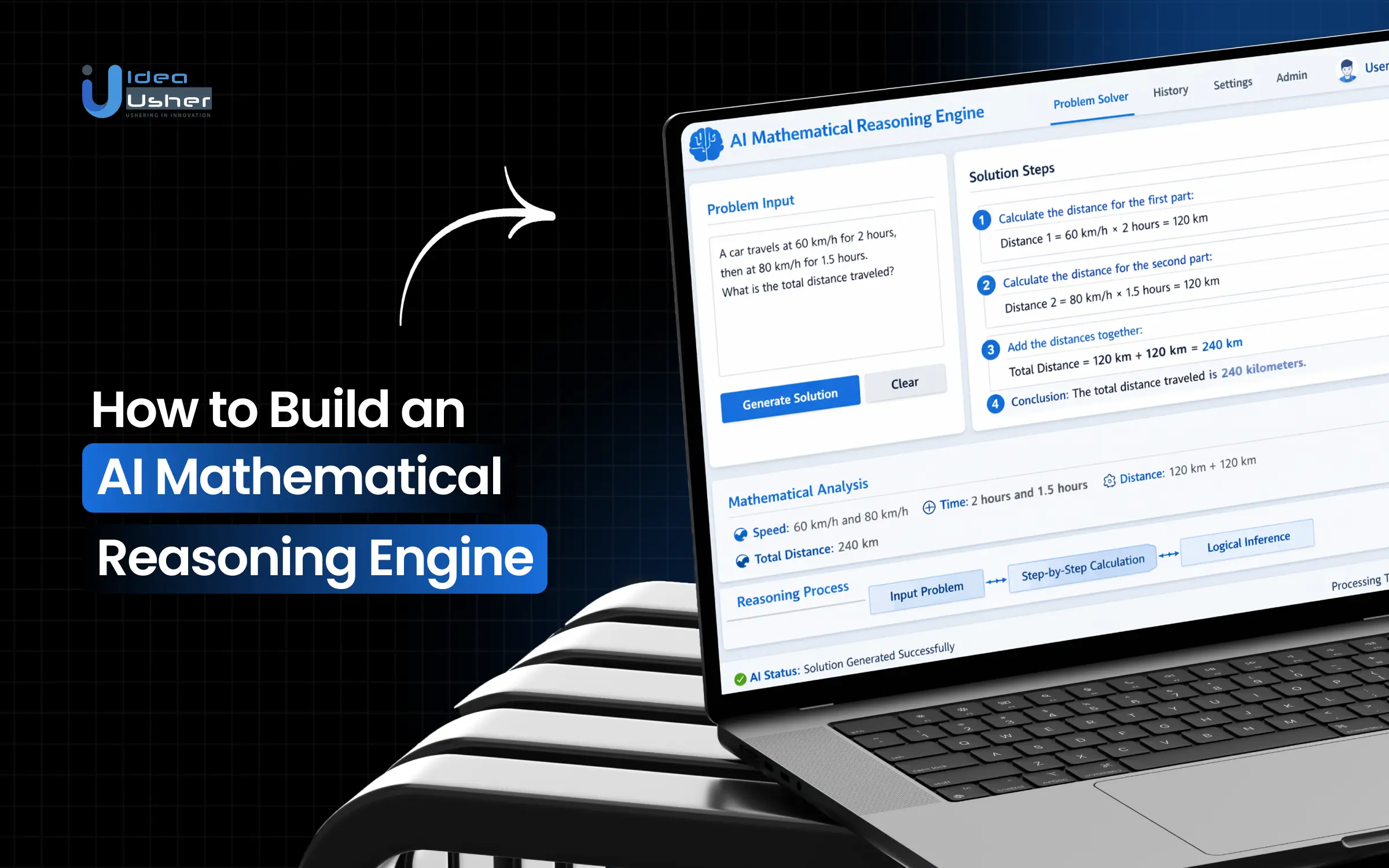
Mathematics has always helped people solve real-world problems, but modern systems now deal with far more complex calculations. Industries today process massive datasets that may contain millions of variables and relationships. Manual analysis can rarely handle such a scale with the speed and accuracy required. This is why many organizations are beginning to use AI mathematical reasoning engines.
These systems can carefully evaluate equations and patterns while analyzing large computational models. They may also automatically explore possible solutions that humans might miss. As data-driven decisions become more important, these reasoning engines will likely become essential tools for complex analytical environments.
We’ve developed numerous AI mathematical reasoning engines that use technologies like symbolic reasoning, AI and computational mathematics frameworks. Given our expertise, we’re sharing this blog post to discuss the steps for building an AI mathematical reasoning engine.
Market Demand for AI Mathematical Reasoning Engines
According to Cognitive Market Research, the Global Math Training market size will grow at a CAGR of 8.20% from 2023 to 2030. This growth reflects a major shift toward specialized AI reasoning engines. Unlike standard LLMs that often fail at logic, these engines provide deterministic, step-by-step solutions.

Source: Cognitive Market Research
As of 2026, organizations are moving toward System 2 thinking. This approach prioritizes deliberate, logically sound processing over simple text generation. This transition is creating a massive niche for AI that understands structural logic rather than just predicting words.
Growth of AI in Scientific Computing
AI reasoning engines are now central to R&D in pharmaceuticals, materials science, and aerospace. They bridge the gap between raw data and the complex differential equations needed to model physical reality. In drug discovery, these engines simulate molecular dynamics with mathematical precision, outperforming older heuristic models.
The push for Sovereign AI has led labs to invest in high-performance computing that prioritizes reasoning. This ensures that AI assisting in nuclear fusion or climate modeling stays grounded in physical laws. Google DeepMind’s Gemini 3 Deep Think exemplifies this, solving research-level problems in geometry by using a natural language verifier to meet formal proof standards.
EdTech Demand for AI Math Tutors
The AI math tutor market is projected to hit $2.27 billion by late 2026. This surge addresses the limits of remote learning and the global focus on STEM proficiency. Modern platforms have evolved from simple answer keys into pedagogical engines that diagnose specific logical gaps in a student’s work.
These systems use the Socratic method to provide real-time feedback, solving the scaling problem in education. Platforms like Symbolab and Photomath interpret handwritten input, breaking down calculus and trigonometry into transparent steps. This helps students move from passive learning to active conceptual mastery.
Enterprise Need for Automated Problem Solving
Enterprises now require Autonomous Agents for complex tasks like financial auditing and supply chain optimization. Decision-makers use these engines to navigate the Inference Economy. For instance, logistics firms solve massive routing problems in real-time while accounting for shifting fuel costs and regulations.
Mathematical accuracy is now a requirement for corporate governance. Microsoft’s rStar-Math addresses this by using Monte Carlo Tree Search to verify its own logic via Python code. This ensures that financial or engineering solutions are mathematically validated through execution rather than just being statistically likely.

What Is an AI Mathematical Reasoning Engine?
An AI mathematical reasoning engine is a computational system designed for logical deduction and deterministic calculation. Unlike standard LLMs that predict the next likely word, reasoning engines use structured logic to navigate proofs and algebraic manipulations. They bridge the gap between intuitive neural networks and the rigid precision of symbolic mathematics.
These engines are defined by their traceability. Instead of just delivering an answer, they generate a verifiable chain of thought. This transparency is vital in high-stakes fields like engineering or finance, where a single calculation error can be catastrophic.
Symbolic vs Neural Mathematical Reasoning
Mathematical reasoning has traditionally been split into symbolic and neural methodologies. Symbolic Reasoning uses fixed rules and predefined logic, much like a calculator. It is perfectly accurate but struggles to understand natural language or handwritten input.
Neural Reasoning uses deep learning to approximate concepts based on vast datasets. While it excels at understanding context, it often lacks a grasp of absolute mathematical laws. Modern systems use a Neuro-symbolic approach: the neural component interprets the problem, while the symbolic component executes the logic, ensuring 100% accuracy.
Why Traditional AI Struggles With Math Logic
Standard AI models are probabilistic. When an LLM solves a problem, it is not “calculating”; it is recalling which numbers frequently follow others in its training data. This works for simple arithmetic but fails in multi-step reasoning, where a single early error can ruin the entire solution.
Furthermore, traditional AI lacks a “world model” for math. It doesn’t inherently understand that mathematical rules are absolute. Without a dedicated engine to enforce these constraints, standard AI often creates logical shortcuts that do not exist, leading to “hallucinations” in complex derivations.
Where AI Math Engines Are Used Today
AI math engines are now foundational across several industries. In Quantitative Finance, they stress-test portfolios against trillions of variables, providing auditors with a clear logical path for every risk assessment. This moves away from “black-box” models toward verifiable transparency.
In Aerospace, these engines assist in trajectory optimization by combining real-time data with rigid physical laws. They are also used in Software Development to verify code correctness. By mathematically proving an algorithm will perform as intended before deployment, they significantly reduce bugs in mission-critical infrastructure.
Why Businesses Are Investing in AI Math Engines?
Businesses are shifting capital toward AI math engines because general-purpose AI lacks the precision for mission-critical logic. Automating complex reasoning provides a structural advantage in a competitive landscape. Specialized engines reduce the error tax caused by human calculation and LLM hallucinations.

These investments are driven by a need for scalability. As systems grow more complex, manual oversight becomes too costly. AI math engines enable enterprises to automate tasks such as auditing and structural analysis with unprecedented consistency. Companies like DeepL and Kyutai are exploring reasoning-heavy models to move into logical, structured data processing.
AI-Driven STEM Education Platforms
The EdTech sector uses math engines to solve the engagement crisis in STEM. Traditional digital learning fails when it marks answers wrong without explaining why. AI engines provide granular, step-by-step feedback that mimics a human tutor.
Platforms like Chegg and Khan Academy (via Khanmigo) lead this investment. By integrating reasoning engines, they offer 1:1 tutoring that identifies specific misconceptions in real time. This personalization increases mastery and allows institutions to scale high-quality STEM programs to millions of students simultaneously.
Financial Modeling and Quant Research
In finance, investment banks and hedge funds deploy AI math engines to enhance quantitative research. These engines build models that account for non-linear market behaviors and tail-risk events. Unlike older black box algorithms, reasoning engines provide a transparent audit trail for every calculation.
Major players like Goldman Sachs and JPMorgan Chase invest in these technologies to automate the verification of complex financial instruments. This is essential for regulatory compliance, where firms must explain the mathematical logic behind risk assessments. These engines allow analysts to focus on strategy rather than manual spreadsheet verification.
Scientific Computing and Engineering Automation
Engineering and research are being transformed by AI reasoning in simulation workflows. In aerospace and automotive design, businesses use these engines to optimize physical components. The AI iterates through thousands of mathematical permutations to find the most aerodynamically efficient designs.
Companies such as Airbus and Tesla use these engines to bridge the gap between digital simulations and physical reality. This automation extends to Self-Driving Labs in pharma, where AI models chemical reactions before physical experiments begin. This drastically reduces time-to-market for new materials and provides a massive return on investment.
Key Capabilities of an AI Mathematical Reasoning Engine
The power of a mathematical reasoning engine lies in its transition from statistical guessing to logical derivation. These engines do not merely predict the next number; they follow a structured mental model that adheres to the immutable laws of mathematics. This provides reliability that standard generative AI cannot achieve.
By integrating these capabilities, organizations automate tasks that previously required human expertise. These engines provide transparent, audit-ready output essential for scientific research, engineering, and financial services.
1. Multi-Step Logical Problem Solving
Standard AI often loses the thread of a problem requiring long-form logic. A reasoning engine uses chain-of-thought architectures to maintain state across complex problems. It breaks a high-level objective, such as calculating structural loads, into discrete, sequential sub-problems.
This capability ensures the engine avoids logical shortcuts. Each step serves as a foundation for the next, allowing the system to solve multi-variable problems involving calculus and linear algebra in a single, cohesive workflow.
2. Symbolic Computation and Equation Solving
Unlike neural networks that treat numbers as text, reasoning engines perform symbolic computation. They manipulate mathematical symbols according to algebraic rules. This allows for simplifying complex expressions and solving differential equations without numerical rounding errors.
When solving a quadratic equation, the engine identifies constants and applies formulas with absolute precision. This is critical for fields like chemistry and physics, where symbolic accuracy is the difference between a successful simulation and a failed experiment.
3. Mathematical Proof Generation
Reasoning engines generate formal proofs, the highest form of mathematical truth. Instead of just stating a theorem is true, the engine constructs a rigorous argument using axioms and established lemmas. This is increasingly used in formal verification for software and hardware design.
By generating these proofs, the AI allows researchers to verify the safety of autonomous systems. Proving that a braking algorithm will trigger under specific mathematical conditions provides a level of safety assurance that traditional testing cannot match.
4. Natural Language to Mathematical Expression
A reasoning engine excels at parsing word problems, extracting relevant variables from text, and converting them into machine-readable formats like LaTeX or Python. This bridges the gap between non-expert users and complex computational tools.
A business analyst can describe a financial trend in plain English, and the engine will automatically generate the corresponding statistical model. This allows for sophisticated data analysis without requiring the user to write complex code or formulas manually.
5. Self-Verification and Error Correction
The most advanced capability of these engines is the self-correction loop. Before presenting an answer, the engine checks its own work by plugging a solution back into the original equation or using a secondary verifier model to audit the logic.
If the engine detects an inconsistency, it backtracks to the point of failure and re-evaluates its logic. This behavior drastically reduces hallucinations, ensuring the final output is verified, accurate, and ready for professional use.
Core Architecture of an AI Math Reasoning Engine
Sophisticated AI math reasoning engines structurally integrate neural language parsers with symbolic logic layers to ensure computational precision. This hybrid architecture must strictly validate every logical step through deterministic solvers to maintain absolute technical integrity.

1. Mathematical Knowledge Base Layer
At the bedrock sits a structured repository of mathematical truths; a fortress of axioms, theorems, and formulas. While a standard neural network might forget a niche identity under pressure, this layer provides persistent, unshakeable access to fundamental laws.
- Axiomatic Foundations: Hard-coded rules that cannot be hallucinated.
- Theorem Libraries: Pre-verified proofs used as logical building blocks.
- Formula Repositories: Standardized expressions for physics and finance.
This layer often interfaces with formal proof assistants. It ensures every solution is built on a structurally sound foundation rather than a statistical guess.
2. Reasoning and Inference Engine
If the knowledge base is the library, the inference engine is the scholar. Using algorithms such as Monte Carlo Tree Search, it explores various paths toward a solution, discarding logical dead ends before they reach the user.
The Chain of Thought Protocol:
This engine manages the complex intermediate states of a derivation. It separates a true reasoning engine from a basic calculator by handling multi-page proofs without losing track of any initial variables.
3. LLM-Powered Natural Language Interface
This layer acts as the high-speed bridge between user intent and formal logic. A Large Language Model parses queries to identify variables in word problems and translates conversational English into machine-readable formats such as LaTeX.
Because it utilizes an LLM, the interface is incredibly forgiving. It can interpret everything from a formal research prompt to a messy, handwritten note. This democratizes power by making advanced math available to anyone who can ask a clear question.
4. Mathematical Solver and Verification Layer
Once translated, the problem enters the Solver and Verification Layer. Using symbolic computation, the system performs the math according to deterministic rules, leaving no room for hallucination.
The Verification Checklist:
- Syntactic Check: Is the expression well-formed?
- Logical Audit: Does each step follow the previous one?
- Result Validation: Does the answer hold true when plugged back in?
The process ends with an audit. A secondary critic model checks the derivation, creating an ecosystem where the output is a proven conclusion, not just an answer.
5. Feedback and Learning Loop
The final piece is a relentless mechanism for self-improvement. When the system detects a friction point, such as a misinterpreted problem or a rejected logical path, it logs that data to fine-tune the engine.
In an enterprise environment, this loop is a game-changer. It allows the engine to adapt to the specific dialect of an industry, such as aerospace or high-frequency trading. The system becomes faster and more intuitive over time as it learns to master recurring challenges.
AI Models Used for Mathematical Reasoning Engine
Modern mathematical AI has moved beyond simple prediction. Today, specialized architectures handle different facets of the reasoning process, ranging from linguistic interpretation to rigid logical verification.
1. Large Language Models for Reasoning
LLMs serve as the primary interface for mathematical AI. Models like GPT-5.2 Thinking and Gemini 3 Pro use “Chain of Thought” processing to break problems into logical steps.
While highly flexible, LLMs are probabilistic; they are best at translating word problems into formal structures rather than performing final, high-precision calculations.
2. Symbolic AI and Theorem Provers
Symbolic AI represents the classical approach to math. These systems operate on explicit rules rather than statistical guesses. Tools such as Lean, Coq, and Isabelle are formal theorem provers that ensure that every step of a proof is logically sound.
- Deterministic Accuracy: If, as such as Lean, Coq, and Isabelle are formal theorem provers that ensure that the symbolic engine validates a proof, it is mathematically certain.
- Traceability: Every conclusion traces back to a fundamental mathematical truth.
- Safety: These systems are the gold standard for verifying high-stakes engineering software.
3. Hybrid Neuro-Symbolic Models
Neuro-symbolic models are the current state of the art. They combine the intuition of neural networks with the rigid logic of symbolic AI. In this setup, the neural component interprets messy human language, while the symbolic component executes the actual math.
The Hybrid Advantage:
This architecture solves the “hallucination” problem. By passing a neural model’s output to a symbolic solver, the system catches logical errors before they reach the user.
4. Reinforcement Learning for Proof Discovery
RL allows AI to discover novel solutions to “unsolvable” problems. By rewarding the model for logically sound moves during millions of self-play iterations, systems like AlphaGeometry 2 have reached gold-medalist standards in international competitions.
This technology enables the AI to move beyond human-taught strategies. It can navigate billions of geometric possibilities to find the most efficient path to a proof, often discovering mathematical shortcuts that human researchers may have overlooked.
How to Build an AI Mathematical Reasoning Engine?
To build an AI mathematical reasoning engine, you must carefully train models that can interpret equations and logical structures using symbolic reasoning and mathematical datasets. The system can then gradually evaluate complex problems and may reliably explore multiple solution paths through structured computational reasoning.
We have worked on several AI mathematical reasoning engine projects for clients, and here is how we build such systems.

1. Define Scope
We begin by mapping the specific logic boundaries of your domain. Whether automating quantitative research or verifying engineering codes, we define axioms and constraints early. This ensures the engine operates within the rigid mathematical laws required by your business.
2. Build Knowledge Base
Precision starts with a curated source of truth. We construct a repository of verified formulas and industry-standard constants. By storing this in formal languages like Lean or Coq, we provide the engine with a persistent “legal code” of mathematics it can reference with 100% certainty.
3. Train Multi-Step Reasoning
We move beyond simple “input-output” patterns. Using supervised fine-tuning, we train the neural component to show its work. This architecture allows the system to decompose your most complex multi-variable problems into a series of transparent, manageable sub-goals.
4. Integrate Symbolic Solvers
To eliminate rounding errors and hallucinations, we hard-wire the engine to a symbolic solver. While the neural model plans the strategy, the symbolic solver executes the algebra. This hybrid approach ensures that the final calculation is deterministic and mathematically perfect.
5. Build Natural Language Interface
We design an interface that translates your team’s everyday language into formal expressions. This layer parses messy word problems and extracts relevant units. It allows your non-technical stakeholders to access high-level computational power using plain English.
6. Implement Verification
Reliability is maintained through a rigorous self-correction loop. Before any result reaches your dashboard, a secondary module audits the logic. It plugs the solution back into the original problem to confirm validity. If an error is detected, the engine backtracks and recalculates.
Cost to Build an AI Mathematical Reasoning Engine
Investing in a mathematical reasoning engine is a strategic capital allocation. Unlike generic chatbots, these systems require high-precision data and specialized hardware. The cost structure is divided between the initial intelligence tax (training the model) and the ongoing operational costs of maintaining a verifiable logic stack.
Estimated Budget: MVP vs. Enterprise System
The financial entry point depends entirely on the depth of the reasoning required. An MVP focuses on a narrow mathematical domain, while an Enterprise system provides cross-functional, mission-critical infrastructure.
| Feature | MVP (Niche Application) | Enterprise (Full-Scale) |
| Development Time | 3 to 5 Months | 10 to 18 Months |
| Core Model | Fine-tuned Open Source | Custom Hybrid Neuro-Symbolic |
| Accuracy Tier | 85% to 90% | 99.9% with Formal Verification |
| Estimated Cost | $150,000 to $450,000 | $1.5M to $5M+ |
Note for Stakeholders:
The jump from MVP to Enterprise is rarely linear. Moving from mostly correct to mathematically certain requires an exponential increase in verification layers and high-quality synthetic data generation.
Infrastructure and Model Training Costs
Compute is the primary driver of the budget. Training a model to reason through millions of permutations requires massive GPU clusters.
- Compute Credits ($50k to $500k+): Renting H100 or A100 clusters for fine-tuning. Reasoning models require more computation over time during inference than standard models.
- Data Acquisition ($30k to $200k): High-quality math data is scarce. Costs involve licensing scientific journals or hiring PhDs to create Gold Standard proof sets for supervised learning.
- Symbolic Integration ($20k to $100k): Licensing specialized solvers or building custom bridges to software like Mathematica or Maple.
Factors That Affect Development Cost
Some AI reasoning engines cost around two hundred thousand dollars, while others cost millions because the system must process deeper logical reasoning and larger datasets. The cost may increase as reasoning complexity and verification accuracy become higher.
1. Reasoning Depth
If the engine only needs to solve arithmetic, costs stay low. If it needs to discover new mathematical proofs or verify aerospace blueprints, the complexity and price skyrocket.
2. Degree of Human-in-the-Loop
Early-stage engines require human experts to audit the Chain of Thought output. The more manual intervention required to teach the model logic, the higher the labor cost.
3. Real-Time Latency Requirements
A system that verifies a proof in ten minutes is significantly cheaper to run than one that must provide a live, millisecond response during a high-frequency trading session. High-speed reasoning requires expensive, dedicated inference hardware.
Designing Datasets for AI Mathematical Reasoning
Data is the lifeblood of any reasoning engine. However, unlike general-purpose AI that thrives on sheer volume, a mathematical engine requires surgical precision. If the training data contains a single logical slip, the model learns a pattern of error rather than a rule of logic. We focus on creating datasets that serve as a rigorous training ground for “System 2” thinking.
Curating High-Quality Math Problem Datasets
We do not just scrape the web for math problems. Instead, we build curated libraries that balance complexity with conceptual variety. Our curation process involves identifying “guess-proof” problems where the final answer cannot be reached without following a specific logical path.
- Expert Sourcing: We collaborate with PhD-level mathematicians to craft novel problems that do not exist in public benchmarks, preventing the model from simply memorizing solutions.
- Multimodal Integration: Problems often include visual elements such as geometric diagrams or coordinate graphs, requiring the model to reconcile visual data with symbolic logic.
- Domain Specificity: For enterprise clients, we curate datasets focused on their niche, such as actuarial science, structural load calculations, or quantitative finance.
Generating Synthetic Mathematical Training Data
Real-world high-level math data is scarce. To bridge this gap, we use a programmatic approach to generate millions of synthetic problem-solution pairs. This allows us to create an infinite number of variations on a single core concept, ensuring the model generalizes the rule rather than the specific numbers.
The Power of Infinite Variation:
Using rule-based systems, we can generate a quadratic equation and automatically produce 10,000 variations with different coefficients and variables. This “stress tests” the model’s ability to apply the quadratic formula under any numerical condition without getting tripped up by edge cases.
This synthetic data also helps in balancing the dataset. If a model is struggling with “Calculus of Variations,” we can instantly generate a massive volume of targeted training samples to shore up that specific logical weakness.
Structuring Step-by-Step Reasoning Examples
The most critical part of our dataset design is the “Reasoning Trace.” We don’t just provide the question and the answer; we provide a dense, multi-step explanation that shows exactly how to get there. This teaches the model to “show its work.”
Key components of our reasoning examples:
- State the Goal: Clearly define what needs to be solved.
- Identify Variables: Extract and label all relevant data.
- Logical Chain: A sequence of intermediate thoughts and calculations.
- Self-Correction Points: Examples where a “wrong turn” is identified and corrected, teaching the model to audit its own logic mid-calculation.
By training on these structured traces, the model learns that the process is just as important as the result. This transparency is what builds trust when we deploy these engines for our clients’ mission-critical tasks.
Integrating AI Math Engines With Existing Platforms
A standalone math engine is only as valuable as its ability to communicate with your current tools. We engineer the “connective tissue” that allows high-precision reasoning to flow into your EdTech, research, or SaaS ecosystems. Our modular approach ensures that adding advanced logic does not require a complete overhaul of the tech stack.
1. APIs for EdTech and Learning Platforms
For EdTech providers, we provide high-performance APIs that transform static assessments into interactive tutoring. Our systems allow your platform to receive a full pedagogical breakdown of a student’s reasoning, rather than a simple correct-or-incorrect flag.
- Real-Time Feedback: Deliver instant, step-by-step hints when a student gets stuck on calculus or algebra.
- Adaptive Testing: Dynamically generate parallel problems of varying difficulty based on student mastery.
- LTI Compliance: Ensure math services embed easily into Learning Management Systems like Canvas or Moodle.
2. Integration With Scientific Computing Tools
In R&D and engineering, precision is non-negotiable. We build bridges between our AI reasoning engines and industry-standard scientific computing libraries. This allows researchers to use AI as a logical co-pilot within familiar workflows.
The Augmented Researcher:
By integrating with tools like SAIUnit, the AI understands physical units and dimensions. If a physicist calculates a trajectory, the AI audits the math for dimensional consistency and suggests optimized numerical algorithms.
We also support Formal Verification workflows. The AI outputs reasoning in formats compatible with theorem provers like Lean or Coq, providing machine-checkable guarantees that mathematical models are structurally sound.
3. Embedding AI Math Systems in SaaS Products
Modern SaaS platforms are moving from being feature-heavy to intelligence-native. We help you embed our math engine directly into your product architecture to automate complex, back-end logical tasks that were previously manual.
Common SaaS Implementation Patterns:
- Embedded Analytics: Users can ask for ROI projections, and the engine builds and solves the underlying financial model instantly.
- Agentic Workflows: Math agents work in the background to audit thousands of invoices, cross-referencing tax laws and contract formulas.
- Multi-Tenant Security: Our architecture ensures that sensitive mathematical data and proprietary formulas remain strictly isolated within secure environments.
Performance Metrics for AI Mathematical Reasoning Engines
Evaluating a mathematical engine requires more than just checking for a correct final answer. Because these systems are designed for high-stakes environments, we measure their performance across a “logic-first” framework. We look at the integrity of the process, the soundness of the proof, and the efficiency of the computation to ensure the system is ready for production.

Accuracy in Multi-Step Problem Solving
True reasoning is measured by the “pass@k” metric across complex, multi-step derivations. We don’t just track if the AI reached the right number; we track “Step-Level Accuracy.” This measures how often the model maintains logical consistency from one line of math to the next without a single hallucination.
- Logic Benchmarking: We evaluate against datasets such as GSM8K and MATH, focusing on “Chain of Thought” validity.
- Path Divergence: We monitor how often the engine begins a correct path but “drifts” into a logical dead end.
- Error Categorization: We distinguish between calculation errors (fixed by symbolic solvers) and reasoning errors (fixed by better fine-tuning).
Proof Generation Success Rates
For clients in formal verification or academic research, the primary metric is the “Formalization Rate.” This is the percentage of natural-language conjectures that the AI can successfully translate into machine-verifiable proofs using languages such as Lean or Coq.
The Verification Standard:
A successful proof is binary. If the formal kernel (the “judge”) accepts the proof, the success rate increases. We measure how many “tactic steps” the AI requires to close a proof, aiming for the most concise and elegant logical path possible.
Latency and Computational Efficiency
In enterprise SaaS or real-time trading, “thinking time” is a cost. Mathematical reasoning is computationally expensive because the model must explore multiple potential solutions before committing to one. We optimize for a balance between depth of thought and speed.
Efficiency Key Performance Indicators:
- Tokens-per-Step: How much “mental energy” the model spends to generate a single logical move.
- Inference Latency: The total time from user query to a verified proof.
- Resource Intensity: The GPU memory required to maintain the “search tree” during complex problem-solving.
By monitoring these metrics, we ensure your engine isn’t just smart, but also scalable and cost-effective for your daily operations.
Industries That Benefit From AI Math Reasoning Engines
Mathematical reasoning engines are transforming sectors where “mostly correct” is not enough. By moving beyond text prediction to true logical deduction, these systems provide a backbone for industries that rely on high-stakes calculations.
Custom solutions integrate into specialized professional workflows, ensuring AI becomes a reliable partner in complex problem-solving.
1. EdTech and Intelligent Tutoring Systems
Education is shifting from static content to personalized, interactive logic coaching. Reasoning engines power tutors that do not just give answers, but guide students through the “why” and “how” of every step.
- Step-by-Step Scaffolding: The AI identifies exactly where a student made a logical leap or an error in calculation and provides a targeted hint.
- Infinite Problem Generation: Educators can generate thousands of unique, high-quality practice problems verified for mathematical accuracy.
- Automated Proof Grading: Platforms can grade complex, long-form derivations with the same precision as multiple-choice questions.
2. Quantitative Finance and Risk Modeling
In finance, a flawed logical assumption can lead to catastrophic losses. Reasoning engines act as formal auditors for financial models, ensuring every projection is mathematically sound.
- Automated Model Validation: The engine ingests financial code to verify that underlying formulas align with accounting and economic theory.
- Risk Scenario Simulation: Using symbolic logic, the AI explores edge-case market conditions that traditional statistical models might miss.
- Audit-Ready Reporting: Systems generate transparent traces of how a specific risk score was derived, moving away from “black box” financial AI.
3. Engineering and Scientific Research
For engineers, math is the language of physical reality. These engines provide the rigorous verification required for designing everything from aerospace components to new chemical compounds.
The Precision Partner:
In structural engineering, engines verify that designs meet specific safety codes by checking thousands of load-bearing calculations against formal physics axioms.
- Dimensional Analysis: The AI automatically checks that units remain consistent throughout a long research paper or technical brief.
- Theorem Proving in R&D: Systems assist researchers in exploring new conjectures or verifying the logical steps in a complex new proof.
- Symbolic Optimization: The software suggests more efficient mathematical forms for algorithms used in simulations, reducing computational costs.
Why Businesses Choose IdeaUsher for AI Development?
Selecting a partner for mathematical reasoning requires a team that understands the difference between pattern matching and true logical architecture. Our team provides the technical rigor necessary to move past standard chatbot limitations into the world of verifiable, high-stakes computation.
Expertise in Advanced AI Systems
Our team specializes in Neuro-Symbolic architectures that define modern mathematical reasoning. By merging the linguistic flexibility of neural networks with the deterministic logic of symbolic solvers, these systems provide absolute accuracy. This expertise ensures every deployment handles complex, multi-step problems without logical hallucinations.
Experience Building Custom AI Platforms
With over 500,000 hours of coding experience, our team has built diverse AI infrastructures across finance, healthcare, and engineering. This massive repository of internal knowledge enables rapid development of custom reasoning engines tailored to specific industrial axioms, creating proprietary logic stacks that offer a competitive edge.
End-to-End Development
Led by ex-MAANG/FAANG developers, our team brings world-class engineering standards to every project. From initial conceptualization and dataset curation to final API integration and performance monitoring, the entire lifecycle is managed under one roof. This guarantees a scalable, production-ready asset.
Conclusion
Building a robust mathematical reasoning engine definitely requires a precise blend of neural intuition and symbolic rigor. Your team should consistently prioritize formal verification to effectively eliminate stochastic errors in the final output. This high-level architectural synergy will ultimately ensure that your custom logic stack remains perfectly scalable for mission-critical deployments.
Looking to Develop an AI Mathematical Reasoning Engine?
IdeaUsher can help you design an AI mathematical reasoning engine that carefully understands equations and logical structures through advanced reasoning models. Our team can gradually build systems that analyze complex mathematical problems and evaluate multiple solution paths with high accuracy.
With over 500,000 hours of coding experience, our team of ex-MAANG/FAANG developers builds high-precision tools that handle the world’s most complex symbolic calculations.
- Hybrid Neuro-Symbolic Models: We combine LLM flexibility with the rigid, error-free logic of symbolic solvers.
- Formal Verification: Our systems can generate machine-checkable proofs in languages such as Lean or Coq.
- Domain-Specific Tuning: We curate specialized datasets to ensure your engine masters the industry axioms.
- End-to-End Integration: From dataset synthesis to API deployment, we handle the entire development lifecycle.
Check out our latest projects to see the kind of work we can do for you.


FAQs
A1: An AI reasoning engine essentially functions as a specialized logic core that goes beyond simple pattern matching. These systems can process complex symbolic rules to verify every step of a proof. This high-level architecture eventually ensures that the model maintains absolute logical consistency during any multi-step computation.
A2: A custom engine might certainly be developed by integrating neural networks with formal symbolic solvers. This technical process usually requires curating massive datasets of verified mathematical traces to train the model effectively. The engineering team must also implement a rigorous verification layer to prevent any probabilistic errors from reaching the final production environment.
A3: Computer science traditionally categorizes these systems into reactive machines and limited-memory or theory-of-mind and self-aware entities. Most modern reasoning engines technically fall into the limited-memory category because they must actively process historical data to improve. These theoretical stages should be clearly distinguished during the architecture of a scalable solution for specific enterprise needs.
A4: Inductive reasoning naturally allows a system to identify patterns, while deductive reasoning strictly applies established axioms to reach a certain conclusion. A professional engine should ideally utilize both to propose a hypothesis and then formally prove it. This dual approach certainly creates a much more robust framework for handling diverse and complex mathematical challenges in any industry.


