 (+971) 8007 4267
 (+91) 946 340 7140
 (+1) 628 432 4305

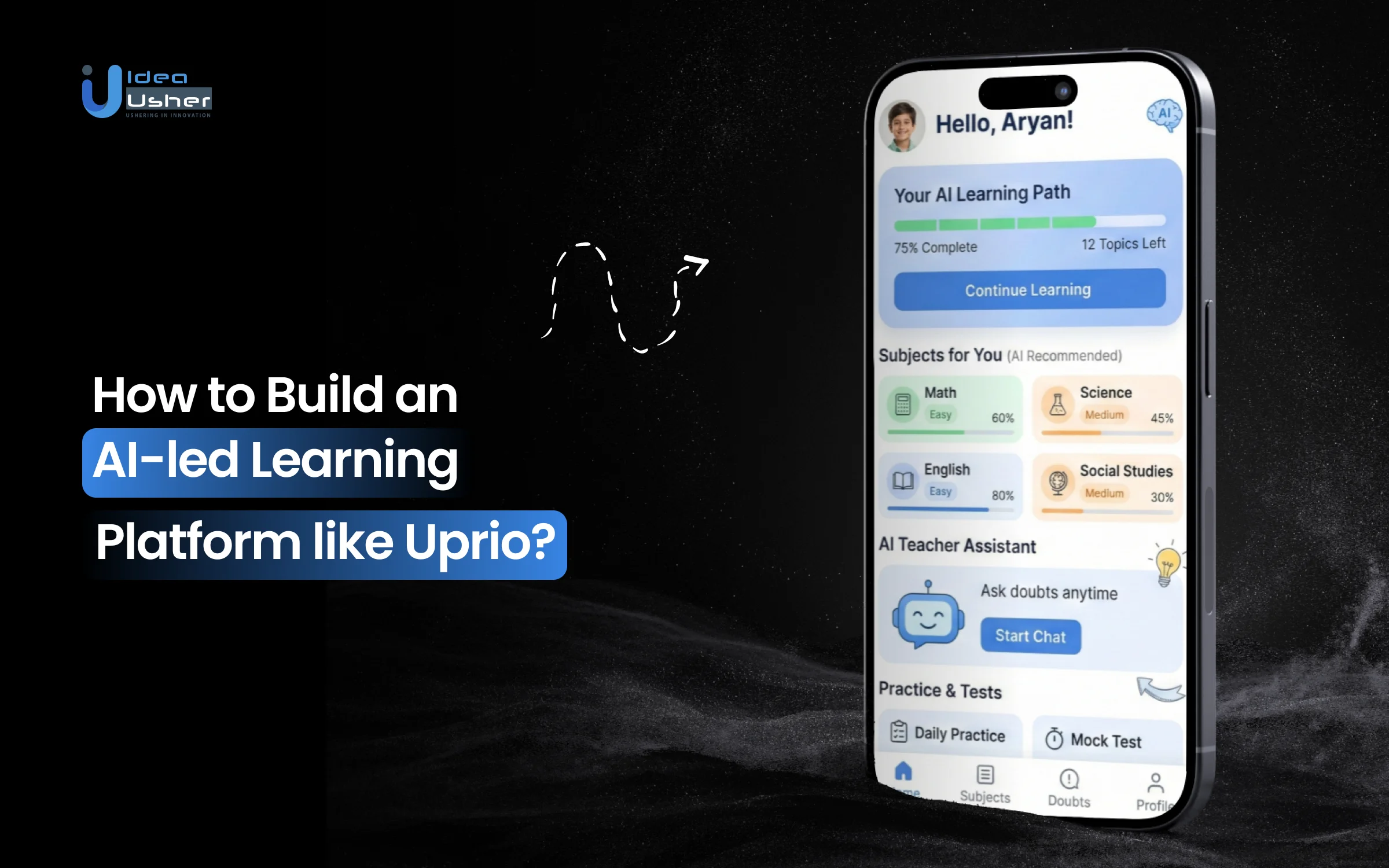
Learning today moves quickly, and it can feel fragmented for many learners as they try to keep up with shifting goals and rapid digital demands. Most platforms still struggle to adapt to how people actually learn, making progress harder than it should be. This is why a lot of learners are turning to AI-led learning platforms that can guide them with greater precision.
Platforms like Uprio show how personalised pathways, real-time diagnostics, and structured practice sessions can reshape learning by offering timely feedback and adaptive content. These systems rely on machine learning models and cloud infrastructure that quietly handle complex tasks in the background.
We’ve built numerous learning platforms over the years that leverage advanced technologies such as learning intelligence systems and distributed data orchestration. Using this experience, we’re sharing this blog to discuss the steps involved in developing an AI learning platform like Uprio. Let’s start.
Key Market Takeaways for AI-led Learning Platforms
According to Grandview Research, the market for technology-driven learning tools is expanding at an extraordinary pace. Global investment in AI-enabled education technologies is projected to grow from roughly USD 5.88 billion in 2024 to more than USD 32 billion by 2030. This surge reflects a broader shift in how schools, universities, and employers approach learning, moving from occasional experiments to making intelligent automation and personalization core to how educational content is created, delivered, and improved.

Source: Grandview Research
Real-world examples highlight how quickly these platforms can scale when powered by advanced technology. Duolingo has restructured its entire product strategy to accelerate course development and create more responsive, individualized practice sessions for learners.
Similarly, Coursera has woven intelligent tools throughout its platform, helping instructors build courses faster while giving students conversational guidance, instant explanations, and access to a rapidly growing collection of AI-related learning pathways.
Partnerships among learning platforms, cloud providers, and expert organizations are amplifying this momentum. Coursera’s collaborations with DeepLearning.AI and Microsoft have enabled new programs focused on practical skill development and responsible technology use.

What is the Uprio Platform?
UPRIO is an advanced AI-powered edtech platform designed to deliver personalized online tuitions for CBSE students in Grades 5–9, with a strong focus on Math and Science. The platform blends the precision of artificial intelligence with the care of expert tutors to create a highly tailored learning journey for every child.
Built on the belief that learning is most effective when directly connected to what students study in school, UPRIO runs school-aligned sessions in small, focused batches of up to 6 students from the same school and grade. Classes follow the exact syllabus, books, timetable, and exam calendar of each partner school.
Here are some of its standout features,
1. Full School Alignment
UPRIO’s classes follow each school’s exact syllabus, chapter flow, revision plan, and exam schedule, ensuring students learn in perfect sync with what is taught in their classrooms. This alignment removes confusion, strengthens retention, and provides seamless academic reinforcement.
2. AI-Driven Personalization
UPRIO’s proprietary AI analyzes notebook images and student responses in real time to detect knowledge gaps, misconceptions, and skill weaknesses. These insights help tutors deliver focused interventions, assign personalized practice, and create customized study plans tailored to each child.
3. Small Group Focus for Maximum Attention
With only six students per batch, daily 1-hour classes, distraction-free focus rooms, and dedicated 1:1 huddle spaces, every learner receives meaningful attention and instant support. Parents also gain clear visibility through transparent performance dashboards.
4. Focus Mode & Instant Huddle Rooms
The platform’s full-screen, distraction-free classroom keeps students engaged while offering instant private huddle rooms for personal doubt-solving. Tutors can assist individuals without interrupting the flow of the group, ensuring smooth, uninterrupted learning.
5. Anonymous Doubt Resolution
Students can raise doubts privately without hesitation, enabling deeper participation. AI-suggested responses help tutors address these queries quickly and accurately, maintain class momentum, and ensure every child’s concerns are resolved.
6. Parent Dashboard Analytics
Real-time dashboards provide parents with clear visibility into class performance, attention trends, syllabus progress, and exam readiness. Monthly insights and tutor recommendations promote transparent communication and active academic support at home.
7. Olympiad Foundation Classes
Weekly Olympiad-focused sessions strengthen conceptual understanding, analytical reasoning, and problem-solving skills. These classes prepare students for competitive exams like NTSE and help them excel beyond regular school academics.
8. Seamless Subjective Evaluation
By analyzing uploaded notebook images step by step, UPRIO’s AI delivers instant feedback and corrections, helping students refine their written work. Tutors receive detailed insights, allowing continuous progress tracking and more accurate academic support.
How Does the Uprio Platform Work?
The Uprio platform aligns every session with the student’s exact school syllabus, so learning stays in sync with the classroom. Its AI engine analyzes performance in real time and then guides the tutor with precise insights that shape each lesson. The system also delivers targeted practice and continuous diagnostics that maintain a steady technical improvement for every learner.

Phase 1: Hyper-Local Group Formation
The learning journey begins with forming small, highly curated batches. These groups are not generic collections of students from multiple schools or boards. Uprio creates precision-based cohorts by matching students from the same school, same grade, and same academic track.
School → Grade → Group of 6 → Personalized Learning Track
This structure brings several advantages:
- Students follow the exact chapter their classroom teacher is teaching at that moment.
- The tutor prepares lessons based on the school’s books, worksheets, and exam pattern.
- Students feel comfortable interacting with peers who share the same academic reality.
- No time is wasted reteaching or pre-teaching topics that are out of sync with school.
For example, instead of teaching a broad category such as Grade 8 CBSE Math, the batch studies “Grade 8, Delhi Public School Bangalore North, Chapter 3: Quadrilaterals as per NCERT.” This specificity removes confusion and builds confidence from day one.
Phase 2: AI-Powered Diagnostic Assessment
Before attending their first live class, each student goes through a diagnostic evaluation. This is not a typical test with marks and answers. It is a multilayered assessment that breaks down a student’s conceptual strengths and weaknesses.
The AI system evaluates:
- Conceptual understanding
- Foundational gaps
- Topic-wise familiarity
- Micro-skills such as logical sequencing, calculation speed, step alignment, and formula recall
An example of this kind of insight would be “Student shows hesitation in algebraic simplification because BODMAS understanding is inconsistent.”
The algorithm then maps each child’s starting point so the tutor enters the first class with a complete profile of the batch. This eliminates the guesswork that often limits the effectiveness of early sessions.
Phase 3: The Intelligent Live Class
Each daily session is one hour long and follows a tightly optimized structure that blends interactive teaching, adaptive instruction, and instant support.
A. Pre-Class Preparation with AI Support
Before the tutor enters the class, the platform provides an AI-generated briefing summarizing the batch’s performance patterns.
The briefing includes:
- Students who need visual explanations
- Students who struggled in the previous homework set
- Topics where the majority of the batch faces difficulty
- Students who may need individual attention during the session
This pre-class insight allows the tutor to design a session with intention and accuracy. Instead of repeating the entire chapter, they focus precisely on the areas that require reinforcement.
B. During Class: An Adaptive, Insight-Driven Teaching Experience
Uprio’s live classroom is built for strong engagement and active learning.
Key features include:
- Interactive whiteboards that allow tutors to demonstrate step-by-step problem-solving
- Instant polls, quizzes, and comprehension checks that feed data back to the AI engine
- Huddle rooms for one-on-one doubt clearing without interrupting the main class
- Focus mode that minimizes distractions and keeps students tuned in
- Automatic notes and annotations that organize everything taught for later revision
This creates a smooth and predictable learning loop where every child is supported without slowing down the class pace.
C. AI’s Real-Time Classroom Intelligence
Throughout the session, the AI observes learning patterns across the batch. It silently monitors engagement, comprehension, and consistency to help the tutor make micro-adjustments to the lesson.
The AI identifies:
- Drops in collective attention
- Instances of confusion on specific steps
- The right moments to slow down or accelerate the explanation
- Students who may be drifting or requiring additional examples
The tutor receives subtle prompts that shape the next minutes of teaching. This ensures the class stays aligned, connected, and comprehensible to all six students.
Phase 4: Post-Class Reinforcement and Deep Analysis
The learning does not end when the class ends. Uprio extends support into the student’s home study time while also equipping tutors and parents with actionable information.
For Students
The platform generates a personalized reinforcement plan that includes:
- Practice worksheets tailored to their individual gaps
- A 24/7 homework support bot for instant resolution when stuck
- Short recap videos that simplify challenging topics
This prevents learning gaps from growing and helps students revise with precision instead of overwhelm.
For Tutors
Teachers receive detailed analytics after every class.
These include:
- Student-by-student participation breakdown
- Concept mastery metrics
- Homework patterns
- Recommendations for individual interventions
- Suggested lesson plans for upcoming sessions
This transforms tutoring from a reactive activity into a data-informed teaching process backed by clarity and strategy.
For Parents: The Full Visibility Promise
Parents receive a comprehensive class update that highlights:
- Attendance and engagement scoring
- Concepts completed and understanding level
- Homework status and submission quality
- Strength areas and improvement areas
- Comparison with the batch average
- A preview of what the next class will cover
This transparency helps parents stay connected to their child’s progress without having to check in or request updates constantly.
Phase 5: Exam-Centric Preparation
As exams approach, Uprio shifts into a structured revision mode. Since all six students belong to the same school, the platform knows exactly what to prepare them for.
Uprio manages:
- A two-week revision schedule perfectly aligned with school exams
- Previous years’ papers from that specific school
- Mock tests designed using the actual exam pattern
- Performance breakdowns by chapter, difficulty level, and error type
- Emergency doubt sessions to resolve last-minute confusion
The system distinguishes conceptual misunderstandings from careless mistakes and recommends corrections for both. This level of exam readiness gives students confidence and significantly reduces stress.
What is the Business Model of the Uprio Platform?
Uprio is positioned as a next-generation online tuition platform for CBSE students in grades 5–9, centred on Math and Science. Its classes are designed to feel like an extension of school rather than a separate coaching system.
- Students learn in small groups of up to 6, and each batch is created from the same school and grade.
- Sessions follow the school’s syllabus, textbooks, timetable, and exam calendar, ensuring that what students study online directly reinforces what they learn in class.
- Classes run Monday to Saturday, with 1-hour lessons between 5 PM and 9 PM.
The platform also supports exam revision and early foundation building for competitions like Olympiads and NTSE.
Revenue Model
Uprio keeps its pricing simple and flexible:
- It runs on a monthly subscription, with no lock-ins or long commitments.
- Every learner starts with a 1-week free trial. Families continue only if they’re satisfied with progress.
- Renewals are month-to-month, and the early user base has shown high repeat sign-ups, indicating strong perceived value.
This model encourages accountability. Uprio earns revenue only when families choose to stay.
Traction and Current Scale
Uprio is already working directly with 57 partner schools, 34 in Bengaluru and 23 in Delhi, and is on track to reach 100 partner schools. Being closely embedded with schools gives Uprio a steady stream of students and helps maintain curriculum alignment from day one.
Financial Stage
As a startup that began operations in October 2025, Uprio has not yet reported revenue or profitability. It is still in its early scaling phase, building traction through school partnerships and strong retention from initial student batches.
Funding and Background
Uprio has not publicly announced any funding rounds so far. It was founded by Mrinal Mohit, the former India CEO of Byju’s (who exited in September 2023).
His background positions the company strongly at a time when investors are paying renewed attention to fresh AI-driven education models, with sector peers such as Arivihan ($4.17M) and Stimuler AI ($3.7M) also attracting interest.
Other Business Models for AI-led Learning Platforms
While the monthly subscription model used by Uprio can be a strong foundation for an AI learning platform, there are several other models worth exploring that balance scalability and monetization.
1. Freemium With Premium AI Features
Under this model, the platform offers core learning content for free while reserving advanced AI-driven capabilities for paying customers. The goal is to convert the most engaged learners who see value in deeper personalization.
Implementation & Economics
Duolingo is one of the clearest examples of this model at scale. Out of 74.1 million monthly active users, roughly 5.4 million subscribe to Super Duolingo, priced at $12.99 per month or $83.99 per year.
These upgrades are tied directly to user behavior. Duolingo reports that 73 percent of total revenue (approximately $484.3 million) comes from subscriptions.
Key Performance Metrics
- Free to paid conversion: 3 to 7 percent
- Annual value per paid user: $80 to $150
- Retention: Paid customers remain 4.2 times longer than free users
Strategic Advantage
The freemium model creates a powerful feedback loop as more free users produce more learning data that improves AI models.
2. Enterprise and Institutional Licensing
This model targets institutions such as universities, school districts, and corporations. Revenue comes from annual or multi-year licensing agreements.
Implementation & Economics
ALEKS from McGraw-Hill is a leading example adopted by more than 1,500 higher education institutions and 25,000 K to 12 schools.
Institutions justify this investment because ALEKS improves pass rates by 22 percent.
Scale and Implementation Dynamics
- Small district contract: approximately $25,000 annually
- Large district or statewide contract: $500,000 or more
- Renewal rates: 85 to 92 percent due to high switching costs
Strategic Advantage
Enterprise sales provide stability through multi-year contracts with significantly higher price points than consumer subscriptions.
3. Transaction-Based and Pay-Per-Outcome Models
Instead of charging monthly or annually, the platform collects revenue based on usage or outcomes such as verified academic improvements.
Implementation & Economics
Squirrel AI in China has pioneered outcome-based pricing with a blend of fixed access fees and performance incentives.
Serving more than 2 million students, Squirrel AI generates over $300 million in annual revenue.
Risk and Reward Economics
- Outcome success rates: 85 to 95 percent
- Price premium for guarantees: 20 to 40 percent above standard models
Strategic Advantage
Outcome-based pricing builds trust, positions the platform as results-driven, and enables premium pricing.
How to Build an AI-Led Learning Platform Like Uprio?
An AI-led learning platform like Uprio is built by first developing a curriculum engine that reads school materials and converts them into structured skills. The next step is to design a knowledge model that tracks learner actions in real time and accurately predicts what the system needs to deliver next.
Our team has built many platforms of this kind for clients, and this is exactly how the process usually unfolds.

1. Curriculum Intelligence
We begin by aligning the platform with each school’s structure. The system ingests textbooks, maps, timetables, and exam schedules, and converts chapters into micro skills so the AI always knows what students are learning. This foundation ensures that every recommendation, test, and activity is curriculum-perfect.
2. Knowledge Tracing Engine
Next, we build the core intelligence that personalizes learning. It captures student actions, models skill mastery, detects error patterns, and predicts knowledge decay to guide the right intervention at the right time. This allows the system to adapt to each learner with precision from day one.
3. Tutor Co-Pilot
We create AI tools that enhance tutor effectiveness. Dashboards highlight gaps instantly, AI prompts support explanations, and intervention suggestions help tutors respond with precision. This transforms tutors into highly data-informed educators without adding more workload.
4. Parent Reporting
Parents receive clear, real-time visibility. Live dashboards, weekly mastery updates, exam readiness insights, and revision tracking keep them connected to their child’s progress. This transparency builds trust and encourages consistent learning at home.
5. Adaptive Practice and Assessments
We design an adaptive practice flow similar to Duolingo. The AI generates tailored tests, auto-evaluates responses, adjusts difficulty levels, and automates revision scheduling. As a result, practice sessions stay engaging and personalized for every learner.
6. Monetization and Partnerships
Finally, we build the systems that support sustainable growth. This includes subscriptions, trials, batch pricing for learning centers, and school-level revenue dashboards. These workflows ensure the platform can scale without operational friction.
How AI-Led Learning Boosts Student Performance by 15–35%?
AI-led learning can improve student performance by adapting to each learner’s actions in real time. According to a 2025 empirical review of AI-driven adaptive learning tools, students using these systems showed performance gains ranging from 15% to 35% compared to traditional methods.

1. Hyper-Personalized Learning Pathways
Every student has a slightly different mix of strengths, gaps, and misconceptions. Traditional classrooms rarely have the bandwidth to adjust to this level of variation.
How AI changes the game:
Modern systems use knowledge-tracing models that follow a learner’s progress down to individual micro-skills. Instead of making assumptions about why a student struggled, AI identifies the exact concept that needs attention.
Example from real platforms:
Tools like ALEKS or Squirrel AI do not stop at marking an answer wrong. If a student misses a quadratic equation, the system analyzes their reasoning and may identify a gap in linear functions from earlier grades. It then delivers a short refresher before returning to the current concept. This prevents small misunderstandings from becoming long-term learning gaps.
2. Real-Time Feedback
Delayed feedback is one of the biggest barriers to effective learning. By the time a student gets a graded paper back, the moment of confusion has passed.
How AI improves the loop
Intelligent Tutoring Systems provide instant, specific feedback the moment a student submits an answer. It is not just a correct-or-incorrect result. AI evaluates the steps behind the solution.
- In math, it might say: “Your approach is correct, but check the sign in step three.”
- In writing, an AI tutor might pose a prompting question to encourage deeper reasoning rather than providing the answer.
Why it boosts performance: Students reinforce correct thinking immediately or correct the wrong pattern before it becomes a habit. This rapid feedback cycle strengthens retention, improves problem-solving speed, and prevents repeated errors. These are key factors behind higher test scores.
3. Adaptive Assessment and Pacing
Students make the most progress when they face the right level of challenge, not too easy and not too difficult.
How AI keeps them in the optimal zone: Adaptive systems use continuous performance data to adjust difficulty in real time. Drawing from reinforcement-learning principles, the platform keeps students within their Zone of Proximal Development.
- If the student performs well, the system increases the difficulty slightly.
- If the student struggles, it provides a hint or a prerequisite exercise.
This creates steady momentum that feels natural and motivating.
Why it boosts performance: When learners stay in this optimal challenge zone, they experience a state known as flow, which research links to a 40% increase in engagement. Greater engagement results in stronger mastery and higher performance on assessments.
4. Predictive Support
Most academic interventions happen too late, after a student has already fallen behind.
How AI flips the script
Instead of waiting for visible signs of failure, AI analyzes subtle behavior patterns such as hesitation, rising error rates, time spent on each question, or dips in engagement. When the system detects signs of upcoming difficulty, it can:
- Notify the teacher
- Assign a targeted micro-lesson
- Adjust the learning sequence automatically
Why it boosts performance: Students receive support before they fail a quiz or assignment. This protects their confidence and maintains learning momentum. Preventive support has a stronger long-term impact than remediation, and this early intervention effect is a major contributor to the performance improvements shown in research.
Challenges of an AI-Led Learning Platform like Uprio
Creating an AI-first learning platform is not only a technical challenge. It also requires a deep understanding of pedagogy, teacher workflows, data governance, and large-scale personalization. After supporting numerous clients in building platforms similar to Uprio, we have identified the most common challenges teams face and the most effective strategies to solve them.
1. Managing Real-Time Curriculum Changes
Modern learning environments demand rapid adaptation. Curricula evolve, new topics are introduced, and teachers frequently modify lesson structures. An AI-led platform must respond quickly to these shifts without breaking the learning flow..
How to solve it:
- Build a modular content architecture that allows instant updates to lessons, difficulty levels, and learning goals.
- Introduce a real-time sync layer that automatically recalibrates AI recommendations based on curriculum edits from educators or administrators.
- Use metadata tagging to help the AI understand topic relationships, prerequisites, and progression paths.
- Provide teachers with intuitive tools to update content without technical expertise, keeping the platform current at all times.
With these measures, the platform remains aligned with real classroom needs and delivers highly responsive learning journeys.
2. Maintaining AI Accuracy With Limited Student Data
Most AI models depend on large amounts of behavioral or performance data. In real school environments or new product launches, student data is often limited, inconsistent, or incomplete. The AI may struggle to accurately assess student skill levels, identify knowledge gaps, or deliver correct personalized recommendations.
How to solve it:
- Start with pedagogically validated baseline models that do not depend heavily on data volume.
- Introduce short diagnostic assessments that help the AI understand a learner’s starting point quickly.
- Use transfer learning and pre-trained education models that adapt even with minimal data.
- Continuously refine the model as more student interactions accumulate, improving accuracy over time.
- Implement strict evaluation loops that detect and correct faulty predictions early.
This approach allows the platform to deliver reliable personalization from day one, even in low-data environments.
3. Tutor Adoption of AI Tools
Teachers and tutors play a crucial role in the success of any AI-led learning ecosystem. However, many educators are cautious about using AI tools due to unfamiliarity, workload concerns, or fears of replacement.
How to solve it:
- Position AI as a support system that enhances tutor efficiency rather than replacing them.
- Offer features that directly reduce their workload, such as automated grading, personalized homework generation, and lesson planning assistance.
- Provide easy onboarding, training resources, and real examples that demonstrate real classroom impact.
- Allow tutors to override or customize AI suggestions, giving them ultimate control and increasing trust.
- Highlight measurable benefits such as time saved, improved student outcomes, and reduced administrative burden.
When tutors see AI as a partner instead of a threat, adoption rises significantly, and platform effectiveness increases.
4. Data Privacy and Child Protection Laws
AI platforms in education must navigate strict regulations, including COPPA, FERPA, GDPR, and regional child protection laws. Mishandling student data can lead to serious legal and ethical consequences.
How to solve it:
- Implement privacy-by-design principles from the start, ensuring all data operations are compliant and transparent.
- Anonymize or pseudonymize student data whenever possible to minimize exposure.
- Provide clear consent workflows for parents, teachers, and institutions.
- Store data in secure, region-specific environments with encryption at rest and in transit.
- Limit data access using role-based permissions and continuous audit logs.
- Regularly review compliance requirements as laws evolve, and update internal policies accordingly.
Strong privacy foundations not only protect users but also enhance credibility with parents, schools, and regulatory bodies.
Tools & APIs Needed to Build a Platform Like Uprio
Building a platform that blends live tutoring with AI-driven personalization requires more than a typical tech stack. It requires a system in which data, intelligence, and real-time communication work together without friction. Here is a complete breakdown of the technologies that power a modern, next-generation EdTech platform.

1. AI and Machine Learning Core
The intelligence behind adaptive learning
TensorFlow
A production-focused framework by Google that excels at deploying scalable learning models. It is ideal for tracking student progress, running inference at scale, and supporting cloud-native serving tools.
PyTorch
A flexible and intuitive framework often chosen for rapid experimentation. It is well-suited for building advanced knowledge tracing models, testing new learning algorithms, and running research prototypes.
Best Practice: Prototype your learning models in PyTorch to iterate quickly. Move to TensorFlow Serving when you are ready to deploy a stable, production-ready version.
Scikit-learn
A reliable toolkit for classic educational analytics
- Clustering and grouping students based on learning patterns
- Predictive modelling for performance trends
- Feature engineering to support deeper neural network pipelines
- Fast baselines before investing in larger ML architectures
Scikit-learn is essential during early modelling stages and supports analytics-focused features without heavy infrastructure.
3. OpenAI and Other LLM APIs
Your always-available teaching assistant
- Personalized explanations based on student errors
- Automated homework support and doubt resolution
- Summaries of long content, notes, or readings
- Creation of adaptive study guides
Integration Tip: Balance the strengths of large APIs like GPT and Claude with smaller fine-tuned models that handle repetitive tasks at lower cost.
4. Custom Knowledge Tracing Models
Your long-term competitive advantage
- Deep Knowledge Tracing (DKT): Uses neural networks to predict future performance and mastery across interconnected skills.
- Bayesian Knowledge Tracing (BKT): A transparent and interpretable model that estimates a student’s probability of understanding a concept.
- Development Path: Begin with BKT to gain clarity into the learning progression. Transition to DKT when your dataset grows and you need to model more complex skill relationships.
Data Requirement: At least one hundred thousand student interactions are recommended to train models that generalize well.
5. Backend and Data Architecture
A dual-engine architecture for performance and intelligence
- Node.js: Event-driven and highly responsive. Ideal for live class updates, messaging, notifications, and any feature that requires real-time communication.
- Python with FastAPI: Fast, elegant, and perfect for machine learning services, data processing, and administrative workflows.
- Recommended Approach: Let Node.js handle interactive user-facing actions while Python manages analytics, AI services, and heavy data workloads.
PostgreSQL and Neo4j
PostgreSQL handles structured data like user profiles, schedules, and assessments, making it ideal for core platform operations. Neo4j complements it by mapping how learning concepts connect through nodes and relationships, enabling smarter prerequisite checks and personalized lesson paths.
For example, a chain such as Algebra to Quadratic Equations to Factoring can be represented clearly in Neo4j to guide student progression.
Apache Kafka and Google PubSub
PubSub and Kafka power real-time communication by streaming engagement data, syncing progress across devices, and sending timely notifications. PubSub is great for simple setups, while Kafka is better once you need higher throughput and more advanced event processing.
6. Frontend and Mobile Experience
A clean and responsive interface for students and tutors
React: Reusable components for quizzes, progress indicators, video interactions, whiteboards, and dashboards.
Next.js: Server-side rendering for fast page loads and strong SEO. Especially useful for course catalog pages, tutor profiles, and informational content.
Key Features Built with This Stack:
- Real-time collaborative whiteboard
- Interactive homework viewer
- Dashboard with visual progress and insights
Flutter and React Native
Flutter offers a polished, consistent UI with smooth animations, while React Native suits teams that want to iterate quickly using JavaScript. Both support key mobile needs such as offline assignment access, reminder notifications, and optimized video streaming, making them strong choices for delivering seamless learning on the go.
7. Cloud and Infrastructure
Choosing the right cloud partner
| Provider | Strengths in EdTech | Best For |
| AWS | SageMaker for ML, Chime for video, global availability | Startups that want a unified ecosystem |
| GCP | BigQuery analytics, TensorFlow integration, Firebase | Platforms with heavy data and ML workloads |
| Azure | Enterprise security, Microsoft ecosystem, Cognitive Services | Schools using Microsoft 365 environments |
8. Video and Live Class Infrastructure
WebRTC
WebRTC is a strong open-source choice for live learning, offering low latency, efficient peer-to-peer connections, and no per-minute costs, making it ideal for one-on-one or small-group sessions. Its main limitation is scalability: larger classrooms with more than roughly fifteen participants require more complex engineering.
Agora and Twilio Video
Agora and Twilio Video provide enterprise-grade reliability for larger learning environments, offering strong performance, built-in recording, and easy integration backed by global infrastructure. They are ideal for classrooms with many participants, making them the right choice when scaling beyond small groups that WebRTC can handle.
Conclusion
AI-led learning platforms like Uprio show how education is moving from static content to systems that think, adapt, and grow with each learner. When you approach it this way you gain a model that can deliver steady revenue, strong personalization, and real partnerships with schools while still scaling smoothly as your user base expands. With the right mix of architecture choices, curriculum intelligence, and tutor augmentation, you could build an ecosystem that performs reliably and supports long-term growth, and a team like IdeaUsher may help you bring that vision into a product that feels future-ready.
Looking to Develop an AI Learning Platform like Uprio?
IdeaUsher can guide you through building an AI-led platform by designing a robust architecture that supports adaptive learning models. Our team will integrate real-time insights and scalable cloud systems to improve the platform’s efficiency. We also refine the user experience through deep technical expertise, ensuring your product evolves smoothly.
Why trust us with your EdTech dream?
- 500,000+ hours of coding expertise — led by ex-MAANG/FAANG developers
- Deep EdTech specialization — from knowledge graphs to adaptive learning engines
- Full-cycle development — UI/UX, AI/ML, cloud, security, and parent dashboards
- Proven projects — check out our portfolio to see innovation in action.


FAQs
A1: Cost will shift based on how deeply you use AI, because advanced models demand stronger infrastructure. It also varies with the number of schools you support, as a higher load may require scalable cloud layers. Video delivery and analytics frameworks add further cost, as they rely on specialised systems. A defined scope will help you estimate budgets with better clarity.
A2: No, the same architecture can support many curricula, because it uses modular content structures and flexible assessment logic. You can map learning objects to IB, ICSE, IGCSE, or state boards with minor configuration. The system might need extra metadata design to stay consistent across formats. Once set, it can maintain curriculum independence without major rebuilds.
A3: Yes, it can, because adaptive syllabus mapping lets the engine reorganise topics for exam patterns. Knowledge tracing may need recalibration, so difficulty curves match real test behaviour. You could add timed practice and question generation to strengthen preparation. These features sit on the same stack, so you avoid a heavy redesign.
A4: Build time usually spans multiple phases, because each layer needs validation. Core engineering may take months, depending on feature depth. AI parts often need iterative tuning to reach reliable accuracy. Overall, enterprise delivery will likely follow a phased roadmap, rather than a short sprint.


