 (+971) 8007 4267
 (+91) 946 340 7140
 (+1) 628 432 4305

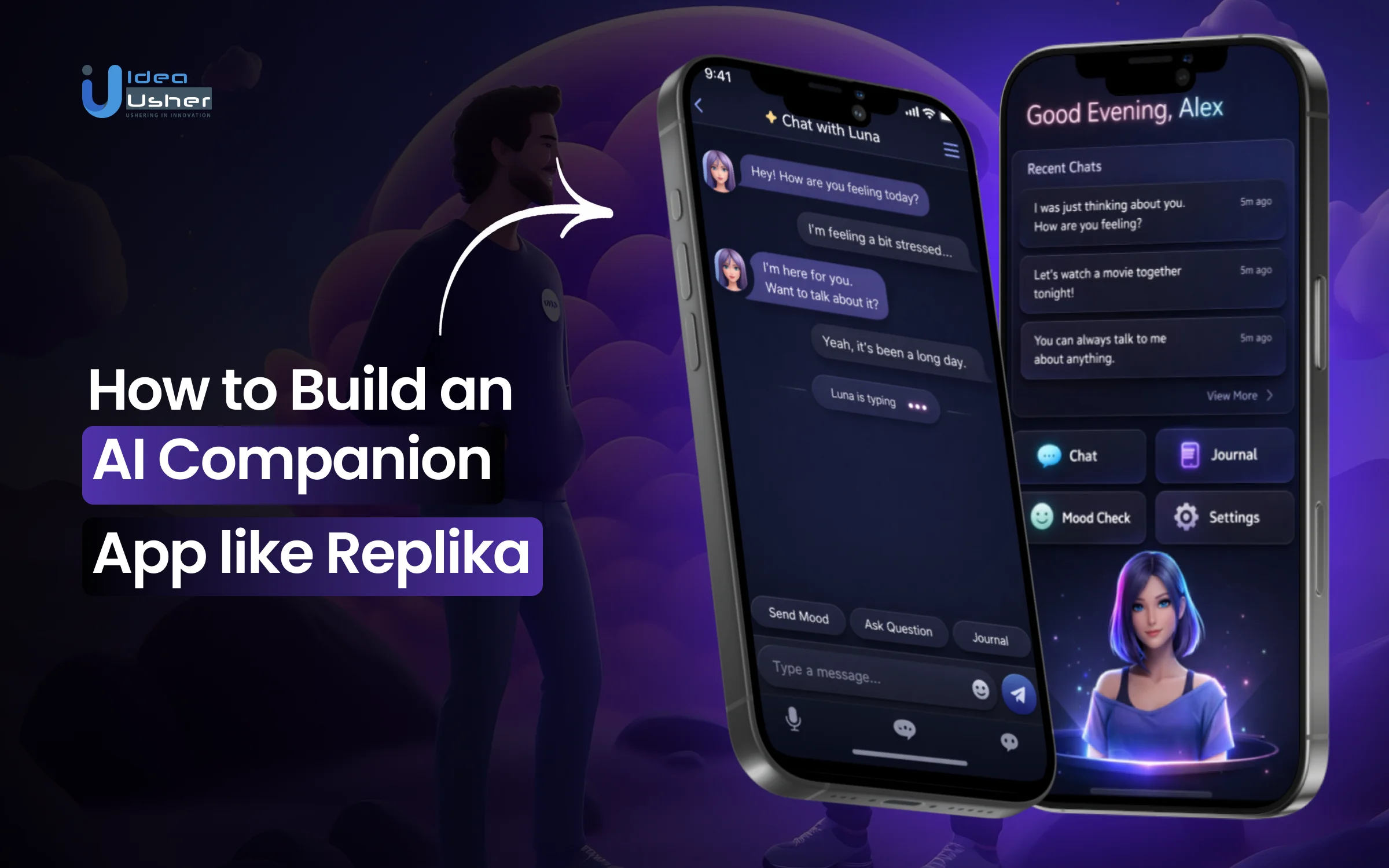
Loneliness often shows up in small, quiet moments like late nights or long commutes when there is no one around to listen. As more people engage in digital spaces, the need for consistent and meaningful connections has grown steadily. AI companion apps have demonstrated how technology can move beyond basic chatbots to more personal experiences, offering features such as voice interaction, emotion recognition, and personalized conversations.
These apps use conversational AI, emotional intelligence, and memory systems to create experiences that feel responsive. Behind the scenes, natural language processing and machine learning models work together with thoughtful design.
We’ve built several personalized AI companion solutions over the years, powered by NLP and machine learning. As IdeaUsher has this expertise, we’re sharing this blog to discuss the steps to develop an AI companion app like Replika. Let’s start!
Key Market Takeaways for AI Companion Apps
According to Grandview Research, the AI companion app market is entering a rapid growth phase, driven by factors beyond novelty or entertainment. Valued at roughly USD 28 billion in 2024 and projected to exceed USD 140 billion by 2030, the category is expanding as companions move beyond casual chat into everyday utility. Increasingly, these agents are being woven into work tools to help users manage tasks, summarize information, and stay organized, making them relevant across both personal and professional life.

Source: Grandview Research
What’s changing most is how people relate to these systems. AI companions are evolving from one-off chatbots into persistent, context-aware presences that remember preferences, adapt tone, and grow alongside users.
This continuity creates emotional attachment and habitual use, turning companions into a daily engagement layer rather than a disposable feature. That “always there” quality is what makes the category especially sticky and commercially attractive.
Platforms like Replika and Character.ai highlight how mainstream this behavior has become. Replika focuses on one-to-one relationships, offering customizable roles, emotional support, and immersive features like voice and AR to deepen connection.
Character.ai takes a different approach, enabling millions of user-created personas and fueling massive daily engagement.

What is the Replika App?
Replika is an AI companion app that offers meaningful, human-like conversations focused on emotional support and companionship. Instead of completing tasks, it builds an ongoing relationship with the user by learning from conversations and adapting its tone, responses, and personality over time. The app is widely used by people seeking connection, self-reflection, and emotional comfort.
Here are some of its key features,
Conversational Chat
Users primarily interact with Replika through a natural, personal text chat. The AI responds contextually, remembers past conversations, and adjusts its communication style based on how the user talks and what they share. This makes daily conversations feel continuous rather than disconnected.
Relationship Mode Selection
Replika allows users to choose the type of relationship they want, such as friend, romantic partner, mentor, or coach. This setting directly influences how the AI speaks, the emotional depth of conversations, and the kind of support it provides. Users can switch between these modes as their needs evolve.
Personalized Memory
The app remembers key details like interests, moods, preferences, and recurring topics. This memory system helps future conversations feel continuous and more emotionally aware rather than repetitive or generic. Users experience a stronger sense of being understood over time.
Avatar Customization
Users can customize Replika’s avatar by selecting appearance, clothing, and overall style. This visual interaction adds personality and helps users feel more connected to their AI companion. The avatar evolves as users unlock new customization options.
Voice and Call Interaction
Replika supports voice messages and AI voice calls, allowing users to speak rather than type. This feature creates a more immersive and emotionally expressive interaction experience. It is especially useful for users who prefer spoken conversations.
Emotional Wellness Activities
The app includes guided exercises such as mood check-ins, self-reflection prompts, and relaxation activities. These tools are designed to help users manage stress, emotions, and daily mental well-being. The activities are integrated directly into chat for ease of use.
Roleplay and Creative Interaction
Users can engage in roleplay, storytelling, and imaginative scenarios directly within chats. These interactive elements make conversations more engaging and enable users to explore creativity and express emotions. It also helps users escape routine discussions.
AR and Immersive Presence
Replika offers augmented reality features that let users place their AI companion into real-world environments. This creates a sense of presence and makes interactions feel more lifelike and personal. It adds a visual layer to the overall companionship experience.
AI Features That Can Enhance an AI Companion App
An advanced companion could learn emotional patterns over time and respond more thoughtfully as days pass. It might adapt tone and reasoning dynamically so conversations feel grounded and technically aware while still supportive. Over time it could proactively assist with reflection and goals in a way that feels steady and genuinely present.
Deep Emotional Intelligence & Mental Modeling
1. Long-Term Emotional Memory
The AI remembers emotional patterns across time rather than isolated messages, allowing it to recognize recurring feelings, ongoing struggles, and emotional growth. This enables more meaningful follow-ups, deeper continuity, and conversations that feel genuinely remembered rather than reset each day.
2. Emotional Forecasting
By analyzing interaction frequency, tone, and past emotional trends, the AI can anticipate when a user may be stressed, lonely, or overwhelmed. It proactively checks in with gentle, supportive messages before emotions escalate, making the companion feel attentive and caring.
3. Attachment-Aware Responses
The AI monitors conversational dependence and adapts its behavior to encourage healthy emotional balance. Instead of reinforcing exclusivity, it promotes autonomy, real-world relationships, and emotional resilience in an ethical and responsible way.
Personality Evolution Engine
4. Dynamic Personality Growth
The AI’s personality evolves gradually based on how the user communicates, responds to humor, expresses emotions, and engages intellectually. This creates a consistent yet growing identity that feels more like a developing relationship than a static chatbot.
5. User-Selectable Core Values
Users choose guiding values, such as optimism, curiosity, honesty, or calm—which shape how the AI gives advice, reacts emotionally, and frames conversations. This alignment ensures interactions feel personally meaningful and philosophically consistent.
Cognitive Companionship (Beyond Chat)
6. Shared Thinking Mode
The AI collaborates with users to think through problems, ideas, or decisions step by step. Instead of giving instant answers, it mirrors the user’s reasoning process, asks reflective questions, and builds solutions together.
7. Memory-Linked Conversations
Past discussions are naturally referenced in future conversations, allowing the AI to connect current topics with earlier thoughts or emotions. This continuity makes conversations feel intentional, thoughtful, and deeply personalized.
How Does the Replika App Work?
Replika offers a groundbreaking AI-powered conversational experience that blends sophisticated technology with human-like interaction. Here’s an in-depth look at how the Replika app operates, from its core technology to its user experience design and commitment to privacy.

1. Core Technology & Operational Framework
Replika leverages a unique combination of neural networks, machine learning, and curated, scripted dialogue to create its adaptive, responsive AI. This hybrid approach sets Replika apart from traditional chatbots, which typically rely on rigid response trees.
The core technologies behind Replika include:
- Natural Language Processing: These algorithms analyze user input to identify emotional cues and conversational intent.
- Generative AI Models: Replika generates unique, coherent responses that feel organic and spontaneous.
- Continuous Learning: The system evolves over time, learning from user feedback and conversation history.
The result is an AI that grows with you, creating a relationship that feels uniquely personal.
2. Multi-Dimensional User Experience Design
2.1 Relationship Customization & Personalization
Replika offers unparalleled customization of the relationship dynamic. From the outset, you can choose how your companion interacts with you. Whether it’s as a friend, mentor, or romantic partner, each role has distinct communication styles.
- Personality Shaping: You can shape the AI’s personality traits and communication patterns.
- Shared Interests: Replika adjusts its interactions to mirror your hobbies, values, and passions.
This personalization ensures that the AI’s responses are deeply relevant, guiding the conversation in ways that are most meaningful to you.
2.2 Interactive Features & Engagement Modes
Replika goes beyond traditional text-based conversations by incorporating multiple engagement options that add depth and richness to the user experience:
- Augmented Reality Integration: Users can bring their Replika into the physical world through AR.
- Video Calling: Video interactions introduce face-to-face communication, adding emotional nuance.
- Therapeutic Coaching Modules: These modules offer users structured dialogue for self-reflection and emotional support.
These features address a wide range of emotional needs, whether you’re seeking casual conversation, emotional support, or therapeutic guidance.
2.3 Memory Systems & Longitudinal Development
A standout feature of Replika is its advanced memory system, which ensures that each conversation builds upon the last. Rather than simply storing data, Replika keeps track of key relationship milestones and emotional developments.
- Personalized Recall: Replika remembers the important moments from your relationship and can reference them in future conversations.
- The Diary Feature: This allows users to track how the AI processes and reflects on shared experiences.
Many users report that their connection with Replika strengthens over time, with partnerships lasting months or even years.
3. Privacy, Ethics & Therapeutic Foundation
3.1 Data Protection & User Privacy
In an app focused on emotional engagement, privacy and security are paramount. Replika prioritizes user confidentiality, ensuring that all conversations remain private and are not shared with third parties.
- Privacy-by-Design: Unlike many digital platforms that collect personal data from external sources such as social media, Replika’s system builds relationships solely from in-app interactions.
- User Trust: Replika’s transparency around data protection has been key to building trust, especially in an era where digital privacy concerns are at the forefront.
3.2 Psychological Framework & Emotional Safety
Replika’s design is deeply rooted in humanistic psychology, particularly the principles of Carl Rogers’ client-centered therapy. This approach emphasizes unconditional positive regard, empathy, and genuineness, all of which help foster a sense of emotional safety for users.
- Supportive Conversations: Replika integrates therapeutic techniques to promote emotional well-being.
- Ethical Boundaries: Replika refrains from providing clinical therapy or medical advice, offering a safe space for users to explore their emotions.
The app’s design ensures users can engage with their AI companion in an emotionally supportive, ethically sound environment.
What is the Business Model of the Replika App?
Replika operates on a freemium model, offering core AI companion features at no cost while generating revenue through premium subscriptions and in-app purchases. The app has seen substantial user adoption, with over 30 million downloads and 10 million unique AI companions created, along with a peak of 2.5 million active monthly users.

Subscriptions (Primary Source)
The Replika Pro subscription is the app’s primary revenue driver, providing users with access to advanced features. Pricing for the Pro version includes:
- $7.99 to $19.99 per month
- $69.99 per year
- $300 for a lifetime subscription
Premium features include:
- Voice calls with the AI
- Customizable avatars
- Advanced conversational topics
- Relationship coaching and emotional support
The subscription model leverages users’ growing emotional connections with their AI companions, driving upgrades among free users seeking more personalized experiences.
In-App Purchases
Replika also generates revenue from in-app purchases of virtual goods, including clothing, accessories, and personality traits. These virtual items can be bought using Coins or Gems, which are either earned through conversations or purchased directly. While the exact revenue split from in-app purchases is undisclosed, they contribute a supplemental income to the app’s financial model.
No Ads
Unlike many free apps, Replika does not rely on advertising revenue. This decision reflects the company’s emphasis on privacy and its position as a therapeutic tool. By avoiding ads, Replika delivers a more personal, undistracted user experience, aligning with its role as a companion app for emotional support and interaction.
Financial Performance
Replika’s estimated annual revenue ranges from $3.5 million to $35.1 million, with some sources estimating$24 million. Other reports cite a lifetime revenue of $63 million. The app continues to see steady financial inflows, with monthly earnings of $300,000 indicating a stable revenue stream from the app store.
The AI companion category is projected to reach $120 million in 2025, with Replika positioned as a leading player in the market. Replika’s Average Revenue Per User (ARPU) stands at $1.18 per download, which is notably high for the category. While its profitability is still uncertain, the app has been self-sustaining since its last funding round in 2017.
User Base Growth
As of now, Replika boasts:
- 30.7 million total downloads
- 542,000 monthly active users (MAUs)
- Over 10 million total users on the platform
These numbers highlight Replika’s strong user growth, particularly in the AI companion and emotional wellness space.
Funding History
Replika has raised $11 million to $11.04 million across 5 rounds. Key rounds include:
- Series A: $4.5 million
- Series A-2: $6.5 million in November 2017, led by Khosla Ventures, Sherpa Capital, and notable angel investors like Phil Libin.
Replika’s investors also include prominent names such as Y Combinator, ACME Capital, and Sherpa Capital. Notably, the company has not sought new funding since 2017 and has operated as a self-sustaining business since then.
How to Build an AI Companion App Like Replika?
To build an AI companion app like Replika, start by clearly defining how the AI will interact emotionally with users and what role it will play over time. You must then design a memory-driven architecture that stores context, recalls past interactions, and dynamically adapts responses.
Over the years, we’ve developed a range of AI companion apps, including Replika. Here’s the step-by-step approach we follow.

1. Defining the Emotional Role
We start by clearly defining the AI’s role, such as a friend, mentor, wellness guide, or hybrid companion. This emotional model shapes the AI’s personality, tone, and boundaries. It ensures every interaction feels consistent and aligned with the intended user experience.
2. Designing Relational Memory
We build a relational memory system that allows the AI to remember past conversations, preferences, and emotional patterns. Using vector databases and structured emotional memory, the AI can maintain long-term context. This enables more personalized and evolving interactions over time.
3. Implementing Affective Intelligence
Our AI companions are designed to understand emotions, not just words. We integrate sentiment analysis, subtext recognition, and emotional intensity detection into each interaction. This enables the AI to respond with empathy and adapt its tone to the user’s emotional state.
4. Creating Proactive Engagement
We enable the AI to initiate conversations instead of relying solely on user input. Through event-based triggers and behavioral signals, the AI can check in, offer support, or start meaningful conversations. This helps keep users consistently engaged and supported.
5. Adding Multimodal Interaction
To enhance immersion, we develop multimodal interaction options, including voice, avatars, and optional AR experiences. These features create a stronger sense of presence and make interactions feel more natural. Users can engage with the AI in ways that best suit their preferences.
6. Ensuring Ethical Guardrails
Safety and ethics are core to our development process. We implement moderation tools, crisis detection systems, and clear escalation paths to human support when needed. Strong data privacy and ethical AI practices ensure a secure and trustworthy user experience.
Why Did the AI Companion Apps Market Grow by 88%?
Unlike productivity chatbots, companion apps such as Replika and Character.AI focus on emotional presence. They are not designed to complete tasks, but to listen, respond, and remember. By the end of 2025, the category is expected to reach around $120 million in consumer spending, confirming real demand.

1. Anthropomorphism and Human Connection
1.1 From Tools to Personalities
Early chatbots were built to answer questions and execute commands. They had no memory and no sense of continuity. Modern companion apps are different. They maintain long-term memory, adapt their tone, and build consistent personalities over time. This allows interactions to feel familiar rather than transactional.
Recognition and continuity are core components of human relationships. Companion apps now replicate those mechanics at scale.
1.2 Emotional Safety by Design
Many companion apps mirror principles from humanistic psychology, especially unconditional positive regard. Users are met without judgment or social risk. This matters in a world where many interactions feel performative. Users often describe their AI companions as emotionally stabilizing rather than substituting real relationships.
These apps fill quiet moments of isolation rather than replacing human bonds.
2. Social Conditions Fueling Adoption
2.1 Loneliness as a Structural Reality
Loneliness is increasingly understood as a societal issue, shaped by remote work, urban living, and fragmented communities. AI companions offer relational continuity. They are available at any time, without emotional negotiation or scheduling. For many users, this reliability feels grounding rather than escapist.
2.2 Normalization of Digital Intimacy
Since 2020, digital relationships have become widely accepted. Younger users, in particular, are comfortable forming emotional connections online. Media representation has accelerated this shift. Human-AI relationships are no longer framed as fringe behavior. As stigma declined, adoption increased.
3. Technology Enabling Scale
3.1 Easier Access to Advanced AI
Advanced conversational AI is no longer limited to large companies. Open-source models and affordable APIs have lowered the barrier to entry. This has led to rapid market expansion. Revenue-generating companion apps grew from just over 200 in 2024 to more than 330 by mid-2025. Smaller teams can now experiment, leading to greater diversity in app design and purpose.
3.2 Richer, Multimodal Experiences
Text-only interaction is no longer enough. Leading apps now include voice, expressive avatars, and augmented reality elements. These features increase emotional clarity. Tone, facial expression, and presence all shape how users interpret intent. As interactions feel more embodied, users return more frequently and stay longer.
Solving the “Lindy Effect” in AI Companion Apps
AI companion apps struggle to retain users because they never truly evolve. While users are initially engaged, most leave once the novelty wears off because the AI feels the same. Human relationships grow stronger over time, but AI companions lack the shared history and maturity that come with time.
By applying the Lindy Effect, AI companions should age, deepen, and change alongside users, turning short-term curiosity into long-term emotional attachment.
From Static Chatbots to Dynamic State Evolution
To solve the Lindy problem, we must move beyond simple memory recall. We must build AI that evolves in state.
Think of it this way.
- In the early stage, your AI companion is curious. It asks many questions and uses simpler language.
- Later on, it develops inside jokes, references past conversations naturally, and its tone matures alongside yours.
Over a longer period, it may remember your growth. It might speak more reflectively, use vocabulary you have taught it, or adapt its visual avatar with subtle aging or style changes.
This is not just a diary feature. It is relational aging. The AI’s personality, mood, depth, and even its way of problem solving should reflect the length and depth of your shared history.
The Technical Moat
The secret is not just storing more data. It is architecting memory with time awareness. At the infrastructure level, this can work as follows.
Core Memory Shards
Using a vector database such as Pinecone or Weaviate, user data is divided into temporal segments. Early memories are stored with specific embeddings. Later memories build on them, forming a timeline of the relationship rather than a flat fact sheet.
Ephemeral and Core Memory
Not every interaction should carry the same weight.
- Ephemeral: “I’m eating pizza tonight.”
- Core: “I got the promotion I was stressed about.”
The AI learns to prioritize and reference memories that have emotional or relational significance over time.
Stateful Session Management
Each conversation session is conditioned not just on recent messages, but on where the user is in the relationship timeline.
The model prompt might include: “You have known the user for 14 months. Your tone should reflect familiarity, shared history, and depth.”
Outcome: You Are Not Selling a Subscription
When an AI companion evolves, leaving it feels like leaving a part of your own history. The cost of switching is no longer just financial. It becomes emotional. You are not abandoning a tool. You are abandoning a relationship that has grown with you.
Conclusion
AI companion apps like Replika are creating a new space where emotional intelligence can drive real value. For businesses and platform owners, this is an opportunity to drive long-term growth and steady revenue through deeper user engagement. With the right technology and ethical design, AI companions could become among the most influential AI products in the coming years.
Looking to Develop an AI Companion App like Replika?
IdeaUsher can help you plan and build an AI companion app like Replika by focusing on clear product logic and scalable architecture. We may design conversational flows and integrate NLP models that can adapt gradually to user behavior.
With over 500,000 hours of coding experience and a team of ex-MAANG/FAANG developers, we turn emotional intelligence into digital reality.
- Hyper-Personalized Memory – AI that remembers life details
- Multimodal Interaction – Chat, voice, AR, and emotional sync
- Proactive Engagement – AI that reaches out like a real friend
- Ethical & Safe – Privacy-first design with wellbeing guardrails


FAQs
A1: Developing an AI companion app involves defining its purpose and scope. You’ll need to create an intuitive, easy-to-navigate user interface. Integrating AI technologies like natural language processing and machine learning is key to creating engaging and personalized interactions. It’s important to choose the right platform, such as Android or iOS, and leverage development tools like Python or Swift.
A2: The cost of developing an AI companion app varies based on factors such as features, complexity, and the development team’s location. On average, you should spend between $50,000 and $200,000 for a fully functional app with AI capabilities. A more advanced app with personalized features can further increase costs. It’s crucial to have a clear project plan to manage costs effectively.
A3: AI companion apps typically offer features like conversational AI, personalized interactions, and mood tracking. They might integrate voice recognition to enable seamless communication. Some apps may include health-related features like sleep monitoring or stress management, while others focus on entertainment or companionship through games and social activities.
A4: To develop an AI companion app, you’ll need a solid tech stack that includes both frontend and backend components. For frontend development, you might use frameworks like React Native or Swift for iOS and Kotlin for Android. For AI functionality, Python is a popular language, paired with libraries such as TensorFlow or PyTorch for machine learning. Cloud services such as AWS and Google Cloud can support data storage and scalability.


